FERTILIZER & ITS CLASSIFICATION
BY
R.JOTHI LAKSHMI
2013006014
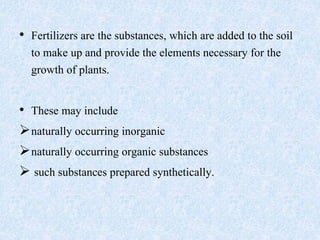
• Fertilizers are the substances, which are added to the soil
to make up and provide the elements necessary for the
growth of plants.
• These may include
naturally occurring inorganic
naturally occurring organic substances
 such substances prepared synthetically.
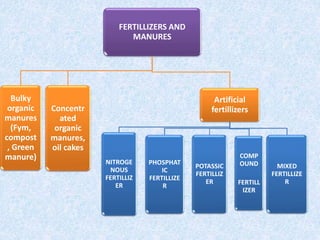
FERTILLIZERS AND
MANURES
Bulky
organic
manures
(Fym,
compost
, Green
manure)
Concentr
ated
organic
manures,
oil cakes
Artificial
fertillizers
NITROGE
NOUS
FERTILLIZ
ER
PHOSPHAT
IC
FERTILLIZE
R
POTASSIC
FERTILLIZ
ER
COMP
OUND
FERTILL
IZER
MIXED
FERTILLIZE
R
1.BASED ON THE COMPOSITION
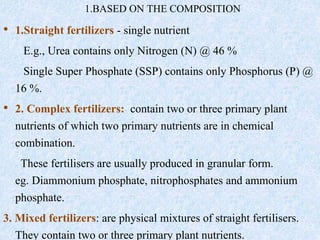
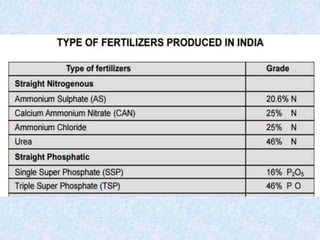
• 1.Straight fertilizers - single nutrient
E.g., Urea contains only Nitrogen (N) @ 46 %
Single Super Phosphate (SSP) contains only Phosphorus (P) @
16 %.
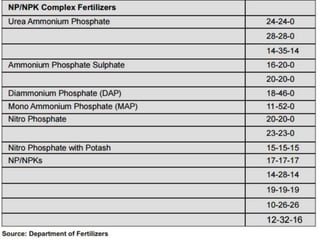
• 2. Complex fertilizers: contain two or three primary plant
nutrients of which two primary nutrients are in chemical
combination.
These fertilisers are usually produced in granular form.
eg. Diammonium phosphate, nitrophosphates and ammonium
phosphate.
3. Mixed fertilizers: are physical mixtures of straight fertilisers.
They contain two or three primary plant nutrients.
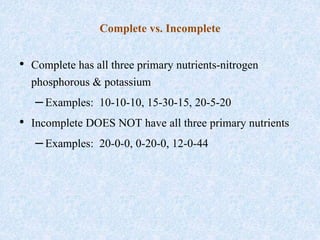
Complete vs. Incomplete
• Complete has all three primary nutrients-nitrogen
phosphorous & potassium
–Examples: 10-10-10, 15-30-15, 20-5-20
• Incomplete DOES NOT have all three primary nutrients
–Examples: 20-0-0, 0-20-0, 12-0-44
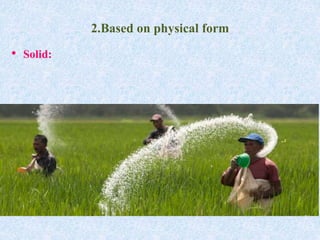
2.Based on physical form
• Solid:
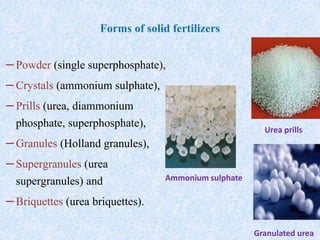
Forms of solid fertilizers
–Powder (single superphosphate),
–Crystals (ammonium sulphate),
–Prills (urea, diammonium
phosphate, superphosphate),
–Granules (Holland granules),
–Supergranules (urea
supergranules) and
–Briquettes (urea briquettes).
Urea prills
Granulated urea
Ammonium sulphate
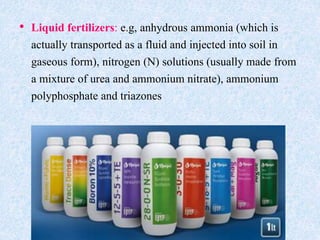
• Liquid fertilizers: e.g, anhydrous ammonia (which is
actually transported as a fluid and injected into soil in
gaseous form), nitrogen (N) solutions (usually made from
a mixture of urea and ammonium nitrate), ammonium
polyphosphate and triazones
• Acid forming fertilizer :Acid forming fertilizer is one
capable of increasing acidity of the soil which is derived
principally from the nitrification of ammonium salts by
soil bacteria.
e.g., All ammonium N fertilizers (except ammonium
nitrate with lime) have a gradual acidforming effect.
That's because the conversion of ammonium (NH.) to
nitrate (NO3) releases acid-forming hydrogen ions (H+).
The same applies to urea and most NP and NPX
fertilizers.
3. BASED ON ITS EFFECT ON CHANGING SOIL pH
• Base Fertilizer : Base fertilizers is one capable decreasing
the acidity of the soil.
e.g., Nitrate N fertilizers that have their nitrate combined
with a strong base have a slightly basic effect (i.e. calcium
nitrate, potassium nitrate, sodium nitrate).
• Neutral fertilizer: Neutral fertilizer is one that is guranted
to leave neither an acidic nor basic residue in soil.
e.g,., The straight P or K fertilizers have no effect on soil
pH. Examples: potassium chloride, potassium sulfate, and
the superphosphates.
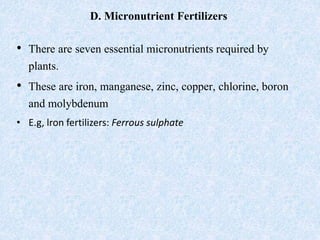
D. Micronutrient Fertilizers
• There are seven essential micronutrients required by
plants.
• These are iron, manganese, zinc, copper, chlorine, boron
and molybdenum
• E.g, lron fertilizers: Ferrous sulphate
REFERENCES:
• INDIAN FERTILIZER SCENARIO 2015:
http://fert.nic.in/sites/default/files/Indian%20Fertilizer%20
SCENARIO-2014.pdf
• http://agritech.tnau.ac.in/agriculture/agri_nutrientmgt_fertil
izers.html
• http://fert.nic.in/urea
• http://utbfc.utk.edu/Content%20Folders/Forages/Fertilizati
on/Publications/PB1637.pdf

Fertilizer and its Classificstion

  • 1.
    FERTILIZER & ITSCLASSIFICATION BY R.JOTHI LAKSHMI 2013006014
  • 2.
    • Fertilizers arethe substances, which are added to the soil to make up and provide the elements necessary for the growth of plants. • These may include naturally occurring inorganic naturally occurring organic substances  such substances prepared synthetically.
  • 3.
    FERTILLIZERS AND MANURES Bulky organic manures (Fym, compost , Green manure) Concentr ated organic manures, oilcakes Artificial fertillizers NITROGE NOUS FERTILLIZ ER PHOSPHAT IC FERTILLIZE R POTASSIC FERTILLIZ ER COMP OUND FERTILL IZER MIXED FERTILLIZE R
  • 4.
    1.BASED ON THECOMPOSITION • 1.Straight fertilizers - single nutrient E.g., Urea contains only Nitrogen (N) @ 46 % Single Super Phosphate (SSP) contains only Phosphorus (P) @ 16 %. • 2. Complex fertilizers: contain two or three primary plant nutrients of which two primary nutrients are in chemical combination. These fertilisers are usually produced in granular form. eg. Diammonium phosphate, nitrophosphates and ammonium phosphate. 3. Mixed fertilizers: are physical mixtures of straight fertilisers. They contain two or three primary plant nutrients.
  • 5.
    Complete vs. Incomplete •Complete has all three primary nutrients-nitrogen phosphorous & potassium –Examples: 10-10-10, 15-30-15, 20-5-20 • Incomplete DOES NOT have all three primary nutrients –Examples: 20-0-0, 0-20-0, 12-0-44
  • 6.
    2.Based on physicalform • Solid:
  • 7.
    Forms of solidfertilizers –Powder (single superphosphate), –Crystals (ammonium sulphate), –Prills (urea, diammonium phosphate, superphosphate), –Granules (Holland granules), –Supergranules (urea supergranules) and –Briquettes (urea briquettes). Urea prills Granulated urea Ammonium sulphate
  • 8.
    • Liquid fertilizers:e.g, anhydrous ammonia (which is actually transported as a fluid and injected into soil in gaseous form), nitrogen (N) solutions (usually made from a mixture of urea and ammonium nitrate), ammonium polyphosphate and triazones
  • 9.
    • Acid formingfertilizer :Acid forming fertilizer is one capable of increasing acidity of the soil which is derived principally from the nitrification of ammonium salts by soil bacteria. e.g., All ammonium N fertilizers (except ammonium nitrate with lime) have a gradual acidforming effect. That's because the conversion of ammonium (NH.) to nitrate (NO3) releases acid-forming hydrogen ions (H+). The same applies to urea and most NP and NPX fertilizers. 3. BASED ON ITS EFFECT ON CHANGING SOIL pH
  • 10.
    • Base Fertilizer: Base fertilizers is one capable decreasing the acidity of the soil. e.g., Nitrate N fertilizers that have their nitrate combined with a strong base have a slightly basic effect (i.e. calcium nitrate, potassium nitrate, sodium nitrate). • Neutral fertilizer: Neutral fertilizer is one that is guranted to leave neither an acidic nor basic residue in soil. e.g,., The straight P or K fertilizers have no effect on soil pH. Examples: potassium chloride, potassium sulfate, and the superphosphates.
  • 13.
    D. Micronutrient Fertilizers •There are seven essential micronutrients required by plants. • These are iron, manganese, zinc, copper, chlorine, boron and molybdenum • E.g, lron fertilizers: Ferrous sulphate
  • 16.
    REFERENCES: • INDIAN FERTILIZERSCENARIO 2015: http://fert.nic.in/sites/default/files/Indian%20Fertilizer%20 SCENARIO-2014.pdf • http://agritech.tnau.ac.in/agriculture/agri_nutrientmgt_fertil izers.html • http://fert.nic.in/urea • http://utbfc.utk.edu/Content%20Folders/Forages/Fertilizati on/Publications/PB1637.pdf