Soft Tissue Injuries
Dr Irfan Malik
Divided into
• Acute extrinsic. Lacerations, bruises, factures
• Acute Intrinsic. Muscle, tendon, ligament
injuries.
• Chronic. Joint erosions
Injuries to muscles, ligaments and
tendons
• Very common as sports injuries
• Common as injuries of RTA, domestic and
work- site accidents
Acute Injuries and Overuse Injuries
• Acute injuries occur suddenly
• Overuse injuries occur gradually
• Terminology
• Sprains. ligaments
• Strain. muscles
Injury classification
• 1st Degree, Grade 1 or mild injury
• 2nd Degree, Grade 2 or moderate injury
• 3rd Degree, Grade 3 or severe injury
• 1st Degree, Grade 1 or mild injury
• Microscopic structural damage
• Slight local tenderness
• 2nd Degree, Grade 2 or moderate injury
• Partial rupture of tissue
• Visible swelling
• Notable tenderness
• Do not affect joint stability
• 3rd Degree, Grade 3 or severe injury
• Complete rupture of tissue
• Significant swelling
• Significant instability
Ligament Injuries
• Diagnosis:
• Clinical Signs and Symptoms
• Brusing, swelling tenderness
• Pain on movement or loading, pain on
palpation
• Instability ± depending on the severity
• MRI scan for confirmation of injury type
Muscle and Tendon Injuries
• Muscles and tendons function together
• Injury may affect the muscle’s
• Origin
• Belly
• muscle – tendon junction
• tendon
• tendon-periosteum junction
Types of Muscle Injuries
• Strains
• Contusions
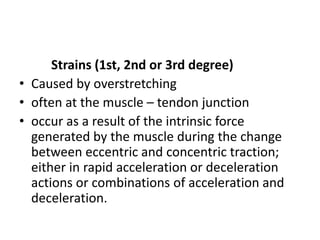
Strains (1st, 2nd or 3rd degree)
• Caused by overstretching
• often at the muscle – tendon junction
• occur as a result of the intrinsic force
generated by the muscle during the change
between eccentric and concentric traction;
either in rapid acceleration or deceleration
actions or combinations of acceleration and
deceleration.
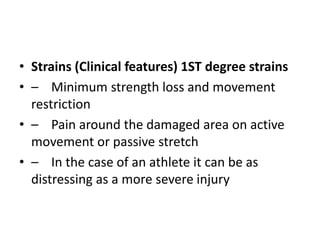
• Strains (Clinical features) 1ST degree strains
• – Minimum strength loss and movement
restriction
• – Pain around the damaged area on active
movement or passive stretch
• – In the case of an athlete it can be as
distressing as a more severe injury
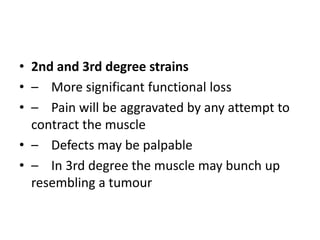
• 2nd and 3rd degree strains
• – More significant functional loss
• – Pain will be aggravated by any attempt to
contract the muscle
• – Defects may be palpable
• – In 3rd degree the muscle may bunch up
resembling a tumour
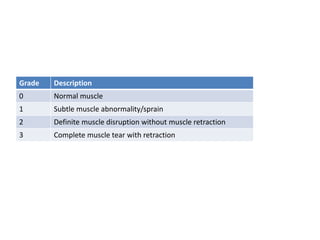
Grade Description
0 Normal muscle
1 Subtle muscle abnormality/sprain
2 Definite muscle disruption without muscle retraction
3 Complete muscle tear with retraction
• (Diagnosis)
• – History suggesting acceleration / deceleration
• – Sharp pain felt at the moment of injury
• – Pain ↓with rest and ↑ or reproduced by
attempted contraction
• – Palpable defects on superficial muscles
• – Local tenderness and swelling
• – Loss of active movement
• – Bruising after 24 hrs with spasm
Contusions
• Caused by direct blow on a muscle
• The muscle is pressed against the bone
• The muscle tears; heavy bleeding*
• deep within muscle → Muscular haematoma
• (Clinical features)
• Depend upon the size and site of haematoma
produced
• When superficial
• – Same as in strains
• Intramuscular heamatoma
• – Bleeding is within the fascia covering the muscle
• – The intramuscular pressure builds up and
counteract further bleeding
• – Resultant swelling lasts > 48hrs, accompanied
tenderness, pain, impaired mobility
• Tendon Injuries
• • Acute injuries to tendons
• – classified according to 1st ,2nd and 3rd
degree
• – are common in sports; superficial tendons are
susceptible to penetrating trauma
• – caused by rapid acceleration / deceleration
• – Injured tendons may have had a
predisposition to injury due to overuse or disease
• Tendons are most susceptible to
overuse injury
– Tendinitis (tendon
inflammation)
– Tenosynovitis (tendon sheath
inflammation)
– Tenoperiostitis (tendon
attachments’ inflammation)
• Tendon Injuries (Diagnosis)
• • History suggesting acute or overuse types
• • Clinical examination to evaluate continuity
• • US or MRI scans → precise diagnosis
• Treatment Principles
• Common to all acute injuries are internal bleeding and
likely acute inflammation. Therefore: prevent bleeding
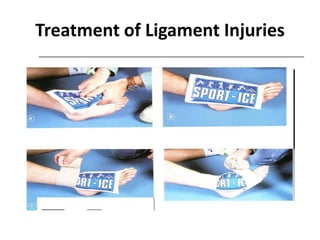
and pain as first aid by following PRICE
• principle
• P - Protection
• R - Rest
• I – Ice for cooling
• C – Compression
• E - Elevation
Treatment of Ligament Injuries
• Grade 1 and 2 ligament injuries can be treated
with pain relief, splinting and gentle
mobilization to avoid stiffness.
• Grade 3 injuries may require surgical repair to
bring together the torn ends of the ligament..
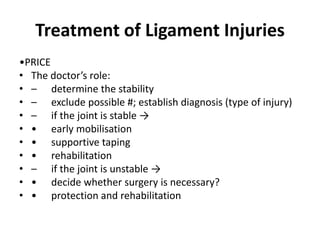
Treatment of Ligament Injuries
•PRICE
• The doctor’s role:
• – determine the stability
• – exclude possible #; establish diagnosis (type of injury)
• – if the joint is stable →
• • early mobilisation
• • supportive taping
• • rehabilitation
• – if the joint is unstable →
• • decide whether surgery is necessary?
• • protection and rehabilitation
Treatment of Ligament Injuries
• Rehabilitation (aim to:)
• – identify any predisposing cause with a view to
remove it
• – prevent adhesion formation
• – strengthen muscles related to the ligament
• – re-educate proprioception
• – restore full mobility of the ligament and
corresponding joint
• – restore patient’s confidence
• – restore full functional activity
Treatment of Acute Muscle Injury
• Immediately start PRICE; be strict on P, R and E up
to 36 hrs
• No massaging the hurt muscle within 48 -72 hrs.
• Close observation for possible compartment
syndrome
• Decrease in swelling and rapid recovery of
function may be expected in intermuscular
bleeding
• Persistent or increasing swelling with poor
function suggest intramuscular bleeding
Treatment of Acute Tendon Injury
• PRICE as in all other injuries administered
initially
• A wide range of approaches to management
based on tendon damaged, age, the degree of
disability and handicap etc. Theoretically all
severed tendons need to be sutured to restore
continuity and allowed to heal.
• Early (within 2 weeks) mobilisation favours
functional recovery.
• After initial acute treatment:
• Gr 1 and 2 strains, intermuscular haematomas and minor
intramuscular haematomas are treated with
• Elastic support bandage
• Local application of heat, contrast treatment with heat and
cold
• Exercises are started after 2-5 days rest; progression as
follows:
• Static without load → with load →free dynamic → PRE
→stretches
• Proprioceptive training → functional / sport specific training
• Gr 3 strains and severe intramuscular haematomas demand
surgical intervention or conservative treatment over a
prolonged period

Soft tissues.pptx

  • 1.
  • 2.
    Divided into • Acuteextrinsic. Lacerations, bruises, factures • Acute Intrinsic. Muscle, tendon, ligament injuries. • Chronic. Joint erosions
  • 3.
    Injuries to muscles,ligaments and tendons • Very common as sports injuries • Common as injuries of RTA, domestic and work- site accidents Acute Injuries and Overuse Injuries • Acute injuries occur suddenly • Overuse injuries occur gradually
  • 4.
    • Terminology • Sprains.ligaments • Strain. muscles
  • 5.
    Injury classification • 1stDegree, Grade 1 or mild injury • 2nd Degree, Grade 2 or moderate injury • 3rd Degree, Grade 3 or severe injury
  • 6.
    • 1st Degree,Grade 1 or mild injury • Microscopic structural damage • Slight local tenderness
  • 7.
    • 2nd Degree,Grade 2 or moderate injury • Partial rupture of tissue • Visible swelling • Notable tenderness • Do not affect joint stability
  • 8.
    • 3rd Degree,Grade 3 or severe injury • Complete rupture of tissue • Significant swelling • Significant instability
  • 9.
    Ligament Injuries • Diagnosis: •Clinical Signs and Symptoms • Brusing, swelling tenderness • Pain on movement or loading, pain on palpation • Instability ± depending on the severity • MRI scan for confirmation of injury type
  • 11.
    Muscle and TendonInjuries • Muscles and tendons function together • Injury may affect the muscle’s • Origin • Belly • muscle – tendon junction • tendon • tendon-periosteum junction
  • 12.
    Types of MuscleInjuries • Strains • Contusions
  • 13.
    Strains (1st, 2ndor 3rd degree) • Caused by overstretching • often at the muscle – tendon junction • occur as a result of the intrinsic force generated by the muscle during the change between eccentric and concentric traction; either in rapid acceleration or deceleration actions or combinations of acceleration and deceleration.
  • 14.
    • Strains (Clinicalfeatures) 1ST degree strains • – Minimum strength loss and movement restriction • – Pain around the damaged area on active movement or passive stretch • – In the case of an athlete it can be as distressing as a more severe injury
  • 15.
    • 2nd and3rd degree strains • – More significant functional loss • – Pain will be aggravated by any attempt to contract the muscle • – Defects may be palpable • – In 3rd degree the muscle may bunch up resembling a tumour
  • 16.
    Grade Description 0 Normalmuscle 1 Subtle muscle abnormality/sprain 2 Definite muscle disruption without muscle retraction 3 Complete muscle tear with retraction
  • 17.
    • (Diagnosis) • –History suggesting acceleration / deceleration • – Sharp pain felt at the moment of injury • – Pain ↓with rest and ↑ or reproduced by attempted contraction • – Palpable defects on superficial muscles • – Local tenderness and swelling • – Loss of active movement • – Bruising after 24 hrs with spasm
  • 18.
    Contusions • Caused bydirect blow on a muscle • The muscle is pressed against the bone • The muscle tears; heavy bleeding* • deep within muscle → Muscular haematoma
  • 19.
    • (Clinical features) •Depend upon the size and site of haematoma produced • When superficial • – Same as in strains • Intramuscular heamatoma • – Bleeding is within the fascia covering the muscle • – The intramuscular pressure builds up and counteract further bleeding • – Resultant swelling lasts > 48hrs, accompanied tenderness, pain, impaired mobility
  • 20.
    • Tendon Injuries •• Acute injuries to tendons • – classified according to 1st ,2nd and 3rd degree • – are common in sports; superficial tendons are susceptible to penetrating trauma • – caused by rapid acceleration / deceleration • – Injured tendons may have had a predisposition to injury due to overuse or disease
  • 21.
    • Tendons aremost susceptible to overuse injury – Tendinitis (tendon inflammation) – Tenosynovitis (tendon sheath inflammation) – Tenoperiostitis (tendon attachments’ inflammation)
  • 22.
    • Tendon Injuries(Diagnosis) • • History suggesting acute or overuse types • • Clinical examination to evaluate continuity • • US or MRI scans → precise diagnosis
  • 23.
    • Treatment Principles •Common to all acute injuries are internal bleeding and likely acute inflammation. Therefore: prevent bleeding and pain as first aid by following PRICE • principle • P - Protection • R - Rest • I – Ice for cooling • C – Compression • E - Elevation
  • 24.
    Treatment of LigamentInjuries • Grade 1 and 2 ligament injuries can be treated with pain relief, splinting and gentle mobilization to avoid stiffness. • Grade 3 injuries may require surgical repair to bring together the torn ends of the ligament..
  • 25.
  • 26.
    Treatment of LigamentInjuries •PRICE • The doctor’s role: • – determine the stability • – exclude possible #; establish diagnosis (type of injury) • – if the joint is stable → • • early mobilisation • • supportive taping • • rehabilitation • – if the joint is unstable → • • decide whether surgery is necessary? • • protection and rehabilitation
  • 27.
    Treatment of LigamentInjuries • Rehabilitation (aim to:) • – identify any predisposing cause with a view to remove it • – prevent adhesion formation • – strengthen muscles related to the ligament • – re-educate proprioception • – restore full mobility of the ligament and corresponding joint • – restore patient’s confidence • – restore full functional activity
  • 28.
    Treatment of AcuteMuscle Injury • Immediately start PRICE; be strict on P, R and E up to 36 hrs • No massaging the hurt muscle within 48 -72 hrs. • Close observation for possible compartment syndrome • Decrease in swelling and rapid recovery of function may be expected in intermuscular bleeding • Persistent or increasing swelling with poor function suggest intramuscular bleeding
  • 29.
    Treatment of AcuteTendon Injury • PRICE as in all other injuries administered initially • A wide range of approaches to management based on tendon damaged, age, the degree of disability and handicap etc. Theoretically all severed tendons need to be sutured to restore continuity and allowed to heal. • Early (within 2 weeks) mobilisation favours functional recovery.
  • 30.
    • After initialacute treatment: • Gr 1 and 2 strains, intermuscular haematomas and minor intramuscular haematomas are treated with • Elastic support bandage • Local application of heat, contrast treatment with heat and cold • Exercises are started after 2-5 days rest; progression as follows: • Static without load → with load →free dynamic → PRE →stretches • Proprioceptive training → functional / sport specific training • Gr 3 strains and severe intramuscular haematomas demand surgical intervention or conservative treatment over a prolonged period