Bursa/Bursae
• A bursa is a small, fluid-filled sac within your
body that lies near bony prominences and
joints. The bursa acts as a cushion between
muscles, ligaments, and bones and allows
structures to glide and slide past one another
with ease and with minimal friction. Injury to
a bursa may cause pain, limited motion, and
decreased functional mobility.
Types of bursa
• Synovial. Near the synovial membrane of the
joints
• Adventitious. The accidental bursa occur only
after continued shearing or repeated pressure
over a bony prominence. A bunion is an
example of an adventitious bursa.
• Subcutaneous. These bursae lie between your
skin and a bony prominence
• pre-patellar bursa
• trochanteric bursa
• olecranon bursa
• Bursitis
• Calcification of a bursa
• Infection
Treatment
• Physiotherapy
• Medications
• Surgery
Cervical spine injuries and its
management
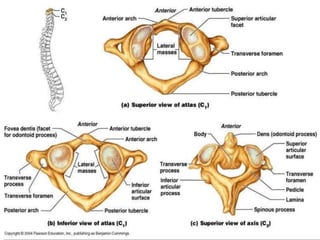
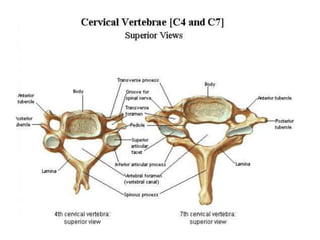
• The cervical vertebrae are the smallest of the
moveable vertebrae, and are characterized by
a foramen in each transverse process.
• Readily identified by the foramen
transversarium perforating the transverse
processes. This foramen transmits the
vertebral artery, the vein,and sympathetic
nerve fibres
• Spines are small and bifid (except C1,C7 which
are single)
• Articular facets are relatively horizontal
• Nodding and lateral flexion movements occur
at the atlanto-occipital joint
• Rotation of the skull occurs at the atlanto-
axial joint around the dens, which acts as a
pivot
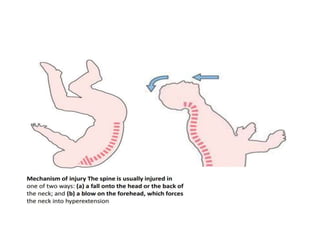
MECHANISM OF INJURY
• Traction injury
• Direct injury
• Indirect injury
– axial compression flexion
– lateral compression
– flexion-rotation
– Shear
– flexion-distraction
– Extension
• Insufficiency fractures
PRINCIPLES OF DIAGNOSIS AND
INITIAL MANAGEMENT
• Diagnosis and management go hand in hand
• Inappropriate movement and examination can
irretrievably change the outcome for the worse
• Early management
• – Airway, Breathing and Circulation
• – Slightest possibility of a spinal injury in a
trauma patient, the spine must be immobilized
until the patient has been resuscitated and other
life-threatening injuries have been identified and
treated.
• A stable injury is one in which the vertebral
components will not be displaced by normal
movements;
• In a stable injury, if the neural elements are
undamaged there is little risk of them becoming
damaged.
• An unstable injury is one in which there is a
significant risk of displacement and consequent
damage – or further damage – to the neural
tissues.
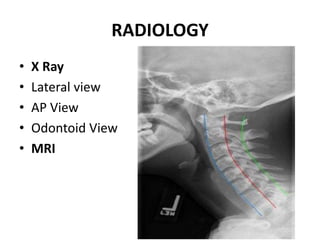
RADIOLOGY
• X Ray
• Lateral view
• AP View
• Odontoid View
• MRI
TREATMENT
• HARD COLLAR IMMOBILIZATION FOR 12
WEEKS AND AVOIDANCE OF FLEX/EXT
ACTIVITIES FOR ANOTHER 12 WEEKS HAS NOT
BEEN ASSOCIATED WITH RECURRENT INJURY
PRINCIPLES OF DEFINITIVE
TREATMENT
The objectives of treatment are:
• to preserve neurological function;
• to minimize a perceived threat of neurological
compression;
• to stabilize the spine;
• to rehabilitate the patient
The indications for urgent surgical
stabilization
• (a) an unstable fracture with progressive
neurological deficit and MRI signs of likely
further neurological deterioration; and •
• (b) controversially an unstable fracture in a
patient with multiple injuries
Initial Treatment
• Immobilization
Rigid cervical collor (philadelphia collor)
Poster braces
Cervico thoracic arthrosis
Halo device
• In unstable injury this is inadequate, cervical
traction required
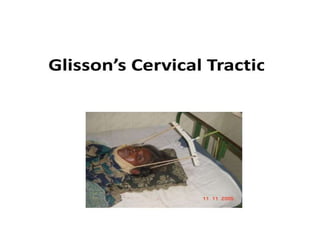
– Skin (glisson’ traction)
– Skeletal • halo traction or gardner-wells tongs
Crutchfield tongs
Pharmacological
• steroids
suppress inflammatory response and
vasogenic edema
 • Occipital condyle fracture:
• • This is usually a high-energy fracture and associated
skull or cervical spine injuries must be sought.
• • The diagnosis is likely to be missed on plain x-ray
examination and CT is essential.
• • Impacted and undisplaced fractures can be treated
by brace immobilization for 8–12 weeks.
• Displaced fractures are best managed by using a halo
vest or by operative fixation.
Occipito-cervical dislocation:
• • This high-energy injury is almost always
associated with other serious bone and/or
soft-tissue injuries, including arterial and
pharyngeal disruption, and the outcome is
often fatal.
• • Patients are best dealt with by a
multidisciplinary team of surgeons and
physicians.
• Diagnosis
X Ray
CT
MRI
• The injury is likely to be unstable and requires
immediate reduction (without traction!) and
stabilization with a halo-vest, pending surgical
treatment.
• After appropriate attention to the more serious soft
tissue injuries and general resuscitation, the dislocation
should be internally fixed;
• specially designed occipito-cervical plates and screws
are available for the purpose.
• In severely unstable injuries, halo-vest stabilization
should be retained for another 6–8 weeks.
• Posterior ligament injury
if it is certain that the injury is stable, a
semirigid collar for 6 weeks is adequate;
• • if the injury is unstable then posterior
fixation and fusion is advisable
• Wedge compression fracture
A pure flexion injury results in a wedge
compression fracture of the vertebral body •
The middle and posterior elements remain
intact and the injury is stable.
• • All that is needed is a comfortable collar for
6– 12 weeks.
SPRAINED NECK (WHIPLASH INJURY)
• Soft-tissue sprains of the neck are so common
aftermotor vehicle accidents.
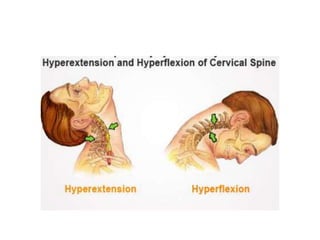
• There is usually a history of a low velocity rear-
end collision in which the occupant’s body is
forced against the car seat while his or her head
flips backwards and then recoils in flexion.
• This mechanism has generated the imaginative
term whiplash injury, which has served effectively
to enhance public apprehension at its occurrence
• Women are affected more often than men
Clinical features
• Often the victim is unaware
• Pain and stiffness of the neck
• Pain sometimes radiates to the shoulders or
interscapular area
• Neck muscles are tender and movements
often restricted;
• X-ray examination may show straightening out
of the normal cervical lordosis, a sign of
muscle spasm
• Proposed grading of whiplash-associated
injuries
• Grade Clinical pattern
• 0 No neck symptoms or signs
• 1 Neck pain, stiffness and tenderness, No physical
signs
• 2 Neck symptoms and musculoskeletal signs
• 3 Neck symptoms and neurological signs
• 4 Neck symptoms and fracture or dislocation
Treatment
• • Collars are more likely to hinder than help recovery.
• • Simple pain-relieving measures, including analgesic
medication, may be needed during the first few weeks.
• However, the emphasis should be on graded
exercises,
• • beginning with isometric muscle contractions and
postural adjustments, then going on gradually to active
movements and lastly movements against resistance.
• • The range of movement in each direction is slowly
increased without subjecting the patient to
unnecessary pain.

Cervicolumber Injury.pptx

  • 1.
    Bursa/Bursae • A bursais a small, fluid-filled sac within your body that lies near bony prominences and joints. The bursa acts as a cushion between muscles, ligaments, and bones and allows structures to glide and slide past one another with ease and with minimal friction. Injury to a bursa may cause pain, limited motion, and decreased functional mobility.
  • 2.
    Types of bursa •Synovial. Near the synovial membrane of the joints • Adventitious. The accidental bursa occur only after continued shearing or repeated pressure over a bony prominence. A bunion is an example of an adventitious bursa. • Subcutaneous. These bursae lie between your skin and a bony prominence
  • 3.
    • pre-patellar bursa •trochanteric bursa • olecranon bursa
  • 4.
    • Bursitis • Calcificationof a bursa • Infection
  • 5.
  • 6.
    Cervical spine injuriesand its management
  • 7.
    • The cervicalvertebrae are the smallest of the moveable vertebrae, and are characterized by a foramen in each transverse process.
  • 10.
    • Readily identifiedby the foramen transversarium perforating the transverse processes. This foramen transmits the vertebral artery, the vein,and sympathetic nerve fibres • Spines are small and bifid (except C1,C7 which are single) • Articular facets are relatively horizontal
  • 11.
    • Nodding andlateral flexion movements occur at the atlanto-occipital joint • Rotation of the skull occurs at the atlanto- axial joint around the dens, which acts as a pivot
  • 12.
    MECHANISM OF INJURY •Traction injury • Direct injury • Indirect injury – axial compression flexion – lateral compression – flexion-rotation – Shear – flexion-distraction – Extension • Insufficiency fractures
  • 14.
    PRINCIPLES OF DIAGNOSISAND INITIAL MANAGEMENT • Diagnosis and management go hand in hand • Inappropriate movement and examination can irretrievably change the outcome for the worse • Early management • – Airway, Breathing and Circulation • – Slightest possibility of a spinal injury in a trauma patient, the spine must be immobilized until the patient has been resuscitated and other life-threatening injuries have been identified and treated.
  • 15.
    • A stableinjury is one in which the vertebral components will not be displaced by normal movements; • In a stable injury, if the neural elements are undamaged there is little risk of them becoming damaged. • An unstable injury is one in which there is a significant risk of displacement and consequent damage – or further damage – to the neural tissues.
  • 16.
    RADIOLOGY • X Ray •Lateral view • AP View • Odontoid View • MRI
  • 17.
    TREATMENT • HARD COLLARIMMOBILIZATION FOR 12 WEEKS AND AVOIDANCE OF FLEX/EXT ACTIVITIES FOR ANOTHER 12 WEEKS HAS NOT BEEN ASSOCIATED WITH RECURRENT INJURY
  • 18.
    PRINCIPLES OF DEFINITIVE TREATMENT Theobjectives of treatment are: • to preserve neurological function; • to minimize a perceived threat of neurological compression; • to stabilize the spine; • to rehabilitate the patient
  • 19.
    The indications forurgent surgical stabilization • (a) an unstable fracture with progressive neurological deficit and MRI signs of likely further neurological deterioration; and • • (b) controversially an unstable fracture in a patient with multiple injuries
  • 20.
    Initial Treatment • Immobilization Rigidcervical collor (philadelphia collor) Poster braces Cervico thoracic arthrosis Halo device • In unstable injury this is inadequate, cervical traction required – Skin (glisson’ traction) – Skeletal • halo traction or gardner-wells tongs Crutchfield tongs
  • 22.
  • 23.
     • Occipitalcondyle fracture: • • This is usually a high-energy fracture and associated skull or cervical spine injuries must be sought. • • The diagnosis is likely to be missed on plain x-ray examination and CT is essential. • • Impacted and undisplaced fractures can be treated by brace immobilization for 8–12 weeks. • Displaced fractures are best managed by using a halo vest or by operative fixation.
  • 24.
    Occipito-cervical dislocation: • •This high-energy injury is almost always associated with other serious bone and/or soft-tissue injuries, including arterial and pharyngeal disruption, and the outcome is often fatal. • • Patients are best dealt with by a multidisciplinary team of surgeons and physicians.
  • 25.
  • 26.
    • The injuryis likely to be unstable and requires immediate reduction (without traction!) and stabilization with a halo-vest, pending surgical treatment. • After appropriate attention to the more serious soft tissue injuries and general resuscitation, the dislocation should be internally fixed; • specially designed occipito-cervical plates and screws are available for the purpose. • In severely unstable injuries, halo-vest stabilization should be retained for another 6–8 weeks.
  • 27.
    • Posterior ligamentinjury if it is certain that the injury is stable, a semirigid collar for 6 weeks is adequate; • • if the injury is unstable then posterior fixation and fusion is advisable
  • 28.
    • Wedge compressionfracture A pure flexion injury results in a wedge compression fracture of the vertebral body • The middle and posterior elements remain intact and the injury is stable. • • All that is needed is a comfortable collar for 6– 12 weeks.
  • 29.
    SPRAINED NECK (WHIPLASHINJURY) • Soft-tissue sprains of the neck are so common aftermotor vehicle accidents. • There is usually a history of a low velocity rear- end collision in which the occupant’s body is forced against the car seat while his or her head flips backwards and then recoils in flexion. • This mechanism has generated the imaginative term whiplash injury, which has served effectively to enhance public apprehension at its occurrence
  • 30.
    • Women areaffected more often than men
  • 32.
    Clinical features • Oftenthe victim is unaware • Pain and stiffness of the neck • Pain sometimes radiates to the shoulders or interscapular area • Neck muscles are tender and movements often restricted;
  • 33.
    • X-ray examinationmay show straightening out of the normal cervical lordosis, a sign of muscle spasm
  • 34.
    • Proposed gradingof whiplash-associated injuries • Grade Clinical pattern • 0 No neck symptoms or signs • 1 Neck pain, stiffness and tenderness, No physical signs • 2 Neck symptoms and musculoskeletal signs • 3 Neck symptoms and neurological signs • 4 Neck symptoms and fracture or dislocation
  • 35.
    Treatment • • Collarsare more likely to hinder than help recovery. • • Simple pain-relieving measures, including analgesic medication, may be needed during the first few weeks. • However, the emphasis should be on graded exercises, • • beginning with isometric muscle contractions and postural adjustments, then going on gradually to active movements and lastly movements against resistance. • • The range of movement in each direction is slowly increased without subjecting the patient to unnecessary pain.