National Aeronautics and Space Administration!


         Recent Research in Lithium Batteries and Fuel
                             Cells

                                            Dean Tigelaar
                                          Polymers Branch
                                      NASA Glenn Research Center


                                                                   www.nasa.gov   1
National Aeronautics and Space Administration!


Polymer/Ionic Liquid Electrolytes and Their
      Potential in Lithium Batteries


                                           Allyson Palker, Dean Tigelaar
                                                 Polymers Branch
                                                  William Bennett
                                              Electrochemistry Branch
                                           NASA Glenn Research Center

                                                                           www.nasa.gov   2
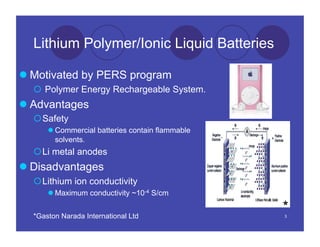
Lithium Polymer/Ionic Liquid Batteries

 Motivated by PERS program
    Polymer Energy Rechargeable System.
 Advantages
   Safety
       Commercial batteries contain flammable
        solvents.
   Li metal anodes
 Disadvantages
   Lithium ion conductivity
       Maximum conductivity ~10-4 S/cm


  *Gaston Narada International Ltd
                                                 *
                                                 3
Our Objective

 Prepare polymer separator that has:
   High lithium ion conductivity (~10-3 S/cm)
   No volatile components
   High long term stability with lithium metal
   electrodes


 Strategy: Polymer gel electrolyte that
  contains ionic liquids
   Nonvolatile, nonflammable, wide ESW.
                                                  4
National Aeronautics and Space Administration!

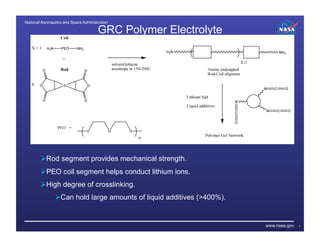
                                       GRC Polymer Electrolyte


         Rod segment provides mechanical strength.
         PEO coil segment helps conduct lithium ions.
         High degree of crosslinking.
                 Can hold large amounts of liquid additives (>400%).


                                                                        www.nasa.gov   5
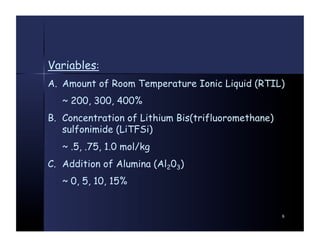
Variables:
A.  Amount of Room Temperature Ionic Liquid (RTIL)
   ~ 200, 300, 400%
B.  Concentration of Lithium Bis(trifluoromethane)
    sulfonimide (LiTFSi)
   ~ .5, .75, 1.0 mol/kg
C.  Addition of Alumina (Al203)
   ~ 0, 5, 10, 15%
Cycling Data
     Experiment 1: Amount of IL added


200% IL with .5 mol/kg       300% IL with .5 mol/kg

                           400% IL is the most
                           compatible with the
                           Lithium electrodes
                           at a current density
                           of .25 mA/cm2, 60°C

                                                      10
  400% IL with .5 mol/kg
Experiment 2: Concentration of LiTFSi


    400% IL with .5 mol/kg      400% IL with .75 mol/kg


                             The concentration of Lithium
                             salt that was the most
                             compatible with the Lithium
                             electrodes was the 1.0 mol/
                             kg.


                                                          11
 400% IL with 1.0 mol/kg
Experiment 3: Addition of Alumina


400% IL with 1.0 mol/kg and 0% Alumina   400% IL with 1.0 mol/kg and 10% Alumina
The addition of 5% Alumina caused the Voltage to decrease five fold
showing there is less resistance and better stability in comparison
to the sample without Alumina.

                                                                         12
Impedance Data


•  Addition of alumina results in a significant decrease in interfacial resistance
     •  More stable interfacial layer.

                                                                                13
Summary
         Made electrolytes by varying:
     1.  Amount of RTIL
     2.  Concentration of Li salt
     3.  Addition of Alumina
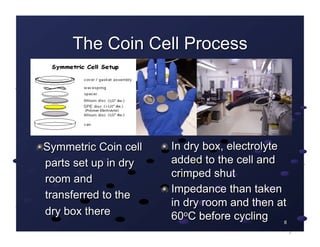
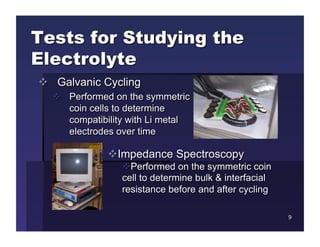
  Symmetric coin cells made with the polymer
   electrolytes
  Improved cycling stability in coin cells from <3
   hrs to >1000 hrs at 0.25 mA/cm2 current density
  400% IL with 1.0 mol/kg and 10% Alumina was
   the most compatible with the Lithium electrodes
     •      Tigelaar, D. M.; Palker, A. P.; Meador, M. A. B.; Bennett,
            W. R., J. Electrochem. Soc., 2008, 155, A768.


                                                                14
National Aeronautics and Space Administration!


         Progress of Proton Exchange Membrane (PEM)
                           Fuel Cells
                                       Dean Tigelaar, Allison Palker
                                            Polymers Branch
                                       NASA Glenn Research Center

                             Huan He, Christine Jackson, Kellina
                            Anderson, Tyler Peter, Jesse Wainright,
                                       Robert Savinell
                              Case Western Reserve University


                                                                       www.nasa.gov   15
National Aeronautics and Space Administration!


                                                 www.nasa.gov   16
National Aeronautics and Space Administration!

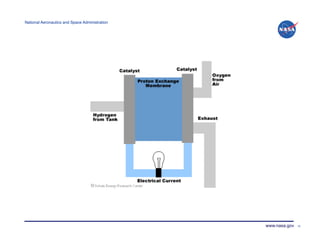
                                                 Advantanges
         •    Efficient energy conversion (up to 70%)
         •    High energy density
         •    Generates water in exhaust
         •    No recharge needed


                                                 Potential Uses
         •  Propulsion
                 –  Automotive, zero emission aircraft
         •  Stationary
                 –  Power supply (Gemini V)
         •  Portable
                 –  Astronaut equipment
         •  Regenerative
                 –  Coupled with photovoltaic systems for energy storage
                 –  Hydrolysis of water back into H2 and O2
                                                                           www.nasa.gov   17
National Aeronautics and Space Administration!


                             Proton Exchange Membrane must:
           •     Have high proton conductivity.
           •     Have low electrical conductivity.
           •     Be mechanically robust in the wet and dry state.
           •     Processable into thin film.
           •     Be stable to a high temperature, high humidity, highly acidic
                 environment for thousands of hours.


                                                                                 www.nasa.gov   18

                                                                                                     18
National Aeronautics and Space Administration!


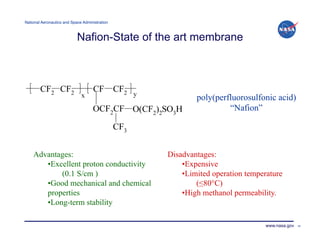
                            Nafion-State of the art membrane


                                                         poly(perfluorosulfonic acid)
                                                                  “Nafion”


    Advantages:                                  Disadvantages:
       • Excellent proton conductivity               • Expensive
            (0.1 S/cm )                              • Limited operation temperature
       • Good mechanical and chemical                     (≤80°C)
       properties                                    •High methanol permeability.
       • Long-term stability

                                                                              www.nasa.gov   19
National Aeronautics and Space Administration!


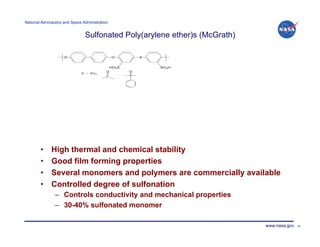
                                Sulfonated Poly(arylene ether)s (McGrath)


        •     High thermal and chemical stability
        •     Good film forming properties
        •     Several monomers and polymers are commercially available
        •     Controlled degree of sulfonation
                –  Controls conductivity and mechanical properties
                –  30-40% sulfonated monomer

                                                                            www.nasa.gov   20
National Aeronautics and Space Administration!


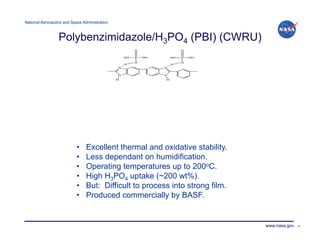
                  Polybenzimidazole/H3PO4 (PBI) (CWRU)


                            •    Excellent thermal and oxidative stability.
                            •    Less dependant on humidification.
                            •    Operating temperatures up to 200oC.
                            •    High H3PO4 uptake (~200 wt%).
                            •    But: Difficult to process into strong film.
                            •    Produced commercially by BASF.


                                                                               www.nasa.gov   21
National Aeronautics and Space Administration!


                   Our Strategy: Synthesize Novel Polymer

        •  Fully Aromatic
            –  Thermo-oxidatively stable and mechanically strong.
        •  Heterocyclic
            –  Coordination with H3PO4 by acid-base or H-bonding.
            –  Similar to PBI but easier to process.
        •  Highly soluble in common organic solvents
            –  NMP, DMAc, CHCl3.


                                                                    www.nasa.gov   22
National Aeronautics and Space Administration!


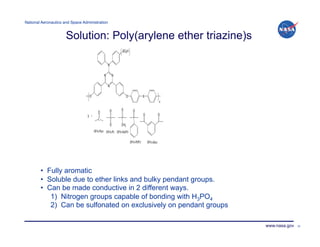
                      Solution: Poly(arylene ether triazine)s


        •  Fully aromatic
        •  Soluble due to ether links and bulky pendant groups.
        •  Can be made conductive in 2 different ways.
            1) Nitrogen groups capable of bonding with H3PO4
            2) Can be sulfonated on exclusively on pendant groups

                                                                    www.nasa.gov   23
National Aeronautics and Space Administration!


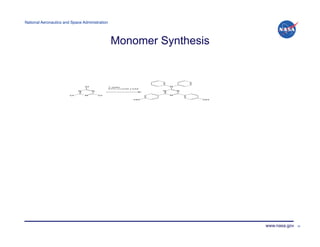
                                                 Monomer Synthesis


                                                                     www.nasa.gov   24
National Aeronautics and Space Administration!


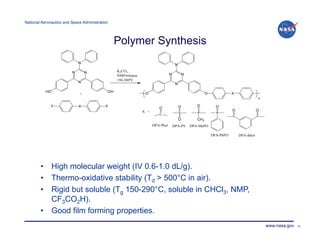
                                                 Polymer Synthesis


        •  High molecular weight (IV 0.6-1.0 dL/g).
        •  Thermo-oxidative stability (Td > 500°C in air).
        •  Rigid but soluble (Tg 150-290°C, soluble in CHCl3, NMP,
           CF3CO2H).
        •  Good film forming properties.
                                                                     www.nasa.gov   25
National Aeronautics and Space Administration!


                                 Glass Transition Temperature


                                                                www.nasa.gov   26
National Aeronautics and Space Administration!


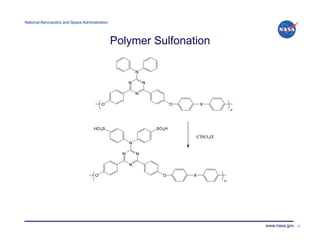
                                                 Polymer Sulfonation


                                                                       www.nasa.gov   27
National Aeronautics and Space Administration!

                         0.12
                                             Conductivity of Sulfonated Films
                          0.1


                         0.08
 Conductivity / S cm-1


                         0.06


                         0.04


                         0.02
                                                   Nafion 115          DPA-Pket          DPA-diket          DPA-PS

                           0
                                0       10        20        30        40        50         60        70        80        90        100
                                                                     Temperature / oC
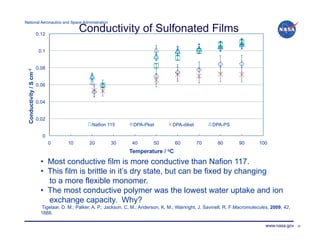
                           • Most conductive film is more conductive than Nafion 117.
                           • This film is brittle in it’s dry state, but can be fixed by changing
                              to a more flexible monomer.
                           •  The most conductive polymer was the lowest water uptake and ion
                              exchange capacity. Why?
                           Tigelaar, D. M.; Palker, A. P.; Jackson, C. M.; Anderson, K. M.; Wainright, J. Savinell, R. F Macromolecules, 2009, 42,
                           1888.

                                                                                                                                      www.nasa.gov   28
National Aeronautics and Space Administration!


                                                 TEM Data


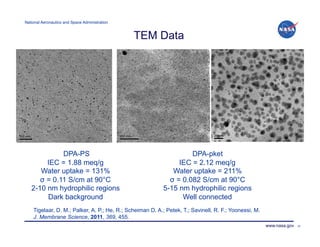
             DPA-PS                                                 DPA-pket
        IEC = 1.88 meq/g                                        IEC = 2.12 meq/g
      Water uptake = 131%                                     Water uptake = 211%
      σ = 0.11 S/cm at 90°C                                  σ = 0.082 S/cm at 90°C
   2-10 nm hydrophilic regions                             5-15 nm hydrophilic regions
        Dark background                                          Well connected
    Tigelaar, D. M.; Palker, A. P.; He, R.; Scheiman D. A.; Petek, T.; Savinell, R. F.; Yoonessi, M.
    J. Membrane Science, 2011, 369, 455.
                                                                                                       www.nasa.gov   29
National Aeronautics and Space Administration!

             Phosphoric Acid Uptake of DPA-PS/PBI Blends
                        900

                        800

                        700

                        600
        Uptake (wt %)


                        500
                                     Room Temp                         50oC                             90oC
                        400
                                                      1:1 DPA-PS:PBI
                                                      3:1 DPA-PS:PBI
                        300                           9:1 DPA-PS:PBI

                        200

                        100

                          0
                              0      20   40     60   80    100    120   140    160   180   200   220    240   260
                                                                    Time (hr)

                                  •  Uptake of PBI by this method is 200%.
                                  •  “As received” PBI can be used for 3:1, 9:1 blends.


                                                                                                                 www.nasa.gov   30
National Aeronautics and Space Administration!


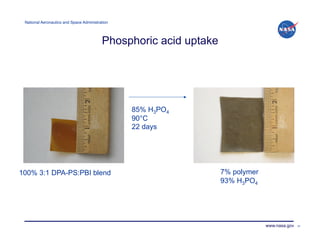
                                           Phosphoric acid uptake


                                                  85% H3PO4
                                                  90°C
                                                  22 days


100% 3:1 DPA-PS:PBI blend                                           7% polymer
                                                                    93% H3PO4


                                                                                 www.nasa.gov   31
National Aeronautics and Space Administration!


                                                   Conclusions
         •  Synthesized novel poly(arylene ether)s that are fully
            aromatic, soluble, and with high molecular weight.
         •  Polymers have high H3PO4 uptake, but lose
            dimensional stability as high temperatures.
         •  Most conductive sulfonated polymer has the same
            conductivity as Nafion 115 at 100% RH.
         •  Most conductive polymer is brittle when dry.
                 –  This problem can be fixed by replacing sulfone with
                    isophthaloyl group or using a comonomer.
                                                 Acknowledgements
               • Dan Scheiman, Mitra Yoonessi
               • Robert Savinell, Jesse Wainright, Christine
                 Jackson, and Kellina Anderson, Huan He.


                                                                          www.nasa.gov   32

Polymer/Ionic Liquid Electrolytes and Their Potential in Lithium Batteries

  • 1.
    National Aeronautics andSpace Administration! Recent Research in Lithium Batteries and Fuel Cells Dean Tigelaar Polymers Branch NASA Glenn Research Center www.nasa.gov 1
  • 2.
    National Aeronautics andSpace Administration! Polymer/Ionic Liquid Electrolytes and Their Potential in Lithium Batteries Allyson Palker, Dean Tigelaar Polymers Branch William Bennett Electrochemistry Branch NASA Glenn Research Center www.nasa.gov 2
  • 3.
    Lithium Polymer/Ionic LiquidBatteries  Motivated by PERS program   Polymer Energy Rechargeable System.  Advantages  Safety  Commercial batteries contain flammable solvents.  Li metal anodes  Disadvantages  Lithium ion conductivity  Maximum conductivity ~10-4 S/cm *Gaston Narada International Ltd * 3
  • 4.
    Our Objective  Prepare polymerseparator that has:  High lithium ion conductivity (~10-3 S/cm)  No volatile components  High long term stability with lithium metal electrodes  Strategy: Polymer gel electrolyte that contains ionic liquids  Nonvolatile, nonflammable, wide ESW. 4
  • 5.
    National Aeronautics andSpace Administration! GRC Polymer Electrolyte  Rod segment provides mechanical strength.  PEO coil segment helps conduct lithium ions.  High degree of crosslinking.  Can hold large amounts of liquid additives (>400%). www.nasa.gov 5
  • 6.
    Variables: A.  Amount ofRoom Temperature Ionic Liquid (RTIL) ~ 200, 300, 400% B.  Concentration of Lithium Bis(trifluoromethane) sulfonimide (LiTFSi) ~ .5, .75, 1.0 mol/kg C.  Addition of Alumina (Al203) ~ 0, 5, 10, 15%
  • 10.
    Cycling Data Experiment 1: Amount of IL added 200% IL with .5 mol/kg 300% IL with .5 mol/kg 400% IL is the most compatible with the Lithium electrodes at a current density of .25 mA/cm2, 60°C 10 400% IL with .5 mol/kg
  • 11.
    Experiment 2: Concentrationof LiTFSi 400% IL with .5 mol/kg 400% IL with .75 mol/kg The concentration of Lithium salt that was the most compatible with the Lithium electrodes was the 1.0 mol/ kg. 11 400% IL with 1.0 mol/kg
  • 12.
    Experiment 3: Additionof Alumina 400% IL with 1.0 mol/kg and 0% Alumina 400% IL with 1.0 mol/kg and 10% Alumina The addition of 5% Alumina caused the Voltage to decrease five fold showing there is less resistance and better stability in comparison to the sample without Alumina. 12
  • 13.
    Impedance Data •  Additionof alumina results in a significant decrease in interfacial resistance •  More stable interfacial layer. 13
  • 14.
    Summary   Made electrolytes by varying: 1.  Amount of RTIL 2.  Concentration of Li salt 3.  Addition of Alumina   Symmetric coin cells made with the polymer electrolytes   Improved cycling stability in coin cells from <3 hrs to >1000 hrs at 0.25 mA/cm2 current density   400% IL with 1.0 mol/kg and 10% Alumina was the most compatible with the Lithium electrodes •  Tigelaar, D. M.; Palker, A. P.; Meador, M. A. B.; Bennett, W. R., J. Electrochem. Soc., 2008, 155, A768. 14
  • 15.
    National Aeronautics andSpace Administration! Progress of Proton Exchange Membrane (PEM) Fuel Cells Dean Tigelaar, Allison Palker Polymers Branch NASA Glenn Research Center Huan He, Christine Jackson, Kellina Anderson, Tyler Peter, Jesse Wainright, Robert Savinell Case Western Reserve University www.nasa.gov 15
  • 16.
    National Aeronautics andSpace Administration! www.nasa.gov 16
  • 17.
    National Aeronautics andSpace Administration! Advantanges •  Efficient energy conversion (up to 70%) •  High energy density •  Generates water in exhaust •  No recharge needed Potential Uses •  Propulsion –  Automotive, zero emission aircraft •  Stationary –  Power supply (Gemini V) •  Portable –  Astronaut equipment •  Regenerative –  Coupled with photovoltaic systems for energy storage –  Hydrolysis of water back into H2 and O2 www.nasa.gov 17
  • 18.
    National Aeronautics andSpace Administration! Proton Exchange Membrane must: •  Have high proton conductivity. •  Have low electrical conductivity. •  Be mechanically robust in the wet and dry state. •  Processable into thin film. •  Be stable to a high temperature, high humidity, highly acidic environment for thousands of hours. www.nasa.gov 18 18
  • 19.
    National Aeronautics andSpace Administration! Nafion-State of the art membrane poly(perfluorosulfonic acid) “Nafion” Advantages: Disadvantages: • Excellent proton conductivity • Expensive (0.1 S/cm ) • Limited operation temperature • Good mechanical and chemical (≤80°C) properties •High methanol permeability. • Long-term stability www.nasa.gov 19
  • 20.
    National Aeronautics andSpace Administration! Sulfonated Poly(arylene ether)s (McGrath) •  High thermal and chemical stability •  Good film forming properties •  Several monomers and polymers are commercially available •  Controlled degree of sulfonation –  Controls conductivity and mechanical properties –  30-40% sulfonated monomer www.nasa.gov 20
  • 21.
    National Aeronautics andSpace Administration! Polybenzimidazole/H3PO4 (PBI) (CWRU) •  Excellent thermal and oxidative stability. •  Less dependant on humidification. •  Operating temperatures up to 200oC. •  High H3PO4 uptake (~200 wt%). •  But: Difficult to process into strong film. •  Produced commercially by BASF. www.nasa.gov 21
  • 22.
    National Aeronautics andSpace Administration! Our Strategy: Synthesize Novel Polymer •  Fully Aromatic –  Thermo-oxidatively stable and mechanically strong. •  Heterocyclic –  Coordination with H3PO4 by acid-base or H-bonding. –  Similar to PBI but easier to process. •  Highly soluble in common organic solvents –  NMP, DMAc, CHCl3. www.nasa.gov 22
  • 23.
    National Aeronautics andSpace Administration! Solution: Poly(arylene ether triazine)s •  Fully aromatic •  Soluble due to ether links and bulky pendant groups. •  Can be made conductive in 2 different ways. 1) Nitrogen groups capable of bonding with H3PO4 2) Can be sulfonated on exclusively on pendant groups www.nasa.gov 23
  • 24.
    National Aeronautics andSpace Administration! Monomer Synthesis www.nasa.gov 24
  • 25.
    National Aeronautics andSpace Administration! Polymer Synthesis •  High molecular weight (IV 0.6-1.0 dL/g). •  Thermo-oxidative stability (Td > 500°C in air). •  Rigid but soluble (Tg 150-290°C, soluble in CHCl3, NMP, CF3CO2H). •  Good film forming properties. www.nasa.gov 25
  • 26.
    National Aeronautics andSpace Administration! Glass Transition Temperature www.nasa.gov 26
  • 27.
    National Aeronautics andSpace Administration! Polymer Sulfonation www.nasa.gov 27
  • 28.
    National Aeronautics andSpace Administration! 0.12 Conductivity of Sulfonated Films 0.1 0.08 Conductivity / S cm-1 0.06 0.04 0.02 Nafion 115 DPA-Pket DPA-diket DPA-PS 0 0 10 20 30 40 50 60 70 80 90 100 Temperature / oC • Most conductive film is more conductive than Nafion 117. • This film is brittle in it’s dry state, but can be fixed by changing to a more flexible monomer. •  The most conductive polymer was the lowest water uptake and ion exchange capacity. Why? Tigelaar, D. M.; Palker, A. P.; Jackson, C. M.; Anderson, K. M.; Wainright, J. Savinell, R. F Macromolecules, 2009, 42, 1888. www.nasa.gov 28
  • 29.
    National Aeronautics andSpace Administration! TEM Data DPA-PS DPA-pket IEC = 1.88 meq/g IEC = 2.12 meq/g Water uptake = 131% Water uptake = 211% σ = 0.11 S/cm at 90°C σ = 0.082 S/cm at 90°C 2-10 nm hydrophilic regions 5-15 nm hydrophilic regions Dark background Well connected Tigelaar, D. M.; Palker, A. P.; He, R.; Scheiman D. A.; Petek, T.; Savinell, R. F.; Yoonessi, M. J. Membrane Science, 2011, 369, 455. www.nasa.gov 29
  • 30.
    National Aeronautics andSpace Administration! Phosphoric Acid Uptake of DPA-PS/PBI Blends 900 800 700 600 Uptake (wt %) 500 Room Temp 50oC 90oC 400 1:1 DPA-PS:PBI 3:1 DPA-PS:PBI 300 9:1 DPA-PS:PBI 200 100 0 0 20 40 60 80 100 120 140 160 180 200 220 240 260 Time (hr) •  Uptake of PBI by this method is 200%. •  “As received” PBI can be used for 3:1, 9:1 blends. www.nasa.gov 30
  • 31.
    National Aeronautics andSpace Administration! Phosphoric acid uptake 85% H3PO4 90°C 22 days 100% 3:1 DPA-PS:PBI blend 7% polymer 93% H3PO4 www.nasa.gov 31
  • 32.
    National Aeronautics andSpace Administration! Conclusions •  Synthesized novel poly(arylene ether)s that are fully aromatic, soluble, and with high molecular weight. •  Polymers have high H3PO4 uptake, but lose dimensional stability as high temperatures. •  Most conductive sulfonated polymer has the same conductivity as Nafion 115 at 100% RH. •  Most conductive polymer is brittle when dry. –  This problem can be fixed by replacing sulfone with isophthaloyl group or using a comonomer. Acknowledgements • Dan Scheiman, Mitra Yoonessi • Robert Savinell, Jesse Wainright, Christine Jackson, and Kellina Anderson, Huan He. www.nasa.gov 32