INTRODUCTION OF BATTERY
•A battery is an electrochemical device which converts chemical energy into electrical
energy.
• Some batteries are chargeable whereas some batteries are non chargeable.
• Non chargeable batteries are called primary cell and chargeable batteries are called
secondary cell.
• Once the primary cell is discharge than it never can charge.
• In electric vehicle chargeable batteries are used.
• All batteries are made up of three basic components: an anode, a cathode and some kind
od electrolyte.
3.
TYPES OF BATTERIES
Thereare following types of batteries
1. Lead Acid Battery
2. Nickel Based Battery
3. Lithium Based Battery
4. Lithium Ion battery
5. Fuel Cell
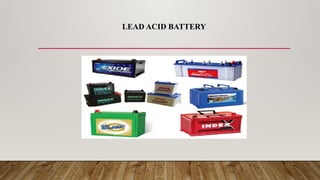
• It isa type of secondary cell which can charge again and again.
• Its anode terminal is made up of "Lead" and sulfuric acid used as electrolyte solution hence it's name is
Lead Acid Battery.
• It is also known as lead storage cell.
• Lead storage battery widely used in the automobiles and invertors.
• A 12V lead storage battery is generally used 6-cell each producing 2V.
WORKING
• Lead acid battery have two working mode namely discharging mode and charging mode.
• During discharging oxidation take place at anode and reduction take place at cathode.
• Electrons emitted from lead plat (anode) and move to the lead oxide (cathode) plate through an
external conductor wire. Hence electric current flows from cathode to anode terminal of battery.
• In this case chemical energy changes into electrical energy.
• During charging electrical supply is given by an external voltage soource. In this case reduction take
place at anode and oxidation take place at cathode. Hence electrical energy converted into chemical
energy.
7.
ADVANTAGE
• It isavailable in all shapes and size.
• It have long life.
• Large current capacity.
• Tolerant of overcharging.
• Can be made for a variety of application
DISADVANTAGE
• Large capacity of battery are larger in sue.
• It is charging slowly.
• It is not environmental friendly.
• Poor weight to energy ratio.
APPLICATION
• It is widely used in all types of vehicle such as diesel engine, petrol engine and electric vehicle.
• Used in inverter.
• Used in power bank in the many industries for back up supply.
• Used in trains.
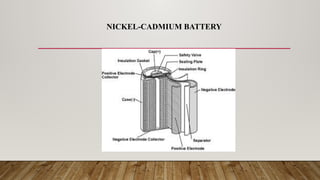
• It’s adevice that produces, DC voltage based on the chemical reaction between the substances
involved.
• In a nickel-cadmium battery, the redox material is used as a base, and around it, the layer of nickel and
a separator are used.
• The nickel-cadmium cell voltage is around 1.2 V. When connected in series generally 3 to 4 cells are
packed together to get an output of 3.6 to 4.8 V
WORKING
• Comprises a nickel oxide hydroxide positive electrode and a cadmium negative electrode, with a
potassium hydroxide (KOH) electrolyte.
• During discharge, cadmium at the negative electrode reacts with hydroxide ions to form cadmium
hydroxide, and nickel oxide at the positive electrode reacts with water to form nickel hydroxide and
hydroxide ions. Charging reverses these reactions.
10.
ADVANTAGE
• Ideal forapplications requiring high current output.
• Resilient to mechanical stress and vibrations.
• Performs well across a broad temperature range.
• Capable of enduring many charge/discharge cycles.
DISADVANTAGE
• Capacity can diminish if not fully discharged before recharging.
• Contains cadmium, which is hazardous to health and the environment.
• Provides less energy per unit weight compared to newer battery technologies.
APPLICATION
• Common in tools requiring high discharge rates.
• Reliable in critical lighting systems.
• Used in devices needing dependable performance and durability.
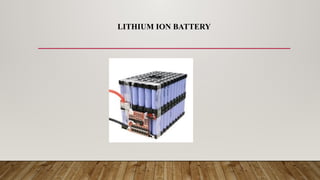
• A lithium-ionbattery or Li-ion battery is a type of rechargeable battery.
• Lithium-ion batteries are commonly used for portable electronics devices and electric vehicles. A number of
electric vehicle such as electric cars, electric bikes, electric scooters, electric cycles, etc employ lithium ion
batteries for their operation.
• This is because lithium -ion batteries have a high power-to-weight ratio, greater tolerance to temperature and
pressure variation and a higher energy density than lead acid batteries.
• Also, they are light in weight, portable, efficient and safer than traditional batteries. Lithium ions is a key
component of lithium-ion battery so its name is lithium -ion battery.
WORKING
• Charging: Lithium ions move from the cathode to the anode through the electrolyte, storing energy in the
anode.
• Discharging: Lithium ions flow back to the cathode, releasing stored energy as electric current.
13.
ADVANTAGE
• Higher specificenergy.
• Higher specific power.
• High power to weight ratio.Up to 80% weight saving.
• Fast charging.
• Low self-discharge.
• Longer life span.
• No harmful emissions.
DISADVANTAGE
• Heated highly.
• High initial cost.
APPLICATION
• Stores energy from renewable sources for homes and the grid.
• Provides reliable, long-lasting power for cordless drills and saws.
• Powers portable medical equipment like infusion pumps and hearing aids.
• Used in satellites and military equipment for reliable power.
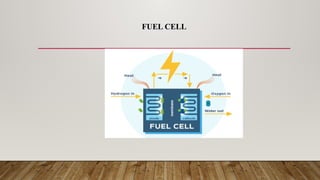
Fuel Cells areelectrochemical devices that convert chemical energy directly into electrical energy through a
chemical reaction, typically between hydrogen and oxygen. They are distinct from traditional combustion engines
and batteries, offering high efficiency and clean energy solutions.
ADVANTAGE
• Converts chemical energy directly into electricity, often achieving higher efficiency than combustion engines.
• When using hydrogen, the primary byproduct is water, making it environmentally friendly.
• Operates silently compared to combustion engines.
• Can be used for a range of applications from small portable devices to large power plants.
DISADVANTAGE
• High production costs for fuel cells and hydrogen infrastructure.
• Storing and transporting hydrogen efficiently and safely remains a challenge.
• Limited refueling infrastructure for hydrogen vehicles.
• Long-term durability and performance can be an issue, especially in harsh conditions.
APPLICATION
• Used in fuel cell vehicles (FCVs) like cars, buses, and trucks. Examples include Toyota Mirai and Hyundai
Nexo.
• Provides electricity for residential, commercial, and industrial applications.
• Used in critical backup power systems for data centers and telecommunications.
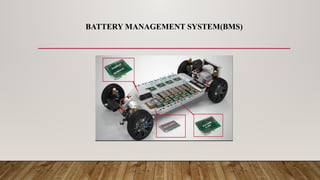
• A batterymanagement system is an electronic regulator that monitors and controls that charging and
discharging of rechargeable batteries.
• Battery management system safely and efficiently operated the batteries in electric vehicle.
• Lithium ion cells required more care during charging and discharging hence it required protection against
overcharging and discharging.
• In electric vehicles mostly lithium ion battery packs are used, hence in that electric vehicle BMS must
used.
There are following functional block of BMS:
1. Battery Pack:-Battery back consists of many number of cell those are charging and discharging together.
2. State of Charge(SOC) SOC indicates the power remaining in battery.
3. State of Health(SOH) :-The battery state of health is a measurement that indicates the level of
degradation and remaining capacity of the battery. It is essentially the difference between the health of a
new battery and the health of a used battery, and typically represented as a percentage of its initial
capacity.
4. Thermal Management:- Thermal management system is the part of BMS which is responsible for the
managing/dissipating the heat generated during the electrochemical process. It allowing the battery to
operate safely and efficiently.
5. Cell Balancing:- Cell balancing is the process of equalizing the voltages among individual cells.
18.
ADVANTAGE
• Ensure thatthe battery is in good working order.
• Battery health is continuously monitored to avoid an explosion.
• Extends the battery's life expectancy.
• Displays the battery level.
DISADVANTAGE
• Advanced BMS can be expensive to implement due to their complexity.
• Integration and software can be intricate and challenging to maintain.
• Potential for system failure, affecting battery performance and safety.
• BMS uses power, slightly reducing overall battery efficiency.
• Adds bulk and weight to the battery pack, which can be a concern in space-constrained applications.




![BATTERY CHEMISTRY [Autosaved].pptx](https://cdn.slidesharecdn.com/ss_thumbnails/batterychemistryautosaved-230306095147-71e692f9-thumbnail.jpg?width=640&height=640&fit=bounds)


