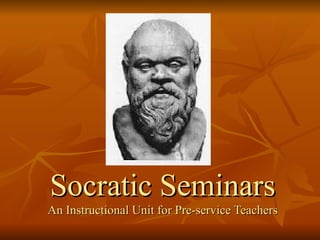
Socratic Seminars An Instructional Unit for Pre-service Teachers
What does  Socratic  mean?   Socratic comes from the name  Socrates    Classical Greek philosopher who developed a  Theory of Knowledge.  http://www.greece.k12.ny.us/instruction/ELA/SocraticSeminars/faqsaboutss.htm
What was Socrates' Theory of Knowledge?   Socrates was convinced that the surest way attain reliable knowledge was through the practice of disciplined  conversation He called this method  dialectic .  http://www.greece.k12.ny.us/instruction/ELA/SocraticSeminars/faqsaboutss.htm
What does dialectic mean?   di-a- lec -tic (noun) means the art or practice of  examining opinions or ideas logically,  often by the method of  Question  and  Answer so as to determine their validity.  http://www.greece.k12.ny.us/instruction/ELA/SocraticSeminars/faqsaboutss.htm
How did Socrates use the dialectic?   He would begin with a discussion of the obvious  aspects of any  problem   Socrates would feign ignorance about a subject  and try to draw out from the other person his fullest possible knowledge about it. 
The Vision Socrates believed that enabling students to  think for themselves  was more important than filling their heads with “right answers.”
The Vision Participants seek  deeper understanding  of complex ideas through rigorously thoughtful  dialogue , rather than by memorizing bits of information.
What is a Socratic Seminar?   A Socratic Seminar is a method used to understand information by creating dialectic in class regarding a specific text Participants seek deeper understanding of complex ideas in text through rigorous thoughtful dialogue, rather than by memorizing bits of information.  http://www.greece.k12.ny.us/instruction/ELA/SocraticSeminars/faqsaboutss.htm
What are Socratic Seminars? Highly motivating  form of intellectual and scholarly discourse.
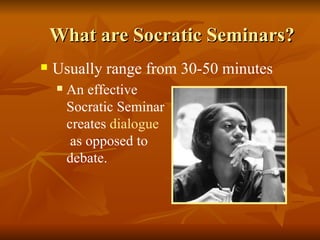
What are Socratic Seminars? Usually range from 30-50 minutes An effective  Socratic Seminar  creates  dialogue   as opposed to  debate.
Benefits include: Time to engage in in-depth discussions, problem solving, and clarification of ideas http://www.greece.k12.ny.us/instruction/ELA/SocraticSeminars/faqsaboutss.htm
Benefits include: Building a strong, collaborative work culture http://www.greece.k12.ny.us/instruction/ELA/SocraticSeminars/faqsaboutss.htm
Benefits include: Enhanced knowledge and research base http://www.greece.k12.ny.us/instruction/ELA/SocraticSeminars/faqsaboutss.htm
Benefits include: Increased success for all students http://www.greece.k12.ny.us/instruction/ELA/SocraticSeminars/faqsaboutss.htm
Benefits include: Teaching respect for diverse ideas, people, and practices http://www.greece.k12.ny.us/instruction/ELA/SocraticSeminars/faqsaboutss.htm
Benefits include: Creating a positive learning  environment for all students http://www.greece.k12.ny.us/instruction/ELA/SocraticSeminars/faqsaboutss.htm
Overview and Review http: //wblrd . sk . ca/~bestpractice/socratic/index .html
Four Elements An effective seminar consists of four interdependent elements: 1. the  text  being considered 2. the  questions  raised 3. the seminar  leader , and 4. the  participants
The Text:   Socratic Seminar texts are chosen for richness in ideas, issues, values and their ability to stimulate dialogue.  A good text raises important questions   There are no right or wrong answers.  At the end of successful Socratic Seminars, participants often leave with more questions than they brought with them. http://www.greece.k12.ny.us/instruction/ELA/SocraticSeminars/faqsaboutss.htm
The Text Socratic Seminar texts are chosen for their  richness in ideas, issues, and values , and their ability to stimulate extended, thoughtful dialogue.  http://www.greece.k12.ny.us/instruction/ELA/SocraticSeminars/faqsaboutss.htm
The Text A seminar  text  can be drawn from readings in literature, history, science, math, health, and philosophy or from works of art or music. http://www.greece.k12.ny.us/instruction/ELA/SocraticSeminars/faqsaboutss.htm
The Question:   A Socratic Seminar opens with a  Question posed by the leader or solicited from participants as they acquire more experience in seminars.  Responses to the opening question generate new questions from the leader and participants, leading to new responses.  http://www.greece.k12.ny.us/instruction/ELA/SocraticSeminars/faqsaboutss.htm
The Question An opening question  has no right answer It reflects a genuine curiosity on the part of the leader.   Does the factory model of education cause the oppression and failure of many non-mainstream cultures?
The Question An effective opening question leads participants back to the text as they speculate, evaluate, define, and clarify the issues involved. Responses to the opening question generate new questions  The line of inquiry evolves on the spot rather than being predetermined by the leader.
Starting Dialogue Asking questions  is the key!  A leader  prompts  the use of dialogue  Participants learn to be less attached to their ideas and less reliant on persuasion for influencing opinions. Dialogue is a skill of collaboration that enables groups to  create collective thinking.
Discussion & Dialogue Discussion  in the dictionary is  "a close examination of a subject with interchange of opinions, sometimes using argument, in an effort to reach an agreement.
The Leader:   In a Socratic Seminar, the leader plays a dual role as  Leader  and  Participant   Keeps the discussion focused on the text by asking follow-up questions helping clarify positions when arguments become confused involving reluctant participants http://www.greece.k12.ny.us/instruction/ELA/SocraticSeminars/faqsaboutss.htm
The Leader: As a seminar participant, the leader actively engages  in the group's exploration of the text To do this effectively, the leader must know the text  well enough to anticipate varied interpretations and  recognize important possibilities
The Participants   In a Socratic Seminar, participants carry the burden  of responsibility for the  quality  of the seminar.  There are three ways to do this: Studying  Participating   Sharing
Expectations of Participants Did I….. Speak loudly and clearly?  Cite reasons and evidence for my statements?  Use the text to find support?  Listen to others respectfully?  Stick with the subject?  Talk to others, not just to the leader?  Paraphrase accurately? Avoid inappropriate language? Ask questions  to clear up confusion?  Support others?  Avoid hostile exchanges?  Question others in a civil manner?  Seem prepared?
The Process - Pre-Seminar http: //wblrd . sk .ca/~bestpractice/socratic/process2.html
The Process - During the Seminar http: //wblrd . sk .ca/~bestpractice/socratic/process3.html
The Process - Post Seminar http: //wblrd . sk .ca/~bestpractice/socratic/process4.html
Seminar Planning Form http://www. journeytoexcellence . org/practice/instruction/theories/miscideas/socratic/form . phtml
Self Rating Form http://www. journeytoexcellence . org/practice/instruction/theories/miscideas/socratic/chart . phtml
Observation Form http://www. journeytoexcellence . org/practice/instruction/theories/miscideas/socratic/observation . phtml
Facility Evaluation Form http://www.journeytoexcellence.org/practice/instruction/theories/miscideas/socratic/facilitator.phtml
Assessment Rubric http://www. journeytoexcellence . org/practice/instruction/theories/miscideas/socratic/facilitator . phtml Other Sample Assessments http: //wblrd . sk . ca/~bestpractice/socratic/assessment .html
References   http: //cfbstaff . cfbisd . edu/juliank/AVID/Socratic %20Seminar%20Notes. htm
Socratic Seminar -  Factory Model of Education as Discussed by Pre-Service Teachers
The Text Education Schooling, Learning http://www. polyarchy .org/education.html Competing Models of Education http://www. commondreams .org/views05/0226-25. htm Remodel Schools into Knowledge Factories http://www. pbs .org/merrow/news/usa_today4.html Models of Pedagogy http://www. riccistreet .net/port80/boardwalk/highered/models. htm
The Questions Does the factory model of education provide students with the skills needed to increase their chance of survival in the United States society? Does the factory model of education cause the oppression and failure of many non-mainstream cultures?
Student Reactions Like many, this Socratic seminar was my first and I found it to be enjoyable. I feel that it is beneficial because every voice in the group is heard. I believe that teaching is a profession in which the professionals need to talk more and be more open about their careers and their practices.
Student Reactions One of only drawbacks to the seminar is a time restraint. It is hard to really delve deep into the questions when everyone needs to talk and there are only 60 minutes to talk. Much time is needed to talk about these problems but I feel it is very important for us to begin now, while in training, so that hopefully in the future we will continue the practice at our school sites.
Student Reactions Exchanging ideas in such an environment allows for both a broad, and a deep, understanding of a text, and for the ideas that the text elicits. Also, gratification from a community-based, respectfully conducted, shared experience holds benefits for all. The drawbacks enter when any of the criteria are not met. That is, when any component (leader, participant, question, text) does not meet its responsibility, the quality of the seminar "can be" sacrificed.
Student Reactions I felt really nervous going into the seminar with it being my first stab. I felt like I was prepared being that I read and re-read the literature, made notes and created questions, but then when we all sat down in a circle, my brain flew the coop. A thought would come to mind and then I'd flip through the readings trying to find the source for the thought, and then I'd feel like the conversation had moved on. But, I did like the structure and felt our group worked at being respectful and being supportive of what our fellow classmates had contributed to the conversation.
Student Reactions Well, for this being my first Socratic seminar ever, I was a bit blown away by the whole process. In general, I like to think before I speak- al least in the educational world, and I found it very hard to listen to what other's were saying while trying to find the quote or piece to back up my comment. However, I did find the conversation to move nicely and we really did come up with new questions and answers to the topics.  I was afraid this was going to turn into a messy debate over personal opinions- we stuck to the directions nicely.
Student Reactions The ability to search out relevant quotes and formulate your own thoughts while simultaneously listening deeply to others' comments is a pretty specialized skill and one that I think develops the more you use the Socratic seminar model. I think we did amazingly well for a first-try. A Socratic seminar is very much a process - it does not fit neatly into a small period of time, The great thing about learning it well, though, is that it is very empowering to know that you have just as much control over the conversation as anyone else . . .


Socratic Seminars

  • 1.
    Socratic Seminars AnInstructional Unit for Pre-service Teachers
  • 2.
    What does Socratic mean? Socratic comes from the name Socrates   Classical Greek philosopher who developed a Theory of Knowledge. http://www.greece.k12.ny.us/instruction/ELA/SocraticSeminars/faqsaboutss.htm
  • 3.
    What was Socrates'Theory of Knowledge? Socrates was convinced that the surest way attain reliable knowledge was through the practice of disciplined conversation He called this method dialectic . http://www.greece.k12.ny.us/instruction/ELA/SocraticSeminars/faqsaboutss.htm
  • 4.
    What does dialecticmean? di-a- lec -tic (noun) means the art or practice of examining opinions or ideas logically, often by the method of Question and Answer so as to determine their validity. http://www.greece.k12.ny.us/instruction/ELA/SocraticSeminars/faqsaboutss.htm
  • 5.
    How did Socratesuse the dialectic? He would begin with a discussion of the obvious aspects of any problem   Socrates would feign ignorance about a subject and try to draw out from the other person his fullest possible knowledge about it. 
  • 6.
    The Vision Socratesbelieved that enabling students to think for themselves was more important than filling their heads with “right answers.”
  • 7.
    The Vision Participantsseek deeper understanding of complex ideas through rigorously thoughtful dialogue , rather than by memorizing bits of information.
  • 8.
    What is aSocratic Seminar? A Socratic Seminar is a method used to understand information by creating dialectic in class regarding a specific text Participants seek deeper understanding of complex ideas in text through rigorous thoughtful dialogue, rather than by memorizing bits of information. http://www.greece.k12.ny.us/instruction/ELA/SocraticSeminars/faqsaboutss.htm
  • 9.
    What are SocraticSeminars? Highly motivating form of intellectual and scholarly discourse.
  • 10.
    What are SocraticSeminars? Usually range from 30-50 minutes An effective Socratic Seminar creates dialogue as opposed to debate.
  • 11.
    Benefits include: Timeto engage in in-depth discussions, problem solving, and clarification of ideas http://www.greece.k12.ny.us/instruction/ELA/SocraticSeminars/faqsaboutss.htm
  • 12.
    Benefits include: Buildinga strong, collaborative work culture http://www.greece.k12.ny.us/instruction/ELA/SocraticSeminars/faqsaboutss.htm
  • 13.
    Benefits include: Enhancedknowledge and research base http://www.greece.k12.ny.us/instruction/ELA/SocraticSeminars/faqsaboutss.htm
  • 14.
    Benefits include: Increasedsuccess for all students http://www.greece.k12.ny.us/instruction/ELA/SocraticSeminars/faqsaboutss.htm
  • 15.
    Benefits include: Teachingrespect for diverse ideas, people, and practices http://www.greece.k12.ny.us/instruction/ELA/SocraticSeminars/faqsaboutss.htm
  • 16.
    Benefits include: Creatinga positive learning environment for all students http://www.greece.k12.ny.us/instruction/ELA/SocraticSeminars/faqsaboutss.htm
  • 17.
    Overview and Reviewhttp: //wblrd . sk . ca/~bestpractice/socratic/index .html
  • 18.
    Four Elements Aneffective seminar consists of four interdependent elements: 1. the text being considered 2. the questions raised 3. the seminar leader , and 4. the participants
  • 19.
    The Text: Socratic Seminar texts are chosen for richness in ideas, issues, values and their ability to stimulate dialogue. A good text raises important questions There are no right or wrong answers. At the end of successful Socratic Seminars, participants often leave with more questions than they brought with them. http://www.greece.k12.ny.us/instruction/ELA/SocraticSeminars/faqsaboutss.htm
  • 20.
    The Text SocraticSeminar texts are chosen for their richness in ideas, issues, and values , and their ability to stimulate extended, thoughtful dialogue. http://www.greece.k12.ny.us/instruction/ELA/SocraticSeminars/faqsaboutss.htm
  • 21.
    The Text Aseminar text can be drawn from readings in literature, history, science, math, health, and philosophy or from works of art or music. http://www.greece.k12.ny.us/instruction/ELA/SocraticSeminars/faqsaboutss.htm
  • 22.
    The Question: A Socratic Seminar opens with a Question posed by the leader or solicited from participants as they acquire more experience in seminars. Responses to the opening question generate new questions from the leader and participants, leading to new responses. http://www.greece.k12.ny.us/instruction/ELA/SocraticSeminars/faqsaboutss.htm
  • 23.
    The Question Anopening question has no right answer It reflects a genuine curiosity on the part of the leader. Does the factory model of education cause the oppression and failure of many non-mainstream cultures?
  • 24.
    The Question Aneffective opening question leads participants back to the text as they speculate, evaluate, define, and clarify the issues involved. Responses to the opening question generate new questions The line of inquiry evolves on the spot rather than being predetermined by the leader.
  • 25.
    Starting Dialogue Askingquestions is the key! A leader prompts the use of dialogue Participants learn to be less attached to their ideas and less reliant on persuasion for influencing opinions. Dialogue is a skill of collaboration that enables groups to create collective thinking.
  • 26.
    Discussion & DialogueDiscussion in the dictionary is "a close examination of a subject with interchange of opinions, sometimes using argument, in an effort to reach an agreement.
  • 27.
    The Leader: In a Socratic Seminar, the leader plays a dual role as Leader and Participant Keeps the discussion focused on the text by asking follow-up questions helping clarify positions when arguments become confused involving reluctant participants http://www.greece.k12.ny.us/instruction/ELA/SocraticSeminars/faqsaboutss.htm
  • 28.
    The Leader: Asa seminar participant, the leader actively engages in the group's exploration of the text To do this effectively, the leader must know the text well enough to anticipate varied interpretations and recognize important possibilities
  • 29.
    The Participants In a Socratic Seminar, participants carry the burden of responsibility for the quality of the seminar. There are three ways to do this: Studying Participating Sharing
  • 30.
    Expectations of ParticipantsDid I….. Speak loudly and clearly? Cite reasons and evidence for my statements? Use the text to find support? Listen to others respectfully? Stick with the subject? Talk to others, not just to the leader? Paraphrase accurately? Avoid inappropriate language? Ask questions to clear up confusion? Support others? Avoid hostile exchanges? Question others in a civil manner? Seem prepared?
  • 31.
    The Process -Pre-Seminar http: //wblrd . sk .ca/~bestpractice/socratic/process2.html
  • 32.
    The Process -During the Seminar http: //wblrd . sk .ca/~bestpractice/socratic/process3.html
  • 33.
    The Process -Post Seminar http: //wblrd . sk .ca/~bestpractice/socratic/process4.html
  • 34.
    Seminar Planning Formhttp://www. journeytoexcellence . org/practice/instruction/theories/miscideas/socratic/form . phtml
  • 35.
    Self Rating Formhttp://www. journeytoexcellence . org/practice/instruction/theories/miscideas/socratic/chart . phtml
  • 36.
    Observation Form http://www.journeytoexcellence . org/practice/instruction/theories/miscideas/socratic/observation . phtml
  • 37.
    Facility Evaluation Formhttp://www.journeytoexcellence.org/practice/instruction/theories/miscideas/socratic/facilitator.phtml
  • 38.
    Assessment Rubric http://www.journeytoexcellence . org/practice/instruction/theories/miscideas/socratic/facilitator . phtml Other Sample Assessments http: //wblrd . sk . ca/~bestpractice/socratic/assessment .html
  • 39.
    References http: //cfbstaff . cfbisd . edu/juliank/AVID/Socratic %20Seminar%20Notes. htm
  • 40.
    Socratic Seminar - Factory Model of Education as Discussed by Pre-Service Teachers
  • 41.
    The Text EducationSchooling, Learning http://www. polyarchy .org/education.html Competing Models of Education http://www. commondreams .org/views05/0226-25. htm Remodel Schools into Knowledge Factories http://www. pbs .org/merrow/news/usa_today4.html Models of Pedagogy http://www. riccistreet .net/port80/boardwalk/highered/models. htm
  • 42.
    The Questions Doesthe factory model of education provide students with the skills needed to increase their chance of survival in the United States society? Does the factory model of education cause the oppression and failure of many non-mainstream cultures?
  • 43.
    Student Reactions Likemany, this Socratic seminar was my first and I found it to be enjoyable. I feel that it is beneficial because every voice in the group is heard. I believe that teaching is a profession in which the professionals need to talk more and be more open about their careers and their practices.
  • 44.
    Student Reactions Oneof only drawbacks to the seminar is a time restraint. It is hard to really delve deep into the questions when everyone needs to talk and there are only 60 minutes to talk. Much time is needed to talk about these problems but I feel it is very important for us to begin now, while in training, so that hopefully in the future we will continue the practice at our school sites.
  • 45.
    Student Reactions Exchangingideas in such an environment allows for both a broad, and a deep, understanding of a text, and for the ideas that the text elicits. Also, gratification from a community-based, respectfully conducted, shared experience holds benefits for all. The drawbacks enter when any of the criteria are not met. That is, when any component (leader, participant, question, text) does not meet its responsibility, the quality of the seminar "can be" sacrificed.
  • 46.
    Student Reactions Ifelt really nervous going into the seminar with it being my first stab. I felt like I was prepared being that I read and re-read the literature, made notes and created questions, but then when we all sat down in a circle, my brain flew the coop. A thought would come to mind and then I'd flip through the readings trying to find the source for the thought, and then I'd feel like the conversation had moved on. But, I did like the structure and felt our group worked at being respectful and being supportive of what our fellow classmates had contributed to the conversation.
  • 47.
    Student Reactions Well,for this being my first Socratic seminar ever, I was a bit blown away by the whole process. In general, I like to think before I speak- al least in the educational world, and I found it very hard to listen to what other's were saying while trying to find the quote or piece to back up my comment. However, I did find the conversation to move nicely and we really did come up with new questions and answers to the topics. I was afraid this was going to turn into a messy debate over personal opinions- we stuck to the directions nicely.
  • 48.
    Student Reactions Theability to search out relevant quotes and formulate your own thoughts while simultaneously listening deeply to others' comments is a pretty specialized skill and one that I think develops the more you use the Socratic seminar model. I think we did amazingly well for a first-try. A Socratic seminar is very much a process - it does not fit neatly into a small period of time, The great thing about learning it well, though, is that it is very empowering to know that you have just as much control over the conversation as anyone else . . .
  • 49.
  • 50.
  • 51.
  • 52.