The Socratic Seminar
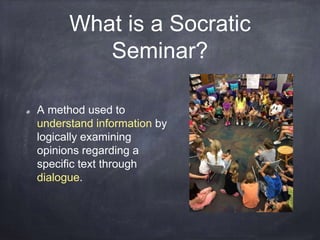
What is a Socratic
Seminar?
A method used to
understand information by
logically examining
opinions regarding a
specific text through
dialogue.
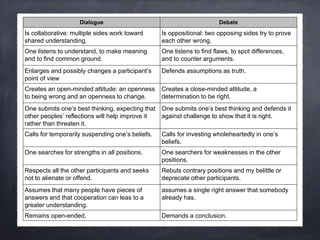
Dialogue Debate
Is collaborative: multiple sides work toward
shared understanding.
Is oppositional: two opposing sides try to prove
each other wrong.
One listens to understand, to make meaning
and to find common ground.
One listens to find flaws, to spot differences,
and to counter arguments.
Enlarges and possibly changes a participant’s
point of view
Defends assumptions as truth.
Creates an open-minded attitude: an openness
to being wrong and an openness to change.
Creates a close-minded attitude, a
determination to be right.
One submits one’s best thinking, expecting that
other peoples’ reflections will help improve it
rather than threaten it.
One submits one’s best thinking and defends it
against challenge to show that it is right.
Calls for temporarily suspending one’s beliefs. Calls for investing wholeheartedly in one’s
beliefs.
One searches for strengths in all positions. One searchers for weaknesses in the other
positions.
Respects all the other participants and seeks
not to alienate or offend.
Rebuts contrary positions and my belittle or
deprecate other participants.
Assumes that many people have pieces of
answers and that cooperation can leas to a
greater understanding.
assumes a single right answer that somebody
already has.
Remains open-ended. Demands a conclusion.
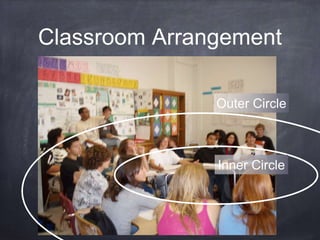
Classroom Arrangement
Inner Circle
Outer Circle
Participant Roles
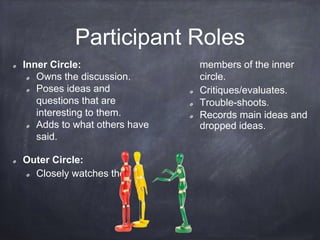
Inner Circle:
Owns the discussion.
Poses ideas and
questions that are
interesting to them.
Adds to what others have
said.
Outer Circle:
Closely watches the
members of the inner
circle.
Critiques/evaluates.
Trouble-shoots.
Records main ideas and
dropped ideas.
Guidelines For Seminar
Come prepared.
Refer to the text.
Stick to the point currently under
discussion.
Don’t raise hands; take turns
speaking.
Talk to each other not to the teacher.
Facilitator’s Role
Ask students to cite support from the text if the
conversation begins to wander.
Keep conversations from becoming a debate.
Ask students questions to challenge their
assumptions.
Ask the outer circle to re-introduce the points
they thought were especially good or prematurely
dropped.

Socratic Seminar

  • 1.
  • 2.
    What is aSocratic Seminar? A method used to understand information by logically examining opinions regarding a specific text through dialogue.
  • 3.
    Dialogue Debate Is collaborative:multiple sides work toward shared understanding. Is oppositional: two opposing sides try to prove each other wrong. One listens to understand, to make meaning and to find common ground. One listens to find flaws, to spot differences, and to counter arguments. Enlarges and possibly changes a participant’s point of view Defends assumptions as truth. Creates an open-minded attitude: an openness to being wrong and an openness to change. Creates a close-minded attitude, a determination to be right. One submits one’s best thinking, expecting that other peoples’ reflections will help improve it rather than threaten it. One submits one’s best thinking and defends it against challenge to show that it is right. Calls for temporarily suspending one’s beliefs. Calls for investing wholeheartedly in one’s beliefs. One searches for strengths in all positions. One searchers for weaknesses in the other positions. Respects all the other participants and seeks not to alienate or offend. Rebuts contrary positions and my belittle or deprecate other participants. Assumes that many people have pieces of answers and that cooperation can leas to a greater understanding. assumes a single right answer that somebody already has. Remains open-ended. Demands a conclusion.
  • 4.
  • 5.
    Participant Roles Inner Circle: Ownsthe discussion. Poses ideas and questions that are interesting to them. Adds to what others have said. Outer Circle: Closely watches the members of the inner circle. Critiques/evaluates. Trouble-shoots. Records main ideas and dropped ideas.
  • 6.
    Guidelines For Seminar Comeprepared. Refer to the text. Stick to the point currently under discussion. Don’t raise hands; take turns speaking. Talk to each other not to the teacher.
  • 7.
    Facilitator’s Role Ask studentsto cite support from the text if the conversation begins to wander. Keep conversations from becoming a debate. Ask students questions to challenge their assumptions. Ask the outer circle to re-introduce the points they thought were especially good or prematurely dropped.