


SocraticSeminars
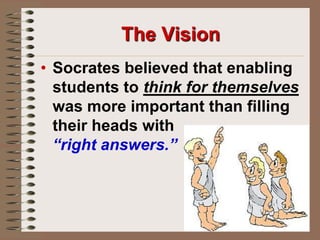
The VisionSocrates believed that enabling students to think for themselves was more important than filling their heads with                                  “right answers.”
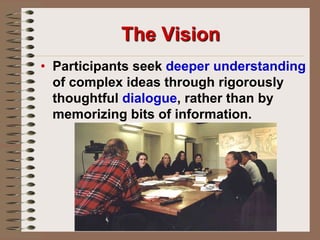
The VisionParticipants seek deeper understanding of complex ideas through rigorously thoughtful dialogue, rather than by memorizing bits of information.
What are Socratic Seminars?Highly motivating form of intellectual and scholarly discourse.
What are Socratic Seminars?Usually range from 30-50 minutesAn effective                                          Socratic Seminar                             creates dialogue                                           as opposed to                                     debate.
Starting DialogueAsking questions is the key! A leader prompts the use of dialogue Participants learn to be less attached to their ideas and less reliant on persuasion for influencing opinions.Dialogue is a skill of collaboration that enables groups to                          createcollective thinking.
Starting DialogueWhen groups begin to use dialogue with discussion, the two practices need to be defined and differentiated.The most productive discourse will flow back and forth from one to the other, from inquiry to advocacy.Starting DialogueStudentsmust risk making mistakes in order to learn how to learn to think critically, and work collaboratively. Teacherssupport this risk-taking when they take their own risks in                             learning how to improve                       themselves as teachers.Discussion & DialogueDiscussion in the dictionary is "a close examination of a subject with interchange of opinions, sometimes using argument, in an effort to reach an agreement.
Discussion & DialogueDialogue is "an interchange of ideas especially when open and frank and seeking mutual understanding."  It is a collective inquiry in which we suspend opinions, share openly, and think creatively about difficult issues.Effective groups need to use both dialogue and discussion
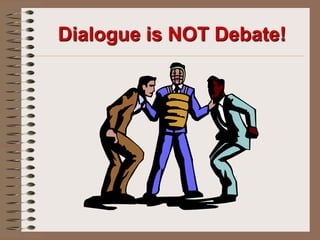
Dialogue is NOT Debate!
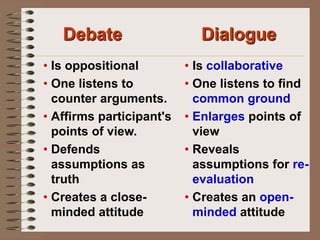
Debate                DialogueIs collaborativeOne listens to find common groundEnlarges points of viewReveals assumptions for re-evaluationCreates an open-minded attitudeIs oppositional
One listens to counter arguments.
Affirms participant's points of view.
Defends assumptions as truth
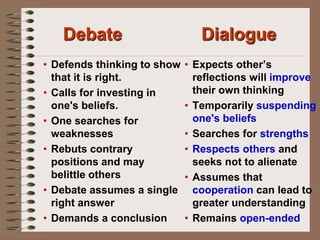
Creates a close-minded attitudeDebate                DialogueExpects other’s reflections will improve their own thinkingTemporarily suspending one's beliefsSearches for strengthsRespects others and seeks not to alienateAssumes that cooperation can lead to greater understandingRemains open-endedDefends thinking to show that it is right.
Calls for investing in one's beliefs.
One searches for weaknesses
Rebuts contrary positions and may belittle others
Debate assumes a single right answer
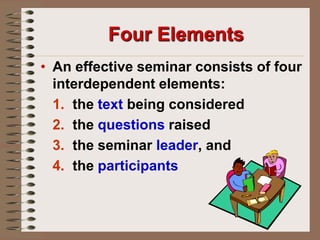
Demands a conclusionFour ElementsAn effective seminar consists of four interdependent elements:1.	the text being considered2.	the questions raised3.	the seminar leader, and4.	the participants
The TextA seminar text can be drawn from readings in literature, history, science, math, health, and philosophy or from works of art or music.
The TextSocratic Seminar texts are chosen for their richness in ideas, issues, and values, and their ability to stimulate extended, thoughtful dialogue.
The QuestionAn opening question has no right answerIt reflects a genuine curiosity on the part of the leader.Should human embryos be cloned in order to save lives?
The QuestionAn effective opening question leads participants back to the text as they speculate, evaluate, define, and clarify the issues involved.Responses to the opening question generate new questionsThe line of inquiry evolves on                       the spot rather than being predetermined by the leader.
The LeaderPlays a dual role as leader and participantConsciously leads a thoughtful exploration of the ideas in the                      text.As a seminar participant,                 actively engages in the                      group's exploration of                               the text.
The LeaderHelps participants clarify theirpositions when arguments become confusedInvolves reluctant                    participants while                    restraining their more                   vocal peers
The LeaderMust be patient enough to allow participants’ understandings to evolveBe willing to help                     participants explore non-traditional insights and unexpected                          interpretations
The ParticipantsShare responsibility for the quality of the seminar.Most effective when                     participants:
study the text closely                               in advance
listen activelyThe ParticipantsMost effective when participants:sharetheir ideas and                                       questions in response                                    to others
search for evidence                                    in the text to support                                            their ideasDesigning the BestSeminars in which something new and unexpected is discovered.Seminar is approached as a joint search.
Designing the BestAt the end of a successful Socratic Seminar, participants often leave with more questions than they brought with them.
Benefits include:Time to engage in in-depth discussions, problem solving, and clarification of ideasBuilding a strong, collaborative work cultureEnhanced knowledge and research baseIncreased success for all studentsTeaching respect for diverse ideas,         people, and practicesCreating a positive learning                 environment for all students
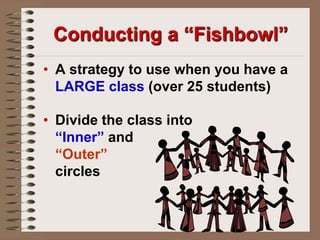
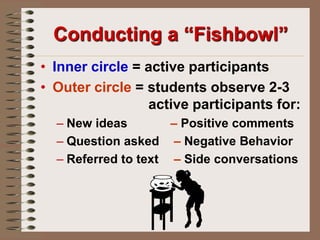
Conducting a “Fishbowl”A strategy to use when you have a LARGE class (over 25 students)Divide the class into                              “Inner” and                                           “Outer”                                                  circlesConducting a “Fishbowl”Inner circle = active participantsOuter circle = students observe 2-3 		active participants for:New ideas		– Positive commentsQuestion asked	 – Negative BehaviorReferred to text	 – Side conversations
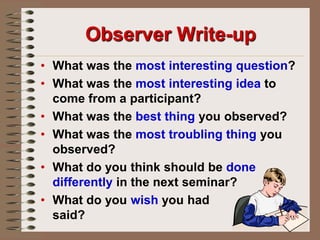
Observer Write-upWhat was the most interestingquestion?What was the most interesting idea to come from a participant?What was the best thing you observed?What was the most troubling thing you observed?What do you think should be done differently in the next seminar?What do you wish you had                               said?
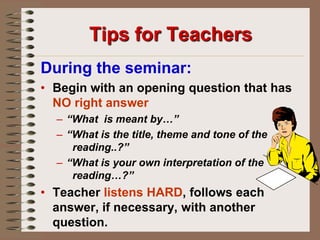
Tips for TeachersBefore the seminar:Read the text CAREFULLYFocus on possible provocative questionsSelect short passages for special          attentionIdentify tough vocabulary wordsChoose an introductory questionin advanceBroad, open-ended,                          provocative
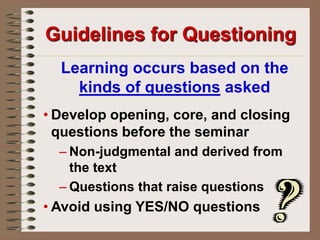
Guidelines for QuestioningLearning occurs based on thekinds of questions askedDevelop opening, core, and closing questions before the seminar
Non-judgmental and derived from the text
Questions that raise questions
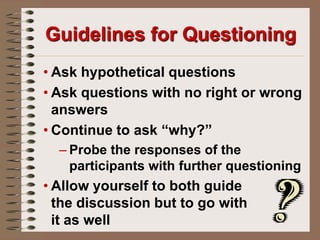
Avoid using YES/NO questionsGuidelines for QuestioningAsk hypothetical questions
Ask questions with no right or wrong answers
Continue to ask “why?”
Probe the responses of the participants with further questioning
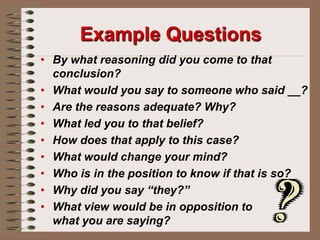
Allow yourself to both guide                  the discussion but to go with                        it as wellExample QuestionsBy what reasoning did you come to that conclusion?What would you say to someone who said __?Are the reasons adequate? Why?What led you to that belief?How does that apply to this case?What would change your mind?Who is in the position to know if that is so?Why did you say “they?”What view would be in opposition to                       what you are saying?

Soc sem

  • 1.
  • 2.
    The VisionSocrates believedthat enabling students to think for themselves was more important than filling their heads with “right answers.”
  • 3.
    The VisionParticipants seekdeeper understanding of complex ideas through rigorously thoughtful dialogue, rather than by memorizing bits of information.
  • 4.
    What are SocraticSeminars?Highly motivating form of intellectual and scholarly discourse.
  • 5.
    What are SocraticSeminars?Usually range from 30-50 minutesAn effective Socratic Seminar creates dialogue as opposed to debate.
  • 6.
    Starting DialogueAsking questionsis the key! A leader prompts the use of dialogue Participants learn to be less attached to their ideas and less reliant on persuasion for influencing opinions.Dialogue is a skill of collaboration that enables groups to createcollective thinking.
  • 7.
    Starting DialogueWhen groupsbegin to use dialogue with discussion, the two practices need to be defined and differentiated.The most productive discourse will flow back and forth from one to the other, from inquiry to advocacy.Starting DialogueStudentsmust risk making mistakes in order to learn how to learn to think critically, and work collaboratively. Teacherssupport this risk-taking when they take their own risks in learning how to improve themselves as teachers.Discussion & DialogueDiscussion in the dictionary is "a close examination of a subject with interchange of opinions, sometimes using argument, in an effort to reach an agreement.
  • 8.
    Discussion & DialogueDialogueis "an interchange of ideas especially when open and frank and seeking mutual understanding." It is a collective inquiry in which we suspend opinions, share openly, and think creatively about difficult issues.Effective groups need to use both dialogue and discussion
  • 9.
  • 10.
    Debate DialogueIs collaborativeOne listens to find common groundEnlarges points of viewReveals assumptions for re-evaluationCreates an open-minded attitudeIs oppositional
  • 11.
    One listens tocounter arguments.
  • 12.
  • 13.
  • 14.
    Creates a close-mindedattitudeDebate DialogueExpects other’s reflections will improve their own thinkingTemporarily suspending one's beliefsSearches for strengthsRespects others and seeks not to alienateAssumes that cooperation can lead to greater understandingRemains open-endedDefends thinking to show that it is right.
  • 15.
    Calls for investingin one's beliefs.
  • 16.
    One searches forweaknesses
  • 17.
    Rebuts contrary positionsand may belittle others
  • 18.
    Debate assumes asingle right answer
  • 19.
    Demands a conclusionFourElementsAn effective seminar consists of four interdependent elements:1. the text being considered2. the questions raised3. the seminar leader, and4. the participants
  • 20.
    The TextA seminartext can be drawn from readings in literature, history, science, math, health, and philosophy or from works of art or music.
  • 21.
    The TextSocratic Seminartexts are chosen for their richness in ideas, issues, and values, and their ability to stimulate extended, thoughtful dialogue.
  • 22.
    The QuestionAn openingquestion has no right answerIt reflects a genuine curiosity on the part of the leader.Should human embryos be cloned in order to save lives?
  • 23.
    The QuestionAn effectiveopening question leads participants back to the text as they speculate, evaluate, define, and clarify the issues involved.Responses to the opening question generate new questionsThe line of inquiry evolves on the spot rather than being predetermined by the leader.
  • 24.
    The LeaderPlays adual role as leader and participantConsciously leads a thoughtful exploration of the ideas in the text.As a seminar participant, actively engages in the group's exploration of the text.
  • 25.
    The LeaderHelps participantsclarify theirpositions when arguments become confusedInvolves reluctant participants while restraining their more vocal peers
  • 26.
    The LeaderMust bepatient enough to allow participants’ understandings to evolveBe willing to help participants explore non-traditional insights and unexpected interpretations
  • 27.
    The ParticipantsShare responsibilityfor the quality of the seminar.Most effective when participants:
  • 28.
    study the textclosely in advance
  • 29.
    listen activelyThe ParticipantsMosteffective when participants:sharetheir ideas and questions in response to others
  • 30.
    search for evidence in the text to support their ideasDesigning the BestSeminars in which something new and unexpected is discovered.Seminar is approached as a joint search.
  • 31.
    Designing the BestAtthe end of a successful Socratic Seminar, participants often leave with more questions than they brought with them.
  • 32.
    Benefits include:Time toengage in in-depth discussions, problem solving, and clarification of ideasBuilding a strong, collaborative work cultureEnhanced knowledge and research baseIncreased success for all studentsTeaching respect for diverse ideas, people, and practicesCreating a positive learning environment for all students
  • 33.
    Conducting a “Fishbowl”Astrategy to use when you have a LARGE class (over 25 students)Divide the class into “Inner” and “Outer” circlesConducting a “Fishbowl”Inner circle = active participantsOuter circle = students observe 2-3 active participants for:New ideas – Positive commentsQuestion asked – Negative BehaviorReferred to text – Side conversations
  • 34.
    Observer Write-upWhat wasthe most interestingquestion?What was the most interesting idea to come from a participant?What was the best thing you observed?What was the most troubling thing you observed?What do you think should be done differently in the next seminar?What do you wish you had said?
  • 35.
    Tips for TeachersBeforethe seminar:Read the text CAREFULLYFocus on possible provocative questionsSelect short passages for special attentionIdentify tough vocabulary wordsChoose an introductory questionin advanceBroad, open-ended, provocative
  • 36.
    Guidelines for QuestioningLearningoccurs based on thekinds of questions askedDevelop opening, core, and closing questions before the seminar
  • 37.
  • 38.
  • 39.
    Avoid using YES/NOquestionsGuidelines for QuestioningAsk hypothetical questions
  • 40.
    Ask questions withno right or wrong answers
  • 41.
    Continue to ask“why?”
  • 42.
    Probe the responsesof the participants with further questioning
  • 43.
    Allow yourself toboth guide the discussion but to go with it as wellExample QuestionsBy what reasoning did you come to that conclusion?What would you say to someone who said __?Are the reasons adequate? Why?What led you to that belief?How does that apply to this case?What would change your mind?Who is in the position to know if that is so?Why did you say “they?”What view would be in opposition to what you are saying?