INTRODUCTION TO SOCIOLOGY
Chapter 1, Section 1
WHAT IS IT?
 Sociology= studies human society and social
behavior in a scientific manner.
 Look at two main aspects of society:
 Social interaction= how people relate to one
another and influence one another’s behavior.
 Social phenomena= observable facts or events
in human society.
WHY DO PEOPLE STUDY SOCIOLOGY?
1) Understand how behavior is influenced by social
factors.
2) Learn how to view the world through others’
eyes
• Look beyond common beliefs and find hidden
meanings= sociological perspective.
3) Attempt to balance one’s personal desires with
their social environment.
• Connect the larger world with personal life=
sociological imagination.
4) Find your ‘place’ both within society and
history.
SOCIOLOGY AS A SOCIAL SCIENCE
 Sociology is one of 6 social sciences. A social
science studies human behavior,
institutions or functions of human society
in a scientific manner.
 Other social sciences:
 Anthropology
 Psychology
 Economics
 Political science
 History
SOCIAL SCIENCES
 What do each of the other social sciences look at?
(Be able to explain each in your own words)
 Anthropology– cultures of past, less-advanced
societies.
 Psychology– focuses on individual behavior.
 Economics– study of choices people make; how people
are affected by economic factors.
 Political science– organization and operation of
government.
 History– study of past events; how past events affect
current behaviors and attitudes.
SOCIOLOGICAL PERSPECTIVES
Chapter 1, Section 2
HOW SOCIOLOGY STARTED
 Sociology did not develop until the 1800s.
 Sociology developed in Europe, because of
changes as a result of the Industrial
Revolution.
 People left their homes in the countryside and came
to cities. As cities became crowded, people began
to interact on a closer scale than ever before.
 Social problems such as housing shortages, crime,
and lack of jobs arose.
 The desire for individual rights amongst
society led to the American and French
Revolutions.
THE EARLIEST SOCIOLOGISTS
 Auguste Comte
 French (1798-1857)
 “father” or “founder” of sociology-- coined the
term
 believed that sociologists should worry about two
problems: order and change
 social statics = overall structure of a society
remains unchanged
 social dynamics = elements within the society
change to allow for social development
 “cerebral hygiene” - attempt to keep his mind pure.
THE EARLY SOCIOLOGISTS (CONT’D)
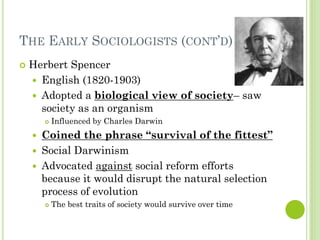
 Herbert Spencer
 English (1820-1903)
 Adopted a biological view of society– saw
society as an organism
 Influenced by Charles Darwin
 Coined the phrase “survival of the fittest”
 Social Darwinism
 Advocated against social reform efforts
because it would disrupt the natural selection
process of evolution
 The best traits of society would survive over time
THE EARLY SOCIOLOGISTS (CONT’D)
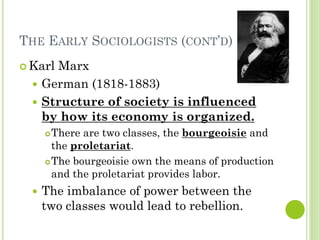
 Karl Marx
 German (1818-1883)
 Structure of society is influenced
by how its economy is organized.
There are two classes, the bourgeoisie and
the proletariat.
The bourgeoisie own the means of production
and the proletariat provides labor.
 The imbalance of power between the
two classes would lead to rebellion.
THE EARLY SOCIOLOGISTS (CONT’D)
 Emile Durkheim
 French (1858-1917)
 First to apply scientific principles to
study of society.
 Study directly observable features.
 Saw society as a series of interrelated parts,
but the function(s) of these parts was his focus.
 Function= a consequence that an element of
society produces in order to maintain the social
system.
 Specifically looked at religion.
 1897 study Suicide was the first of its kind
THE EARLY SOCIOLOGISTS (CONT’D)
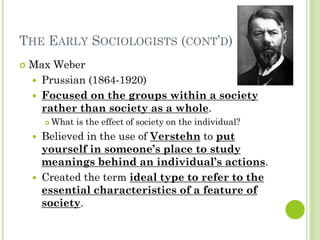
 Max Weber
 Prussian (1864-1920)
 Focused on the groups within a society
rather than society as a whole.
 What is the effect of society on the individual?
 Believed in the use of Verstehn to put
yourself in someone’s place to study
meanings behind an individual’s actions.
 Created the term ideal type to refer to the
essential characteristics of a feature of
society.
THE THREE PERSPECTIVES
 Theory= explanation of relationships
among phenomena.
 Theoretical perspective= a ‘school of
thought’, outlining specific ideas about the
nature of social life.
 Three perspectives:
 Functionalist
 Conflict
 Interactionist
THE THREE PERSPECTIVES
Chapter 1, Section 2 (cont’d)
FUNCTIONALISM
 Emphasizes function
of social parts
 Family, religion etc.
 See social parts as
in integrated
whole society
 Patterns of unrest,
change, integration
and stability
 Consensus on social
values
Social
Change
Social
Integration
Stability
Social
Unrest
Functionalist
Perspective
FUNCTIONALISM TERMS
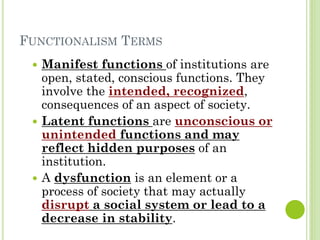
 Manifest functions of institutions are
open, stated, conscious functions. They
involve the intended, recognized,
consequences of an aspect of society.
 Latent functions are unconscious or
unintended functions and may
reflect hidden purposes of an
institution.
 A dysfunction is an element or a
process of society that may actually
disrupt a social system or lead to a
decrease in stability.
CONFLICT PERSPECTIVE
 Permanent social
conflict
 Competition for
interests and value
 Power and who
gets what
 Change occurs
when power shifts
powershift
conflict
Power
shift
conflict
Conflict Perspective
CONFLICT- EXPLAINED
WHAT DOES THE TITANIC HAVE TO DO
WITH IT?
Not exactly ‘fair’, is it?
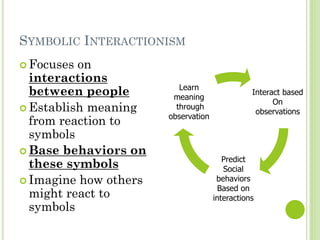
SYMBOLIC INTERACTIONISM
 Focuses on
interactions
between people
 Establish meaning
from reaction to
symbols
 Base behaviors on
these symbols
 Imagine how others
might react to
symbols
Interact based
On
observations
Predict
Social
behaviors
Based on
interactions
Learn
meaning
through
observation
INTERACTIONS MEAN DIFFERENT THINGS
TO DIFFERENT INDIVIDUALS
REVIEW: WHICH IS FUNCTIONALISM,
CONFLICT PERSPECTIVE, OR SYMBOLIC
INTERACTIONISM
 Societies are in relative balance
 F
 Power is the most important element in life
 C
 Religion helps hold together a society morally
 F
 Symbols are crucial to social life
 S/I
 Many element exist in society to benefit the powerful
 C
 Social change is constantly occurring
 C
 Conflict is harmful and disruptive to society
 F

009809103.pdf

  • 1.
  • 2.
    WHAT IS IT? Sociology= studies human society and social behavior in a scientific manner.  Look at two main aspects of society:  Social interaction= how people relate to one another and influence one another’s behavior.  Social phenomena= observable facts or events in human society.
  • 3.
    WHY DO PEOPLESTUDY SOCIOLOGY? 1) Understand how behavior is influenced by social factors. 2) Learn how to view the world through others’ eyes • Look beyond common beliefs and find hidden meanings= sociological perspective. 3) Attempt to balance one’s personal desires with their social environment. • Connect the larger world with personal life= sociological imagination. 4) Find your ‘place’ both within society and history.
  • 4.
    SOCIOLOGY AS ASOCIAL SCIENCE  Sociology is one of 6 social sciences. A social science studies human behavior, institutions or functions of human society in a scientific manner.  Other social sciences:  Anthropology  Psychology  Economics  Political science  History
  • 5.
    SOCIAL SCIENCES  Whatdo each of the other social sciences look at? (Be able to explain each in your own words)  Anthropology– cultures of past, less-advanced societies.  Psychology– focuses on individual behavior.  Economics– study of choices people make; how people are affected by economic factors.  Political science– organization and operation of government.  History– study of past events; how past events affect current behaviors and attitudes.
  • 6.
  • 7.
    HOW SOCIOLOGY STARTED Sociology did not develop until the 1800s.  Sociology developed in Europe, because of changes as a result of the Industrial Revolution.  People left their homes in the countryside and came to cities. As cities became crowded, people began to interact on a closer scale than ever before.  Social problems such as housing shortages, crime, and lack of jobs arose.  The desire for individual rights amongst society led to the American and French Revolutions.
  • 8.
    THE EARLIEST SOCIOLOGISTS Auguste Comte  French (1798-1857)  “father” or “founder” of sociology-- coined the term  believed that sociologists should worry about two problems: order and change  social statics = overall structure of a society remains unchanged  social dynamics = elements within the society change to allow for social development  “cerebral hygiene” - attempt to keep his mind pure.
  • 9.
    THE EARLY SOCIOLOGISTS(CONT’D)  Herbert Spencer  English (1820-1903)  Adopted a biological view of society– saw society as an organism  Influenced by Charles Darwin  Coined the phrase “survival of the fittest”  Social Darwinism  Advocated against social reform efforts because it would disrupt the natural selection process of evolution  The best traits of society would survive over time
  • 10.
    THE EARLY SOCIOLOGISTS(CONT’D)  Karl Marx  German (1818-1883)  Structure of society is influenced by how its economy is organized. There are two classes, the bourgeoisie and the proletariat. The bourgeoisie own the means of production and the proletariat provides labor.  The imbalance of power between the two classes would lead to rebellion.
  • 11.
    THE EARLY SOCIOLOGISTS(CONT’D)  Emile Durkheim  French (1858-1917)  First to apply scientific principles to study of society.  Study directly observable features.  Saw society as a series of interrelated parts, but the function(s) of these parts was his focus.  Function= a consequence that an element of society produces in order to maintain the social system.  Specifically looked at religion.  1897 study Suicide was the first of its kind
  • 12.
    THE EARLY SOCIOLOGISTS(CONT’D)  Max Weber  Prussian (1864-1920)  Focused on the groups within a society rather than society as a whole.  What is the effect of society on the individual?  Believed in the use of Verstehn to put yourself in someone’s place to study meanings behind an individual’s actions.  Created the term ideal type to refer to the essential characteristics of a feature of society.
  • 13.
    THE THREE PERSPECTIVES Theory= explanation of relationships among phenomena.  Theoretical perspective= a ‘school of thought’, outlining specific ideas about the nature of social life.  Three perspectives:  Functionalist  Conflict  Interactionist
  • 14.
    THE THREE PERSPECTIVES Chapter1, Section 2 (cont’d)
  • 15.
    FUNCTIONALISM  Emphasizes function ofsocial parts  Family, religion etc.  See social parts as in integrated whole society  Patterns of unrest, change, integration and stability  Consensus on social values Social Change Social Integration Stability Social Unrest Functionalist Perspective
  • 16.
    FUNCTIONALISM TERMS  Manifestfunctions of institutions are open, stated, conscious functions. They involve the intended, recognized, consequences of an aspect of society.  Latent functions are unconscious or unintended functions and may reflect hidden purposes of an institution.  A dysfunction is an element or a process of society that may actually disrupt a social system or lead to a decrease in stability.
  • 17.
    CONFLICT PERSPECTIVE  Permanentsocial conflict  Competition for interests and value  Power and who gets what  Change occurs when power shifts powershift conflict Power shift conflict Conflict Perspective
  • 18.
  • 19.
    WHAT DOES THETITANIC HAVE TO DO WITH IT? Not exactly ‘fair’, is it?
  • 20.
    SYMBOLIC INTERACTIONISM  Focuseson interactions between people  Establish meaning from reaction to symbols  Base behaviors on these symbols  Imagine how others might react to symbols Interact based On observations Predict Social behaviors Based on interactions Learn meaning through observation
  • 21.
    INTERACTIONS MEAN DIFFERENTTHINGS TO DIFFERENT INDIVIDUALS
  • 22.
    REVIEW: WHICH ISFUNCTIONALISM, CONFLICT PERSPECTIVE, OR SYMBOLIC INTERACTIONISM  Societies are in relative balance  F  Power is the most important element in life  C  Religion helps hold together a society morally  F  Symbols are crucial to social life  S/I  Many element exist in society to benefit the powerful  C  Social change is constantly occurring  C  Conflict is harmful and disruptive to society  F