IntroductionIntroduction toto
SociologySociology
Henry L. TischlerHenry L. Tischler
Prepared by Charles E. Faupel
Chapter 1:Chapter 1:
The Sociological PerspectiveThe Sociological Perspective
What to Expect in This Chapter...What to Expect in This Chapter...
 Defining the Sociological PerspectiveDefining the Sociological Perspective
• The Sociological ImaginationThe Sociological Imagination
• Sociology and Common SenseSociology and Common Sense
• Sociology and ScienceSociology and Science
 Sociology and the Social SciencesSociology and the Social Sciences
 The Development of SociologyThe Development of Sociology
 Theoretical Perspectives in SociologyTheoretical Perspectives in Sociology
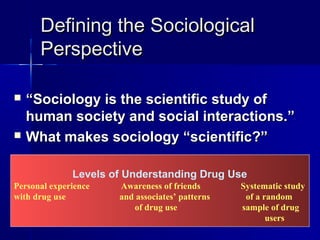
Personal experience Awareness of friends Systematic study
with drug use and associates’ patterns of a random
of drug use sample of drug
users
Defining the SociologicalDefining the Sociological
PerspectivePerspective
 ““Sociology is the scientific study ofSociology is the scientific study of
human society and social interactions.”human society and social interactions.”
 What makes sociology “scientific?”What makes sociology “scientific?”
Levels of Understanding Drug Use
The Sociological ImaginationThe Sociological Imagination
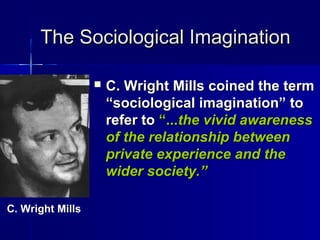
 C. Wright Mills coined the termC. Wright Mills coined the term
“sociological imagination” to“sociological imagination” to
refer torefer to “...“...the vivid awarenessthe vivid awareness
of the relationship betweenof the relationship between
private experience and theprivate experience and the
wider society.”wider society.”
C. Wright Mills
Sociology and CommonSociology and Common
SenseSense
 Common sense assumptions are usually based on veryCommon sense assumptions are usually based on very
limited observation.limited observation.
 Moreover, the premises on which common senseMoreover, the premises on which common sense
assumptions are seldom examined.assumptions are seldom examined.
 Sociology seeks to:Sociology seeks to:
• use a broad range of carefully selected observations; anduse a broad range of carefully selected observations; and
• theoretically understand and explain those observations.theoretically understand and explain those observations.
 While sociological research might confirm commonWhile sociological research might confirm common
sense observation, its broader base and theoreticalsense observation, its broader base and theoretical
rational provide a stronger basis for conclusions.rational provide a stronger basis for conclusions.
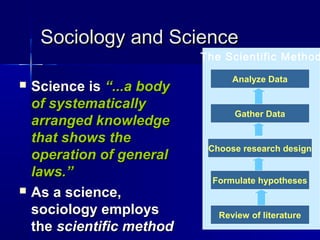
The Scientific Method
Sociology and ScienceSociology and Science
 Science isScience is “...a body“...a body
of systematicallyof systematically
arranged knowledgearranged knowledge
that shows thethat shows the
operation of generaloperation of general
laws.”laws.”
 As a science,As a science,
sociology employssociology employs
thethe scientific methodscientific method
Formulate hypotheses
Choose research design
Gather Data
Analyze Data
Review of literature
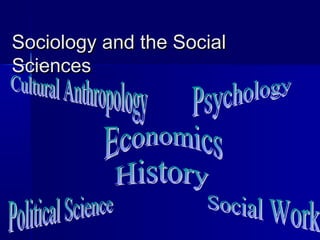
Sociology and the SocialSociology and the Social
SciencesSciences
The Development ofThe Development of
SociologySociology
 Sociology emerged as a separateSociology emerged as a separate
discipline in the nineteenth centurydiscipline in the nineteenth century
 This was a time of great socialThis was a time of great social
upheaval due largely to the Frenchupheaval due largely to the French
and Industrial Revolutionsand Industrial Revolutions
 Several early sociologists shapedSeveral early sociologists shaped
the direction of the disciplinethe direction of the discipline
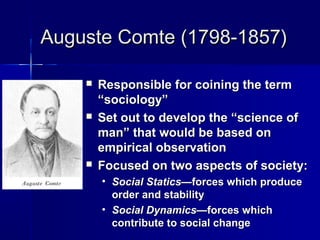
Auguste Comte (1798-1857)Auguste Comte (1798-1857)
 Responsible for coining the termResponsible for coining the term
“sociology”“sociology”
 Set out to develop the “science ofSet out to develop the “science of
man” that would be based onman” that would be based on
empirical observationempirical observation
 Focused on two aspects of society:Focused on two aspects of society:
• Social Statics—Social Statics—forces which produceforces which produce
order and stabilityorder and stability
• Social Dynamics—Social Dynamics—forces whichforces which
contribute to social changecontribute to social change
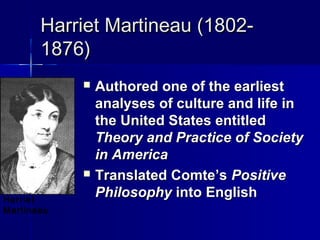
Harriet Martineau (1802-Harriet Martineau (1802-
1876)1876)
 Authored one of the earliestAuthored one of the earliest
analyses of culture and life inanalyses of culture and life in
the United States entitledthe United States entitled
Theory and Practice of SocietyTheory and Practice of Society
in Americain America
 Translated Comte’sTranslated Comte’s PositivePositive
PhilosophyPhilosophy into Englishinto EnglishHarriet
Martineau
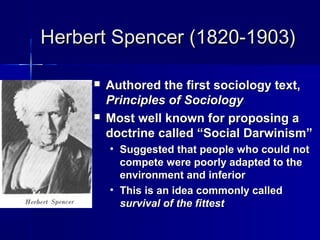
Herbert Spencer (1820-1903)Herbert Spencer (1820-1903)
 Authored the first sociology text,Authored the first sociology text,
Principles of SociologyPrinciples of Sociology
 Most well known for proposing aMost well known for proposing a
doctrine called “Social Darwinism”doctrine called “Social Darwinism”
• Suggested that people who could notSuggested that people who could not
compete were poorly adapted to thecompete were poorly adapted to the
environment and inferiorenvironment and inferior
• This is an idea commonly calledThis is an idea commonly called
survival of the fittestsurvival of the fittest
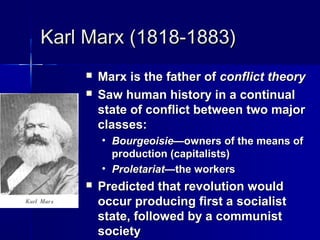
Karl Marx (1818-1883)Karl Marx (1818-1883)
 Marx is the father ofMarx is the father of conflictconflict theorytheory
 Saw human history in a continualSaw human history in a continual
state of conflict between two majorstate of conflict between two major
classes:classes:
• Bourgeoisie—Bourgeoisie—owners of the means ofowners of the means of
production (capitalists)production (capitalists)
• Proletariat—Proletariat—the workersthe workers
 Predicted that revolution wouldPredicted that revolution would
occur producing first a socialistoccur producing first a socialist
state, followed by a communiststate, followed by a communist
societysociety
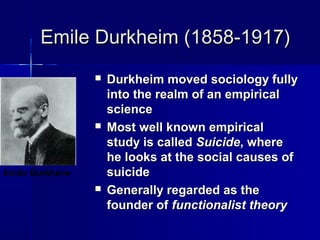
Emile Durkheim (1858-1917)Emile Durkheim (1858-1917)
 Durkheim moved sociology fullyDurkheim moved sociology fully
into the realm of an empiricalinto the realm of an empirical
sciencescience
 Most well known empiricalMost well known empirical
study is calledstudy is called SuicideSuicide, where, where
he looks at the social causes ofhe looks at the social causes of
suicidesuicide
 Generally regarded as theGenerally regarded as the
founder offounder of functionalist theoryfunctionalist theory
Emile Durkheim
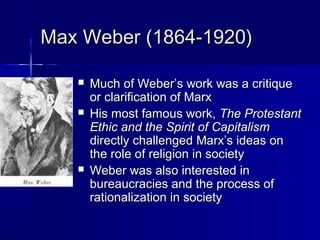
Max Weber (1864-1920)Max Weber (1864-1920)
 Much of Weber’s work was a critiqueMuch of Weber’s work was a critique
or clarification of Marxor clarification of Marx
 His most famous work,His most famous work, The ProtestantThe Protestant
Ethic and the Spirit of CapitalismEthic and the Spirit of Capitalism
directly challenged Marx’s ideas ondirectly challenged Marx’s ideas on
the role of religion in societythe role of religion in society
 Weber was also interested inWeber was also interested in
bureaucracies and the process ofbureaucracies and the process of
rationalization in societyrationalization in society
The Development ofThe Development of
Sociology in the United StatesSociology in the United States
 American sociology had its beginnings at theAmerican sociology had its beginnings at the
University of Chicago in the early 20University of Chicago in the early 20thth
centurycentury
 The early emphasis was on empirical study ofThe early emphasis was on empirical study of
communities and neighborhoodscommunities and neighborhoods
 Later, East Coast schools such as Columbia andLater, East Coast schools such as Columbia and
Harvard Universities began sociology departments,Harvard Universities began sociology departments,
producing scholars such as W.E.B. Dubois, Talcottproducing scholars such as W.E.B. Dubois, Talcott
Parsons, and Robert MertonParsons, and Robert Merton
Home page of the University of the Chicago Sociology Dep’t
Theoretical Perspectives:Theoretical Perspectives:
FunctionalismFunctionalism
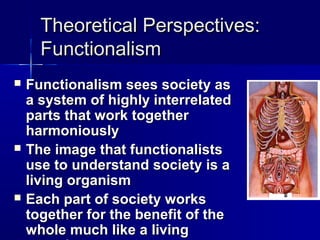
 Functionalism sees society asFunctionalism sees society as
a system of highly interrelateda system of highly interrelated
parts that work togetherparts that work together
harmoniouslyharmoniously
 The image that functionalistsThe image that functionalists
use to understand society is ause to understand society is a
living organismliving organism
 Each part of society worksEach part of society works
together for the benefit of thetogether for the benefit of the
whole much like a livingwhole much like a living
Theoretical Perspectives:Theoretical Perspectives:
Conflict TheoryConflict Theory
 Conflict theory is grounded in the work of KarlConflict theory is grounded in the work of Karl
MarxMarx
 Society is understood to be made up ofSociety is understood to be made up of
conflicting interest groups who vie for powerconflicting interest groups who vie for power
and privilegeand privilege
 This dynamic results in continuous socialThis dynamic results in continuous social
change, which is the normal state of affairschange, which is the normal state of affairs
 Conflict theory focuses heavily on inequalityConflict theory focuses heavily on inequality
and differential distribution of power andand differential distribution of power and
wealthwealth
Theoretical Perspectives:Theoretical Perspectives:
The InteractionistThe Interactionist
PerspectivePerspective
 Focuses on how individuals make sense ofFocuses on how individuals make sense of
and interpret the worldand interpret the world
 This perspective tends to focus on the “micro-This perspective tends to focus on the “micro-
order” of small groupsorder” of small groups
 Has given rise to several specific approaches:Has given rise to several specific approaches:
– Symbolic InteractionismSymbolic Interactionism developed by Georgedeveloped by George
Herbert MeadHerbert Mead
– EthnomethodologyEthnomethodology developed by Harold Garfinkeldeveloped by Harold Garfinkel
– DramaturgyDramaturgy developed by Erving Goffmandeveloped by Erving Goffman
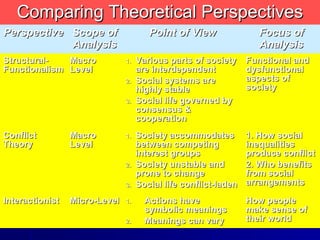
Comparing Theoretical PerspectivesComparing Theoretical Perspectives
PerspectivePerspective Scope ofScope of
AnalysisAnalysis
Point of ViewPoint of View Focus ofFocus of
AnalysisAnalysis
Structural-Structural-
FunctionalismFunctionalism
MacroMacro
LevelLevel
1.1. Various parts of societyVarious parts of society
are interdependentare interdependent
2.2. Social systems areSocial systems are
highly stablehighly stable
3.3. Social life governed bySocial life governed by
consensus &consensus &
cooperationcooperation
Functional andFunctional and
dysfunctionaldysfunctional
aspects ofaspects of
societysociety
ConflictConflict
TheoryTheory
MacroMacro
LevelLevel
1.1. Society accommodatesSociety accommodates
between competingbetween competing
interest groupsinterest groups
2.2. Society unstable andSociety unstable and
prone to changeprone to change
3.3. Social life conflict-ladenSocial life conflict-laden
1. How social1. How social
inequalitiesinequalities
produce conflictproduce conflict
2. Who benefits2. Who benefits
from socialfrom social
arrangementsarrangements
InteractionistInteractionist Micro-LevelMicro-Level 1.1. Actions haveActions have
symbolic meaningssymbolic meanings
2.2. Meanings can varyMeanings can vary
How peopleHow people
make sense ofmake sense of
their worldtheir world

Sociology intro

  • 1.
    IntroductionIntroduction toto SociologySociology Henry L.TischlerHenry L. Tischler Prepared by Charles E. Faupel
  • 2.
    Chapter 1:Chapter 1: TheSociological PerspectiveThe Sociological Perspective
  • 3.
    What to Expectin This Chapter...What to Expect in This Chapter...  Defining the Sociological PerspectiveDefining the Sociological Perspective • The Sociological ImaginationThe Sociological Imagination • Sociology and Common SenseSociology and Common Sense • Sociology and ScienceSociology and Science  Sociology and the Social SciencesSociology and the Social Sciences  The Development of SociologyThe Development of Sociology  Theoretical Perspectives in SociologyTheoretical Perspectives in Sociology
  • 4.
    Personal experience Awarenessof friends Systematic study with drug use and associates’ patterns of a random of drug use sample of drug users Defining the SociologicalDefining the Sociological PerspectivePerspective  ““Sociology is the scientific study ofSociology is the scientific study of human society and social interactions.”human society and social interactions.”  What makes sociology “scientific?”What makes sociology “scientific?” Levels of Understanding Drug Use
  • 5.
    The Sociological ImaginationTheSociological Imagination  C. Wright Mills coined the termC. Wright Mills coined the term “sociological imagination” to“sociological imagination” to refer torefer to “...“...the vivid awarenessthe vivid awareness of the relationship betweenof the relationship between private experience and theprivate experience and the wider society.”wider society.” C. Wright Mills
  • 6.
    Sociology and CommonSociologyand Common SenseSense  Common sense assumptions are usually based on veryCommon sense assumptions are usually based on very limited observation.limited observation.  Moreover, the premises on which common senseMoreover, the premises on which common sense assumptions are seldom examined.assumptions are seldom examined.  Sociology seeks to:Sociology seeks to: • use a broad range of carefully selected observations; anduse a broad range of carefully selected observations; and • theoretically understand and explain those observations.theoretically understand and explain those observations.  While sociological research might confirm commonWhile sociological research might confirm common sense observation, its broader base and theoreticalsense observation, its broader base and theoretical rational provide a stronger basis for conclusions.rational provide a stronger basis for conclusions.
  • 7.
    The Scientific Method Sociologyand ScienceSociology and Science  Science isScience is “...a body“...a body of systematicallyof systematically arranged knowledgearranged knowledge that shows thethat shows the operation of generaloperation of general laws.”laws.”  As a science,As a science, sociology employssociology employs thethe scientific methodscientific method Formulate hypotheses Choose research design Gather Data Analyze Data Review of literature
  • 8.
    Sociology and theSocialSociology and the Social SciencesSciences
  • 9.
    The Development ofTheDevelopment of SociologySociology  Sociology emerged as a separateSociology emerged as a separate discipline in the nineteenth centurydiscipline in the nineteenth century  This was a time of great socialThis was a time of great social upheaval due largely to the Frenchupheaval due largely to the French and Industrial Revolutionsand Industrial Revolutions  Several early sociologists shapedSeveral early sociologists shaped the direction of the disciplinethe direction of the discipline
  • 10.
    Auguste Comte (1798-1857)AugusteComte (1798-1857)  Responsible for coining the termResponsible for coining the term “sociology”“sociology”  Set out to develop the “science ofSet out to develop the “science of man” that would be based onman” that would be based on empirical observationempirical observation  Focused on two aspects of society:Focused on two aspects of society: • Social Statics—Social Statics—forces which produceforces which produce order and stabilityorder and stability • Social Dynamics—Social Dynamics—forces whichforces which contribute to social changecontribute to social change
  • 11.
    Harriet Martineau (1802-HarrietMartineau (1802- 1876)1876)  Authored one of the earliestAuthored one of the earliest analyses of culture and life inanalyses of culture and life in the United States entitledthe United States entitled Theory and Practice of SocietyTheory and Practice of Society in Americain America  Translated Comte’sTranslated Comte’s PositivePositive PhilosophyPhilosophy into Englishinto EnglishHarriet Martineau
  • 12.
    Herbert Spencer (1820-1903)HerbertSpencer (1820-1903)  Authored the first sociology text,Authored the first sociology text, Principles of SociologyPrinciples of Sociology  Most well known for proposing aMost well known for proposing a doctrine called “Social Darwinism”doctrine called “Social Darwinism” • Suggested that people who could notSuggested that people who could not compete were poorly adapted to thecompete were poorly adapted to the environment and inferiorenvironment and inferior • This is an idea commonly calledThis is an idea commonly called survival of the fittestsurvival of the fittest
  • 13.
    Karl Marx (1818-1883)KarlMarx (1818-1883)  Marx is the father ofMarx is the father of conflictconflict theorytheory  Saw human history in a continualSaw human history in a continual state of conflict between two majorstate of conflict between two major classes:classes: • Bourgeoisie—Bourgeoisie—owners of the means ofowners of the means of production (capitalists)production (capitalists) • Proletariat—Proletariat—the workersthe workers  Predicted that revolution wouldPredicted that revolution would occur producing first a socialistoccur producing first a socialist state, followed by a communiststate, followed by a communist societysociety
  • 14.
    Emile Durkheim (1858-1917)EmileDurkheim (1858-1917)  Durkheim moved sociology fullyDurkheim moved sociology fully into the realm of an empiricalinto the realm of an empirical sciencescience  Most well known empiricalMost well known empirical study is calledstudy is called SuicideSuicide, where, where he looks at the social causes ofhe looks at the social causes of suicidesuicide  Generally regarded as theGenerally regarded as the founder offounder of functionalist theoryfunctionalist theory Emile Durkheim
  • 15.
    Max Weber (1864-1920)MaxWeber (1864-1920)  Much of Weber’s work was a critiqueMuch of Weber’s work was a critique or clarification of Marxor clarification of Marx  His most famous work,His most famous work, The ProtestantThe Protestant Ethic and the Spirit of CapitalismEthic and the Spirit of Capitalism directly challenged Marx’s ideas ondirectly challenged Marx’s ideas on the role of religion in societythe role of religion in society  Weber was also interested inWeber was also interested in bureaucracies and the process ofbureaucracies and the process of rationalization in societyrationalization in society
  • 16.
    The Development ofTheDevelopment of Sociology in the United StatesSociology in the United States  American sociology had its beginnings at theAmerican sociology had its beginnings at the University of Chicago in the early 20University of Chicago in the early 20thth centurycentury  The early emphasis was on empirical study ofThe early emphasis was on empirical study of communities and neighborhoodscommunities and neighborhoods  Later, East Coast schools such as Columbia andLater, East Coast schools such as Columbia and Harvard Universities began sociology departments,Harvard Universities began sociology departments, producing scholars such as W.E.B. Dubois, Talcottproducing scholars such as W.E.B. Dubois, Talcott Parsons, and Robert MertonParsons, and Robert Merton Home page of the University of the Chicago Sociology Dep’t
  • 17.
    Theoretical Perspectives:Theoretical Perspectives: FunctionalismFunctionalism Functionalism sees society asFunctionalism sees society as a system of highly interrelateda system of highly interrelated parts that work togetherparts that work together harmoniouslyharmoniously  The image that functionalistsThe image that functionalists use to understand society is ause to understand society is a living organismliving organism  Each part of society worksEach part of society works together for the benefit of thetogether for the benefit of the whole much like a livingwhole much like a living
  • 18.
    Theoretical Perspectives:Theoretical Perspectives: ConflictTheoryConflict Theory  Conflict theory is grounded in the work of KarlConflict theory is grounded in the work of Karl MarxMarx  Society is understood to be made up ofSociety is understood to be made up of conflicting interest groups who vie for powerconflicting interest groups who vie for power and privilegeand privilege  This dynamic results in continuous socialThis dynamic results in continuous social change, which is the normal state of affairschange, which is the normal state of affairs  Conflict theory focuses heavily on inequalityConflict theory focuses heavily on inequality and differential distribution of power andand differential distribution of power and wealthwealth
  • 19.
    Theoretical Perspectives:Theoretical Perspectives: TheInteractionistThe Interactionist PerspectivePerspective  Focuses on how individuals make sense ofFocuses on how individuals make sense of and interpret the worldand interpret the world  This perspective tends to focus on the “micro-This perspective tends to focus on the “micro- order” of small groupsorder” of small groups  Has given rise to several specific approaches:Has given rise to several specific approaches: – Symbolic InteractionismSymbolic Interactionism developed by Georgedeveloped by George Herbert MeadHerbert Mead – EthnomethodologyEthnomethodology developed by Harold Garfinkeldeveloped by Harold Garfinkel – DramaturgyDramaturgy developed by Erving Goffmandeveloped by Erving Goffman
  • 20.
    Comparing Theoretical PerspectivesComparingTheoretical Perspectives PerspectivePerspective Scope ofScope of AnalysisAnalysis Point of ViewPoint of View Focus ofFocus of AnalysisAnalysis Structural-Structural- FunctionalismFunctionalism MacroMacro LevelLevel 1.1. Various parts of societyVarious parts of society are interdependentare interdependent 2.2. Social systems areSocial systems are highly stablehighly stable 3.3. Social life governed bySocial life governed by consensus &consensus & cooperationcooperation Functional andFunctional and dysfunctionaldysfunctional aspects ofaspects of societysociety ConflictConflict TheoryTheory MacroMacro LevelLevel 1.1. Society accommodatesSociety accommodates between competingbetween competing interest groupsinterest groups 2.2. Society unstable andSociety unstable and prone to changeprone to change 3.3. Social life conflict-ladenSocial life conflict-laden 1. How social1. How social inequalitiesinequalities produce conflictproduce conflict 2. Who benefits2. Who benefits from socialfrom social arrangementsarrangements InteractionistInteractionist Micro-LevelMicro-Level 1.1. Actions haveActions have symbolic meaningssymbolic meanings 2.2. Meanings can varyMeanings can vary How peopleHow people make sense ofmake sense of their worldtheir world