THE POLITICAL EFFECTS
Creator: Josiah Bent
 Crime refers to activities that breaks the laws of the land
and are subjected to official punishment by the court
system
 Deviance describes any activity that does not conform to
the norms and expectations of a particular society
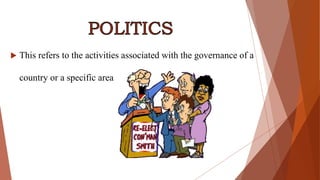
 This refers to the activities associated with the governance of a
country or a specific area
 Functionalist theory; Emile Durkheim-
He stated that crime and deviance are useful to society. One
usefulness of both crime and deviance in society he explained is
to be used as a means of warning signals in society, indicating
the areas that are ineffective.
.
 Functionalist theory; Robert Merton-
He explained the major cause of persons going into criminal
activities and committing deviant act. He explained this major
cause as being to achieve a specific goal in society.
.
 Interactionist Perspective; The labelling theory-
This theory investigates why persons are labelled as criminals or
deviants in society. Once an act is committed, for instance a criminal
act, then an agent of the political system will definitely label this
person as a criminal. The same goes for deviant behaviours.
.
 Interactionist Perspective; The differential theory-
This theory states that criminal and deviant behaviours are
most times learned from others just like any other behaviours,
through the media, social interaction etc.
.
 Interactionist Perspective; The Social Control theory-
This theory, which is led by Hirschi, speaks about everyone
having the potential to commit criminal and deviant acts
however fears the consequences. Therefore refraining from
doing so in order for a negative sanction not to be applied.
.
 Crime typically force persons to evaluate the
effectiveness of politics. This will result in persons
becoming disappointed with the government and what
the political leaders are doing for that particular country
or region.
.
 Crime force persons to be socially isolated from
political events in a particular region. Therefore, they
withdraw from participating in civic and political life
such as election of political leaders.
.
 Crime and deviance force persons to have a feeling of
carelessness towards other nation crisis and measures
the government want to put in place with the help of the
residents.
.
 Crime and deviance force persons to support vigilant
justice within communities rather than using the justice
of the land.
“Jungle Justice”
.
 Crime and deviance forces persons to join groups which
violently overthrows elected political governments.
.
.

Crime and deviance sociology presentation

  • 1.
  • 2.
     Crime refersto activities that breaks the laws of the land and are subjected to official punishment by the court system
  • 3.
     Deviance describesany activity that does not conform to the norms and expectations of a particular society
  • 4.
     This refersto the activities associated with the governance of a country or a specific area
  • 5.
     Functionalist theory;Emile Durkheim- He stated that crime and deviance are useful to society. One usefulness of both crime and deviance in society he explained is to be used as a means of warning signals in society, indicating the areas that are ineffective.
  • 6.
  • 7.
     Functionalist theory;Robert Merton- He explained the major cause of persons going into criminal activities and committing deviant act. He explained this major cause as being to achieve a specific goal in society.
  • 8.
  • 9.
     Interactionist Perspective;The labelling theory- This theory investigates why persons are labelled as criminals or deviants in society. Once an act is committed, for instance a criminal act, then an agent of the political system will definitely label this person as a criminal. The same goes for deviant behaviours.
  • 10.
  • 11.
     Interactionist Perspective;The differential theory- This theory states that criminal and deviant behaviours are most times learned from others just like any other behaviours, through the media, social interaction etc.
  • 12.
  • 13.
     Interactionist Perspective;The Social Control theory- This theory, which is led by Hirschi, speaks about everyone having the potential to commit criminal and deviant acts however fears the consequences. Therefore refraining from doing so in order for a negative sanction not to be applied.
  • 14.
  • 15.
     Crime typicallyforce persons to evaluate the effectiveness of politics. This will result in persons becoming disappointed with the government and what the political leaders are doing for that particular country or region.
  • 16.
  • 17.
     Crime forcepersons to be socially isolated from political events in a particular region. Therefore, they withdraw from participating in civic and political life such as election of political leaders.
  • 18.
  • 19.
     Crime anddeviance force persons to have a feeling of carelessness towards other nation crisis and measures the government want to put in place with the help of the residents.
  • 20.
  • 21.
     Crime anddeviance force persons to support vigilant justice within communities rather than using the justice of the land. “Jungle Justice”
  • 22.
  • 24.
     Crime anddeviance forces persons to join groups which violently overthrows elected political governments.
  • 25.
  • 26.