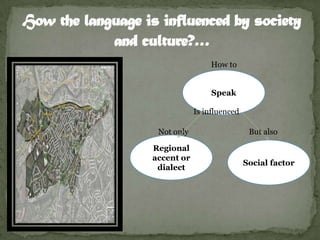
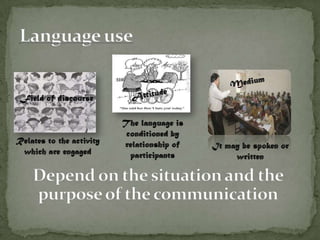
How the language is influenced by society
            and culture?…
                                    How to


                                    Speak

                               Is influenced

                    Not only                    But also

                   Regional
                   accent or
                                               Social factor
                    dialect
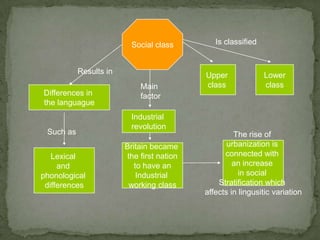
Social class        Is classified


           Results in                      Upper              Lower
                            Main           class              class
Differences in              factor
the languague
                         Industrial
                         revolution
 Such as                                            The rise of
                        Britain became            urbanization is
   Lexical              the first nation         connected with
     and                   to have an               an increase
phonological                Industrial                in social
 differences             working class         Stratification which
                                           affects in lingusitic variation
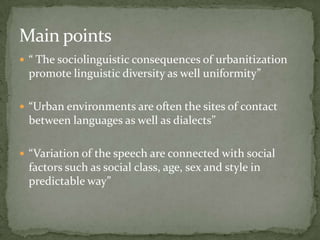
Main points
 “ The sociolinguistic consequences of urbanitization
 promote linguistic diversity as well uniformity”

 “Urban environments are often the sites of contact
 between languages as well as dialects”

 “Variation of the speech are connected with social
 factors such as social class, age, sex and style in
 predictable way”
Some studies
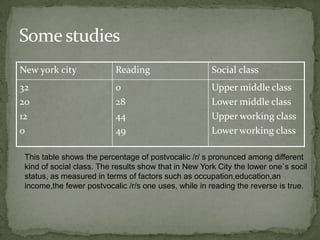
New york city              Reading                     Social class
32                         0                           Upper middle class
20                         28                          Lower middle class
12                         44                          Upper working class
0                          49                          Lower working class

 This table shows the percentage of postvocalic /r/ s pronunced among different
 kind of social class. The results show that in New York City the lower one`s socil
 status, as measured in terms of factors such as occupation,education,an
 income,the fewer postvocalic /r/s one uses, while in reading the reverse is true.
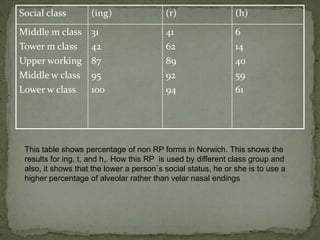
Social class        (ing)                 (r)                  (h)
Middle m class      31                    41                   6
Tower m class       42                    62                   14
Upper working       87                    89                   40
Middle w class      95                    92                   59
Lower w class       100                   94                   61


 This table shows percentage of non RP forms in Norwich. This shows the
 results for ing, t, and h,. How this RP is used by different class group and
 also, it shows that the lower a person`s social status, he or she is to use a
 higher percentage of alveolar rather than velar nasal endings
Style and language
 It is related to casual or formal. Style can range from
  formal to informal depending on social
  context,relationship of the participants,social
  class,sex,age,physical environment, and topic.

 Style is a multidimensional phenomenon.
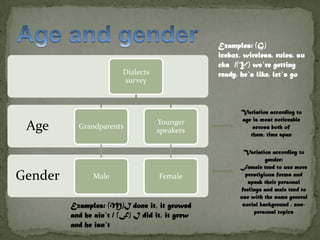
Examples: (G)
                                                icebox, wireless, rules, su
                                                cks /(Y) we`re getting
                        Dialects                ready, he`s like, let`s go
                        survey


                                                       Variation according to
                                   Younger             age is most noticeable
 Age       Grandparents
                                   speakers
                                                           across both of
                                                          them, time span

                                                       Variation according to
                                                                gender:
                                                      Female tend to use more
Gender         Male                Female               prestigious forms and
                                                         speak their personal
                                                      feelings and male tend to
                                                      use with the same general
         Examples: (M)I done it, it growed             social background , non-
                                                           personal topics
         and he ain`t / (F) I did it, it grew
         and he isn`t
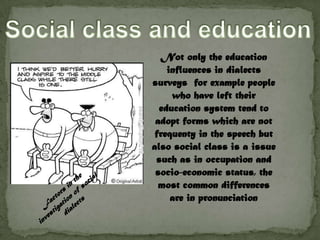
Not only the education
    influences in dialects
surveys for example people
     who have left their
  education system tend to
 adopt forms which are not
 frequenty in the speech but
also social class is a issue
 such as in occupation and
 socio-economic status, the
  most common differences
     are in pronunciation
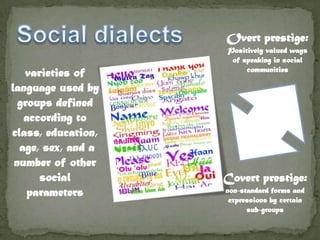
Overt prestige:
                    Positively valued ways
                     of speaking in social
                         communities
   varieties of
language used by
  groups defined
   according to
class, education,
  age, sex, and a
 number of other
      social        Covert prestige:
    parameters      non-standard forms and
                     expressions by certain
                          sub-groups
Language and social network
 Some linguistic studies have emphasized the nature of contacts
  and networks in a society and also have mentioned that there is a
  relation between individual`s netwrok with the effect on
  language choice.
 “Dense network has relation with the people whom speaker
  knows and interacts with also know each other while “Multiplex
  network” has relation with the individuals who interact are tied
  to one another in other ways.
 High network scores indicating the strength of association with
  the local community used more local, nonstandard forms of
  speech
 The notion of network is thus more useful than social class and
  it applies equally well to multilingual adn monolingual settings.
Standardization
 Standardization is the main agents of inequality
 The process of standardization converts one variety
  into a standard by fixing and regulating its spelling,
  grammar., etc.
 Standardization is not an inherent, but rather an
  acquired or deliberately and artificially imposed
  characteristic
 Most of the present day standard languages of Europe
  emerged within a climate of intense political
  nationalism
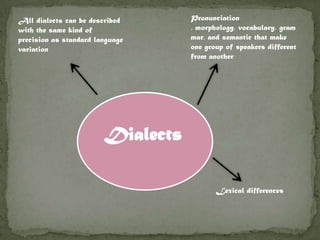
All dialects can be described      Pronunciation
with the same kind of              , morphology, vocabulary, gram
precision as standard language     mar, and semantic that make
variation                          one group of speakers different
                                   from another


                        Dialects

                                          Lexical differences
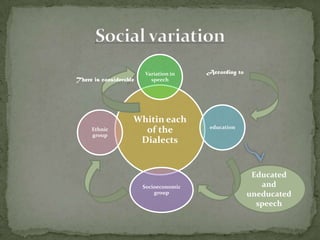
Variation in    According to
There is considerable     speech


                    Whitin each
                                         education
     Ethnic
     group
                      of the
                     Dialects


                                                        Educated
                        Socioeconomic                     and
                            group                      uneducated
                                                         speech
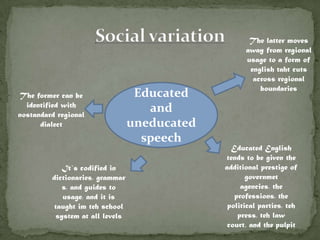
The latter moves
                                                    away from regional
                                                    usage to a form of
                                                     english taht cuts
                                                      across regional
                                                        boundaries
The former can be                 Educated
  identified with
nostandard regional
                                    and
      dialect                    uneducated
                                   speech
                                                Educated English
                                              tends to be given the
            It`s codified in                  additional prestige of
         dictionaries, grammar                       governmet
            s, and guides to                       agencies, the
            usage, and it is                     professions, the
          taught im teh school                 political parties, teh
          system at all levels                    press, teh law
                                               court, and the pulpit
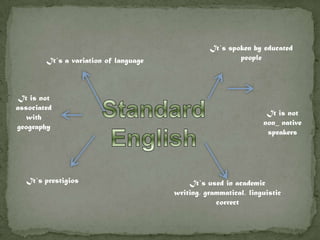
It`s spoken by educated
        It`s a variation of language                     people


 It is not
associated
                                                                  It is not
   with
                                                                 non_ native
geography
                                                                  speakers


  It`s prestigios                          It`s used in academic
                                       writing, grammatical, linguistic
                                                   correct
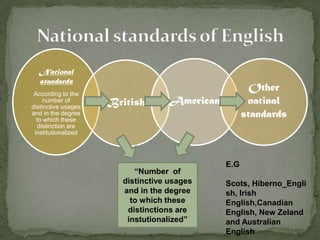
National
  standards
 According to the
                                                      Other
     number of
distinctive usages
                     British       American          natinal
and in the degree
  to which these
                                                    standards
  distinction are
 institutionalized


                                              E.G
                          “Number of
                       distinctive usages     Scots, Hiberno_Engli
                       and in the degree      sh, Irish
                         to which these       English,Canadian
                        distinctions are      English, New Zeland
                        instutionalized”      and Australian
                                              English
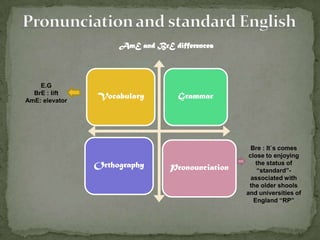
AmE and BrE differences


    E.G
  BrE : lift
AmE: elevator
                Vocabulary         Grammar


                                                    Bre : It`s comes
                                                   close to enjoying
                Orthography      Pronounciation
                                                      the status of
                                                       “standard”-
                                                    associated with
                                                   the older shools
                                                  and universities of
                                                     England “RP”
Formal and
informal
contexts show
grade of
differences in
attitude
References
 Sociolinguistic Patterns, Chapter 3.


•“Language, society and culture” Yule, G (1996) The
study of language UK, Cambridge University Press

Sociolinguisticpatterns

  • 2.
    How the languageis influenced by society and culture?… How to Speak Is influenced Not only But also Regional accent or Social factor dialect
  • 3.
    Social class Is classified Results in Upper Lower Main class class Differences in factor the languague Industrial revolution Such as The rise of Britain became urbanization is Lexical the first nation connected with and to have an an increase phonological Industrial in social differences working class Stratification which affects in lingusitic variation
  • 4.
    Main points  “The sociolinguistic consequences of urbanitization promote linguistic diversity as well uniformity”  “Urban environments are often the sites of contact between languages as well as dialects”  “Variation of the speech are connected with social factors such as social class, age, sex and style in predictable way”
  • 6.
    Some studies New yorkcity Reading Social class 32 0 Upper middle class 20 28 Lower middle class 12 44 Upper working class 0 49 Lower working class This table shows the percentage of postvocalic /r/ s pronunced among different kind of social class. The results show that in New York City the lower one`s socil status, as measured in terms of factors such as occupation,education,an income,the fewer postvocalic /r/s one uses, while in reading the reverse is true.
  • 7.
    Social class (ing) (r) (h) Middle m class 31 41 6 Tower m class 42 62 14 Upper working 87 89 40 Middle w class 95 92 59 Lower w class 100 94 61 This table shows percentage of non RP forms in Norwich. This shows the results for ing, t, and h,. How this RP is used by different class group and also, it shows that the lower a person`s social status, he or she is to use a higher percentage of alveolar rather than velar nasal endings
  • 10.
    Style and language It is related to casual or formal. Style can range from formal to informal depending on social context,relationship of the participants,social class,sex,age,physical environment, and topic.  Style is a multidimensional phenomenon.
  • 11.
    Examples: (G) icebox, wireless, rules, su cks /(Y) we`re getting Dialects ready, he`s like, let`s go survey Variation according to Younger age is most noticeable Age Grandparents speakers across both of them, time span Variation according to gender: Female tend to use more Gender Male Female prestigious forms and speak their personal feelings and male tend to use with the same general Examples: (M)I done it, it growed social background , non- personal topics and he ain`t / (F) I did it, it grew and he isn`t
  • 12.
    Not only theeducation influences in dialects surveys for example people who have left their education system tend to adopt forms which are not frequenty in the speech but also social class is a issue such as in occupation and socio-economic status, the most common differences are in pronunciation
  • 13.
    Overt prestige: Positively valued ways of speaking in social communities varieties of language used by groups defined according to class, education, age, sex, and a number of other social Covert prestige: parameters non-standard forms and expressions by certain sub-groups
  • 14.
    Language and socialnetwork  Some linguistic studies have emphasized the nature of contacts and networks in a society and also have mentioned that there is a relation between individual`s netwrok with the effect on language choice.  “Dense network has relation with the people whom speaker knows and interacts with also know each other while “Multiplex network” has relation with the individuals who interact are tied to one another in other ways.  High network scores indicating the strength of association with the local community used more local, nonstandard forms of speech  The notion of network is thus more useful than social class and it applies equally well to multilingual adn monolingual settings.
  • 15.
    Standardization  Standardization isthe main agents of inequality  The process of standardization converts one variety into a standard by fixing and regulating its spelling, grammar., etc.  Standardization is not an inherent, but rather an acquired or deliberately and artificially imposed characteristic  Most of the present day standard languages of Europe emerged within a climate of intense political nationalism
  • 17.
    All dialects canbe described Pronunciation with the same kind of , morphology, vocabulary, gram precision as standard language mar, and semantic that make variation one group of speakers different from another Dialects Lexical differences
  • 18.
    Variation in According to There is considerable speech Whitin each education Ethnic group of the Dialects Educated Socioeconomic and group uneducated speech
  • 19.
    The latter moves away from regional usage to a form of english taht cuts across regional boundaries The former can be Educated identified with nostandard regional and dialect uneducated speech Educated English tends to be given the It`s codified in additional prestige of dictionaries, grammar governmet s, and guides to agencies, the usage, and it is professions, the taught im teh school political parties, teh system at all levels press, teh law court, and the pulpit
  • 20.
    It`s spoken byeducated It`s a variation of language people It is not associated It is not with non_ native geography speakers It`s prestigios It`s used in academic writing, grammatical, linguistic correct
  • 21.
    National standards According to the Other number of distinctive usages British American natinal and in the degree to which these standards distinction are institutionalized E.G “Number of distinctive usages Scots, Hiberno_Engli and in the degree sh, Irish to which these English,Canadian distinctions are English, New Zeland instutionalized” and Australian English
  • 22.
    AmE and BrEdifferences E.G BrE : lift AmE: elevator Vocabulary Grammar Bre : It`s comes close to enjoying Orthography Pronounciation the status of “standard”- associated with the older shools and universities of England “RP”
  • 23.
    Formal and informal contexts show gradeof differences in attitude
  • 24.
    References  Sociolinguistic Patterns,Chapter 3. •“Language, society and culture” Yule, G (1996) The study of language UK, Cambridge University Press