
Term Paper
Introduction to Gender and Discourse
Analysis
Gender Analysis in Hamlet
Muhammad Aqeel Hayder
M.phil (Session 2015-17)
Bahauddin Zakariya University Multan (Pakistan)
Abstract
This paper focuses on the literature that has contributed to the understanding of the major research
questions underlying two major strands, language and gender, concentrating on the development
of the literature from the deficit and dominance models to the social constructivist era of post-
modernism in order to provide a context for recent developments in language and gender theories.
The study of language and gender has increasingly become the study of discourse and gender.
While phonological, lexical, and other kinds of linguistic analysis continue to be influential, the
interdisciplinary investigation of discourse-level phenomena, always a robust area of language
and gender scholarship, has become the central approach of the field.
Introduction
In sociolinguistics and other related areas of academia, discourse is usually defined as the
relationship between language and its real-world context. Many researchers and theorists relate
discourse specifically to power structures in a given society, and this is the area where there is
the most overlap between gender and discourse. Approaches to gender and discourse research
may analyze the way language reflects or influences gender stereotypes, or they may discuss the
differences between how men and women use language.
Much use of the word discourse in the late 20th and early 21st centuries was influenced by the
work of the French philosopher Michel Foucault, who defined the use of language and other sign
systems as a means to control people's actions. Drawing on Foucault's theories, many researchers
have analyzed gender in relation to existing social and cultural power structures. Some theorists
argue that the way language is used re-enforces existing power structures, while others claim that
discourse simply reflects the existing state of affairs. The relationship between power and
discourse may also be viewed as cyclical or mutually re-enforcing: social structures influence
language, and language influences social structures. Foucaultian approaches to gender and
discourse tend to focus on the relationship between gender and power.
Language and Gender
Language and gender is an interdisciplinary field of research that studies varieties
of speech (and, to a lesser extent, writing) in terms of gender, gender relations, gendered
practices, and sexuality.
In The Handbook of Language and Gender (2003), Janet Holmes and Miriam Meyerhoff discuss
the shift that has occurred in the field since the early 1970s--a movement away from "essentialist
and dichotomous conceptions of gender to a differentiated, contextualized, and performative
model which questions generalized claims about gender."
One of the most striking phenomenon in language study in the 1970s and 1980s was the
development of the field of research known as ‘language and gender’. This area of research
continues to grow: the international Gender and Language Association was founded in 1999 and
holds biennial conferences, and a journal- Gender and Language- was launched in 2007,
dedicated to the publication of research in this area.
Language is the most important communication tool for human beings. It not only reflects the
reality of the society, but also has various functions to strengthen and maintain social existence.
Given such a view, language does mirror the gendered perspectives and can also impact and
contribute to changing people's perception of gender over time. Thus, for a long time feminists
and sociolinguists have shown interest in describing
the differences in language use between women and men, and studies of the cultural roles
ascribed to gender. However, interest in language usage differences between the two sexes has a
very long tradition in attempting to explain the distinction between language and gender and how
language supports, enforces, and maintains attitudes about gender in general and women in
particular.
This paper attempts to discuss the following points: (1) some important issues on the relationship
between gender and language; (2) some explanations on the differences between male and
female speech such as: power in gender relationships, community practice, conversational styles
and strategies, attitudes and prestige, and discrimination and sexist language practices; and (3)
the implications for language planning.
A brief overview of key language and gender approaches
Since the 1960s, sociolinguists (e.g., Camerron,1995; Eckert,1989; Holmes & Meyerrhoff, 1999;
Labov,1994, 2001; Lakoff,1975; Tannen,1990; Trugill,1975; Zimmerman & West,1975) have
been exploring the gendered dimension of language. These early works have assisted in
distinguishing different aspects of sex and gender. Although many sociolinguistic researchers use
gender and sex interchangeably, it is very critical to understand that sex refers to biological
features such as XX chromosomes for females and XY chromosomes for males. Some studies
claim that the assumptions associated with characteristics for male as masculinity, or likewise
characteristics for females as femininity, are inaccurate. Such a biological view on sexual
character leads to reification (making real/concrete) of male and female inequality in our society.
This interpretation results in numerous sociobiological claims relative to neurological factors
about the relationship of male and female speech behavior.
On the contrary, gender refers to cultural and social attributes that have been acquired via the
socialization process. It is up to individuals to choose characteristics that they deem suitable for
males and females and employ them accordingly. According to Wardhaugh (2010), gender is
also a fact that we cannot avoid; it is part of the way in which societies are formed around us
(pp.334). Therefore, Cameron (2007), Coates (1986), Crawford (1995), Eckert (1989), Tannen
(1990), Holmes & Meyerhoff (1999), and other scholars have considered gender as a social
construct in the study of language and gender and social sciences. Gender division is a
fundamental aspect of society, as it is deeply imbedded in social organization and taught to
individuals from early childhood to adulthood stages. However, numerous studies argue that
gender categories have changed throughout history and varied depending on specific race,
ethnicity, culture, religion, nationality, region, and class (Labov, 1994, 2001; Lakoff, 1975,
Wardhaugh, 2010). Eckert and McConnell-Ginet claim that “The force of gender categories in
society makes it impossible for us to move through our lives in a non-gendered way and
impossible not to behave in a way that brings out gendered behavior in others (2003, p. 50, as
cited in Wardhaugh, 2010).
The sex and gender definitions and explanations put forth the following key approaches on the
relationship between language and gender:
The Biological Approach
The biological approach was the initial focus in the field of language research in the 1960s. It
accounted for the distinction between men and women in speech behavior on lexical,
phonological, and morphological forms. For example, typical male voice characteristics are
different from those of typical female voice characteristics; women usually have a fundamental
voice-frequency nearly twice as high as those of men (LIN8015, 2012; Md Sohel Rana & Osama
Khalifa Moh, 2011).
The Cultural Approach
In numerous studies, such as those of Tannen’s (1990) and Maltz and Borker’s (1982), two
cultural approaches were examined. They argued that males and females belong to their own
sub-culture and thus use language to maintain identity within their respective groups. Maltz and
Borker (1982) indicated that girls tend to engage in pairs or small groups. Their speech aims to
build an intimate friendship, loyalty, equality, support, a win-win situation, and a lack of desire
to be a leader (in fact they are encouraged not to be). On the contrary, males choose to work in
larger and hierarchically organized groups. They are more concerned with power, status, and
control. They compete to draw participants’ attention and win games. They enjoy showing skills,
size, and ability and try to express their dominance even when others speak. These cultural
differences in the male and female groups lead to variance in the ways in which they converse
and convey ideas (Coates, 1986; LIN8015, 2012; Md Sohel Rana & Osama Khalifa Moh, 2011).
The power and dominance approach
Several scholars, e.g., Spender, 1985; Zimmerman & West, 1975; Coates, 1986; and O’Barr &
Bowman, 1980, highlighted the power and dominance approach. They claim that women in a
patriarchal system have a low social status and position; therefore, the employment of standard
language use aims to raise their self-esteem. The difference in an interaction approach assumes
as a fact that interactions between males and females are attempts toward male domination, or
social inequalities between males and females. This approach allows for intepretations of
communication problems between men and women because of the unequal hierarchical statuses
and gender roles held in society. Women’s speech was considered unimportant; therefore, they
used linguistic forms that were associated with their low positions in society. These forms
included tag questions, question intonations, hedges, politeness strategies, and others.
Conversely, men’s speech, for example, became an implicit tool of patriarchal power through
conscious and less conscious gender-role training where they learned to dominate a conversation
through interruptions, talk time, etc. (Spender, 1985; Tannen, 1990; Zimmerman & West, 1975).
Thus, the early deficit approach was changed to a dominance approach.
The social constructionist approach
Last but not least, the social constructionist approach has been a particularly influential model in
recent studies on language and gender (Coates, 1986; Holmes & Meryerhoff, 1999). These
studies explored not only social constructs, the relationship between gender and other aspects of
identity, but also the magnitude of context in determining how individuals use language
(LIN8015, 2012; Md Sohel Rana & Osama Khalifa Moh, 2011; Spender, 1985).
The following issues were ascribed by Holmes (1998) that
 women and men develop different language use patterns,
 tend to focus on the affective functions of an interaction more often than men,
 tend to use linguistic devices that stress solidarity more often than men,
 tend to interact in ways that will maintain and increase solidarity, while (especially in formal
contexts) men tend to interact in ways that will maintain and increase their power and status,
and are stylistically more flexible than men.
These issues are still under debate and have become promising topics for interdisciplinary
explanations (as cited in Wardhaugh, pp.342).
In addition, there are issues that have been raised and are still in great need of language and
gender research (Maltz and Borker, 1982; Tannen, 1990). They include:
 The influence of gender on perceptions of categories,
 The influence of gender and sex on male and female conversational discourse,
 The relationship between women’s speech patterns and cross-cultural
communication
Claims of Differences between Male and Female Speech
Claims of differences between male and female speech are:
Power in Gender Relations
Numerous studies by DeFrancisco (1997); Herring (1992), Lakoff (1975) and Tannen (1990)
analyzed the complex relationships between women and power through interactions. Lakoff
explored a discourse analysis of writing texts from three major American institutions: academia
using Schegloff’s claims on the appropriate way of treating gender in a conversation analysis,
and art from an Oleanna play that highlights the distribution of talk in the controversial Mamet,
and proper politics in the way print media sexualizes, objectifies, and ridicules women in
politics. Lakoff argues that aspects of the disruption of conventional speech convey subordinated
and dominant ideologies. Herring presents gender issues in computer-mediated communication
on the internet and she stresses that issues of power relationships emerge and reinforce norms of
society at large and how women place and express themselves in the virtual word. Others who
have viewed cross-gender communications (Spender, 1985, Zimmerman & West, 1975; Tannen,
1990, 1993, 1994, 1998) explained that male communication is the norm and that males
interrupt, challenge, and control more in conversations. Such characteristics are not for women in
communication. In other words, language behavior posits males into a superior status and
females in subservient positions. Therefore, women have to adopt standard language forms as a
means of responding to, working with, and challenging authority.
Community of practice
Community of practice (COP) is defined as another important variable in language and gender
research. According to Eckert & McConnell-Ginet (2003), COP is a group of individuals who
share a profession and come together through shared goals. The practice includes both global and
specific aspects of structure, discourse, and interaction patterns. Thus, it extends the notion of a
speech community. All practices belong to an identity group that helps members learn how to
modify and shape their linguistic and other behaviors in a way that fits the perceptions of self
and others. Apparently, this framework assists sociolinguists to examine three crucial
dimensions: mutual engagement, joint negotiated enterprise, and a shared repertoire of
negotiable resources accumulated over time. Examples of COP are research groups, sport-teams,
and policy making groups (Holmes & Meyerhoff, 1999; Wardhaugh, 2010).
Conversational styles and strategies
Are women more stylish in their speech or do they use more politeness strategies than do men?
Lakoff (1975) on “Language and Woman’s Place” explained the deficit positions of women in
language use in comparison to that of men in various ways: women are taught not to express
themselves strongly, encouraged to talk in an uncertain ways, use more polite and weaker forms
of directives while men’s speech is described as direct, forceful, authoritative, and confident. She
pointed out that women are more likely to use too many qualifiers or intensifiers like: “I think
that” or “very”; or empty adjectives such as: divine, adorable; or among others tag questions like
(isn’t it?). She identified these features to reveal that the male dominant position in society places
greater emphasis on differences in power of speech between men and women (as cited in
Wardhaugh, 2010).
Attitudes and prestige
In his work on language, class, and gender, Peter Trudgill (1972) had research participants, who
were grouped according to social class and sex, read a paragraph that consisted of words ending
in “ing” sounds. He found that male speakers tended to drop the final sound of “g” and
pronounced the endings as “in”. That is, they used low prestige pronunciation. On the contrary,
female speakers were more likely not to drop the final sound of “g” and pronounced the word-
ending as “ing”. That is, women tended to employ the prestige pronunciation of certain speech
sounds due to their hyper-correctness. To support this analysis, Trudgill adopted this view of
‘covert and overt prestige’ from Labov. Labov defines covert prestige as a low-prestige language
that is used by traditional working class neighborhoods. In certain groups, standard language is
not desirable because of a powerful in-group marker and the use of non-standard forms reflects
the group identity and solidarity. For men, they show lack of non-standard forms because men in
society are judged through their work and masculine values, so they employ the standard forms
of language due to the ‘covert prestige’. In contrast to covert prestige, women are more likely to
overstress the standard form due to ‘overt prestige’ as they aspire toward a higher social class.
Their speech style is considered better or more hyper-correct because their social positions are
lower and less secure and they are judged by their language and appearance, so they use more
standard forms. But the explanation may be different if women attain a more social status
through education, work, and social changes (Md Sohel Rana & Osama Khalifa Moh, 2011).
Discrimination and sexist language practices
For years, feminists have argued that sexist language exists in every culture. The use of the
gendered title pronounced (Mrs or Miss) reflects not only sexism but also ideas and expectations
about gender roles, career selection, and goals for males and females in society. Gender bias,
occuring consciously or unconsciously and which underlies sexist language, is another common
error. Speakers tend to assume that man is the norm and woman the “other”. For example, “Each
student does his own assignments” or using the words “congressman, policeman, or mankind for
all people”, thus indicating a view of men as the first citizen regarding morality, spirituality,
intellectuality, and absolute to women. In this modern era this may cause offence, therefore,
these forms need to be changed (Lakoff, 1975; Talbot, 1998).
Implications of language planning
Gender bias is reflected in language both structurally and in informal communication. To
facilitate gender equality in the family, in the workplace and in society, it is important to create
equality in language through language planning. This is the reason why eliminating expression of
gender bias against women in language has rapidly become part of the planning of language with
the name: “feminist language reform”, "non-sexist language reform”, "feminist linguistic
intervention", "sexist language reform", "feminist language planning”, "feminist language
policy", and "reform of gender-biased language” (Lakoff, 1975; Chesire & Trugill, 1998,
Nguyen, 1999; Wardhaugh, 2010).
Modification and reform are two gendered language planning strategies. Modification is to
change the habit of using gender discrimination in language. For example, by eliminating the use
of “man” and replacing the term with the generic: person/people, individual(s), human(s), or
human-being(s) instead; and by avoiding sexism when formally addressing persons by
employing Ms instead of Miss or Mrs regardless of their marital status solves the gender
discrimination problem. Another strategy for language reform includes replacing forms that
disregard women by the use of stereotypical roles, such as “chairman with chairperson, salesman
with salesperson, fireman with fighter-fighter”. Recently, there have emerged some new
gendered words: statesman and stateswoman, sportsman and sportswoman.
To create equality in the use of the two pronouns he and she, some researchers suggest varying
the use of male and female pronouns or use replacing gendered pronouns with “we”. Thus, we
can see the purpose of language planning by targeting equal rights for women is to gradually
reduce the disregard for women in language through eliminating the habit of using language that
carries gender bias. Along with changing the habit of using gender bias language, new
expressions are created that avoid gender bias. Finally, language modification must be carried
out in both the written and spoken forms, for example, through curriculum change, as well as in
textbooks, theses, and essays in educational school environments. The media industry is also
responsible for combatting sexism by eliminating gendered and discriminatory language
(Cheshire & Trugill, 1998; Nguyen, 1999; Wardhaugh, 2010).
Literature, Gender and Discourse Analysis
Role of gender has great significance in literature. Different writers portray gender power
relations differently. Shakespearian tragedies are dominated by male characters, while comedies
are dominated by female characters. Hamlet by William Shakespeare has been taken as a sample
for gender analysis.
Conversational Dominance Strategies
 The men used various non-cooperative strategies for conversational dominance, these are
 Interruptions
 No-Response or Silence
 Holding the floor for lengthy periods
 Inadequate or delayed response
Interruptions
Second, the play begins with a series of interruptions, which take the form of a series of demands
for identification: "Stand and unfold yourself" and "Stand, ho! Who is there?" (1.1.3, 14).
Barnardo is interrupted in his watch by Francisco, and those two by the entry of Horatio and
Marcellus. Barnardo begins to describe the ghost's appearance with a speech that is remarkably
leisurely (1.1.35ff), but his story is interrupted by the ghost. When Horatio begins to describe the
meaning of ghosts and portents, the ghost interrupts again (1.1.112-125). Just as the ghost
appears to be beginning to speak, he is interrupted by the cock crow, and steals away like a guilty
thing (1.1.138, 148).
In the middle of scene 2, another interruption: Hamlet's meditations are cut short by the
appearance of Horatio and the soldiers – effectively another appearance of the ghost. And
then the time between is taken up with another interruption, as Laertes takes his leave of
Polonius and Elsinore. He instructs Ophelia not to trust Hamlet's professions of love,
emphasizing that Hamlet must listen more to the demands of the body politic than to the urges
and desires of his own body (1.3.22-23). Polonius' speech contains advice to Laertes as he
leaves.
Findings
Holding the Floorfor Lengthy Periods
In dominance approach male members of the conversation hold the floor for lengthy period,
using this strategy they maintain their dominance. Hamlet by Shakespeare has no exceptions.
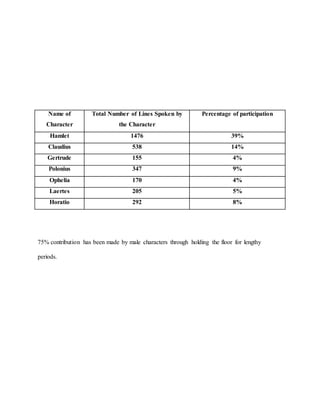
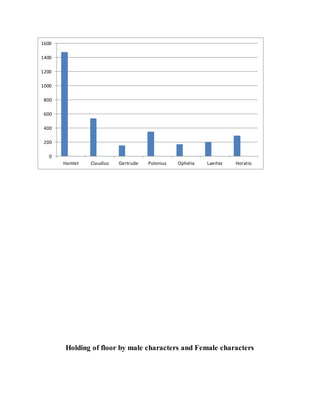
The following table shows the male dominance in the paly:
Total numbers of lines in play “Hamlet” are 3834. The distribution of these lines have been
shown following:
Name of
Character
Total Number of Lines Spoken by
the Character
Percentage of participation
Hamlet 1476 39%
Claudius 538 14%
Gertrude 155 4%
Polonius 347 9%
Ophelia 170 4%
Laertes 205 5%
Horatio 292 8%
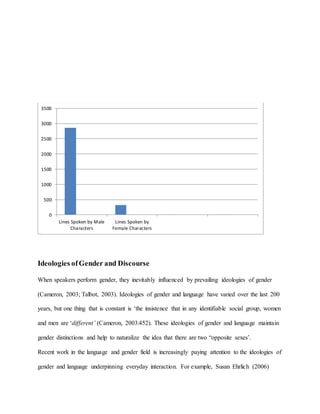
75% contribution has been made by male characters through holding the floor for lengthy
periods.
HAMLET LINE COUNT GRAPH
Holding of floor by male characters and Female characters
0
200
400
600
800
1000
1200
1400
1600
Hamlet Claudius Gertrude Polonius Ophelia Laertes Horatio
Ideologies ofGender and Discourse
When speakers perform gender, they inevitably influenced by prevailing ideologies of gender
(Cameron, 2003; Talbot, 2003). Ideologies of gender and language have varied over the last 200
years, but one thing that is constant is ‘the insistence that in any identifiable social group, women
and men are ‘different’ (Cameron, 2003:452). These ideologies of gender and language maintain
gender distinctions and help to naturalize the idea that there are two “opposite sexes’.
Recent work in the language and gender field is increasingly paying attention to the ideologies of
gender and language underpinning everyday interaction. For example, Susan Ehrlich (2006)
0
500
1000
1500
2000
2500
3000
3500
Lines Spoken by Male
Characters
Lines Spoken by
Female Characters
looks at the language used in a Canadian court room, in a trial about sexual assault, and shows
how dominate ideologies of gender and of sexual behavior make it very difficult for the woman
complainant to be heard.
Following are the some glimpses of gender ideologies in the paly Hamlet. Some extracts show
the gender attitude of different characters:
HAMLET (Act-1-Scene-2)
1. That it should come to this:
But two months dead—nay, not so much, not two.
So excellent a king, that was, to this
Hyperion to a satyr; so loving to my mother
That he might not beteem the winds of heaven
Visit her face too roughly. Heaven and Earth.
Must I remember? why, she would hang on him
As if increase of appetite had grown
By what it fed on. And yet, within a month
(Let me not think on 't; frailty, thy name is woman!)
(1.2.141-150)
Hamlet may start with his mom, but he ends with all women. He's disgusted by his mother's
sexual "appetite," and blames that for her treacherous remarriage. Ergo, somehow, all women are
"frail." He doesn't say "Frailty, thy name is Gertrude!"; he says, "Frailty, thy name is woman."
2. LAERTES (Act-1-Scene-3)
[…] Then, if he says he loves
you,
It fits your wisdom so far to believe it
As he in his particular act and place
May give his saying deed, which is no further
Than the main voice of Denmark goes withal.
Then weigh what loss your honor may sustain
If with too credent ear you list his songs
Or lose your heart, or your chaste treasure open
To his unmaster'd importunity.
Fear it, Ophelia; fear it, my dear sister,
And keep you in the rear of your affection,
Out of the shot and danger of desire.
(1.3.27-39)
Laertes tells her to guard her "chaste treasure" —not because he's interested in chastity as a
moral issue (this isn't about Promise Keepers), but because he believes Ophelia's virginity is
literally valuable. It'll determine what kind of marriage offers she'll get, and what kind of family
she—and he—can align themselves with.
History Snack: In Shakespeare's day, there were plenty of handbooks on this matter, including
Juan Vives's Education of a Christian Woman, which says a maid "hath within her a treasure
without comparison." (Vives's handbook was translated from Latin and published in English in
1592.) Another handbook called A Godly Form of Household Government (1603) says that a
woman's virginity is "the best portion, the greatest inheritance, and the most precious jewel" of
her dowry. Why all this talk of treasure? Well, in the 16th and 17th centuries, eldest sons
inherited all their fathers' wealth, titles, and lands (this is called "Primogeniture"). Marrying a
virgin insured (theoretically) that a man's children were legitimate and that the family wealth
could be passed on from generation to generation. So, literally, marrying a virgin was like
insuring your fortune: just good business.
3. HAMLET (Act III Scene I)
If thou dost marry, I'll give thee this plague
for thy dowry: be thou as chaste as ice, as pure as
snow, thou shalt not escape calumny. Get thee to a
nunnery, farewell. Or, if thou wilt needs marry,
marry a fool, for wise men know well enough what
monsters you make of them. To a nunnery, go, and
quickly too. Farewell.
(3.1.146-152)
This is seriously mean. Here, Hamlet tells Ophelia that women make husbands into "monsters,"
which is allusion to the idea that cuckolds (men whose wives cheated on them) grew horns. In
other words, he assumes that all women are unfaithful and all wives cheat, which is why he
orders Ophelia to a "nunnery" (a convent for unmarried women but also a slang term for
"brothel"). But why does he flip out like this? Does Hamlet know that Claudius and Polonius are
using Ophelia as bait to eavesdrop? If so, does he view Ophelia's participation as a betrayal?
Does Ophelia's seeming betrayal remind Hamlet of his mother's betrayal of his father?
Conclusion:
Gender is not a fixed category, rather it is dynamic and is negotiated according to the
event/activity/ context, thus males and females negotiate a continuum of femininity and
masculinity which is determined by its linguistic marking and the role they have in a particular
activity.
Gender difference can never be an adequate explanatory end point for our analyses, because
it is a social construction that needs studying in and of itself. Thus, in order to develop a
politically productive approach which moves beyond an essentialist framework, we must
‘bracket’ or suspend our belief in the idea that gender is a dualistic category that exists prior to
and outside talk, and explore the uncountable ways in which gender, and gender difference, are
constructed, oriented to and used in language. In addition, researchers must pay more attention to
other social variables which could be affecting their data, rather than automatically attributing
every difference between male and female speech to gender differences.
References
Cameron, D. (1995). Verbal hygiene. London: Routleedge.
Cameron, D. (2007). The myth of Mars and Venus. Oxford University Press. ISBN 0-19-921447-
6.
Cheshire, J. and Trudgill, P. (Eds.), (1998). The sociolinguistics reader, vol. 2: Gender and
discourse. London: Arnold.
Coates, J. (1986). Women, men and language: A sociolinguistic account of gender differences in
language. London: Longman.
Coates, J. (1996). Women Talk: Conversation between women friends. Oxford: Blackwell.
Crawford, M. (1995). Talking Differences: On Gender and Language. London: Sage.
DeFrancisco, V. (1997). Gender, power and practice: Or, Putting your money (and your
research) where your mouth is. In Wardhaugh (2010).
Eckert, P. (1989). The whole woman: Sex and gender differences in variation. Language
Variation and Change 1: 245-67.
Eckert, P. & McConnell-Ginet, S. (1992). Think practically and look locally: Language and
gender as community-based practice. Annual Review of Anthropology, 21: 461-90.
Eckert, P. & McConnell-Ginet, S. (1998). Communities of practice: Where language, gender,
and power all live. In Wardhaugh, (2010).
Eckert, P. & McConnell-Ginet, S. (2003). Language and gender. Cambridge: Cambridge
University Press.
Herring, Susan C. (1992). Gender and participation in computer-mediated linguistic discourse.
Washington, DC: ERIC Clearinghouse on languages and linguistics document no. ED345552.
Holmes, J. (1998). Women’s talk: The question of sociolinguistic universals. In Wardhaugh,
(2010).
Holmes, J. and Meyerhoff, M. (1999). The Community of practice: Theories and methodologies
in language and gender research. Language in Society, 28 (2). 173-183.
doi: 10.1017/S004740459900202X
Labov, W. (1994). Principles of linguistic change, I: Internal factors. Oxford: Blackwell.
Labov, W. (2001). Principles of linguistic change, II: Social factors. Oxford: Blackwell.
Lakoff, R. (1975). Language and woman's place. New York: Harper & Row.
LIN8015 Introduction to sociolinguistics: Introductory book. (2012). University of Southern
Queensland.
Maltz, D. N. and Borker, R. A. (1982). A cultural approach to male female miscommunication.
In John J. Gumperz (ed.) Language and Social Identity. Cambridge: Cambridge University Press,
pp. 196-216.
Md, Sohel. Ranai. & Osama, Khalifa. Moh. (2011). Sex as an independent variable related to
linguistics variables. Jazan University, Kingdom of Saudi Arabia
Nguyen, V. K. (1999). Ung xu ngon ngu trong giao tiep gia dinh nguoi Viet. Publisher: Van Hoa
Thong tin.
O’Barr, W. & Bowman, A. (1980). Women’s language' or 'powerless language'. In McConnell-
Ginet et al. (Eds.) Women and languages in Literature and Society. pp. 93-110. New York:
Praeger.
Spender, D. (1985). Man made language. 2nd edn. London: Routledge & Kegan Pail.
Talbot, M. M. (1998). Language and Gender: an introduction. Cambridge: Polity.
Tannen, D. (1990). You Just Don't Understand: Women and Men in Conversation. New York:
William Morrow.
Tannen, D. (1993). Gender and conversational interaction. New York: Oxford University Press.
Tannen, D. (1994). Gender and discourse. New York: Oxford University Press.
Tannen, D. (1998). Talk in the intimate relationship: His and hers. Wardhaugh (2010).
Trudgill, P. (1972). Sex, covert prestige and linguistic change in the urban British English of
Norwich. Language in Society, 1: 179-95.
Wardhaugh, R. (2010). An Introduction to sociolinguistics. Oxford: Blackwell.
Zimmerman, D. and West, C. (1975). Sex roles, interruptions, and silences in conversation. In
Barrie Thorne and Nancy Henley. (Eds.) Language and Sex: Difference and Dominance.
Rowley, MA: Newbury House, pp. 105-29
https://sites.google.com/a/shakespearelinecount.com/www/hamlet-graph
http://www.shmoop.com/hamlet/gender-theme.html

Gender analysis in Hamlet

  • 1.
    Term Paper Introduction toGender and Discourse Analysis Gender Analysis in Hamlet Muhammad Aqeel Hayder M.phil (Session 2015-17) Bahauddin Zakariya University Multan (Pakistan)
  • 2.
    Abstract This paper focuseson the literature that has contributed to the understanding of the major research questions underlying two major strands, language and gender, concentrating on the development of the literature from the deficit and dominance models to the social constructivist era of post- modernism in order to provide a context for recent developments in language and gender theories. The study of language and gender has increasingly become the study of discourse and gender. While phonological, lexical, and other kinds of linguistic analysis continue to be influential, the interdisciplinary investigation of discourse-level phenomena, always a robust area of language and gender scholarship, has become the central approach of the field.
  • 3.
    Introduction In sociolinguistics andother related areas of academia, discourse is usually defined as the relationship between language and its real-world context. Many researchers and theorists relate discourse specifically to power structures in a given society, and this is the area where there is the most overlap between gender and discourse. Approaches to gender and discourse research may analyze the way language reflects or influences gender stereotypes, or they may discuss the differences between how men and women use language. Much use of the word discourse in the late 20th and early 21st centuries was influenced by the work of the French philosopher Michel Foucault, who defined the use of language and other sign systems as a means to control people's actions. Drawing on Foucault's theories, many researchers have analyzed gender in relation to existing social and cultural power structures. Some theorists argue that the way language is used re-enforces existing power structures, while others claim that discourse simply reflects the existing state of affairs. The relationship between power and discourse may also be viewed as cyclical or mutually re-enforcing: social structures influence language, and language influences social structures. Foucaultian approaches to gender and discourse tend to focus on the relationship between gender and power. Language and Gender
  • 4.
    Language and genderis an interdisciplinary field of research that studies varieties of speech (and, to a lesser extent, writing) in terms of gender, gender relations, gendered practices, and sexuality. In The Handbook of Language and Gender (2003), Janet Holmes and Miriam Meyerhoff discuss the shift that has occurred in the field since the early 1970s--a movement away from "essentialist and dichotomous conceptions of gender to a differentiated, contextualized, and performative model which questions generalized claims about gender." One of the most striking phenomenon in language study in the 1970s and 1980s was the development of the field of research known as ‘language and gender’. This area of research continues to grow: the international Gender and Language Association was founded in 1999 and holds biennial conferences, and a journal- Gender and Language- was launched in 2007, dedicated to the publication of research in this area. Language is the most important communication tool for human beings. It not only reflects the reality of the society, but also has various functions to strengthen and maintain social existence. Given such a view, language does mirror the gendered perspectives and can also impact and contribute to changing people's perception of gender over time. Thus, for a long time feminists and sociolinguists have shown interest in describing the differences in language use between women and men, and studies of the cultural roles ascribed to gender. However, interest in language usage differences between the two sexes has a very long tradition in attempting to explain the distinction between language and gender and how language supports, enforces, and maintains attitudes about gender in general and women in particular.
  • 5.
    This paper attemptsto discuss the following points: (1) some important issues on the relationship between gender and language; (2) some explanations on the differences between male and female speech such as: power in gender relationships, community practice, conversational styles and strategies, attitudes and prestige, and discrimination and sexist language practices; and (3) the implications for language planning. A brief overview of key language and gender approaches Since the 1960s, sociolinguists (e.g., Camerron,1995; Eckert,1989; Holmes & Meyerrhoff, 1999; Labov,1994, 2001; Lakoff,1975; Tannen,1990; Trugill,1975; Zimmerman & West,1975) have been exploring the gendered dimension of language. These early works have assisted in distinguishing different aspects of sex and gender. Although many sociolinguistic researchers use gender and sex interchangeably, it is very critical to understand that sex refers to biological features such as XX chromosomes for females and XY chromosomes for males. Some studies claim that the assumptions associated with characteristics for male as masculinity, or likewise characteristics for females as femininity, are inaccurate. Such a biological view on sexual character leads to reification (making real/concrete) of male and female inequality in our society. This interpretation results in numerous sociobiological claims relative to neurological factors about the relationship of male and female speech behavior. On the contrary, gender refers to cultural and social attributes that have been acquired via the socialization process. It is up to individuals to choose characteristics that they deem suitable for males and females and employ them accordingly. According to Wardhaugh (2010), gender is also a fact that we cannot avoid; it is part of the way in which societies are formed around us (pp.334). Therefore, Cameron (2007), Coates (1986), Crawford (1995), Eckert (1989), Tannen (1990), Holmes & Meyerhoff (1999), and other scholars have considered gender as a social
  • 6.
    construct in thestudy of language and gender and social sciences. Gender division is a fundamental aspect of society, as it is deeply imbedded in social organization and taught to individuals from early childhood to adulthood stages. However, numerous studies argue that gender categories have changed throughout history and varied depending on specific race, ethnicity, culture, religion, nationality, region, and class (Labov, 1994, 2001; Lakoff, 1975, Wardhaugh, 2010). Eckert and McConnell-Ginet claim that “The force of gender categories in society makes it impossible for us to move through our lives in a non-gendered way and impossible not to behave in a way that brings out gendered behavior in others (2003, p. 50, as cited in Wardhaugh, 2010). The sex and gender definitions and explanations put forth the following key approaches on the relationship between language and gender: The Biological Approach The biological approach was the initial focus in the field of language research in the 1960s. It accounted for the distinction between men and women in speech behavior on lexical, phonological, and morphological forms. For example, typical male voice characteristics are different from those of typical female voice characteristics; women usually have a fundamental voice-frequency nearly twice as high as those of men (LIN8015, 2012; Md Sohel Rana & Osama Khalifa Moh, 2011). The Cultural Approach In numerous studies, such as those of Tannen’s (1990) and Maltz and Borker’s (1982), two cultural approaches were examined. They argued that males and females belong to their own sub-culture and thus use language to maintain identity within their respective groups. Maltz and Borker (1982) indicated that girls tend to engage in pairs or small groups. Their speech aims to
  • 7.
    build an intimatefriendship, loyalty, equality, support, a win-win situation, and a lack of desire to be a leader (in fact they are encouraged not to be). On the contrary, males choose to work in larger and hierarchically organized groups. They are more concerned with power, status, and control. They compete to draw participants’ attention and win games. They enjoy showing skills, size, and ability and try to express their dominance even when others speak. These cultural differences in the male and female groups lead to variance in the ways in which they converse and convey ideas (Coates, 1986; LIN8015, 2012; Md Sohel Rana & Osama Khalifa Moh, 2011). The power and dominance approach Several scholars, e.g., Spender, 1985; Zimmerman & West, 1975; Coates, 1986; and O’Barr & Bowman, 1980, highlighted the power and dominance approach. They claim that women in a patriarchal system have a low social status and position; therefore, the employment of standard language use aims to raise their self-esteem. The difference in an interaction approach assumes as a fact that interactions between males and females are attempts toward male domination, or social inequalities between males and females. This approach allows for intepretations of communication problems between men and women because of the unequal hierarchical statuses and gender roles held in society. Women’s speech was considered unimportant; therefore, they used linguistic forms that were associated with their low positions in society. These forms included tag questions, question intonations, hedges, politeness strategies, and others. Conversely, men’s speech, for example, became an implicit tool of patriarchal power through conscious and less conscious gender-role training where they learned to dominate a conversation through interruptions, talk time, etc. (Spender, 1985; Tannen, 1990; Zimmerman & West, 1975). Thus, the early deficit approach was changed to a dominance approach. The social constructionist approach
  • 8.
    Last but notleast, the social constructionist approach has been a particularly influential model in recent studies on language and gender (Coates, 1986; Holmes & Meryerhoff, 1999). These studies explored not only social constructs, the relationship between gender and other aspects of identity, but also the magnitude of context in determining how individuals use language (LIN8015, 2012; Md Sohel Rana & Osama Khalifa Moh, 2011; Spender, 1985). The following issues were ascribed by Holmes (1998) that  women and men develop different language use patterns,  tend to focus on the affective functions of an interaction more often than men,  tend to use linguistic devices that stress solidarity more often than men,  tend to interact in ways that will maintain and increase solidarity, while (especially in formal contexts) men tend to interact in ways that will maintain and increase their power and status, and are stylistically more flexible than men. These issues are still under debate and have become promising topics for interdisciplinary explanations (as cited in Wardhaugh, pp.342). In addition, there are issues that have been raised and are still in great need of language and gender research (Maltz and Borker, 1982; Tannen, 1990). They include:  The influence of gender on perceptions of categories,  The influence of gender and sex on male and female conversational discourse,  The relationship between women’s speech patterns and cross-cultural communication Claims of Differences between Male and Female Speech Claims of differences between male and female speech are:
  • 9.
    Power in GenderRelations Numerous studies by DeFrancisco (1997); Herring (1992), Lakoff (1975) and Tannen (1990) analyzed the complex relationships between women and power through interactions. Lakoff explored a discourse analysis of writing texts from three major American institutions: academia using Schegloff’s claims on the appropriate way of treating gender in a conversation analysis, and art from an Oleanna play that highlights the distribution of talk in the controversial Mamet, and proper politics in the way print media sexualizes, objectifies, and ridicules women in politics. Lakoff argues that aspects of the disruption of conventional speech convey subordinated and dominant ideologies. Herring presents gender issues in computer-mediated communication on the internet and she stresses that issues of power relationships emerge and reinforce norms of society at large and how women place and express themselves in the virtual word. Others who have viewed cross-gender communications (Spender, 1985, Zimmerman & West, 1975; Tannen, 1990, 1993, 1994, 1998) explained that male communication is the norm and that males interrupt, challenge, and control more in conversations. Such characteristics are not for women in communication. In other words, language behavior posits males into a superior status and females in subservient positions. Therefore, women have to adopt standard language forms as a means of responding to, working with, and challenging authority. Community of practice Community of practice (COP) is defined as another important variable in language and gender research. According to Eckert & McConnell-Ginet (2003), COP is a group of individuals who share a profession and come together through shared goals. The practice includes both global and specific aspects of structure, discourse, and interaction patterns. Thus, it extends the notion of a speech community. All practices belong to an identity group that helps members learn how to
  • 10.
    modify and shapetheir linguistic and other behaviors in a way that fits the perceptions of self and others. Apparently, this framework assists sociolinguists to examine three crucial dimensions: mutual engagement, joint negotiated enterprise, and a shared repertoire of negotiable resources accumulated over time. Examples of COP are research groups, sport-teams, and policy making groups (Holmes & Meyerhoff, 1999; Wardhaugh, 2010). Conversational styles and strategies Are women more stylish in their speech or do they use more politeness strategies than do men? Lakoff (1975) on “Language and Woman’s Place” explained the deficit positions of women in language use in comparison to that of men in various ways: women are taught not to express themselves strongly, encouraged to talk in an uncertain ways, use more polite and weaker forms of directives while men’s speech is described as direct, forceful, authoritative, and confident. She pointed out that women are more likely to use too many qualifiers or intensifiers like: “I think that” or “very”; or empty adjectives such as: divine, adorable; or among others tag questions like (isn’t it?). She identified these features to reveal that the male dominant position in society places greater emphasis on differences in power of speech between men and women (as cited in Wardhaugh, 2010). Attitudes and prestige In his work on language, class, and gender, Peter Trudgill (1972) had research participants, who were grouped according to social class and sex, read a paragraph that consisted of words ending in “ing” sounds. He found that male speakers tended to drop the final sound of “g” and pronounced the endings as “in”. That is, they used low prestige pronunciation. On the contrary, female speakers were more likely not to drop the final sound of “g” and pronounced the word- ending as “ing”. That is, women tended to employ the prestige pronunciation of certain speech
  • 11.
    sounds due totheir hyper-correctness. To support this analysis, Trudgill adopted this view of ‘covert and overt prestige’ from Labov. Labov defines covert prestige as a low-prestige language that is used by traditional working class neighborhoods. In certain groups, standard language is not desirable because of a powerful in-group marker and the use of non-standard forms reflects the group identity and solidarity. For men, they show lack of non-standard forms because men in society are judged through their work and masculine values, so they employ the standard forms of language due to the ‘covert prestige’. In contrast to covert prestige, women are more likely to overstress the standard form due to ‘overt prestige’ as they aspire toward a higher social class. Their speech style is considered better or more hyper-correct because their social positions are lower and less secure and they are judged by their language and appearance, so they use more standard forms. But the explanation may be different if women attain a more social status through education, work, and social changes (Md Sohel Rana & Osama Khalifa Moh, 2011). Discrimination and sexist language practices For years, feminists have argued that sexist language exists in every culture. The use of the gendered title pronounced (Mrs or Miss) reflects not only sexism but also ideas and expectations about gender roles, career selection, and goals for males and females in society. Gender bias, occuring consciously or unconsciously and which underlies sexist language, is another common error. Speakers tend to assume that man is the norm and woman the “other”. For example, “Each student does his own assignments” or using the words “congressman, policeman, or mankind for all people”, thus indicating a view of men as the first citizen regarding morality, spirituality, intellectuality, and absolute to women. In this modern era this may cause offence, therefore, these forms need to be changed (Lakoff, 1975; Talbot, 1998). Implications of language planning
  • 12.
    Gender bias isreflected in language both structurally and in informal communication. To facilitate gender equality in the family, in the workplace and in society, it is important to create equality in language through language planning. This is the reason why eliminating expression of gender bias against women in language has rapidly become part of the planning of language with the name: “feminist language reform”, "non-sexist language reform”, "feminist linguistic intervention", "sexist language reform", "feminist language planning”, "feminist language policy", and "reform of gender-biased language” (Lakoff, 1975; Chesire & Trugill, 1998, Nguyen, 1999; Wardhaugh, 2010). Modification and reform are two gendered language planning strategies. Modification is to change the habit of using gender discrimination in language. For example, by eliminating the use of “man” and replacing the term with the generic: person/people, individual(s), human(s), or human-being(s) instead; and by avoiding sexism when formally addressing persons by employing Ms instead of Miss or Mrs regardless of their marital status solves the gender discrimination problem. Another strategy for language reform includes replacing forms that disregard women by the use of stereotypical roles, such as “chairman with chairperson, salesman with salesperson, fireman with fighter-fighter”. Recently, there have emerged some new gendered words: statesman and stateswoman, sportsman and sportswoman. To create equality in the use of the two pronouns he and she, some researchers suggest varying the use of male and female pronouns or use replacing gendered pronouns with “we”. Thus, we can see the purpose of language planning by targeting equal rights for women is to gradually reduce the disregard for women in language through eliminating the habit of using language that carries gender bias. Along with changing the habit of using gender bias language, new expressions are created that avoid gender bias. Finally, language modification must be carried
  • 13.
    out in boththe written and spoken forms, for example, through curriculum change, as well as in textbooks, theses, and essays in educational school environments. The media industry is also responsible for combatting sexism by eliminating gendered and discriminatory language (Cheshire & Trugill, 1998; Nguyen, 1999; Wardhaugh, 2010). Literature, Gender and Discourse Analysis Role of gender has great significance in literature. Different writers portray gender power relations differently. Shakespearian tragedies are dominated by male characters, while comedies are dominated by female characters. Hamlet by William Shakespeare has been taken as a sample for gender analysis. Conversational Dominance Strategies  The men used various non-cooperative strategies for conversational dominance, these are  Interruptions  No-Response or Silence  Holding the floor for lengthy periods  Inadequate or delayed response Interruptions Second, the play begins with a series of interruptions, which take the form of a series of demands for identification: "Stand and unfold yourself" and "Stand, ho! Who is there?" (1.1.3, 14). Barnardo is interrupted in his watch by Francisco, and those two by the entry of Horatio and Marcellus. Barnardo begins to describe the ghost's appearance with a speech that is remarkably leisurely (1.1.35ff), but his story is interrupted by the ghost. When Horatio begins to describe the meaning of ghosts and portents, the ghost interrupts again (1.1.112-125). Just as the ghost
  • 14.
    appears to bebeginning to speak, he is interrupted by the cock crow, and steals away like a guilty thing (1.1.138, 148). In the middle of scene 2, another interruption: Hamlet's meditations are cut short by the appearance of Horatio and the soldiers – effectively another appearance of the ghost. And then the time between is taken up with another interruption, as Laertes takes his leave of Polonius and Elsinore. He instructs Ophelia not to trust Hamlet's professions of love, emphasizing that Hamlet must listen more to the demands of the body politic than to the urges and desires of his own body (1.3.22-23). Polonius' speech contains advice to Laertes as he leaves. Findings Holding the Floorfor Lengthy Periods In dominance approach male members of the conversation hold the floor for lengthy period, using this strategy they maintain their dominance. Hamlet by Shakespeare has no exceptions. The following table shows the male dominance in the paly: Total numbers of lines in play “Hamlet” are 3834. The distribution of these lines have been shown following:
  • 15.
    Name of Character Total Numberof Lines Spoken by the Character Percentage of participation Hamlet 1476 39% Claudius 538 14% Gertrude 155 4% Polonius 347 9% Ophelia 170 4% Laertes 205 5% Horatio 292 8% 75% contribution has been made by male characters through holding the floor for lengthy periods.
  • 16.
  • 17.
    Holding of floorby male characters and Female characters 0 200 400 600 800 1000 1200 1400 1600 Hamlet Claudius Gertrude Polonius Ophelia Laertes Horatio
  • 18.
    Ideologies ofGender andDiscourse When speakers perform gender, they inevitably influenced by prevailing ideologies of gender (Cameron, 2003; Talbot, 2003). Ideologies of gender and language have varied over the last 200 years, but one thing that is constant is ‘the insistence that in any identifiable social group, women and men are ‘different’ (Cameron, 2003:452). These ideologies of gender and language maintain gender distinctions and help to naturalize the idea that there are two “opposite sexes’. Recent work in the language and gender field is increasingly paying attention to the ideologies of gender and language underpinning everyday interaction. For example, Susan Ehrlich (2006) 0 500 1000 1500 2000 2500 3000 3500 Lines Spoken by Male Characters Lines Spoken by Female Characters
  • 19.
    looks at thelanguage used in a Canadian court room, in a trial about sexual assault, and shows how dominate ideologies of gender and of sexual behavior make it very difficult for the woman complainant to be heard. Following are the some glimpses of gender ideologies in the paly Hamlet. Some extracts show the gender attitude of different characters: HAMLET (Act-1-Scene-2) 1. That it should come to this: But two months dead—nay, not so much, not two. So excellent a king, that was, to this Hyperion to a satyr; so loving to my mother That he might not beteem the winds of heaven Visit her face too roughly. Heaven and Earth. Must I remember? why, she would hang on him As if increase of appetite had grown By what it fed on. And yet, within a month (Let me not think on 't; frailty, thy name is woman!) (1.2.141-150) Hamlet may start with his mom, but he ends with all women. He's disgusted by his mother's sexual "appetite," and blames that for her treacherous remarriage. Ergo, somehow, all women are "frail." He doesn't say "Frailty, thy name is Gertrude!"; he says, "Frailty, thy name is woman." 2. LAERTES (Act-1-Scene-3)
  • 20.
    […] Then, ifhe says he loves you, It fits your wisdom so far to believe it As he in his particular act and place May give his saying deed, which is no further Than the main voice of Denmark goes withal. Then weigh what loss your honor may sustain If with too credent ear you list his songs Or lose your heart, or your chaste treasure open To his unmaster'd importunity. Fear it, Ophelia; fear it, my dear sister, And keep you in the rear of your affection, Out of the shot and danger of desire. (1.3.27-39) Laertes tells her to guard her "chaste treasure" —not because he's interested in chastity as a moral issue (this isn't about Promise Keepers), but because he believes Ophelia's virginity is literally valuable. It'll determine what kind of marriage offers she'll get, and what kind of family she—and he—can align themselves with. History Snack: In Shakespeare's day, there were plenty of handbooks on this matter, including Juan Vives's Education of a Christian Woman, which says a maid "hath within her a treasure without comparison." (Vives's handbook was translated from Latin and published in English in 1592.) Another handbook called A Godly Form of Household Government (1603) says that a
  • 21.
    woman's virginity is"the best portion, the greatest inheritance, and the most precious jewel" of her dowry. Why all this talk of treasure? Well, in the 16th and 17th centuries, eldest sons inherited all their fathers' wealth, titles, and lands (this is called "Primogeniture"). Marrying a virgin insured (theoretically) that a man's children were legitimate and that the family wealth could be passed on from generation to generation. So, literally, marrying a virgin was like insuring your fortune: just good business. 3. HAMLET (Act III Scene I) If thou dost marry, I'll give thee this plague for thy dowry: be thou as chaste as ice, as pure as snow, thou shalt not escape calumny. Get thee to a nunnery, farewell. Or, if thou wilt needs marry, marry a fool, for wise men know well enough what monsters you make of them. To a nunnery, go, and quickly too. Farewell. (3.1.146-152) This is seriously mean. Here, Hamlet tells Ophelia that women make husbands into "monsters," which is allusion to the idea that cuckolds (men whose wives cheated on them) grew horns. In other words, he assumes that all women are unfaithful and all wives cheat, which is why he orders Ophelia to a "nunnery" (a convent for unmarried women but also a slang term for "brothel"). But why does he flip out like this? Does Hamlet know that Claudius and Polonius are using Ophelia as bait to eavesdrop? If so, does he view Ophelia's participation as a betrayal? Does Ophelia's seeming betrayal remind Hamlet of his mother's betrayal of his father? Conclusion:
  • 22.
    Gender is nota fixed category, rather it is dynamic and is negotiated according to the event/activity/ context, thus males and females negotiate a continuum of femininity and masculinity which is determined by its linguistic marking and the role they have in a particular activity. Gender difference can never be an adequate explanatory end point for our analyses, because it is a social construction that needs studying in and of itself. Thus, in order to develop a politically productive approach which moves beyond an essentialist framework, we must ‘bracket’ or suspend our belief in the idea that gender is a dualistic category that exists prior to and outside talk, and explore the uncountable ways in which gender, and gender difference, are constructed, oriented to and used in language. In addition, researchers must pay more attention to other social variables which could be affecting their data, rather than automatically attributing every difference between male and female speech to gender differences. References Cameron, D. (1995). Verbal hygiene. London: Routleedge. Cameron, D. (2007). The myth of Mars and Venus. Oxford University Press. ISBN 0-19-921447- 6. Cheshire, J. and Trudgill, P. (Eds.), (1998). The sociolinguistics reader, vol. 2: Gender and discourse. London: Arnold.
  • 23.
    Coates, J. (1986).Women, men and language: A sociolinguistic account of gender differences in language. London: Longman. Coates, J. (1996). Women Talk: Conversation between women friends. Oxford: Blackwell. Crawford, M. (1995). Talking Differences: On Gender and Language. London: Sage. DeFrancisco, V. (1997). Gender, power and practice: Or, Putting your money (and your research) where your mouth is. In Wardhaugh (2010). Eckert, P. (1989). The whole woman: Sex and gender differences in variation. Language Variation and Change 1: 245-67. Eckert, P. & McConnell-Ginet, S. (1992). Think practically and look locally: Language and gender as community-based practice. Annual Review of Anthropology, 21: 461-90. Eckert, P. & McConnell-Ginet, S. (1998). Communities of practice: Where language, gender, and power all live. In Wardhaugh, (2010). Eckert, P. & McConnell-Ginet, S. (2003). Language and gender. Cambridge: Cambridge University Press. Herring, Susan C. (1992). Gender and participation in computer-mediated linguistic discourse. Washington, DC: ERIC Clearinghouse on languages and linguistics document no. ED345552. Holmes, J. (1998). Women’s talk: The question of sociolinguistic universals. In Wardhaugh, (2010). Holmes, J. and Meyerhoff, M. (1999). The Community of practice: Theories and methodologies in language and gender research. Language in Society, 28 (2). 173-183. doi: 10.1017/S004740459900202X Labov, W. (1994). Principles of linguistic change, I: Internal factors. Oxford: Blackwell. Labov, W. (2001). Principles of linguistic change, II: Social factors. Oxford: Blackwell.
  • 24.
    Lakoff, R. (1975).Language and woman's place. New York: Harper & Row. LIN8015 Introduction to sociolinguistics: Introductory book. (2012). University of Southern Queensland. Maltz, D. N. and Borker, R. A. (1982). A cultural approach to male female miscommunication. In John J. Gumperz (ed.) Language and Social Identity. Cambridge: Cambridge University Press, pp. 196-216. Md, Sohel. Ranai. & Osama, Khalifa. Moh. (2011). Sex as an independent variable related to linguistics variables. Jazan University, Kingdom of Saudi Arabia Nguyen, V. K. (1999). Ung xu ngon ngu trong giao tiep gia dinh nguoi Viet. Publisher: Van Hoa Thong tin. O’Barr, W. & Bowman, A. (1980). Women’s language' or 'powerless language'. In McConnell- Ginet et al. (Eds.) Women and languages in Literature and Society. pp. 93-110. New York: Praeger. Spender, D. (1985). Man made language. 2nd edn. London: Routledge & Kegan Pail. Talbot, M. M. (1998). Language and Gender: an introduction. Cambridge: Polity. Tannen, D. (1990). You Just Don't Understand: Women and Men in Conversation. New York: William Morrow. Tannen, D. (1993). Gender and conversational interaction. New York: Oxford University Press. Tannen, D. (1994). Gender and discourse. New York: Oxford University Press. Tannen, D. (1998). Talk in the intimate relationship: His and hers. Wardhaugh (2010). Trudgill, P. (1972). Sex, covert prestige and linguistic change in the urban British English of Norwich. Language in Society, 1: 179-95. Wardhaugh, R. (2010). An Introduction to sociolinguistics. Oxford: Blackwell.
  • 25.
    Zimmerman, D. andWest, C. (1975). Sex roles, interruptions, and silences in conversation. In Barrie Thorne and Nancy Henley. (Eds.) Language and Sex: Difference and Dominance. Rowley, MA: Newbury House, pp. 105-29 https://sites.google.com/a/shakespearelinecount.com/www/hamlet-graph http://www.shmoop.com/hamlet/gender-theme.html