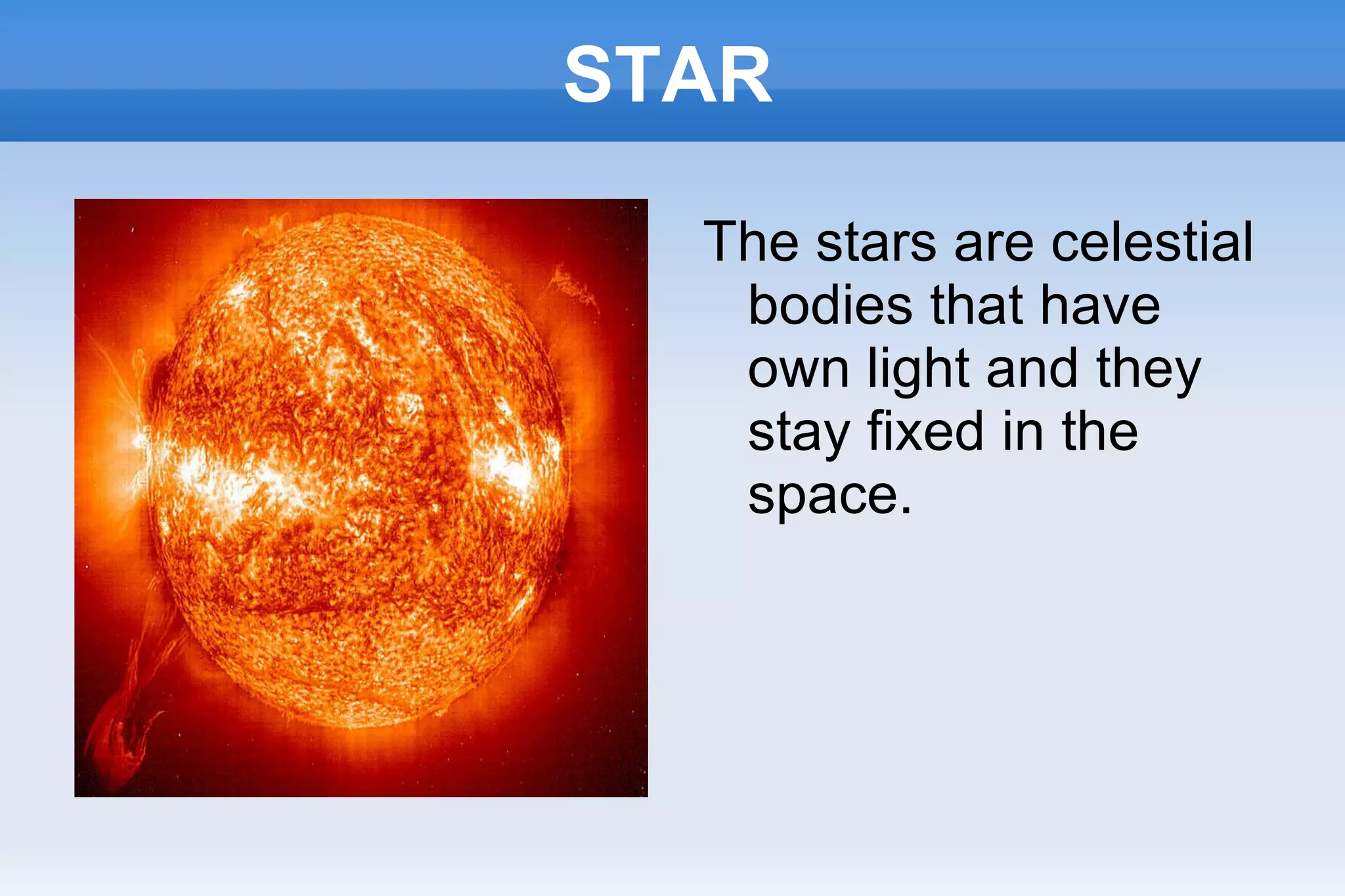
STAR The stars are celestial bodies that have own light and they stay fixed in the space.
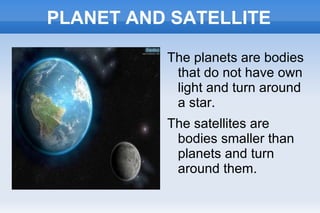
PLANET AND SATELLITE The planets are bodies that do not have own light and turn around a star.
The satellites are bodies smaller than planets and turn around them.
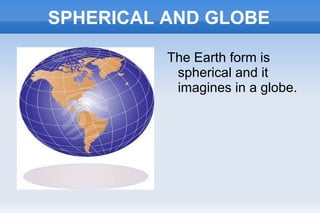
SPHERICAL AND GLOBE The Earth form is spherical and it imagines in a globe.
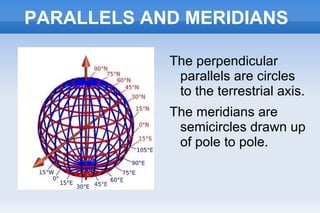
PARALLELS AND MERIDIANS  The perpendicular parallels are circles to the terrestrial axis.
The meridians are semicircles drawn up of pole to pole.
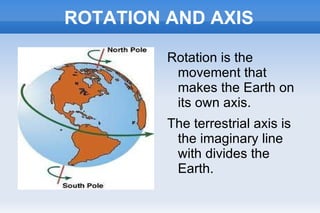
ROTATION AND AXIS Rotation is the movement that makes the Earth on its own axis.
The terrestrial axis is the imaginary line with divides the Earth.
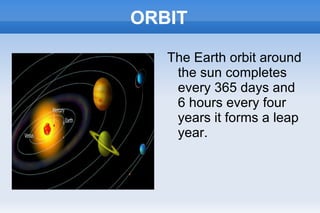
ORBIT The Earth orbit around the sun completes every 365 days and 6 hours every four years it forms a leap year.
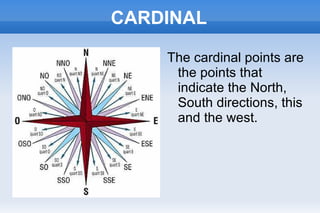
CARDINAL The cardinal points are the points that indicate the North, South directions, this and the west.
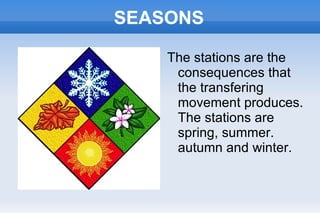
SEASONS The stations are the consequences that the transfering movement produces. The stations are spring, summer. autumn and winter.
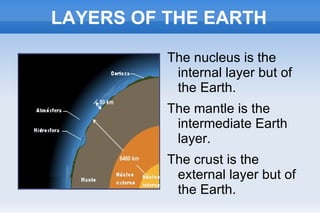
LAYERS OF THE EARTH The nucleus is the internal layer but of the Earth.
The mantle is the intermediate Earth layer.
The crust is the external layer but of the Earth.
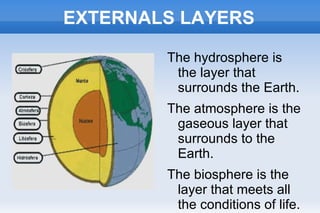
EXTERNALS LAYERS The hydrosphere is the layer that surrounds the Earth.
The atmosphere is the gaseous layer that surrounds to the Earth.
The biosphere is the layer that meets all the conditions of life.
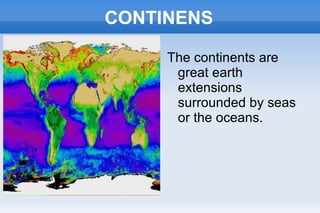
CONTINENS The continents are great earth extensions surrounded by seas or the oceans.
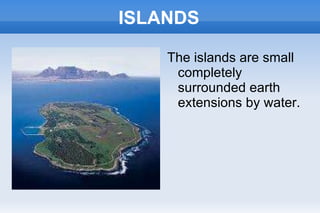
ISLANDS The islands are small completely surrounded earth extensions by water.
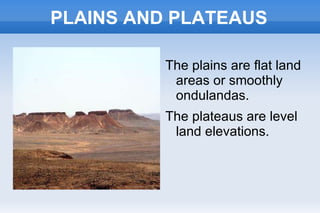
PLAINS AND PLATEAUS The plains are flat land areas or smoothly ondulandas.

Social Science