WELCOME
TO
THE PRESENTATION
www.correcteducate.blogspot.com
 UNIVERSE
The Universe is all of space and time and their contents, including planets, stars, galaxies, and all
other forms of matter and energy.
 GALAXY
A galaxy is a huge system of billions of stars, and clouds of dust and gases.
 CELESTIAL BODIES
The sun, the moon and all those objects shining in the night sky are called celestial bodies.
 SOLAR SYSTEM
solar system consists of :
• The Sun
• The Planets
• Dwarf Planets & countless fragments of left – overs called
asteroids, meteors, comets & satellites of the planets (Called
small solar system Bodies).
 SUN
The sun is in the center of the solar system. It is huge
and made up of extremely hot gases. It provides the
pulling force that binds the solar system. The sun is
the ultimate source of heat and light for the solar
system.
 PLANETS
There are eight planets in our solar system. In order of
their distance from the sun, they are: Mercury,
Venus, Earth, Mars, Jupiter, Saturn, Uranus and
Neptune.
 ASTEROIDS
Apart from the stars, planets and satellites, there are
numerous tiny bodies which also move around the
sun. These bodies are called asteroids. They are found
between the orbits of Mars and Jupiter
 METEOROIDS
The small pieces of rocks which move around the sun
are called meteoroids.
 Biggest Planet Jupiter
 Smallest Planet Mercury
 Nearest Planet to Sun Mercury
 Farthest Planet from Sun Neptune
 Nearest Planet to Earth Venus
 Brightest Planet Venus
 Brightest star after Sun Sirius
 Planet with maximum satellites Jupiter
 Coldest Planet Neptune
 Hottest Planet Venus
 Heaviest Planet Jupiter
 Red Planet Mars
 Biggest Satellite Ganymede
 Smallest Satellite Deimos
 Blue Planet Earth
 Morning/Evening Star Venus
 Earth's Twin Venus
 Green Planet Neptune
 Planet with a big red spot Jupiter
 Lord of the Heavens Jupiter
LATITUDE
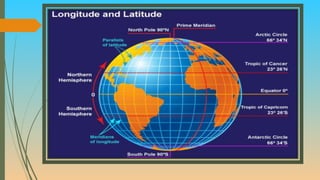
• These are imaginary lines drawn parallel to the equator. Measured
as an angle whose apex is at the center of the earth.
• The equator represents 0° latitude, while the North Pole is
90° N & the South Pole 90° S.
• Tropic of Cancer while 23½° N, Tropic of Capricorn 23½° N.
• 66½° N represents Arctic Circle while 66½° S represents
Antarctic Circle.
• There are total 181 latitudes including the equator. Each
parallel of latitude is a circle, but they are not equal.
• The circle becomes smaller towards the poles. Equator is
the ‘Greatest Circle’ that can be drawn on the earth’s
surface.
• The distance between any two parallels of latitude is
always equal.
• 1 degree latitude at equator = 111km.
LONGITUDE
1. It is the angular distance measured from die center of the
earth. On the globe the lines of longitude are drawn as a
series of semicircles that extend from the North Pole to the
South Pole through the equator. They are also called
meridians.
2. The distance between any two meridians is not equal.
3. At the equator, 1 degree = 111 km. At 30°N or S, it is 96.5
km. It goes on decreasing this way until it is zero at the
poles.
4. There are 360 meridians of longitude. The prime meridian
is a longitude of 0 degree, passing through the Royal
Observatory at Greenwich near London.
5. This meridian is taken by geographers to divide the earth
into the eastern & the western hemispheres.
6. Each meridian of longitude is a semi-circle.
7. 180° meridian (International Date Line) lies exactly opposite to 0°
meridian. Such points are called Antipodal Points.
8. The earth is divided into 24 longitudinal zones, each being
15° or 1 hour apart in time (4 minutes / degree).
TIME
INTERNATIONAL DATE LINE
UNIVERSE
Introduction to geography

Introduction to geography

  • 1.
  • 2.
     UNIVERSE The Universeis all of space and time and their contents, including planets, stars, galaxies, and all other forms of matter and energy.  GALAXY A galaxy is a huge system of billions of stars, and clouds of dust and gases.  CELESTIAL BODIES The sun, the moon and all those objects shining in the night sky are called celestial bodies.  SOLAR SYSTEM solar system consists of : • The Sun • The Planets • Dwarf Planets & countless fragments of left – overs called asteroids, meteors, comets & satellites of the planets (Called small solar system Bodies).
  • 3.
     SUN The sunis in the center of the solar system. It is huge and made up of extremely hot gases. It provides the pulling force that binds the solar system. The sun is the ultimate source of heat and light for the solar system.  PLANETS There are eight planets in our solar system. In order of their distance from the sun, they are: Mercury, Venus, Earth, Mars, Jupiter, Saturn, Uranus and Neptune.  ASTEROIDS Apart from the stars, planets and satellites, there are numerous tiny bodies which also move around the sun. These bodies are called asteroids. They are found between the orbits of Mars and Jupiter  METEOROIDS The small pieces of rocks which move around the sun are called meteoroids.
  • 4.
     Biggest PlanetJupiter  Smallest Planet Mercury  Nearest Planet to Sun Mercury  Farthest Planet from Sun Neptune  Nearest Planet to Earth Venus  Brightest Planet Venus  Brightest star after Sun Sirius  Planet with maximum satellites Jupiter  Coldest Planet Neptune  Hottest Planet Venus  Heaviest Planet Jupiter  Red Planet Mars  Biggest Satellite Ganymede  Smallest Satellite Deimos  Blue Planet Earth  Morning/Evening Star Venus  Earth's Twin Venus  Green Planet Neptune  Planet with a big red spot Jupiter  Lord of the Heavens Jupiter
  • 5.
    LATITUDE • These areimaginary lines drawn parallel to the equator. Measured as an angle whose apex is at the center of the earth. • The equator represents 0° latitude, while the North Pole is 90° N & the South Pole 90° S. • Tropic of Cancer while 23½° N, Tropic of Capricorn 23½° N. • 66½° N represents Arctic Circle while 66½° S represents Antarctic Circle. • There are total 181 latitudes including the equator. Each parallel of latitude is a circle, but they are not equal. • The circle becomes smaller towards the poles. Equator is the ‘Greatest Circle’ that can be drawn on the earth’s surface. • The distance between any two parallels of latitude is always equal. • 1 degree latitude at equator = 111km.
  • 6.
    LONGITUDE 1. It isthe angular distance measured from die center of the earth. On the globe the lines of longitude are drawn as a series of semicircles that extend from the North Pole to the South Pole through the equator. They are also called meridians. 2. The distance between any two meridians is not equal. 3. At the equator, 1 degree = 111 km. At 30°N or S, it is 96.5 km. It goes on decreasing this way until it is zero at the poles. 4. There are 360 meridians of longitude. The prime meridian is a longitude of 0 degree, passing through the Royal Observatory at Greenwich near London. 5. This meridian is taken by geographers to divide the earth into the eastern & the western hemispheres. 6. Each meridian of longitude is a semi-circle. 7. 180° meridian (International Date Line) lies exactly opposite to 0° meridian. Such points are called Antipodal Points. 8. The earth is divided into 24 longitudinal zones, each being 15° or 1 hour apart in time (4 minutes / degree).
  • 7.
  • 8.