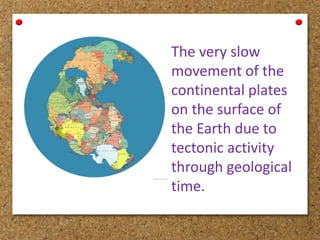
The very slow
movement of the
continental plates
on the surface of
the Earth due to
tectonic activity
through geological
time.
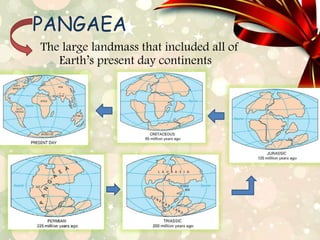
PANGAEA
The large landmass that included all of
Earth’s present day continents
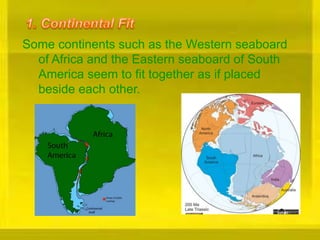
Some continents such as the Western seaboard
of Africa and the Eastern seaboard of South
America seem to fit together as if placed
beside each other.
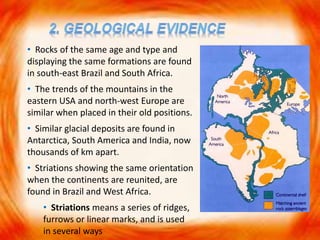
• Rocks of the same age and type and
displaying the same formations are found
in south-east Brazil and South Africa.
• The trends of the mountains in the
eastern USA and north-west Europe are
similar when placed in their old positions.
• Similar glacial deposits are found in
Antarctica, South America and India, now
thousands of km apart.
• Striations showing the same orientation
when the continents are reunited, are
found in Brazil and West Africa.
• Striations means a series of ridges,
furrows or linear marks, and is used
in several ways
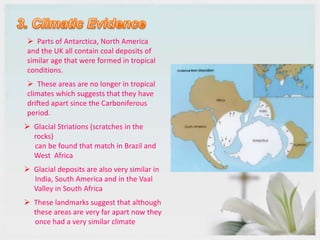
 Parts of Antarctica, North America
and the UK all contain coal deposits of
similar age that were formed in tropical
conditions.
 These areas are no longer in tropical
climates which suggests that they have
drifted apart since the Carboniferous
period.
 Glacial Striations (scratches in the
rocks)
can be found that match in Brazil and
West Africa
 Glacial deposits are also very similar in
India, South America and in the Vaal
Valley in South Africa
 These landmarks suggest that although
these areas are very far apart now they
once had a very similar climate
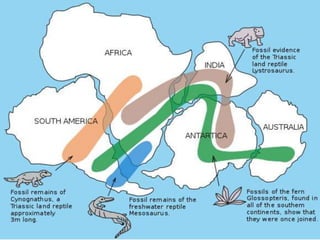
Similar fossil formations are found on either side of the
Atlantic. For example, a reptile called Mesosaurus, is found
only in South America and Southern African sediments.
These are dated from the Permian age (approx. 280million
years ago).
 Plant remains from the humid swamps that later formed
coal deposits have been found in India and Antarctica.
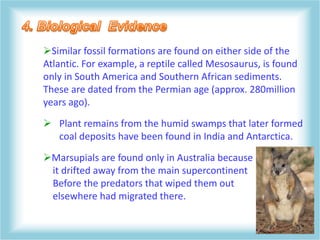
Marsupials are found only in Australia because
it drifted away from the main supercontinent
Before the predators that wiped them out
elsewhere had migrated there.
Jack Oliver
 Jack Oliver provided a
research paper on plate
tectonics that proved vital in
providing hard evidence for the
existence of continental drift,
which was released in 1968.
The 1968 paper finally proved
Wegener right and continental
drift was accepted by the world
of science.
CONTINENTAL DRIFT IN DOUBT
Why didn’t people believe in
continental drift?
 People couldn’t image how the
earth could be millions of years
old
 People couldn’t image a force
great enough to move the
continents
 BUT by the 1960’s evidence
would prove continental drift is
TRUE and…. The story continues
(as does all good science!)
Continental Drift Theory-Abhinav gupta

Continental Drift Theory-Abhinav gupta

  • 2.
    The very slow movementof the continental plates on the surface of the Earth due to tectonic activity through geological time.
  • 3.
    PANGAEA The large landmassthat included all of Earth’s present day continents
  • 5.
    Some continents suchas the Western seaboard of Africa and the Eastern seaboard of South America seem to fit together as if placed beside each other.
  • 6.
    • Rocks ofthe same age and type and displaying the same formations are found in south-east Brazil and South Africa. • The trends of the mountains in the eastern USA and north-west Europe are similar when placed in their old positions. • Similar glacial deposits are found in Antarctica, South America and India, now thousands of km apart. • Striations showing the same orientation when the continents are reunited, are found in Brazil and West Africa. • Striations means a series of ridges, furrows or linear marks, and is used in several ways
  • 7.
     Parts ofAntarctica, North America and the UK all contain coal deposits of similar age that were formed in tropical conditions.  These areas are no longer in tropical climates which suggests that they have drifted apart since the Carboniferous period.  Glacial Striations (scratches in the rocks) can be found that match in Brazil and West Africa  Glacial deposits are also very similar in India, South America and in the Vaal Valley in South Africa  These landmarks suggest that although these areas are very far apart now they once had a very similar climate
  • 8.
    Similar fossil formationsare found on either side of the Atlantic. For example, a reptile called Mesosaurus, is found only in South America and Southern African sediments. These are dated from the Permian age (approx. 280million years ago).  Plant remains from the humid swamps that later formed coal deposits have been found in India and Antarctica. Marsupials are found only in Australia because it drifted away from the main supercontinent Before the predators that wiped them out elsewhere had migrated there.
  • 13.
    Jack Oliver  JackOliver provided a research paper on plate tectonics that proved vital in providing hard evidence for the existence of continental drift, which was released in 1968. The 1968 paper finally proved Wegener right and continental drift was accepted by the world of science.
  • 14.
    CONTINENTAL DRIFT INDOUBT Why didn’t people believe in continental drift?  People couldn’t image how the earth could be millions of years old  People couldn’t image a force great enough to move the continents  BUT by the 1960’s evidence would prove continental drift is TRUE and…. The story continues (as does all good science!)