A Unifying Theory
A unifying theory is one that helps  explain a broad range of diverse observations  interpret many aspects of a science on a grand scale and relate many seemingly unrelated phenomena Plate tectonics is a unifying theory for the earth sciences.
Plate tectonics helps to explain earthquakes volcanic eruptions formation of mountains location of continents  location of ocean basins
Tectonic interactions affect atmospheric and oceanic circulation and climate geographic distribution,  evolution and extinction of organisms distribution and formation of resources
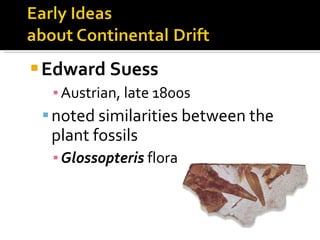
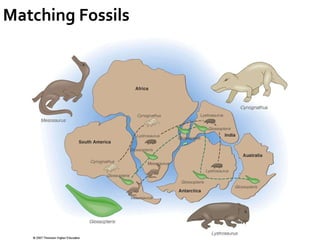
Edward Suess   Austrian, late 1800s noted similarities between the plant fossils  Glossopteris  flora
and evidence for glaciation in rock sequences of  India Australia South Africa  South America He proposed the name  Gondwanaland  (or  Gondwana )  for a supercontinent composed of these continents
Frank Taylor   (American, 1910)   presented a hypothesis of continental drift with these features: lateral movement of continents formed mountain ranges a continent broke apart at the Mid-Atlantic Ridge to form the Atlantic Ocean
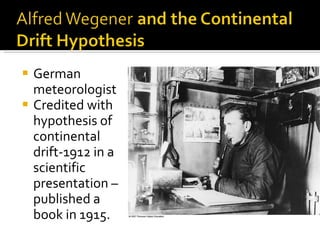
German meteorologist Credited with hypothesis of continental drift-1912 in a scientific presentation – published a book in 1915.
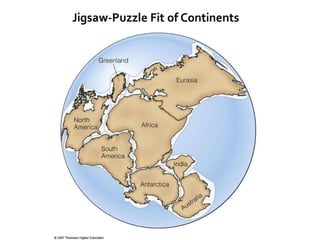
He proposed that all landmasses  were originally united into a supercontinent  he named Pangaea from the Greek meaning “all land” He presented a series of maps  showing the breakup of Pangaea
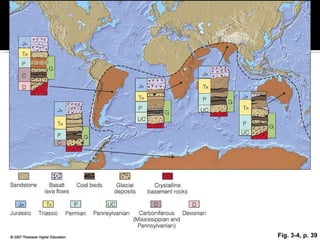
Shorelines of continents fit together matching marine, nonmarine  and glacial rock sequences  from Pennsylvanian to Jurassic age  for all five Gondwana continents  including Antarctica
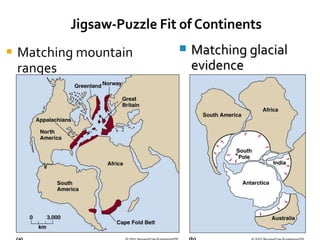
Mountain ranges and glacial deposits  match up when continents are united  into a single landmass
 
Fig. 3-4, p. 39
Matching mountain ranges Matching glacial evidence
 
Most geologists did not accept the idea of moving continents There was no suitable mechanism to explain  how continents could move over Earth’s surface
Interest in continental drift only revived when new evidence from studies of Earth’s magnetic field  and oceanographic research  showed that the ocean basins were geologically young features
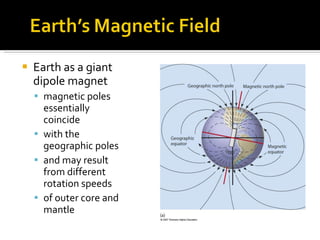
Earth as a giant dipole magnet magnetic poles essentially coincide  with the geographic poles and may result from different rotation speeds of outer core and mantle
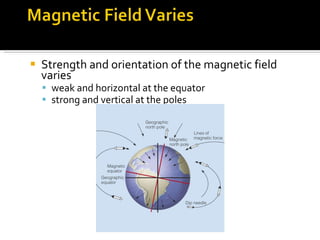
Strength and orientation of the magnetic field varies weak and horizontal at the equator strong and vertical at the poles
Is a remanent magnetism in ancient rocks recording the direction and the strength of Earth’s magnetic field at the time of the rock’s formation When magma cools  magnetic iron-bearing minerals align with Earth’s magnetic field
Magnetic poles apparently moved. The apparent movement was called polar wandering. Different continents had different paths. In 1950s, research revealed  that paleomagnetism of ancient rocks showed  orientations different from the present magnetic field
Earth’s present magnetic field is called normal,  with magnetic north near the north geographic pole  and magnetic south near the south geographic pole At various times in the past,  Earth’s magnetic field has completely reversed,  with magnetic south near the north geographic pole  and magnetic north near the south geographic pole This is referred to as a magnetic reversal
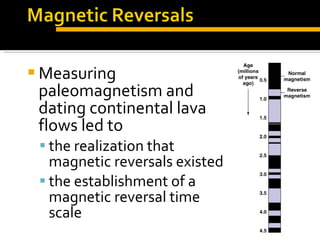
Measuring paleomagnetism and dating continental lava flows led to  the realization that magnetic reversals existed the establishment of a magnetic reversal time scale
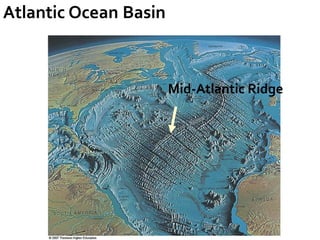
Ocean mapping revealed a ridge system more than 65,000 km long, the most extensive mountain range in the world The Mid-Atlantic Ridge is the best known part of the system and divides the Atlantic Ocean basin  in two nearly equal parts
Mid-Atlantic Ridge
Harry Hess , in 1962, proposed the theory of seafloor spreading: Continents and oceanic crust move together Seafloor separates at oceanic ridges where new crust forms from upwelling and cooling magma, and the new crust moves laterally away from the ridge
The mechanism that drives seafloor spreading was thermal convection cells in the mantle hot magma rises from mantle to form new crust cold crust subducts into the mantle at oceanic trenches, where it is heated and recycled
In addition to mapping mid-ocean ridges,  ocean research also revealed magnetic anomalies on the sea floor
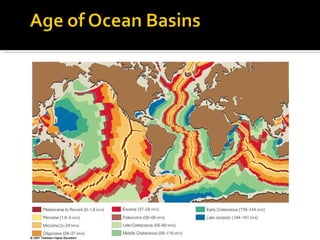
Seafloor spreading theory indicates that  oceanic crust is geologically young because  it forms during spreading  and is destroyed during subduction Radiometric dating confirms  the oldest oceanic crust  is less than 180 million years old whereas oldest continental crust  is 3.96 billion yeas old
 
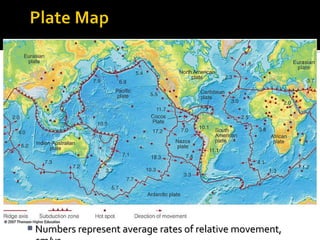
Plate tectonic theory is based on the simple model that the lithosphere is rigid it consists of oceanic and continental crust with upper mantle it consists of variable-sized pieces called plates  with plate regions containing continental crust  up to 250 km thick and plate regions containing oceanic crust  up to 100 km thick
Numbers represent average rates of relative movement, cm/yr

Unifying theory

  • 1.
  • 2.
    A unifying theoryis one that helps explain a broad range of diverse observations interpret many aspects of a science on a grand scale and relate many seemingly unrelated phenomena Plate tectonics is a unifying theory for the earth sciences.
  • 3.
    Plate tectonics helpsto explain earthquakes volcanic eruptions formation of mountains location of continents location of ocean basins
  • 4.
    Tectonic interactions affectatmospheric and oceanic circulation and climate geographic distribution, evolution and extinction of organisms distribution and formation of resources
  • 5.
    Edward Suess Austrian, late 1800s noted similarities between the plant fossils Glossopteris flora
  • 6.
    and evidence forglaciation in rock sequences of India Australia South Africa South America He proposed the name Gondwanaland (or Gondwana ) for a supercontinent composed of these continents
  • 7.
    Frank Taylor (American, 1910) presented a hypothesis of continental drift with these features: lateral movement of continents formed mountain ranges a continent broke apart at the Mid-Atlantic Ridge to form the Atlantic Ocean
  • 8.
    German meteorologist Creditedwith hypothesis of continental drift-1912 in a scientific presentation – published a book in 1915.
  • 9.
    He proposed thatall landmasses were originally united into a supercontinent he named Pangaea from the Greek meaning “all land” He presented a series of maps showing the breakup of Pangaea
  • 10.
    Shorelines of continentsfit together matching marine, nonmarine and glacial rock sequences from Pennsylvanian to Jurassic age for all five Gondwana continents including Antarctica
  • 11.
    Mountain ranges andglacial deposits match up when continents are united into a single landmass
  • 12.
  • 13.
  • 14.
    Matching mountain rangesMatching glacial evidence
  • 15.
  • 16.
    Most geologists didnot accept the idea of moving continents There was no suitable mechanism to explain how continents could move over Earth’s surface
  • 17.
    Interest in continentaldrift only revived when new evidence from studies of Earth’s magnetic field and oceanographic research showed that the ocean basins were geologically young features
  • 18.
    Earth as agiant dipole magnet magnetic poles essentially coincide with the geographic poles and may result from different rotation speeds of outer core and mantle
  • 19.
    Strength and orientationof the magnetic field varies weak and horizontal at the equator strong and vertical at the poles
  • 20.
    Is a remanentmagnetism in ancient rocks recording the direction and the strength of Earth’s magnetic field at the time of the rock’s formation When magma cools magnetic iron-bearing minerals align with Earth’s magnetic field
  • 21.
    Magnetic poles apparentlymoved. The apparent movement was called polar wandering. Different continents had different paths. In 1950s, research revealed that paleomagnetism of ancient rocks showed orientations different from the present magnetic field
  • 22.
    Earth’s present magneticfield is called normal, with magnetic north near the north geographic pole and magnetic south near the south geographic pole At various times in the past, Earth’s magnetic field has completely reversed, with magnetic south near the north geographic pole and magnetic north near the south geographic pole This is referred to as a magnetic reversal
  • 23.
    Measuring paleomagnetism anddating continental lava flows led to the realization that magnetic reversals existed the establishment of a magnetic reversal time scale
  • 24.
    Ocean mapping revealeda ridge system more than 65,000 km long, the most extensive mountain range in the world The Mid-Atlantic Ridge is the best known part of the system and divides the Atlantic Ocean basin in two nearly equal parts
  • 25.
  • 26.
    Harry Hess ,in 1962, proposed the theory of seafloor spreading: Continents and oceanic crust move together Seafloor separates at oceanic ridges where new crust forms from upwelling and cooling magma, and the new crust moves laterally away from the ridge
  • 27.
    The mechanism thatdrives seafloor spreading was thermal convection cells in the mantle hot magma rises from mantle to form new crust cold crust subducts into the mantle at oceanic trenches, where it is heated and recycled
  • 28.
    In addition tomapping mid-ocean ridges, ocean research also revealed magnetic anomalies on the sea floor
  • 29.
    Seafloor spreading theoryindicates that oceanic crust is geologically young because it forms during spreading and is destroyed during subduction Radiometric dating confirms the oldest oceanic crust is less than 180 million years old whereas oldest continental crust is 3.96 billion yeas old
  • 30.
  • 31.
    Plate tectonic theoryis based on the simple model that the lithosphere is rigid it consists of oceanic and continental crust with upper mantle it consists of variable-sized pieces called plates with plate regions containing continental crust up to 250 km thick and plate regions containing oceanic crust up to 100 km thick
  • 32.
    Numbers represent averagerates of relative movement, cm/yr

Editor's Notes

  • #10 He amassed a tremendous amount of geologic, paleontologic, and climatologic evidence
  • #14 Figure 3.4: Similarity of Rock Sequences on the Gondwana Continents. Sequences of marine, nonmarine, and glacial rocks of Pennsylvanian (UC) to Jurassic (JR) age are nearly the same on all five Gondwana continents (South America, Africa, India, Australia, and Antarctica). These continents are widely separated today and have different environments and climates ranging from tropical to polar. Thus, the rocks forming on each continent are very different. When the continents were all joined together in the past, however, the environments of adjacent continents were similar and the rocks forming in those areas were similar. The range indicated by G in each column is the age range (Carboniferous-Permian) of the Glossopteris flora.
  • #22 The best explanation is stationary poles and moving continents