

Alcohol, Meth, and Other Drugs Social Problems of Alcohol, Illegal Drugs, and Mental Health
Quick copyright note Several of these slides are from The McGraw-Hill Company, so I have noted at the bottom of the entire presentation where some of these slides originated.
Ethnography Next Tuesday we will discuss the ethnographic assignment You can still conduct the assignment next week if necessary Do not worry if you have run into challenges.
Plan for Today Discuss Drug use, notably alcohol use Discuss Physical and Mental Health as they relate to social problems Watch the video on the Meth Epidemic  (from the Frontline.org website, 2006) http://www.pbs.org/wgbh/pages/frontline/meth/view/?utm_campaign=viewpage&utm_medium=grid&utm_source=grid Watch the video on the AIDS Epidemic (from the Frontline.org website, 2006) http://www.pbs.org/wgbh/pages/frontline/aids/view/?utm_campaign=viewpage&utm_medium=grid&utm_source=grid
Social Construction of Social Problems Erich Goode - Drug Fallacy Social construction of Mental Health Social construction of Physical Health Are we human beings “what we think we are”? Howard Becker and research on drug use
Abuse and Addiction Addiction: repeated use of a drug or alcohol to the point of periodic or chronic intoxication that is detrimental to the user of society. Abuse: improper use of drugs or alcohol to the degree that the consequences are defined as detrimental to the user or society.
Blood Alcohol Levels .05% can make the individual feel a sense of release from tensions and inhibitions. .10% the individual’s motor control is affected. .20% both the motor and the emotional functions of the brain are impaired. .30% an individual is incapable of adequately perceiving and responding to the environment and may go into a stupor.  .40% or higher could cause the persons to lapse into a coma and die.
Patterns of Alcohol Use Approximately 63% of Americans identify themselves as drinkers. American Indians probably have the highest rates of use and abuse of alcohol. Alcohol abuse and alcoholism are primarily male problems. 44% of college students are considered binge drinkers.
Alcohol and the Quality of Life Physical Health Cirrhosis of the liver Muscle diseases and tremors Impotence and sterility in men  Early death  Psychological Health Dementia  Alcohol abuse is associated with a substantial proportion of suicides Inhibits sexual performance
Alcohol and the Quality of Life—Continued  Interpersonal Problems Problems of interaction within and outside the family. Higher rates of verbal and physical abuse.  Stress within the family. Economic Costs ©Spencer Grant/PhotoEdit
Family Experiences Alcohol abusers are more likely to come from homes where other family members are abusers. Alcohol abusers are more likely to come from broken homes. Alcohol abuse is associated with various problematic relationships within the family.
Non-Alcoholic Drugs Seven main types: Narcotics Depressants Stimulants Hallucinogens Cannabis  Steroids Designer drugs © James Pickerell/ The Image Works
Narcotic vs.  Non-narcotic Drugs Opium Morphine Codeine  Heroin Meperidine Methadone Marijuana Hallucinogens LSD PCP Stimulants Cocaine Amphetamines Depressants Barbiturates Tranquilizers Chloral hydrate
Patterns of Use  Alcohol is the most widely used drug. Non-narcotic drugs are more widely used than are narcotics.  People 18-25 years of age are the most common users. Rates are higher among men than women.
Drug Usage Statistics The table presented on the previous slide showed the proportion  of current users. The following represent the proportions of those  who have ever used the drugs. any illicit drug: 46.4% marijuana & hashish: 40.6% cocaine: 14.7% crack: 3.3% inhalants: 9.7% hallucinogens: 14.5% methamphetamine: 5.2% Drug use is higher in the lower than in the middle or upper social classes.
Physical Harm Resulting From Drug Usage  Death. Medical emergencies from acute reaction to drugs or toxic adulterants. Exposure to HIV infection, hepatitis, and other diseases resulting from intravenous drug use. Injury from accidents caused by drug-related impairment. Injuries from violence while obtaining drugs in the drug distribution network. Dependence or addiction. Chronic physical problems.
Cigarettes Mortality rates of older adults from all causes are highest among current smokers.  85% of lung cancer deaths and 1/3 or more deaths from heart and blood vessel disease are directly related to smoking.  Non-smokers who live or work in a smoking environment are more likely than those not in such an environment to develop coronary heart disease.
Marijuana Acute effects: Impaired memory, thinking, speaking, and problem solving. Impaired time perception. Increased heart rate. Reddening of the eyes. Impaired psychomotor performance.  Chronic effects: Adverse effects on the respiratory system. Reduced sperm count. Possible adverse effects on children when the mother uses the drug. Interference with the normal pattern of sex hormones.
Contributing Factors Social Structural Factors Group Norms Role Problems Family Experiences Government Economy Supply Social Psychological Factors Positive Attitudes Motivations for Abuse Boredom  Curiosity  Ideology
Please watch the first video http://www.pbs.org/wgbh/pages/frontline/meth/view/?utm_campaign=viewpage&utm_medium=grid&utm_source=grid
Health Care and Illness: Physical and Mental Let’s change topics to…
Definitions  Prevalence  – the number of cases of an illness that exist at any particular time.  Incidence  – the number of new cases of an illness that occur during a particular period of time.  Epidemiology  – the study of factors that affect the incidence, prevalence, and distribution of illnesses.
Physical Illness Life expectancy  – the average number of years a person can expect to live.  Chronic diseases are the major cause of death in the U.S.  Progressive Lung cancer Constant Stroke  Infectious diseases cause more deaths worldwide than heart disease and cancer combined.  The health problems you are likely to face vary according your sex, age, and/or racial/ethnic origin.
Expectation of Life at Birth
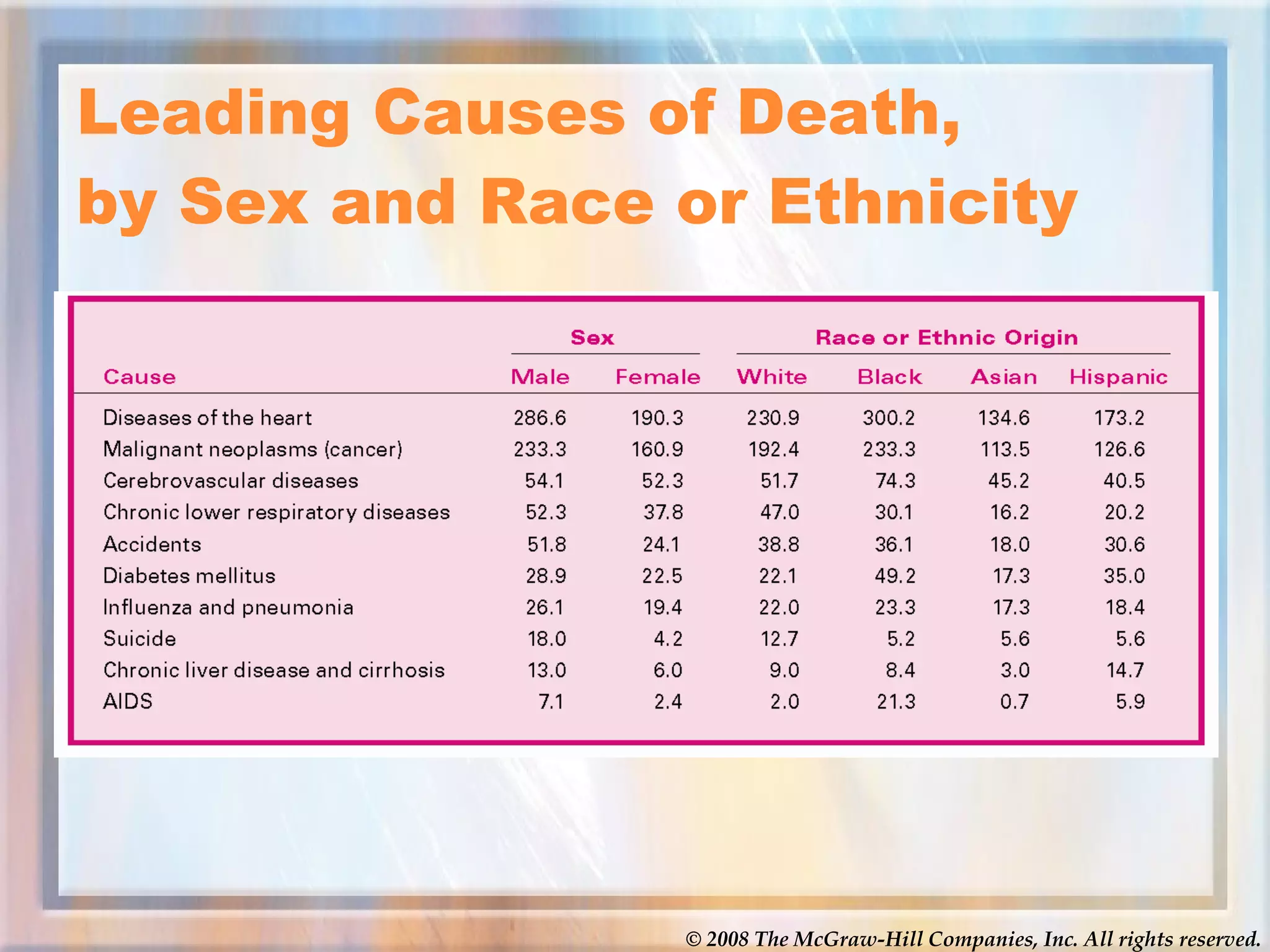
Leading Causes of Death,  by Sex and Race or Ethnicity
AIDS Acquired Immune Deficiency Syndrome.  A disease in which a viral infection causes the immune system to stop functioning, inevitably resulting in death.  There is no cure for AIDS.  Spread through sex with someone infected with AIDS and sharing drug needles and syringes with an infected person.
AIDS Statistics  More than half of all AIDS victims reside in Sub-Saharan Africa.  Worldwide, 40 million people are infected with the AIDS virus; 63% of them in Africa.  Since the first reported case in 1981, more than 25 million people have died of AIDS. Total number of cases in U.S. by 2004 was 908,905. Of those:  35.1% non-Hispanic whites; 42.9% non-Hispanic blacks; 20.2% Hispanic; 1% Asian American; 0.4% American Indian.
Please watch the second video http://www.pbs.org/wgbh/pages/frontline/aids/view/?utm_campaign=viewpage&utm_medium=grid&utm_source=grid
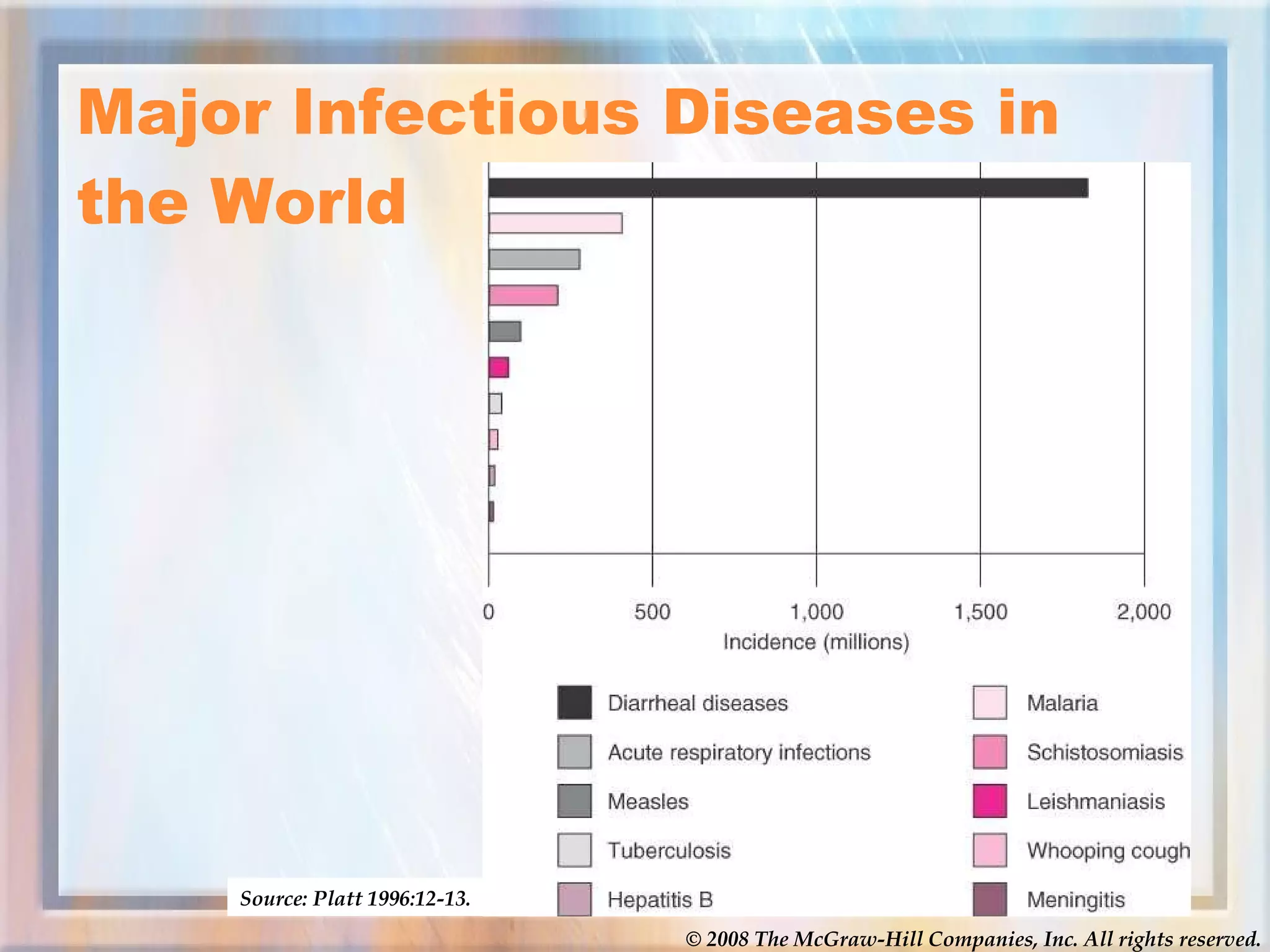
Major Infectious Diseases in the World Source: Platt 1996:12-13.
Types of Mental Illness Psychosis – the individual fails to distinguish between internal and external stimuli.  Neurosis – anxiety that impairs functioning. Psychosomatic disorder – impairment in physiological functioning that results from the individual’s emotional state. Schizophrenia – psychosis that involves a thinking disorder, particular hallucinations and fantasies.  Manic-depressive reaction – involves fluctuation between emotional extremes.
Health Care, Illness, & the Quality of Life Stress and Suffering Interpersonal Relationships Some illnesses carry a social stigma.  Inadequate Care Iatrogenic  – caused by the physician in the course of his or her treatment of the patient.  Deinstitutionalization  a movement to change the setting of treatment of mental disorders form hospitals to the community through rapid discharge of patients. Individual Freedom Economic Costs
Social Structural Factors Roles Certain roles are considered stress inducing.  Women have higher rates of morbidity.  Multiple roles are associated with better health.  The Family Context of Illness Married people of both sexes have lower rates of mental illness than the unmarried.  For children, both physical and mental health are related to the quality of the relationship between the parents and the child.  Family disruption is stressful for children and typically leads to higher rates of physical and emotional problems.
Social Structural Factors— Continued The Industrial Economy In an industrial world, people move around the globe in great numbers and exposure to different diseases is increased.  Pollution. Fluctuations in the state of the economy.  The Politics of Illness Maldistribution of health care.  Rising insurance costs. Funding for research.  Stem cell research.  Governmental regulations.
Social Structural Factors— Continued The Stratification of Illness The different patterns of illness and variations in health care among the socioeconomic strata.  People in the lower strata have more physical health problems and more days of restricted activity due to illness.  People in the lower strata are less knowledgeable about and less likely to use health care services, are less knowledgeable and less likely to engage in good health practices, and are less likely to have basic preventive health measures and health insurance.  Changing Structure: The Future Shock Thesis
Social Psychological Factors  Negative attitudes toward one’s work can increase the risk of illness.  A particular personality type, identified by a cluster of attitudes and values, has an increased probability of coronary heart disease.  The sick person’s attitudes about his or her illness and prospects for recovery.
Myths About Mental Illness A person who has been mentally ill can never be normal. Persons with mental illness are unpredictable. Mentally ill people are dangerous.  Anyone who has had shock treatment must be in a rally bad way. When you learn that a person has been mentally ill, you have learned the most important think about his or her personality. A former mental patient will make a second-rate employee.
If you have any questions… Please let me know! We will review these issues and discuss the institutions of politics and economy as they relate to social problems next time

Social problems of_alcohol_drugs_mental_health

  • 1.
    Alcohol, Meth, andOther Drugs Social Problems of Alcohol, Illegal Drugs, and Mental Health
  • 2.
    Quick copyright noteSeveral of these slides are from The McGraw-Hill Company, so I have noted at the bottom of the entire presentation where some of these slides originated.
  • 3.
    Ethnography Next Tuesdaywe will discuss the ethnographic assignment You can still conduct the assignment next week if necessary Do not worry if you have run into challenges.
  • 4.
    Plan for TodayDiscuss Drug use, notably alcohol use Discuss Physical and Mental Health as they relate to social problems Watch the video on the Meth Epidemic (from the Frontline.org website, 2006) http://www.pbs.org/wgbh/pages/frontline/meth/view/?utm_campaign=viewpage&utm_medium=grid&utm_source=grid Watch the video on the AIDS Epidemic (from the Frontline.org website, 2006) http://www.pbs.org/wgbh/pages/frontline/aids/view/?utm_campaign=viewpage&utm_medium=grid&utm_source=grid
  • 5.
    Social Construction ofSocial Problems Erich Goode - Drug Fallacy Social construction of Mental Health Social construction of Physical Health Are we human beings “what we think we are”? Howard Becker and research on drug use
  • 6.
    Abuse and AddictionAddiction: repeated use of a drug or alcohol to the point of periodic or chronic intoxication that is detrimental to the user of society. Abuse: improper use of drugs or alcohol to the degree that the consequences are defined as detrimental to the user or society.
  • 7.
    Blood Alcohol Levels.05% can make the individual feel a sense of release from tensions and inhibitions. .10% the individual’s motor control is affected. .20% both the motor and the emotional functions of the brain are impaired. .30% an individual is incapable of adequately perceiving and responding to the environment and may go into a stupor. .40% or higher could cause the persons to lapse into a coma and die.
  • 8.
    Patterns of AlcoholUse Approximately 63% of Americans identify themselves as drinkers. American Indians probably have the highest rates of use and abuse of alcohol. Alcohol abuse and alcoholism are primarily male problems. 44% of college students are considered binge drinkers.
  • 9.
    Alcohol and theQuality of Life Physical Health Cirrhosis of the liver Muscle diseases and tremors Impotence and sterility in men Early death Psychological Health Dementia Alcohol abuse is associated with a substantial proportion of suicides Inhibits sexual performance
  • 10.
    Alcohol and theQuality of Life—Continued Interpersonal Problems Problems of interaction within and outside the family. Higher rates of verbal and physical abuse. Stress within the family. Economic Costs ©Spencer Grant/PhotoEdit
  • 11.
    Family Experiences Alcoholabusers are more likely to come from homes where other family members are abusers. Alcohol abusers are more likely to come from broken homes. Alcohol abuse is associated with various problematic relationships within the family.
  • 12.
    Non-Alcoholic Drugs Sevenmain types: Narcotics Depressants Stimulants Hallucinogens Cannabis Steroids Designer drugs © James Pickerell/ The Image Works
  • 13.
    Narcotic vs. Non-narcotic Drugs Opium Morphine Codeine Heroin Meperidine Methadone Marijuana Hallucinogens LSD PCP Stimulants Cocaine Amphetamines Depressants Barbiturates Tranquilizers Chloral hydrate
  • 14.
    Patterns of Use Alcohol is the most widely used drug. Non-narcotic drugs are more widely used than are narcotics. People 18-25 years of age are the most common users. Rates are higher among men than women.
  • 15.
    Drug Usage StatisticsThe table presented on the previous slide showed the proportion of current users. The following represent the proportions of those who have ever used the drugs. any illicit drug: 46.4% marijuana & hashish: 40.6% cocaine: 14.7% crack: 3.3% inhalants: 9.7% hallucinogens: 14.5% methamphetamine: 5.2% Drug use is higher in the lower than in the middle or upper social classes.
  • 16.
    Physical Harm ResultingFrom Drug Usage Death. Medical emergencies from acute reaction to drugs or toxic adulterants. Exposure to HIV infection, hepatitis, and other diseases resulting from intravenous drug use. Injury from accidents caused by drug-related impairment. Injuries from violence while obtaining drugs in the drug distribution network. Dependence or addiction. Chronic physical problems.
  • 17.
    Cigarettes Mortality ratesof older adults from all causes are highest among current smokers. 85% of lung cancer deaths and 1/3 or more deaths from heart and blood vessel disease are directly related to smoking. Non-smokers who live or work in a smoking environment are more likely than those not in such an environment to develop coronary heart disease.
  • 18.
    Marijuana Acute effects:Impaired memory, thinking, speaking, and problem solving. Impaired time perception. Increased heart rate. Reddening of the eyes. Impaired psychomotor performance. Chronic effects: Adverse effects on the respiratory system. Reduced sperm count. Possible adverse effects on children when the mother uses the drug. Interference with the normal pattern of sex hormones.
  • 19.
    Contributing Factors SocialStructural Factors Group Norms Role Problems Family Experiences Government Economy Supply Social Psychological Factors Positive Attitudes Motivations for Abuse Boredom Curiosity Ideology
  • 20.
    Please watch thefirst video http://www.pbs.org/wgbh/pages/frontline/meth/view/?utm_campaign=viewpage&utm_medium=grid&utm_source=grid
  • 21.
    Health Care andIllness: Physical and Mental Let’s change topics to…
  • 22.
    Definitions Prevalence – the number of cases of an illness that exist at any particular time. Incidence – the number of new cases of an illness that occur during a particular period of time. Epidemiology – the study of factors that affect the incidence, prevalence, and distribution of illnesses.
  • 23.
    Physical Illness Lifeexpectancy – the average number of years a person can expect to live. Chronic diseases are the major cause of death in the U.S. Progressive Lung cancer Constant Stroke Infectious diseases cause more deaths worldwide than heart disease and cancer combined. The health problems you are likely to face vary according your sex, age, and/or racial/ethnic origin.
  • 24.
  • 25.
    Leading Causes ofDeath, by Sex and Race or Ethnicity
  • 26.
    AIDS Acquired ImmuneDeficiency Syndrome. A disease in which a viral infection causes the immune system to stop functioning, inevitably resulting in death. There is no cure for AIDS. Spread through sex with someone infected with AIDS and sharing drug needles and syringes with an infected person.
  • 27.
    AIDS Statistics More than half of all AIDS victims reside in Sub-Saharan Africa. Worldwide, 40 million people are infected with the AIDS virus; 63% of them in Africa. Since the first reported case in 1981, more than 25 million people have died of AIDS. Total number of cases in U.S. by 2004 was 908,905. Of those: 35.1% non-Hispanic whites; 42.9% non-Hispanic blacks; 20.2% Hispanic; 1% Asian American; 0.4% American Indian.
  • 28.
    Please watch thesecond video http://www.pbs.org/wgbh/pages/frontline/aids/view/?utm_campaign=viewpage&utm_medium=grid&utm_source=grid
  • 29.
    Major Infectious Diseasesin the World Source: Platt 1996:12-13.
  • 30.
    Types of MentalIllness Psychosis – the individual fails to distinguish between internal and external stimuli. Neurosis – anxiety that impairs functioning. Psychosomatic disorder – impairment in physiological functioning that results from the individual’s emotional state. Schizophrenia – psychosis that involves a thinking disorder, particular hallucinations and fantasies. Manic-depressive reaction – involves fluctuation between emotional extremes.
  • 31.
    Health Care, Illness,& the Quality of Life Stress and Suffering Interpersonal Relationships Some illnesses carry a social stigma. Inadequate Care Iatrogenic – caused by the physician in the course of his or her treatment of the patient. Deinstitutionalization a movement to change the setting of treatment of mental disorders form hospitals to the community through rapid discharge of patients. Individual Freedom Economic Costs
  • 32.
    Social Structural FactorsRoles Certain roles are considered stress inducing. Women have higher rates of morbidity. Multiple roles are associated with better health. The Family Context of Illness Married people of both sexes have lower rates of mental illness than the unmarried. For children, both physical and mental health are related to the quality of the relationship between the parents and the child. Family disruption is stressful for children and typically leads to higher rates of physical and emotional problems.
  • 33.
    Social Structural Factors—Continued The Industrial Economy In an industrial world, people move around the globe in great numbers and exposure to different diseases is increased. Pollution. Fluctuations in the state of the economy. The Politics of Illness Maldistribution of health care. Rising insurance costs. Funding for research. Stem cell research. Governmental regulations.
  • 34.
    Social Structural Factors—Continued The Stratification of Illness The different patterns of illness and variations in health care among the socioeconomic strata. People in the lower strata have more physical health problems and more days of restricted activity due to illness. People in the lower strata are less knowledgeable about and less likely to use health care services, are less knowledgeable and less likely to engage in good health practices, and are less likely to have basic preventive health measures and health insurance. Changing Structure: The Future Shock Thesis
  • 35.
    Social Psychological Factors Negative attitudes toward one’s work can increase the risk of illness. A particular personality type, identified by a cluster of attitudes and values, has an increased probability of coronary heart disease. The sick person’s attitudes about his or her illness and prospects for recovery.
  • 36.
    Myths About MentalIllness A person who has been mentally ill can never be normal. Persons with mental illness are unpredictable. Mentally ill people are dangerous. Anyone who has had shock treatment must be in a rally bad way. When you learn that a person has been mentally ill, you have learned the most important think about his or her personality. A former mental patient will make a second-rate employee.
  • 37.
    If you haveany questions… Please let me know! We will review these issues and discuss the institutions of politics and economy as they relate to social problems next time