The document discusses the concept of community from sociological perspectives. It explores different theories of community, including viewing community as a symbolic boundary that distinguishes insiders from outsiders, and the role of symbols and place in defining communities. Theories from sociologists like Durkheim, Weber, and Oldenburg are summarized in regards to how they viewed the modern loss of community and importance of place. The document also discusses how the internet may be transforming notions of community by allowing for new types of belonging beyond physical places and hierarchies.
Explores the concept of community through sociological perspectives and individual perceptions. Discusses identity and agency within community contexts.
Analyzes personal associations with the term 'Internet' and its role in shaping community characteristics.
Addresses community leadership, change initiatives, and the sociological definition of community.
Looks at the multiple meanings and boundaries associated with 'community' and its locational dimensions.
Discusses the symbolic boundaries of community and the role of attachments and shared identities.
Explores the significance of symbols in forming community meanings and boundaries within sociological debates.
Examines Max Weber and Emile Durkheim's theories on community, labor, and social solidarity.
Highlights the centrality of place in community, referencing Putnam's statistics on social interactions.
Analyzes how the Internet reshapes community interactions and the nature of belonging beyond geographical limits.
Discusses the rapid growth of online communities and the complexity of interactions in the digital age.
Encourages individual reflection on participation in community activities and concludes the session.
Bowling and BeingAlone in the Community: Thinking about Community Social ScientificallyWhat is community?The sociological perspective and SymbolsSome Theories/Explanations
2.
Robert Putnam hasbeen described as one of the most influential social scientists in the world today. The ideas in Bowling Alone seems to have struck a chord with many concerned with the state of social and public life.Tonight Dr. Guadalupe, Dr. Pierce, and I explore community, identity, and agency from our different disciplinary perspectives.Bowling Alone in the Community
3.
Exercise in Thinkingabout CommunityTake two minutes to write down all the words or images that you think of when someone says the word "Community.“What do you see?What should appear?What do you imagine?What does it feel like?What should it feel like?
4.
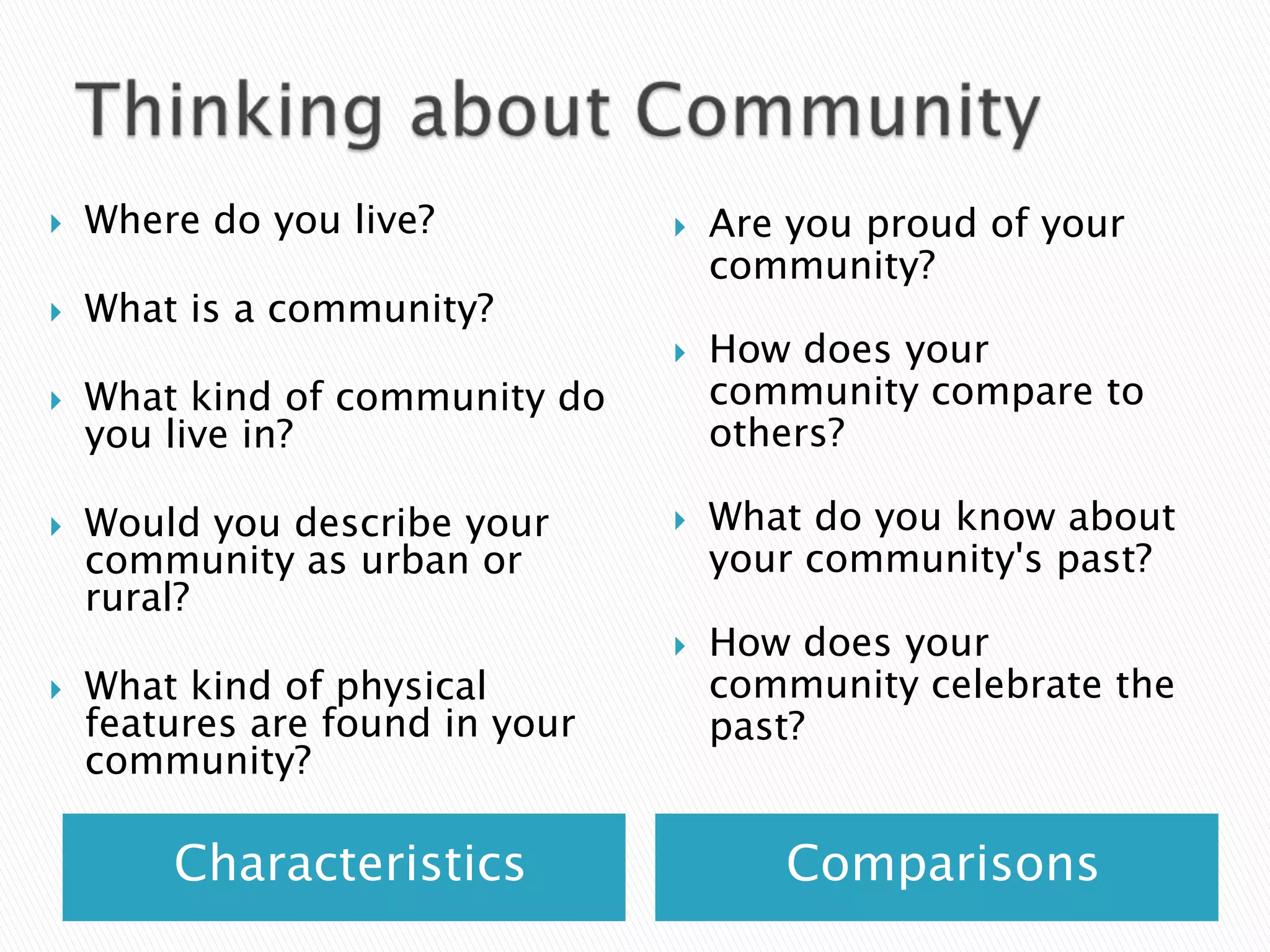
Thinking about CommunityWheredo you live? What is a community? What kind of community do you live in? Would you describe your community as urban or rural? What kind of physical features are found in your community? Are you proud of your community?How does your community compare to others?What do you know about your community's past?How does your community celebrate the past?CharacteristicsComparisons
5.
Take two minutesto write down all the words or images that you think of when someone says the word “Internet.“What do you see?What should appear?What do you imagine?What does it feel like?What should it feel like?Exercise 2: Internet
6.
What are thecommon characteristics that you believe represent use of the Internet?What do you use?Why do you use it/them?Internet Characteristics
7.
Community Development &ChangeWho are the leaders of your community? How do you think people have changed the way your community looks over the years? What are some of the things people have done to improve your community? How might you contribute to your community?
8.
There has beena lot of discussion by social scientists about what community is, but we can ask: who defines community? Should the people who belong (or might belong) to a community decide what it is and whether they are in or out? Or is it social scientists and professionals who really decide who is part of a community?Who defines community?
9.
What is community?People use the word when talking about their neighbors, their friends, entire racial groups, international politics, national identity groups, you name it. It's an everyday word. But have we have stopped to think about what community really is and what it means to us – as members of the community – personally?Community is a word
10.
'"Community" is oneof those words…bandied around in ordinary, everyday speech, apparently readily intelligible to speaker and listener, which… however, causes immense difficulty'(Cohen, 1985: 11)Difficulty in Defining It
11.
When we thinkabout communities most people think about a particular place, a geographical location for the community, such as the Dayton Community or the University of Dayton Community. The geographical community can be a town, a suburb, or even a small section of a suburb. There might be a few communities in the same town. There are other times when a town might be only part of a community, such as when he community involves the rural areas outside town, or two towns are closely linked.The Centrality of Place
12.
Do you thinkcommunity is a thing? a system? a process? By system I mean an interconnected set of parts which are capable of acting as a whole. By process I mean that it has an observable operation or action. We can ask: is community a thing which exists apart from us? Or is it something that we are part of? Or is it something that we do together?What is a community?
13.
According to AnthonyCohen, when we use the word ‘community’, what we are doing is establishing a symbolic boundary around a class of people. That is, we are using language to mark a difference between people inside and those outside the ‘community’. Cohen suggests the word is used loosely to imply that community is: A group or category of people, who have something in common with each other, which distinguishes them in a significant way from other groups.Sociological View of Community
14.
Community implies thoseinside are similar to each other and different from others. It creates a bond between some people and excludes others. AttachmentInvolvementCommitmentBeliefThus community implies and creates a boundary between us and them, inside a group and outside a group.We are connected
15.
This boundary ismarked in symbolic ways.There are many types of symbol which mark the boundaries of community - flags, badges, colors, dances, languages and more. The point is that we are creating distinctionsSymbols and Boundaries
16.
Symbols (including symbolicwords) always carry a range of meanings whose differences can be glossed over. So, it is possible to share the symbols without sharing the meanings.What does it mean to be an American?The use of symbols is important
17.
‘Community’ is onesuch boundary marking symbol. As a symbol it is held in common by all the members, but its meaning might vary with each member’s unique understanding of it. According to Cohen, people construct community symbolically, making community a resource and a repository of meaning, and a point of reference for their social identity.Community as Boundary
18.
These enquiries intothe fate of collective social forms played an integral role in defining some of the key debates of sociological inquiry as a whole - captured, for example, in the theoretical and conceptual 'dualisms' between 'individual' and 'society', 'structure' and 'agency', and 'freedom' and 'constraint'. Why Theory Matters
19.
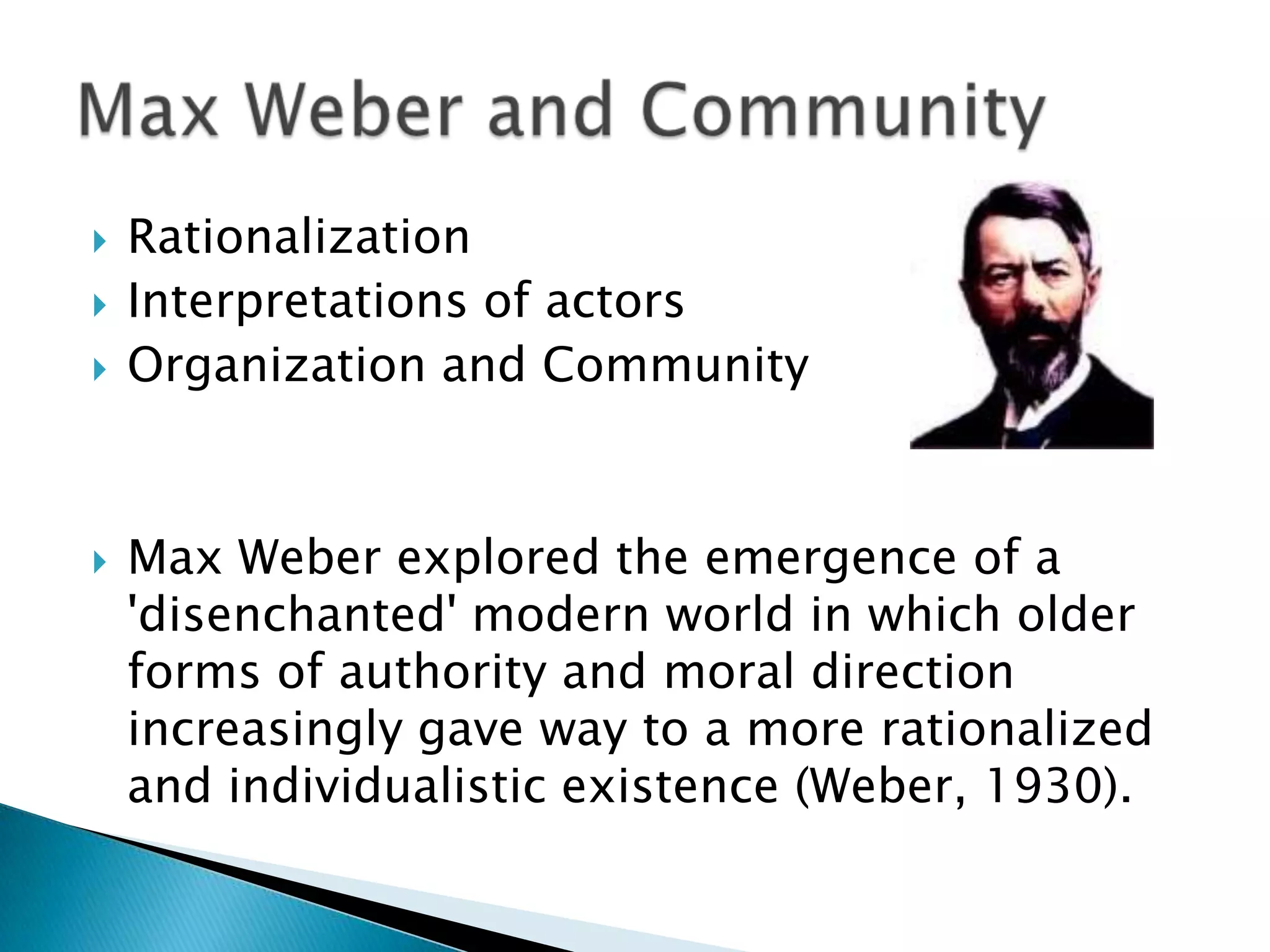
RationalizationInterpretations of actorsOrganizationand CommunityMax Weber explored the emergence of a 'disenchanted' modern world in which older forms of authority and moral direction increasingly gave way to a more rationalized and individualistic existence (Weber, 1930).Max Weber and Community
20.
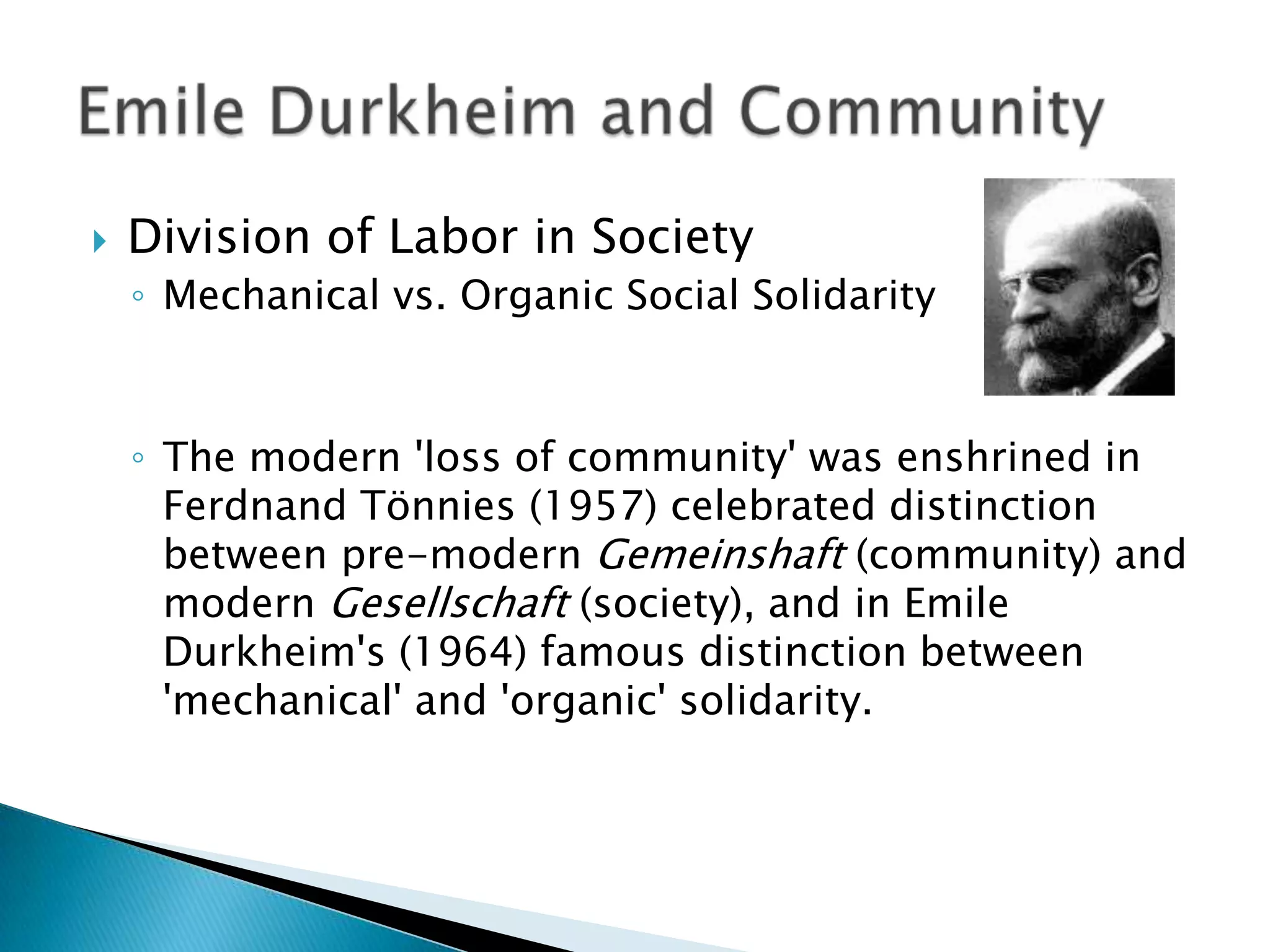
Division of Laborin SocietyMechanical vs. Organic Social SolidarityThe modern 'loss of community' was enshrined in FerdnandTönnies (1957) celebrated distinction between pre-modern Gemeinshaft (community) and modern Gesellschaft (society), and in Emile Durkheim's (1964) famous distinction between 'mechanical' and 'organic' solidarity.Emile Durkheim and Community
21.
The Great GoodPlace – Place is KeyWhere do we make solidarity?Where do we establish boundaries?How do we symbolically establish community?Oldenberg and Community
22.
Putnam and CommunityWhereis community established and reinforced?What happens when community fails?In 1975 the average American entertained friends at home 15 times per year; the equivalent figure (1998) is now less than half that. Virtually all leisure activities that involve doing something with someone else, from playing volleyball to playing chamber music, are declining.
23.
…is social interactionsharefeelingbuild social identitypool collective intelligenceinterpret collectivelyact reciprocally According to Nancy BaymInternet and Community
24.
Has the Internettransformed what it means to be in a community?Communities are created more rapidly and successfully now than ever before, with consequences not just for their own experience, but for everyone involved in the activity. But what if you cannot participate?Online, people are making a new kind of belonging that transcends place and shakes up long-standing balances of power. Or does it?Internet and Community
25.
“Downloading of music,movies, games and programsis only one side of the story as well. On the other handthere is communities, blogs, websites with loads ofinformation, free information of high and low (THElowest) quality everywhere, all the time and it'sincreasing by the minute. It goes hand in hand withthe downloading of music, movies, programs andgames. It's stressful, highpaced, superficial and attimes very rewarding. It's a world of culture underongoing change at a level so basic that it probably willhave replaced the old system completely in a couple ofyears. 4 years, counting from last Thursday, is ourguess.”- Hybris Records blogNature & Pace of Interaction Online
26.
How do YOUbuild community here at UD?How do YOU participate in activities?Attachment?Involvement?Commitment?Belief?What do you think?
#2 My goal tonight is to provide a big picture perspective on how it is that the idea of community has changed within the discipline of sociology, how those ideas might be useful for you now and as you continue your studies, and how the internet has both created problems and empowered those who use it – in terms of the communities they create.
#3 What relational consequences are there for our understanding of community. And make some suggestions on how to foster relationships from which everyone can benefit.