Addiction?
Jackie Daniels
Indiana University
danieljm@indiana.edu
Objectives
 Define
 Review models of Addiction
 Understand definition of addiction within
  common models
 Common Symptoms and consequences
 Identify important co-occurring disorders
 Familiarize yourself: addiction within
  special populations
 Implications for practice
 Case Studies
Models of Addiction
   Moral/ Temperance Model
    ◦   Sin or Crime
    ◦   Personal Flaw/Weakness
    ◦   Failure in personal responsibility (control)
   Disease of Medical
    ◦   Genetic and Biological Factors
   Behavioral and Cog-Bx Models
    ◦   Conditioning and reinforcement
    ◦   Social learning and modeling
    ◦   Drug expectancies cognitive factors
   Family
    ◦   Family disease and systems
    ◦   Behavioral and marital and family
   Harm Reduction
    ◦   Decrease harm created by addiction, does not necessary eliminate addictive behavior
    ◦   Ex: Needle exchange programs
   Life Process Model
    ◦   Habit, not Disease
    ◦   Biological factors that account for medical model are not identified
   12-Step Framework
    ◦   Addiction is result of spiritual malady, surrender and relationship with Higher Power, Service work and mentoring can
        help avoid relapse
    ◦   Contains all models listed above except harm reduction (abstinence based)
    ◦   Terminology- Alcoholic, Addict
Define Addiction
   America Heritage Dictionary:
    ◦ Compulsive physiological and psychological need for
      a habit-forming substance: a drug used in the
      treatment of heroin addiction.
    ◦ An instance of this: a person with multiple chemical
      addictions.
    ◦ The condition of being habitually or compulsively
      occupied with or involved in something.
    ◦ An instance of this: had an addiction for fast cars
   Medical Model:
    ◦ DSM, ICD-9 Criteria
    ◦ the onset and development of addiction are
      influenced though genetic predisposition and
      environmental factors
    ◦ Brain Disease- Chronic, progressive and relapsing
      with no cure, but treatable
Common
Symptoms, Consequences
Clinical signs: Withdrawal and signs of
 Physical Identification
  intoxication
 Identify social predeterminates/risk in
  assessment
    ◦ Resources (are basic needs met? i.e. food, shelter,
      clean water, healthcare)
    ◦ Cultural and racial, ethnic discrimination
    ◦ Gender and Personal Identity (Female/Male, GLBT)
    ◦ Age (first use, stage of life)
    ◦ Community (social stratification)
   Corrections Populations
   Child Welfare System
   Trauma and domestic violence
   Mental Health Symptoms (Comorbidity)
   Chronic Pain
Co-Occurring Disorders
   Definition- Presence of mental health and substance use disorder

    ◦ Adults with mental illness/substance use disorders are twice as likely to
      have incomes less than 150% of poverty level as adults without either
      disorder
    ◦ Over 8.9 million persons have co-occurring disorders
       Depression and anxiety exist in 20-50% of people with
         alcoholism, cocaine and other stimulant disorders
    ◦ Only 7.4% of individuals receive treatment for both conditions with 55.8%
      receiving no treatment at all.
    ◦ 24% of Medicaid recipients had psychiatric conditions, cardiovascular
      disease and central nervous disorders
    ◦ Women more at risk of anxiety, depression and substance use disorder &
      history of trauma
    ◦ Common Co-Occuring combos:
      Psychotic disorders (schizophrenia)
      Mood Disorders (bipolar disorder, depression, anxiety)
      Trauma (PTSD and DID)
      Personality Clusters B & C
      (Borderline, Antisocial, Narcissistic, Histrionic, Dependent and Avoidant)
                                        (Kreek, et. Al, 2005, Volkow and
       Li, 2005, NSDUH)
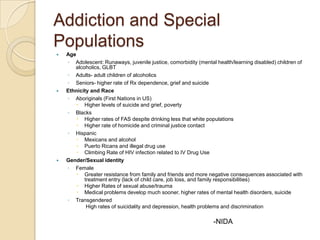
Addiction and Special
Populations
   Age
    ◦ Adolescent: Runaways, juvenile justice, comorbidity (mental health/learning disabled) children of
       alcoholics, GLBT
    ◦ Adults- adult children of alcoholics
    ◦ Seniors- higher rate of Rx dependence, grief and suicide
   Ethnicity and Race
    ◦ Aboriginals (First Nations in US)
         Higher levels of suicide and grief, poverty
    ◦ Blacks
         Higher rates of FAS despite drinking less that white populations
         Higher rate of homicide and criminal justice contact
    ◦ Hispanic
         Mexicans and alcohol
         Puerto Ricans and illegal drug use
         Climbing Rate of HIV infection related to IV Drug Use
   Gender/Sexual identity
    ◦ Female
         Greater resistance from family and friends and more negative consequences associated with
           treatment entry (lack of child care, job loss, and family responsibilities)
         Higher Rates of sexual abuse/trauma
         Medical problems develop much sooner, higher rates of mental health disorders, suicide
    ◦ Transgendered
            High rates of suicidality and depression, health problems and discrimination

                                                                 -NIDA
Special Risk
Contexts/Populations
   Occupations
    ◦   Military (active and veteran)
    ◦   Law enforcement
    ◦   Lawyers
    ◦   Medical professionals (nurse, doctor, psych)
   Geographic
    ◦ Rural vs. inner city
   Biological
    ◦ Pregnancy, IV drug users, Chronic Pain
   Psychological
    ◦ Co-occuring disorders
   Social
    ◦ Homeless, prostitutes, GLBT, Offenders
Implications for Practice
 Controversy of Medically-Assisted Treatment
 Dual Relationships for people in recovery
 Transference and counter-transferrence
 12-step Recovery
    ◦ Spiritual, not religious
    ◦ Legal ramifications
 Identification of risk factors
 Cultural Competency
    ◦ (a) Awareness of one's own cultural worldview, (b) Attitude
      towards cultural differences, (c) Knowledge of different
      cultural practices and worldviews, and (d) Cross-cultural
      skills
    ◦ Developing cultural competence results in an ability to
      understand, communicate with, and effectively interact with
      people across cultures
   What else?
Case Study #1- Will
Will is a 40 year-old SWM referred for
assessment by Monroe County Probation
with repeated offenses of DUI. History of
head injury, domestic violence as a child
and family history of alcohol dependence.
Has worked in construction.
Married, divorced, full custody of son (age
2). Unstable work history, familial support.
Assessment and treatment implications
Best course of treatment
Case Study #2- Lori
Lori is a 19 y/o SWF self-referred to
treatment for alcohol dependence.
Extensive hx of PI arrests, family history
of cult involvement with religious
focus, child abuse and alcoholism.
Eating disorder has ruined her front
teeth. Looking for sober housing and
support, not willing to address eating
disorder. History of suicide attempt.
Assessment and treatment implications
Best course of treatment
THANK YOU!

Addiction

  • 1.
  • 2.
    Objectives  Define  Reviewmodels of Addiction  Understand definition of addiction within common models  Common Symptoms and consequences  Identify important co-occurring disorders  Familiarize yourself: addiction within special populations  Implications for practice  Case Studies
  • 3.
    Models of Addiction  Moral/ Temperance Model ◦ Sin or Crime ◦ Personal Flaw/Weakness ◦ Failure in personal responsibility (control)  Disease of Medical ◦ Genetic and Biological Factors  Behavioral and Cog-Bx Models ◦ Conditioning and reinforcement ◦ Social learning and modeling ◦ Drug expectancies cognitive factors  Family ◦ Family disease and systems ◦ Behavioral and marital and family  Harm Reduction ◦ Decrease harm created by addiction, does not necessary eliminate addictive behavior ◦ Ex: Needle exchange programs  Life Process Model ◦ Habit, not Disease ◦ Biological factors that account for medical model are not identified  12-Step Framework ◦ Addiction is result of spiritual malady, surrender and relationship with Higher Power, Service work and mentoring can help avoid relapse ◦ Contains all models listed above except harm reduction (abstinence based) ◦ Terminology- Alcoholic, Addict
  • 4.
    Define Addiction  America Heritage Dictionary: ◦ Compulsive physiological and psychological need for a habit-forming substance: a drug used in the treatment of heroin addiction. ◦ An instance of this: a person with multiple chemical addictions. ◦ The condition of being habitually or compulsively occupied with or involved in something. ◦ An instance of this: had an addiction for fast cars  Medical Model: ◦ DSM, ICD-9 Criteria ◦ the onset and development of addiction are influenced though genetic predisposition and environmental factors ◦ Brain Disease- Chronic, progressive and relapsing with no cure, but treatable
  • 5.
    Common Symptoms, Consequences Clinical signs:Withdrawal and signs of  Physical Identification intoxication  Identify social predeterminates/risk in assessment ◦ Resources (are basic needs met? i.e. food, shelter, clean water, healthcare) ◦ Cultural and racial, ethnic discrimination ◦ Gender and Personal Identity (Female/Male, GLBT) ◦ Age (first use, stage of life) ◦ Community (social stratification)  Corrections Populations  Child Welfare System  Trauma and domestic violence  Mental Health Symptoms (Comorbidity)  Chronic Pain
  • 6.
    Co-Occurring Disorders  Definition- Presence of mental health and substance use disorder ◦ Adults with mental illness/substance use disorders are twice as likely to have incomes less than 150% of poverty level as adults without either disorder ◦ Over 8.9 million persons have co-occurring disorders  Depression and anxiety exist in 20-50% of people with alcoholism, cocaine and other stimulant disorders ◦ Only 7.4% of individuals receive treatment for both conditions with 55.8% receiving no treatment at all. ◦ 24% of Medicaid recipients had psychiatric conditions, cardiovascular disease and central nervous disorders ◦ Women more at risk of anxiety, depression and substance use disorder & history of trauma ◦ Common Co-Occuring combos: Psychotic disorders (schizophrenia) Mood Disorders (bipolar disorder, depression, anxiety) Trauma (PTSD and DID) Personality Clusters B & C (Borderline, Antisocial, Narcissistic, Histrionic, Dependent and Avoidant) (Kreek, et. Al, 2005, Volkow and Li, 2005, NSDUH)
  • 7.
    Addiction and Special Populations  Age ◦ Adolescent: Runaways, juvenile justice, comorbidity (mental health/learning disabled) children of alcoholics, GLBT ◦ Adults- adult children of alcoholics ◦ Seniors- higher rate of Rx dependence, grief and suicide  Ethnicity and Race ◦ Aboriginals (First Nations in US)  Higher levels of suicide and grief, poverty ◦ Blacks  Higher rates of FAS despite drinking less that white populations  Higher rate of homicide and criminal justice contact ◦ Hispanic  Mexicans and alcohol  Puerto Ricans and illegal drug use  Climbing Rate of HIV infection related to IV Drug Use  Gender/Sexual identity ◦ Female  Greater resistance from family and friends and more negative consequences associated with treatment entry (lack of child care, job loss, and family responsibilities)  Higher Rates of sexual abuse/trauma  Medical problems develop much sooner, higher rates of mental health disorders, suicide ◦ Transgendered High rates of suicidality and depression, health problems and discrimination -NIDA
  • 8.
    Special Risk Contexts/Populations  Occupations ◦ Military (active and veteran) ◦ Law enforcement ◦ Lawyers ◦ Medical professionals (nurse, doctor, psych)  Geographic ◦ Rural vs. inner city  Biological ◦ Pregnancy, IV drug users, Chronic Pain  Psychological ◦ Co-occuring disorders  Social ◦ Homeless, prostitutes, GLBT, Offenders
  • 9.
    Implications for Practice Controversy of Medically-Assisted Treatment  Dual Relationships for people in recovery  Transference and counter-transferrence  12-step Recovery ◦ Spiritual, not religious ◦ Legal ramifications  Identification of risk factors  Cultural Competency ◦ (a) Awareness of one's own cultural worldview, (b) Attitude towards cultural differences, (c) Knowledge of different cultural practices and worldviews, and (d) Cross-cultural skills ◦ Developing cultural competence results in an ability to understand, communicate with, and effectively interact with people across cultures  What else?
  • 10.
    Case Study #1-Will Will is a 40 year-old SWM referred for assessment by Monroe County Probation with repeated offenses of DUI. History of head injury, domestic violence as a child and family history of alcohol dependence. Has worked in construction. Married, divorced, full custody of son (age 2). Unstable work history, familial support. Assessment and treatment implications Best course of treatment
  • 11.
    Case Study #2-Lori Lori is a 19 y/o SWF self-referred to treatment for alcohol dependence. Extensive hx of PI arrests, family history of cult involvement with religious focus, child abuse and alcoholism. Eating disorder has ruined her front teeth. Looking for sober housing and support, not willing to address eating disorder. History of suicide attempt. Assessment and treatment implications Best course of treatment
  • 12.