
Social Media as New Learning Tool
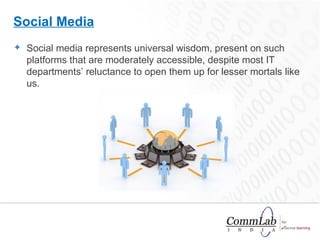
Social media represents universal wisdom, present on such platforms that are moderately accessible, despite most IT departments’ reluctance to open them up for lesser mortals like us. Social Media
It is advisable to keep in mind that educating people on new innovation takes time and effort. To better understand, take a quick look at adopter categorization on relative time taken. How to Market the use of Social Media as a New Tool of Learning?
Research shows that when any new innovation is presented, potential users go through five distinct stages of adoption: Awareness  Interest  Evaluation  Trial  Adoption  Stages of Adoption
Diffusion of Innovation We should also keep in mind that, people vary in the time to adopt new things.  This process of “Diffusion of Innovation” was first popularized by Everett Rogers (1962) in his text book, Diffusion of Innovations (Rogers 1964).  He defines diffusion as “the process by which an innovation is communicated through certain channels over time among the members of a social system.”
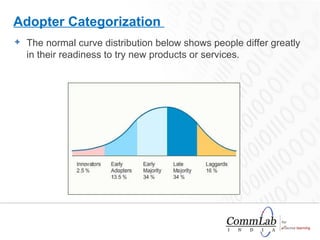
The normal curve distribution below shows people differ greatly in their readiness to try new products or services.  Adopter Categorization
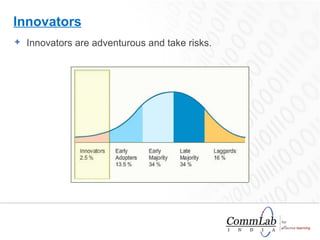
Innovators are adventurous and take risks. Innovators
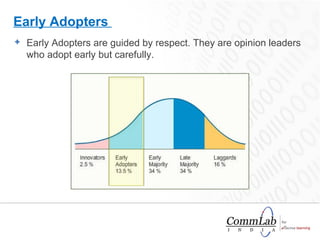
Early Adopters are guided by respect. They are opinion leaders who adopt early but carefully. Early Adopters
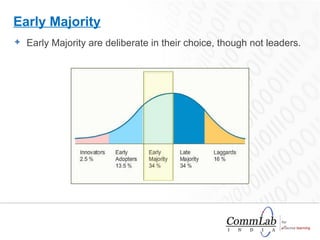
Early Majority are deliberate in their choice, though not leaders.  Early Majority
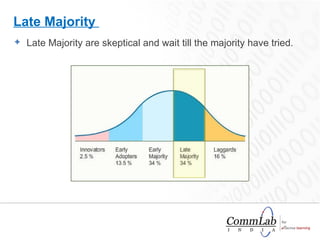
Late Majority are skeptical and wait till the majority have tried. Late Majority
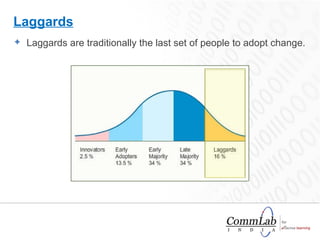
Laggards are traditionally the last set of people to adopt change.  Laggards
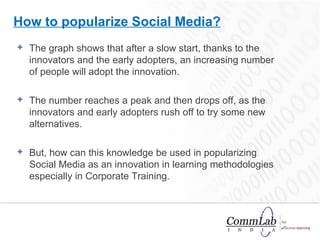
The graph shows that after a slow start, thanks to the innovators and the early adopters, an increasing number of people will adopt the innovation.  The number reaches a peak and then drops off, as the innovators and early adopters rush off to try some new alternatives. But, how can this knowledge be used in popularizing Social Media as an innovation in learning methodologies especially in Corporate Training. How to popularize Social Media?
First target the Innovators and the Early Adopters through free workshops and contests. They are risk takers and get attracted by anything new.  Present success stories and case studies collected from the Innovators and the Early Adopters to the Early Majority.  Once these groups are behind you, the others (Later Majority and Laggards) will automatically follow.  Suggestions
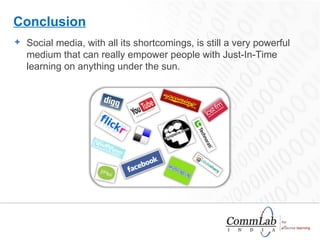
Social media, with all its shortcomings, is still a very powerful medium that can really empower people with Just-In-Time learning on anything under the sun. Conclusion
Hence, it is our responsibility to present this medium to our ‘customers’, so that they benefit from it and thereby benefit our organizations.

Social Media as New Learning Tool

  • 1.
    Social Media asNew Learning Tool
  • 2.
    Social media representsuniversal wisdom, present on such platforms that are moderately accessible, despite most IT departments’ reluctance to open them up for lesser mortals like us. Social Media
  • 3.
    It is advisableto keep in mind that educating people on new innovation takes time and effort. To better understand, take a quick look at adopter categorization on relative time taken. How to Market the use of Social Media as a New Tool of Learning?
  • 4.
    Research shows thatwhen any new innovation is presented, potential users go through five distinct stages of adoption: Awareness Interest Evaluation Trial Adoption Stages of Adoption
  • 5.
    Diffusion of InnovationWe should also keep in mind that, people vary in the time to adopt new things. This process of “Diffusion of Innovation” was first popularized by Everett Rogers (1962) in his text book, Diffusion of Innovations (Rogers 1964). He defines diffusion as “the process by which an innovation is communicated through certain channels over time among the members of a social system.”
  • 6.
    The normal curvedistribution below shows people differ greatly in their readiness to try new products or services. Adopter Categorization
  • 7.
    Innovators are adventurousand take risks. Innovators
  • 8.
    Early Adopters areguided by respect. They are opinion leaders who adopt early but carefully. Early Adopters
  • 9.
    Early Majority aredeliberate in their choice, though not leaders. Early Majority
  • 10.
    Late Majority areskeptical and wait till the majority have tried. Late Majority
  • 11.
    Laggards are traditionallythe last set of people to adopt change. Laggards
  • 12.
    The graph showsthat after a slow start, thanks to the innovators and the early adopters, an increasing number of people will adopt the innovation. The number reaches a peak and then drops off, as the innovators and early adopters rush off to try some new alternatives. But, how can this knowledge be used in popularizing Social Media as an innovation in learning methodologies especially in Corporate Training. How to popularize Social Media?
  • 13.
    First target theInnovators and the Early Adopters through free workshops and contests. They are risk takers and get attracted by anything new. Present success stories and case studies collected from the Innovators and the Early Adopters to the Early Majority. Once these groups are behind you, the others (Later Majority and Laggards) will automatically follow. Suggestions
  • 14.
    Social media, withall its shortcomings, is still a very powerful medium that can really empower people with Just-In-Time learning on anything under the sun. Conclusion
  • 15.
    Hence, it isour responsibility to present this medium to our ‘customers’, so that they benefit from it and thereby benefit our organizations.