Social Interaction
in Everyday Life
Social
Interaction
• Social interaction is the process by
which people act and react in relation
to others.
• Human beings rely on social
structure to make sense of everyday
life
• Social structure guides human
behavior rather than rigidly
determining it.
Status
• Status is a social position that
an individual occupies. Most
important however is your
status set.
• Status set consists of all the
statuses a person holds at a
given time
• For example, I am a
teacher; I am also a:
• Husband
• Father
• Son
• Brother
• Friend
Types of
Status
Ascribed status is a social
position one receives at birth or
involuntarily assumes later in life
•The Queen of England is an ascribed
status
Achieved status is a social
position that someone assumes
voluntarily and that reflects
personal ability and effort
•Becoming President of the US is an
achieved status
Often, these two types work
together; what we are ascribed
often helps us achieve other
statuses
Types of
Status
A master status is a status
that has special importance
for social identity, often
shaping a person’s entire life.
A master status is one that
overrides all other statuses.
Roles
• A role consists of behavior expected
of someone who holds a particular
status.
• Role set refers to a number of roles
attached to a single status.
• For example, the role of mother
has several role sets attached
to it. Mothers are:
• Doctors
• Chauffeurs
• Appointment keepers
• House keepers
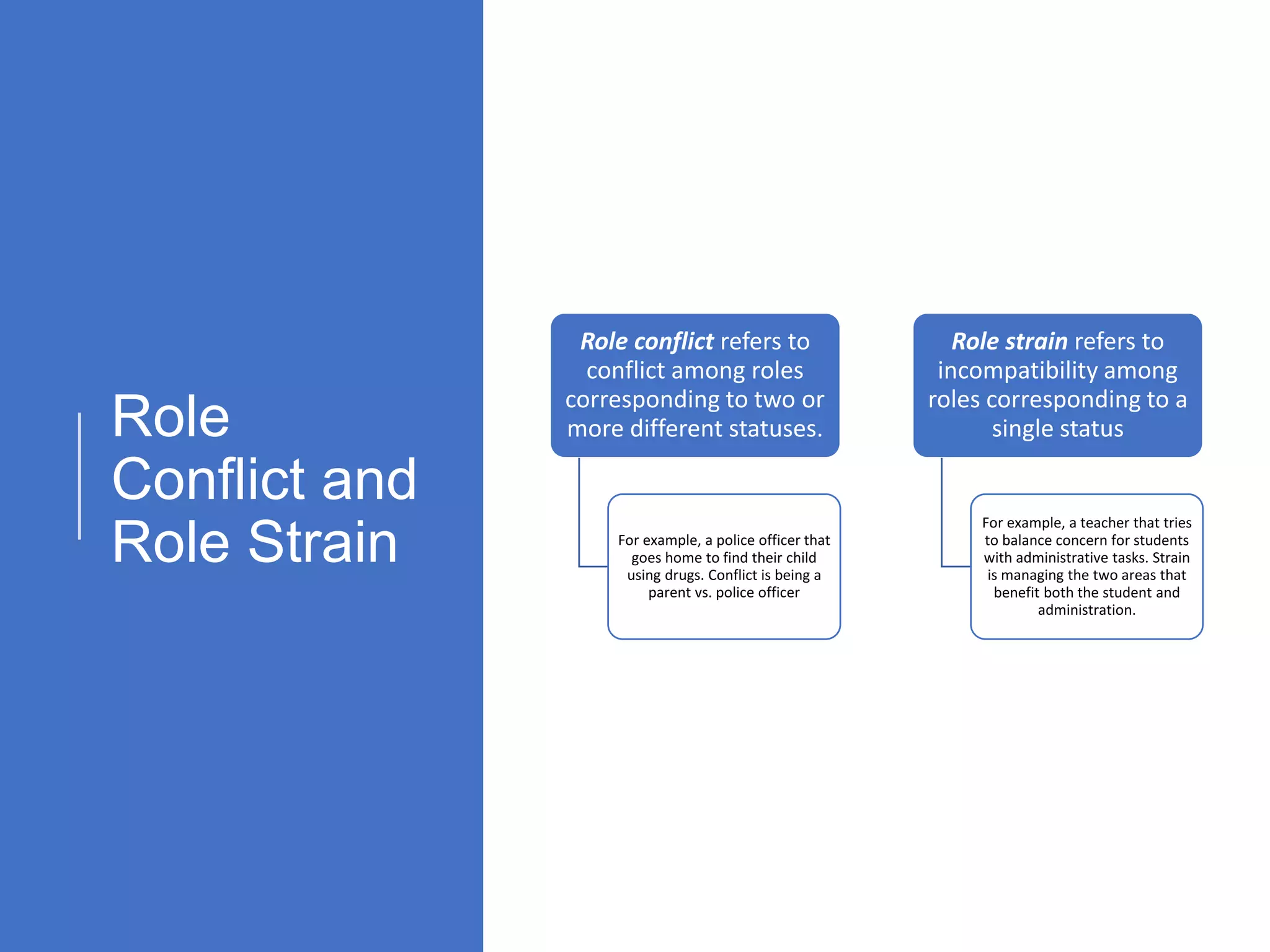
Role
Conflict and
Role Strain
Role conflict refers to
conflict among roles
corresponding to two or
more different statuses.
For example, a police officer that
goes home to find their child
using drugs. Conflict is being a
parent vs. police officer
Role strain refers to
incompatibility among
roles corresponding to a
single status
For example, a teacher that tries
to balance concern for students
with administrative tasks. Strain
is managing the two areas that
benefit both the student and
administration.
Reason Example
Because many people are overextended, some roles
are bound to conflict with others.
Students may study less than they want because
employers demand that they work overtime or on
weekends.
People have little or no training for many roles. Parents are expected to turn out “perfect” kids even
though they receive training for driving a car but none
for parenting.
Some role expectations are unclear or contradictory. Some employers pride themselves on having family-
friendly policies but expect employees to work 12
hours a day, travel on weekends, and use vacation
days to care for a sick child.
Highly demanding jobs often create difficulties at
home.
Some jobs (being in the military, policing, and
firefighting) require people to be away from their
families for extended periods of time or during crises.
TABLE 5.1: WHY DO WE EXPERIENCE ROLE CONFLICT AND ROLE
STRAIN?
(Benokraitis 86-87)
Benokraitis, Nijole V. SOC, 5th Edition. Cengage Learning, 20160201. VitalBook file.
Social
Construction of
Reality
• This is the process by which
individuals creatively shape
reality through social
interaction with others.
• What people commonly call
“street smarts” really amounts
to constructing reality.
• Ethnomethodology is the
study of how people make
sense of their social
encounters
Dramaturgical
Analysis:
Erving
Goffman
• This examines social interactions as if
individuals were actors on stage
• Consists of the “front stage” and “back
stage”
• Front stage is part of your performance you
want people to see
• Similar to cleaning your house before
company comes over
• Back stage is part of your performance you
want to hide from others
• Similar to when you don’t have a chance
to clean house before company comes
over
The
Presentation
of Self
• Also associated with Goffman, this is
the effort of an individual to create
specific impressions in the minds of
others
• Impression management is very
important and includes things like
dress, props, and manner of acting.
• For example, when you go to the
doctor, think about what you
expect to happen (greeted by
staff, doctor enters room wearing
white coat, etc.).
• The presentation of self is the central
focus of the dramaturgical analysis
Interaction in
Everyday Life:
Nonverbal
Communication
• Nonverbal communication is an
important part of the presentation
of self
• Communication using body
movements, gestures, and
facial expressions.
• Most of it is culture-specific.
• Close attention to nonverbal
communication is often an
effective way of telling whether or
not someone is telling the truth.
• Body language can contradict
verbal communication.
• Pay attention to four elements of
performance: words, voice, body
language, and facial expression.
The Symbol of Gestures
Interaction
in
Everyday
Life:
Using
Humor
• Humor provides a way to express an opinion
without being serious; using humor relieves
tension in uncomfortable situations.
• Humor is a great icebreaker and allows some
sensitive topics to be discussed in a non-
threatening way.
• For everyone, humor deals with topics that
lend themselves to double meanings or
controversy.
• The dynamics of humor: “getting it.” To
“get” humor, the audience must
understand the two realities involved well
enough to appreciate their differences.

Social interaction

  • 1.
  • 2.
    Social Interaction • Social interactionis the process by which people act and react in relation to others. • Human beings rely on social structure to make sense of everyday life • Social structure guides human behavior rather than rigidly determining it.
  • 3.
    Status • Status isa social position that an individual occupies. Most important however is your status set. • Status set consists of all the statuses a person holds at a given time • For example, I am a teacher; I am also a: • Husband • Father • Son • Brother • Friend
  • 4.
    Types of Status Ascribed statusis a social position one receives at birth or involuntarily assumes later in life •The Queen of England is an ascribed status Achieved status is a social position that someone assumes voluntarily and that reflects personal ability and effort •Becoming President of the US is an achieved status Often, these two types work together; what we are ascribed often helps us achieve other statuses
  • 5.
    Types of Status A masterstatus is a status that has special importance for social identity, often shaping a person’s entire life. A master status is one that overrides all other statuses.
  • 6.
    Roles • A roleconsists of behavior expected of someone who holds a particular status. • Role set refers to a number of roles attached to a single status. • For example, the role of mother has several role sets attached to it. Mothers are: • Doctors • Chauffeurs • Appointment keepers • House keepers
  • 7.
    Role Conflict and Role Strain Roleconflict refers to conflict among roles corresponding to two or more different statuses. For example, a police officer that goes home to find their child using drugs. Conflict is being a parent vs. police officer Role strain refers to incompatibility among roles corresponding to a single status For example, a teacher that tries to balance concern for students with administrative tasks. Strain is managing the two areas that benefit both the student and administration.
  • 8.
    Reason Example Because manypeople are overextended, some roles are bound to conflict with others. Students may study less than they want because employers demand that they work overtime or on weekends. People have little or no training for many roles. Parents are expected to turn out “perfect” kids even though they receive training for driving a car but none for parenting. Some role expectations are unclear or contradictory. Some employers pride themselves on having family- friendly policies but expect employees to work 12 hours a day, travel on weekends, and use vacation days to care for a sick child. Highly demanding jobs often create difficulties at home. Some jobs (being in the military, policing, and firefighting) require people to be away from their families for extended periods of time or during crises. TABLE 5.1: WHY DO WE EXPERIENCE ROLE CONFLICT AND ROLE STRAIN? (Benokraitis 86-87) Benokraitis, Nijole V. SOC, 5th Edition. Cengage Learning, 20160201. VitalBook file.
  • 9.
    Social Construction of Reality • Thisis the process by which individuals creatively shape reality through social interaction with others. • What people commonly call “street smarts” really amounts to constructing reality. • Ethnomethodology is the study of how people make sense of their social encounters
  • 10.
    Dramaturgical Analysis: Erving Goffman • This examinessocial interactions as if individuals were actors on stage • Consists of the “front stage” and “back stage” • Front stage is part of your performance you want people to see • Similar to cleaning your house before company comes over • Back stage is part of your performance you want to hide from others • Similar to when you don’t have a chance to clean house before company comes over
  • 11.
    The Presentation of Self • Alsoassociated with Goffman, this is the effort of an individual to create specific impressions in the minds of others • Impression management is very important and includes things like dress, props, and manner of acting. • For example, when you go to the doctor, think about what you expect to happen (greeted by staff, doctor enters room wearing white coat, etc.). • The presentation of self is the central focus of the dramaturgical analysis
  • 12.
    Interaction in Everyday Life: Nonverbal Communication •Nonverbal communication is an important part of the presentation of self • Communication using body movements, gestures, and facial expressions. • Most of it is culture-specific. • Close attention to nonverbal communication is often an effective way of telling whether or not someone is telling the truth. • Body language can contradict verbal communication. • Pay attention to four elements of performance: words, voice, body language, and facial expression.
  • 13.
    The Symbol ofGestures
  • 14.
    Interaction in Everyday Life: Using Humor • Humor providesa way to express an opinion without being serious; using humor relieves tension in uncomfortable situations. • Humor is a great icebreaker and allows some sensitive topics to be discussed in a non- threatening way. • For everyone, humor deals with topics that lend themselves to double meanings or controversy. • The dynamics of humor: “getting it.” To “get” humor, the audience must understand the two realities involved well enough to appreciate their differences.