









Applied Linguistics
Social Influences on Language
Learning
By : Zahra Aamir .
 Different perspectives of social influences on learning
When we talk about what is being acquired in SLA, it is not enough
just to talk about the language itself. We must also include the social
and cultural knowledge embedded in the language being learned,
that is required for appropriate language use. It is significant to study
social influences on language learning because " languages are
learned in social context" (Spolsky, 1989:131).
Hutchinson & Waters (1987) refer to the social influences on
language learning as "Learning can, should, be seen in the context
in which it takes place.
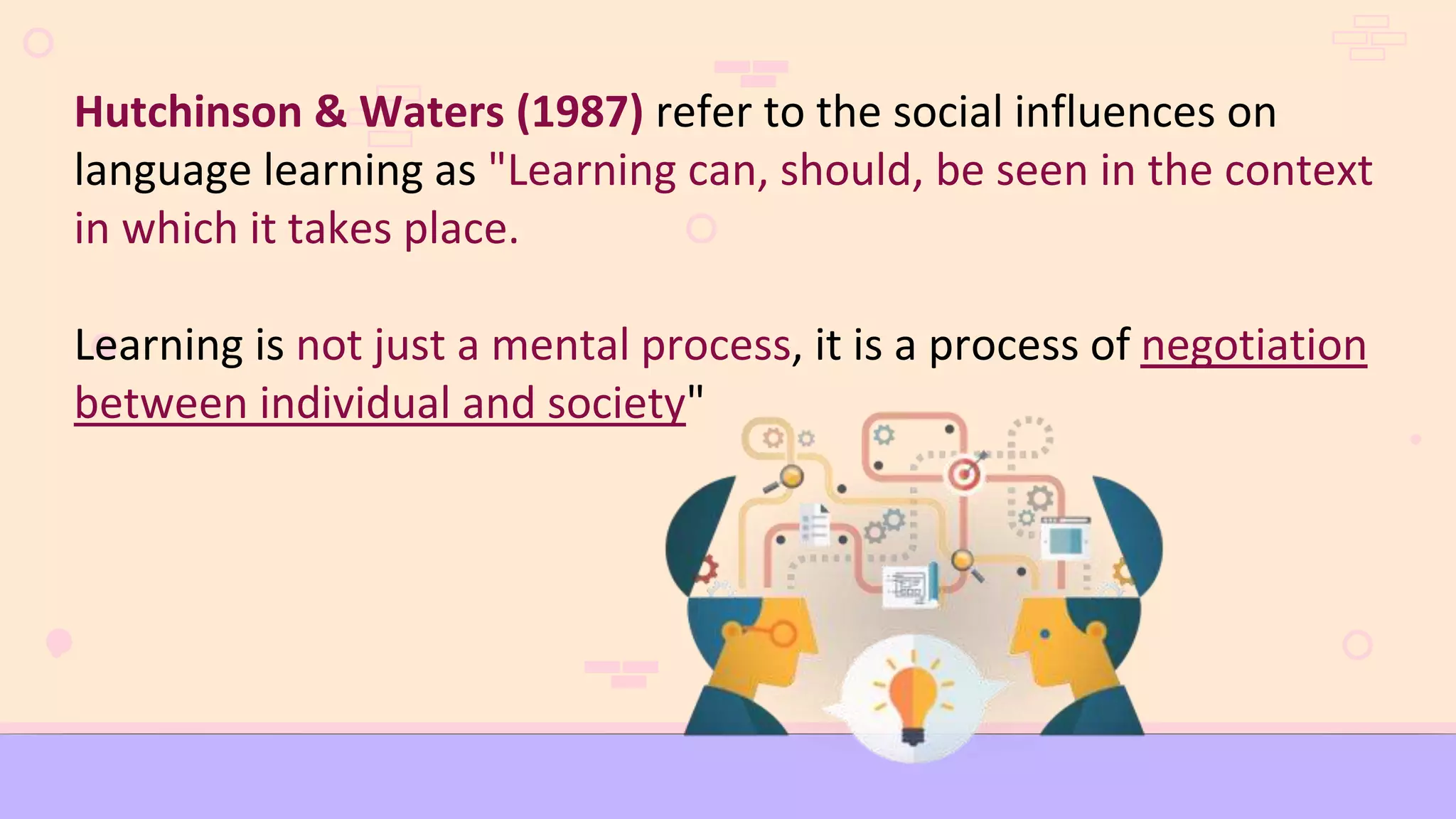
Learning is not just a mental process, it is a process of negotiation
between individual and society"
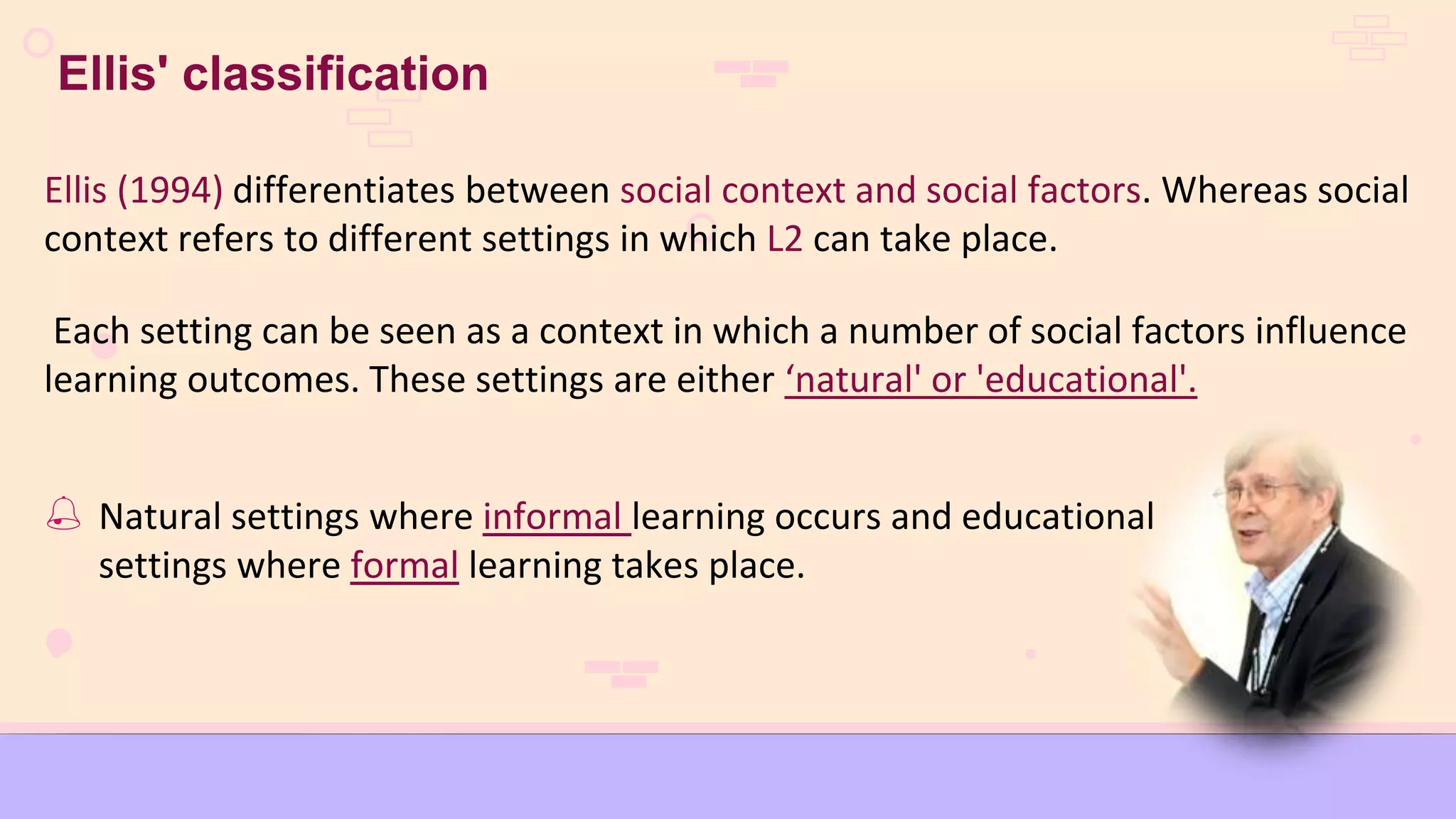
Ellis (1994) differentiates between social context and social factors. Whereas social
context refers to different settings in which L2 can take place.
Each setting can be seen as a context in which a number of social factors influence
learning outcomes. These settings are either ‘natural' or 'educational'.
Ellis' classification
 Natural settings where informal learning occurs and educational
settings where formal learning takes place.
 Troike (2012) distinguishes between microsocial and macrosocial
factors .
 The microsocial factors include features of setting and interaction
that relate to communicative events within language which is
produced and interpreted .
 Lier (1988) describes the macrosocial view as involving the wider
community, and microsocial view, by contrast, is restricted within
classroom.
Hymes'classification
According to Hymes' communicative competence, what the learner needs to know
depends on the social context which the learner learns and uses language.
According to Troike, he classifies macrosocial factors into the following:
1. Global and national level Its influences on second language acquisition involve the
power and status of learners’ native and target languages, whether overtly stated in
official policies or covertly realized in cultural values and practices.
2. Social boundaries Influences on second language acquisition (SLA) at this level often
involve the relationship between native and target language groups, as well as the
openness and perviousness of community boundaries.
3. Institutional forces and constraints They often affect the use and knowledge of L2 in
relation to such things as social control, political and religious practices, and economic and
educational opportunities
4. Social categories Age, gender, and ethnicity education level,
occupation, and economic status. are factors of social group
membership which may potentially be relevant to second language
learning.
5. circumstances of learning They can influence SLA, such as
learners’ prior educational experiences, whether the L2 learning
process is informal or formal, and (if formal) the type of educational
model learners have access to and the pedagogical orientation of
their teachers and administrators. (Troike,2006:101).
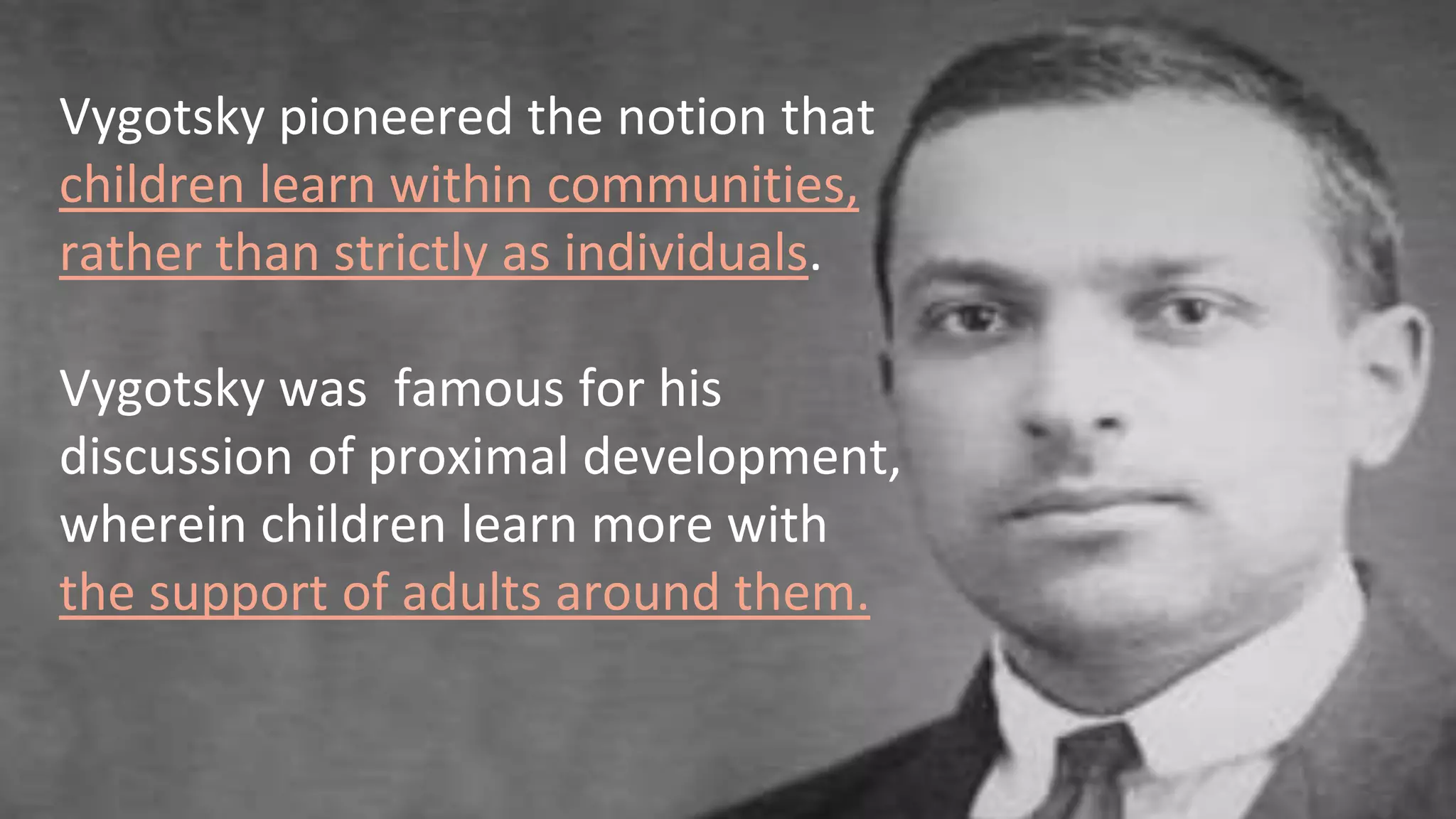
Vygotsky pioneered the notion that
children learn within communities,
rather than strictly as individuals.
Vygotsky was famous for his
discussion of proximal development,
wherein children learn more with
the support of adults around them.
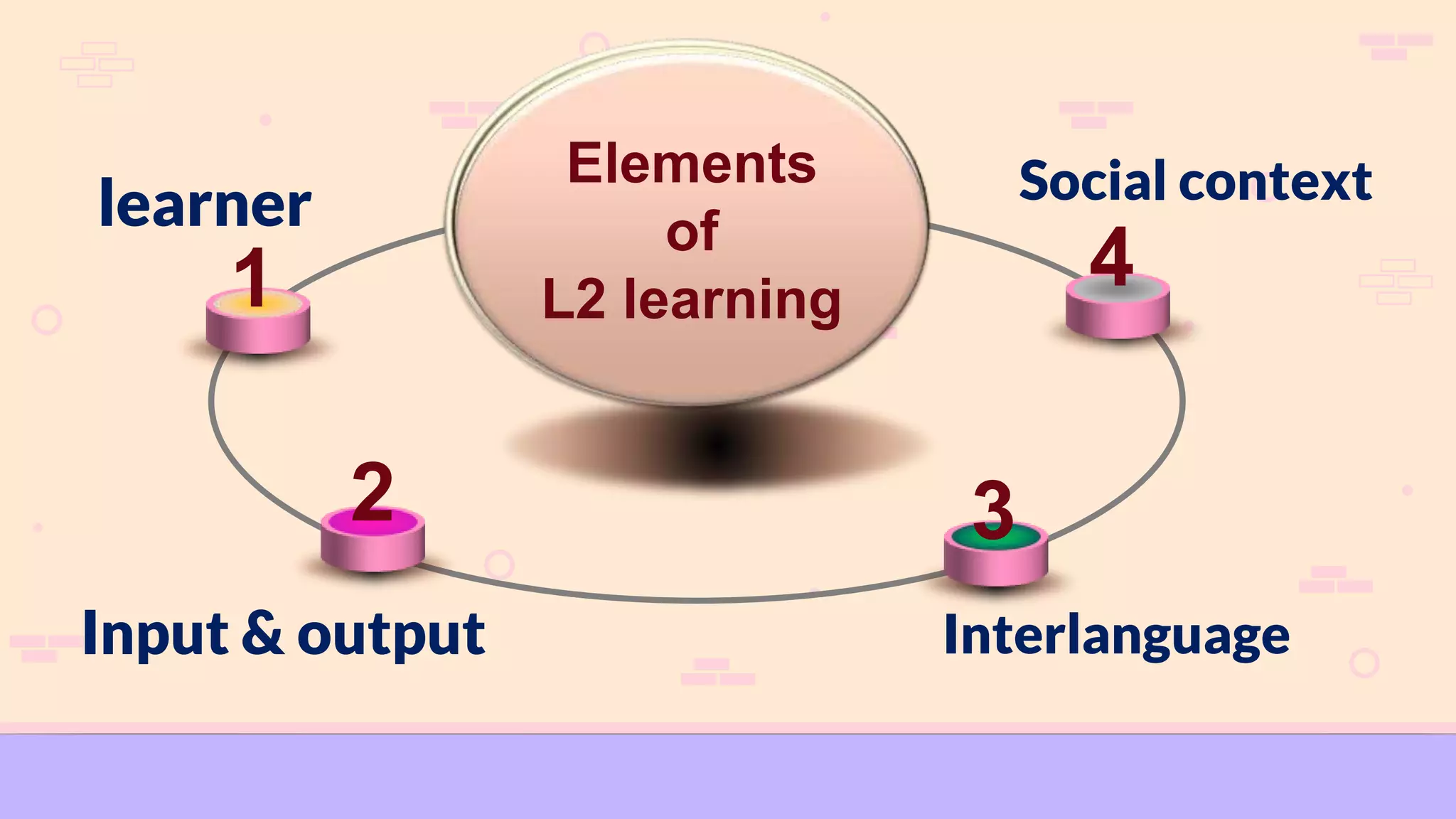
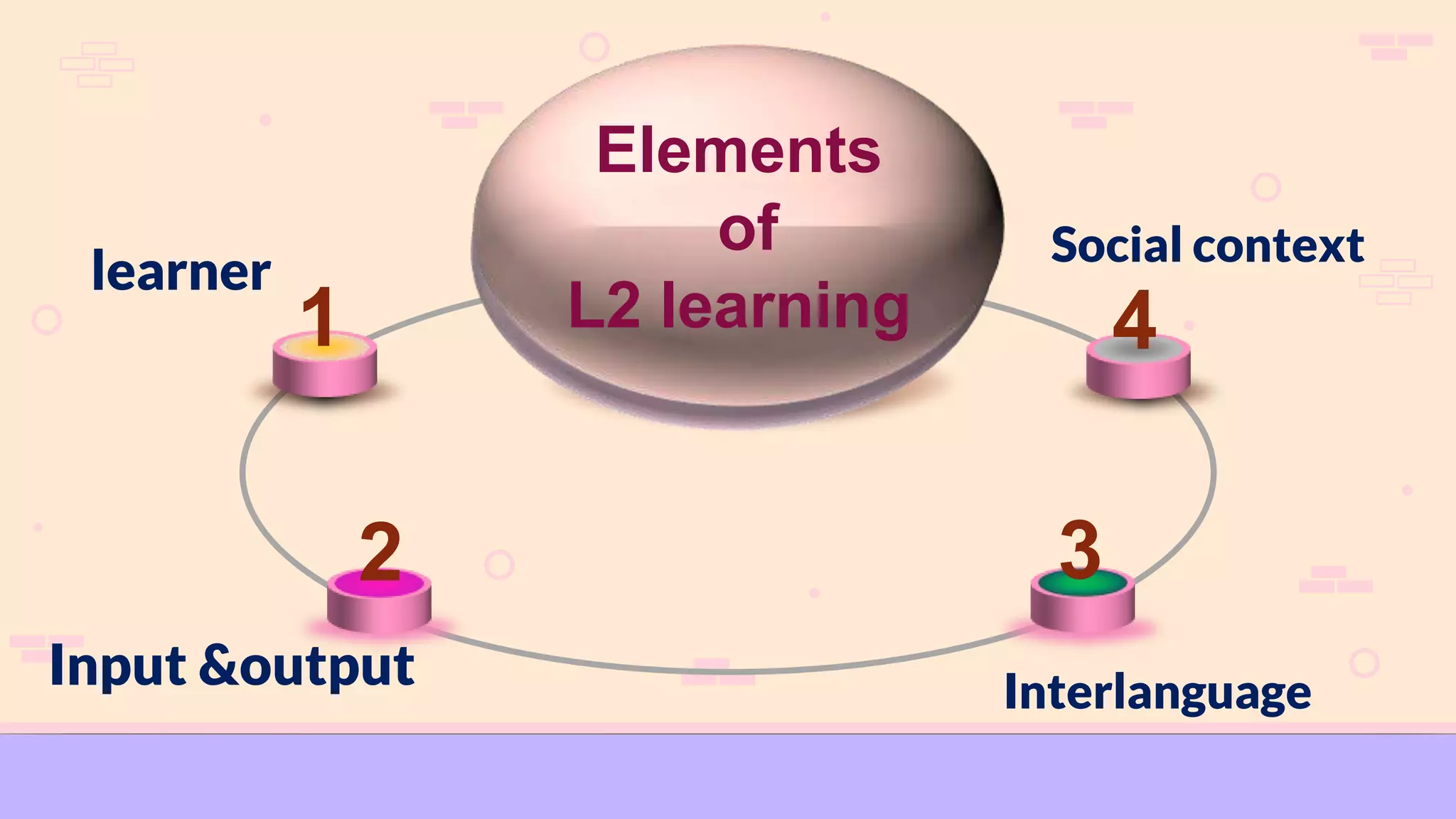
Elements of second language
learning
1
2 3
4
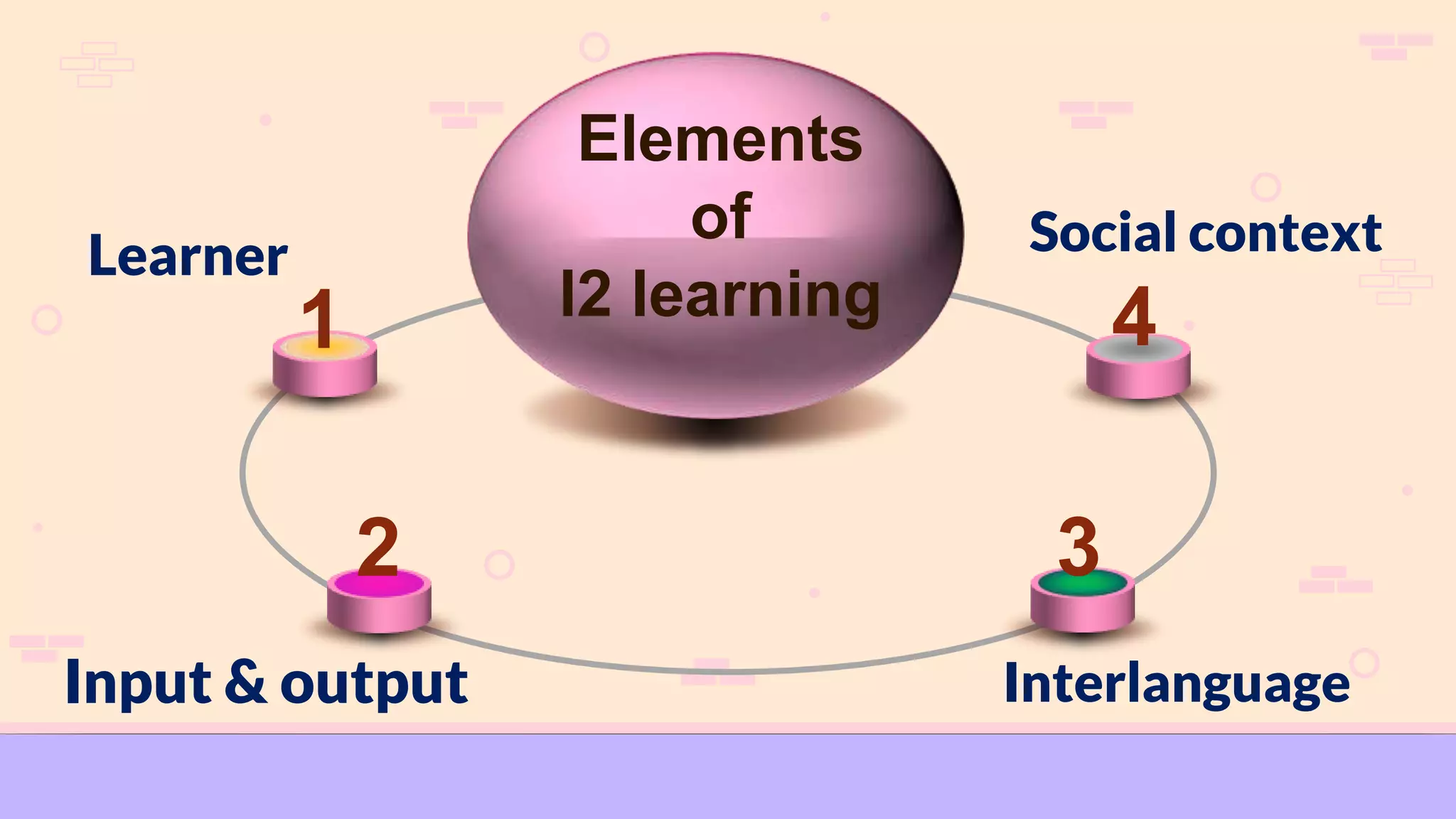
Elements
of
L2 learning
Input & output
learner
Interlanguage
Social context
1
Learner is the most important element in learning process which has
different attitude toward L2, its speakers, its culture, some its uses, social
value being learning the L2. These attitudes have impact on second
language learning .
There are a number of social factors that can be mediated through
learner attitudes which affect language learning.
Ellis mentioned four factors: gender, age, social class ,ethnic identity and notes
that these factors determine L2 proficiency but the social conditions
associated with these variables.
1
 Sociolinguistic research has shown that men use a higher
frequency of non-standard forms than women. So the women
might be better at L2 learning than men because they are
likely to be open to new linguistic forms.
1
 Ellis (1994) concludes that younger learners are
generally more successful at learning languages than
older.
1
2 3
4
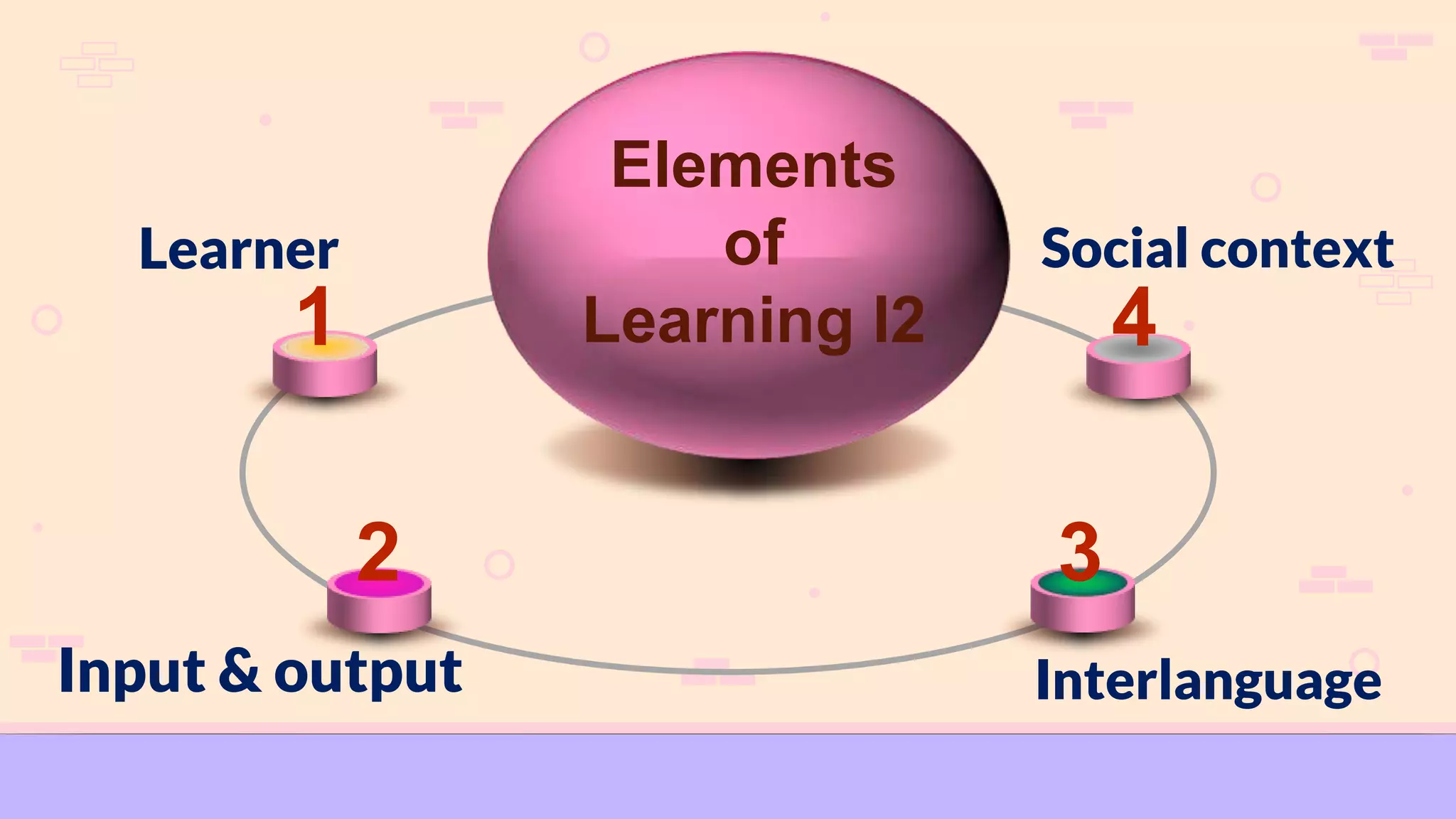
Elements
of
L2 learning
Input &output
learner
Interlanguage
Social context
2
The environment, where the learning process takes place, contributes to
form second language input, that is perceived by the language learner,
and the output, that is produced by him/her.
Davies & Elder(2004) state that input is received by learners when listening
or reading in second language learning takes place whether in a natural
setting or artificial one like classroom. Output, on the other hand, depends
on the learner's writing or speaking.
2
 Some studies in the field on language learning indicates the role
that learner's social identity and relations of power, play in how
input and output are constructed their role in language learning.
 Output is not merely using linguistic forms appropriately, but it has
a political role within the target language.
 Spada (1997) notes that it is not very clear what the effect of
input is on language learning. Both of input and output are parts
of social context. They play important part, and have a great
influence on interlanguage.
1
2 3
4
Elements
of
l2 learning
Input & output
Learner
Interlanguage
Social context
3 A learner's interlanguage system is "neither the system of the native
language nor the system of target language, but instead falls between the
two" (Brown, 1994, p. 204).
Interlanguage means the relationship that exist between two dialects or
varieties of language. Mother tongue interference is a situation in which the
L1 influences the L2, either phonologically, semantically or syntactically.
Then, error analysis refers to a systematic process of providing solutions to
broken utterances and sentences that are not in conformity with the rules of
a language. English
Arabic
English
3
Interlanguage, as another element of learning process, is nonnative language which
contains new forms that are not found in L1 as well as in L2 (Robinson,2013: 338).
One of the goals of language learning is to construct a mental system of L2
knowledge, what is referred to in different ways as an interlanguage (IL).
Interlanguage indicates the linguistic system evidenced when a second language
learner tries to express some meanings in the target language. This system is
different from L1 and L2 but relates to both of them.
1
2 3
4
Elements
of
Learning l2
Input & output
Learner
Interlanguage
Social context
4
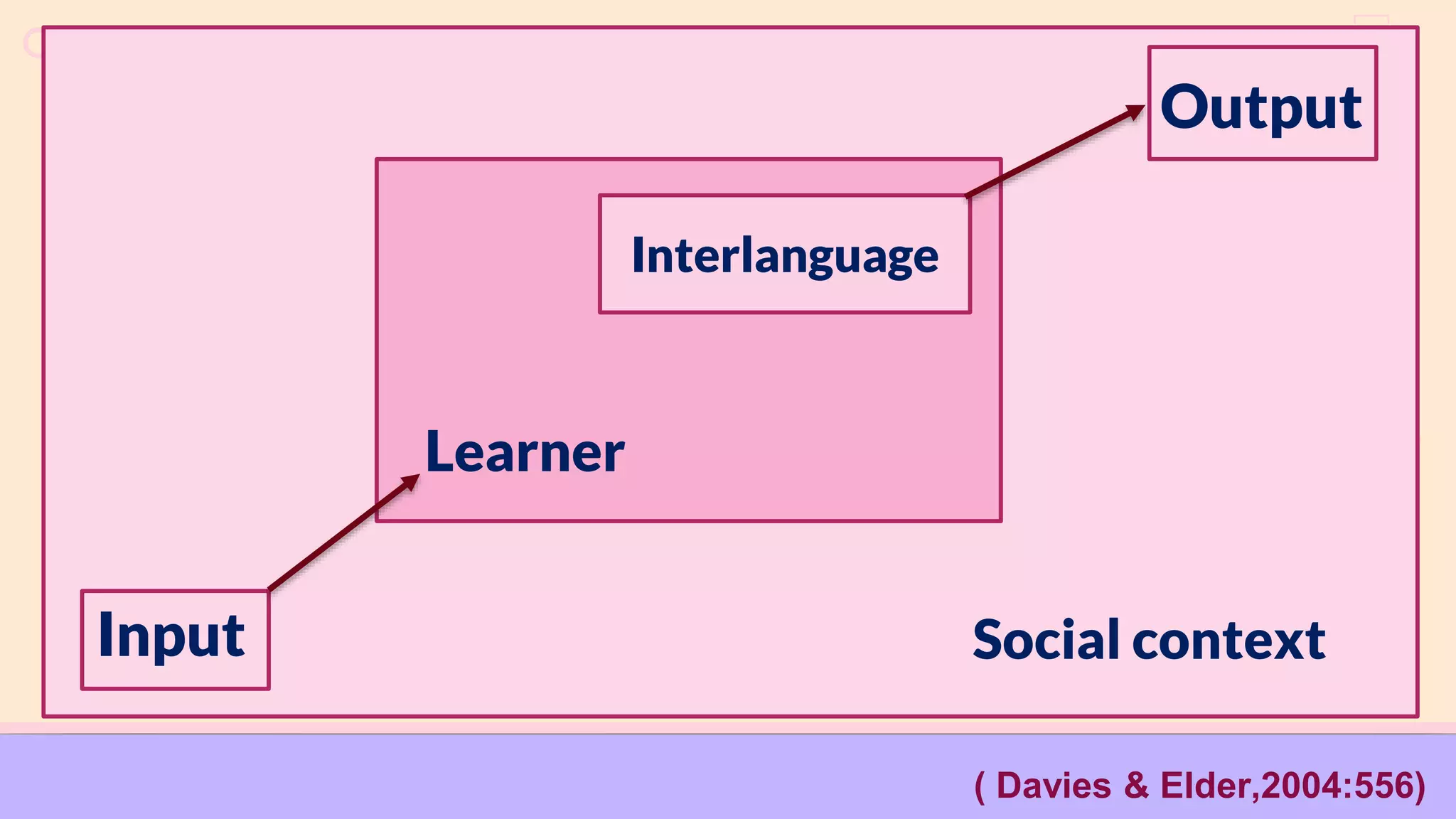
Davies & Elder(2004) note that there is a social and contextual dimension to
every naturally occurring use of language and these social factors determine
the choice and form of what is written, said or understood.
Sociolinguistics helps us to see the influences of ethnicity, gender, ideology
and social rank on language events.
Input
Output
Interlanguage
Social context
Learner
( Davies & Elder,2004:556)
Social Factors
Social factors refer to any feature of community that may influence
a learner´s acquisition of a second language and the elements of
second language learning .
(learner, input and output, interlanguage, and social context) are
affected by some social factors. These social factors have a
major effect on learning , but they do not influence directly
(Ellis,1994:197).
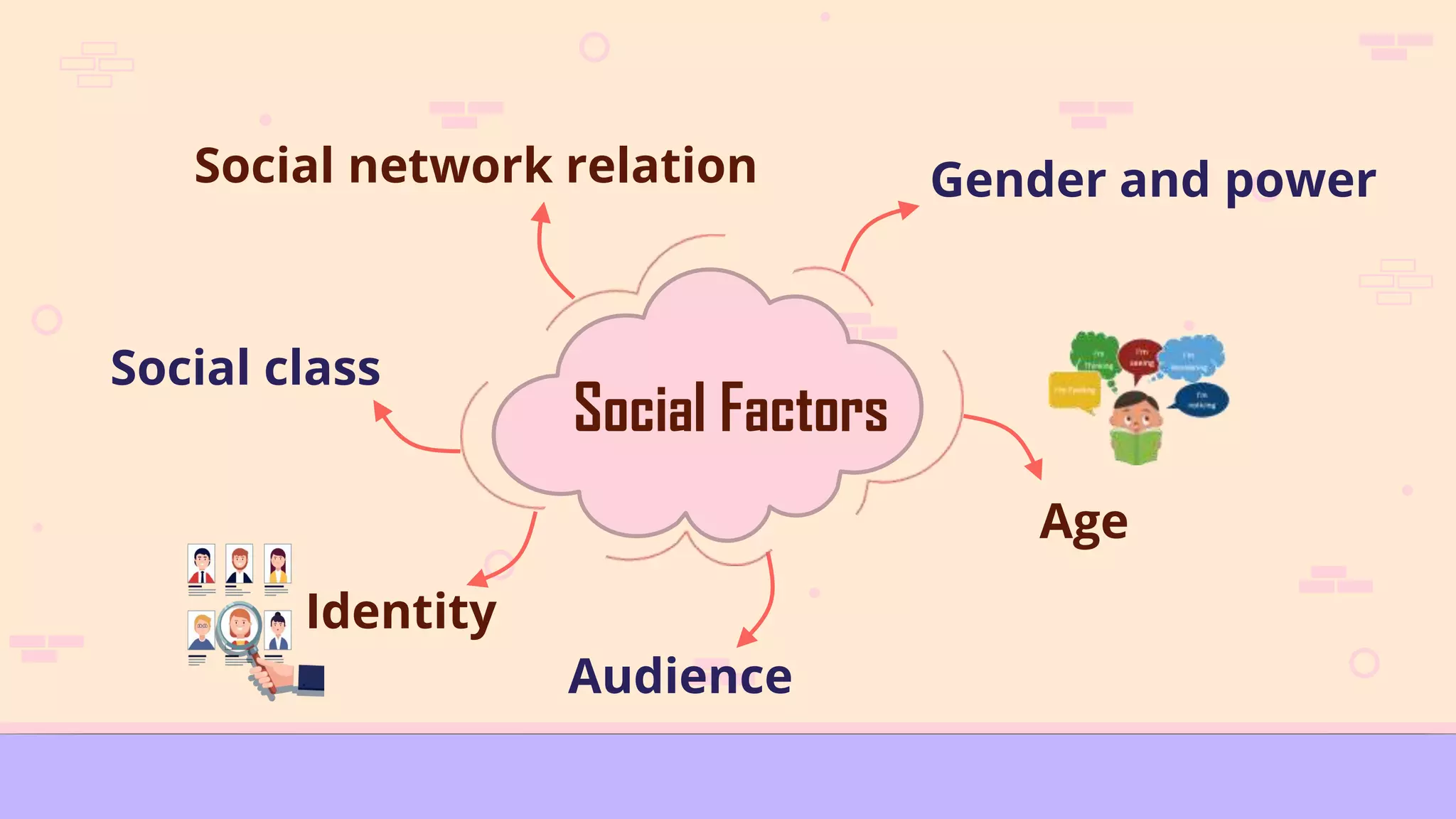
Gender and power
Age
Audience
Identity
Social class
Social Factors
Social network relation
The influence of gender and asymmetries in
power relations have been a major aspect of
sociolinguistic discussion in recent years.
Gender reflects some differences in how
women and men use their language.
Gender and power
Males and females are greatly different in terms of social
interactions.
The differences could be in terms of the way that people plan
their narratives, discourse organization, and different accents
that men and women use from one region to the other
(Ellis,1997:37). For instance, men use non-standard forms
frequently while women use standard ones.
Ellis differentiates between Asian men and Asian women as the
following:
 Gender of course, likely to interact with other variables in
determining L2 proficiency. It will not always be the case, therefore,
females outperform males.
 Asian men in Britain generally attain higher levels of proficiency in L2
English than do Asian women for the simple reason that their jobs
bring them into contact with the majority English speaking group, while
women are often "enclosed" in the home.
Adamson and Regan (1991) found that
 Women had a higher use of the prestige than men.
 Women also use more formal variants than men. In addition to that ,
women might be better at L2 learning than men.
 Ellis notes that women tend to use new forms in their speech.Men,on the
other hand, may less use to new forms.
 Ellis concludes that men use translation strategies more than women.
Therefore, gender is the major factors that interacts with other social factors.
Age
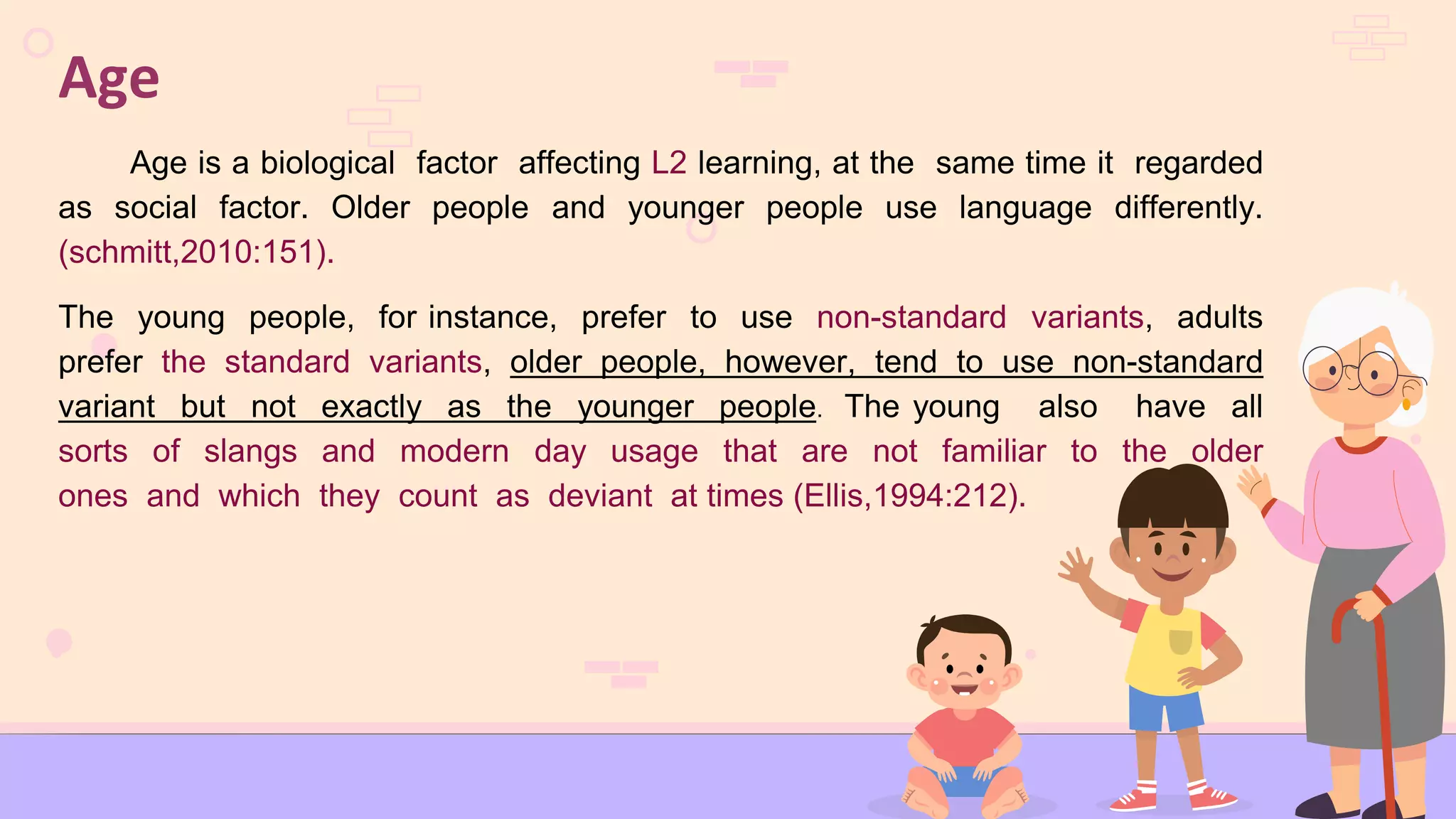
Age is a biological factor affecting L2 learning, at the same time it regarded
as social factor. Older people and younger people use language differently.
(schmitt,2010:151).
The young people, for instance, prefer to use non-standard variants, adults
prefer the standard variants, older people, however, tend to use non-standard
variant but not exactly as the younger people. The young also have all
sorts of slangs and modern day usage that are not familiar to the older
ones and which they count as deviant at times (Ellis,1994:212).
Audience
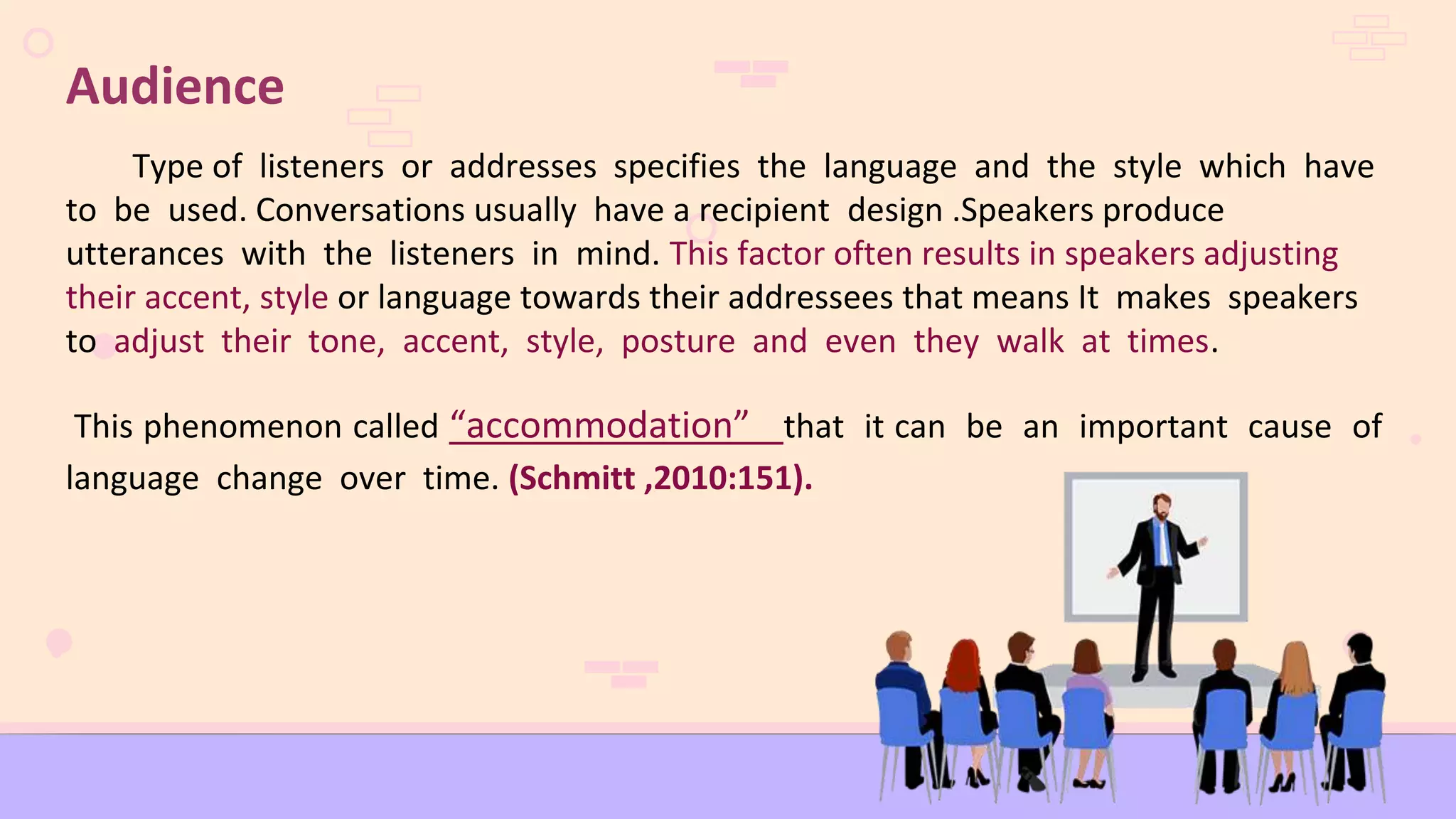
Type of listeners or addresses specifies the language and the style which have
to be used. Conversations usually have a recipient design .Speakers produce
utterances with the listeners in mind. This factor often results in speakers adjusting
their accent, style or language towards their addressees that means It makes speakers
to adjust their tone, accent, style, posture and even they walk at times.
This phenomenon called “accommodation” that it can be an important cause of
language change over time. (Schmitt ,2010:151).
There is a clear parallel between sociolinguistic phenomenon
associated with social class ,a language change and interlanguage
development. There is also a relationship between social class and
L2 achievement. Children from lower socio-economic group are
less successful educationally than those from higher group.
Middle-class children achieve higher level of L2 proficiency and
more positive attitudes than working class children.
Social Class
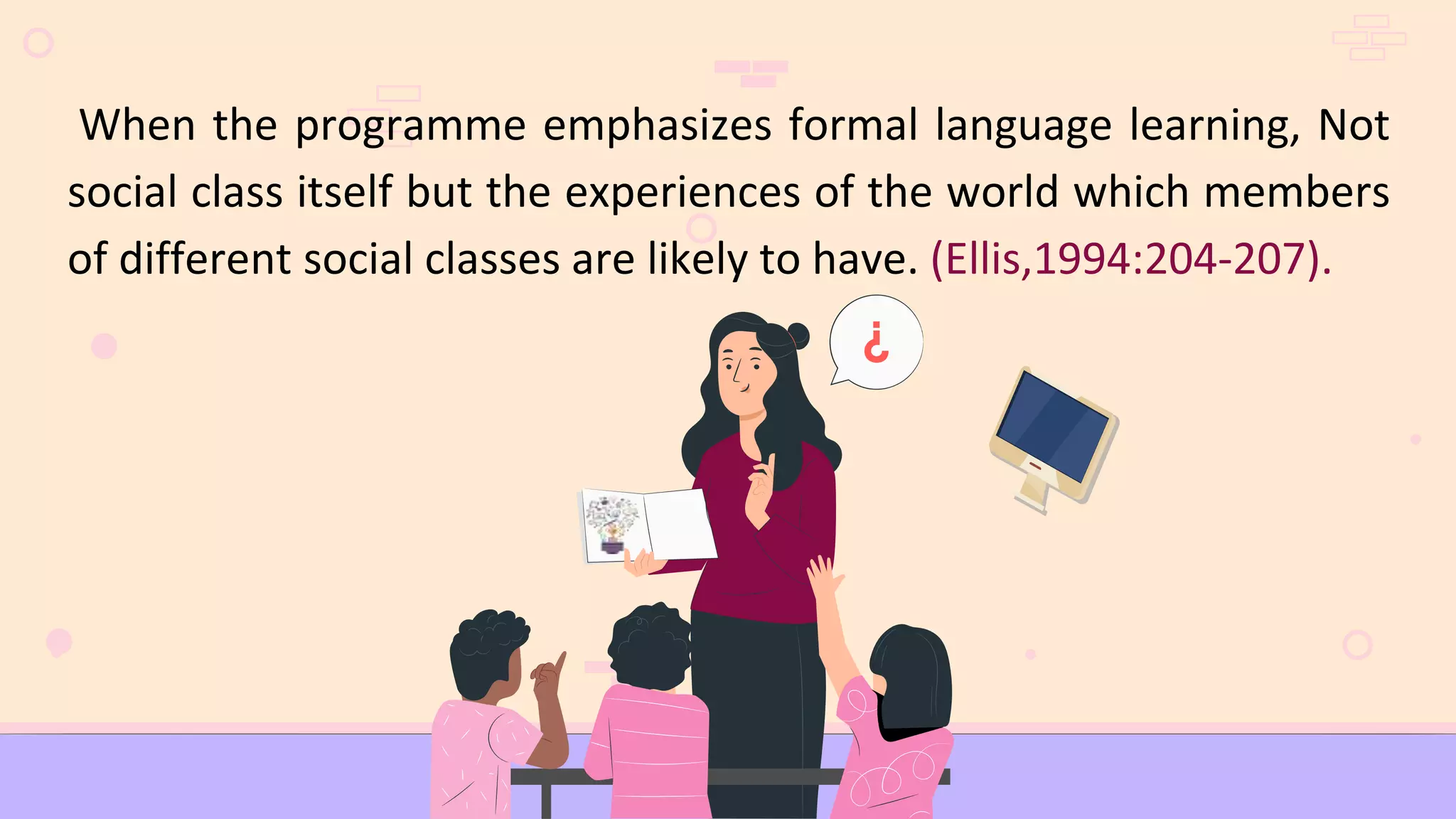
When the programme emphasizes formal language learning, Not
social class itself but the experiences of the world which members
of different social classes are likely to have. (Ellis,1994:204-207).
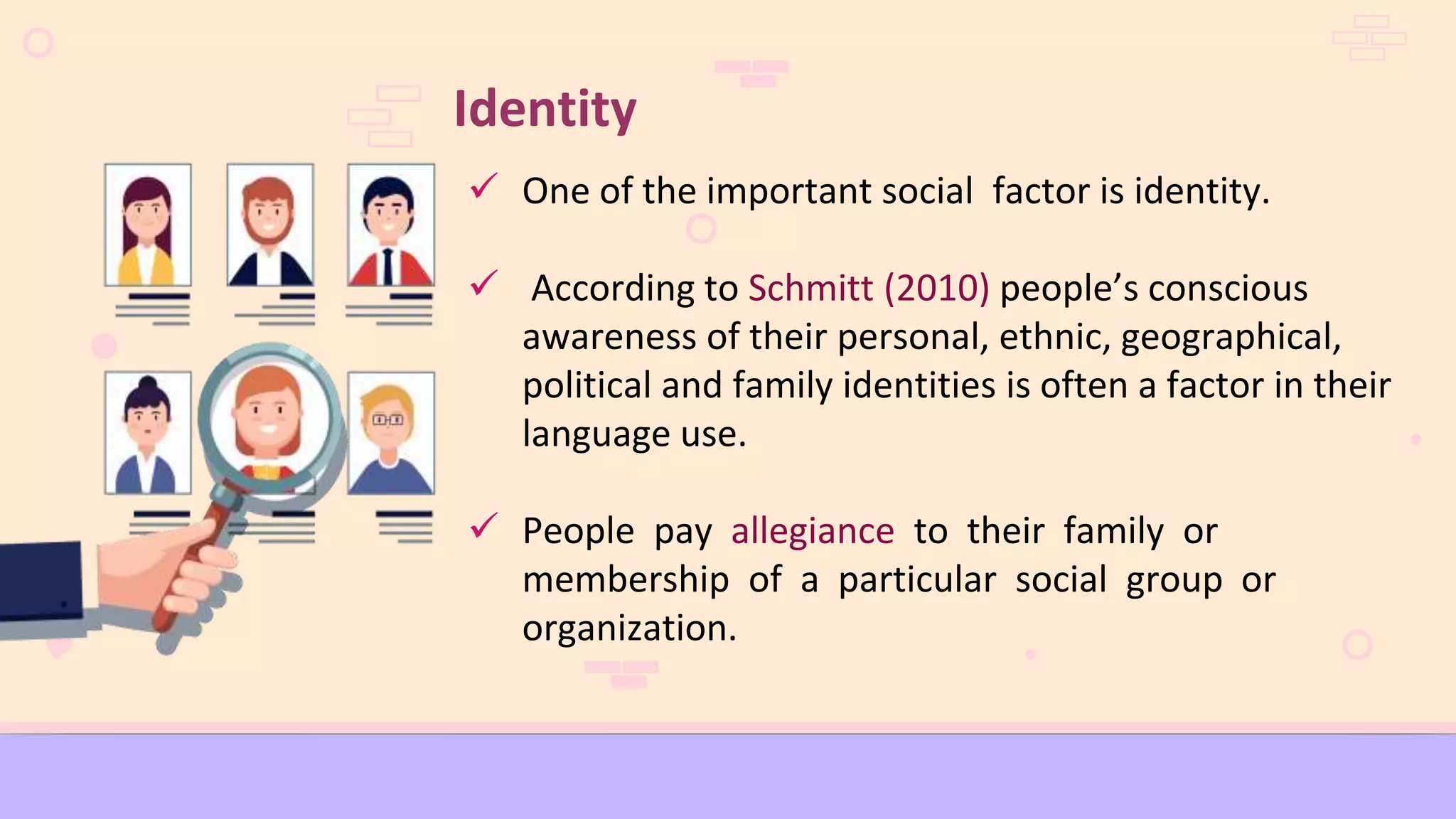
Identity
 One of the important social factor is identity.
 According to Schmitt (2010) people’s conscious
awareness of their personal, ethnic, geographical,
political and family identities is often a factor in their
language use.
 People pay allegiance to their family or
membership of a particular social group or
organization.
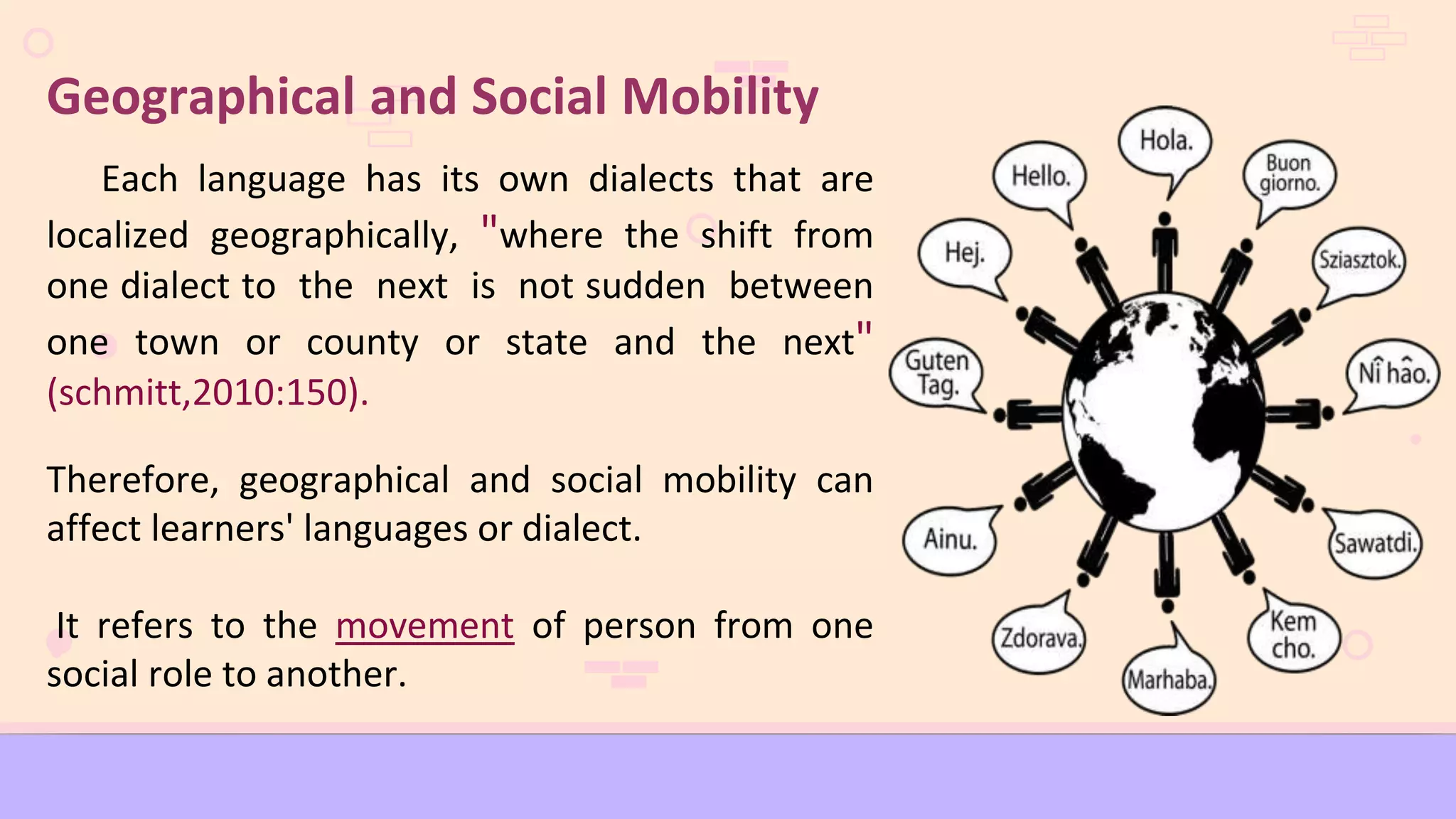
Geographical and Social Mobility
Each language has its own dialects that are
localized geographically, "where the shift from
one dialect to the next is not sudden between
one town or county or state and the next"
(schmitt,2010:150).
Therefore, geographical and social mobility can
affect learners' languages or dialect.
It refers to the movement of person from one
social role to another.
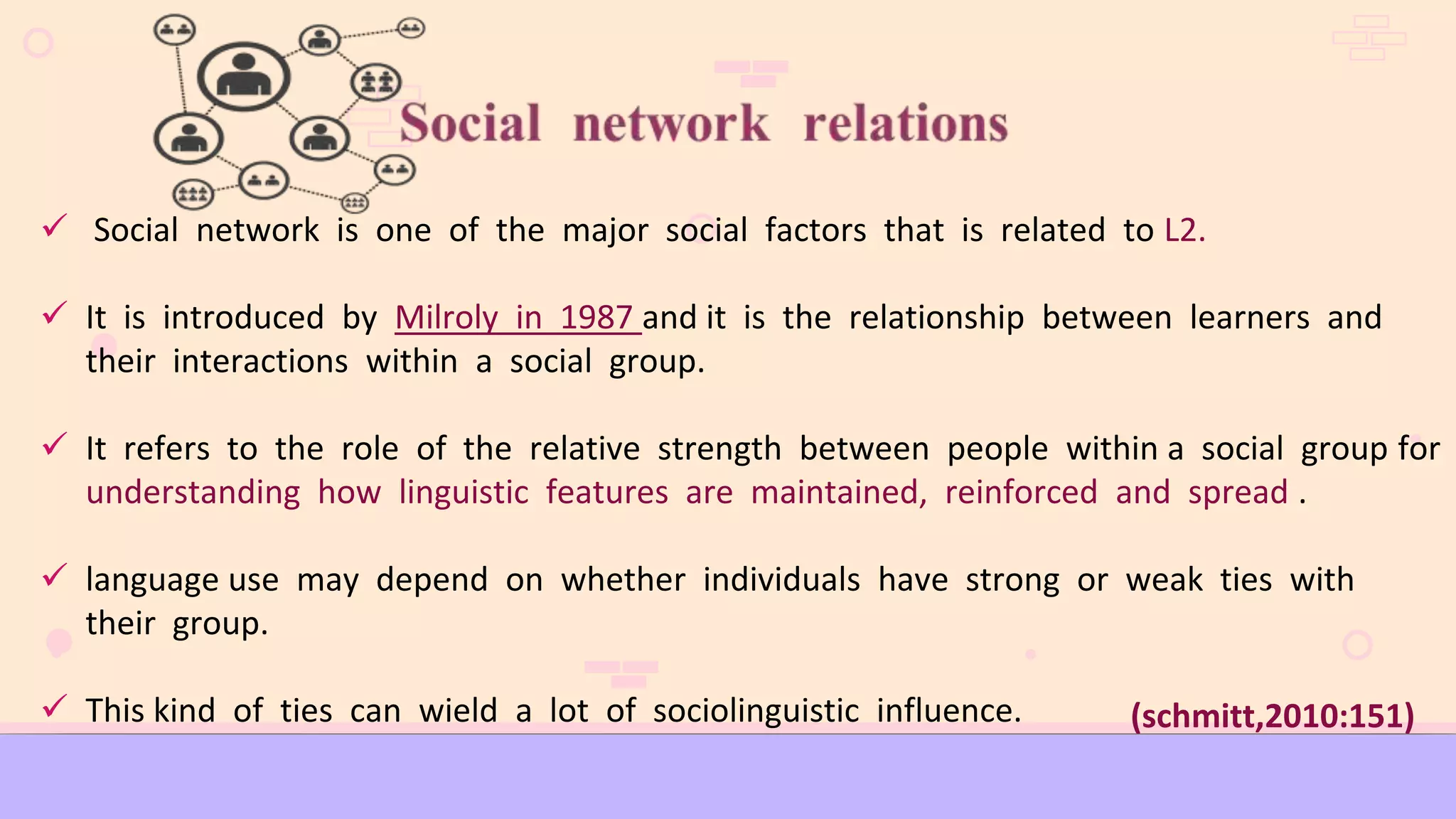
 Social network is one of the major social factors that is related to L2.
 It is introduced by Milroly in 1987 and it is the relationship between learners and
their interactions within a social group.
 It refers to the role of the relative strength between people within a social group for
understanding how linguistic features are maintained, reinforced and spread .
 language use may depend on whether individuals have strong or weak ties with
their group.
 This kind of ties can wield a lot of sociolinguistic influence. (schmitt,2010:151)
References
Alhassan,M .(2015). Social Influences on Language Learning: Applied Linguistics.
https://zcw.academia.edu/Mustafaalhassan.
Davies, A. & Elder, C. (2004) .The Handbook of Applied Linguistics. Oxford: Blackwell Publishing .
Ellis, R.(1994). The study of Second Language Acquisition. Oxford: Oxford University Press.
Ellis, R. (1997). Second Language Acquisition. Oxford: Oxford University press.
Robinson,P. (2013). The Routledge Encyclopedia of second Language Acquisition. London: Routledge .
Schmitt,N. (2010). An Introduction to Applied Linguistics. Abingdon: Hodder & Stoughton Ltd.
Spada, N. (1997). Form-focused instruction and second language acquisition:A review of classroom laboratory
research. Language Teaching, 30, 73-87.
Troike, M. (2006). Introducing second Language Acquisition (1st ed Ed). Cambridge: Cambridge University
Press.
Social Influences On Second Language Learning ( Applied Linguistics)

Social Influences On Second Language Learning ( Applied Linguistics)

  • 1.
  • 2.
    Social Influences onLanguage Learning By : Zahra Aamir .
  • 3.
     Different perspectivesof social influences on learning When we talk about what is being acquired in SLA, it is not enough just to talk about the language itself. We must also include the social and cultural knowledge embedded in the language being learned, that is required for appropriate language use. It is significant to study social influences on language learning because " languages are learned in social context" (Spolsky, 1989:131).
  • 4.
    Hutchinson & Waters(1987) refer to the social influences on language learning as "Learning can, should, be seen in the context in which it takes place. Learning is not just a mental process, it is a process of negotiation between individual and society"
  • 5.
    Ellis (1994) differentiatesbetween social context and social factors. Whereas social context refers to different settings in which L2 can take place. Each setting can be seen as a context in which a number of social factors influence learning outcomes. These settings are either ‘natural' or 'educational'. Ellis' classification  Natural settings where informal learning occurs and educational settings where formal learning takes place.
  • 6.
     Troike (2012)distinguishes between microsocial and macrosocial factors .  The microsocial factors include features of setting and interaction that relate to communicative events within language which is produced and interpreted .  Lier (1988) describes the macrosocial view as involving the wider community, and microsocial view, by contrast, is restricted within classroom. Hymes'classification According to Hymes' communicative competence, what the learner needs to know depends on the social context which the learner learns and uses language.
  • 7.
    According to Troike,he classifies macrosocial factors into the following: 1. Global and national level Its influences on second language acquisition involve the power and status of learners’ native and target languages, whether overtly stated in official policies or covertly realized in cultural values and practices. 2. Social boundaries Influences on second language acquisition (SLA) at this level often involve the relationship between native and target language groups, as well as the openness and perviousness of community boundaries. 3. Institutional forces and constraints They often affect the use and knowledge of L2 in relation to such things as social control, political and religious practices, and economic and educational opportunities
  • 8.
    4. Social categoriesAge, gender, and ethnicity education level, occupation, and economic status. are factors of social group membership which may potentially be relevant to second language learning. 5. circumstances of learning They can influence SLA, such as learners’ prior educational experiences, whether the L2 learning process is informal or formal, and (if formal) the type of educational model learners have access to and the pedagogical orientation of their teachers and administrators. (Troike,2006:101).
  • 9.
    Vygotsky pioneered thenotion that children learn within communities, rather than strictly as individuals. Vygotsky was famous for his discussion of proximal development, wherein children learn more with the support of adults around them.
  • 10.
    Elements of secondlanguage learning
  • 11.
    1 2 3 4 Elements of L2 learning Input& output learner Interlanguage Social context
  • 12.
    1 Learner is themost important element in learning process which has different attitude toward L2, its speakers, its culture, some its uses, social value being learning the L2. These attitudes have impact on second language learning . There are a number of social factors that can be mediated through learner attitudes which affect language learning. Ellis mentioned four factors: gender, age, social class ,ethnic identity and notes that these factors determine L2 proficiency but the social conditions associated with these variables.
  • 13.
    1  Sociolinguistic researchhas shown that men use a higher frequency of non-standard forms than women. So the women might be better at L2 learning than men because they are likely to be open to new linguistic forms.
  • 14.
    1  Ellis (1994)concludes that younger learners are generally more successful at learning languages than older.
  • 15.
    1 2 3 4 Elements of L2 learning Input&output learner Interlanguage Social context
  • 16.
    2 The environment, wherethe learning process takes place, contributes to form second language input, that is perceived by the language learner, and the output, that is produced by him/her. Davies & Elder(2004) state that input is received by learners when listening or reading in second language learning takes place whether in a natural setting or artificial one like classroom. Output, on the other hand, depends on the learner's writing or speaking.
  • 18.
    2  Some studiesin the field on language learning indicates the role that learner's social identity and relations of power, play in how input and output are constructed their role in language learning.  Output is not merely using linguistic forms appropriately, but it has a political role within the target language.  Spada (1997) notes that it is not very clear what the effect of input is on language learning. Both of input and output are parts of social context. They play important part, and have a great influence on interlanguage.
  • 19.
    1 2 3 4 Elements of l2 learning Input& output Learner Interlanguage Social context
  • 20.
    3 A learner'sinterlanguage system is "neither the system of the native language nor the system of target language, but instead falls between the two" (Brown, 1994, p. 204). Interlanguage means the relationship that exist between two dialects or varieties of language. Mother tongue interference is a situation in which the L1 influences the L2, either phonologically, semantically or syntactically. Then, error analysis refers to a systematic process of providing solutions to broken utterances and sentences that are not in conformity with the rules of a language. English Arabic English
  • 21.
    3 Interlanguage, as anotherelement of learning process, is nonnative language which contains new forms that are not found in L1 as well as in L2 (Robinson,2013: 338). One of the goals of language learning is to construct a mental system of L2 knowledge, what is referred to in different ways as an interlanguage (IL). Interlanguage indicates the linguistic system evidenced when a second language learner tries to express some meanings in the target language. This system is different from L1 and L2 but relates to both of them.
  • 23.
    1 2 3 4 Elements of Learning l2 Input& output Learner Interlanguage Social context
  • 24.
    4 Davies & Elder(2004)note that there is a social and contextual dimension to every naturally occurring use of language and these social factors determine the choice and form of what is written, said or understood. Sociolinguistics helps us to see the influences of ethnicity, gender, ideology and social rank on language events.
  • 25.
  • 26.
  • 27.
    Social factors referto any feature of community that may influence a learner´s acquisition of a second language and the elements of second language learning . (learner, input and output, interlanguage, and social context) are affected by some social factors. These social factors have a major effect on learning , but they do not influence directly (Ellis,1994:197).
  • 28.
    Gender and power Age Audience Identity Socialclass Social Factors Social network relation
  • 29.
    The influence ofgender and asymmetries in power relations have been a major aspect of sociolinguistic discussion in recent years. Gender reflects some differences in how women and men use their language. Gender and power
  • 30.
    Males and femalesare greatly different in terms of social interactions. The differences could be in terms of the way that people plan their narratives, discourse organization, and different accents that men and women use from one region to the other (Ellis,1997:37). For instance, men use non-standard forms frequently while women use standard ones.
  • 31.
    Ellis differentiates betweenAsian men and Asian women as the following:  Gender of course, likely to interact with other variables in determining L2 proficiency. It will not always be the case, therefore, females outperform males.  Asian men in Britain generally attain higher levels of proficiency in L2 English than do Asian women for the simple reason that their jobs bring them into contact with the majority English speaking group, while women are often "enclosed" in the home.
  • 32.
    Adamson and Regan(1991) found that  Women had a higher use of the prestige than men.  Women also use more formal variants than men. In addition to that , women might be better at L2 learning than men.  Ellis notes that women tend to use new forms in their speech.Men,on the other hand, may less use to new forms.  Ellis concludes that men use translation strategies more than women. Therefore, gender is the major factors that interacts with other social factors.
  • 33.
    Age Age is abiological factor affecting L2 learning, at the same time it regarded as social factor. Older people and younger people use language differently. (schmitt,2010:151). The young people, for instance, prefer to use non-standard variants, adults prefer the standard variants, older people, however, tend to use non-standard variant but not exactly as the younger people. The young also have all sorts of slangs and modern day usage that are not familiar to the older ones and which they count as deviant at times (Ellis,1994:212).
  • 34.
    Audience Type of listenersor addresses specifies the language and the style which have to be used. Conversations usually have a recipient design .Speakers produce utterances with the listeners in mind. This factor often results in speakers adjusting their accent, style or language towards their addressees that means It makes speakers to adjust their tone, accent, style, posture and even they walk at times. This phenomenon called “accommodation” that it can be an important cause of language change over time. (Schmitt ,2010:151).
  • 35.
    There is aclear parallel between sociolinguistic phenomenon associated with social class ,a language change and interlanguage development. There is also a relationship between social class and L2 achievement. Children from lower socio-economic group are less successful educationally than those from higher group. Middle-class children achieve higher level of L2 proficiency and more positive attitudes than working class children. Social Class
  • 36.
    When the programmeemphasizes formal language learning, Not social class itself but the experiences of the world which members of different social classes are likely to have. (Ellis,1994:204-207).
  • 37.
    Identity  One ofthe important social factor is identity.  According to Schmitt (2010) people’s conscious awareness of their personal, ethnic, geographical, political and family identities is often a factor in their language use.  People pay allegiance to their family or membership of a particular social group or organization.
  • 38.
    Geographical and SocialMobility Each language has its own dialects that are localized geographically, "where the shift from one dialect to the next is not sudden between one town or county or state and the next" (schmitt,2010:150). Therefore, geographical and social mobility can affect learners' languages or dialect. It refers to the movement of person from one social role to another.
  • 39.
     Social networkis one of the major social factors that is related to L2.  It is introduced by Milroly in 1987 and it is the relationship between learners and their interactions within a social group.  It refers to the role of the relative strength between people within a social group for understanding how linguistic features are maintained, reinforced and spread .  language use may depend on whether individuals have strong or weak ties with their group.  This kind of ties can wield a lot of sociolinguistic influence. (schmitt,2010:151)
  • 40.
    References Alhassan,M .(2015). SocialInfluences on Language Learning: Applied Linguistics. https://zcw.academia.edu/Mustafaalhassan. Davies, A. & Elder, C. (2004) .The Handbook of Applied Linguistics. Oxford: Blackwell Publishing . Ellis, R.(1994). The study of Second Language Acquisition. Oxford: Oxford University Press. Ellis, R. (1997). Second Language Acquisition. Oxford: Oxford University press. Robinson,P. (2013). The Routledge Encyclopedia of second Language Acquisition. London: Routledge . Schmitt,N. (2010). An Introduction to Applied Linguistics. Abingdon: Hodder & Stoughton Ltd. Spada, N. (1997). Form-focused instruction and second language acquisition:A review of classroom laboratory research. Language Teaching, 30, 73-87. Troike, M. (2006). Introducing second Language Acquisition (1st ed Ed). Cambridge: Cambridge University Press.