SUBECT: LANGUAGE ANQUISITION
TEACHER: MGS.MÓNICA DEL CARMEN PINTO
STUDENT’S NAME: ESPERANZA ALEJANDRINA MORA
ACTIVITY 1.4
Why are some learners more successful than others?
Considering the most relevant information about the way a learner acquires L2
knowledge.
L2 learning and
teaching
First , some students learn a new language more quicly than others. This simple fact is
known because there are different factors that influence in the study .
Why are
some learners
more
successful
than others?
Social context
- Social
experience - -
Relationship of L1
and L2 - Age -
Aptitude
Motivation
Social Context
Features of social context which affect degree of
successs include the status of L1. and L2 boundary and
identity factores within and between the L1 and L2
speech commuities, and institutional forces and
constraints.
Macrosocial factors influence L2 learning primarily
because of their impact on attitude and opportunity.
L2 is being learned as a second
language
A foreign language an auxiliary language or
langauge for specific purposes.
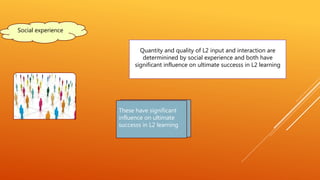
Quantity and quality of L2 input and interaction are
determinined by social experience and both have
significant influence on ultimate successs in L2 learning
Social experience
These have significant
influence on ultimate
successs in L2 learning
Age
 children are more successful L2 learners than adults.
 Younger learner generally have an advantage in brain
plasticity.
Older learners generally have an advantage in learning
capacity. in analytic
ability, in pragmatic skills, in greater knowledge of their L1.
 Learners differ in capacity to discriminate and process
 auditory input, to identify patterns
 to identify patterns and make generalizations
 To store linguistic elements in memory.
 Aptitude.
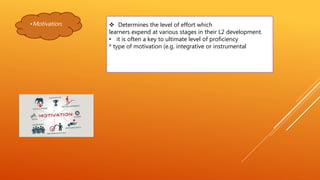
•Motivation.  Determines the level of effort which
learners expend at various stages in their L2 development.
• it is often a key to ultimate level of proficiency
* type of motivation (e.g. integrative or instrumental
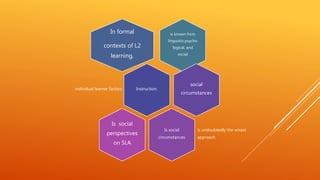
is known from
linguistic,psycho
logical, and
social
In formal
contexts of L2
learning,
Instruction.individual learner factors
social
circumstances
Is social
circumstances
is undoubtedly the wisest
approach
Is social
perspectives
on SLA
Language adquisition  Activity: 2.4

Language adquisition Activity: 2.4

  • 1.
    SUBECT: LANGUAGE ANQUISITION TEACHER:MGS.MÓNICA DEL CARMEN PINTO STUDENT’S NAME: ESPERANZA ALEJANDRINA MORA
  • 2.
    ACTIVITY 1.4 Why aresome learners more successful than others? Considering the most relevant information about the way a learner acquires L2 knowledge.
  • 3.
    L2 learning and teaching First, some students learn a new language more quicly than others. This simple fact is known because there are different factors that influence in the study .
  • 4.
    Why are some learners more successful thanothers? Social context - Social experience - - Relationship of L1 and L2 - Age - Aptitude Motivation
  • 5.
    Social Context Features ofsocial context which affect degree of successs include the status of L1. and L2 boundary and identity factores within and between the L1 and L2 speech commuities, and institutional forces and constraints. Macrosocial factors influence L2 learning primarily because of their impact on attitude and opportunity. L2 is being learned as a second language A foreign language an auxiliary language or langauge for specific purposes.
  • 6.
    Quantity and qualityof L2 input and interaction are determinined by social experience and both have significant influence on ultimate successs in L2 learning Social experience These have significant influence on ultimate successs in L2 learning
  • 7.
    Age  children aremore successful L2 learners than adults.  Younger learner generally have an advantage in brain plasticity. Older learners generally have an advantage in learning capacity. in analytic ability, in pragmatic skills, in greater knowledge of their L1.
  • 8.
     Learners differin capacity to discriminate and process  auditory input, to identify patterns  to identify patterns and make generalizations  To store linguistic elements in memory.  Aptitude.
  • 9.
    •Motivation.  Determinesthe level of effort which learners expend at various stages in their L2 development. • it is often a key to ultimate level of proficiency * type of motivation (e.g. integrative or instrumental
  • 10.
    is known from linguistic,psycho logical,and social In formal contexts of L2 learning, Instruction.individual learner factors social circumstances Is social circumstances is undoubtedly the wisest approach Is social perspectives on SLA