
The word ( Category) is a very useful and common word in
linguistics that means a class of units (such as noun and verb)
or features (such as number and case) that share a common
set of characteristics.
- Conceptual Categories
The notion of conceptual categories is closely tied to the
problem of how to provide meaningful glosses or labels
for grammatical units ( words ,morphemes….etc.)
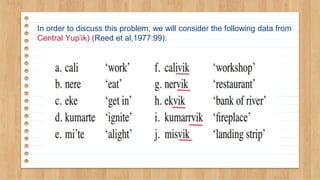
In order to discuss this problem, we will consider the following data from
Central Yup’ik) (Reed et al,1977:99):
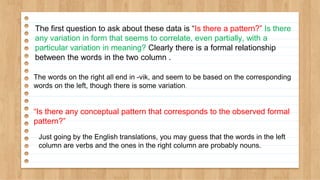
The first question to ask about these data is “Is there a pattern?” Is there
any variation in form that seems to correlate, even partially, with a
particular variation in meaning? Clearly there is a formal relationship
between the words in the two column .
The words on the right all end in -vik, and seem to be based on the corresponding
words on the left, though there is some variation.
“Is there any conceptual pattern that corresponds to the observed formal
pattern?”
Just going by the English translations, you may guess that the words in the left
column are verbs and the ones in the right column are probably nouns.
This is how linguists make hypotheses regarding conceptual
categories – they stand back and make an educated guess about
the general function of any grammatical pattern based on
evidence from the clear examples, and observation of native
speakers in conversation.
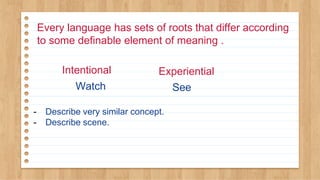
Every language has sets of roots that differ according
to some definable element of meaning .
Watch See
- Describe very similar concept.
- Describe scene.
Intentional Experiential
The important ideas to keep in mind at this point are:
- Conceptual category labels or (“glosses”) are interpretations
designed to help readers of a grammatical description understand and
remember the functions of particular structures
- A conceptual category exists when there is an expectation of patterned
behavior – a recurring relationship between variation in form and variation
in meaning.
Derivational Vs. inflectional
categories….
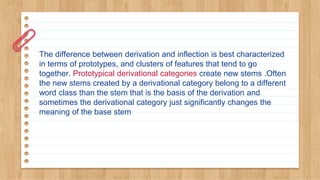
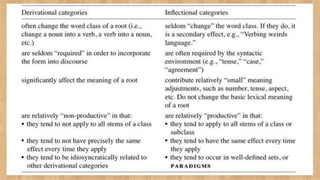
The difference between derivation and inflection is best characterized
in terms of prototypes, and clusters of features that tend to go
together. Prototypical derivational categories create new stems .Often
the new stems created by a derivational category belong to a different
word class than the stem that is the basis of the derivation and
sometimes the derivational category just significantly changes the
meaning of the base stem
NOMINALIZATION:
VERB → NOUN :
Grow growth
Destroy destruction
ADJ → NOUN:
Wide width
Happy happiness
(“nominalize” something means to make it into a noun).
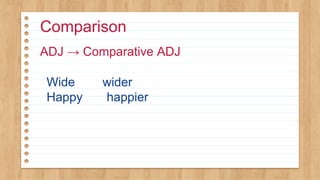
Comparison
ADJ → Comparative ADJ
Wide wider
Happy happier
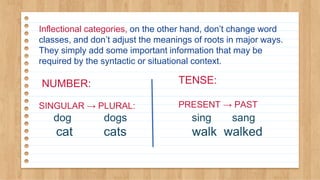
Inflectional categories, on the other hand, don’t change word
classes, and don’t adjust the meanings of roots in major ways.
They simply add some important information that may be
required by the syntactic or situational context.
NUMBER:
SINGULAR → PLURAL:
dog dogs sing sang
cat cats walk walked
TENSE:
PRESENT → PAST
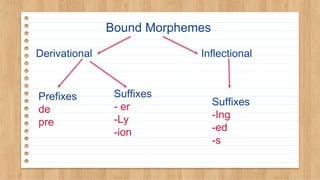
Bound Morphemes
Derivational Inflectional
Suffixes
-Ing
-ed
-s
Suffixes
- er
-Ly
-ion
Prefixes
de
pre
Conceptual Catigories

Conceptual Catigories

  • 2.
    The word (Category) is a very useful and common word in linguistics that means a class of units (such as noun and verb) or features (such as number and case) that share a common set of characteristics.
  • 3.
    - Conceptual Categories Thenotion of conceptual categories is closely tied to the problem of how to provide meaningful glosses or labels for grammatical units ( words ,morphemes….etc.)
  • 4.
    In order todiscuss this problem, we will consider the following data from Central Yup’ik) (Reed et al,1977:99):
  • 5.
    The first questionto ask about these data is “Is there a pattern?” Is there any variation in form that seems to correlate, even partially, with a particular variation in meaning? Clearly there is a formal relationship between the words in the two column . The words on the right all end in -vik, and seem to be based on the corresponding words on the left, though there is some variation. “Is there any conceptual pattern that corresponds to the observed formal pattern?” Just going by the English translations, you may guess that the words in the left column are verbs and the ones in the right column are probably nouns.
  • 6.
    This is howlinguists make hypotheses regarding conceptual categories – they stand back and make an educated guess about the general function of any grammatical pattern based on evidence from the clear examples, and observation of native speakers in conversation.
  • 7.
    Every language hassets of roots that differ according to some definable element of meaning . Watch See - Describe very similar concept. - Describe scene. Intentional Experiential
  • 8.
    The important ideasto keep in mind at this point are: - Conceptual category labels or (“glosses”) are interpretations designed to help readers of a grammatical description understand and remember the functions of particular structures - A conceptual category exists when there is an expectation of patterned behavior – a recurring relationship between variation in form and variation in meaning.
  • 9.
  • 10.
    The difference betweenderivation and inflection is best characterized in terms of prototypes, and clusters of features that tend to go together. Prototypical derivational categories create new stems .Often the new stems created by a derivational category belong to a different word class than the stem that is the basis of the derivation and sometimes the derivational category just significantly changes the meaning of the base stem
  • 11.
    NOMINALIZATION: VERB → NOUN: Grow growth Destroy destruction ADJ → NOUN: Wide width Happy happiness (“nominalize” something means to make it into a noun).
  • 12.
    Comparison ADJ → ComparativeADJ Wide wider Happy happier
  • 13.
    Inflectional categories, onthe other hand, don’t change word classes, and don’t adjust the meanings of roots in major ways. They simply add some important information that may be required by the syntactic or situational context. NUMBER: SINGULAR → PLURAL: dog dogs sing sang cat cats walk walked TENSE: PRESENT → PAST
  • 14.