INDIVIDUAL DIFFERENCE AND CALL MODELS OF SECOND LANGUAGE LEARNING AND THEIR VARIABLES
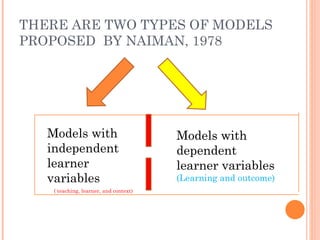
THERE ARE TWO TYPES OF MODELS PROPOSED  BY NAIMAN, 1978 Models with independent learner variables ( teaching, learner, and context) Models with dependent  learner variables (Learning and outcome)
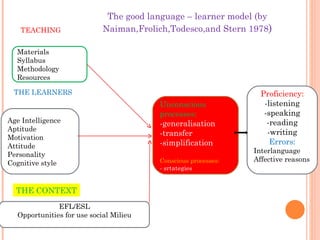
The good language – learner model (by Naiman,Frolich,Todesco,and Stern 1978 ) Materials Syllabus Methodology Resources TEACHING Age Intelligence Aptitude Motivation Attitude Personality Cognitive style THE LEARNERS THE CONTEXT EFL/ESL Opportunities for use social Milieu Unconscious processes: -generalisation -transfer -simplification Conscious processes: - srtategies Proficiency: -listening -speaking -reading -writing Errors: Interlanguage Affective reasons
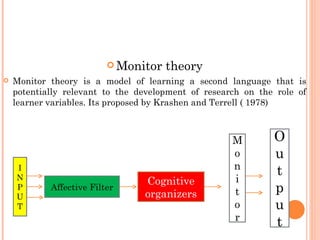
Monitor theory Monitor theory is a model of learning a second language that is potentially relevant to the development of research on the role of learner variables. Its proposed by Krashen and Terrell ( 1978) INPUT Affective Filter Cognitive organizers Mon i t o r Output
The affective filter is a major source of variation, the success of language learning varies depending on several factors embraced within the affective filter such as, attitude, motivation, self convidence or anxiety, so it causes higher or lower output.
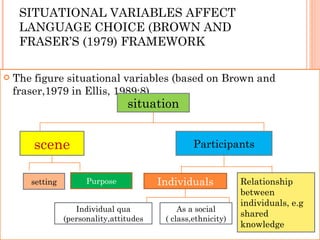
SITUATIONAL VARIABLES AFFECT LANGUAGE CHOICE (BROWN AND FRASER’S (1979) FRAMEWORK The figure situational variables (based on Brown and fraser,1979 in Ellis, 1989:8) situation scene Participants setting Purpose Individuals Relationship between individuals, e.g shared knowledge  Individual qua (personality,attitudes As a social ( class,ethnicity)
SHEMATIC MODEL (LEVIN,S),1977 He proposed two major stages, diagnostic and prescriptive. He focused on two variables input and output variables.
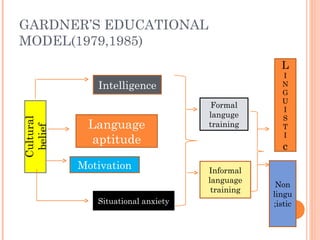
GARDNER’S EDUCATIONAL MODEL(1979,1985) Cultural belief Intelligence Language aptitude Motivation Situational anxiety Formal languge training Informal language training L I N G U I S T I c Non lingu;istic
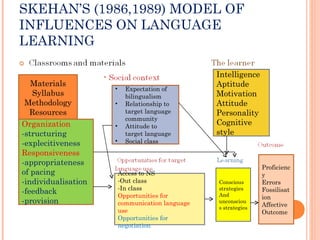
SKEHAN’S (1986,1989) MODEL OF INFLUENCES ON LANGUAGE LEARNING Materials Syllabus Methodology Resources Organization -structuring -explecitiveness Responsiveness -appropriateness of pacing -individualisation -feedback -provision Expectation of bilingualism Relationship to target language community Attitude to target language Social class Access to NS Out class In class Opportunities for communication language use Opportunities for negotiation Intelligence Aptitude Motivation Attitude Personality Cognitive style Conscious strategies And unconscious strategies Proficiency Errors Fossilisation Affective Outcome
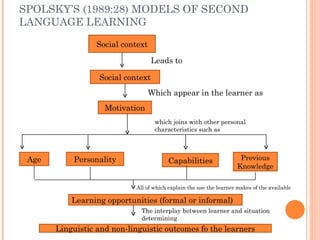
SPOLSKY’S (1989:28) MODELS OF SECOND LANGUAGE LEARNING Social context Social context Motivation Age Personality Capabilities Previous Knowledge Learning opportunities (formal or informal)  Linguistic and non-linguistic outcomes fo the learners Leads to Which appear in the learner as which joins with other personal characteristics such as All of which explain the use the learner makes of the available The interplay between learner and situation determining
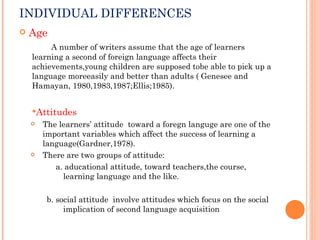
INDIVIDUAL DIFFERENCES Age A number of writers assume that the age of learners learning a second of foreign language affects their achievements,young children are supposed tobe able to pick up a language moreeasily and better than adults ( Genesee and Hamayan, 1980,1983,1987;Ellis;1985). Attitudes The learners’ attitude  toward a foregn languge are one of the important variables which affect the success of learning a language(Gardner,1978). There are two groups of attitude: a. aducational attitude, toward teachers,the course,  learning language and the like. b. social attitude  involve attitudes which focus on the social implication of second language acquisition
Motivation Motivation is  anticipation of reinforcement (Brown,1994:35) There  are  two types of reinforcement,intrinsic and extrinsic proposed by deci ( 1975). Intelligence  There is a positive relationship between intelligence and language learning achievement ( for instance the correlation between IQ and Reading comprehension achievement  ( Hartoyo,1988) Language aptitude Aptitude according to Carroll (1981:84) can be defined as: a concept which corresponds to the notion that in approaching a particular learning task or program, the individual may be thought of as possesing some current state of capacity of learning that task – if the individual is motivated, and has the opportunity of doing so. The capacity is presumed to depend on some combination of more or less enduring characteristics of the individual .
Previous knowledge The level of development in a first language combined with the situational ability to sustain that language are important variables in language learning succes for at least some age groups. Despite the strenght of this finding, it is clear that prior knowledge alone does not determine succes. Familiarity with computer Familiarity with computers may need to be considered  as a  variable in a computer-mediated  language learning environement. Familiarity with computers reflects a learner’s experience of using computers. Liu and Reed (1995) state the computer familiarity reflects self-confidence in using computers as well as a belief that one can do well using computers. Interaction with native-speakers of English It has been assumed for a long time that interaction with native speakers of the target language being lerned can enhance language learning achievment.
The frequency of interaction with English native speakers may be useful in predicting the answers to the first two question. Language used for interaction with the community Smith-Kreuzen (1988) has claimed that learners will interact using the target language. However, the results of may study reveal that only in formal teaching-learning situations (classroom context), do learners appear to use the target language most of time. In informal situations (outside the classroom), Indonesian is likely to be used more than English.

Kum

  • 1.
    INDIVIDUAL DIFFERENCE ANDCALL MODELS OF SECOND LANGUAGE LEARNING AND THEIR VARIABLES
  • 2.
    THERE ARE TWOTYPES OF MODELS PROPOSED BY NAIMAN, 1978 Models with independent learner variables ( teaching, learner, and context) Models with dependent learner variables (Learning and outcome)
  • 3.
    The good language– learner model (by Naiman,Frolich,Todesco,and Stern 1978 ) Materials Syllabus Methodology Resources TEACHING Age Intelligence Aptitude Motivation Attitude Personality Cognitive style THE LEARNERS THE CONTEXT EFL/ESL Opportunities for use social Milieu Unconscious processes: -generalisation -transfer -simplification Conscious processes: - srtategies Proficiency: -listening -speaking -reading -writing Errors: Interlanguage Affective reasons
  • 4.
    Monitor theory Monitortheory is a model of learning a second language that is potentially relevant to the development of research on the role of learner variables. Its proposed by Krashen and Terrell ( 1978) INPUT Affective Filter Cognitive organizers Mon i t o r Output
  • 5.
    The affective filteris a major source of variation, the success of language learning varies depending on several factors embraced within the affective filter such as, attitude, motivation, self convidence or anxiety, so it causes higher or lower output.
  • 6.
    SITUATIONAL VARIABLES AFFECTLANGUAGE CHOICE (BROWN AND FRASER’S (1979) FRAMEWORK The figure situational variables (based on Brown and fraser,1979 in Ellis, 1989:8) situation scene Participants setting Purpose Individuals Relationship between individuals, e.g shared knowledge Individual qua (personality,attitudes As a social ( class,ethnicity)
  • 7.
    SHEMATIC MODEL (LEVIN,S),1977He proposed two major stages, diagnostic and prescriptive. He focused on two variables input and output variables.
  • 8.
    GARDNER’S EDUCATIONAL MODEL(1979,1985)Cultural belief Intelligence Language aptitude Motivation Situational anxiety Formal languge training Informal language training L I N G U I S T I c Non lingu;istic
  • 9.
    SKEHAN’S (1986,1989) MODELOF INFLUENCES ON LANGUAGE LEARNING Materials Syllabus Methodology Resources Organization -structuring -explecitiveness Responsiveness -appropriateness of pacing -individualisation -feedback -provision Expectation of bilingualism Relationship to target language community Attitude to target language Social class Access to NS Out class In class Opportunities for communication language use Opportunities for negotiation Intelligence Aptitude Motivation Attitude Personality Cognitive style Conscious strategies And unconscious strategies Proficiency Errors Fossilisation Affective Outcome
  • 10.
    SPOLSKY’S (1989:28) MODELSOF SECOND LANGUAGE LEARNING Social context Social context Motivation Age Personality Capabilities Previous Knowledge Learning opportunities (formal or informal) Linguistic and non-linguistic outcomes fo the learners Leads to Which appear in the learner as which joins with other personal characteristics such as All of which explain the use the learner makes of the available The interplay between learner and situation determining
  • 11.
    INDIVIDUAL DIFFERENCES AgeA number of writers assume that the age of learners learning a second of foreign language affects their achievements,young children are supposed tobe able to pick up a language moreeasily and better than adults ( Genesee and Hamayan, 1980,1983,1987;Ellis;1985). Attitudes The learners’ attitude toward a foregn languge are one of the important variables which affect the success of learning a language(Gardner,1978). There are two groups of attitude: a. aducational attitude, toward teachers,the course, learning language and the like. b. social attitude involve attitudes which focus on the social implication of second language acquisition
  • 12.
    Motivation Motivation is anticipation of reinforcement (Brown,1994:35) There are two types of reinforcement,intrinsic and extrinsic proposed by deci ( 1975). Intelligence There is a positive relationship between intelligence and language learning achievement ( for instance the correlation between IQ and Reading comprehension achievement ( Hartoyo,1988) Language aptitude Aptitude according to Carroll (1981:84) can be defined as: a concept which corresponds to the notion that in approaching a particular learning task or program, the individual may be thought of as possesing some current state of capacity of learning that task – if the individual is motivated, and has the opportunity of doing so. The capacity is presumed to depend on some combination of more or less enduring characteristics of the individual .
  • 13.
    Previous knowledge Thelevel of development in a first language combined with the situational ability to sustain that language are important variables in language learning succes for at least some age groups. Despite the strenght of this finding, it is clear that prior knowledge alone does not determine succes. Familiarity with computer Familiarity with computers may need to be considered as a variable in a computer-mediated language learning environement. Familiarity with computers reflects a learner’s experience of using computers. Liu and Reed (1995) state the computer familiarity reflects self-confidence in using computers as well as a belief that one can do well using computers. Interaction with native-speakers of English It has been assumed for a long time that interaction with native speakers of the target language being lerned can enhance language learning achievment.
  • 14.
    The frequency ofinteraction with English native speakers may be useful in predicting the answers to the first two question. Language used for interaction with the community Smith-Kreuzen (1988) has claimed that learners will interact using the target language. However, the results of may study reveal that only in formal teaching-learning situations (classroom context), do learners appear to use the target language most of time. In informal situations (outside the classroom), Indonesian is likely to be used more than English.

Editor's Notes

  • #11 The interplay between learner and situation determining
  • #13 oposd