SOCIAL DIALECT
Submitted By :
Renaissance Ahmed Sayma
Department of English,
Comilla University.
Email : saymalombu@gmail.com
DIALECT
A variety of a language .
A dialect is distinguished by its vocabulary,
grammar, and pronunciation and by its use by
a group of speakers who are set off from
others geographically or socially.
A dialect is very different from accent
Dialect can be divided into two types :
Regional and Social.
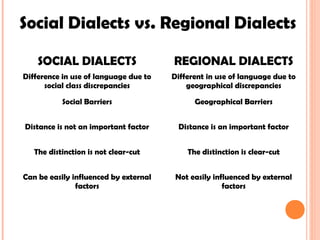
Social Dialects vs. Regional Dialects
SOCIAL DIALECTS REGIONAL DIALECTS
Difference in use of language due to
social class discrepancies
Different in use of language due to
geographical discrepancies
Social Barriers Geographical Barriers
Distance is not an important factor Distance is an important factor
The distinction is not clear-cut The distinction is clear-cut
Can be easily influenced by external
factors
Not easily influenced by external
factors
WHAT IS SOCIAL DIALECT ?
  a variety of language that reflects social
variation in language use, according to certain
factors related to the social group of the speaker
such as education, occupation, income level etc.
 Social dialect is also known as sociolect.
 According to Peter Trudgill,” Sociolect is a
variety which is thought of as being related to its
speakers’ social background rather than
geographical background.”
FACTORS AFFECTING SOCIAL
DIALECT
 Social class
 Religion
 Education
 Profession
 Caste
 Age
 Gender
HOW LANGUAGES VARY IN
SOCIAL DIALECT?
Vocabulary
Pronunciation
Grammar
Examples of Social Dialects in England
(1) Words that initiate with ‘h’
 Two types of pronunciations for ‘h’ in words such as ‘house’ – [h] or Ø
 The rate of ‘h’ omission in word initials increase as we go lower in social class
Social Class Rate of ‘h’ omission
1 17
2 21
3 43
4 64
5 96
< Comparison between social class and the rate of ‘h’ omission>
(2) ‘r’ that comes behind a vowel
Two types of pronunciations in ‘r’ in words such as ‘car’ or ‘card’ – [r] or Ø
 People of high social class have the tendency to omit the sound ‘r’ behind a vowel
Social Class Reading
1 0
2 28
3 44
4 49
< The realization of [r] in words >
(3) Suffix ‘-ing’
 Two types of pronunciation in ‘-ing’ in words such as ‘swimming’ and
‘sleeping’ – [in] or [iŋ]
 Higher social classes use more [in] compared to [iŋ]
< Use of pronunciation [iŋ] for suffix ‘-ing’>
Social Class Norwich West Yorkshire
1 31 5
2 41 34
3 91 61
4 100 83
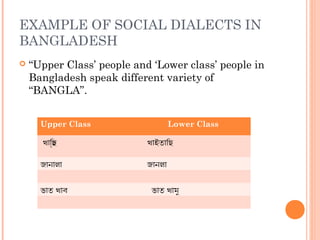
EXAMPLE OF SOCIAL DIALECTS IN
BANGLADESH
 “Upper Class’ people and ‘Lower class’ people in
Bangladesh speak different variety of
“BANGLA”.
Upper Class Lower Class
খাচ্ছিΨচ্ছ খাচ্ছইতাচ্ছিΨছ
জাচ্ছনাচ্ছলাচ্ছ জাচ্ছনলাচ্ছ
ভাচ্ছত খাচ্ছব ভাচ্ছত খাচ্ছমু
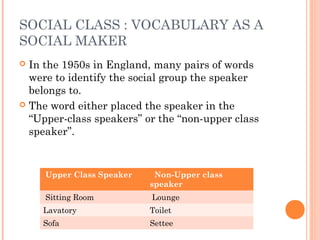
SOCIAL CLASS : VOCABULARY AS A
SOCIAL MAKER
 In the 1950s in England, many pairs of words
were to identify the social group the speaker
belongs to.
 The word either placed the speaker in the
“Upper-class speakers” or the “non-upper class
speaker”.
Upper Class Speaker Non-Upper class
speaker
Sitting Room Lounge
Lavatory Toilet
Sofa Settee
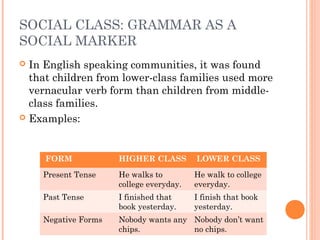
SOCIAL CLASS: GRAMMAR AS A
SOCIAL MARKER
 In English speaking communities, it was found
that children from lower-class families used more
vernacular verb form than children from middle-
class families.
 Examples:
FORM HIGHER CLASS LOWER CLASS
Present Tense He walks to
college everyday.
He walk to college
everyday.
Past Tense I finished that
book yesterday.
I finish that book
yesterday.
Negative Forms Nobody wants any
chips.
Nobody don’t want
no chips.
CASTES AND SOCIAL DIALECT
 Social dialects can be seen clearly in Indonesia or
India where caste systems determined by birth.
 People’s language reflect their social grouping
when they use different social dialect.
 These social distinctions are also reflected in
speech and a person’s social dialect reflects his
social background.
EXAMPLES FROM CASTES
 In Indonesia, the Javanese language reflects the
social status not just in the choice of linguistic
forms but also in the combination of forms which
each social group uses. There are 3 distinct social
groups-
1)The dialect of lowest status group(peasants,
uneducated town people)
2)The dialect of urbanized people with some
education.
3)The dialect of the highly educated people.
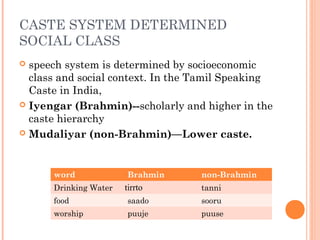
CASTE SYSTEM DETERMINED
SOCIAL CLASS
 speech system is determined by socioeconomic
class and social context. In the Tamil Speaking
Caste in India,
 Iyengar (Brahmin)--scholarly and higher in the
caste hierarchy
 Mudaliyar (non-Brahmin)—Lower caste.
word Brahmin non-Brahmin
Drinking Water tirrto tanni
food saado sooru
worship puuje puuse
LANGUAGE VARIATION DUE TO
EDUCATIONAL BACKGROUND
 Well Educated people’s Language :
--- Formal
--Appropriate
--Grammatically Correct
-- Talk Like a book.
 Less Educated people’s language :
--- More Casual
--some times ungrammatical
--infrequent words in speech
SOCIAL VARIATION (AGE)
 Within the same social class,
differences may link with the
age or sex of the speakers.
 Grandparent-grandchild time span.
SOCIAL VARIATION (ETHNIC
BACKGROUND)
 A variety of a language spoken by a particular
ethnic group.
 For Example,
 African American Vernacular English
(AAVE),also called Black English or Ebonics.
 Absence of copula “be” : “You crazy”.
 Multiple negation : “I don’t know nobody”.
 Omission of the 3rd person –s/es: e.g. “he like
reading”.
/R/ SOUND REFERS TO CLASS
DISTINCTION
 According to Trudgill ,
Lower-Higher == omission of /r/sound
Higher Lower == use of /r/ sound
 According to Labov,
higher socioeconomic status==use more /r/sound
lower socioeconomic status == use fewer /r/ sound.
REGISTER RELATED TO SOCIAL
DIALECT
 The concept of linguistic register has been
described by Trudgill as follows:
 “Linguistic varieties that are linked to
occupations, professions or topics have been
termed registers. The register of law, for example,
is different from the register of medicine, which
in turn is different from the language of
engineering and so on.
 They are characterized solely by vocabulary
differences; either by the use of particular words,
or by the use of words in a particular sense.”
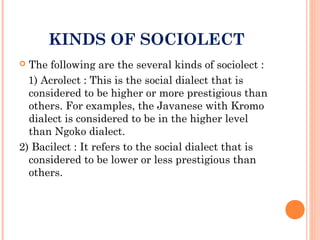
KINDS OF SOCIOLECT
 The following are the several kinds of sociolect :
1) Acrolect : This is the social dialect that is
considered to be higher or more prestigious than
others. For examples, the Javanese with Kromo
dialect is considered to be in the higher level
than Ngoko dialect.
2) Bacilect : It refers to the social dialect that is
considered to be lower or less prestigious than
others.
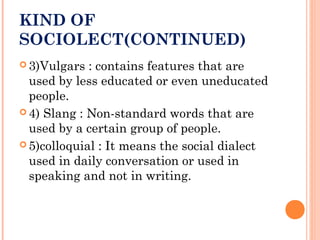
KIND OF
SOCIOLECT(CONTINUED)
 3)Vulgars : contains features that are
used by less educated or even uneducated
people.
 4) Slang : Non-standard words that are
used by a certain group of people.
 5)colloquial : It means the social dialect
used in daily conversation or used in
speaking and not in writing.
THANK YOU !

SOCIAL DIALECT

  • 1.
    SOCIAL DIALECT Submitted By: Renaissance Ahmed Sayma Department of English, Comilla University. Email : saymalombu@gmail.com
  • 2.
    DIALECT A variety ofa language . A dialect is distinguished by its vocabulary, grammar, and pronunciation and by its use by a group of speakers who are set off from others geographically or socially. A dialect is very different from accent Dialect can be divided into two types : Regional and Social.
  • 3.
    Social Dialects vs.Regional Dialects SOCIAL DIALECTS REGIONAL DIALECTS Difference in use of language due to social class discrepancies Different in use of language due to geographical discrepancies Social Barriers Geographical Barriers Distance is not an important factor Distance is an important factor The distinction is not clear-cut The distinction is clear-cut Can be easily influenced by external factors Not easily influenced by external factors
  • 4.
    WHAT IS SOCIALDIALECT ?   a variety of language that reflects social variation in language use, according to certain factors related to the social group of the speaker such as education, occupation, income level etc.  Social dialect is also known as sociolect.  According to Peter Trudgill,” Sociolect is a variety which is thought of as being related to its speakers’ social background rather than geographical background.”
  • 5.
    FACTORS AFFECTING SOCIAL DIALECT Social class  Religion  Education  Profession  Caste  Age  Gender
  • 6.
    HOW LANGUAGES VARYIN SOCIAL DIALECT? Vocabulary Pronunciation Grammar
  • 7.
    Examples of SocialDialects in England (1) Words that initiate with ‘h’  Two types of pronunciations for ‘h’ in words such as ‘house’ – [h] or Ø  The rate of ‘h’ omission in word initials increase as we go lower in social class Social Class Rate of ‘h’ omission 1 17 2 21 3 43 4 64 5 96 < Comparison between social class and the rate of ‘h’ omission>
  • 8.
    (2) ‘r’ thatcomes behind a vowel Two types of pronunciations in ‘r’ in words such as ‘car’ or ‘card’ – [r] or Ø  People of high social class have the tendency to omit the sound ‘r’ behind a vowel Social Class Reading 1 0 2 28 3 44 4 49 < The realization of [r] in words >
  • 9.
    (3) Suffix ‘-ing’ Two types of pronunciation in ‘-ing’ in words such as ‘swimming’ and ‘sleeping’ – [in] or [iŋ]  Higher social classes use more [in] compared to [iŋ] < Use of pronunciation [iŋ] for suffix ‘-ing’> Social Class Norwich West Yorkshire 1 31 5 2 41 34 3 91 61 4 100 83
  • 10.
    EXAMPLE OF SOCIALDIALECTS IN BANGLADESH  “Upper Class’ people and ‘Lower class’ people in Bangladesh speak different variety of “BANGLA”. Upper Class Lower Class খাচ্ছিΨচ্ছ খাচ্ছইতাচ্ছিΨছ জাচ্ছনাচ্ছলাচ্ছ জাচ্ছনলাচ্ছ ভাচ্ছত খাচ্ছব ভাচ্ছত খাচ্ছমু
  • 11.
    SOCIAL CLASS :VOCABULARY AS A SOCIAL MAKER  In the 1950s in England, many pairs of words were to identify the social group the speaker belongs to.  The word either placed the speaker in the “Upper-class speakers” or the “non-upper class speaker”. Upper Class Speaker Non-Upper class speaker Sitting Room Lounge Lavatory Toilet Sofa Settee
  • 12.
    SOCIAL CLASS: GRAMMARAS A SOCIAL MARKER  In English speaking communities, it was found that children from lower-class families used more vernacular verb form than children from middle- class families.  Examples: FORM HIGHER CLASS LOWER CLASS Present Tense He walks to college everyday. He walk to college everyday. Past Tense I finished that book yesterday. I finish that book yesterday. Negative Forms Nobody wants any chips. Nobody don’t want no chips.
  • 13.
    CASTES AND SOCIALDIALECT  Social dialects can be seen clearly in Indonesia or India where caste systems determined by birth.  People’s language reflect their social grouping when they use different social dialect.  These social distinctions are also reflected in speech and a person’s social dialect reflects his social background.
  • 14.
    EXAMPLES FROM CASTES In Indonesia, the Javanese language reflects the social status not just in the choice of linguistic forms but also in the combination of forms which each social group uses. There are 3 distinct social groups- 1)The dialect of lowest status group(peasants, uneducated town people) 2)The dialect of urbanized people with some education. 3)The dialect of the highly educated people.
  • 15.
    CASTE SYSTEM DETERMINED SOCIALCLASS  speech system is determined by socioeconomic class and social context. In the Tamil Speaking Caste in India,  Iyengar (Brahmin)--scholarly and higher in the caste hierarchy  Mudaliyar (non-Brahmin)—Lower caste. word Brahmin non-Brahmin Drinking Water tirrto tanni food saado sooru worship puuje puuse
  • 16.
    LANGUAGE VARIATION DUETO EDUCATIONAL BACKGROUND  Well Educated people’s Language : --- Formal --Appropriate --Grammatically Correct -- Talk Like a book.  Less Educated people’s language : --- More Casual --some times ungrammatical --infrequent words in speech
  • 17.
    SOCIAL VARIATION (AGE) Within the same social class, differences may link with the age or sex of the speakers.  Grandparent-grandchild time span.
  • 18.
    SOCIAL VARIATION (ETHNIC BACKGROUND) A variety of a language spoken by a particular ethnic group.  For Example,  African American Vernacular English (AAVE),also called Black English or Ebonics.  Absence of copula “be” : “You crazy”.  Multiple negation : “I don’t know nobody”.  Omission of the 3rd person –s/es: e.g. “he like reading”.
  • 19.
    /R/ SOUND REFERSTO CLASS DISTINCTION  According to Trudgill , Lower-Higher == omission of /r/sound Higher Lower == use of /r/ sound  According to Labov, higher socioeconomic status==use more /r/sound lower socioeconomic status == use fewer /r/ sound.
  • 20.
    REGISTER RELATED TOSOCIAL DIALECT  The concept of linguistic register has been described by Trudgill as follows:  “Linguistic varieties that are linked to occupations, professions or topics have been termed registers. The register of law, for example, is different from the register of medicine, which in turn is different from the language of engineering and so on.  They are characterized solely by vocabulary differences; either by the use of particular words, or by the use of words in a particular sense.”
  • 21.
    KINDS OF SOCIOLECT The following are the several kinds of sociolect : 1) Acrolect : This is the social dialect that is considered to be higher or more prestigious than others. For examples, the Javanese with Kromo dialect is considered to be in the higher level than Ngoko dialect. 2) Bacilect : It refers to the social dialect that is considered to be lower or less prestigious than others.
  • 22.
    KIND OF SOCIOLECT(CONTINUED)  3)Vulgars: contains features that are used by less educated or even uneducated people.  4) Slang : Non-standard words that are used by a certain group of people.  5)colloquial : It means the social dialect used in daily conversation or used in speaking and not in writing.
  • 23.