VARIATIONS IN LANGUAGE
AND LITERACY DEVELOPMENT
DAGDAGAN, R. A. M.,
DE LEON, L. C.,
SALCEDO, S. M. N.
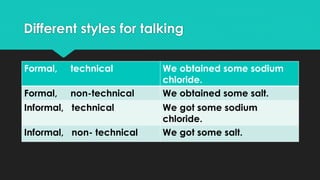
Different styles for talking
Formal, technical We obtained some sodium
chloride.
Formal, non-technical We obtained some salt.
Informal, technical We got some sodium
chloride.
Informal, non- technical We got some salt.
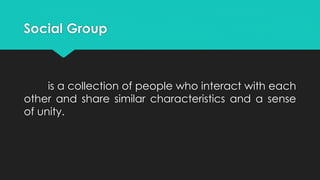
Social Group
is a collection of people who interact with each
other and share similar characteristics and a sense
of unity.
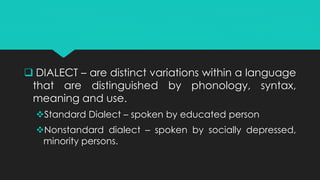
 DIALECT – are distinct variations within a language
that are distinguished by phonology, syntax,
meaning and use.
Standard Dialect – spoken by educated person
Nonstandard dialect – spoken by socially depressed,
minority persons.
The interaction of social, cultural, and regional
variations produces a complex overlapping of
dialects in most countries.
Sensitivity to dialect use is often accompanied by
negative perceptions of the speech of others.
Because children come to school with the
language of their homes and communities, any
denigration of that dialect is also a denigration of
them and their families.
On the other hand, if children adhere to a dialect
that is low in prestige, they are likely to find few
opportunities for successful employment outside
their speech community (Shuy 1971).
The Evidence For
Language Bias
Biased language
insults the person or group to which it is applied. In
denigrating others, biased language creates division and
separation. In using biased language about races and ethnic or
cultural groups, speakers and writers risk alienating members of
those groups, thus undermining the communication and shared
understanding language should promote.”
(Robert DiYanni and Pat C. Hoy II, The Scribner Handbook for
Writers. Allyn and Bacon, 2001)
Gender-biased language
 implies that people are male unless 'proven' to be female.
Female gender may be designated by either tagging on a
feminine descriptor (e.g. lady professor, women doctor, female
engineer) or by belonging to a stereotypically female group
(e.g., kindergarten teacher, social worker)."
(Janet B. Ruscher, Prejudiced Communication: A Social
Psychological Perspective. Guilford, 2001)
Economic status
Nonstandard dialects tend to be from
the lower classes; their lower class status
and different dialect complicate efforts
to make schooling equal.
Implicit biases toward pupil’s language may
interfere with learning if teachers lower their
expectations for their students’ success.
Teachers held negative judgments toward
black children and their black English dialect
(Williams 1970)
Low expectations by teachers has been
found to result in low achievement.
If the teacher was of the same race as the
children, the bias was reduced, but this finding
was true only if the children were of a higher
socioeconomic level than the teacher.
It is important that professionals make every
effort to reduce any negative bias they may
hold toward students on the basis of those
students’ dialect.
The Deficit View
Deficit View
Socioeconomic status
Impairment of auditory
poverty
Socioeconomic
The IQs of black children were lower than
those of white children. (Deutsch, Brown)
Being poor and/or a member of a minority
group resulted in a tendency to have poorer
language functioning than being white and
middle class.
Lower class mothers tended to provide less
verbal explanation to their four-year old
children in problem solving tasks than black
middle class mothers did.
Auditory discrimination
C. Deutsch found poor auditory
discrimination in lower class black
first graders who were unsuccessful
in beginning reading.
poverty
The language of children of poverty lacked
sufficient structure and meaning for appropriate
learning.
The Difference View
Rather than looking to the individual and the individual’s
cognition for the sources of educational problems, these
linguists examined the language of nonstandard speakers
with the view that different forms(dialects) of language
are equally sufficient for expression.
Creolization
The process in which creole cultures engage in the
new world. As a result of colonization there was a mixture
between people of indigenous
Creole Language (Creole)
a stable natural language that has developed from a
pidgin or simplified version of a language.
Continual modification of the dialect after slavery
ended brought this dialect closer to other forms of
American English.
There have been lexical borrowings from black to
standard English despite of shown influence of standard
American English to the black English
“uh-huh”
SUCH AS…
man – comrade
the man – cool, hot, etc.
gig or pad – (older jazz term)
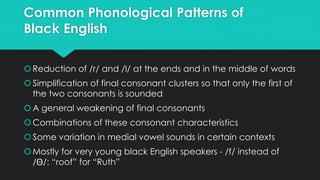
Common Phonological Patterns of
Black English
Reduction of /r/ and /l/ at the ends and in the middle of words
Simplification of final consonant clusters so that only the first of
the two consonants is sounded
A general weakening of final consonants
Combinations of these consonant characteristics
Some variation in medial vowel sounds in certain contexts
Mostly for very young black English speakers - /f/ instead of
/ /: “roof” for “Ruth”
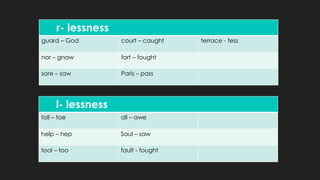
r- lessness
guard – God court – caught terrace - tess
nor – gnaw fort – fought
sore – saw Paris – pass
l- lessness
toll – toe all – awe
help – hep Saul – saw
tool – too fault - fought
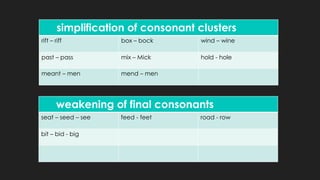
simplification of consonant clusters
rift – riff box – bock wind – wine
past – pass mix – Mick hold - hole

meant – men mend – men
weakening of final consonants
seat – seed – see feed - feet road - row
bit – bid - big
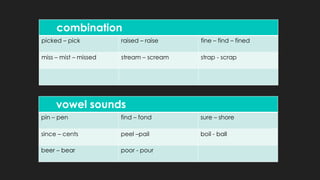
combination
picked – pick raised – raise fine – find – fined
miss – mist – missed stream – scream strap - scrap
vowel sounds
pin – pen find – fond sure – shore
since – cents peel –pail boil - ball
beer – bear poor - pour
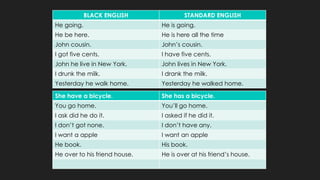
BLACK ENGLISH STANDARD ENGLISH
He going. He is going.
He be here. He is here all the time
John cousin. John’s cousin.
I got five cents. I have five cents.
John he live in New York. John lives in New York.
I drunk the milk. I drank the milk.
Yesterday he walk home. Yesterday he walked home.
She have a bicycle. She has a bicycle.
You go home. You’ll go home.
I ask did he do it. I asked if he did it.
I don’t got none. I don’t have any.
I want a apple I want an apple
He book. His book.
He over to his friend house. He is over at his friend’s house.
Further Characteristics of Black English
 Optional deletion of possessive marker
 Deletion of noun plural in some instances
 Insertion of pronoun after the proper noun
 Alternate forms of variant verbs
 Different systems of noun-verb agreement
 Variant structure of embedded questions
 Differential transformational rules for some negatives
 Indefinite article differences
 Possessive and other pronoun differences
 Prepositions that vary in some settings
The Communication View
Communication View
Children learn the language of their families
Styles of interaction may vary by family and by cultural
group
Metaphor in Black English
Bible story metaphorically to represent current issues
Metaphor in Black English
Signify – speech form which negative meaning is
portrayed in an INDIRECT even hidden, manner.
Marking – narrative form in which EXAGGERATION and
EMPHASIS establish the nonliteral meaning as the real one.
Sounding – is a popular form of exchange among
adolescents. Initially an insult about someone’s family
member.
Differences between
Parent-Child
Exchanges
Black Children
growing up in Trackton
Learn to communicate in a different style
Little dialogue, play songs and monologue
With an emphasis on creation and embellishment,
children needed to interrupt to talk with adults
White Children
 growing up in Roadville
 Working-class family
 Considerable attention to the set time, the set place and the set
way of talking
 Much on baby talk than in Trackton
 Parents spent sharing books with their children until they enter
school
 Parents knew that their role was to teach the children
 But did not establish links between early literacy experiences
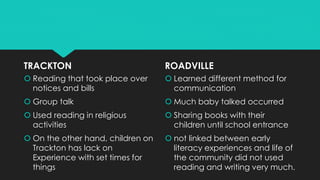
TRACKTON
 Reading that took place over
notices and bills
 Group talk
 Used reading in religious
activities
 On the other hand, children on
Trackton has lack on
Experience with set times for
things
ROADVILLE
 Learned different method for
communication
 Much baby talked occurred
 Sharing books with their
children until school entrance
 not linked between early
literacy experiences and life of
the community did not used
reading and writing very much.
Children had difficulty extending their knowledge into
new areas when school came
Parents stopped their teaching, believing that it was the
job of the school
The separateness of school and home was not helpful to
the children.
Tough concluded that there are important class
differences in the talk between child and parent,
differences that are carried into school.
three year-old Jimmie comes to his
mother:
Jimmie: Look – look what I’ve found
Mother: Just look at your hands – black bright aren’t they?
Jimmie: Look at this thing – the ladybird – look it’s right little.
Mother: Go wash your hands now – just look at the color of them.
Jimmie: It’s a ladybird. I want to keep it . . .
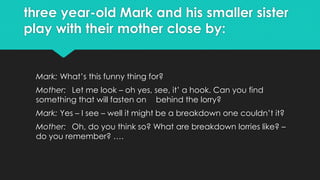
three year-old Mark and his smaller sister
play with their mother close by:
Mark: What’s this funny thing for?
Mother: Let me look – oh yes, see, it’ a hook. Can you find
something that will fasten on behind the lorry?
Mark: Yes – I see – well it might be a breakdown one couldn’t it?
Mother: Oh, do you think so? What are breakdown lorries like? –
do you remember? ….
Parents influence how their children think
Communication view of language differences rests upon
the concept that discourse styles in families influence
language development
The apparent lack of understanding of school
expectations comes from differences in communication
rather than from inability to communicate
Language Differences in
literacy
Questions:
Does dialect and language variation influence
reading and writing?
What is the extent of the influence, if any, are
explored?
Answers:
keep the regular school talk and materials
Adjust to the mismatch through teaching or
to revise the material to meet the children’s
language.
Dialect and reading
Does dialect affect reading?
Does changing the dialect will help the students in
reading?
How does emergent language affect reading?
Evidence for direct interference
School
Reading
writting
Evidence for indirect interference
Oral reading
Spelling
Writing Requires the encoding of one’s language
knowledge into representative graphemes
Bilingualism
 having some ability to use two or more
languages.
 have equal competence (thus native ability)in
using two languages
Acquisition of a second language at
home.
Does bilingualism affects children’s overall
language and cognitive development?
(Linhom 1980) acquiring two language suggest
very little harm and some advantage derived from
simultaneous acquisition.
The explanation lies in social roots
Acquisition of a second language at
school.
(Carrow- Woolfolk and lynch 1982)there is no
evidence that lexical, syntactic, and
meaning structure of second language are
more easily acquired by children
Schooling and Bilingualism
Beneficial educational environments should offer
the opportunity for children to acquire a second
language in naturalistic ways.
Language Immersion
Immersion Program (Lambert, 1970)
Immersion and underlying language
competency
To the extent that instruction in Lx is effective in
promoting cognitive/ academic proficiency in Lx,
transfer of this proficiency to Ly will occur provided
there is adequate exposure to Ly (either in school
or environment)and adequate motivation to learn
Ly(1981, 141)
PRESENTOR
DAGDAGAN, RIC ANGELO M.
DE LEON, LEYNETTE C.
SALCEDO, SAIRAH MYRRH N.

Language Differences in Literacy

  • 1.
    VARIATIONS IN LANGUAGE ANDLITERACY DEVELOPMENT DAGDAGAN, R. A. M., DE LEON, L. C., SALCEDO, S. M. N.
  • 2.
    Different styles fortalking Formal, technical We obtained some sodium chloride. Formal, non-technical We obtained some salt. Informal, technical We got some sodium chloride. Informal, non- technical We got some salt.
  • 3.
    Social Group is acollection of people who interact with each other and share similar characteristics and a sense of unity.
  • 4.
     DIALECT –are distinct variations within a language that are distinguished by phonology, syntax, meaning and use. Standard Dialect – spoken by educated person Nonstandard dialect – spoken by socially depressed, minority persons.
  • 5.
    The interaction ofsocial, cultural, and regional variations produces a complex overlapping of dialects in most countries.
  • 6.
    Sensitivity to dialectuse is often accompanied by negative perceptions of the speech of others.
  • 7.
    Because children cometo school with the language of their homes and communities, any denigration of that dialect is also a denigration of them and their families.
  • 8.
    On the otherhand, if children adhere to a dialect that is low in prestige, they are likely to find few opportunities for successful employment outside their speech community (Shuy 1971).
  • 9.
  • 10.
    Biased language insults theperson or group to which it is applied. In denigrating others, biased language creates division and separation. In using biased language about races and ethnic or cultural groups, speakers and writers risk alienating members of those groups, thus undermining the communication and shared understanding language should promote.” (Robert DiYanni and Pat C. Hoy II, The Scribner Handbook for Writers. Allyn and Bacon, 2001)
  • 11.
    Gender-biased language  impliesthat people are male unless 'proven' to be female. Female gender may be designated by either tagging on a feminine descriptor (e.g. lady professor, women doctor, female engineer) or by belonging to a stereotypically female group (e.g., kindergarten teacher, social worker)." (Janet B. Ruscher, Prejudiced Communication: A Social Psychological Perspective. Guilford, 2001)
  • 12.
    Economic status Nonstandard dialectstend to be from the lower classes; their lower class status and different dialect complicate efforts to make schooling equal.
  • 13.
    Implicit biases towardpupil’s language may interfere with learning if teachers lower their expectations for their students’ success.
  • 14.
    Teachers held negativejudgments toward black children and their black English dialect (Williams 1970)
  • 15.
    Low expectations byteachers has been found to result in low achievement.
  • 16.
    If the teacherwas of the same race as the children, the bias was reduced, but this finding was true only if the children were of a higher socioeconomic level than the teacher.
  • 17.
    It is importantthat professionals make every effort to reduce any negative bias they may hold toward students on the basis of those students’ dialect.
  • 18.
  • 19.
  • 20.
    Socioeconomic The IQs ofblack children were lower than those of white children. (Deutsch, Brown)
  • 21.
    Being poor and/ora member of a minority group resulted in a tendency to have poorer language functioning than being white and middle class.
  • 22.
    Lower class motherstended to provide less verbal explanation to their four-year old children in problem solving tasks than black middle class mothers did.
  • 23.
    Auditory discrimination C. Deutschfound poor auditory discrimination in lower class black first graders who were unsuccessful in beginning reading.
  • 24.
    poverty The language ofchildren of poverty lacked sufficient structure and meaning for appropriate learning.
  • 25.
  • 26.
    Rather than lookingto the individual and the individual’s cognition for the sources of educational problems, these linguists examined the language of nonstandard speakers with the view that different forms(dialects) of language are equally sufficient for expression.
  • 27.
    Creolization The process inwhich creole cultures engage in the new world. As a result of colonization there was a mixture between people of indigenous
  • 28.
    Creole Language (Creole) astable natural language that has developed from a pidgin or simplified version of a language.
  • 29.
    Continual modification ofthe dialect after slavery ended brought this dialect closer to other forms of American English.
  • 30.
    There have beenlexical borrowings from black to standard English despite of shown influence of standard American English to the black English
  • 31.
  • 32.
    SUCH AS… man –comrade the man – cool, hot, etc. gig or pad – (older jazz term)
  • 33.
    Common Phonological Patternsof Black English Reduction of /r/ and /l/ at the ends and in the middle of words Simplification of final consonant clusters so that only the first of the two consonants is sounded A general weakening of final consonants Combinations of these consonant characteristics Some variation in medial vowel sounds in certain contexts Mostly for very young black English speakers - /f/ instead of / /: “roof” for “Ruth”
  • 34.
    r- lessness guard –God court – caught terrace - tess nor – gnaw fort – fought sore – saw Paris – pass l- lessness toll – toe all – awe help – hep Saul – saw tool – too fault - fought
  • 35.
    simplification of consonantclusters rift – riff box – bock wind – wine past – pass mix – Mick hold - hole meant – men mend – men weakening of final consonants seat – seed – see feed - feet road - row bit – bid - big
  • 36.
    combination picked – pickraised – raise fine – find – fined miss – mist – missed stream – scream strap - scrap vowel sounds pin – pen find – fond sure – shore since – cents peel –pail boil - ball beer – bear poor - pour
  • 37.
    BLACK ENGLISH STANDARDENGLISH He going. He is going. He be here. He is here all the time John cousin. John’s cousin. I got five cents. I have five cents. John he live in New York. John lives in New York. I drunk the milk. I drank the milk. Yesterday he walk home. Yesterday he walked home. She have a bicycle. She has a bicycle. You go home. You’ll go home. I ask did he do it. I asked if he did it. I don’t got none. I don’t have any. I want a apple I want an apple He book. His book. He over to his friend house. He is over at his friend’s house.
  • 38.
    Further Characteristics ofBlack English  Optional deletion of possessive marker  Deletion of noun plural in some instances  Insertion of pronoun after the proper noun  Alternate forms of variant verbs  Different systems of noun-verb agreement  Variant structure of embedded questions  Differential transformational rules for some negatives  Indefinite article differences  Possessive and other pronoun differences  Prepositions that vary in some settings
  • 39.
  • 40.
    Communication View Children learnthe language of their families Styles of interaction may vary by family and by cultural group
  • 41.
    Metaphor in BlackEnglish Bible story metaphorically to represent current issues
  • 42.
    Metaphor in BlackEnglish Signify – speech form which negative meaning is portrayed in an INDIRECT even hidden, manner. Marking – narrative form in which EXAGGERATION and EMPHASIS establish the nonliteral meaning as the real one. Sounding – is a popular form of exchange among adolescents. Initially an insult about someone’s family member.
  • 43.
  • 44.
    Black Children growing upin Trackton Learn to communicate in a different style Little dialogue, play songs and monologue With an emphasis on creation and embellishment, children needed to interrupt to talk with adults
  • 45.
    White Children  growingup in Roadville  Working-class family  Considerable attention to the set time, the set place and the set way of talking  Much on baby talk than in Trackton  Parents spent sharing books with their children until they enter school  Parents knew that their role was to teach the children  But did not establish links between early literacy experiences
  • 46.
    TRACKTON  Reading thattook place over notices and bills  Group talk  Used reading in religious activities  On the other hand, children on Trackton has lack on Experience with set times for things ROADVILLE  Learned different method for communication  Much baby talked occurred  Sharing books with their children until school entrance  not linked between early literacy experiences and life of the community did not used reading and writing very much.
  • 47.
    Children had difficultyextending their knowledge into new areas when school came Parents stopped their teaching, believing that it was the job of the school The separateness of school and home was not helpful to the children.
  • 48.
    Tough concluded thatthere are important class differences in the talk between child and parent, differences that are carried into school.
  • 49.
    three year-old Jimmiecomes to his mother: Jimmie: Look – look what I’ve found Mother: Just look at your hands – black bright aren’t they? Jimmie: Look at this thing – the ladybird – look it’s right little. Mother: Go wash your hands now – just look at the color of them. Jimmie: It’s a ladybird. I want to keep it . . .
  • 50.
    three year-old Markand his smaller sister play with their mother close by: Mark: What’s this funny thing for? Mother: Let me look – oh yes, see, it’ a hook. Can you find something that will fasten on behind the lorry? Mark: Yes – I see – well it might be a breakdown one couldn’t it? Mother: Oh, do you think so? What are breakdown lorries like? – do you remember? ….
  • 51.
    Parents influence howtheir children think
  • 52.
    Communication view oflanguage differences rests upon the concept that discourse styles in families influence language development
  • 53.
    The apparent lackof understanding of school expectations comes from differences in communication rather than from inability to communicate
  • 54.
  • 55.
    Questions: Does dialect andlanguage variation influence reading and writing? What is the extent of the influence, if any, are explored?
  • 56.
    Answers: keep the regularschool talk and materials Adjust to the mismatch through teaching or to revise the material to meet the children’s language.
  • 57.
    Dialect and reading Doesdialect affect reading? Does changing the dialect will help the students in reading? How does emergent language affect reading?
  • 58.
    Evidence for directinterference School Reading writting
  • 59.
    Evidence for indirectinterference Oral reading
  • 60.
    Spelling Writing Requires theencoding of one’s language knowledge into representative graphemes
  • 61.
    Bilingualism  having someability to use two or more languages.  have equal competence (thus native ability)in using two languages
  • 62.
    Acquisition of asecond language at home. Does bilingualism affects children’s overall language and cognitive development? (Linhom 1980) acquiring two language suggest very little harm and some advantage derived from simultaneous acquisition. The explanation lies in social roots
  • 63.
    Acquisition of asecond language at school. (Carrow- Woolfolk and lynch 1982)there is no evidence that lexical, syntactic, and meaning structure of second language are more easily acquired by children
  • 64.
    Schooling and Bilingualism Beneficialeducational environments should offer the opportunity for children to acquire a second language in naturalistic ways.
  • 65.
  • 66.
    Immersion and underlyinglanguage competency To the extent that instruction in Lx is effective in promoting cognitive/ academic proficiency in Lx, transfer of this proficiency to Ly will occur provided there is adequate exposure to Ly (either in school or environment)and adequate motivation to learn Ly(1981, 141)
  • 67.
    PRESENTOR DAGDAGAN, RIC ANGELOM. DE LEON, LEYNETTE C. SALCEDO, SAIRAH MYRRH N.