Gender and Development
Introduction 
Gender is a development issue. 
Different concepts: 
• women in development (WID) 
• women and development (WAD) 
• gender and development (GAD) 
• the efficiency approach 
• the empowerment approach 
• gender and the environment (GED) 
• mainstreaming gender equality
Gender Issues 
 Gender and education 
 Resources 
 Work and women 
 Maternal mortality ratio 
 Declining sex ratio 
 Gendered patterns of migration 
 Gender and violence
Gender is a social construct 
 In contrast to sex, which refers to biological 
differences between males and females, 
gender is a social or cultural construct of the 
differences between women and men. 
 People are born female or male, but they 
acquire a gender identity that shapes socially 
acceptable activities for women and men, 
their relations, and their relative power.
Gender and education 
 Gender differences in education exist in many 
parts of the world 
 Education and development 
 Reduction in child mortality 
 Improvement in nutrition 
 Decrease in fertility rates
Educating Women Reduces National Infant Mortality 
Infant mortality (deaths per 1,000 births) 
120 
100 
80 
60 
40 
20 
0 
Sub-Saharan Africa 
50 70 90 110 
Secondary education (females per 100 males) 
South Asia 
Middle East 
& North Africa 
Latin America 
& Caribbean 
East Asia 
OECD
Educated Women Have Healthier Children 
250 
200 
150 
100 
50 
0 
Africa Latin America & 
Caribbean 
Asia 
0 Yrs. 
4-6 Yrs. 
7+ Yrs. 
Under 5 mortality per 1,000 
Years of education of mother 
(Average of household survey results)
IInnddiiaa KKeennyyaa 
Calculation of Net Social Benefits to Girls’ Education 
for Representative Countries 
Cost of one additional year of primary schooling 
for 1,000 women $32,000 $58,000 
Benefits of an additional year of schooling: 
CChhiilldd mmoorrttaalliittyy rreedduucceedd bbyy:: 7.5% 7.5% 
Alternative cost per child death $750 $750 
Total value of averted deaths $32,000 $36,000 
BBiirrtthhss aavveerrtteedd: 
Percentage reduction in total fertility rate 7.5% 7.5% 
Alternative cost per birth averted $250 $300 
Value of averted births $75,000 $98,000 
MMaatteerrnnaall mmoorrttaalliittyy:: 
Maternal deaths averted 2 2 
Alternative cost per averted maternal death $1,500 $1,500 
Value of averted maternal deaths 2,300 2,600 
Discounted social benefits (15 years, 5%) $52,000 $66,000
Resources 
 Women have poor command over land, information 
and financial resources. 
 In South-east Asia female resource possession is low 
and female autonomy is very low. 
 In developing countries women rarely possess land 
 Female headed households 
 Female headed enterprises
Declining sex-ratio 
 There are at least 60 to 100 million missing 
women. 
 Female infanticide and sex-selective foeticide 
 Declining child sex-ratios 
 Relation of declining sex-ratios to the 
population policies and son preference 
 Example
Where is there anti-girl discrimination and a 
resulting shortage of girls? 
 East Asia: China, Taiwan, South Korea 
 South Asia: India, Nepal, Pakistan 
 Not in most Muslim countries of Arab Middle East, 
North Africa, Southeast Asia, or Central Asia. 
 Not in most of Latin America, Africa, Middle East, 
Less Developed, or Least Developed Countries. 
 Not in Europe, North America, Russia. 
 Only certain cultures have such strong traditional 
anti-daughter bias that is now exacerbated by 
declining and low fertility, leading to sex-selective 
abortion and/or excess mortality of daughters.
Maternal Mortality Ratio(MMR) 
 MMR measures the number of deaths to women per 
100,000 lives births due to pregnancy-related 
complications, 
 400 per 100,000 live births globally in 2000. 
 By region, it was highest in Africa (830), followed by Asia 
- excluding Japan (330), Oceania - excluding Australia and 
New Zealand (240), Latin America and the Caribbean (190) 
and the developed countries (20). 
 Worldwide, 13 developing countries accounted for 70 per 
cent of all maternal deaths.
Work and Women 
 Women work considerably longer hours than men in 
many countries. 
 Division of labor (mostly household job at the 
expense of education, leisure and health) 
 Common in the absence of adequate infrastructure 
for water, energy and transport
Participation 
 Women still earn less than men in the labor 
market 
 On average in developed countries, women in 
the wage sector earn 77% of what men earn; 
in developing countries 73% 
 In politics, women continue to be vastly 
unrepresentative
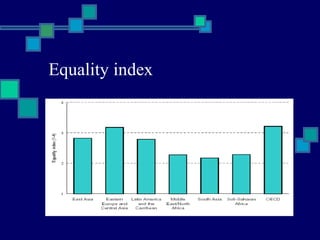
Equality index
Gender inequalities are costly for 
development 
 Societies that discriminate on the basis of 
gender pay a significant price- in more 
poverty, slower economic growth, weaker 
governance and in lower quality of life. 
 Gender inequalities in basic rights, education, 
access to productive resources, participation 
in public life- all have detrimental impacts on 
development
Infant and child mortality 
 Impact of gender gap in education on infant 
and child mortality can be observed in 
countries where girls are only half likely to 
go to school as boys have 21 more infant 
deaths per 1,000 live births than countries 
with no gender gap 
 Sub-Saharan Africa (under five mortality would 
have been 25 percent lower)
Nutritional status 
 Mothers education, health and income are key 
determinants of child nutrition in developing 
countries 
 Study that observed child malnutrition pattern from 63 
countries between 1970 and 1995 
 In Brazil, the positive impact on children’s nutritional 
indicators of additional income in mothers’ hands is 4-8 
times larger than the impact of additional income in fathers’ 
hands.
Economic growth and gender 
equality 
 Income growth promotes gender equality in the long 
run by increasing women’s education, investment in 
girls human development and for women to 
participate in the labor force. 
 Ghana, India, Malaysia, Pakistan, Peru, Tanzania, Turkey 
and Vietnam 
 More investment in rural infrastructure like water, 
transportation and fuel eases the burden of females 
 Nepal and Pakistan- water and energy infrastructure 
 Morocco- pipes water increases girls school attendance
Adolescent child bearing 
More than 15 million girls aged 15 to 19 give birth 
each year. 
Motherhood at a very young age entails 
complications during pregnancy and delivery 
and a risk of maternal death that is much 
greater than average. 
The children of young mothers have higher levels of 
morbidity and mortality. 
Early child-bearing continues to be an impediment 
to improvements in the educational, economic 
and social status of women in all parts of the 
world.
Gender and violence 
 Sexual and gender-based violence, including 
physical and psychological abuse, trafficking 
in women and girls, and other forms of abuse 
and sexual exploitation place girls and women 
at high risk of physical and mental trauma, 
disease and unwanted pregnancy. Such 
situations often deter women from using 
health and other services.
Gender and development 
All societies have established a clear-cut division of labor by 
sex, although what is considered a male or female task varies 
cross-culturally, implying that there is no natural and fixed 
gender division of labor. 
Second, research has shown that, in order to comprehend gender 
roles in production, we also need to understand gender roles 
within the household. 
The third fundamental finding is that economic development 
has been shown to have a differential impact on men and 
women and the impact on women has both positive and 
negative results. .
Three-part strategy 
 Reforming institutions 
 Implementing policies for sustained 
economic growth and development 
 Taking active measures to improve women’s 
command of resources and political voice
Conclusion 
 After three decades of Women in Development and 
Gender and Development policies the work of 
redressing gender inequalities has only just begun… 
 Investing in women will not put an end to poverty 
but it will make a critical contribution to improving 
household well-being. 
 Furthermore, it will help to create the basis for future 
generations to make better use of both resource and 
opportunities

Gender

  • 1.
  • 2.
    Introduction Gender isa development issue. Different concepts: • women in development (WID) • women and development (WAD) • gender and development (GAD) • the efficiency approach • the empowerment approach • gender and the environment (GED) • mainstreaming gender equality
  • 3.
    Gender Issues Gender and education  Resources  Work and women  Maternal mortality ratio  Declining sex ratio  Gendered patterns of migration  Gender and violence
  • 4.
    Gender is asocial construct  In contrast to sex, which refers to biological differences between males and females, gender is a social or cultural construct of the differences between women and men.  People are born female or male, but they acquire a gender identity that shapes socially acceptable activities for women and men, their relations, and their relative power.
  • 5.
    Gender and education  Gender differences in education exist in many parts of the world  Education and development  Reduction in child mortality  Improvement in nutrition  Decrease in fertility rates
  • 6.
    Educating Women ReducesNational Infant Mortality Infant mortality (deaths per 1,000 births) 120 100 80 60 40 20 0 Sub-Saharan Africa 50 70 90 110 Secondary education (females per 100 males) South Asia Middle East & North Africa Latin America & Caribbean East Asia OECD
  • 7.
    Educated Women HaveHealthier Children 250 200 150 100 50 0 Africa Latin America & Caribbean Asia 0 Yrs. 4-6 Yrs. 7+ Yrs. Under 5 mortality per 1,000 Years of education of mother (Average of household survey results)
  • 8.
    IInnddiiaa KKeennyyaa Calculationof Net Social Benefits to Girls’ Education for Representative Countries Cost of one additional year of primary schooling for 1,000 women $32,000 $58,000 Benefits of an additional year of schooling: CChhiilldd mmoorrttaalliittyy rreedduucceedd bbyy:: 7.5% 7.5% Alternative cost per child death $750 $750 Total value of averted deaths $32,000 $36,000 BBiirrtthhss aavveerrtteedd: Percentage reduction in total fertility rate 7.5% 7.5% Alternative cost per birth averted $250 $300 Value of averted births $75,000 $98,000 MMaatteerrnnaall mmoorrttaalliittyy:: Maternal deaths averted 2 2 Alternative cost per averted maternal death $1,500 $1,500 Value of averted maternal deaths 2,300 2,600 Discounted social benefits (15 years, 5%) $52,000 $66,000
  • 9.
    Resources  Womenhave poor command over land, information and financial resources.  In South-east Asia female resource possession is low and female autonomy is very low.  In developing countries women rarely possess land  Female headed households  Female headed enterprises
  • 10.
    Declining sex-ratio There are at least 60 to 100 million missing women.  Female infanticide and sex-selective foeticide  Declining child sex-ratios  Relation of declining sex-ratios to the population policies and son preference  Example
  • 11.
    Where is thereanti-girl discrimination and a resulting shortage of girls?  East Asia: China, Taiwan, South Korea  South Asia: India, Nepal, Pakistan  Not in most Muslim countries of Arab Middle East, North Africa, Southeast Asia, or Central Asia.  Not in most of Latin America, Africa, Middle East, Less Developed, or Least Developed Countries.  Not in Europe, North America, Russia.  Only certain cultures have such strong traditional anti-daughter bias that is now exacerbated by declining and low fertility, leading to sex-selective abortion and/or excess mortality of daughters.
  • 12.
    Maternal Mortality Ratio(MMR)  MMR measures the number of deaths to women per 100,000 lives births due to pregnancy-related complications,  400 per 100,000 live births globally in 2000.  By region, it was highest in Africa (830), followed by Asia - excluding Japan (330), Oceania - excluding Australia and New Zealand (240), Latin America and the Caribbean (190) and the developed countries (20).  Worldwide, 13 developing countries accounted for 70 per cent of all maternal deaths.
  • 13.
    Work and Women  Women work considerably longer hours than men in many countries.  Division of labor (mostly household job at the expense of education, leisure and health)  Common in the absence of adequate infrastructure for water, energy and transport
  • 14.
    Participation  Womenstill earn less than men in the labor market  On average in developed countries, women in the wage sector earn 77% of what men earn; in developing countries 73%  In politics, women continue to be vastly unrepresentative
  • 15.
  • 16.
    Gender inequalities arecostly for development  Societies that discriminate on the basis of gender pay a significant price- in more poverty, slower economic growth, weaker governance and in lower quality of life.  Gender inequalities in basic rights, education, access to productive resources, participation in public life- all have detrimental impacts on development
  • 17.
    Infant and childmortality  Impact of gender gap in education on infant and child mortality can be observed in countries where girls are only half likely to go to school as boys have 21 more infant deaths per 1,000 live births than countries with no gender gap  Sub-Saharan Africa (under five mortality would have been 25 percent lower)
  • 18.
    Nutritional status Mothers education, health and income are key determinants of child nutrition in developing countries  Study that observed child malnutrition pattern from 63 countries between 1970 and 1995  In Brazil, the positive impact on children’s nutritional indicators of additional income in mothers’ hands is 4-8 times larger than the impact of additional income in fathers’ hands.
  • 19.
    Economic growth andgender equality  Income growth promotes gender equality in the long run by increasing women’s education, investment in girls human development and for women to participate in the labor force.  Ghana, India, Malaysia, Pakistan, Peru, Tanzania, Turkey and Vietnam  More investment in rural infrastructure like water, transportation and fuel eases the burden of females  Nepal and Pakistan- water and energy infrastructure  Morocco- pipes water increases girls school attendance
  • 20.
    Adolescent child bearing More than 15 million girls aged 15 to 19 give birth each year. Motherhood at a very young age entails complications during pregnancy and delivery and a risk of maternal death that is much greater than average. The children of young mothers have higher levels of morbidity and mortality. Early child-bearing continues to be an impediment to improvements in the educational, economic and social status of women in all parts of the world.
  • 21.
    Gender and violence  Sexual and gender-based violence, including physical and psychological abuse, trafficking in women and girls, and other forms of abuse and sexual exploitation place girls and women at high risk of physical and mental trauma, disease and unwanted pregnancy. Such situations often deter women from using health and other services.
  • 22.
    Gender and development All societies have established a clear-cut division of labor by sex, although what is considered a male or female task varies cross-culturally, implying that there is no natural and fixed gender division of labor. Second, research has shown that, in order to comprehend gender roles in production, we also need to understand gender roles within the household. The third fundamental finding is that economic development has been shown to have a differential impact on men and women and the impact on women has both positive and negative results. .
  • 23.
    Three-part strategy Reforming institutions  Implementing policies for sustained economic growth and development  Taking active measures to improve women’s command of resources and political voice
  • 24.
    Conclusion  Afterthree decades of Women in Development and Gender and Development policies the work of redressing gender inequalities has only just begun…  Investing in women will not put an end to poverty but it will make a critical contribution to improving household well-being.  Furthermore, it will help to create the basis for future generations to make better use of both resource and opportunities