Rural Development: Approaches,
Discourses and Theories (MARD
511
Lesson : Redistribution with Growth
By
Khemraj Subedi
Associate Professor
Tikapur Multiple Campus
M.Phil
PhD Scholar
Unit 5 : Alternative
Rural Development
Approach
What is meant by redistribution?
 Redistribution refers to rearranging transfer of economic resources
From well off people to befit worse off people through economic
policy shift on an economy-wide basis.
 In other words, redistribution of income and wealth is the transfer
of income and wealth (including physical property) from some
individuals to others by means of a social mechanism such as taxation,
charity, welfare, public services, land reform, fiscal policy, monetary
policy, and confiscation.
 The term typically refers to redistribution on an economy-wide basis
rather than between selected individuals.
What is growth (economic growth)?
Economic growth is an increase in the production of
economic goods and services, compared from one
period of time to another.
It can be measured in nominal or real (adjusted for
inflation) terms.
Traditionally, aggregate economic growth is
measured in terms of Gross Domestic Product
(GNP) although alternative metrics are sometimes
used.
Economic growth cont….
 In simplest terms, economic growth refers to an increase in
aggregate production in an economy.
 That leads to an increase in incomes, inspiring consumers to
open up their wallets and buy more, which means a higher
material quality of life or standard of living.
Redistribution With Growth
 Trickle -down theory: increase increase in growth rates enables
enables the poor to derive maximum benefits.
 Growth is good for the poor (Dollar & Kraay, 2000)
 Yet in rare cases the economic growth might increase inequality and
offset gains of the poor from the economic growth (Esanov, 2006).
 Kuznet’s (1955) inverted-U predicts rise in inequality at early periods
of high and rising growth rates and fall in inequality during later
periods.
 Okun’s (1975) treatise on equality and efficiency argue that greater
income inequality is an incentive for work and investment.
Practice of Redistribution
 Redistributive policies attempt to take wealth, income, and
other resources from the "haves" and give them to the "have-
nots",
 Different types of economic system feature varying degrees of
interventionism aimed at redistributing income, depending on
how unequal their initial distributions of income are.
 Free-market capitalist economies tend to feature high degrees
of income redistribution.
 The socialist planned economies do not allow to own private
property and non existence of inequality problem.
Forms of redistribution
 The redistribution of wealth and its practical application are bound to change with
the continuous evolution of social norms, politics, and culture.
 Governmental redistribution of income may include a direct benefit program
involving either cash transfers or the purchase of specific services for an individual.
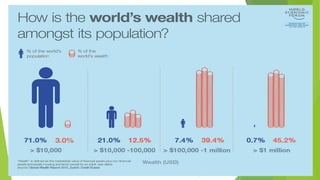
 Developed countries income inequality has become a widely popular issue that has
dominated the debate stage for the past few years.
 Redistributing wealth comes from the implementation of a carefully thought out
well described system of taxation.
 The implementation of such a system would aid in achieving the desired social and
economic objective of diminishing social inequality and maximizing social welfare.
 Progressive system of taxation to achieve a certain level of income redistribution.
Forms of Redistribution cont…
 Progressive-rate income tax policy as redistributive, because some of the tax
revenue goes to social programs such as welfare and Medicare.
 Other common types of governmental redistribution of income
are subsidies and vouchers.
 Medicare is a government-run health insurance program that covers people
age 65 or older, certain younger people with disabilities.
 Wealth redistribution can be implemented through land reform that transfers
ownership of land from one category of people to another, or through
inheritances taxes or direct wealth tax.
 Economies also implement unemployment benefits as redistribution measure.
 Legislation of minimum wage fixation program.
Measures of Redistribution
 Redistributive fiscal policies (pprogressive taxation and transfer payments),
 Improving access and quality of education,
 Providing better and wider access to health and nutrition,
 Improve access to credit markets through financial inclusion policies;
 Better access to public goods like the internet, mobile telephones, clean
water and sewerage, electricity, and so forth (through broader provision of
such goods by the government).
 Land reform to ensuring ownership of land as means of livelihood,
 Ownership of housing to poor and destitute,
Conclusions
 Scholars are not in consensus on whether redistribution promotes growth.
 Redistribution via direct transfer may ensure social justice but stagnates growth.
 Redistribution via improvement in land ownership(land reform) may increase land productivity and ensure
social justice.
 Redistribution via improving in access and quality of education will upgrade labour productivity and
eventually promotes growth.
 Redistribution via public finance will increase productivity and growth.
 Redistribution through monetary policy will ensure better access to money market and capital market thereby
increasing investment and growth.
 Redistribution through better healthcare, nutrition, drinking water, housing will upgrade productivity of
human capital thereby increase growth.
 Redistribution through better provision of public goods like public transportation, electricity, communication
service, judicial system, defence, law and order and security reduce cost and promote growth.
 Public policies that potentially have redistributing effects may facilitate growth by publicly providing for
insurances against risks such as unemployment, disabilities, and old age that markets cannot (efficiently)
provide for.
 Okun, A.M. (1975). Equality and Efficiency: the Big Trade-Off
(Washington: Brookings Institution Press).
 Dollar, D., T. Kleineberg, and Kraay, A.(2000). “Growth Is Still Good for
the Poor,” Policy Research Working Paper No. 6568 (Washington: World
Bank).
 Kuznets, S. (1955) Economic Growth and Income Inequality, Anzrican
Economic Review 45(1):1-28.
Thanks

Redistribution with growth

  • 1.
    Rural Development: Approaches, Discoursesand Theories (MARD 511 Lesson : Redistribution with Growth By Khemraj Subedi Associate Professor Tikapur Multiple Campus M.Phil PhD Scholar Unit 5 : Alternative Rural Development Approach
  • 2.
    What is meantby redistribution?  Redistribution refers to rearranging transfer of economic resources From well off people to befit worse off people through economic policy shift on an economy-wide basis.  In other words, redistribution of income and wealth is the transfer of income and wealth (including physical property) from some individuals to others by means of a social mechanism such as taxation, charity, welfare, public services, land reform, fiscal policy, monetary policy, and confiscation.  The term typically refers to redistribution on an economy-wide basis rather than between selected individuals.
  • 3.
    What is growth(economic growth)? Economic growth is an increase in the production of economic goods and services, compared from one period of time to another. It can be measured in nominal or real (adjusted for inflation) terms. Traditionally, aggregate economic growth is measured in terms of Gross Domestic Product (GNP) although alternative metrics are sometimes used.
  • 4.
    Economic growth cont…. In simplest terms, economic growth refers to an increase in aggregate production in an economy.  That leads to an increase in incomes, inspiring consumers to open up their wallets and buy more, which means a higher material quality of life or standard of living.
  • 6.
    Redistribution With Growth Trickle -down theory: increase increase in growth rates enables enables the poor to derive maximum benefits.  Growth is good for the poor (Dollar & Kraay, 2000)  Yet in rare cases the economic growth might increase inequality and offset gains of the poor from the economic growth (Esanov, 2006).  Kuznet’s (1955) inverted-U predicts rise in inequality at early periods of high and rising growth rates and fall in inequality during later periods.  Okun’s (1975) treatise on equality and efficiency argue that greater income inequality is an incentive for work and investment.
  • 7.
    Practice of Redistribution Redistributive policies attempt to take wealth, income, and other resources from the "haves" and give them to the "have- nots",  Different types of economic system feature varying degrees of interventionism aimed at redistributing income, depending on how unequal their initial distributions of income are.  Free-market capitalist economies tend to feature high degrees of income redistribution.  The socialist planned economies do not allow to own private property and non existence of inequality problem.
  • 8.
    Forms of redistribution The redistribution of wealth and its practical application are bound to change with the continuous evolution of social norms, politics, and culture.  Governmental redistribution of income may include a direct benefit program involving either cash transfers or the purchase of specific services for an individual.  Developed countries income inequality has become a widely popular issue that has dominated the debate stage for the past few years.  Redistributing wealth comes from the implementation of a carefully thought out well described system of taxation.  The implementation of such a system would aid in achieving the desired social and economic objective of diminishing social inequality and maximizing social welfare.  Progressive system of taxation to achieve a certain level of income redistribution.
  • 9.
    Forms of Redistributioncont…  Progressive-rate income tax policy as redistributive, because some of the tax revenue goes to social programs such as welfare and Medicare.  Other common types of governmental redistribution of income are subsidies and vouchers.  Medicare is a government-run health insurance program that covers people age 65 or older, certain younger people with disabilities.  Wealth redistribution can be implemented through land reform that transfers ownership of land from one category of people to another, or through inheritances taxes or direct wealth tax.  Economies also implement unemployment benefits as redistribution measure.  Legislation of minimum wage fixation program.
  • 10.
    Measures of Redistribution Redistributive fiscal policies (pprogressive taxation and transfer payments),  Improving access and quality of education,  Providing better and wider access to health and nutrition,  Improve access to credit markets through financial inclusion policies;  Better access to public goods like the internet, mobile telephones, clean water and sewerage, electricity, and so forth (through broader provision of such goods by the government).  Land reform to ensuring ownership of land as means of livelihood,  Ownership of housing to poor and destitute,
  • 11.
    Conclusions  Scholars arenot in consensus on whether redistribution promotes growth.  Redistribution via direct transfer may ensure social justice but stagnates growth.  Redistribution via improvement in land ownership(land reform) may increase land productivity and ensure social justice.  Redistribution via improving in access and quality of education will upgrade labour productivity and eventually promotes growth.  Redistribution via public finance will increase productivity and growth.  Redistribution through monetary policy will ensure better access to money market and capital market thereby increasing investment and growth.  Redistribution through better healthcare, nutrition, drinking water, housing will upgrade productivity of human capital thereby increase growth.  Redistribution through better provision of public goods like public transportation, electricity, communication service, judicial system, defence, law and order and security reduce cost and promote growth.  Public policies that potentially have redistributing effects may facilitate growth by publicly providing for insurances against risks such as unemployment, disabilities, and old age that markets cannot (efficiently) provide for.
  • 12.
     Okun, A.M.(1975). Equality and Efficiency: the Big Trade-Off (Washington: Brookings Institution Press).  Dollar, D., T. Kleineberg, and Kraay, A.(2000). “Growth Is Still Good for the Poor,” Policy Research Working Paper No. 6568 (Washington: World Bank).  Kuznets, S. (1955) Economic Growth and Income Inequality, Anzrican Economic Review 45(1):1-28. Thanks