Social Anthropology
For Higher Education Students
Instructor: DAWIT F.
Email: dawitfetene2006@gmail.com
Academic Year : 2022
Addis Ababa, Ethiopia
1
Chapter One: Definition, Scope and
Subject Matter of Anthropology
 Concepts in Anthropology
 The term anthropology is a compound of two
Greek words, ‘anthropos’ and ‘logos’, which
can be translated as
 ‘human being/mankind’ and
 ‘reason/study/science’, respectively.
 Anthropology means ‘reason about humans’ or
‘the study or science of humankind or
humanity’.
2
Cont’d….
 Man has two important characteristics:
 biological and
 cultural:
 The biological and the cultural characteristics are
inseparable elements.
 Culture influences human physical structures and the
vise-versa.
 Anthropology is the study of people:
Origins, development and contemporary variations.
 It is a broad scientific discipline dedicated to the
comparative study of humans as a group, from its first
appearance on earth to its present stage of
development.
3
Cont’d….
 Anthropology is a science which:
 Investigates the strategies for living that are
learned and shared by people as members of
human social groups;
 Examines the characteristics that human beings
share as members of one species and the
diverse ways that people live in different
environments.
 Analyses the products of social groups -material
objects (material cultures) and non-material
creations .
 Anthropology primarily offers two kinds of insight.
 the discipline produces knowledge about the actual
biological and cultural variations in the world; 4
The Historical Development of
Anthropology
 Anthropology is a fairly recent discipline.
 It was given its present shape during the
twentieth century.
 But it has important forerunners in the
 historiography,
 geography,
 travel writing,
 philosophy and jurisprudence of earlier times.
5
Cont’d….
 If we restrict ourselves to anthropology as a
scientific discipline:
 Some trace its roots back to the
European Enlightenment(18 th C).
 anthropology did not arise as a science
until the 1850s,
 anthropological research in its present-
day sense only commenced after the
WWI.
6
Cont’d….
 The present academic anthropology has its
roots:
 the great ancient and Medieval Greek,
 Roman, and Hebrew philosophers and social
thinkers.
 These people were interested in;
 nature
 origin and destiny of man, and
 morality and ethics of human relationships.
7
Cont’d….
 The roots of anthropology can be generally
traced through the history of western
culture.
 Anthropology did not emerge as distinct
field of study until the mid-nineteenth
century.
 Anthropology as an academic discipline
was born during the 19th century, out of the
intellectual atmosphere of Enlightenment
and based on Darwinian Theory of
Evolution. 8
Cont’d….
 By the late 1870s, anthropology was
beginning to emerge as a profession.
 A major impetus for its growth was the
expansion of western colonial powers and
their consequent desire to better understand
the peoples living under colonial domination.
9
Cont’d….
 During its formative years, anthropology
became a profession primarily in
museums.
 In the 1870s and 1880s many museums
devoted to the study of humankind were
found in Europe, North America and South
America.
 Early anthropologists mainly studied
small communities in technologically
simple societies.
10
Cont’d….
 Such societies are often called by various
names, such as,
 Anthropologists of “traditional”,
 “non-industrialized and/or
 simple societies”.
 the early 1900s emphasized the study of
social and cultural differences among human
groups.
 Here, many of the indigenous peoples of non-
western world and their social and cultural
features were studied in detail and
documented. This approach is called11
Cont’d….
 By the mid-1900, however, anthropologists
attempted to discover universal human
patterns and the common bio-
psychological traits that bind all human
beings. This approach is called ethnology.
 Ethnology aims at the comparative
understanding and analysis of different
ethnic groups across time and space.
12
Scope and subject matter of
anthropology
 The breadth and depth of anthropology is
immense.
 There no time and space left as far as man
exists.
 Temporal dimension, anthropology,
covers the past, the present and even the
future.
 Spatial dimension, anthropology studies
from Arctic to Desert, from Megapolis to
hunting gathering areas.
13
Cont’d….
 The discipline covers all aspects of human ways of life
experiences and existence, as humans live in a social
group.
 Anthropology studies humanity with its all aspects of
existence, and in its all means of differences (diversity)
and similarities (commonality).
 Anthropologists strive for an understanding of:
 the biological and cultural origins and
 evolutionary development of the species.
 They are concerned with:
 all humans,
 both past and present,
 behavior patterns
 thought systems, and
 material possessions.
14
Sub-fields of anthropology
 Anthropology has often categorized into
four major subfields:
 Physical/Biological Anthropology,
 Archeology,
 Linguistic Anthropology and
 Socio-Cultural Anthropology.
15
Physical/Biological Anthropology
 Physical anthropology:
 is the branch of anthropology most closely
related to the natural sciences, particularly
biology.
 study how culture and environment have
influenced these two areas of biological
evolution and contemporary variations.
 Human biology affects or even explains some
aspects of behavior, society, and culture.
 E.g. marriage patterns, sexual division of labor,
gender ideology etc.
 The features of culture in turn have biological
effects.
 E.g. the standards of attractiveness, food
preferences, and human sexuality. 16
Cont’d….
 Human biological variations are the result of the
cumulative processes of invisible changes occurring
in every fraction of second in human life. These
changes have been accumulated and passed
through genes.
 Genes are characteristics that carry biological traits
of an organism, including human beings.
 Human evolution:
 is the study of the gradual processes of simple
forms into more differentiated structures in
hominid.
 Human evolution is divided into three specialties:
 Paleoanthropology and
 Primatology 17
Cont’d….
Palaeoanthropology:
 is the study of human biological evolution through the
analysis of fossil remains from prehistoric times to
determine the missing link that connect modern
human with its biological ancestors.
 The major sources of biological variations are:
 natural selection,
 geographical isolation, and
 genetic mutations.
 Physical anthropology is essentially concerned with two
broad areas of investigation:
 human evolution and
 genetics.
18
Cont’d….
 Primatology:
 studies about primates or recent human
ancestors to explain human evolution.
 studies the animals that most closely
resemble human beings in terms of
physiological and anatomical structure.
 study the anatomy and social behavior of
such non-human primate species in an effort
to gain clues about our own evolution as a
species.
 These include gorillas, chimpanzees, and
other apes. 19
Cont’d….
 Anthropometry:
 studies physical differences among human
groups.
 These physical differences may be in terms of;
 blood types,
 skin colors,
 skull shape,
 facial shape,
 hair type, and the like.
 Human genetics concerns to investigate how and
why the physical traits of contemporary human
populations vary throughout the world.
 It focuses to examine the genetic materials of an
organism such as DNA and RNA.
20
Archaeological Anthropology
 Archaeological anthropology:
 studies the ways of lives of past peoples
by excavating and analyzing the physical
remains they left behind.
 The material culture/physical remains
are;
 artifacts,
 features and
 eco-facts
21
Cont’d….
 Artefacts:
 are material remains made and used by
the past peoples.
 It can be removed from the site and
taken to the laboratory for further
analysis.
 examples of artifacts are:
 Tools,
 ornaments
 arrowheads
 coins
 fragments of pottery 22
Cont’d….
 Features:
 are like artifacts, are made or modified
by past people, but they cannot be
readily carried away from the site.
 Archaeological features includes;
 house foundations
 ancient buildings
 fireplaces
 steles, and postholes.
23
Cont’d….
 Eco-facts:
 are non-artfactual, organic and environmental
remains such as soil, animal bones, and plant
remains.
 They were not made or altered by humans;
but were used by them.
 It provide archaeologists with important data
 concerning the environment and
 how people used natural resources in the
past.
24
Cont’d….
 Archaeology has also its own subfields.
 Prehistoric Archaeology and
 Historical Archaeology
 Prehistoric archaeology
 investigates human prehistory and prehistoric
cultures.
 the periods of time in a region before the art of
writing developed.
 Historic archaeologists:
 help to reconstruct the cultures of people who
used writing and about whom historical
documents have been written.
 uses the evidence provided by excavated remains
to enhance our understanding of historic peoples.
25
Linguistic Anthropology
 Linguistic anthropology:
 studies human language as a cultural resource
and speaking as a cultural practice in its social
and cultural context, across space and time.
 Language is basically a system of information
transmission and reception.
 Humans communicate messages;
 by sound (speech),
 by gesture (body language), and
 in other visual ways such as writing.
 Languages hand down cultural traits from one
generation to another.
 language is the most distinctive feature of being
human.
 It study contemporary human languages as well as
those of the past. 26
Cont’d…..
 Linguistic anthropology is divided into four
distinct branches or areas of research:
 Structural or Descriptive Linguistics
 Historical Linguistics
 Ethno-Linguistics and
 Socio-linguistics.
27
Cont’d….
 Structural /Descriptive Linguistics:
 studies the structure of linguistic patterns.
 It examines sound systems, grammatical
systems, and the meanings attached to
words in specific languages to understand
the structure and set of rules of given
language.
 The task of the descriptive linguist is to
compile dictionaries and grammar books
for previously unwritten languages
28
Cont’d….
 Historical linguistics:
 deals with the emergence and development of
language in general and how specific languages have
diverged over time.
 It focuses on the comparison and classifications of
different languages to differentiate the historical links
between them.
 Ethno-linguistics (cultural linguistics):
 examines the relationship between language and
culture.
 explore how different linguistic categories can affect;
 how people categorize their experiences,
 how they think, and
 how they perceive the world around them.
29
Cont’d….
 Socio-linguistics:
 investigates linguistic variation within a given
language.
 No language is a homogeneous system in which
everyone speaks just like everyone else.
 One reason for variation is geography, as in regional
dialects and accents.
 Linguistic variation also is expressed in the
bilingualism of ethnic groups.
In general:
Linguistic anthropology :
 generally focuses on the evolution of languages.
 It tries to understand languages variation in their
structures, units, and grammatical formations.
 It gives special attention to the study of unwritten
languages. 30
Socio-Cultural Anthropology
 It is also often called social anthropology or
cultural anthropology.
 It is the largest sub-fields of anthropology.
 It deals with human society and culture.
 It is concerned with the social and cultural
dimensions of the living peoples.
 It describes, analyzes, interprets, and explains
social, cultural and material life of
contemporary human societies.
31
Cont’d….
Socio-cultural anthropologists engage in two
aspects of study:
Ethnography (based on field work) and
Ethnology (based on cross-cultural
comparison).
Ethnography:
 provides a comprehensive account of a particular
community, society, or culture.
describes the features of specific cultures in detail.
is more of empirical study/description of the culture
and ways of lives of a particular group of people.
 E.g.
local behavior, beliefs, customs, social life,
economic activities, politics, and religion.
These detailed descriptions are the result of
extensive field studies. ( 32
Cont’d….
 Ethnology:
 is the comparative study of contemporary cultures
and societies.
 It examines, interprets, analyzes, and compares the
results of ethnography data gathered in different
societies.
 It uses ethnography data to compare and contrast
and to make generalizations about society and
culture.
 Ethnologists attempt to;
 identify and explain cultural differences and
similarities
 test hypotheses
 build theory to enhance our understanding of how
social and cultural systems work.
 Its primary objective is to uncover general
cultural principles, the “rules” that govern
human behavior. 33
Cont’d….
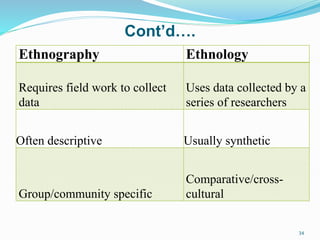
Ethnography Ethnology
Requires field work to collect
data
Uses data collected by a
series of researchers
Often descriptive Usually synthetic
Group/community specific
Comparative/cross-
cultural
34
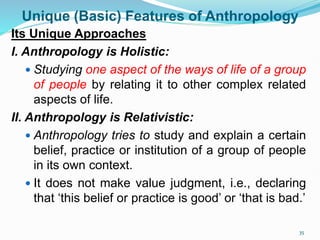
Unique (Basic) Features of Anthropology
Its Unique Approaches
I. Anthropology is Holistic:
 Studying one aspect of the ways of life of a group
of people by relating it to other complex related
aspects of life.
II. Anthropology is Relativistic:
 Anthropology tries to study and explain a certain
belief, practice or institution of a group of people
in its own context.
 It does not make value judgment, i.e., declaring
that ‘this belief or practice is good’ or ‘that is bad.’
35
Cont’d….
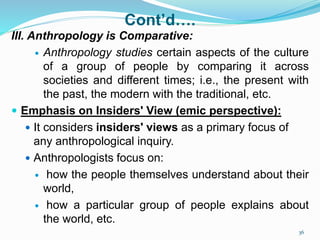
III. Anthropology is Comparative:
 Anthropology studies certain aspects of the culture
of a group of people by comparing it across
societies and different times; i.e., the present with
the past, the modern with the traditional, etc.
 Emphasis on Insiders' View (emic perspective):
 It considers insiders' views as a primary focus of
any anthropological inquiry.
 Anthropologists focus on:
 how the people themselves understand about their
world,
 how a particular group of people explains about
the world, etc.
36
Cont’d….
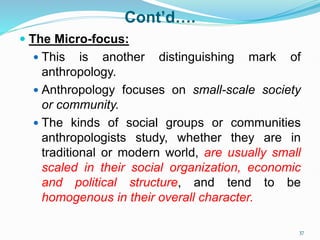
 The Micro-focus:
 This is another distinguishing mark of
anthropology.
 Anthropology focuses on small-scale society
or community.
 The kinds of social groups or communities
anthropologists study, whether they are in
traditional or modern world, are usually small
scaled in their social organization, economic
and political structure, and tend to be
homogenous in their overall character.
37
Cont’d….
 Its Method of Research:
 The hallmarks of anthropology are qualitative
research methods such as:
 extended fieldwork,
focus- group discussion,
 participant observation,
 in-depth and key informant interviews.
 Although these methods are now practiced in other
behavioral sciences as well, no other discipline
seems to be so associated with and employs such
methods as anthropologists.
38
Misconceptions about anthropology
 Due to lack of appropriate awareness
about the nature, scope and subject matter
of the discipline, different misconceptions
are held about anthropology.
 One misconception about anthropology is
related to the area of its study. It is said
that anthropology is limited to the study of
"primitive" societies.
39
Cont’d……
 Indeed, most of the works done by
anthropologists during early periods focused on
isolated, so called "primitive", small scale
societies.
 However, anthropologists nowadays study most
advanced and most complex societies as well.
 Another misconception is that anthropologists
only study the rural people and rural areas.
 Most of the studies conducted during the
formative years of the discipline focused on rural
areas. But now, anthropologists are also
interested in the study of urban people and urban
areas.
 For instance, Urban Anthropology 40
Cont’d……
 It is also wrongly misconceived that
anthropology is the study/analysis of fossil
evidences of the proto-humans like that of
Lucy/Dinkeneshe.
 It is true that anthropology is interested in
the question of the origin of modern human
beings.
 However, this doesn’t mean that
anthropology is all about the study of human
evolution.
 41
Cont’d……
 It studies both the biological and the cultural
aspects of humans and examines the existing
human physical and biological variations and
cultural diversity.
 It is also misconceived that the purpose of
anthropology is to study in order to keep and
preserve communities far from development
and obsolete cultural practices in museums.
 Rather, anthropologists’ duties are to support
those communities' capacity to empower
themselves in development processes.
 They assist peoples' initiatives instead of
imposed policies and ideas coming from
outside and play active roles in bringing about
positive change and development in their own
lives. 42
Relationship between Anthropology and
Other Disciplines
 Anthropology is similar with other social sciences such as
sociology, psychology, political sciences, economics,
history, etc.
 Anthropology greatly overlaps with these disciplines that
study human society.
 However, anthropology differs from other social sciences
and the humanities by its;
 broad scope
 unique approach,
 perspective
 unit of analysis
 methods used.
43
The Contributions of anthropology
 By studying anthropology, we get the following
benefits, among others.
A) Anthropology gives us an insight into different
ways and modes of life of a given society, to
understand the logic behind and justification
for human activities and behavior.
44
Cont’d……
B. Anthropology also helps us understand our own
ways of lives.
 Many aspects of our lives seem to us normal,
so we don't know the logic behind.
 Eating injera, for example, is assumed to be
normal to those whose staple (main) food item
is injera.
 By studying anthropology, we look into
ourselves through the others' ways of lives.
 As we study anthropology, we encounter a
different way of lives from ourselves, and
hence we get opportunity to appreciate and
understand ourselves.
45
Cont’d……
C. Because of its relativistic approach, anthropology helps us
to be more sensitive and appreciative of cultural diversity
and variability.
 It helps us to avoid some of the misunderstandings that
commonly arise when individuals of different cultural traditions
come into contact.
 Anthropology helps us fight against prejudices and
discriminations.
 It helps us fight against ethnocentrism; the attitude that
one's own culture and one's own way of life is the center of
the world and the best of all.
 This arises from ignorance about other ethnic groups and their
ways of lives,
D) Anthropology is also used as a tool for development.
 Paying attention to local conditions is crucial to solve community
problems.
 Applied anthropology, here, is the application of anthropological
knowledge and research results in the solution of some social
problems or in the implementation of project plans.
46
Cont’d……
 E. Because of its broad scope, anthropology allows us
to understand the biological, technological and cultural
development of humanity over long period of time in
human evolution.
 F. Because of its comparative approach to
humanity, anthropology allows us to separate what
is unique to our way of life from what is general to
all people.
 G. Anthropologists bring a holistic approach to
national and international development agencies.
 H. Anthropologists use their expertise in particular
subjects to formulate practical ways of coping with
immediate social problems.
47
Unit Two: Human Culture and Ties that
Connect
 Definition of Culture
 The term culture is not used with consistent
meanings.
 Anthropologists and sociologists define culture in
different ways.
 Edward B. Tylor defined culture as
 “a complex whole which includes knowledge,
belief, art, morals, law, custom, and any other
capabilities and habits acquired by man as a
member of society”.
48
Cont’d….
 The phrase “acquired by man as a member of
society“ in his definition is very important.
 It is not any habit or capability of man as a biological
being, but man as a member of a social group.
 The definition focuses on beliefs and behavior that
people acquire not through biological heredity but by
growing up in a particular society and social group
where they are exposed to a specific cultural
tradition.
 It is through the socialization process that a person
acquires a cultural knowledge.
49
Cont’d….
 B. Malinowski has defined culture
 “as cumulative creation of man". He
regarded culture as the handiwork of man
and the medium through which he achieves
his ends.
 Robert Bierstedt says,
 “Culture is the complex whole that consists of
everything we think and do and have as
members of society.”
 We may define culture as the common way
of life shared by a group of people.
 It includes all things beyond nature and
50
Cont’d….
 Culture is moral, intellectual and spiritual
discipline for advancement, in accordance with
the norms and values based on accumulated
heritage.
 Culture is a system of learned behavior shared
by and transmitted among the members of the
group.
 Culture is a collective heritage learned by
individuals and passed from one generation to
another.
51
Characteristic Features of Culture
 Culture Is Learned:
 Culture is not transmitted genetically.
 It is acquired through the process of learning or
interacting with one’s environment.
 Human have no instinct, which genetically
programmed to direct to behave in a particular
way. This process of acquiring culture after we
born is called enculturation.
 Enculturation is the process by which an
individual learns the rules and values of one’s
culture.

52
Cont’d….
 Culture Is Shared:
 For a thing, idea, or behavior pattern to qualify as
being “cultural” it must have a shared meaning
by at least two people within a society.
 In order for a society to operate effectively, the
guidelines must be shared by its members.
 Without shared culture members of a society
would be unable to communicate and cooperates
and confusion and disorder world result.
53
Cont’d….
 Culture Is Symbolic:
 Symbols refer to anything to which people
attach meaning and which they use to
communicate with others.
 Symbols are words, objects, gestures,
sounds or images that represent something
else rather than themselves.
 Symbolic thought is unique and crucial to
humans and to cultural learning.
 Symbolic thought is the human ability to give
a thing or event an arbitrary meaning and
grasp and appreciate that meaning.
54
Cont’d….
 A symbol is something verbal or nonverbal,
within a particular language or culture that
comes to stand for something else.
 There is no obvious natural or necessary
connection between a symbol and what it
symbolizes.
 A symbol’s meaning is not always obvious.
 However, many symbols are powerful and often
trigger behaviors or emotional states.
 For example, the designs and colors of the
flags of different countries represent symbolic
associations with abstract ideas and concepts.
55
Cont’d….
 Culture Is All-Encompassing
 Culture encompasses all aspects, which affect
people in their everyday lives.
 Culture comprises countless material and non-
material aspects of human lives.
 When we talk about a particular people’s culture,
we are referring to all of its man- made objects,
ideas, activities.
56
Cont’d….
 Culture Is Integrated:
 Cultures are not haphazard collections of
customs and beliefs.
 Culture should be thought as of integrated
wholes, the parts of which, to some degree,
are interconnected with one another.
 A culture is a system, change in one
aspect will likely generate changes in
other aspects.
 E.g. Analogy between a culture and a living
organism. 57
Cont’d….
 Culture Can Be Adaptive and Maladaptive
 Humans have both biological and cultural ways
of coping with environmental stresses.
 Our biological means of adaptation, we also use
"cultural adaptive kits," which contain customary
activities and tools that aid us.
 People adapt themselves to the environment
using culture.
 The ability to adapt themselves to practically any
ecological condition, unlike other animals, makes
humans unique.
58
Cont’d….
 Adaptive behavior that offers short-term benefits to
particular subgroups or individuals may harm the
environment and threaten the group's long-term survival.
 Example:
 Automobiles permit us to make a living by getting us
from home to workplace.
 But the by-products of such "beneficial" technology
often create new problems.
 Chemical emissions increase air pollution,
 deplete the ozone layer, and
 contribute to global warming.
 Many cultural patterns such as overconsumption and
pollution appear to be maladaptive in the long run.
59
Cont’d….
 Culture Is Dynamic:
 There are no cultures that remain completely static
year after year.
 Culture is changing constantly as new ideas and
new techniques are added as time passes
modifying or changing the old ways.
 This is the characteristics of culture that stems
from the culture’s cumulative quality.
60
Aspects/Elements of Culture
 Two of the most basic aspects of culture are
 material and nonmaterial culture.
 Material culture
 consist of man-made objects such as
 tools, implements, furniture, automobiles, buildings,
dams, roads, bridges
 the physical substance which has been changed
and used by man.
 all the tangible products created by human
interaction
 It is concerned with the external, mechanical and
utilitarian objects.
 It includes technical and material equipment.
 It is referred to as civilization. 61
Cont’d….
 Non – Material culture
 It is something internal and intrinsically valuable, reflects
the inward nature of man.
 the intangible creations of human interaction
 Non-material culture consists of;
 the words the people use or the language they
speak,
 the beliefs they hold
 values and virtues they cherish,
 habits they follow,
 rituals and practices that they do and
 the ceremonies they observe.
62
Cont’d….
 Values:
 are the standards by which member of a society
define what is good or bad, beautiful or ugly.
 are a central aspect of the nonmaterial culture of a
society .
 are important because they influence the behavior
of the members of a society.
 Every society develops both values and
expectations regarding the right way to reflect
them.
 Values:
 are generalized notions of what is good and bad;
 are more specific
 have more content.
63
Cont’d….
 Beliefs
 are cultural conventions that concern true or false
assumptions, specific descriptions of the nature of the
universe and humanity’s place in it.
 “Education is good” is a fundamental value in American
society, whereas “Grading is the best way to evaluate
students” is a belief that reflects assumptions about the
most appropriate way to determine educational
achievement.
 Norms
 are another aspect of nonmaterial culture.
 are shared rules or guidelines that define how people
“ought” to behave under certain circumstances.
 are generally connected to the values, beliefs, and
ideologies of a society. 64
Cont’d….
 Norms vary in terms of their importance to a
culture, these are:
 Folkway:
 Norms guiding ordinary usages and
conventions of everyday life are known as
folkways.
 are norms that are not strictly enforced, such
as not leaving your seat for an elderly people
inside a bus/taxi.
 They may result in a person getting a bad
look.
65
Cont’d….
 Mores (pronounced MOR-ays):
 are much stronger norms than are folkways.
 are norms that are believed to be essential to
core values and we insist on conformity.
 A person who steals, rapes, and kills has violated
some of society’s most important mores.
 People who violate mores are usually severely
punished.
 Punishment for the violation of mores varies from
society to society.
 Ostracism, vicious gossip, public ridicule,
exile, loss of one’s job, physical beating,
imprisonment, commitment to a mental
asylum, or even execution.
66
Universality, Generality and Particularity of Culture
 Universality:
 Universals are cultural traits that span across all
cultures.
 Example family.
 Generality:
 are cultural traits that occur in many societies but
not all of them.
 Societies can share same beliefs and customs
because of borrowing Domination (colonial rule).
 The imposition of customs and procedures on one
culture can also cause generality.
 Examples: – Nuclear family Parents and children
• monogamy, strict control over women’s
virginity 67
Cont’d….
 Particularity:
 Are Trait of a culture that is not widespread.
 are cultural traditions which are unique to
only few societies.
 They occur rarely.
 For example:
 Homosexualism or lesbianism as a
way of life,
polyandrous marriage practice,
eating of raw meat, etc
68
Ethnocentrism, Cultural Relativism and Human Rights
 Ethnocentrism: refers to the tendency to see the
behaviors, beliefs, values, and norms of one's own
group as the only right way of living and to judge others
by those standards.
 Cultural relativism: is the perspective that each culture
must be understood in terms of the values and ideas of
that culture and not judged by the standards of another
culture.
 Cultural relativism suspends judgment and views about
the behavior of people from the perspective of their own
culture.
 A culture has to be studied in terms of its own
meanings and values.
 Cultural relativism describes a situation where there is
an attitude of respect for cultural differences rather than
condemning other people's culture as uncivilized or
backward. 69
Cont’d....
 Respect for cultural differences involves:
 Appreciating cultural diversity;
 Accepting and respecting other cultures;
 Trying to understand every culture and its elements in
terms of its own context and logic;
 Accepting that each body of custom has inherent dignity
and meaning as the way of life of one group which has
worked out to its environment, to the biological needs of
its members, and to the group relationships;
 Knowing that a person's own culture is only one among
many; and
 Recognizing that what is immoral, ethical, acceptable,
etc, in one culture may not be so in another culture.
70
Human Rights
 Human rights advocates challenge many of the
tenets of cultural relativism.
 Many anthropologists are uncomfortable with
the strong form of cultural relativism that
suggests that all patterns of culture are equally
valid.
 Human rights: rights based on justice and
morality beyond and superior to particular
countries, cultures, and religions.
 The idea of human rights challenges cultural
relativism by invoking a realm of justice and
morality beyond and superior to the laws and
customs of particular countries, cultures, and
religions. 71
Cont’d…
 Human rights include the right to:
 speak freely,
 to hold religious beliefs without persecution,
and
 to not be murdered,
 injured, or enslaved or imprisoned without
charge.
 Such rights are seen as inalienable and
international one.
 A doctrine of universal human rights, which
emphasizes the rights of the individual over those
of the community, would condemn such killings. 72
Culture Change
 Its culture has changed over time.
 Culture change can occur as a result of the following
Mechanisms:
 Diffusion: The process by which cultural elements are
borrowed from another society and incorporated into the
culture of the recipient group is called diffusion.
 Diffusion is direct when two cultures trade with, intermarry
among, or wage war on one another.
 Diffusion is forced when one culture subjugates another
and imposes its customs on the dominated group.
 Diffusion is indirect when items or traits move from group A
to group C via group B without any firsthand contact between
A and C.
 In this case, group B might consist of traders or merchants
who take products from a variety of places to new markets.
 Or group B might be geographically situated between A and
C, so that what it gets from A eventually winds up in C, and
vice versa.
73
 The cultures of either or both groups may
be changed by this contact.
 This usually happens in situations of trade
or colonialism.
 In situations of continuous contact, cultures
have also exchanged and blended foods,
recipes, music, dances, clothing, tools, and
technologies.
74
Acculturation
Invention
 Invention-the process by which humans
innovate, creatively finding solutions to
problems is a third mechanism of cultural
change.
 Faced with comparable problems and
challenges, people in different societies
have innovated and changed in similar
ways, which is one reason cultural
generalities exist.
75
Marriage, Family and Kinship
 MARRIAGE:
 Almost all known societies recognize marriage.
 Marriage is defined as basically a sexual union
between a man and a woman such that children
born to the woman are considered as the
legitimate off- spring of both parents.
 Every society has established for itself some type
of rules regulating mating (sexual intercourse).
 Prohibitions on mating with certain categories of
relatives known as incest taboos.
76
Cont’d….
 The most universal form of incest taboo involves
mating between members of the immediate (nuclear)
family:
 mother-sons,
 father-daughters, and
 brother-sisters.
 There are a few striking examples of marriage
between members of the immediate family that
violate the universality of the incest taboo.
 For political, religious, or economic reasons,
members of the royal families among the ancient
Egyptians, Incas and Hawaiians were permitted
to mate with and marry their siblings.
 However, this practice did not extended to the
ordinary members of those societies.
77
Mate Selection
 In a society one cannot marry anyone whom he or
she likes.
 There are certain strict rules and regulations.
 a) Exogamy:
 a man is not allowed to marry someone from his
own social group.
 Such prohibited union is designated as incest.
 Incest is often considered as sin.
 Reasons for which practice of exogamy got
approval:
 A conception of blood relation prevails among the
members of a group.
 Attraction between a male and female gets lost
due to close relationship in a small group.
78
Cont’d….
 b) Endogamy:
 A rule of endogamy requires individuals to marry within
their own group and forbids them to marry outside it.
 they marry people who come from the same social
class, racial-ethnic group, and religious affiliation.
 Religious groups such as
 the Amish
 Mormons
 Catholics, and
 Jews have rules of endogamy
 Castes in India and Nepal are also endogamous.
 they usually do not need a formal rule requiring people
to marry someone from their own society.
79
Preferential Cousin Marriage:
 Preferential cousin marriage is:
 a common form of preferred marriage
 is practiced in one form or another in most of the
major regions of the world.
 Based on lineages, there are two types of preferential
cousin marriage:
 Cross Cousins
 Parallel Cousins
Cross Cousins:
 are children of siblings of the opposite sex that is
one’s mother’s brothers’ children and one’s father’s
sisters’ children.
 It is most common form of preferential cousin
marriage because it functions to strengthen and
maintain ties between kin groups.
80
Cont’d….
 Parallel Cousins Marriage:
 is takes place between the children of the siblings
of the same sex.
 the children of one’s mother’s sister and one’s
father brother.
 The mate may come either from one’s father’s
brother’s children or mother's sister’s children.
 It is much less common form of cousin marriage.
 Found among some Arabic societies in North
Africa.
 It can serve to prevent the fragmentation of family
property.
81
The Levirate and Sororate
 The levirate:
 a widow is expected to marry the brother of her
dead husband.
 It serves as a form of social security for the widow
and her children.
 It has also preserved the rights of her husband’s
family to her sexuality and future children.
 The sororate:
 is the practice of a widower’s marrying the sister
of his deceased wife.
 In the event that the deceased spouse has no
sibling, the family of the deceased is under a
general obligation to supply some equivalent
relative as a substitute.
82
NUMBER OF SPOUSES
 Societies have rules regulating:
 whom one may/may not marry;
 how many mates a person may/should have.
 Monogamy: the marriage of one man to one
woman at a time.
 Polygamy: the marriage of a man or woman
with two or more mates.
 Polygamy can be of two types:
 Polygyny
 Polyandy
83
Cont’d….
 Polygyny: the marriage of a man to two or more
women at a time.
 Sororal polygyny: the marriage of a man
with two or more sisters at a time.
 Non-sororal polygyny: When wives are not
sisters.
 Polyandy: the marriage of a woman to two or
more men at a time.
 Polyandry has two distinctive forms.
 Fraternal: the husbands are all brothers
(where the several men are brothers.)
 Non-fraternal: the husbands are not brothers
or related.
84
Advantages & Disadvantages of Polygamy
marriage
 Having two/more wives is often seen as a sign of
pristige.
 Having multiple wives means wealth, power, &
status both for the polygnous husband, wives and
children.
 It produces more children, who are considered
valuable for future economic and political assets.
 Economic advantage: It encourages to work hard
(more cows, goats..) for more wives
 The Drawbacks of Polygyny:
 Jealousy among the co-wives who frequently
compete for the husband’s attention. 85
Economic Consideration of Marriage
 Often the transfer of rights is accompanied by the
transfer of some type of economic consideration.
 These transactions, which may take place either
before or after the marriage can be divided into three
categories:
 Bride Price
 Bride Service
 Dowry
 Bride Price:
 It is also known as bride wealth
 is the compensation given upon marriage by
the family of the groom to the family of the bride.
86
Cont’d….
 Bride price has been seen:
 as security or insurance for the good treatment of the
wife;
 as mechanism to stabilize marriage by reducing the
possibility of divorce;
 as a form of compensation to the bride’s lineage for
the loss of her economic potential and childbearing
capacity;
 as a symbol of the union between two large groups of
kin.
 Bride Service:
 The groom works for his wife’s family.
 E.g. Bride service was also practiced by the
Yanomamo.
 During this time, the groom lives with the bride’s
parents and hunts for them.
 Dowry: transfer of goods or money from the bride’s
family to the groom’s family. 87
Post-Marital Residence
 Where the newly married couple lives after the
marriage ritual is governed by cultural rules, which
are referred to as post-marital residence rule.
 Patrilocal Residence: the married couple lives
with or near the relatives of the husband’s father.
 Matrilocal Residence: the married couple lives
with or near the relatives of the wife.
 Avunculocal Residence: The married couple lives
with or near the husband’s mother’s brother.
 Ambilocal/Bilocal Residence: The married couple
has a choice of living with relatives of the wife or
relatives of the husband.
 Neolocal: newly marries couples reside on their
own house independent of their parents. 88
FAMILY
 Family :
 is the basis of human society.
 It is the most important primary group in
society.
 it is universal institution.
 It is the most permanent and most pervasive of
all social institutions.
 The interpersonal relationships within the
family make the family an endurable social
unit.
 There are two fundamentally different types of
family structure.
 the nuclear family and 89
Cont’d….
 The Nuclear Family:
 Consisting of husband, wife and their dependent
children.
 It is a two-generation family formed around the
conjugal or marital union.
 It remains relatively autonomous and
independent unity.
 In any society every adult individual belongs to two
different nuclear families.
 family of orientation
 family of procreation
 Family of orientation: The type of family in which
he was born and reared.
 Family of procreation :The other family to which he
establishes relation through marriage.
90
Cont’d….
 The Extended Family:
 Consist of two or more families that are linked
by blood ties or
 Consists of two or more nuclear families
affiliated through an extension of the parent-
child relationship.
 In extended family systems, marriage is
viewed more as bringing a daughter into the
family than acquiring a wife.
 A man’s obligations of obedience to his father
and loyalty to his brothers is far more
important than his relationship to his wife.

91
Functions Marriage and Family
 Family performs certain specific functions which can be
mentioned as follows:
 Biological Function:
 It serves as a biological (sexual and reproductive)
function.
 It regulates and socially validates long term sexual
relations between males and females.
 The task of perpetuating the population of a society is
an important function of a family.
 Society reproduces itself through family.
 Economic Function:
 It brings economic co-operation between men and
women and ensure survival of individuals in a society.
 Division of labor based on sex
 In small scale societies family is a self-contained
economic unit of production, consumption and
distribution. 92
Cont’d….
 Social Function:
 Marriage is based on the desire to perpetuate
one’s family line.
 The institution of marriage brings with it the
creation and perpetuation of the family, the form
of person to person relations and linking once
kin group to another kin group.
 Educational and Socialization Function:
 The burden of socialization of new born infants
fall primarily upon the family.
 The task of educating and enculturating children
is distributed among parents.
 Moreover, family behaves as an effective agent
in the transmission of social heritage.
93
KINSHIP
 Kinship :
 is defined as the network in which people are
related to one another through blood, marriage
and other ties.
 is a kind of social relationship that ties people.
 is the method of reckoning relationship.
 Kinship can be created through three ways:
 Through blood
 Through marriage
 Through adoption, fostering, god-
parenthoods, etc:
94
Cont’d….
 Through blood:
 this is the principle of consanguinity.
 A consanguine is a person who is related to
another person through blood.
 Consanguine includes kin, not friends.
 E.g., a parent's (father/mother/grand-
parent) relation to a child;
 relation between siblings (brothers and
sisters);
 an individual’s relation to his/ her uncle,
aunt, niece or nephew; etc
95
Cont’d….
 Through marriage:
 this is the principle of affinity.
 E.g. kinship ties between husband and
wife;
 husband and his wife's group;
 wife and her husband's group, etc
 Through adoption:
 This is called the principle of fictitious
kinship.
 Fictitious kinship is a kind of relationship in
which two individuals create a kind of parent-
child relationship without any blood or
marriage ties. 96
Cont’d….
 Descent: refers to the social recognition of the biological
relationship that exists between the individuals.
 The rule of descent refers to a set of principles by
which an individual traces his descent.
 In almost all societies kinship connections are very
significant.
 An individual always possesses certain obligations
towards his kinsmen and he also expects the same
from his kinsmen.
 Succession and inheritance is related to this rule of
descent.
 There are three important rules of decent are follows;
 Patrilineal descent:
 The descent is traced solely through the male line.
 Succession and inheritance pass through the male
line.
97
Cont’d….
 Matrilineal descent:
 The descent is traced solely through the female line.
 At birth, children of both sexes belong to mother’s
descent group, but later only females acquire the
succession and inheritance.
 Therefore, daughters carry the tradition, generation
after generation.
 Cognatic Descent:
 It provides a measure of flexibility not usually found
under unilineal descent.
 Individuals are free to show their genealogical links
either through men or women.
 There is no fixed rule to trace the succession and
inheritance.
 Any combination of lineal link is possible in such
societies.
98
Cont’d….
 Cognatic Descent:
 It provides a measure of flexibility not usually
found under unilineal descent.
 Individuals are free to show their genealogical
links either through men or women.
 There is no fixed rule to trace the succession
and inheritance.
 Any combination of lineal link is possible in
such societies.
99

Anthropology-presentation Chapter 1&2 .pptx

  • 1.
    Social Anthropology For HigherEducation Students Instructor: DAWIT F. Email: dawitfetene2006@gmail.com Academic Year : 2022 Addis Ababa, Ethiopia 1
  • 2.
    Chapter One: Definition,Scope and Subject Matter of Anthropology  Concepts in Anthropology  The term anthropology is a compound of two Greek words, ‘anthropos’ and ‘logos’, which can be translated as  ‘human being/mankind’ and  ‘reason/study/science’, respectively.  Anthropology means ‘reason about humans’ or ‘the study or science of humankind or humanity’. 2
  • 3.
    Cont’d….  Man hastwo important characteristics:  biological and  cultural:  The biological and the cultural characteristics are inseparable elements.  Culture influences human physical structures and the vise-versa.  Anthropology is the study of people: Origins, development and contemporary variations.  It is a broad scientific discipline dedicated to the comparative study of humans as a group, from its first appearance on earth to its present stage of development. 3
  • 4.
    Cont’d….  Anthropology isa science which:  Investigates the strategies for living that are learned and shared by people as members of human social groups;  Examines the characteristics that human beings share as members of one species and the diverse ways that people live in different environments.  Analyses the products of social groups -material objects (material cultures) and non-material creations .  Anthropology primarily offers two kinds of insight.  the discipline produces knowledge about the actual biological and cultural variations in the world; 4
  • 5.
    The Historical Developmentof Anthropology  Anthropology is a fairly recent discipline.  It was given its present shape during the twentieth century.  But it has important forerunners in the  historiography,  geography,  travel writing,  philosophy and jurisprudence of earlier times. 5
  • 6.
    Cont’d….  If werestrict ourselves to anthropology as a scientific discipline:  Some trace its roots back to the European Enlightenment(18 th C).  anthropology did not arise as a science until the 1850s,  anthropological research in its present- day sense only commenced after the WWI. 6
  • 7.
    Cont’d….  The presentacademic anthropology has its roots:  the great ancient and Medieval Greek,  Roman, and Hebrew philosophers and social thinkers.  These people were interested in;  nature  origin and destiny of man, and  morality and ethics of human relationships. 7
  • 8.
    Cont’d….  The rootsof anthropology can be generally traced through the history of western culture.  Anthropology did not emerge as distinct field of study until the mid-nineteenth century.  Anthropology as an academic discipline was born during the 19th century, out of the intellectual atmosphere of Enlightenment and based on Darwinian Theory of Evolution. 8
  • 9.
    Cont’d….  By thelate 1870s, anthropology was beginning to emerge as a profession.  A major impetus for its growth was the expansion of western colonial powers and their consequent desire to better understand the peoples living under colonial domination. 9
  • 10.
    Cont’d….  During itsformative years, anthropology became a profession primarily in museums.  In the 1870s and 1880s many museums devoted to the study of humankind were found in Europe, North America and South America.  Early anthropologists mainly studied small communities in technologically simple societies. 10
  • 11.
    Cont’d….  Such societiesare often called by various names, such as,  Anthropologists of “traditional”,  “non-industrialized and/or  simple societies”.  the early 1900s emphasized the study of social and cultural differences among human groups.  Here, many of the indigenous peoples of non- western world and their social and cultural features were studied in detail and documented. This approach is called11
  • 12.
    Cont’d….  By themid-1900, however, anthropologists attempted to discover universal human patterns and the common bio- psychological traits that bind all human beings. This approach is called ethnology.  Ethnology aims at the comparative understanding and analysis of different ethnic groups across time and space. 12
  • 13.
    Scope and subjectmatter of anthropology  The breadth and depth of anthropology is immense.  There no time and space left as far as man exists.  Temporal dimension, anthropology, covers the past, the present and even the future.  Spatial dimension, anthropology studies from Arctic to Desert, from Megapolis to hunting gathering areas. 13
  • 14.
    Cont’d….  The disciplinecovers all aspects of human ways of life experiences and existence, as humans live in a social group.  Anthropology studies humanity with its all aspects of existence, and in its all means of differences (diversity) and similarities (commonality).  Anthropologists strive for an understanding of:  the biological and cultural origins and  evolutionary development of the species.  They are concerned with:  all humans,  both past and present,  behavior patterns  thought systems, and  material possessions. 14
  • 15.
    Sub-fields of anthropology Anthropology has often categorized into four major subfields:  Physical/Biological Anthropology,  Archeology,  Linguistic Anthropology and  Socio-Cultural Anthropology. 15
  • 16.
    Physical/Biological Anthropology  Physicalanthropology:  is the branch of anthropology most closely related to the natural sciences, particularly biology.  study how culture and environment have influenced these two areas of biological evolution and contemporary variations.  Human biology affects or even explains some aspects of behavior, society, and culture.  E.g. marriage patterns, sexual division of labor, gender ideology etc.  The features of culture in turn have biological effects.  E.g. the standards of attractiveness, food preferences, and human sexuality. 16
  • 17.
    Cont’d….  Human biologicalvariations are the result of the cumulative processes of invisible changes occurring in every fraction of second in human life. These changes have been accumulated and passed through genes.  Genes are characteristics that carry biological traits of an organism, including human beings.  Human evolution:  is the study of the gradual processes of simple forms into more differentiated structures in hominid.  Human evolution is divided into three specialties:  Paleoanthropology and  Primatology 17
  • 18.
    Cont’d…. Palaeoanthropology:  is thestudy of human biological evolution through the analysis of fossil remains from prehistoric times to determine the missing link that connect modern human with its biological ancestors.  The major sources of biological variations are:  natural selection,  geographical isolation, and  genetic mutations.  Physical anthropology is essentially concerned with two broad areas of investigation:  human evolution and  genetics. 18
  • 19.
    Cont’d….  Primatology:  studiesabout primates or recent human ancestors to explain human evolution.  studies the animals that most closely resemble human beings in terms of physiological and anatomical structure.  study the anatomy and social behavior of such non-human primate species in an effort to gain clues about our own evolution as a species.  These include gorillas, chimpanzees, and other apes. 19
  • 20.
    Cont’d….  Anthropometry:  studiesphysical differences among human groups.  These physical differences may be in terms of;  blood types,  skin colors,  skull shape,  facial shape,  hair type, and the like.  Human genetics concerns to investigate how and why the physical traits of contemporary human populations vary throughout the world.  It focuses to examine the genetic materials of an organism such as DNA and RNA. 20
  • 21.
    Archaeological Anthropology  Archaeologicalanthropology:  studies the ways of lives of past peoples by excavating and analyzing the physical remains they left behind.  The material culture/physical remains are;  artifacts,  features and  eco-facts 21
  • 22.
    Cont’d….  Artefacts:  arematerial remains made and used by the past peoples.  It can be removed from the site and taken to the laboratory for further analysis.  examples of artifacts are:  Tools,  ornaments  arrowheads  coins  fragments of pottery 22
  • 23.
    Cont’d….  Features:  arelike artifacts, are made or modified by past people, but they cannot be readily carried away from the site.  Archaeological features includes;  house foundations  ancient buildings  fireplaces  steles, and postholes. 23
  • 24.
    Cont’d….  Eco-facts:  arenon-artfactual, organic and environmental remains such as soil, animal bones, and plant remains.  They were not made or altered by humans; but were used by them.  It provide archaeologists with important data  concerning the environment and  how people used natural resources in the past. 24
  • 25.
    Cont’d….  Archaeology hasalso its own subfields.  Prehistoric Archaeology and  Historical Archaeology  Prehistoric archaeology  investigates human prehistory and prehistoric cultures.  the periods of time in a region before the art of writing developed.  Historic archaeologists:  help to reconstruct the cultures of people who used writing and about whom historical documents have been written.  uses the evidence provided by excavated remains to enhance our understanding of historic peoples. 25
  • 26.
    Linguistic Anthropology  Linguisticanthropology:  studies human language as a cultural resource and speaking as a cultural practice in its social and cultural context, across space and time.  Language is basically a system of information transmission and reception.  Humans communicate messages;  by sound (speech),  by gesture (body language), and  in other visual ways such as writing.  Languages hand down cultural traits from one generation to another.  language is the most distinctive feature of being human.  It study contemporary human languages as well as those of the past. 26
  • 27.
    Cont’d…..  Linguistic anthropologyis divided into four distinct branches or areas of research:  Structural or Descriptive Linguistics  Historical Linguistics  Ethno-Linguistics and  Socio-linguistics. 27
  • 28.
    Cont’d….  Structural /DescriptiveLinguistics:  studies the structure of linguistic patterns.  It examines sound systems, grammatical systems, and the meanings attached to words in specific languages to understand the structure and set of rules of given language.  The task of the descriptive linguist is to compile dictionaries and grammar books for previously unwritten languages 28
  • 29.
    Cont’d….  Historical linguistics: deals with the emergence and development of language in general and how specific languages have diverged over time.  It focuses on the comparison and classifications of different languages to differentiate the historical links between them.  Ethno-linguistics (cultural linguistics):  examines the relationship between language and culture.  explore how different linguistic categories can affect;  how people categorize their experiences,  how they think, and  how they perceive the world around them. 29
  • 30.
    Cont’d….  Socio-linguistics:  investigateslinguistic variation within a given language.  No language is a homogeneous system in which everyone speaks just like everyone else.  One reason for variation is geography, as in regional dialects and accents.  Linguistic variation also is expressed in the bilingualism of ethnic groups. In general: Linguistic anthropology :  generally focuses on the evolution of languages.  It tries to understand languages variation in their structures, units, and grammatical formations.  It gives special attention to the study of unwritten languages. 30
  • 31.
    Socio-Cultural Anthropology  Itis also often called social anthropology or cultural anthropology.  It is the largest sub-fields of anthropology.  It deals with human society and culture.  It is concerned with the social and cultural dimensions of the living peoples.  It describes, analyzes, interprets, and explains social, cultural and material life of contemporary human societies. 31
  • 32.
    Cont’d…. Socio-cultural anthropologists engagein two aspects of study: Ethnography (based on field work) and Ethnology (based on cross-cultural comparison). Ethnography:  provides a comprehensive account of a particular community, society, or culture. describes the features of specific cultures in detail. is more of empirical study/description of the culture and ways of lives of a particular group of people.  E.g. local behavior, beliefs, customs, social life, economic activities, politics, and religion. These detailed descriptions are the result of extensive field studies. ( 32
  • 33.
    Cont’d….  Ethnology:  isthe comparative study of contemporary cultures and societies.  It examines, interprets, analyzes, and compares the results of ethnography data gathered in different societies.  It uses ethnography data to compare and contrast and to make generalizations about society and culture.  Ethnologists attempt to;  identify and explain cultural differences and similarities  test hypotheses  build theory to enhance our understanding of how social and cultural systems work.  Its primary objective is to uncover general cultural principles, the “rules” that govern human behavior. 33
  • 34.
    Cont’d…. Ethnography Ethnology Requires fieldwork to collect data Uses data collected by a series of researchers Often descriptive Usually synthetic Group/community specific Comparative/cross- cultural 34
  • 35.
    Unique (Basic) Featuresof Anthropology Its Unique Approaches I. Anthropology is Holistic:  Studying one aspect of the ways of life of a group of people by relating it to other complex related aspects of life. II. Anthropology is Relativistic:  Anthropology tries to study and explain a certain belief, practice or institution of a group of people in its own context.  It does not make value judgment, i.e., declaring that ‘this belief or practice is good’ or ‘that is bad.’ 35
  • 36.
    Cont’d…. III. Anthropology isComparative:  Anthropology studies certain aspects of the culture of a group of people by comparing it across societies and different times; i.e., the present with the past, the modern with the traditional, etc.  Emphasis on Insiders' View (emic perspective):  It considers insiders' views as a primary focus of any anthropological inquiry.  Anthropologists focus on:  how the people themselves understand about their world,  how a particular group of people explains about the world, etc. 36
  • 37.
    Cont’d….  The Micro-focus: This is another distinguishing mark of anthropology.  Anthropology focuses on small-scale society or community.  The kinds of social groups or communities anthropologists study, whether they are in traditional or modern world, are usually small scaled in their social organization, economic and political structure, and tend to be homogenous in their overall character. 37
  • 38.
    Cont’d….  Its Methodof Research:  The hallmarks of anthropology are qualitative research methods such as:  extended fieldwork, focus- group discussion,  participant observation,  in-depth and key informant interviews.  Although these methods are now practiced in other behavioral sciences as well, no other discipline seems to be so associated with and employs such methods as anthropologists. 38
  • 39.
    Misconceptions about anthropology Due to lack of appropriate awareness about the nature, scope and subject matter of the discipline, different misconceptions are held about anthropology.  One misconception about anthropology is related to the area of its study. It is said that anthropology is limited to the study of "primitive" societies. 39
  • 40.
    Cont’d……  Indeed, mostof the works done by anthropologists during early periods focused on isolated, so called "primitive", small scale societies.  However, anthropologists nowadays study most advanced and most complex societies as well.  Another misconception is that anthropologists only study the rural people and rural areas.  Most of the studies conducted during the formative years of the discipline focused on rural areas. But now, anthropologists are also interested in the study of urban people and urban areas.  For instance, Urban Anthropology 40
  • 41.
    Cont’d……  It isalso wrongly misconceived that anthropology is the study/analysis of fossil evidences of the proto-humans like that of Lucy/Dinkeneshe.  It is true that anthropology is interested in the question of the origin of modern human beings.  However, this doesn’t mean that anthropology is all about the study of human evolution.  41
  • 42.
    Cont’d……  It studiesboth the biological and the cultural aspects of humans and examines the existing human physical and biological variations and cultural diversity.  It is also misconceived that the purpose of anthropology is to study in order to keep and preserve communities far from development and obsolete cultural practices in museums.  Rather, anthropologists’ duties are to support those communities' capacity to empower themselves in development processes.  They assist peoples' initiatives instead of imposed policies and ideas coming from outside and play active roles in bringing about positive change and development in their own lives. 42
  • 43.
    Relationship between Anthropologyand Other Disciplines  Anthropology is similar with other social sciences such as sociology, psychology, political sciences, economics, history, etc.  Anthropology greatly overlaps with these disciplines that study human society.  However, anthropology differs from other social sciences and the humanities by its;  broad scope  unique approach,  perspective  unit of analysis  methods used. 43
  • 44.
    The Contributions ofanthropology  By studying anthropology, we get the following benefits, among others. A) Anthropology gives us an insight into different ways and modes of life of a given society, to understand the logic behind and justification for human activities and behavior. 44
  • 45.
    Cont’d…… B. Anthropology alsohelps us understand our own ways of lives.  Many aspects of our lives seem to us normal, so we don't know the logic behind.  Eating injera, for example, is assumed to be normal to those whose staple (main) food item is injera.  By studying anthropology, we look into ourselves through the others' ways of lives.  As we study anthropology, we encounter a different way of lives from ourselves, and hence we get opportunity to appreciate and understand ourselves. 45
  • 46.
    Cont’d…… C. Because ofits relativistic approach, anthropology helps us to be more sensitive and appreciative of cultural diversity and variability.  It helps us to avoid some of the misunderstandings that commonly arise when individuals of different cultural traditions come into contact.  Anthropology helps us fight against prejudices and discriminations.  It helps us fight against ethnocentrism; the attitude that one's own culture and one's own way of life is the center of the world and the best of all.  This arises from ignorance about other ethnic groups and their ways of lives, D) Anthropology is also used as a tool for development.  Paying attention to local conditions is crucial to solve community problems.  Applied anthropology, here, is the application of anthropological knowledge and research results in the solution of some social problems or in the implementation of project plans. 46
  • 47.
    Cont’d……  E. Becauseof its broad scope, anthropology allows us to understand the biological, technological and cultural development of humanity over long period of time in human evolution.  F. Because of its comparative approach to humanity, anthropology allows us to separate what is unique to our way of life from what is general to all people.  G. Anthropologists bring a holistic approach to national and international development agencies.  H. Anthropologists use their expertise in particular subjects to formulate practical ways of coping with immediate social problems. 47
  • 48.
    Unit Two: HumanCulture and Ties that Connect  Definition of Culture  The term culture is not used with consistent meanings.  Anthropologists and sociologists define culture in different ways.  Edward B. Tylor defined culture as  “a complex whole which includes knowledge, belief, art, morals, law, custom, and any other capabilities and habits acquired by man as a member of society”. 48
  • 49.
    Cont’d….  The phrase“acquired by man as a member of society“ in his definition is very important.  It is not any habit or capability of man as a biological being, but man as a member of a social group.  The definition focuses on beliefs and behavior that people acquire not through biological heredity but by growing up in a particular society and social group where they are exposed to a specific cultural tradition.  It is through the socialization process that a person acquires a cultural knowledge. 49
  • 50.
    Cont’d….  B. Malinowskihas defined culture  “as cumulative creation of man". He regarded culture as the handiwork of man and the medium through which he achieves his ends.  Robert Bierstedt says,  “Culture is the complex whole that consists of everything we think and do and have as members of society.”  We may define culture as the common way of life shared by a group of people.  It includes all things beyond nature and 50
  • 51.
    Cont’d….  Culture ismoral, intellectual and spiritual discipline for advancement, in accordance with the norms and values based on accumulated heritage.  Culture is a system of learned behavior shared by and transmitted among the members of the group.  Culture is a collective heritage learned by individuals and passed from one generation to another. 51
  • 52.
    Characteristic Features ofCulture  Culture Is Learned:  Culture is not transmitted genetically.  It is acquired through the process of learning or interacting with one’s environment.  Human have no instinct, which genetically programmed to direct to behave in a particular way. This process of acquiring culture after we born is called enculturation.  Enculturation is the process by which an individual learns the rules and values of one’s culture.  52
  • 53.
    Cont’d….  Culture IsShared:  For a thing, idea, or behavior pattern to qualify as being “cultural” it must have a shared meaning by at least two people within a society.  In order for a society to operate effectively, the guidelines must be shared by its members.  Without shared culture members of a society would be unable to communicate and cooperates and confusion and disorder world result. 53
  • 54.
    Cont’d….  Culture IsSymbolic:  Symbols refer to anything to which people attach meaning and which they use to communicate with others.  Symbols are words, objects, gestures, sounds or images that represent something else rather than themselves.  Symbolic thought is unique and crucial to humans and to cultural learning.  Symbolic thought is the human ability to give a thing or event an arbitrary meaning and grasp and appreciate that meaning. 54
  • 55.
    Cont’d….  A symbolis something verbal or nonverbal, within a particular language or culture that comes to stand for something else.  There is no obvious natural or necessary connection between a symbol and what it symbolizes.  A symbol’s meaning is not always obvious.  However, many symbols are powerful and often trigger behaviors or emotional states.  For example, the designs and colors of the flags of different countries represent symbolic associations with abstract ideas and concepts. 55
  • 56.
    Cont’d….  Culture IsAll-Encompassing  Culture encompasses all aspects, which affect people in their everyday lives.  Culture comprises countless material and non- material aspects of human lives.  When we talk about a particular people’s culture, we are referring to all of its man- made objects, ideas, activities. 56
  • 57.
    Cont’d….  Culture IsIntegrated:  Cultures are not haphazard collections of customs and beliefs.  Culture should be thought as of integrated wholes, the parts of which, to some degree, are interconnected with one another.  A culture is a system, change in one aspect will likely generate changes in other aspects.  E.g. Analogy between a culture and a living organism. 57
  • 58.
    Cont’d….  Culture CanBe Adaptive and Maladaptive  Humans have both biological and cultural ways of coping with environmental stresses.  Our biological means of adaptation, we also use "cultural adaptive kits," which contain customary activities and tools that aid us.  People adapt themselves to the environment using culture.  The ability to adapt themselves to practically any ecological condition, unlike other animals, makes humans unique. 58
  • 59.
    Cont’d….  Adaptive behaviorthat offers short-term benefits to particular subgroups or individuals may harm the environment and threaten the group's long-term survival.  Example:  Automobiles permit us to make a living by getting us from home to workplace.  But the by-products of such "beneficial" technology often create new problems.  Chemical emissions increase air pollution,  deplete the ozone layer, and  contribute to global warming.  Many cultural patterns such as overconsumption and pollution appear to be maladaptive in the long run. 59
  • 60.
    Cont’d….  Culture IsDynamic:  There are no cultures that remain completely static year after year.  Culture is changing constantly as new ideas and new techniques are added as time passes modifying or changing the old ways.  This is the characteristics of culture that stems from the culture’s cumulative quality. 60
  • 61.
    Aspects/Elements of Culture Two of the most basic aspects of culture are  material and nonmaterial culture.  Material culture  consist of man-made objects such as  tools, implements, furniture, automobiles, buildings, dams, roads, bridges  the physical substance which has been changed and used by man.  all the tangible products created by human interaction  It is concerned with the external, mechanical and utilitarian objects.  It includes technical and material equipment.  It is referred to as civilization. 61
  • 62.
    Cont’d….  Non –Material culture  It is something internal and intrinsically valuable, reflects the inward nature of man.  the intangible creations of human interaction  Non-material culture consists of;  the words the people use or the language they speak,  the beliefs they hold  values and virtues they cherish,  habits they follow,  rituals and practices that they do and  the ceremonies they observe. 62
  • 63.
    Cont’d….  Values:  arethe standards by which member of a society define what is good or bad, beautiful or ugly.  are a central aspect of the nonmaterial culture of a society .  are important because they influence the behavior of the members of a society.  Every society develops both values and expectations regarding the right way to reflect them.  Values:  are generalized notions of what is good and bad;  are more specific  have more content. 63
  • 64.
    Cont’d….  Beliefs  arecultural conventions that concern true or false assumptions, specific descriptions of the nature of the universe and humanity’s place in it.  “Education is good” is a fundamental value in American society, whereas “Grading is the best way to evaluate students” is a belief that reflects assumptions about the most appropriate way to determine educational achievement.  Norms  are another aspect of nonmaterial culture.  are shared rules or guidelines that define how people “ought” to behave under certain circumstances.  are generally connected to the values, beliefs, and ideologies of a society. 64
  • 65.
    Cont’d….  Norms varyin terms of their importance to a culture, these are:  Folkway:  Norms guiding ordinary usages and conventions of everyday life are known as folkways.  are norms that are not strictly enforced, such as not leaving your seat for an elderly people inside a bus/taxi.  They may result in a person getting a bad look. 65
  • 66.
    Cont’d….  Mores (pronouncedMOR-ays):  are much stronger norms than are folkways.  are norms that are believed to be essential to core values and we insist on conformity.  A person who steals, rapes, and kills has violated some of society’s most important mores.  People who violate mores are usually severely punished.  Punishment for the violation of mores varies from society to society.  Ostracism, vicious gossip, public ridicule, exile, loss of one’s job, physical beating, imprisonment, commitment to a mental asylum, or even execution. 66
  • 67.
    Universality, Generality andParticularity of Culture  Universality:  Universals are cultural traits that span across all cultures.  Example family.  Generality:  are cultural traits that occur in many societies but not all of them.  Societies can share same beliefs and customs because of borrowing Domination (colonial rule).  The imposition of customs and procedures on one culture can also cause generality.  Examples: – Nuclear family Parents and children • monogamy, strict control over women’s virginity 67
  • 68.
    Cont’d….  Particularity:  AreTrait of a culture that is not widespread.  are cultural traditions which are unique to only few societies.  They occur rarely.  For example:  Homosexualism or lesbianism as a way of life, polyandrous marriage practice, eating of raw meat, etc 68
  • 69.
    Ethnocentrism, Cultural Relativismand Human Rights  Ethnocentrism: refers to the tendency to see the behaviors, beliefs, values, and norms of one's own group as the only right way of living and to judge others by those standards.  Cultural relativism: is the perspective that each culture must be understood in terms of the values and ideas of that culture and not judged by the standards of another culture.  Cultural relativism suspends judgment and views about the behavior of people from the perspective of their own culture.  A culture has to be studied in terms of its own meanings and values.  Cultural relativism describes a situation where there is an attitude of respect for cultural differences rather than condemning other people's culture as uncivilized or backward. 69
  • 70.
    Cont’d....  Respect forcultural differences involves:  Appreciating cultural diversity;  Accepting and respecting other cultures;  Trying to understand every culture and its elements in terms of its own context and logic;  Accepting that each body of custom has inherent dignity and meaning as the way of life of one group which has worked out to its environment, to the biological needs of its members, and to the group relationships;  Knowing that a person's own culture is only one among many; and  Recognizing that what is immoral, ethical, acceptable, etc, in one culture may not be so in another culture. 70
  • 71.
    Human Rights  Humanrights advocates challenge many of the tenets of cultural relativism.  Many anthropologists are uncomfortable with the strong form of cultural relativism that suggests that all patterns of culture are equally valid.  Human rights: rights based on justice and morality beyond and superior to particular countries, cultures, and religions.  The idea of human rights challenges cultural relativism by invoking a realm of justice and morality beyond and superior to the laws and customs of particular countries, cultures, and religions. 71
  • 72.
    Cont’d…  Human rightsinclude the right to:  speak freely,  to hold religious beliefs without persecution, and  to not be murdered,  injured, or enslaved or imprisoned without charge.  Such rights are seen as inalienable and international one.  A doctrine of universal human rights, which emphasizes the rights of the individual over those of the community, would condemn such killings. 72
  • 73.
    Culture Change  Itsculture has changed over time.  Culture change can occur as a result of the following Mechanisms:  Diffusion: The process by which cultural elements are borrowed from another society and incorporated into the culture of the recipient group is called diffusion.  Diffusion is direct when two cultures trade with, intermarry among, or wage war on one another.  Diffusion is forced when one culture subjugates another and imposes its customs on the dominated group.  Diffusion is indirect when items or traits move from group A to group C via group B without any firsthand contact between A and C.  In this case, group B might consist of traders or merchants who take products from a variety of places to new markets.  Or group B might be geographically situated between A and C, so that what it gets from A eventually winds up in C, and vice versa. 73
  • 74.
     The culturesof either or both groups may be changed by this contact.  This usually happens in situations of trade or colonialism.  In situations of continuous contact, cultures have also exchanged and blended foods, recipes, music, dances, clothing, tools, and technologies. 74 Acculturation
  • 75.
    Invention  Invention-the processby which humans innovate, creatively finding solutions to problems is a third mechanism of cultural change.  Faced with comparable problems and challenges, people in different societies have innovated and changed in similar ways, which is one reason cultural generalities exist. 75
  • 76.
    Marriage, Family andKinship  MARRIAGE:  Almost all known societies recognize marriage.  Marriage is defined as basically a sexual union between a man and a woman such that children born to the woman are considered as the legitimate off- spring of both parents.  Every society has established for itself some type of rules regulating mating (sexual intercourse).  Prohibitions on mating with certain categories of relatives known as incest taboos. 76
  • 77.
    Cont’d….  The mostuniversal form of incest taboo involves mating between members of the immediate (nuclear) family:  mother-sons,  father-daughters, and  brother-sisters.  There are a few striking examples of marriage between members of the immediate family that violate the universality of the incest taboo.  For political, religious, or economic reasons, members of the royal families among the ancient Egyptians, Incas and Hawaiians were permitted to mate with and marry their siblings.  However, this practice did not extended to the ordinary members of those societies. 77
  • 78.
    Mate Selection  Ina society one cannot marry anyone whom he or she likes.  There are certain strict rules and regulations.  a) Exogamy:  a man is not allowed to marry someone from his own social group.  Such prohibited union is designated as incest.  Incest is often considered as sin.  Reasons for which practice of exogamy got approval:  A conception of blood relation prevails among the members of a group.  Attraction between a male and female gets lost due to close relationship in a small group. 78
  • 79.
    Cont’d….  b) Endogamy: A rule of endogamy requires individuals to marry within their own group and forbids them to marry outside it.  they marry people who come from the same social class, racial-ethnic group, and religious affiliation.  Religious groups such as  the Amish  Mormons  Catholics, and  Jews have rules of endogamy  Castes in India and Nepal are also endogamous.  they usually do not need a formal rule requiring people to marry someone from their own society. 79
  • 80.
    Preferential Cousin Marriage: Preferential cousin marriage is:  a common form of preferred marriage  is practiced in one form or another in most of the major regions of the world.  Based on lineages, there are two types of preferential cousin marriage:  Cross Cousins  Parallel Cousins Cross Cousins:  are children of siblings of the opposite sex that is one’s mother’s brothers’ children and one’s father’s sisters’ children.  It is most common form of preferential cousin marriage because it functions to strengthen and maintain ties between kin groups. 80
  • 81.
    Cont’d….  Parallel CousinsMarriage:  is takes place between the children of the siblings of the same sex.  the children of one’s mother’s sister and one’s father brother.  The mate may come either from one’s father’s brother’s children or mother's sister’s children.  It is much less common form of cousin marriage.  Found among some Arabic societies in North Africa.  It can serve to prevent the fragmentation of family property. 81
  • 82.
    The Levirate andSororate  The levirate:  a widow is expected to marry the brother of her dead husband.  It serves as a form of social security for the widow and her children.  It has also preserved the rights of her husband’s family to her sexuality and future children.  The sororate:  is the practice of a widower’s marrying the sister of his deceased wife.  In the event that the deceased spouse has no sibling, the family of the deceased is under a general obligation to supply some equivalent relative as a substitute. 82
  • 83.
    NUMBER OF SPOUSES Societies have rules regulating:  whom one may/may not marry;  how many mates a person may/should have.  Monogamy: the marriage of one man to one woman at a time.  Polygamy: the marriage of a man or woman with two or more mates.  Polygamy can be of two types:  Polygyny  Polyandy 83
  • 84.
    Cont’d….  Polygyny: themarriage of a man to two or more women at a time.  Sororal polygyny: the marriage of a man with two or more sisters at a time.  Non-sororal polygyny: When wives are not sisters.  Polyandy: the marriage of a woman to two or more men at a time.  Polyandry has two distinctive forms.  Fraternal: the husbands are all brothers (where the several men are brothers.)  Non-fraternal: the husbands are not brothers or related. 84
  • 85.
    Advantages & Disadvantagesof Polygamy marriage  Having two/more wives is often seen as a sign of pristige.  Having multiple wives means wealth, power, & status both for the polygnous husband, wives and children.  It produces more children, who are considered valuable for future economic and political assets.  Economic advantage: It encourages to work hard (more cows, goats..) for more wives  The Drawbacks of Polygyny:  Jealousy among the co-wives who frequently compete for the husband’s attention. 85
  • 86.
    Economic Consideration ofMarriage  Often the transfer of rights is accompanied by the transfer of some type of economic consideration.  These transactions, which may take place either before or after the marriage can be divided into three categories:  Bride Price  Bride Service  Dowry  Bride Price:  It is also known as bride wealth  is the compensation given upon marriage by the family of the groom to the family of the bride. 86
  • 87.
    Cont’d….  Bride pricehas been seen:  as security or insurance for the good treatment of the wife;  as mechanism to stabilize marriage by reducing the possibility of divorce;  as a form of compensation to the bride’s lineage for the loss of her economic potential and childbearing capacity;  as a symbol of the union between two large groups of kin.  Bride Service:  The groom works for his wife’s family.  E.g. Bride service was also practiced by the Yanomamo.  During this time, the groom lives with the bride’s parents and hunts for them.  Dowry: transfer of goods or money from the bride’s family to the groom’s family. 87
  • 88.
    Post-Marital Residence  Wherethe newly married couple lives after the marriage ritual is governed by cultural rules, which are referred to as post-marital residence rule.  Patrilocal Residence: the married couple lives with or near the relatives of the husband’s father.  Matrilocal Residence: the married couple lives with or near the relatives of the wife.  Avunculocal Residence: The married couple lives with or near the husband’s mother’s brother.  Ambilocal/Bilocal Residence: The married couple has a choice of living with relatives of the wife or relatives of the husband.  Neolocal: newly marries couples reside on their own house independent of their parents. 88
  • 89.
    FAMILY  Family : is the basis of human society.  It is the most important primary group in society.  it is universal institution.  It is the most permanent and most pervasive of all social institutions.  The interpersonal relationships within the family make the family an endurable social unit.  There are two fundamentally different types of family structure.  the nuclear family and 89
  • 90.
    Cont’d….  The NuclearFamily:  Consisting of husband, wife and their dependent children.  It is a two-generation family formed around the conjugal or marital union.  It remains relatively autonomous and independent unity.  In any society every adult individual belongs to two different nuclear families.  family of orientation  family of procreation  Family of orientation: The type of family in which he was born and reared.  Family of procreation :The other family to which he establishes relation through marriage. 90
  • 91.
    Cont’d….  The ExtendedFamily:  Consist of two or more families that are linked by blood ties or  Consists of two or more nuclear families affiliated through an extension of the parent- child relationship.  In extended family systems, marriage is viewed more as bringing a daughter into the family than acquiring a wife.  A man’s obligations of obedience to his father and loyalty to his brothers is far more important than his relationship to his wife.  91
  • 92.
    Functions Marriage andFamily  Family performs certain specific functions which can be mentioned as follows:  Biological Function:  It serves as a biological (sexual and reproductive) function.  It regulates and socially validates long term sexual relations between males and females.  The task of perpetuating the population of a society is an important function of a family.  Society reproduces itself through family.  Economic Function:  It brings economic co-operation between men and women and ensure survival of individuals in a society.  Division of labor based on sex  In small scale societies family is a self-contained economic unit of production, consumption and distribution. 92
  • 93.
    Cont’d….  Social Function: Marriage is based on the desire to perpetuate one’s family line.  The institution of marriage brings with it the creation and perpetuation of the family, the form of person to person relations and linking once kin group to another kin group.  Educational and Socialization Function:  The burden of socialization of new born infants fall primarily upon the family.  The task of educating and enculturating children is distributed among parents.  Moreover, family behaves as an effective agent in the transmission of social heritage. 93
  • 94.
    KINSHIP  Kinship : is defined as the network in which people are related to one another through blood, marriage and other ties.  is a kind of social relationship that ties people.  is the method of reckoning relationship.  Kinship can be created through three ways:  Through blood  Through marriage  Through adoption, fostering, god- parenthoods, etc: 94
  • 95.
    Cont’d….  Through blood: this is the principle of consanguinity.  A consanguine is a person who is related to another person through blood.  Consanguine includes kin, not friends.  E.g., a parent's (father/mother/grand- parent) relation to a child;  relation between siblings (brothers and sisters);  an individual’s relation to his/ her uncle, aunt, niece or nephew; etc 95
  • 96.
    Cont’d….  Through marriage: this is the principle of affinity.  E.g. kinship ties between husband and wife;  husband and his wife's group;  wife and her husband's group, etc  Through adoption:  This is called the principle of fictitious kinship.  Fictitious kinship is a kind of relationship in which two individuals create a kind of parent- child relationship without any blood or marriage ties. 96
  • 97.
    Cont’d….  Descent: refersto the social recognition of the biological relationship that exists between the individuals.  The rule of descent refers to a set of principles by which an individual traces his descent.  In almost all societies kinship connections are very significant.  An individual always possesses certain obligations towards his kinsmen and he also expects the same from his kinsmen.  Succession and inheritance is related to this rule of descent.  There are three important rules of decent are follows;  Patrilineal descent:  The descent is traced solely through the male line.  Succession and inheritance pass through the male line. 97
  • 98.
    Cont’d….  Matrilineal descent: The descent is traced solely through the female line.  At birth, children of both sexes belong to mother’s descent group, but later only females acquire the succession and inheritance.  Therefore, daughters carry the tradition, generation after generation.  Cognatic Descent:  It provides a measure of flexibility not usually found under unilineal descent.  Individuals are free to show their genealogical links either through men or women.  There is no fixed rule to trace the succession and inheritance.  Any combination of lineal link is possible in such societies. 98
  • 99.
    Cont’d….  Cognatic Descent: It provides a measure of flexibility not usually found under unilineal descent.  Individuals are free to show their genealogical links either through men or women.  There is no fixed rule to trace the succession and inheritance.  Any combination of lineal link is possible in such societies. 99

Editor's Notes

  • #64 Ideal culture: the values and norms claimed by a society Real culture: the values and norms that are actually practiced.