Social Audit
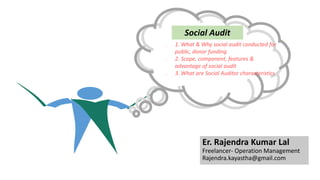
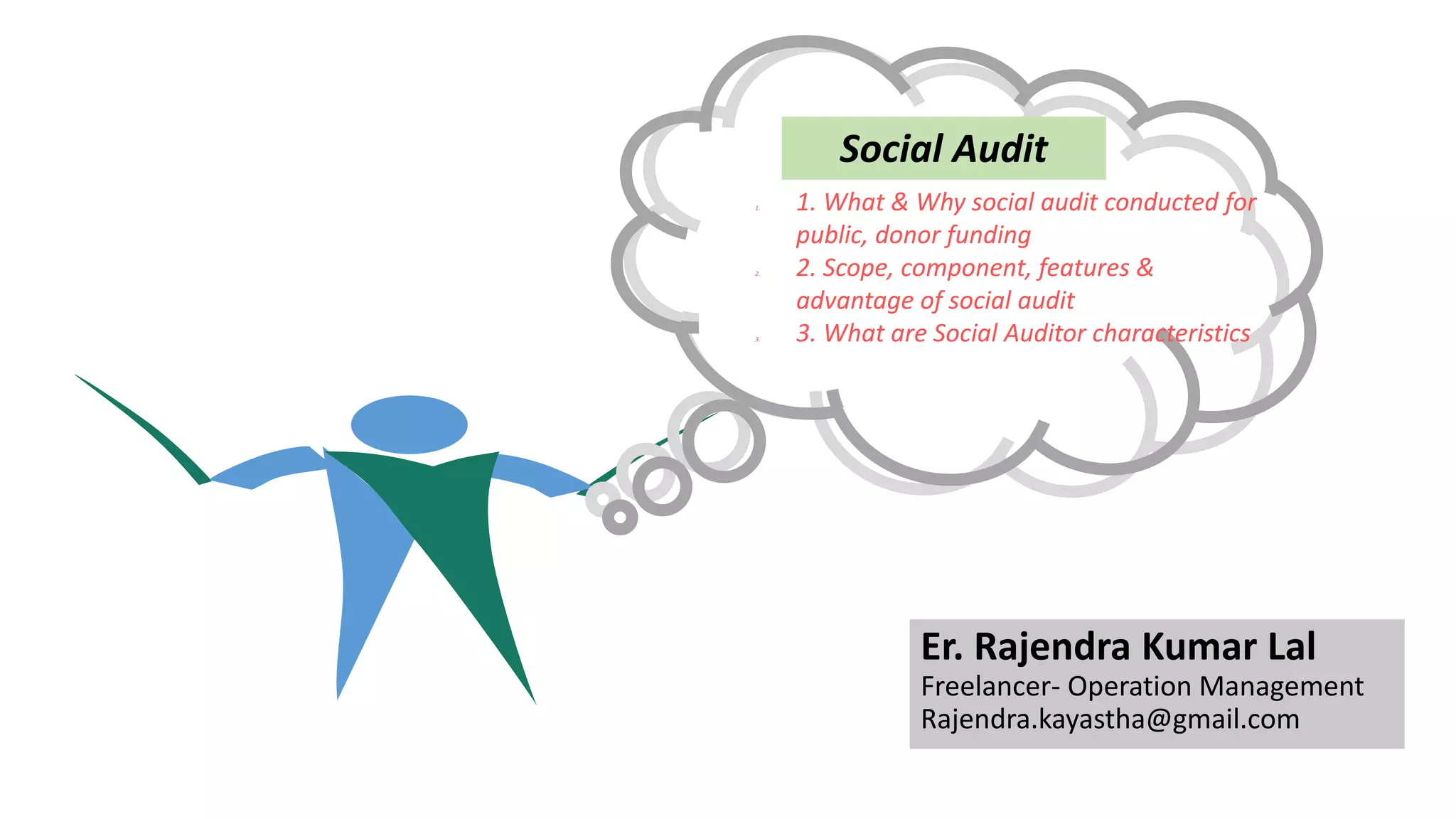
1. 1. What & Why social audit conducted for
public, donor funding
2. 2. Scope, component, features &
advantage of social audit
3. 3. What are Social Auditor characteristics
Er. Rajendra Kumar Lal
Freelancer- Operation Management
Rajendra.kayastha@gmail.com
1.1 What is Social Audit
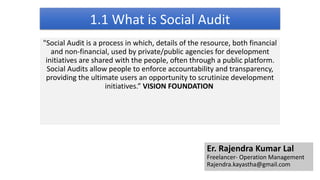
"Social Audit is a process in which, details of the resource, both financial
and non-financial, used by private/public agencies for development
initiatives are shared with the people, often through a public platform.
Social Audits allow people to enforce accountability and transparency,
providing the ultimate users an opportunity to scrutinize development
initiatives.” VISION FOUNDATION
Er. Rajendra Kumar Lal
Freelancer- Operation Management
Rajendra.kayastha@gmail.com
Evaluation of project activities conducted
jointly by implementer/government/third
party and beneficiaries
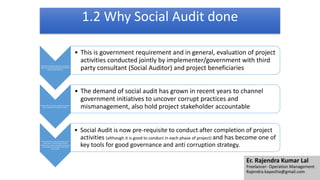
• This is government requirement and in general, evaluation of project
activities conducted jointly by implementer/government with third
party consultant (Social Auditor) and project beneficiaries
Social Audit is now pre-requisite to conduct
after completion of project activities.
• The demand of social audit has grown in recent years to channel
government initiatives to uncover corrupt practices and
mismanagement, also hold project stakeholder accountable
The demand of social audit has grown in
recent years to channel government
initiatives to uncover corrupt practices and
mismanagement, also hold stakeholder
accountable
• Social Audit is now pre-requisite to conduct after completion of project
activities (although it is good to conduct in each phase of project) and has become one of
key tools for good governance and anti corruption strategy.
1.2 Why Social Audit done
Er. Rajendra Kumar Lal
Freelancer- Operation Management
Rajendra.kayastha@gmail.com
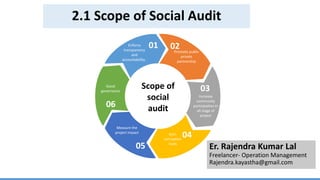
2.1 Scope of Social Audit
Enforce
transparency
and
accountability .
01 02Promote public
private
partnership
03
Increase
community
participation in
all stage of
project
04Anti-
corruption
tools
05
Measure the
project impact
06
Good
governance
Scope of
social
audit
Er. Rajendra Kumar Lal
Freelancer- Operation Management
Rajendra.kayastha@gmail.com
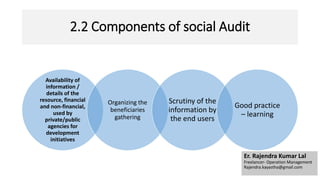
2.2 Components of social Audit
Availability of
information /
details of the
resource, financial
and non-financial,
used by
private/public
agencies for
development
initiatives
Organizing the
beneficiaries
gathering
Scrutiny of the
information by
the end users
Good practice
– learning
Er. Rajendra Kumar Lal
Freelancer- Operation Management
Rajendra.kayastha@gmail.com
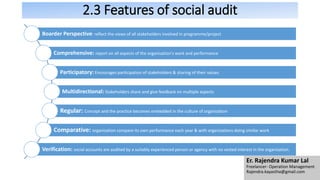
2.3 Features of social audit
Boarder Perspective: reflect the views of all stakeholders involved in programme/project
Comprehensive: report on all aspects of the organisation's work and performance
Participatory: Encourages participation of stakeholders & sharing of their values
Multidirectional: Stakeholders share and give feedback on multiple aspects
Regular: Concept and the practice becomes embedded in the culture of organization
Comparative: organization compare its own performance each year & with organizations doing similar work
Verification: social accounts are audited by a suitably experienced person or agency with no vested interest in the organization.
Er. Rajendra Kumar Lal
Freelancer- Operation Management
Rajendra.kayastha@gmail.com
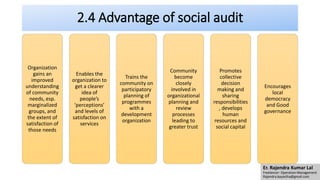
2.4 Advantage of social audit
Organization
gains an
improved
understanding
of community
needs, esp.
marginalized
groups, and
the extent of
satisfaction of
those needs
Enables the
organization to
get a clearer
idea of
people’s
‘perceptions’
and levels of
satisfaction on
services
Trains the
community on
participatory
planning of
programmes
with a
development
organization
Community
become
closely
involved in
organizational
planning and
review
processes
leading to
greater trust
Promotes
collective
decision
making and
sharing
responsibilities
, develops
human
resources and
social capital
Encourages
local
democracy
and Good
governance
Er. Rajendra Kumar Lal
Freelancer- Operation Management
Rajendra.kayastha@gmail.com
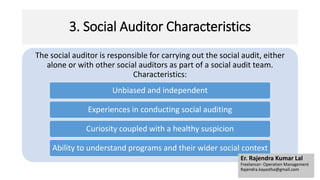
3. Social Auditor Characteristics
The social auditor is responsible for carrying out the social audit, either
alone or with other social auditors as part of a social audit team.
Characteristics:
Unbiased and independent
Experiences in conducting social auditing
Curiosity coupled with a healthy suspicion
Ability to understand programs and their wider social context
Er. Rajendra Kumar Lal
Freelancer- Operation Management
Rajendra.kayastha@gmail.com

Social audit tutorial class

  • 1.
    Social Audit 1. 1.What & Why social audit conducted for public, donor funding 2. 2. Scope, component, features & advantage of social audit 3. 3. What are Social Auditor characteristics Er. Rajendra Kumar Lal Freelancer- Operation Management Rajendra.kayastha@gmail.com
  • 2.
    1.1 What isSocial Audit "Social Audit is a process in which, details of the resource, both financial and non-financial, used by private/public agencies for development initiatives are shared with the people, often through a public platform. Social Audits allow people to enforce accountability and transparency, providing the ultimate users an opportunity to scrutinize development initiatives.” VISION FOUNDATION Er. Rajendra Kumar Lal Freelancer- Operation Management Rajendra.kayastha@gmail.com
  • 3.
    Evaluation of projectactivities conducted jointly by implementer/government/third party and beneficiaries • This is government requirement and in general, evaluation of project activities conducted jointly by implementer/government with third party consultant (Social Auditor) and project beneficiaries Social Audit is now pre-requisite to conduct after completion of project activities. • The demand of social audit has grown in recent years to channel government initiatives to uncover corrupt practices and mismanagement, also hold project stakeholder accountable The demand of social audit has grown in recent years to channel government initiatives to uncover corrupt practices and mismanagement, also hold stakeholder accountable • Social Audit is now pre-requisite to conduct after completion of project activities (although it is good to conduct in each phase of project) and has become one of key tools for good governance and anti corruption strategy. 1.2 Why Social Audit done Er. Rajendra Kumar Lal Freelancer- Operation Management Rajendra.kayastha@gmail.com
  • 4.
    2.1 Scope ofSocial Audit Enforce transparency and accountability . 01 02Promote public private partnership 03 Increase community participation in all stage of project 04Anti- corruption tools 05 Measure the project impact 06 Good governance Scope of social audit Er. Rajendra Kumar Lal Freelancer- Operation Management Rajendra.kayastha@gmail.com
  • 5.
    2.2 Components ofsocial Audit Availability of information / details of the resource, financial and non-financial, used by private/public agencies for development initiatives Organizing the beneficiaries gathering Scrutiny of the information by the end users Good practice – learning Er. Rajendra Kumar Lal Freelancer- Operation Management Rajendra.kayastha@gmail.com
  • 6.
    2.3 Features ofsocial audit Boarder Perspective: reflect the views of all stakeholders involved in programme/project Comprehensive: report on all aspects of the organisation's work and performance Participatory: Encourages participation of stakeholders & sharing of their values Multidirectional: Stakeholders share and give feedback on multiple aspects Regular: Concept and the practice becomes embedded in the culture of organization Comparative: organization compare its own performance each year & with organizations doing similar work Verification: social accounts are audited by a suitably experienced person or agency with no vested interest in the organization. Er. Rajendra Kumar Lal Freelancer- Operation Management Rajendra.kayastha@gmail.com
  • 7.
    2.4 Advantage ofsocial audit Organization gains an improved understanding of community needs, esp. marginalized groups, and the extent of satisfaction of those needs Enables the organization to get a clearer idea of people’s ‘perceptions’ and levels of satisfaction on services Trains the community on participatory planning of programmes with a development organization Community become closely involved in organizational planning and review processes leading to greater trust Promotes collective decision making and sharing responsibilities , develops human resources and social capital Encourages local democracy and Good governance Er. Rajendra Kumar Lal Freelancer- Operation Management Rajendra.kayastha@gmail.com
  • 8.
    3. Social AuditorCharacteristics The social auditor is responsible for carrying out the social audit, either alone or with other social auditors as part of a social audit team. Characteristics: Unbiased and independent Experiences in conducting social auditing Curiosity coupled with a healthy suspicion Ability to understand programs and their wider social context Er. Rajendra Kumar Lal Freelancer- Operation Management Rajendra.kayastha@gmail.com