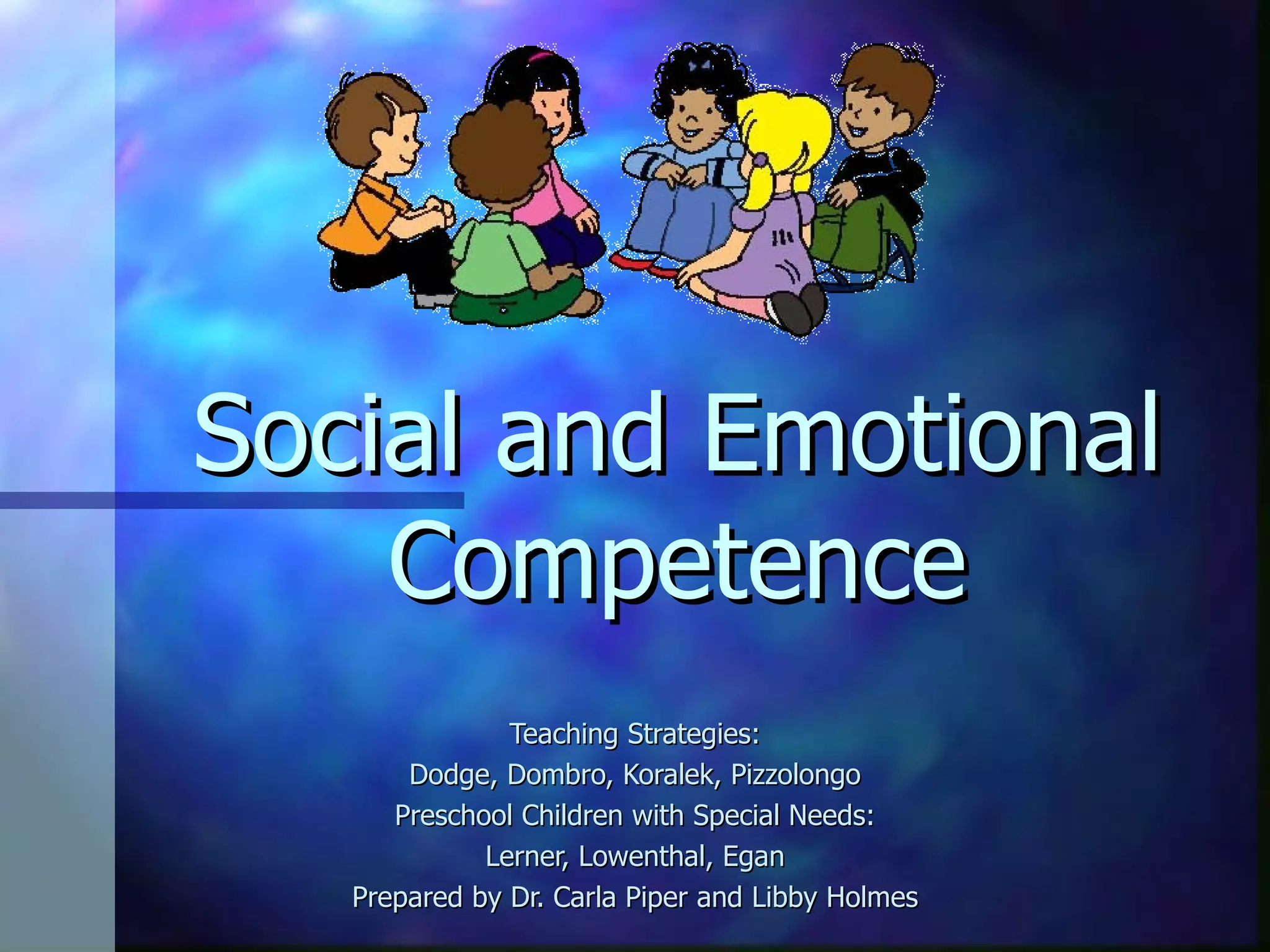
Social and Emotional Competence Teaching Strategies: Dodge, Dombro, Koralek, Pizzolongo Preschool Children with Special Needs: Lerner, Lowenthal, Egan Prepared by Dr. Carla Piper and Libby Holmes
Goal is Self-discipline Ability   to control one’s own behavior Make own decisions and choices based on what is right Know the difference between right and wrong Can correct own mistakes Value acceptable behavior Don’t behave well just because of fear of punishment .
Positive Guidance Take action to prevent dangerous or unacceptable behavior before it occurs Intervene and redirect behavior to guide child towards a better choice Step in and stop an inappropriate behavior Model what is acceptable and what is not Encourage and offer your own acceptance of good behavior by a child
Provide an environment that promotes self-discipline Remove safety hazards and encourage safe exploration Store toys and equipment on low shelves Prepare children for changes in advance Organize daily routines to keep waiting time down to a minimum Arrange the room to provide child with private space Follow children’s cues when planning activities Involve children in making up rules.
Use Positive Methods to Guide  Each Child’s Behavior Try to understand why a child is crying Help children see the consequences of their actions Redirect children to acceptable activities Stay with child who is having tantrum Use simple, positive reminders to restate rules Gently move children while accepting their need to say no Know when ignoring inappropriate behavior is constructive Assume a firm, authoritarian role only when necessary to keep children safe
Help Children Understand and Express their Feelings in Acceptable Ways Make it easier to wait for a turn Offer an angry child a soothing activity Give children words for their feelings Model acceptable ways to express anger Listen to children’s crying or words that tell how they are feeling Tell children you accept their feelings, even when their actions are not acceptable Work with parents to help a child with a challenging behavior
Infants Need what they need when they need it Studies show that when infants needs are met quickly, the infant cries less often At 6-8 months, infants begin to have more control over their actions Between 10-12 months, infants begin to realize that caregivers don’t approve of some of the things they do A caregiver’s tone of voice or firm “no” can help infants learn the limits.
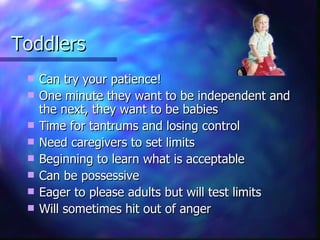
Toddlers Can try your patience! One minute they want to be independent and the next, they want to be babies Time for tantrums and losing control Need caregivers to set limits Beginning to learn what is acceptable Can be possessive Eager to please adults but will test limits Will sometimes hit out of anger
Preschool Children Milestones Dr. Stanley Greenspan’s Milestones Children learn to get involved in their play and activities Children enjoy being with others Children understand and respond appropriately to nonverbal cues Children learn to use words to express their feelings Children learn to understand the consequence of their actions.
Discipline versus Punishment Punishment Controlling child’s behavior through fear May stop children’s negative behavior temporarily Doesn’t help children develop self-discipline May reinforce bad feelings about themselves Discipline Guiding and directing children toward acceptable behavior Help children learn how to control their own behavior Children not born with self control – but learn through daily interactions with other children and adults .
Principles for Enhancing  Social Competence Children’s feelings deserve respect.  Respecting children’s feelings does not always mean allowing children to act on those feelings. Social competence is socially defined. Must show respect for different cultures Respect different patterns of appropriate interaction.
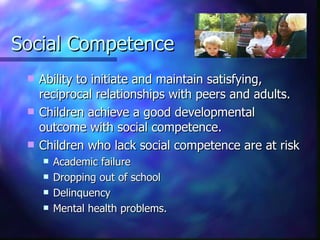
Social Competence Ability to initiate and maintain satisfying, reciprocal relationships with peers and adults.  Children achieve a good developmental outcome with social competence. Children who lack social competence are at risk Academic failure  Dropping out of school  Delinquency Mental health problems.
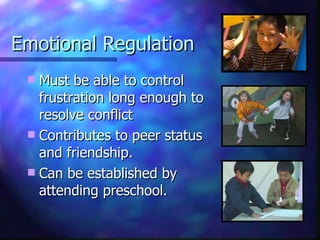
Emotional Regulation Must be able to control frustration long enough to resolve conflict Contributes to peer status and friendship. Can be established by attending preschool.
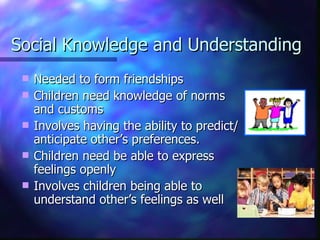
Social Knowledge and Understanding Needed to form friendships Children need knowledge of norms and customs Involves having the ability to predict/anticipate other’s preferences.  Children need be able to express feelings openly Involves children being able to understand other’s feelings as well
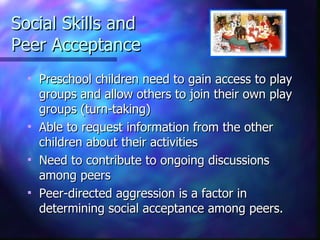
Social Skills and  Peer Acceptance Preschool children need to gain access to play groups and allow others to join their own play groups (turn-taking) Able to request information from the other children about their activities Need to contribute to ongoing discussions among peers Peer-directed aggression is a factor in determining social acceptance among peers.
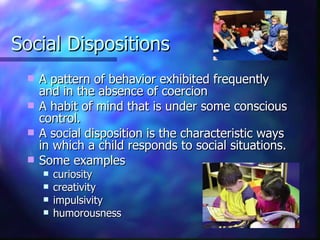
Social Dispositions A pattern of behavior exhibited frequently and in the absence of coercion A habit of mind that is under some conscious control. A social disposition is the characteristic ways in which a child responds to social situations. Some examples  curiosity  creativity impulsivity  humorousness
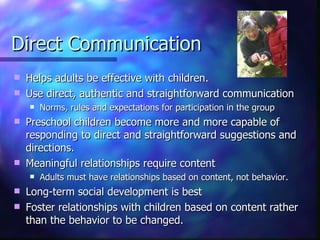
Direct Communication Helps adults be effective with children. Use direct, authentic and straightforward communication Norms, rules and expectations for participation in the group Preschool children become more and more capable of responding to direct and straightforward suggestions and directions. Meaningful relationships require content  Adults must have relationships based on content, not behavior.  Long-term social development is best Foster relationships with children based on content rather than the behavior to be changed.
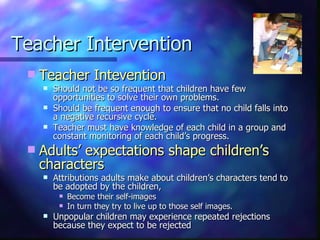
Teacher Intervention Teacher Intevention   Should not be so frequent that children have few opportunities to solve their own problems.  Should be frequent enough to ensure that no child falls into a negative recursive cycle. Teacher must have knowledge of each child in a group and constant monitoring of each child’s progress. Adults’ expectations shape children’s characters Attributions adults make about children’s characters tend to be adopted by the children,  Become their self-images  In turn they try to live up to those self images. Unpopular children may experience repeated rejections because they expect to be rejected
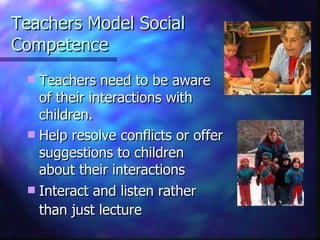
Teachers Model Social Competence Teachers need to be aware of their interactions with children.  Help resolve conflicts or offer suggestions to children about their interactions Interact and listen rather than just lecture
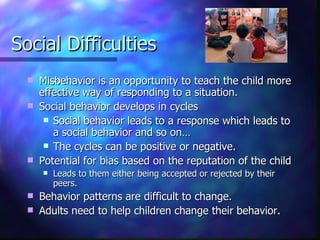
Social Difficulties Misbehavior is an opportunity to teach the child more effective way of responding to a situation. Social behavior develops in cycles Social behavior leads to a response which leads to a social behavior and so on… The cycles can be positive or negative. Potential for bias based on the reputation of the child  Leads to them either being accepted or rejected by their peers. Behavior patterns are difficult to change.  Adults need to help children change their behavior.
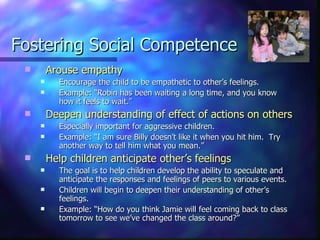
Fostering Social Competence Arouse empathy   Encourage the child to be empathetic to other’s feelings.  Example: “Robin has been waiting a long time, and you know how it feels to wait.” Deepen understanding of effect of actions on others   Especially important for aggressive children.  Example: “I am sure Billy doesn’t like it when you hit him.  Try another way to tell him what you mean.” Help children anticipate other’s feelings   The goal is to help children develop the ability to speculate and anticipate the responses and feelings of peers to various events. Children will begin to deepen their understanding of other’s feelings.  Example: “How do you think Jamie will feel coming back to class tomorrow to see we’ve changed the class around?”
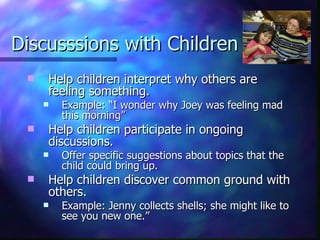
Discusssions with Children Help children interpret why others are feeling something.  Example: “I wonder why Joey was feeling mad this morning” Help children participate in ongoing discussions.  Offer specific suggestions about topics that the child could bring up. Help children discover common ground with others.  Example: Jenny collects shells; she might like to see you new one.”
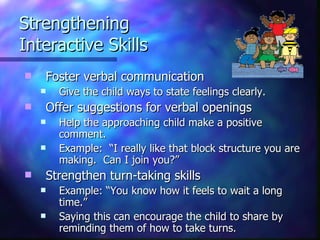
Strengthening  Interactive Skills Foster verbal communication  Give the child ways to state feelings clearly.  Offer suggestions for verbal openings  Help the approaching child make a positive comment.  Example:  “I really like that block structure you are making.  Can I join you?” Strengthen turn-taking skills  Example: “You know how it feels to wait a long time.”  Saying this can encourage the child to share by reminding them of how to take turns.
Help Children  Negotiate Help children learn to negotiate  “ Tell Johnny that you’ll let him use the truck if you get to use it after him”  Children will need assistance making sure that the agreement made is followed through upon.  If a child negotiates and adults don’t assist with follow through, the child is less like to use the skill again. Teach children to assert their preferences gracefully Help children come up with reasons for why they want certain things.  Ex: “ Let Janey know why you want to play the mother, not the cat.” Help bullies change their behavior  “ I don’t like it when you hit Tina.  It hurts her.”  Give the child an alternative action.
Changing Behavior Help victims change their behavior  “ Tell him you don’t like it when he hits you.” Encourage the child to use their words to solve the problem rather than go straight to an adult for help.  Pair children  Pair a child who lacks social competence skills with one that has some.
Provide Social Skills  Training Knowledge   Does the child have the knowledge of what skills are needed in specific situations? Action  Is the child developmentally capable to practice and act in accordance with their knowledge? Application Can the child generalize skills to new situations? Can the child take a skill that is appropriate in one situation and apply it to a similar situation?

Social

  • 1.
    Social and EmotionalCompetence Teaching Strategies: Dodge, Dombro, Koralek, Pizzolongo Preschool Children with Special Needs: Lerner, Lowenthal, Egan Prepared by Dr. Carla Piper and Libby Holmes
  • 2.
    Goal is Self-disciplineAbility to control one’s own behavior Make own decisions and choices based on what is right Know the difference between right and wrong Can correct own mistakes Value acceptable behavior Don’t behave well just because of fear of punishment .
  • 3.
    Positive Guidance Takeaction to prevent dangerous or unacceptable behavior before it occurs Intervene and redirect behavior to guide child towards a better choice Step in and stop an inappropriate behavior Model what is acceptable and what is not Encourage and offer your own acceptance of good behavior by a child
  • 4.
    Provide an environmentthat promotes self-discipline Remove safety hazards and encourage safe exploration Store toys and equipment on low shelves Prepare children for changes in advance Organize daily routines to keep waiting time down to a minimum Arrange the room to provide child with private space Follow children’s cues when planning activities Involve children in making up rules.
  • 5.
    Use Positive Methodsto Guide Each Child’s Behavior Try to understand why a child is crying Help children see the consequences of their actions Redirect children to acceptable activities Stay with child who is having tantrum Use simple, positive reminders to restate rules Gently move children while accepting their need to say no Know when ignoring inappropriate behavior is constructive Assume a firm, authoritarian role only when necessary to keep children safe
  • 6.
    Help Children Understandand Express their Feelings in Acceptable Ways Make it easier to wait for a turn Offer an angry child a soothing activity Give children words for their feelings Model acceptable ways to express anger Listen to children’s crying or words that tell how they are feeling Tell children you accept their feelings, even when their actions are not acceptable Work with parents to help a child with a challenging behavior
  • 7.
    Infants Need whatthey need when they need it Studies show that when infants needs are met quickly, the infant cries less often At 6-8 months, infants begin to have more control over their actions Between 10-12 months, infants begin to realize that caregivers don’t approve of some of the things they do A caregiver’s tone of voice or firm “no” can help infants learn the limits.
  • 8.
    Toddlers Can tryyour patience! One minute they want to be independent and the next, they want to be babies Time for tantrums and losing control Need caregivers to set limits Beginning to learn what is acceptable Can be possessive Eager to please adults but will test limits Will sometimes hit out of anger
  • 9.
    Preschool Children MilestonesDr. Stanley Greenspan’s Milestones Children learn to get involved in their play and activities Children enjoy being with others Children understand and respond appropriately to nonverbal cues Children learn to use words to express their feelings Children learn to understand the consequence of their actions.
  • 10.
    Discipline versus PunishmentPunishment Controlling child’s behavior through fear May stop children’s negative behavior temporarily Doesn’t help children develop self-discipline May reinforce bad feelings about themselves Discipline Guiding and directing children toward acceptable behavior Help children learn how to control their own behavior Children not born with self control – but learn through daily interactions with other children and adults .
  • 11.
    Principles for Enhancing Social Competence Children’s feelings deserve respect. Respecting children’s feelings does not always mean allowing children to act on those feelings. Social competence is socially defined. Must show respect for different cultures Respect different patterns of appropriate interaction.
  • 12.
    Social Competence Abilityto initiate and maintain satisfying, reciprocal relationships with peers and adults. Children achieve a good developmental outcome with social competence. Children who lack social competence are at risk Academic failure Dropping out of school Delinquency Mental health problems.
  • 13.
    Emotional Regulation Mustbe able to control frustration long enough to resolve conflict Contributes to peer status and friendship. Can be established by attending preschool.
  • 14.
    Social Knowledge andUnderstanding Needed to form friendships Children need knowledge of norms and customs Involves having the ability to predict/anticipate other’s preferences. Children need be able to express feelings openly Involves children being able to understand other’s feelings as well
  • 15.
    Social Skills and Peer Acceptance Preschool children need to gain access to play groups and allow others to join their own play groups (turn-taking) Able to request information from the other children about their activities Need to contribute to ongoing discussions among peers Peer-directed aggression is a factor in determining social acceptance among peers.
  • 16.
    Social Dispositions Apattern of behavior exhibited frequently and in the absence of coercion A habit of mind that is under some conscious control. A social disposition is the characteristic ways in which a child responds to social situations. Some examples curiosity creativity impulsivity humorousness
  • 17.
    Direct Communication Helpsadults be effective with children. Use direct, authentic and straightforward communication Norms, rules and expectations for participation in the group Preschool children become more and more capable of responding to direct and straightforward suggestions and directions. Meaningful relationships require content Adults must have relationships based on content, not behavior. Long-term social development is best Foster relationships with children based on content rather than the behavior to be changed.
  • 18.
    Teacher Intervention TeacherIntevention Should not be so frequent that children have few opportunities to solve their own problems. Should be frequent enough to ensure that no child falls into a negative recursive cycle. Teacher must have knowledge of each child in a group and constant monitoring of each child’s progress. Adults’ expectations shape children’s characters Attributions adults make about children’s characters tend to be adopted by the children, Become their self-images In turn they try to live up to those self images. Unpopular children may experience repeated rejections because they expect to be rejected
  • 19.
    Teachers Model SocialCompetence Teachers need to be aware of their interactions with children. Help resolve conflicts or offer suggestions to children about their interactions Interact and listen rather than just lecture
  • 20.
    Social Difficulties Misbehavioris an opportunity to teach the child more effective way of responding to a situation. Social behavior develops in cycles Social behavior leads to a response which leads to a social behavior and so on… The cycles can be positive or negative. Potential for bias based on the reputation of the child Leads to them either being accepted or rejected by their peers. Behavior patterns are difficult to change. Adults need to help children change their behavior.
  • 21.
    Fostering Social CompetenceArouse empathy Encourage the child to be empathetic to other’s feelings. Example: “Robin has been waiting a long time, and you know how it feels to wait.” Deepen understanding of effect of actions on others Especially important for aggressive children. Example: “I am sure Billy doesn’t like it when you hit him. Try another way to tell him what you mean.” Help children anticipate other’s feelings The goal is to help children develop the ability to speculate and anticipate the responses and feelings of peers to various events. Children will begin to deepen their understanding of other’s feelings. Example: “How do you think Jamie will feel coming back to class tomorrow to see we’ve changed the class around?”
  • 22.
    Discusssions with ChildrenHelp children interpret why others are feeling something. Example: “I wonder why Joey was feeling mad this morning” Help children participate in ongoing discussions. Offer specific suggestions about topics that the child could bring up. Help children discover common ground with others. Example: Jenny collects shells; she might like to see you new one.”
  • 23.
    Strengthening InteractiveSkills Foster verbal communication Give the child ways to state feelings clearly. Offer suggestions for verbal openings Help the approaching child make a positive comment. Example: “I really like that block structure you are making. Can I join you?” Strengthen turn-taking skills Example: “You know how it feels to wait a long time.” Saying this can encourage the child to share by reminding them of how to take turns.
  • 24.
    Help Children Negotiate Help children learn to negotiate “ Tell Johnny that you’ll let him use the truck if you get to use it after him” Children will need assistance making sure that the agreement made is followed through upon. If a child negotiates and adults don’t assist with follow through, the child is less like to use the skill again. Teach children to assert their preferences gracefully Help children come up with reasons for why they want certain things. Ex: “ Let Janey know why you want to play the mother, not the cat.” Help bullies change their behavior “ I don’t like it when you hit Tina. It hurts her.” Give the child an alternative action.
  • 25.
    Changing Behavior Helpvictims change their behavior “ Tell him you don’t like it when he hits you.” Encourage the child to use their words to solve the problem rather than go straight to an adult for help. Pair children Pair a child who lacks social competence skills with one that has some.
  • 26.
    Provide Social Skills Training Knowledge Does the child have the knowledge of what skills are needed in specific situations? Action Is the child developmentally capable to practice and act in accordance with their knowledge? Application Can the child generalize skills to new situations? Can the child take a skill that is appropriate in one situation and apply it to a similar situation?