PROBLEM IDENTIFICATION
9/23/2020
INTRODUCTION
• Problem identification is the first and foremost step to initiate a
journey.
• Know your destination first.
• Confusion is the beginning of gaining clarity.
9/23/2020
Selecting the Research Problem
depends on
• Expertise of researcher in Research Methodology.
• Knowledge of researcher about the subject area.
• Understanding of issues to be examined.
• Predetermining the focus of researcher’s study.
9/23/2020
Sources of Research Problem:
Research in Humanities revolve around 4Ps
• People
• Problems
• Programmes
• Phenomena
Most research studies are based on a combination of 2Ps.
e.g. Person and problem , Phenomenon and programme.
9/23/2020
Considerations in selecting a
research problem:
• Interest of researcher
• Magnitude of the subject under selection.
• Measurement of concepts
• Level of Expertise
• Relevance
• Availability of Data
• Ethical Issues
9/23/2020
Steps in selecting a research problem
I. Identify a broad field or subject area of interest to researcher
Ask Yourself
What interests me?
What is the use of research in future?
9/23/2020
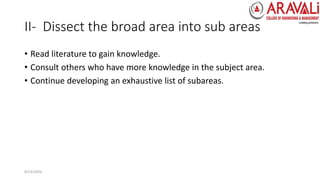
II- Dissect the broad area into sub areas
• Read literature to gain knowledge.
• Consult others who have more knowledge in the subject area.
• Continue developing an exhaustive list of subareas.
9/23/2020
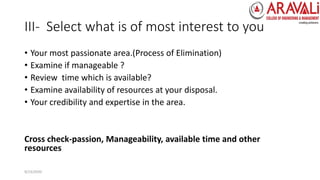
III- Select what is of most interest to you
• Your most passionate area.(Process of Elimination)
• Examine if manageable ?
• Review time which is available?
• Examine availability of resources at your disposal.
• Your credibility and expertise in the area.
Cross check-passion, Manageability, available time and other
resources
9/23/2020
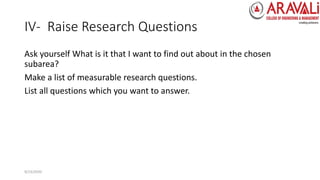
IV- Raise Research Questions
Ask yourself What is it that I want to find out about in the chosen
subarea?
Make a list of measurable research questions.
List all questions which you want to answer.
9/23/2020
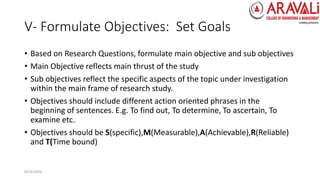
V- Formulate Objectives: Set Goals
• Based on Research Questions, formulate main objective and sub objectives
• Main Objective reflects main thrust of the study
• Sub objectives reflect the specific aspects of the topic under investigation
within the main frame of research study.
• Objectives should include different action oriented phrases in the
beginning of sentences. E.g. To find out, To determine, To ascertain, To
examine etc.
• Objectives should be S(specific),M(Measurable),A(Achievable),R(Reliable)
and T(Time bound)
9/23/2020
VI- Double Check All The Steps
Review all steps again and ask these questions
• Are you sufficiently interested?
• Do you have adequate resources?
• Are you enthusiastic in undertaking the research?
• Do you have the required technical expertise?
• Do you have the required time at your disposal?
9/23/2020
Scope of the Study
• Decision regarding the study population
Decide who will constitute your study population?
e.g. If you have to ascertain the needs of adolescents living in an urban
slum you must decide
Who is an adolescent?
Which urban slum are you talking about? (Geographical Area)
9/23/2020
Establishing Operational Definitions
• Operationalize all the terms in the title as well as objectives. Simplify
till you are able to understand them yourself.
• Operationalization : Defining or establishing a set of rules, indicators
or yardsticks to establish clearly the meaning of all concepts whose
meaning may vary from respondent to respondent. It is very
important to obtain information from the respondents in a uniform
and unambiguous manner. It could also be different from legal ,
census or dictionary definition depending on the requirements of the
research study.
• e.g. Children below poverty line. The definition of poverty line needs
to be decided.
9/23/2020
9/23/2020
Aravali College of Engineering And Management
Jasana, Tigoan Road, Neharpar, Faridabad, Delhi NCR
Toll Free Number : 91- 8527538785
Website : www.acem.edu.in

Acem problem identification

  • 1.
  • 2.
    INTRODUCTION • Problem identificationis the first and foremost step to initiate a journey. • Know your destination first. • Confusion is the beginning of gaining clarity. 9/23/2020
  • 3.
    Selecting the ResearchProblem depends on • Expertise of researcher in Research Methodology. • Knowledge of researcher about the subject area. • Understanding of issues to be examined. • Predetermining the focus of researcher’s study. 9/23/2020
  • 4.
    Sources of ResearchProblem: Research in Humanities revolve around 4Ps • People • Problems • Programmes • Phenomena Most research studies are based on a combination of 2Ps. e.g. Person and problem , Phenomenon and programme. 9/23/2020
  • 5.
    Considerations in selectinga research problem: • Interest of researcher • Magnitude of the subject under selection. • Measurement of concepts • Level of Expertise • Relevance • Availability of Data • Ethical Issues 9/23/2020
  • 6.
    Steps in selectinga research problem I. Identify a broad field or subject area of interest to researcher Ask Yourself What interests me? What is the use of research in future? 9/23/2020
  • 7.
    II- Dissect thebroad area into sub areas • Read literature to gain knowledge. • Consult others who have more knowledge in the subject area. • Continue developing an exhaustive list of subareas. 9/23/2020
  • 8.
    III- Select whatis of most interest to you • Your most passionate area.(Process of Elimination) • Examine if manageable ? • Review time which is available? • Examine availability of resources at your disposal. • Your credibility and expertise in the area. Cross check-passion, Manageability, available time and other resources 9/23/2020
  • 9.
    IV- Raise ResearchQuestions Ask yourself What is it that I want to find out about in the chosen subarea? Make a list of measurable research questions. List all questions which you want to answer. 9/23/2020
  • 10.
    V- Formulate Objectives:Set Goals • Based on Research Questions, formulate main objective and sub objectives • Main Objective reflects main thrust of the study • Sub objectives reflect the specific aspects of the topic under investigation within the main frame of research study. • Objectives should include different action oriented phrases in the beginning of sentences. E.g. To find out, To determine, To ascertain, To examine etc. • Objectives should be S(specific),M(Measurable),A(Achievable),R(Reliable) and T(Time bound) 9/23/2020
  • 11.
    VI- Double CheckAll The Steps Review all steps again and ask these questions • Are you sufficiently interested? • Do you have adequate resources? • Are you enthusiastic in undertaking the research? • Do you have the required technical expertise? • Do you have the required time at your disposal? 9/23/2020
  • 12.
    Scope of theStudy • Decision regarding the study population Decide who will constitute your study population? e.g. If you have to ascertain the needs of adolescents living in an urban slum you must decide Who is an adolescent? Which urban slum are you talking about? (Geographical Area) 9/23/2020
  • 13.
    Establishing Operational Definitions •Operationalize all the terms in the title as well as objectives. Simplify till you are able to understand them yourself. • Operationalization : Defining or establishing a set of rules, indicators or yardsticks to establish clearly the meaning of all concepts whose meaning may vary from respondent to respondent. It is very important to obtain information from the respondents in a uniform and unambiguous manner. It could also be different from legal , census or dictionary definition depending on the requirements of the research study. • e.g. Children below poverty line. The definition of poverty line needs to be decided. 9/23/2020
  • 14.
    9/23/2020 Aravali College ofEngineering And Management Jasana, Tigoan Road, Neharpar, Faridabad, Delhi NCR Toll Free Number : 91- 8527538785 Website : www.acem.edu.in