Lesson 4 RESEARCH METHODS 1b
Students will … recognize  primary  and  secondary   approaches  to research identify appropriate primary and secondary research  sources categorize  methods  for primary and secondary research identify  quantitative  and  qualitative  approaches to primary research evaluate  secondary research sources explore secondary sources  online L e arning Out c om e s
The searching for and gathering of information and ideas in response to a specific question The set of methods used to address a particular research problem   research methodology
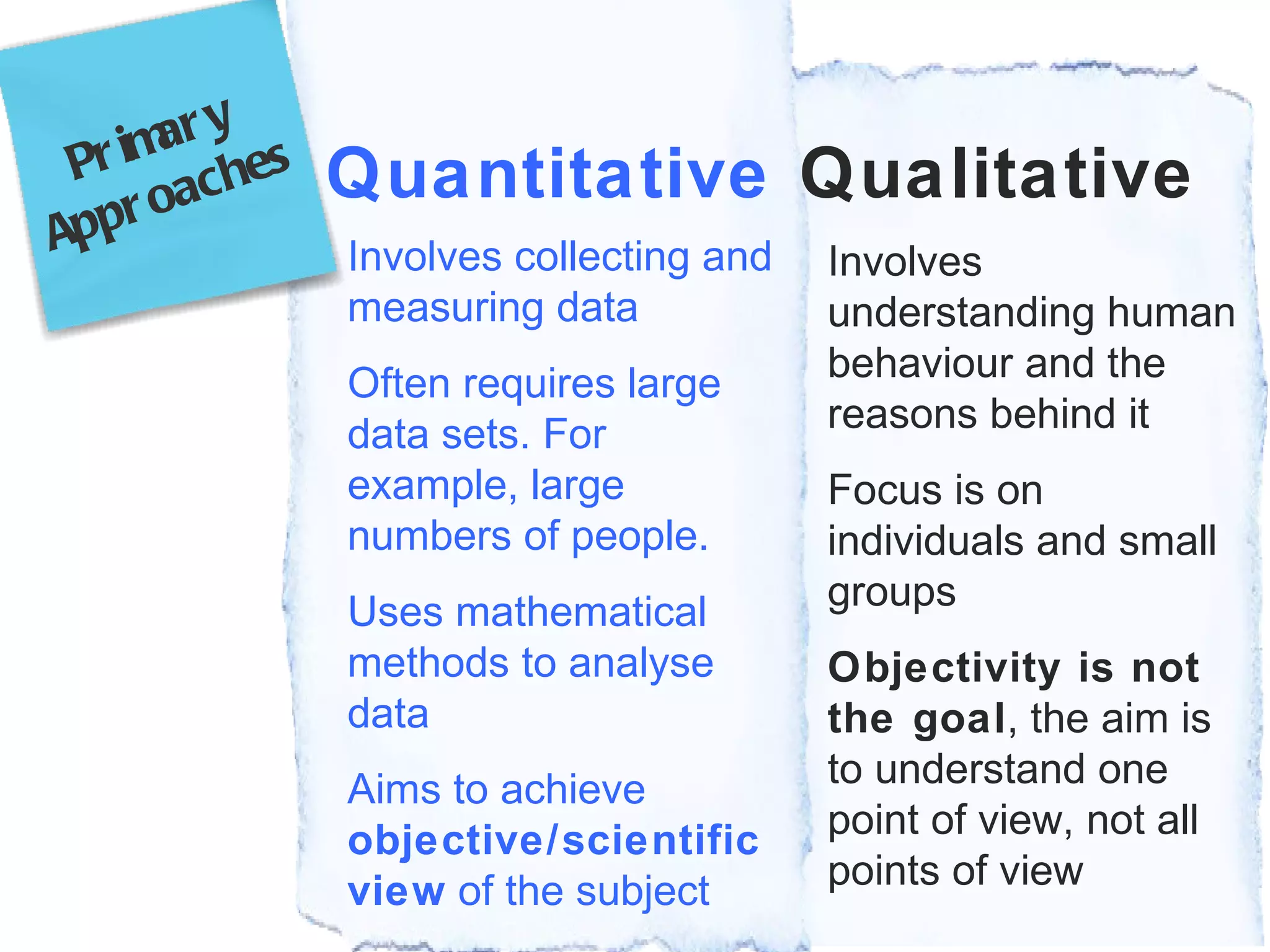
Involves collecting and measuring data Often requires large data sets. For example, large numbers of people. Uses mathematical methods to analyse data  Aims to achieve  objective/scientific  view  of the subject Quantitative Involves understanding human behaviour and the reasons behind it Focus is on individuals and small groups Objectivity is not the goal , the aim is to understand one point of view, not all points of view Qualitative Primary Approaches
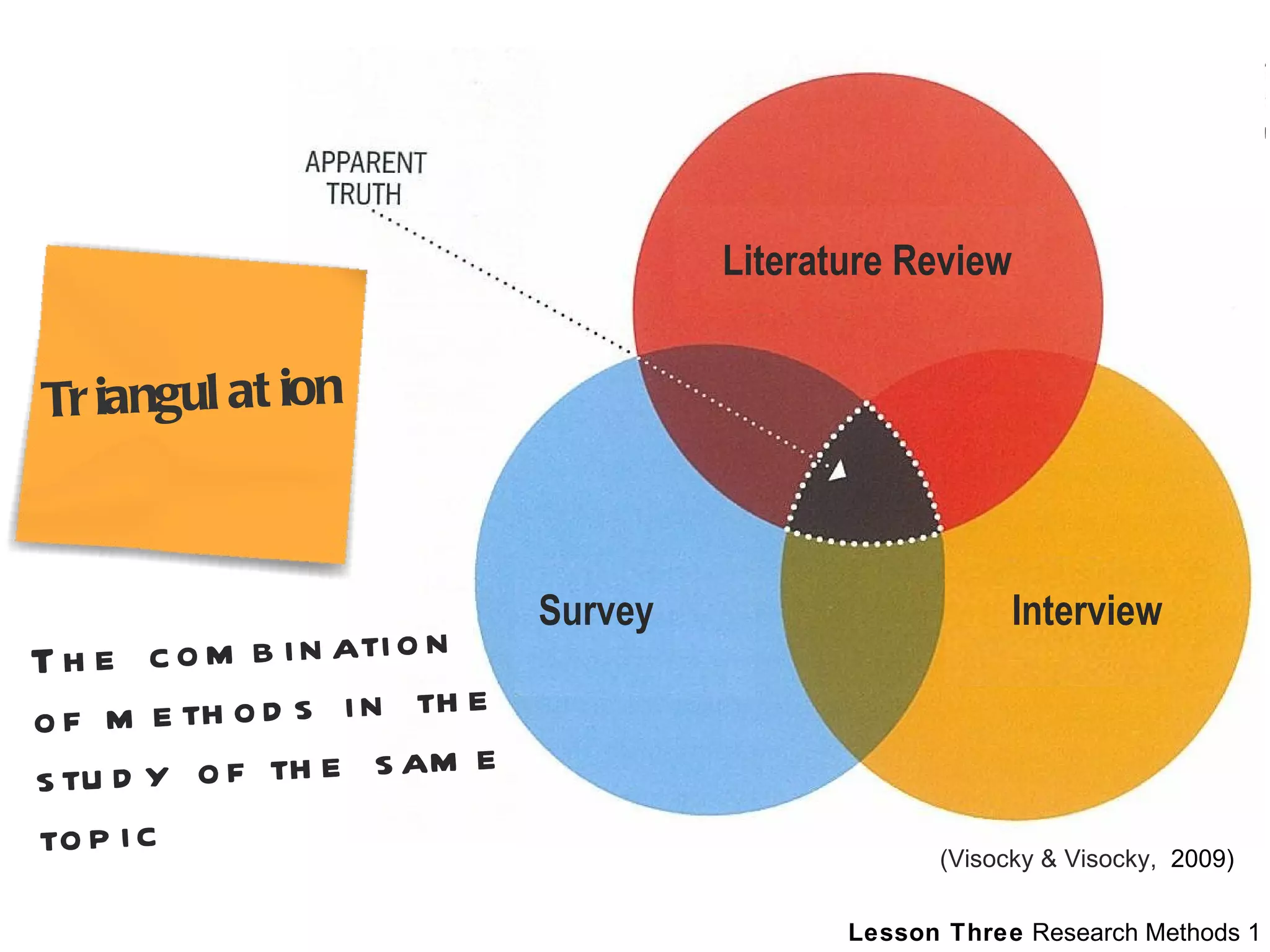
Photo Ethnography Study Literature Review Questionnaire Literature Review Interview Survey The combination of methods in the study of the same topic (Visocky & Visocky,   2009) Triangulation
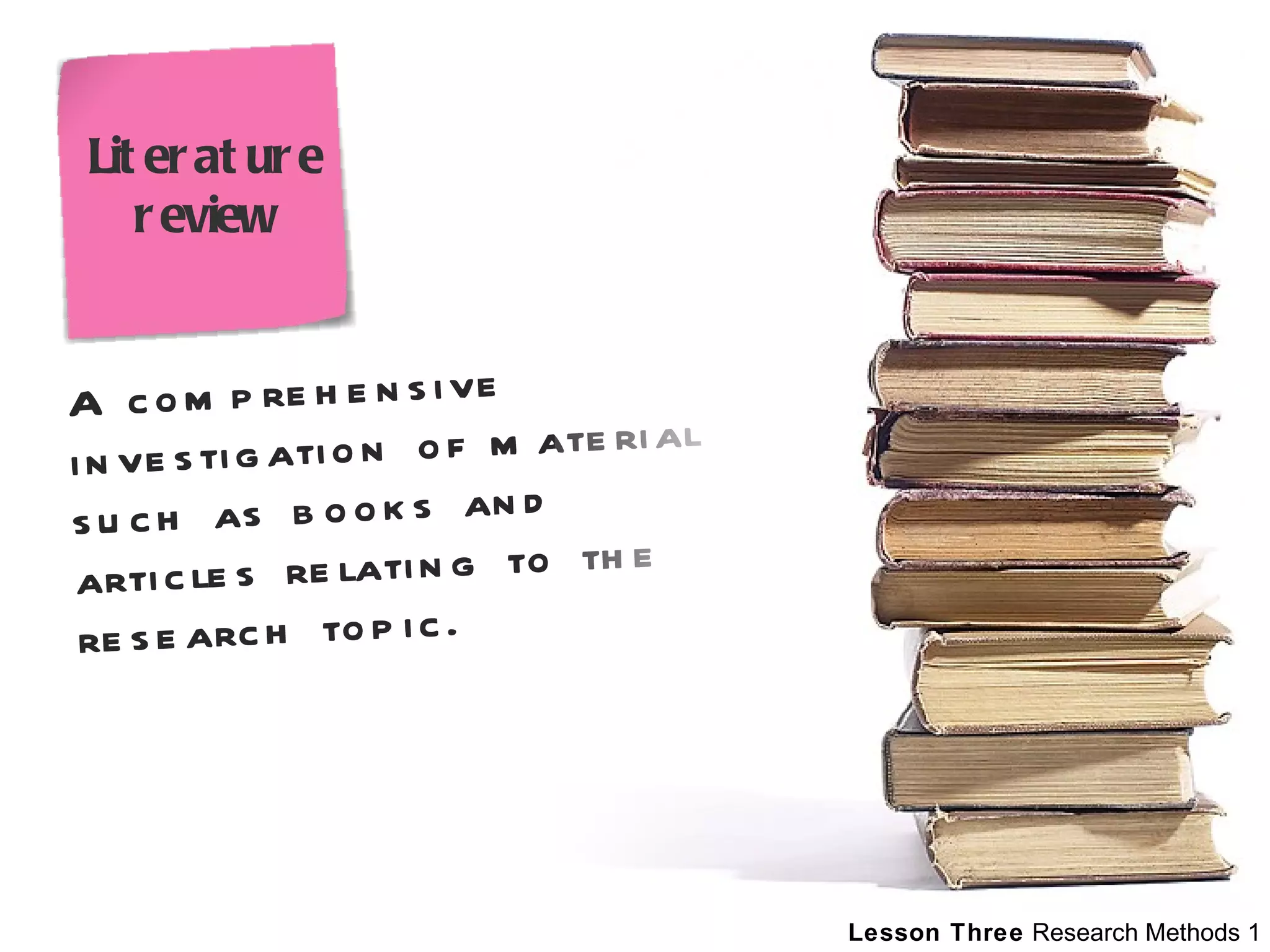
A comprehensive investigation of material such as books and articles relating to the research topic.   Literature review
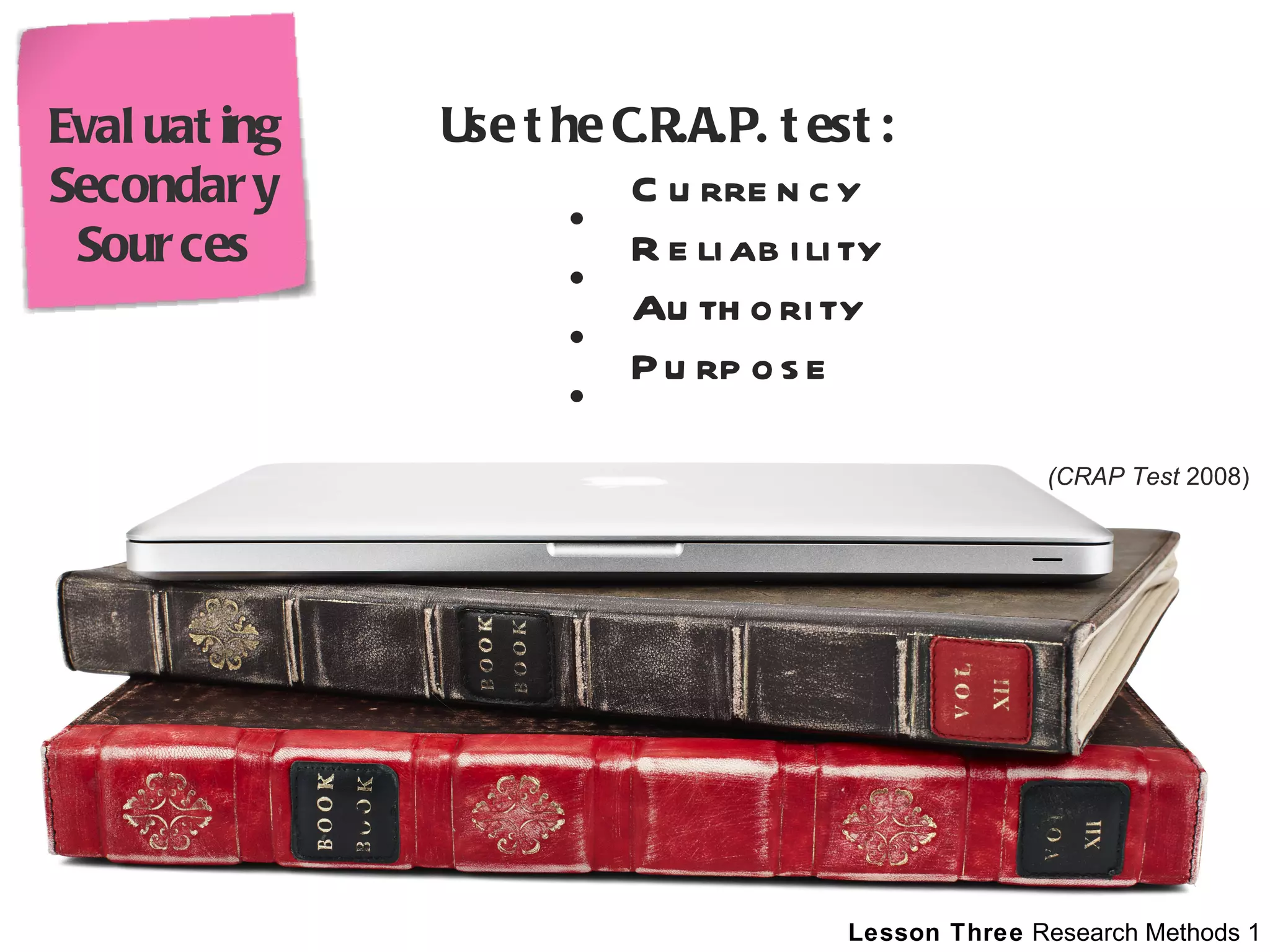
Use the C.R.A.P. test: Currency Reliability Authority Purpose (CRAP Test  2008) Evaluating Secondary Sources
    *  Currency -      How recent is the information?      Are there more recent updates available?      Is it current enough for your topic? (CRAP Test  2008) Evaluating Secondary Sources
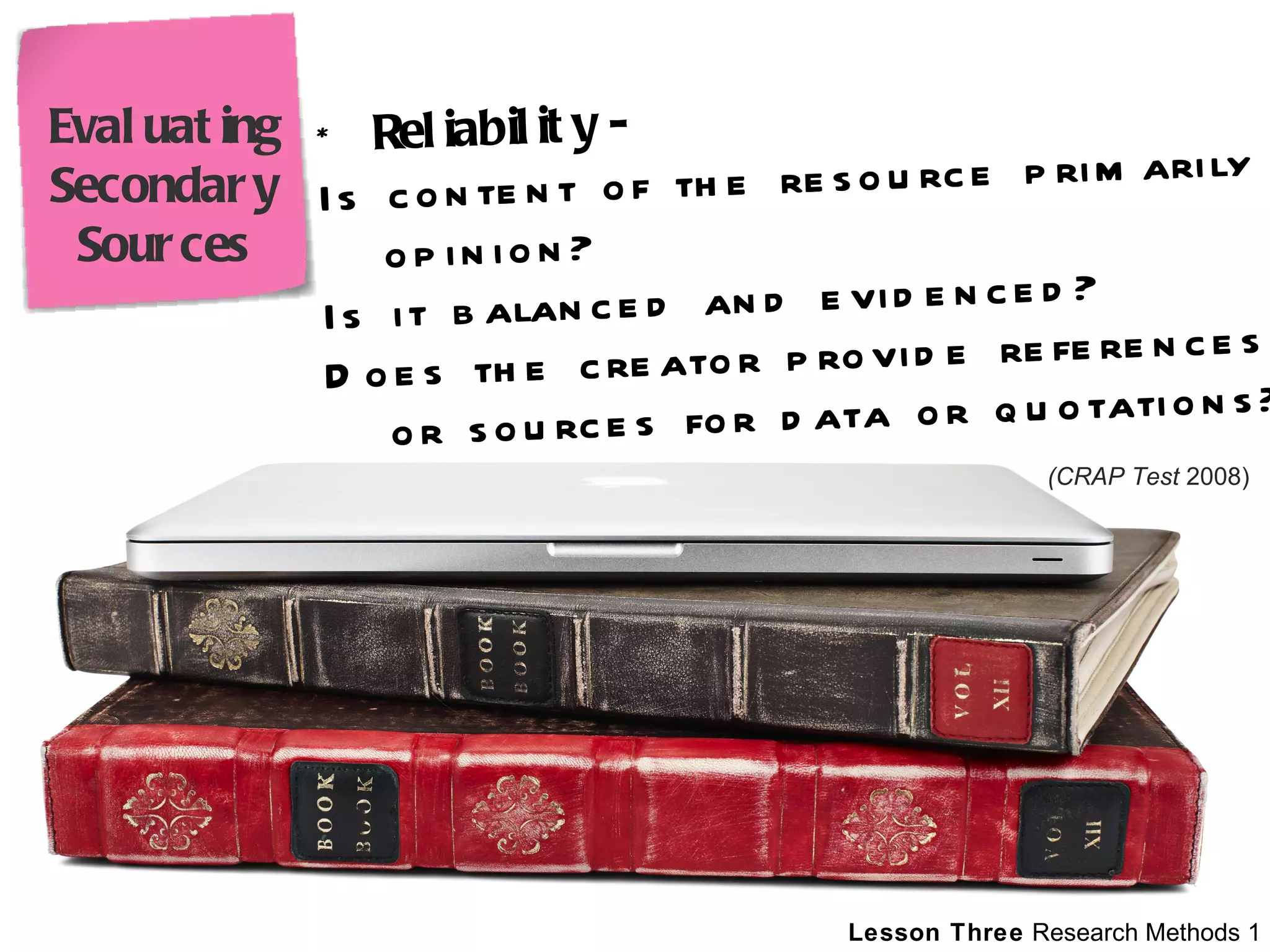
*  Reliability - Is content of the resource primarily opinion? Is it balanced and evidenced? Does the creator provide references or sources for data or quotations? (CRAP Test  2008) Evaluating Secondary Sources
*Authority - Who is the creator or author? What are his/her credentials? Is he/she an expert? Who is the published or sponsor? Are they reputable? (CRAP Test  2008) Evaluating Secondary Sources
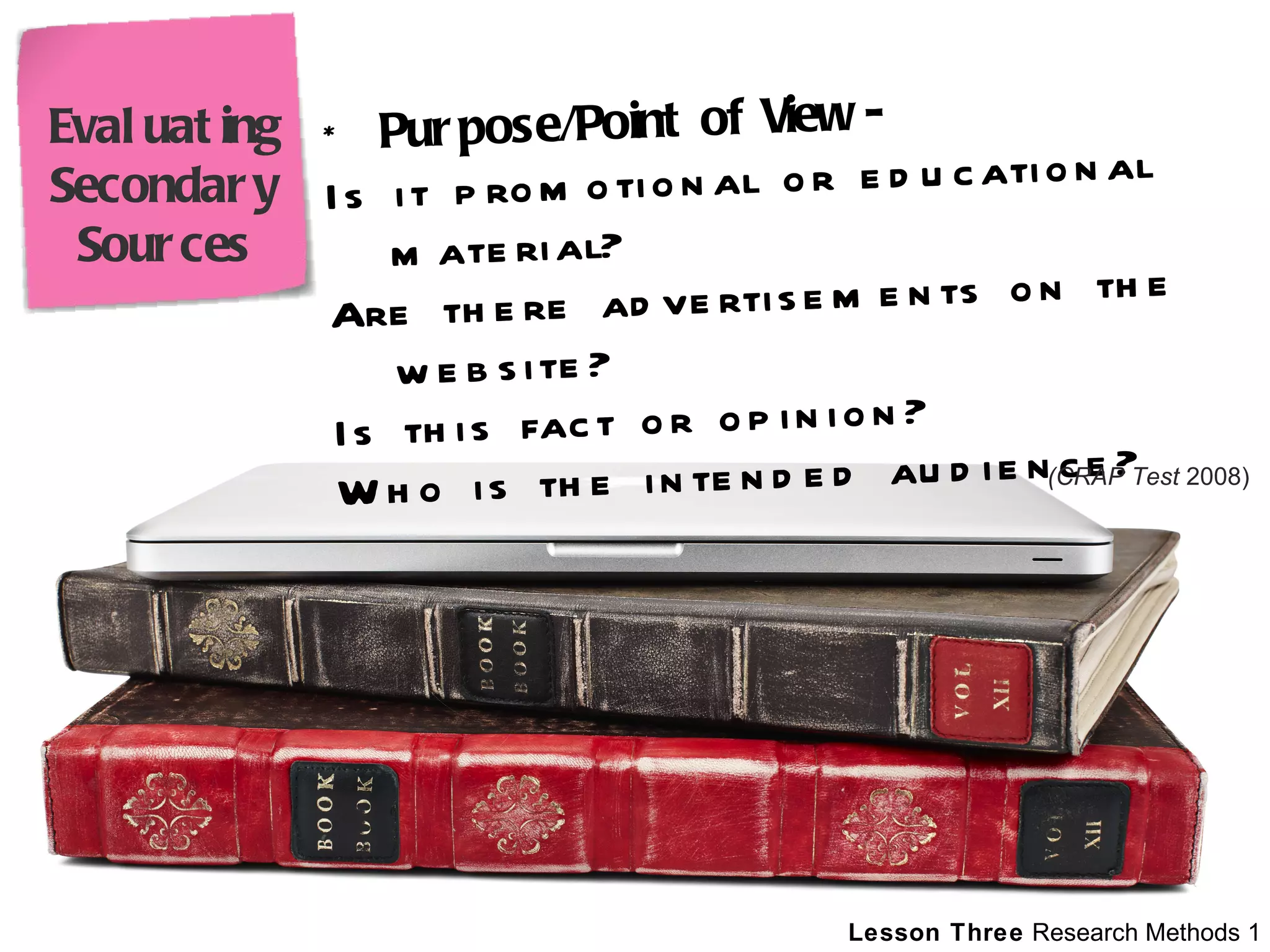
*  Purpose/Point of View - Is it promotional or educational material? Are there advertisements on the website? Is this fact or opinion? Who is the intended audience?  (CRAP Test  2008) Evaluating Secondary Sources
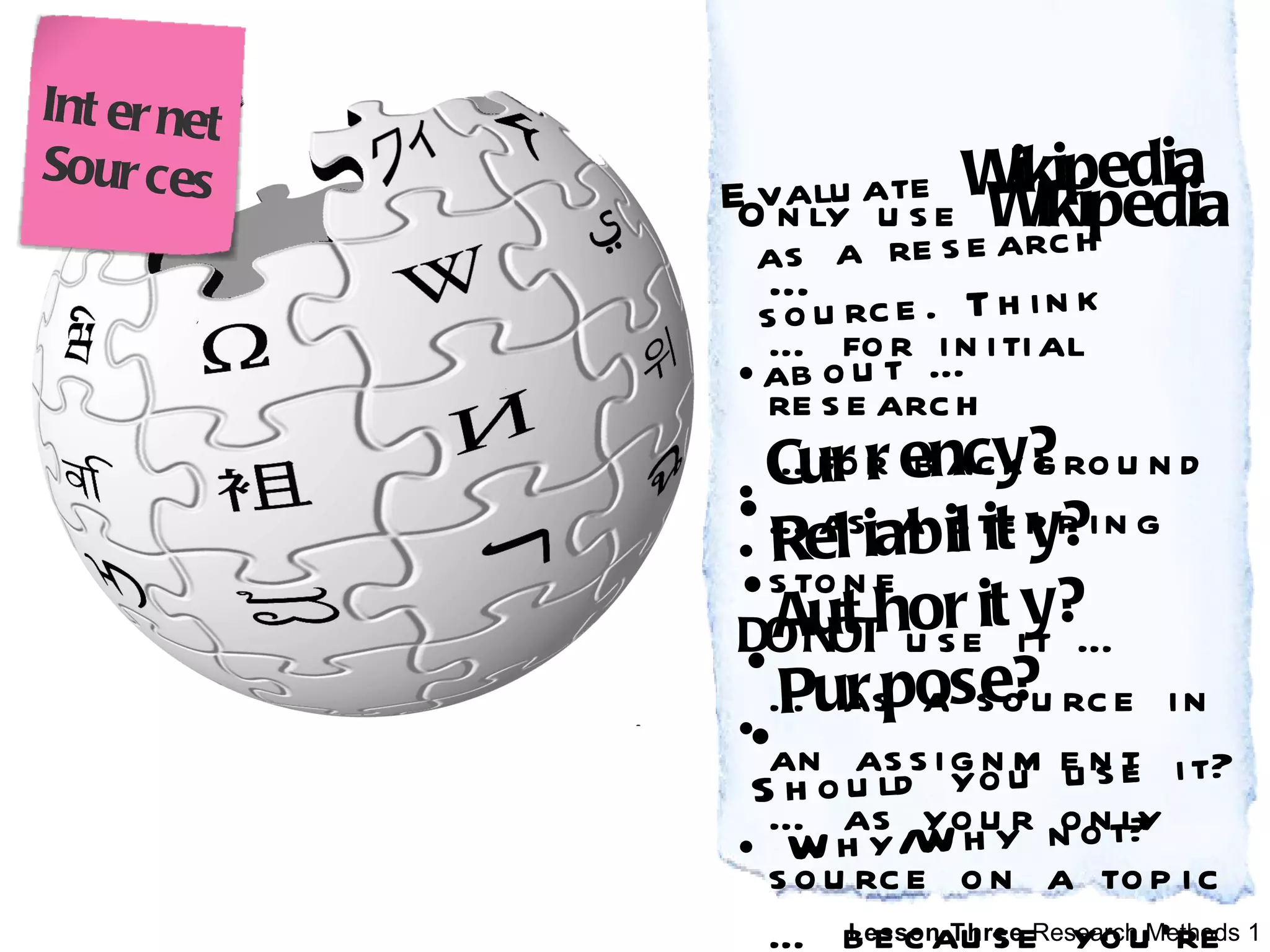
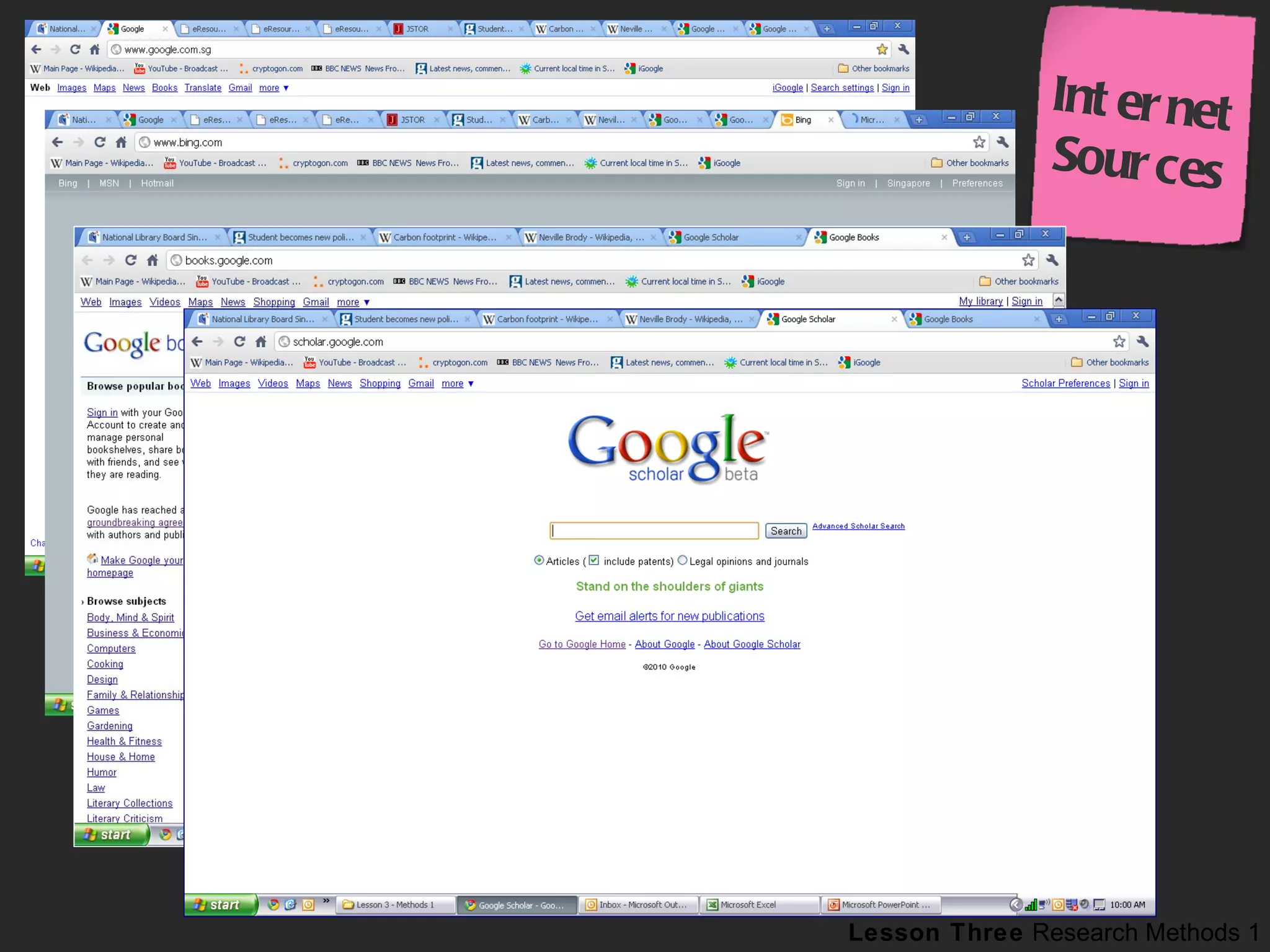
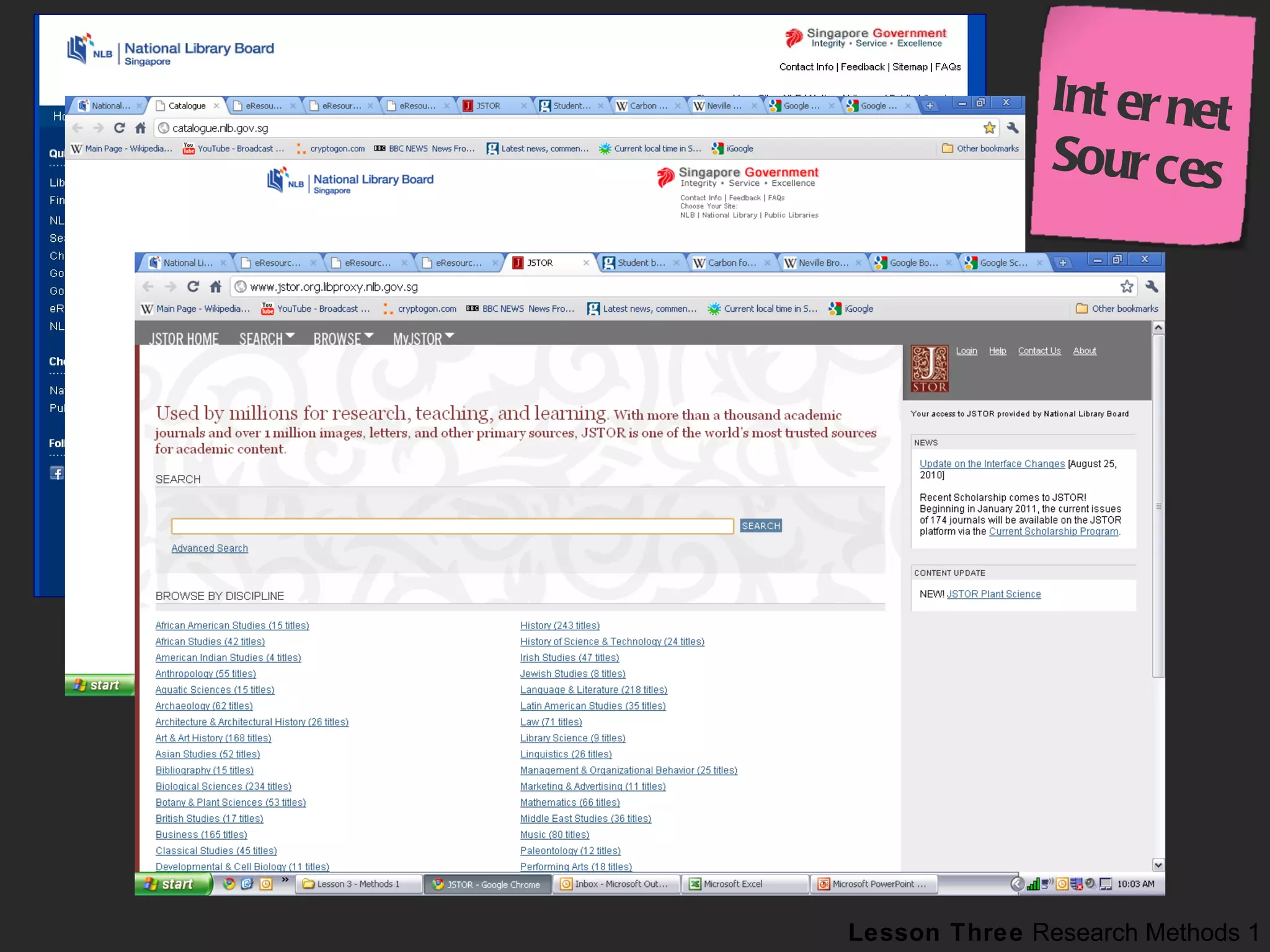
Evaluate  Wikipedia   as a research source. Think about …  Currency? Reliability? Authority? Purpose?   Should you use it? Why/Why not? Only use  Wikipedia  …  …  for initial research … for background … as a stepping stone DO NOT  use it … …  as a source in an assignment …  as your only source on a topic …  because you’re lazy Internet Sources
Internet Sources
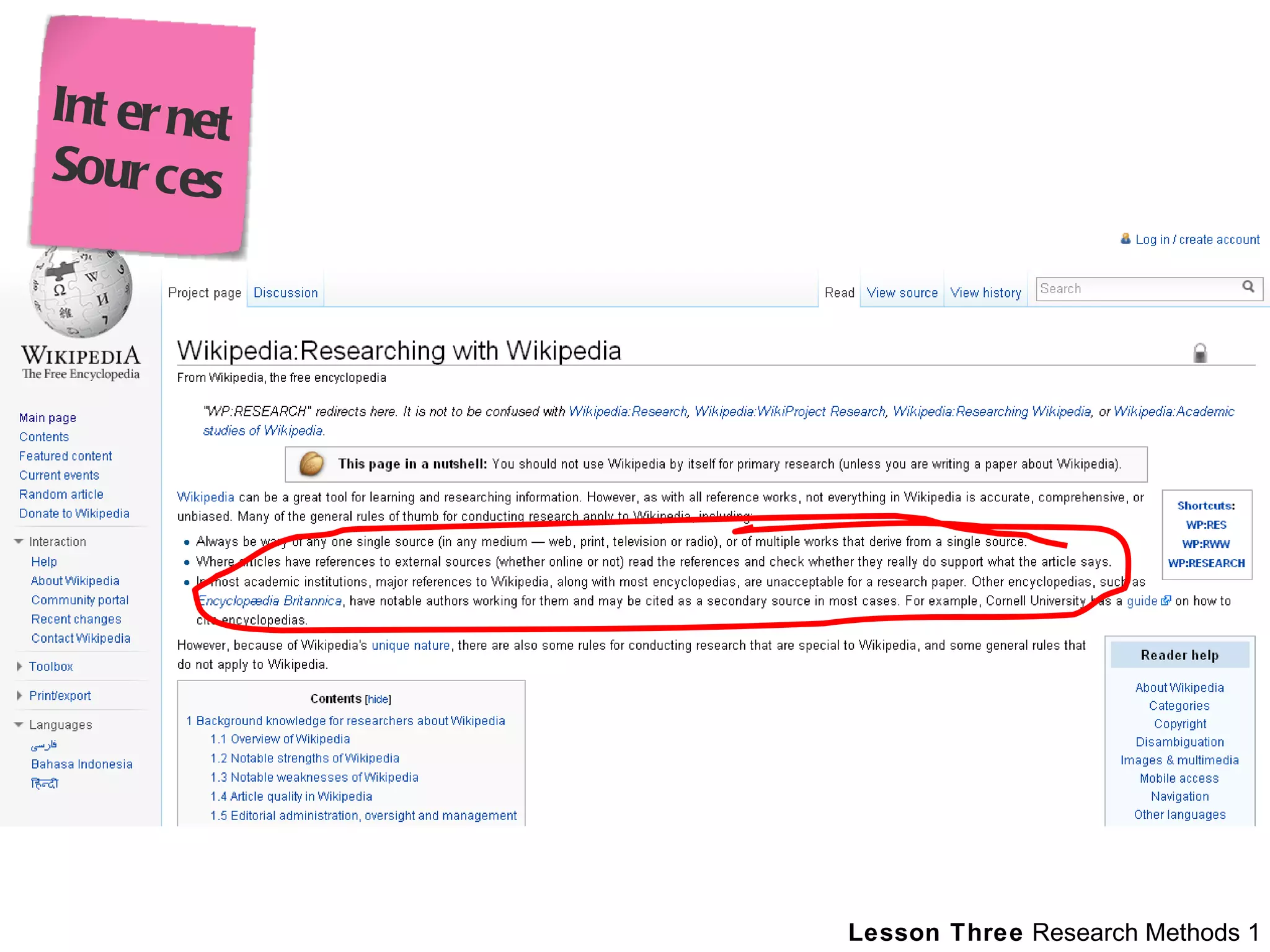
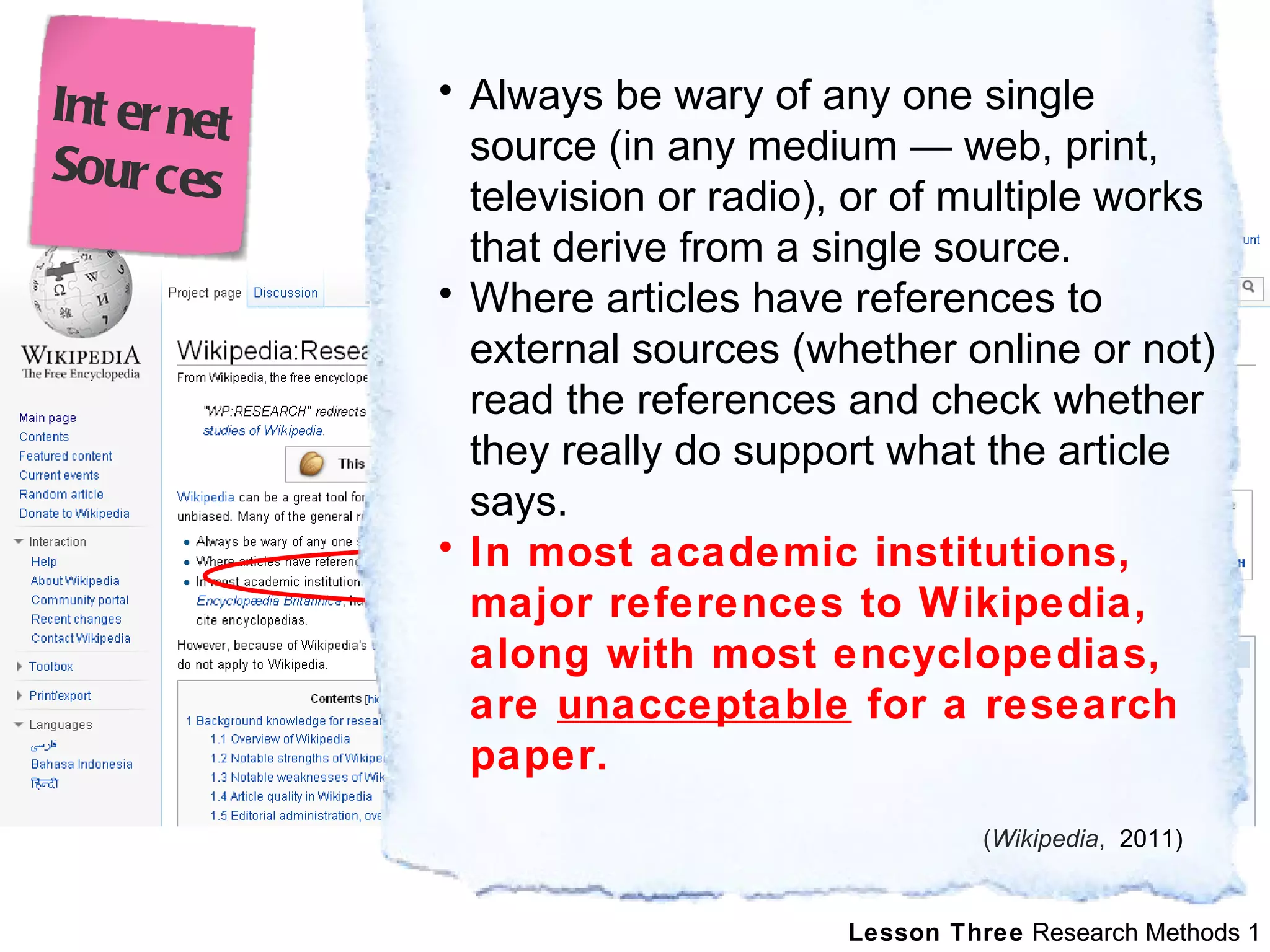
Always be wary of any one single source (in any medium — web, print, television or radio), or of multiple works that derive from a single source. Where articles have references to external sources (whether online or not) read the references and check whether they really do support what the article says. In most academic institutions, major references to Wikipedia, along with most encyclopedias, are  unacceptable  for a research paper.  ( Wikipedia ,   2011) Internet Sources
Internet Sources
Internet Sources
What have you l e arned? There are 2 approaches to all research:  primary  and  secondary   These approaches are differentiated by the  sources  of data used The  methods  used in primary research depend upon the data desired Quantitative  methods provide general, objective, often statistical data Qualitative  methods provide individual, subjective data  Secondary data must be carefully  evaluated   The  Internet  can be a rich source of secondary data if exploited wisely
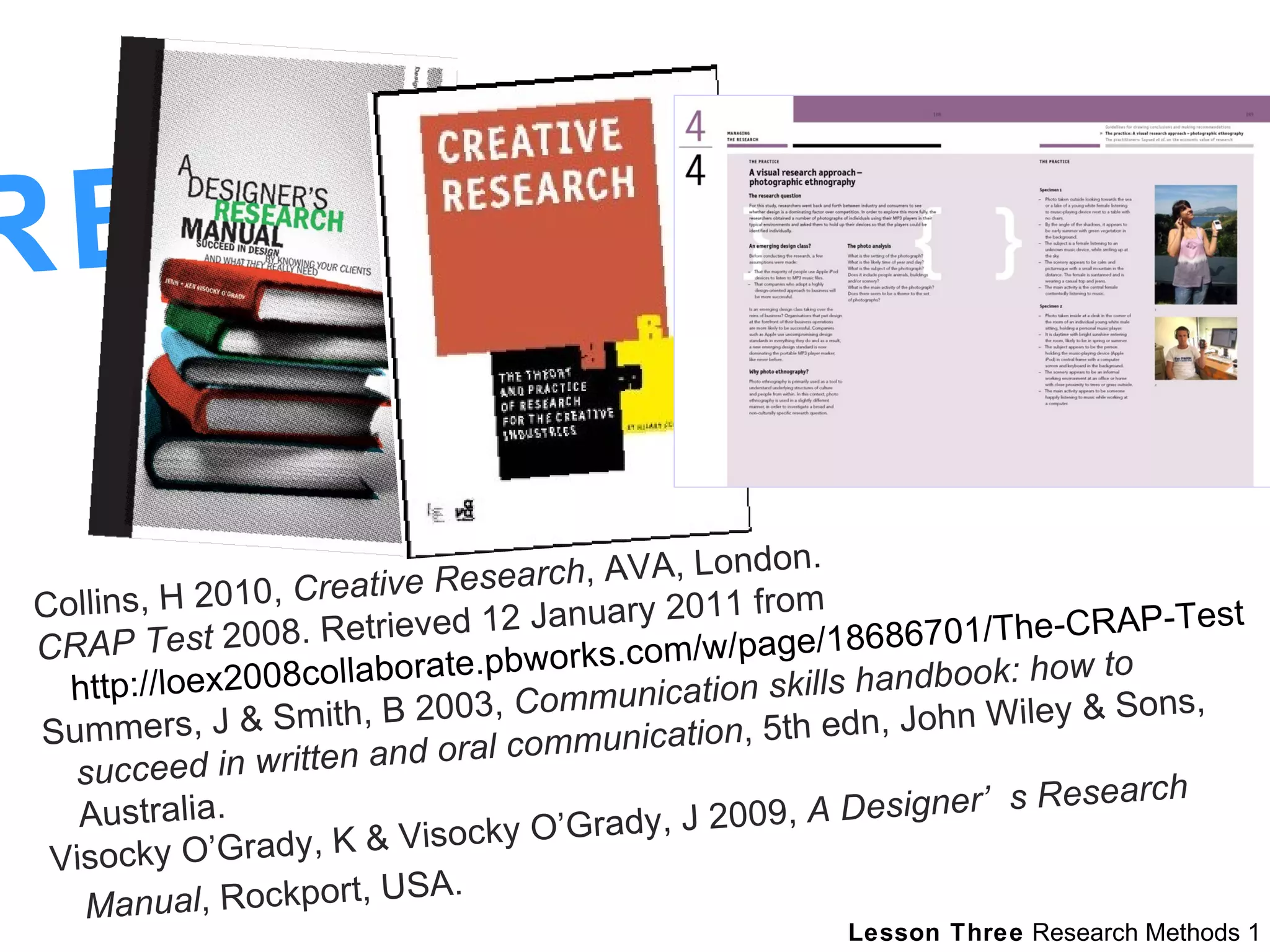
REFERENCES  Collins, H 2010,  Creative Research , AVA, London.  CRAP Test  2008. Retrieved 12 January 2011 from  http://loex2008collaborate.pbworks.com/w/page/18686701/The-CRAP-Test   Summers, J & Smith, B 2003,  Communication skills handbook: how to succeed in written and oral communication , 5th edn, John Wiley & Sons, Australia.  Visocky O’Grady, K & Visocky O’Grady, J 2009,  A Designer’s Research Manual , Rockport, USA.
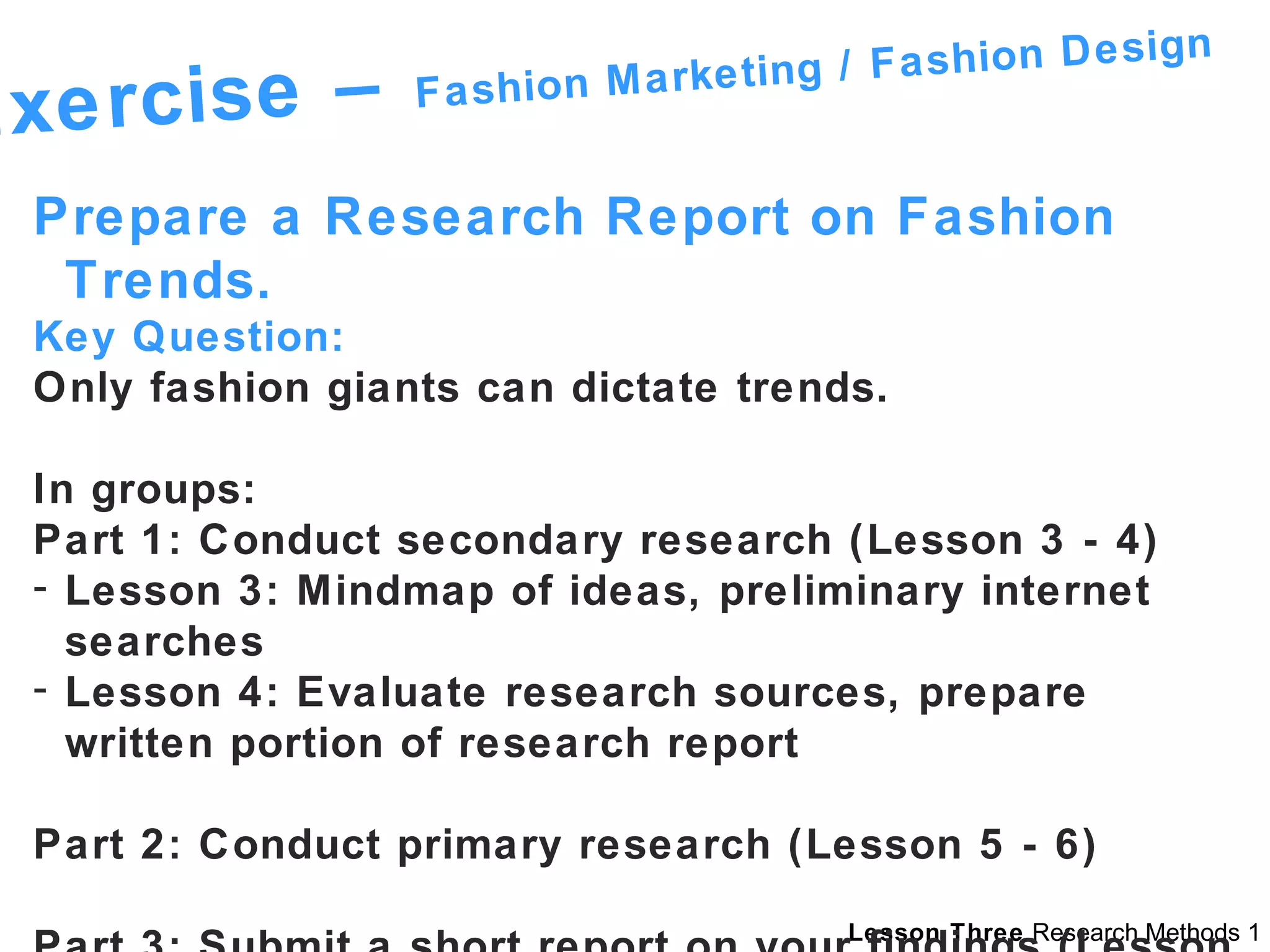
Exercise –  Fashion Marketing / Fashion Design Prepare a Research Report on Fashion Trends. Key Question: Only fashion giants can dictate trends. In groups: Part 1: Conduct secondary research (Lesson 3 - 4) Lesson 3: Mindmap of ideas, preliminary internet searches Lesson 4: Evaluate research sources, prepare written portion of research report Part 2: Conduct primary research (Lesson 5 - 6) Part 3: Submit a short report on your findings (Lesson 9)
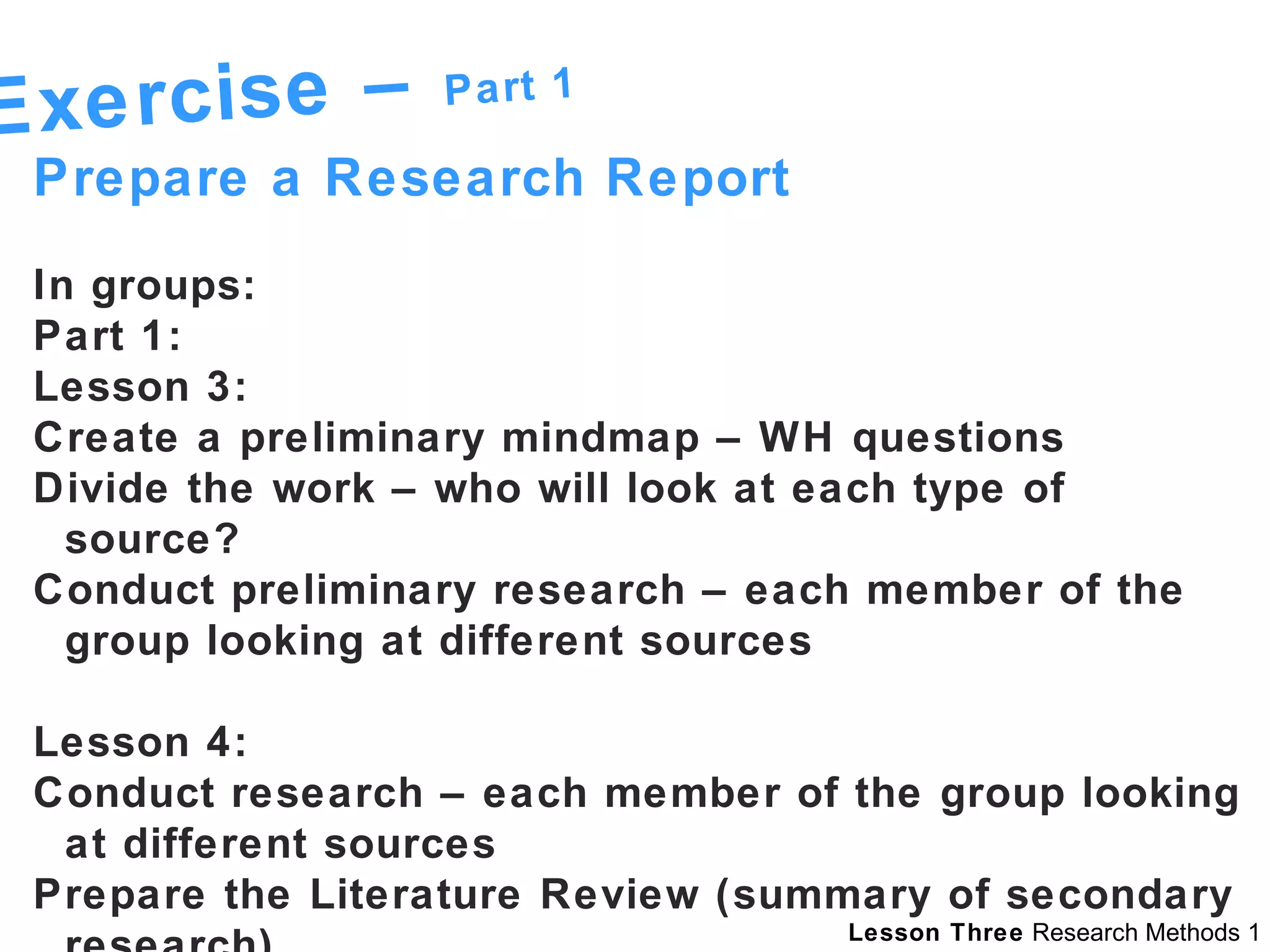
Exercise –  Part 1 Prepare a Research Report  In groups: Part 1:  Lesson 3:  Create a preliminary mindmap – WH questions Divide the work – who will look at each type of source? Conduct preliminary research – each member of the group looking at different sources Lesson 4:  Conduct research – each member of the group looking at different sources Prepare the Literature Review (summary of secondary research)
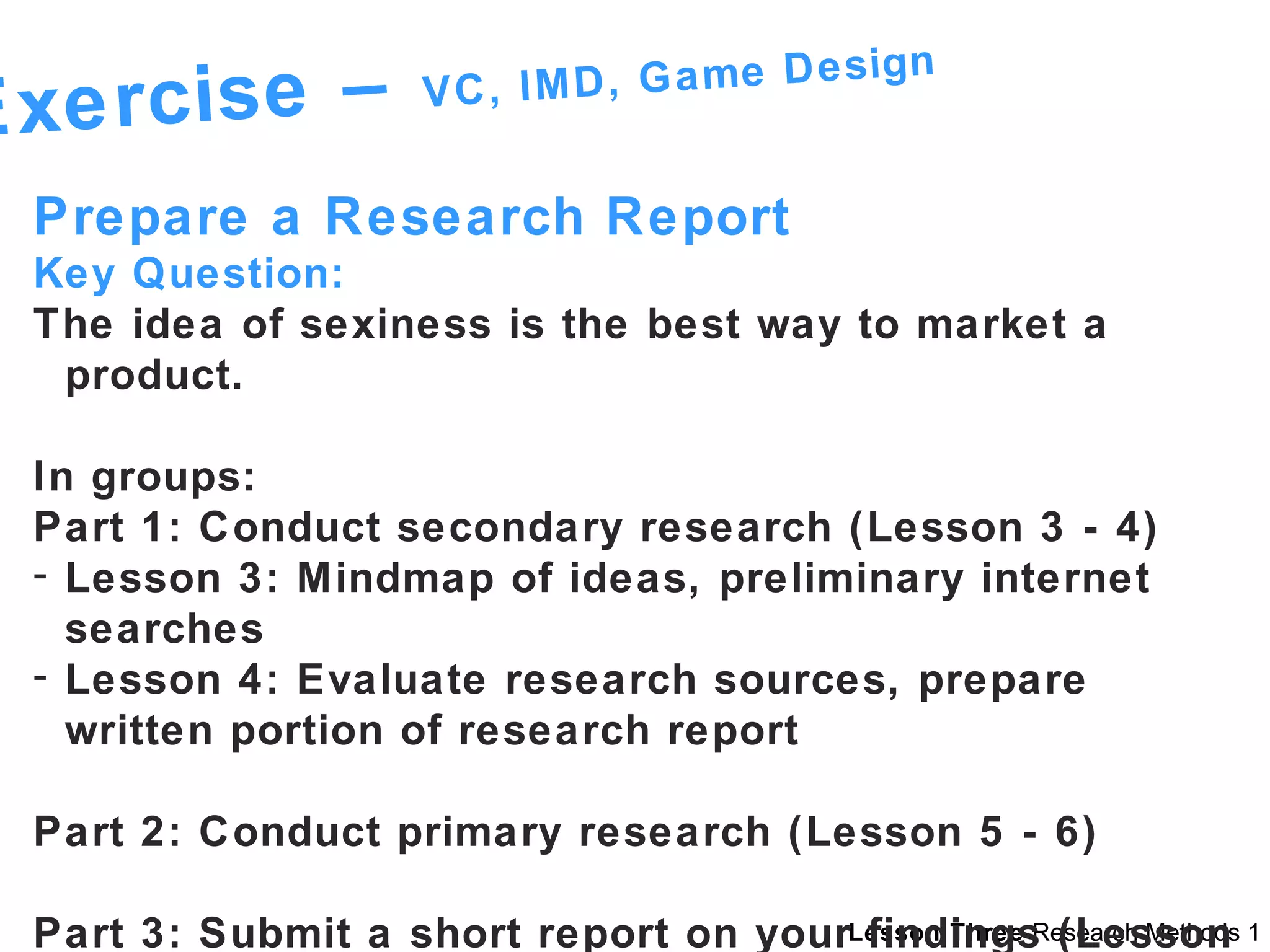
Exercise –  VC, IMD, Game Design Prepare a Research Report  Key Question: The idea of sexiness is the best way to market a product. In groups: Part 1: Conduct secondary research (Lesson 3 - 4) Lesson 3: Mindmap of ideas, preliminary internet searches Lesson 4: Evaluate research sources, prepare written portion of research report Part 2: Conduct primary research (Lesson 5 - 6) Part 3: Submit a short report on your findings (Lesson 9)
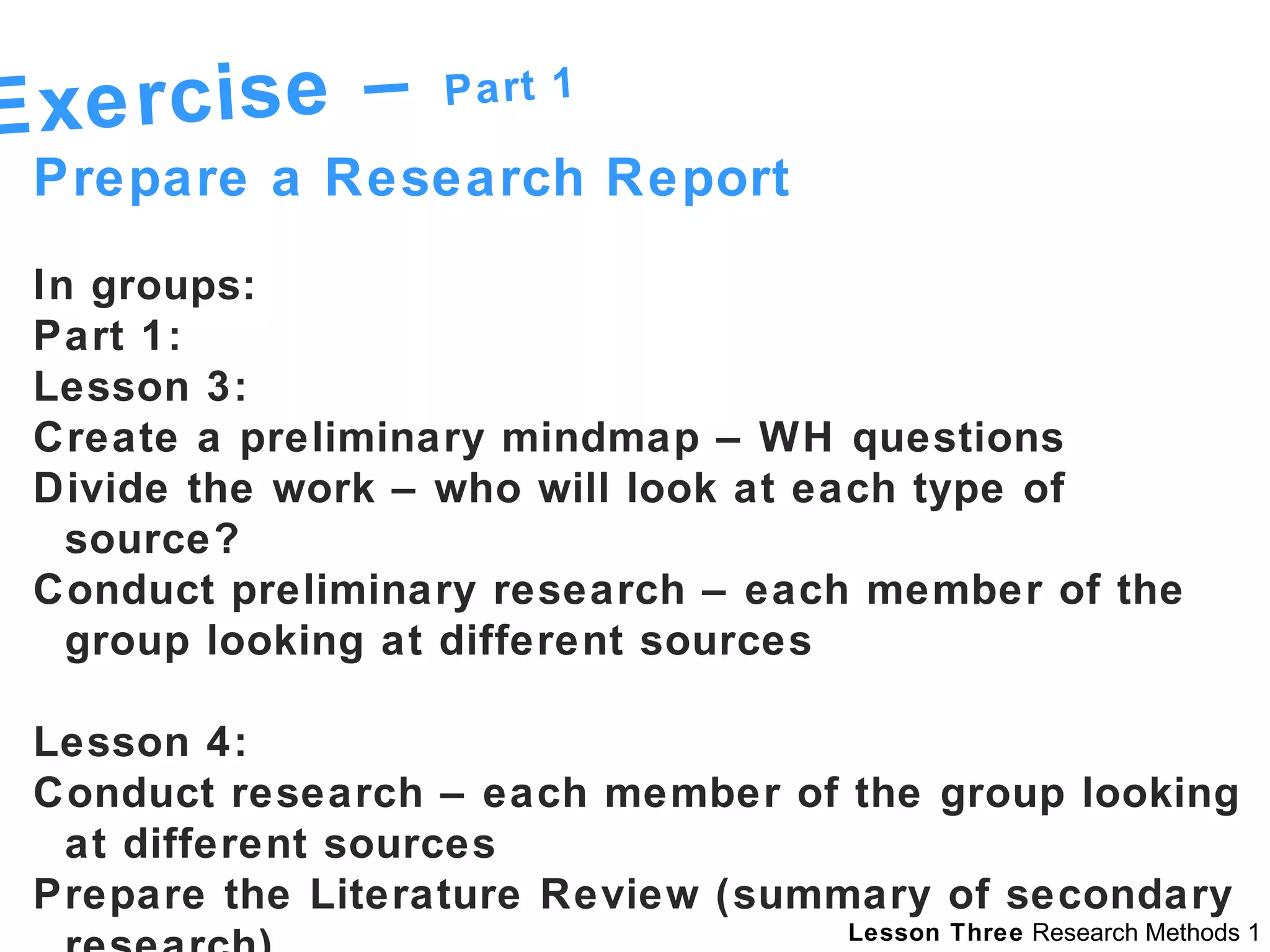
Exercise –  Part 1 Prepare a Research Report  In groups: Part 1:  Lesson 3:  Create a preliminary mindmap – WH questions Divide the work – who will look at each type of source? Conduct preliminary research – each member of the group looking at different sources Lesson 4:  Conduct research – each member of the group looking at different sources Prepare the Literature Review (summary of secondary research)
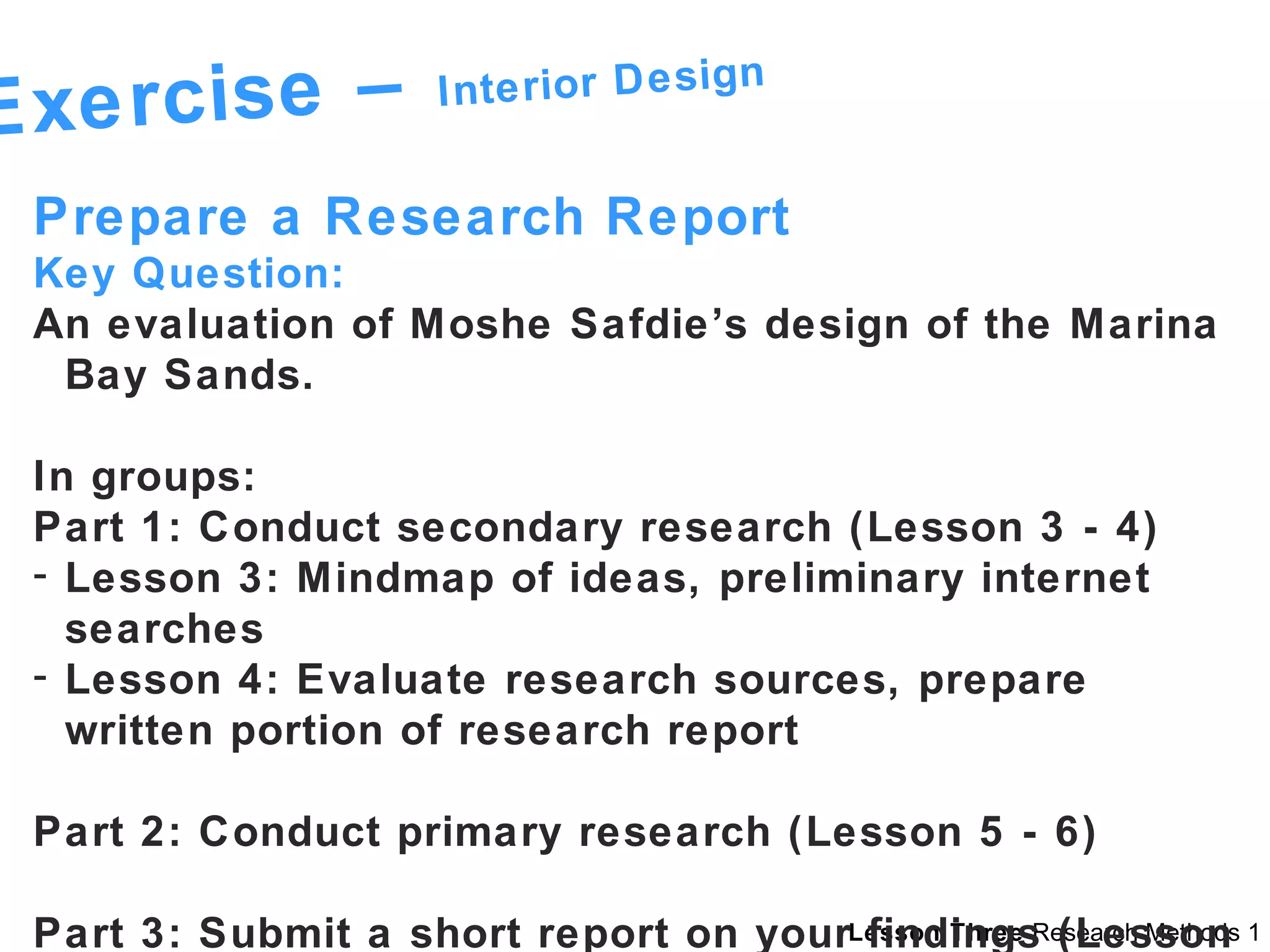
Exercise –  Interior Design Prepare a Research Report  Key Question: An evaluation of Moshe Safdie’s design of the Marina Bay Sands. In groups: Part 1: Conduct secondary research (Lesson 3 - 4) Lesson 3: Mindmap of ideas, preliminary internet searches Lesson 4: Evaluate research sources, prepare written portion of research report Part 2: Conduct primary research (Lesson 5 - 6) Part 3: Submit a short report on your findings (Lesson 9)
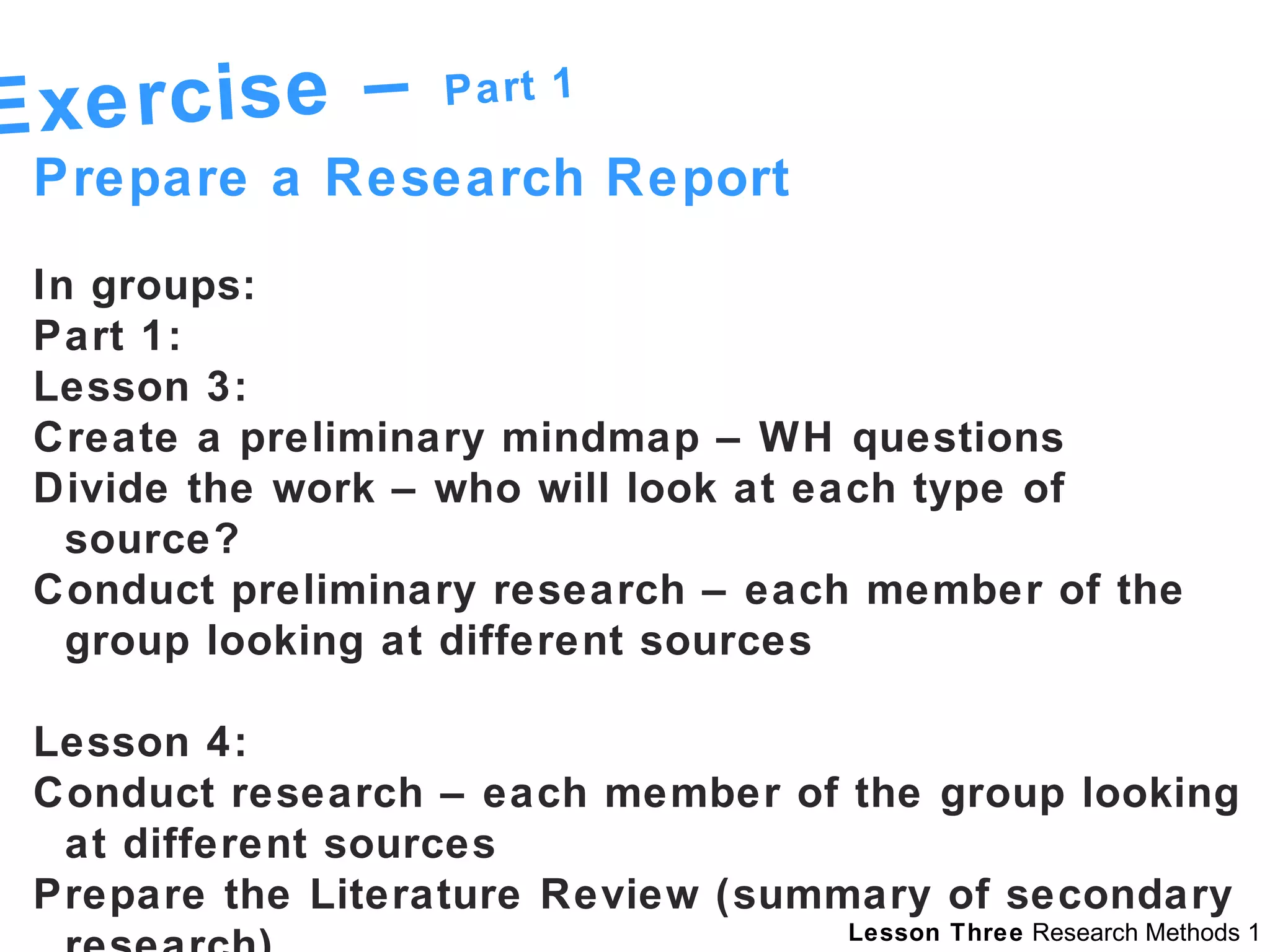
Exercise –  Part 1 Prepare a Research Report  In groups: Part 1:  Lesson 3:  Create a preliminary mindmap – WH questions Divide the work – who will look at each type of source? Conduct preliminary research – each member of the group looking at different sources Lesson 4:  Conduct research – each member of the group looking at different sources Prepare the Literature Review (summary of secondary research)
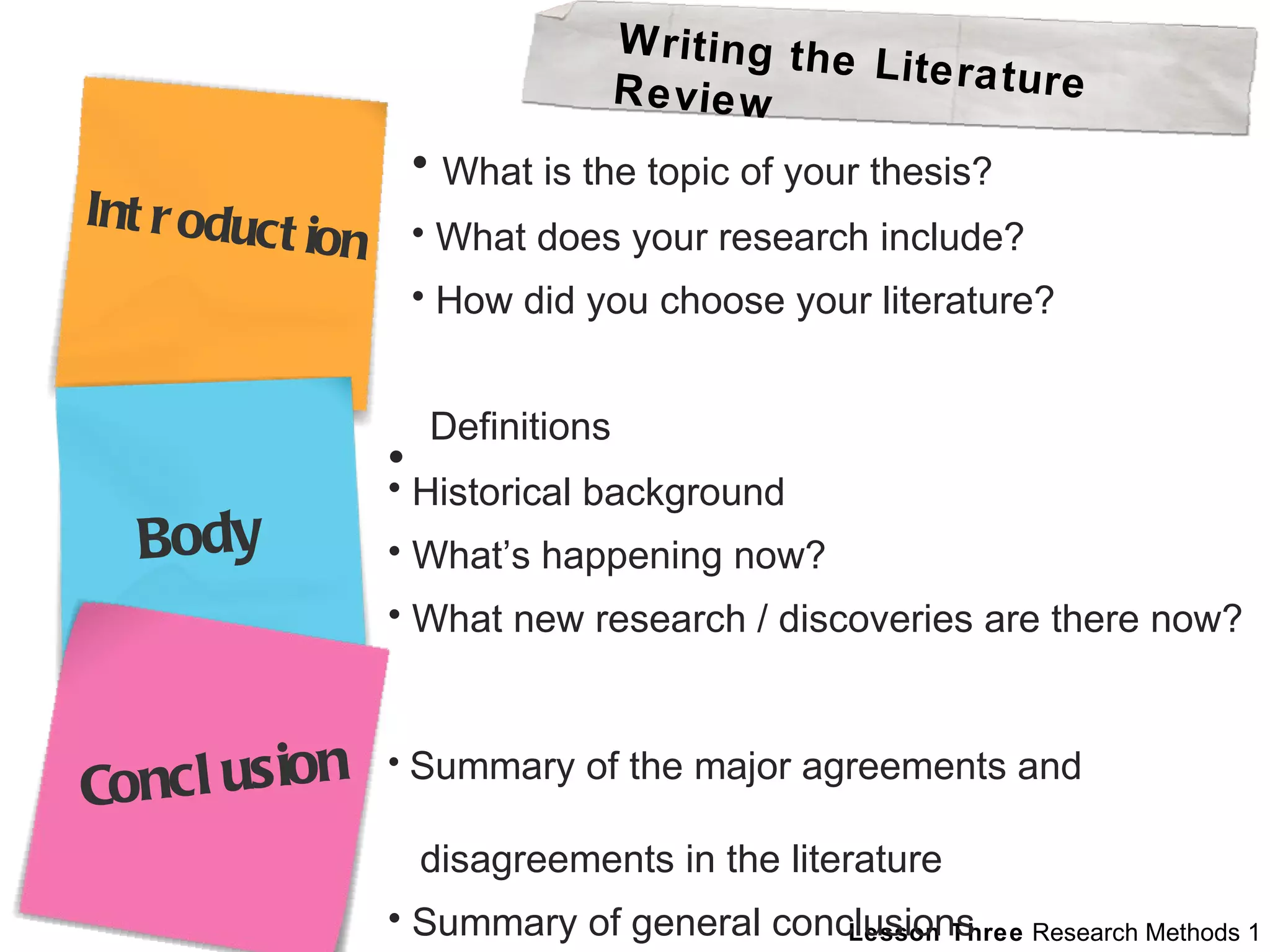
What is the topic of your thesis? What does your research include? How did you choose your literature? Definitions  Historical background What’s happening now? What new research / discoveries are there now? Summary of the major agreements and  disagreements in the literature Summary of general conclusions Writing the Literature Review Introduction Body Conclusion
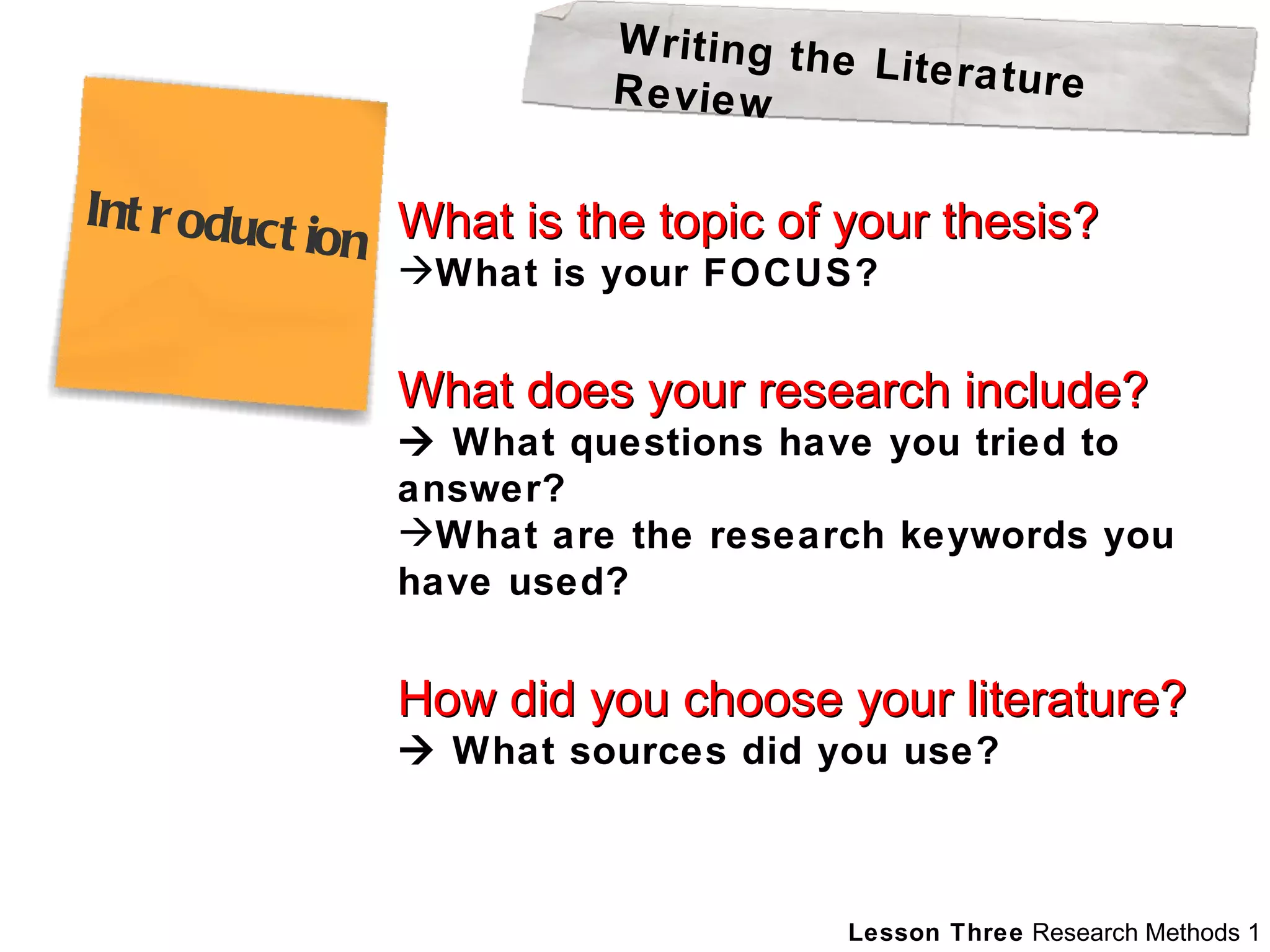
What is the topic of your thesis? What is your FOCUS? What does your research include?   What questions have you tried to answer? What are the research keywords you have used? How did you choose your literature?    What sources did you use? Writing the Literature Review Introduction
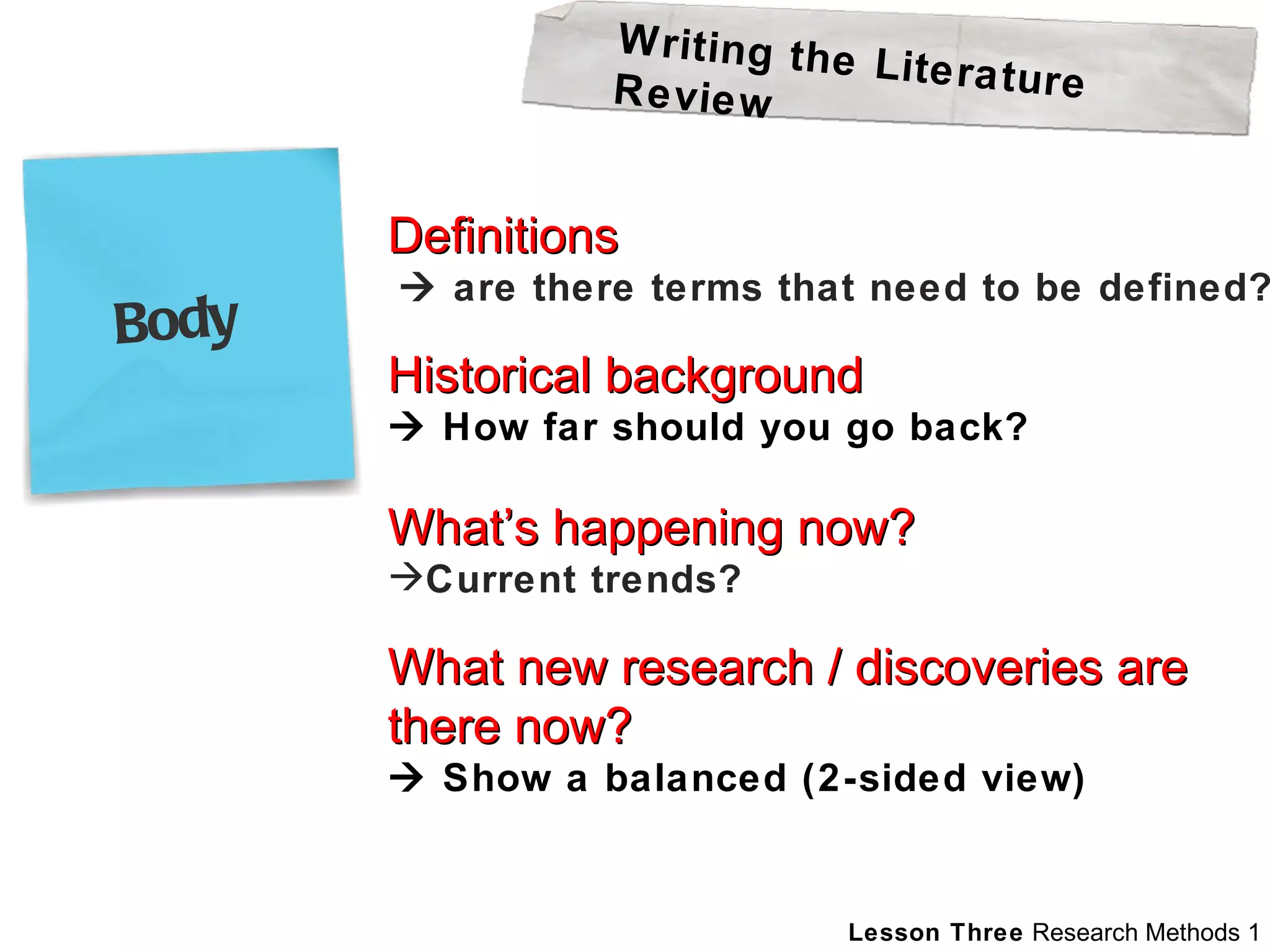
Definitions    are there terms that need to be defined? Historical background    How far should you go back? What’s happening now? Current trends?  What new research / discoveries are  there now?    Show a balanced (2-sided view) Writing the Literature Review Body
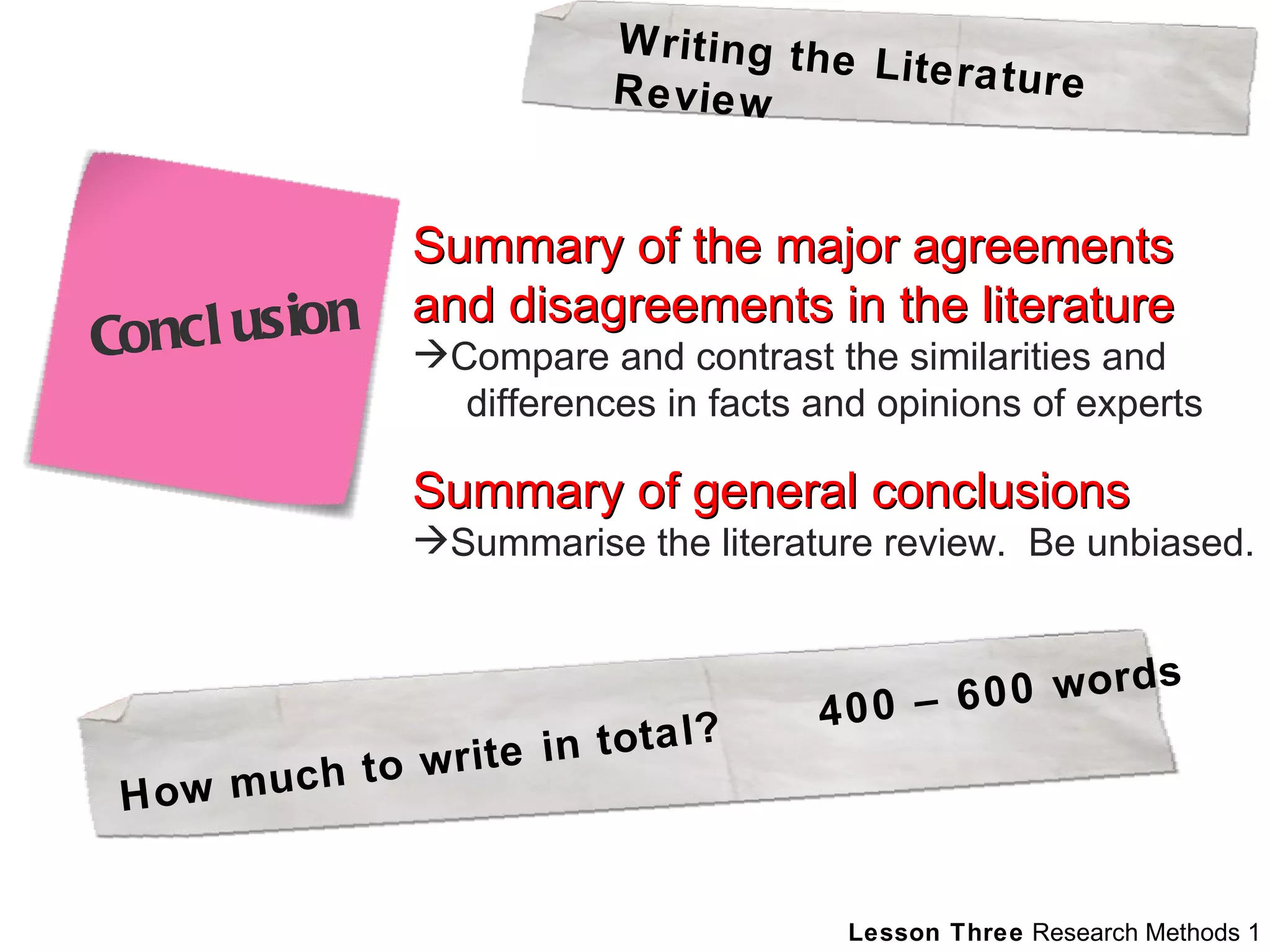
Summary of the major agreements and disagreements in the literature Compare and contrast the similarities and   differences in facts and opinions of experts Summary of general conclusions Summarise the literature review.  Be unbiased. Writing the Literature Review How much to write in total?  400 – 600 words Conclusion
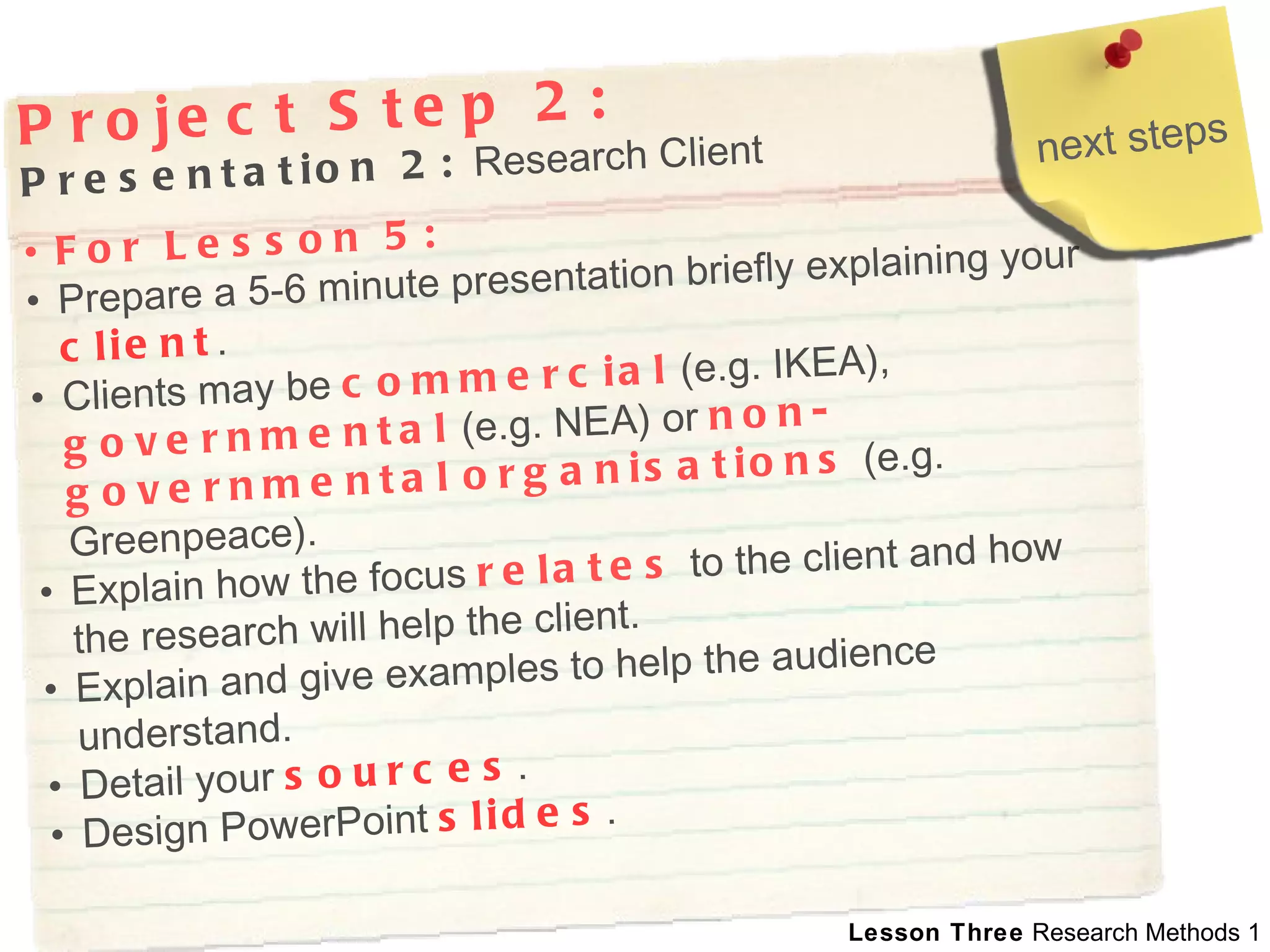
Project Step 2: Presentation 2:  Research Client For Lesson 5:   Prepare a 5-6 minute presentation briefly explaining your  client . Clients may be  commercial  (e.g. IKEA),  governmental  (e.g. NEA) or  non-governmental   organisations  (e.g. Greenpeace).  Explain how the focus   relates  to the client and how the research will help the client.  Explain and give examples to help the audience understand.  Detail your  sources .  Design PowerPoint  slides . next steps

Lesson 4 secondary research 2

  • 1.
  • 2.
    Students will …recognize primary and secondary approaches to research identify appropriate primary and secondary research sources categorize methods for primary and secondary research identify quantitative and qualitative approaches to primary research evaluate secondary research sources explore secondary sources online L e arning Out c om e s
  • 3.
    The searching forand gathering of information and ideas in response to a specific question The set of methods used to address a particular research problem research methodology
  • 4.
    Involves collecting andmeasuring data Often requires large data sets. For example, large numbers of people. Uses mathematical methods to analyse data Aims to achieve objective/scientific view of the subject Quantitative Involves understanding human behaviour and the reasons behind it Focus is on individuals and small groups Objectivity is not the goal , the aim is to understand one point of view, not all points of view Qualitative Primary Approaches
  • 5.
    Photo Ethnography StudyLiterature Review Questionnaire Literature Review Interview Survey The combination of methods in the study of the same topic (Visocky & Visocky, 2009) Triangulation
  • 6.
    A comprehensive investigationof material such as books and articles relating to the research topic. Literature review
  • 7.
    Use the C.R.A.P.test: Currency Reliability Authority Purpose (CRAP Test 2008) Evaluating Secondary Sources
  • 8.
       * Currency -      How recent is the information?      Are there more recent updates available?      Is it current enough for your topic? (CRAP Test 2008) Evaluating Secondary Sources
  • 9.
    *  Reliability -Is content of the resource primarily opinion? Is it balanced and evidenced? Does the creator provide references or sources for data or quotations? (CRAP Test 2008) Evaluating Secondary Sources
  • 10.
    *Authority - Whois the creator or author? What are his/her credentials? Is he/she an expert? Who is the published or sponsor? Are they reputable? (CRAP Test 2008) Evaluating Secondary Sources
  • 11.
    *  Purpose/Point ofView - Is it promotional or educational material? Are there advertisements on the website? Is this fact or opinion? Who is the intended audience? (CRAP Test 2008) Evaluating Secondary Sources
  • 12.
    Evaluate Wikipedia as a research source. Think about … Currency? Reliability? Authority? Purpose? Should you use it? Why/Why not? Only use Wikipedia … … for initial research … for background … as a stepping stone DO NOT use it … … as a source in an assignment … as your only source on a topic … because you’re lazy Internet Sources
  • 13.
  • 14.
    Always be waryof any one single source (in any medium — web, print, television or radio), or of multiple works that derive from a single source. Where articles have references to external sources (whether online or not) read the references and check whether they really do support what the article says. In most academic institutions, major references to Wikipedia, along with most encyclopedias, are unacceptable for a research paper. ( Wikipedia , 2011) Internet Sources
  • 15.
  • 16.
  • 17.
    What have youl e arned? There are 2 approaches to all research: primary and secondary These approaches are differentiated by the sources of data used The methods used in primary research depend upon the data desired Quantitative methods provide general, objective, often statistical data Qualitative methods provide individual, subjective data Secondary data must be carefully evaluated The Internet can be a rich source of secondary data if exploited wisely
  • 18.
    REFERENCES Collins,H 2010, Creative Research , AVA, London. CRAP Test 2008. Retrieved 12 January 2011 from http://loex2008collaborate.pbworks.com/w/page/18686701/The-CRAP-Test Summers, J & Smith, B 2003, Communication skills handbook: how to succeed in written and oral communication , 5th edn, John Wiley & Sons, Australia. Visocky O’Grady, K & Visocky O’Grady, J 2009, A Designer’s Research Manual , Rockport, USA.
  • 19.
    Exercise – Fashion Marketing / Fashion Design Prepare a Research Report on Fashion Trends. Key Question: Only fashion giants can dictate trends. In groups: Part 1: Conduct secondary research (Lesson 3 - 4) Lesson 3: Mindmap of ideas, preliminary internet searches Lesson 4: Evaluate research sources, prepare written portion of research report Part 2: Conduct primary research (Lesson 5 - 6) Part 3: Submit a short report on your findings (Lesson 9)
  • 20.
    Exercise – Part 1 Prepare a Research Report In groups: Part 1: Lesson 3: Create a preliminary mindmap – WH questions Divide the work – who will look at each type of source? Conduct preliminary research – each member of the group looking at different sources Lesson 4: Conduct research – each member of the group looking at different sources Prepare the Literature Review (summary of secondary research)
  • 21.
    Exercise – VC, IMD, Game Design Prepare a Research Report Key Question: The idea of sexiness is the best way to market a product. In groups: Part 1: Conduct secondary research (Lesson 3 - 4) Lesson 3: Mindmap of ideas, preliminary internet searches Lesson 4: Evaluate research sources, prepare written portion of research report Part 2: Conduct primary research (Lesson 5 - 6) Part 3: Submit a short report on your findings (Lesson 9)
  • 22.
    Exercise – Part 1 Prepare a Research Report In groups: Part 1: Lesson 3: Create a preliminary mindmap – WH questions Divide the work – who will look at each type of source? Conduct preliminary research – each member of the group looking at different sources Lesson 4: Conduct research – each member of the group looking at different sources Prepare the Literature Review (summary of secondary research)
  • 23.
    Exercise – Interior Design Prepare a Research Report Key Question: An evaluation of Moshe Safdie’s design of the Marina Bay Sands. In groups: Part 1: Conduct secondary research (Lesson 3 - 4) Lesson 3: Mindmap of ideas, preliminary internet searches Lesson 4: Evaluate research sources, prepare written portion of research report Part 2: Conduct primary research (Lesson 5 - 6) Part 3: Submit a short report on your findings (Lesson 9)
  • 24.
    Exercise – Part 1 Prepare a Research Report In groups: Part 1: Lesson 3: Create a preliminary mindmap – WH questions Divide the work – who will look at each type of source? Conduct preliminary research – each member of the group looking at different sources Lesson 4: Conduct research – each member of the group looking at different sources Prepare the Literature Review (summary of secondary research)
  • 25.
    What is thetopic of your thesis? What does your research include? How did you choose your literature? Definitions Historical background What’s happening now? What new research / discoveries are there now? Summary of the major agreements and disagreements in the literature Summary of general conclusions Writing the Literature Review Introduction Body Conclusion
  • 26.
    What is thetopic of your thesis? What is your FOCUS? What does your research include?  What questions have you tried to answer? What are the research keywords you have used? How did you choose your literature?  What sources did you use? Writing the Literature Review Introduction
  • 27.
    Definitions  are there terms that need to be defined? Historical background  How far should you go back? What’s happening now? Current trends? What new research / discoveries are there now?  Show a balanced (2-sided view) Writing the Literature Review Body
  • 28.
    Summary of themajor agreements and disagreements in the literature Compare and contrast the similarities and differences in facts and opinions of experts Summary of general conclusions Summarise the literature review. Be unbiased. Writing the Literature Review How much to write in total? 400 – 600 words Conclusion
  • 29.
    Project Step 2:Presentation 2: Research Client For Lesson 5: Prepare a 5-6 minute presentation briefly explaining your client . Clients may be commercial (e.g. IKEA), governmental (e.g. NEA) or non-governmental organisations (e.g. Greenpeace). Explain how the focus relates to the client and how the research will help the client. Explain and give examples to help the audience understand. Detail your sources . Design PowerPoint slides . next steps