Qualitative
Data Analysis
Presented To: Dr. Jam Muhammad Zafar
Presented By: Ghazala Shaheen
PHD Scholar
Khwaja Fareed University of Engineering and
Information Technology Rahim Yar Khan
Outline
• Qualitative research
• Analysis methods
• Validity and generalizability
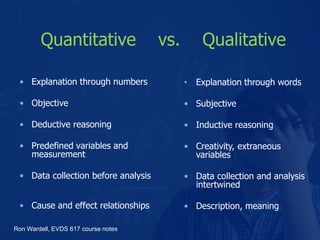
Quantitative vs. Qualitative
• Explanation through numbers
• Objective
• Deductive reasoning
• Predefined variables and
measurement
• Data collection before analysis
• Cause and effect relationships
• Explanation through words
• Subjective
• Inductive reasoning
• Creativity, extraneous
variables
• Data collection and analysis
intertwined
• Description, meaning
Ron Wardell, EVDS 617 course notes
Qualitative Research Goals
• Meaning: how people see the world
• Context: the world in which people act
• Process: what actions and activities people do
• Reasoning: why people act and behave the way they do
Maxwell, 2005
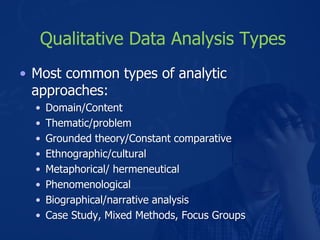
Qualitative Data Analysis Types
• Most common types of analytic
approaches:
• Domain/Content
• Thematic/problem
• Grounded theory/Constant comparative
• Ethnographic/cultural
• Metaphorical/ hermeneutical
• Phenomenological
• Biographical/narrative analysis
• Case Study, Mixed Methods, Focus Groups
Qualitative Research Methods
• Interviews
• Ethnographic interviews (Spradley, 1979)
• Contextual interviews (Holtzblatt and Jones, 1995)
• Ethnographic observation (Spradley, 1980)
• Participatory design sessions (Sanders, 2005)
• Field deployments
Getting ‘Good’ Qualitative Results
• Depends on:
• The quality of the data collector
• The quality of the data analyzer
• The quality of the presenter / writer
Ron Wardell, EVDS 617 course notes
Types of Qualitative Data
• Structured text (writings field notes, stories, survey
comments, news articles, books etc )
• Un Structured text ( transcriptions, interviews, focus
group, conversation )
• Audio recordings of conversations, music
• Video recordings of activities ( graphic, pictures, art,
visuals )
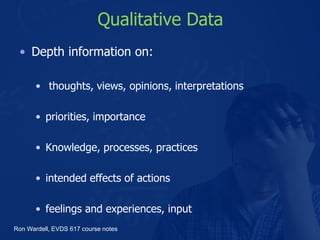
Qualitative Data
• Depth information on:
• thoughts, views, opinions, interpretations
• priorities, importance
• Knowledge, processes, practices
• intended effects of actions
• feelings and experiences, input
Ron Wardell, EVDS 617 course notes
Outline
• Qualitative research
• Analysis methods
• Validity and generalizability
Four Basic Steps
• All qualitative data analysis involves the same
four essential steps:
• 1. Raw data management - data cleaning
• 2. Data reduction - chunking, coding
• 3. Data interpretation - coding, clustering
• 4. Data representation - telling the story
making sense of the data for others
Data Analysis
• Open Coding
• Systematic Coding
• Affinity Diagramming
Open Coding
• Goal: Treat data as answers to open-ended
questions
• ask data specific questions
• assign codes for answers
• record theoretical notes
• Moving from describing the data units to
inferring meaning
Strauss and Corbin, 1998, Ron Wardell, EVDS 617 course notes
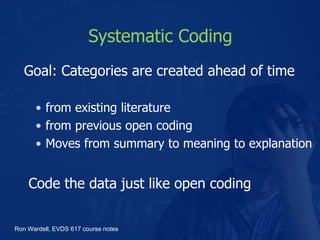
Systematic Coding
Goal: Categories are created ahead of time
• from existing literature
• from previous open coding
• Moves from summary to meaning to explanation
Code the data just like open coding
Ron Wardell, EVDS 617 course notes
Affinity Diagramming
Goal: what are the main themes?
• Write ideas on sticky notes
• Place notes on a large wall / surface
• Group notes hierarchically to see main themes
• Moves from initial theory to developing
relationships between codes for emerging
theory
Holtzblatt et al., 2005
Outline
• Qualitative research
• Analysis methods
• Validity and generalizability
Validity Threats
• Bias
• researcher’s influence on the study
• e.g., studying one’s own culture
• Reactivity
• researcher's effect on the setting or people
• e.g., people may do things differently
Maxwell, 2005
Validity Tests
Maxwell, 2005
• Negative cases
• Triangulation
• Quasi-statistics
• Comparison
• Intensive / long term
• Rich data
• Respondent validation
• Intervention
Generalizability
• Internal generalizability
• do findings extend within the group studied?
• External generalizability
• do findings extend outside the group studied?
• Face generalizability
• there is no reason to believe the results don’t
generalize
Maxwell, 2005
Summary
• Qualitative goals:
• meaning, context, process, reasoning
• Good qualitative research:
• data collector / analyzer / presenter
• Qualitative data:
• detailed descriptions (audio, written, video)
Summary
• methods:
• open coding
• systematic coding
• affinity diagramming
• Report descriptions / scenarios / quotes
• Look for face generalizability
• Use validity tests
References
1. Dix, A., Finlay, J., Abowd, G., & Beale, R., (1998) Human Computer Interaction, 2nd ed. Toronto: Prentice-Hall.
- Chapter 11: qualitative methods in general
2. Holtzblatt, K, and Jones, S., (1995) Conducting and Analyzing a Contextual Interview, In Readings in Human-Computer
Interaction: Toward the Year 2000, 2nd ed., R.M. Baecker,et al., Editors, Morgan Kaufman, pp. 241-253.
- conducting and analyzing contextual interviews
3. Holtzblatt, K, Wendell, J., and Wood, S., (2005) Rapid Contextual Design: A How-To Guide to Key Techniques for User-
Centered Design, Morgan Kaufmann.
- Chapter 8: building affinity diagrams
4. Maxwell, J., (2005) Qualitative Research Design, In Applied Social Research Methods Series, Volume 41.
- Chapter 1: a model for qualitative research design
- Chapter 5: choosing qualitative methods and analysis
- Chapter 6: validity and generalizability
5. Neustaedter, C. 2007. Domestic Awareness and Family Calendars, PhD Dissertation, University of Calgary, Canada.
- example qualitative studies, analysis, and results reporting
6. Sanders, E.B. 1999. From User-Centered to Participatory Design Approaches, In Design and Social Sciences, J. Frascara
(Ed.), Taylor and Francis Books Limited.
- participatory design for idea generation
7. Spradley, J. (1979) The Ethnographic Interview, Holt, Rinehart & Winston.
- Part 2, Step 2: interviewing an informant
- Part 2, Step 5: analyzing ethnographic interviews
8. Spradley, J., (1980) Participant Observation, Harcourt Brace Jovanovich.
- Part 2, Step 2: doing participant observation
- Part 2, Step 3: making an ethnographic record
9. Strauss, A., and Corbin, J., (1998). Basics of Qualitative Research: Techniques and Procedures for Developing Grounded
Theory, SAGE Publications.
- Part 2: coding procedures
Thank you

Assignment presentation QDA analysis

  • 2.
    Qualitative Data Analysis Presented To:Dr. Jam Muhammad Zafar Presented By: Ghazala Shaheen PHD Scholar Khwaja Fareed University of Engineering and Information Technology Rahim Yar Khan
  • 3.
    Outline • Qualitative research •Analysis methods • Validity and generalizability
  • 4.
    Quantitative vs. Qualitative •Explanation through numbers • Objective • Deductive reasoning • Predefined variables and measurement • Data collection before analysis • Cause and effect relationships • Explanation through words • Subjective • Inductive reasoning • Creativity, extraneous variables • Data collection and analysis intertwined • Description, meaning Ron Wardell, EVDS 617 course notes
  • 5.
    Qualitative Research Goals •Meaning: how people see the world • Context: the world in which people act • Process: what actions and activities people do • Reasoning: why people act and behave the way they do Maxwell, 2005
  • 6.
    Qualitative Data AnalysisTypes • Most common types of analytic approaches: • Domain/Content • Thematic/problem • Grounded theory/Constant comparative • Ethnographic/cultural • Metaphorical/ hermeneutical • Phenomenological • Biographical/narrative analysis • Case Study, Mixed Methods, Focus Groups
  • 7.
    Qualitative Research Methods •Interviews • Ethnographic interviews (Spradley, 1979) • Contextual interviews (Holtzblatt and Jones, 1995) • Ethnographic observation (Spradley, 1980) • Participatory design sessions (Sanders, 2005) • Field deployments
  • 8.
    Getting ‘Good’ QualitativeResults • Depends on: • The quality of the data collector • The quality of the data analyzer • The quality of the presenter / writer Ron Wardell, EVDS 617 course notes
  • 9.
    Types of QualitativeData • Structured text (writings field notes, stories, survey comments, news articles, books etc ) • Un Structured text ( transcriptions, interviews, focus group, conversation ) • Audio recordings of conversations, music • Video recordings of activities ( graphic, pictures, art, visuals )
  • 10.
    Qualitative Data • Depthinformation on: • thoughts, views, opinions, interpretations • priorities, importance • Knowledge, processes, practices • intended effects of actions • feelings and experiences, input Ron Wardell, EVDS 617 course notes
  • 11.
    Outline • Qualitative research •Analysis methods • Validity and generalizability
  • 12.
    Four Basic Steps •All qualitative data analysis involves the same four essential steps: • 1. Raw data management - data cleaning • 2. Data reduction - chunking, coding • 3. Data interpretation - coding, clustering • 4. Data representation - telling the story making sense of the data for others
  • 13.
    Data Analysis • OpenCoding • Systematic Coding • Affinity Diagramming
  • 14.
    Open Coding • Goal:Treat data as answers to open-ended questions • ask data specific questions • assign codes for answers • record theoretical notes • Moving from describing the data units to inferring meaning Strauss and Corbin, 1998, Ron Wardell, EVDS 617 course notes
  • 15.
    Systematic Coding Goal: Categoriesare created ahead of time • from existing literature • from previous open coding • Moves from summary to meaning to explanation Code the data just like open coding Ron Wardell, EVDS 617 course notes
  • 16.
    Affinity Diagramming Goal: whatare the main themes? • Write ideas on sticky notes • Place notes on a large wall / surface • Group notes hierarchically to see main themes • Moves from initial theory to developing relationships between codes for emerging theory Holtzblatt et al., 2005
  • 17.
    Outline • Qualitative research •Analysis methods • Validity and generalizability
  • 18.
    Validity Threats • Bias •researcher’s influence on the study • e.g., studying one’s own culture • Reactivity • researcher's effect on the setting or people • e.g., people may do things differently Maxwell, 2005
  • 19.
    Validity Tests Maxwell, 2005 •Negative cases • Triangulation • Quasi-statistics • Comparison • Intensive / long term • Rich data • Respondent validation • Intervention
  • 20.
    Generalizability • Internal generalizability •do findings extend within the group studied? • External generalizability • do findings extend outside the group studied? • Face generalizability • there is no reason to believe the results don’t generalize Maxwell, 2005
  • 21.
    Summary • Qualitative goals: •meaning, context, process, reasoning • Good qualitative research: • data collector / analyzer / presenter • Qualitative data: • detailed descriptions (audio, written, video)
  • 22.
    Summary • methods: • opencoding • systematic coding • affinity diagramming • Report descriptions / scenarios / quotes • Look for face generalizability • Use validity tests
  • 23.
    References 1. Dix, A.,Finlay, J., Abowd, G., & Beale, R., (1998) Human Computer Interaction, 2nd ed. Toronto: Prentice-Hall. - Chapter 11: qualitative methods in general 2. Holtzblatt, K, and Jones, S., (1995) Conducting and Analyzing a Contextual Interview, In Readings in Human-Computer Interaction: Toward the Year 2000, 2nd ed., R.M. Baecker,et al., Editors, Morgan Kaufman, pp. 241-253. - conducting and analyzing contextual interviews 3. Holtzblatt, K, Wendell, J., and Wood, S., (2005) Rapid Contextual Design: A How-To Guide to Key Techniques for User- Centered Design, Morgan Kaufmann. - Chapter 8: building affinity diagrams 4. Maxwell, J., (2005) Qualitative Research Design, In Applied Social Research Methods Series, Volume 41. - Chapter 1: a model for qualitative research design - Chapter 5: choosing qualitative methods and analysis - Chapter 6: validity and generalizability 5. Neustaedter, C. 2007. Domestic Awareness and Family Calendars, PhD Dissertation, University of Calgary, Canada. - example qualitative studies, analysis, and results reporting 6. Sanders, E.B. 1999. From User-Centered to Participatory Design Approaches, In Design and Social Sciences, J. Frascara (Ed.), Taylor and Francis Books Limited. - participatory design for idea generation 7. Spradley, J. (1979) The Ethnographic Interview, Holt, Rinehart & Winston. - Part 2, Step 2: interviewing an informant - Part 2, Step 5: analyzing ethnographic interviews 8. Spradley, J., (1980) Participant Observation, Harcourt Brace Jovanovich. - Part 2, Step 2: doing participant observation - Part 2, Step 3: making an ethnographic record 9. Strauss, A., and Corbin, J., (1998). Basics of Qualitative Research: Techniques and Procedures for Developing Grounded Theory, SAGE Publications. - Part 2: coding procedures
  • 24.