Albia Dugger • Miami Dade College
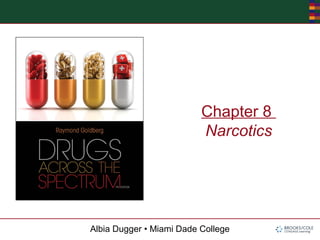
Chapter 8
Narcotics
History
• Opium-based drugs such as morphine and heroin are referred
to as narcotics
• Throughout history, opium has figured prominently in wars
between nations, the economies of some countries, in
medicine, and in the work of lyricists and authors
• Laudanum, a mixture of opium and alcohol, was developed in
the 1500s by Paracelsus
Opium Poppies in Afghanistan
History
• By 1906, opium and its derivatives were found in more than
50,000 medicines
• The hypodermic needle hastened the effects of morphine
• By the late 1800s, an estimated 4.59 per 1,000 people were
dependent on opiates
• Ironically, the drug promoted to help people overcome
morphine dependency was heroin
History
• The Harrison Act of 1914 made narcotic use without a
prescription illegal
• The typical opiate addict shifted from a middle-class woman
to a young, lower-class man
• Perceptions of the opiate addict went from unfortunate victim
to a deviant criminal who was a threat to society
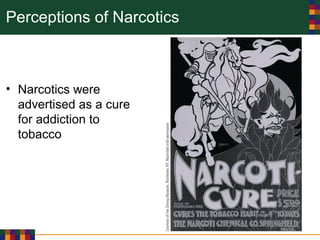
Perceptions of Narcotics
• Narcotics were
advertised as a cure
for addiction to
tobacco
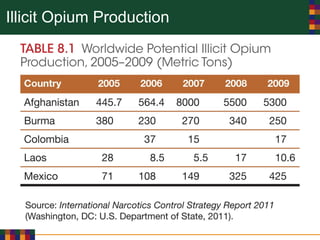
Illicit Opium Production
Extent of Narcotic Use
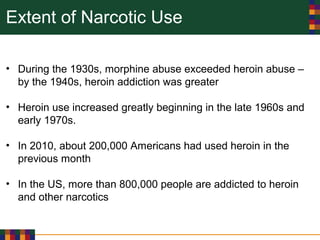
• During the 1930s, morphine abuse exceeded heroin abuse –
by the 1940s, heroin addiction was greater
• Heroin use increased greatly beginning in the late 1960s and
early 1970s.
• In 2010, about 200,000 Americans had used heroin in the
previous month
• In the US, more than 800,000 people are addicted to heroin
and other narcotics
Students Reporting Heroin Use
Extent of Narcotic Use
• Controlled users (chippers) fit the following pattern:
• Seldom used the drug more than once a day
• Could keep opiates around without using them
• Avoided opiates when addicts were present
• Did not use opiates to alleviate depression
• Seldom binged on opiates
• Knew the opiate source or dealer
• Took opiates for recreation or relaxation
• Did not take opiates to escape life’s daily hassles
Extent of Narcotic Use
• 68% of heroin addicts admitted into treatment are male, 59%
are White, and ¾ have been in treatment previously
• Increase in abuse is significantly higher in rural areas than in
metropolitan areas
• During the Vietnam War, 10-15% of US troops were addicted
to heroin
Worldwide Comparison
• More than 15 million people worldwide illegally use opium,
morphine, and heroin
• Afghanistan is the largest heroin producer worldwide
• China is believed to have the largest number of narcotic
addicts
• An estimated 24 million to 34 million people throughout the
world use opium
Characteristics of Narcotics
• Opium poppy
• Plant from which narcotics are derived
• Narcotic
• An opium-based central nervous system depressant used
to relieve pain and diarrhea
• Opiate
• A class of drugs derived from opium
• Opioid
• Drugs with characteristics similar to those of opium
Opium
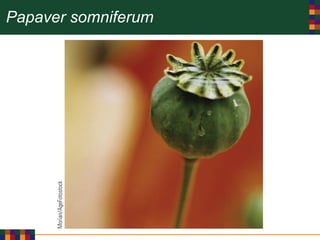
• The opium poppy, Papaver somniferum, is cultivated
throughout Asia and the Middle East
• When the seedpod is cut open, it exudes a white, milky sap
which dries to a brown, thick, gummy resin (opium)
• There is only a ten-day window in which opium can be made
from the resin of the opium poppy
Papaver somniferum
Morphine
• In 1803, Friedrich Serturner of Germany synthesized
morphine from opium and called it morphium
• Morphine is about ten times more potent than opium,
although physicians thought it was safer and purer
• Codeine was isolated from opium 30 years later
• How morphine is administered and its dosage has a bearing
on its effectiveness
Heroin
• Heroin (diacetylmorphine) was first synthesized from
morphine in 1874
• When heroin was introduced, it was believed not to be
addicting
• When smoked, its effects are rapid – it is ineffective when
ingested
• Heroin is three to ten times more powerful than morphine
because it is more lipid-soluble
Synthetic Opiates
• Fentanyl (Sublimaze)
• Synthetic narcotic 1,000 times more potent than heroin
• Greater risk of a fatal overdose than heroin
• China white
• Synthetic analgesic drug derived from fentanyl that mimics
heroin but is considerably more potent
• Meperidine
• Synthetic derivative of morphine widely used as an
analgesic – less potent than morphine
Synthetic Opiates
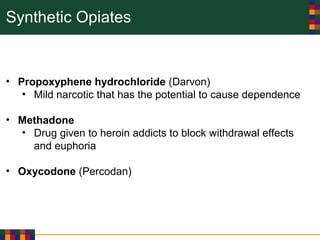
• Propoxyphene hydrochloride (Darvon)
• Mild narcotic that has the potential to cause dependence
• Methadone
• Drug given to heroin addicts to block withdrawal effects
and euphoria
• Oxycodone (Percodan)
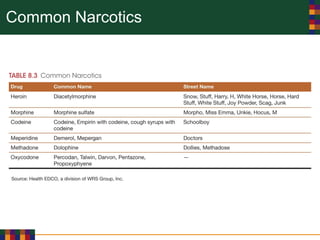
Common Narcotics
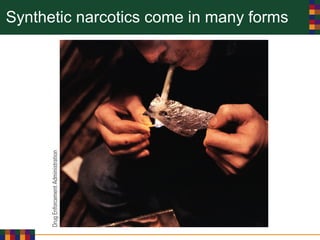
Synthetic narcotics come in many forms
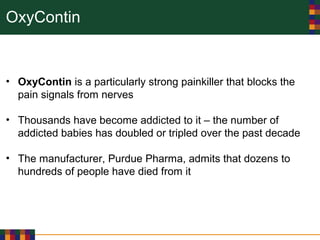
OxyContin
• OxyContin is a particularly strong painkiller that blocks the
pain signals from nerves
• Thousands have become addicted to it – the number of
addicted babies has doubled or tripled over the past decade
• The manufacturer, Purdue Pharma, admits that dozens to
hundreds of people have died from it
Physical and Psychological Effects
• Opiates mimic endorphins in the brain
• Physical problems frequently result from using narcotics in
unclean, unsafe environments
• Narcotics often are contaminated with other drugs, sugar,
starch, powdered milk, quinine, or strychnine
• Sharing needles is a major risk for HIV infection
Physical Effects
• Narcotics cause drowsiness, vomiting, nausea, and difficulty
concentrating
• Euphoria is followed by gradually anesthetizing sensations,
then sleep and lethargy
• Opiates impede the ability to urinate, and can cause
potentially serious constipation
• Male addicts have difficulty achieving an erection
Emotional and Social Effects
• Narcotics relieve psychic distress arising from anxiety,
hostility, feelings of inadequacy, and aggression
• Heroin addicts have difficulty regulating inhibitions and
frequently make risky decisions
• Users sometimes ignore or become alienated and hostile
toward friends and family members
• Heroin use has been associated with criminal behavior,
unemployment, and violence
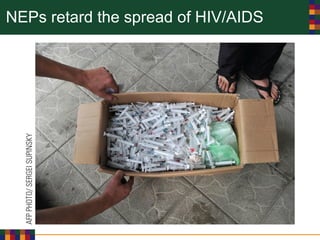
Needle-Exchange Programs
• The second most common HIV risk is injection drug use
• Many health care personnel favor needle-exchange programs
(NEPs) or giving hypodermic needles to addicts at no cost
• One study reported a 5.9% decrease in HIV infection rates in
cities with NEPs
• Congress banned federal funding for NEPs in 1988 and has
since renewed the ban numerous times
NEPs retard the spread of HIV/AIDS
Dependency
• Physical dependence, psychological dependence, and
tolerance develop quickly
• Withdrawal symptoms include:
• Diarrhea and runny nose
• Insomnia
• Muscle aches and pains
• Dysphoria
• Fatigue
• Anxiety and irritability
• Stomach cramps
Dependency
• Factors affecting the difficulty of withdrawal:
• Availability of a social support network
• Addict’s desire to stop
• Physical environment during withdrawal
• Convenience and practicality of alternative opiates
• About half of narcotic abusers become dependent:
• People can become drug-dependent in less than two
weeks if they take increasing amounts of narcotics
• Average addiction is six to eight years
Toxicity
• Narcotics are capable of depressing the respiratory system to
the point of death
• According to the CDC, painkillers kill twice as many people as
cocaine and five times more people than heroin
• Synergistic effect of narcotics and other drugs can be fatal
• Death from an overdose of heroin is slow – people who die
quickly are likely to die from anaphylactic shock
Medical Benefits
• Analgesics
• Patients receiving morphine are aware of pain, but their
perception and response are altered in positive ways
• Gastrointestinal difficulties
• In less-developed countries, narcotics treat diarrhea that is
a major cause of death among the young and elderly
• Cough suppressant (antitussive)
• Narcotics slow activity of the cough control center
• Nonopiate dextromethorphan is chemically similar
Treatment and Support Groups
• The recidivism (relapse) rate for narcotic addiction is high,
but success improves the longer one is off drugs
• Most addicts are withdrawn from narcotics gradually, although
rapid detoxification can be just as effective
• Addicts in withdrawal receive drugs such as clonidine,
buprenorphine, naltrexone, naloxone, or methadone
• Typically, detoxification is completed in 10 to 14 days on an
inpatient basis
Narcotic Antagonists
• Drugs that block narcotics from producing their reinforcing
effects are called antagonists
• They remove the physical need for opiates, but not the
psychic need
• Examples are naltrexone, buprenorphine, nalorphine,
naloxone, and cyclazocine
Methadone
• Since 1960, methadone has been the drug used most
frequently to treat heroin addiction
• Methadone is highly specific to opiate addiction
• Methadone use leads to addiction, though many people
consider it preferable to heroin addiction
• Methadone has to be administered daily to avert withdrawal
symptoms
Levo-alpha-acetylmethadol (LAAM)
• In 1993 the FDA approved an alternative to methadone called
levo-alpha-acetylmethadol (LAAM)
• Can block the withdrawal symptoms for up to 3 days
• LAAM produces fewer withdrawal symptoms than methadone,
and could help patients who do not benefit from methadone
• Individuals taking LAAM are more likely to stay in treatment
Narcotics Anonymous
• Modeled on Alcoholics Anonymous, Narcotics Anonymous
(NA) is a self-help group designed to help people who are
addicted to heroin and medically prescribed narcotics
• More than 58,000 group meetings in 2010
• NA addresses all drugs including alcohol

SOC 204 Goldberg Chapter 8

  • 1.
    Albia Dugger •Miami Dade College Chapter 8 Narcotics
  • 2.
    History • Opium-based drugssuch as morphine and heroin are referred to as narcotics • Throughout history, opium has figured prominently in wars between nations, the economies of some countries, in medicine, and in the work of lyricists and authors • Laudanum, a mixture of opium and alcohol, was developed in the 1500s by Paracelsus
  • 3.
    Opium Poppies inAfghanistan
  • 4.
    History • By 1906,opium and its derivatives were found in more than 50,000 medicines • The hypodermic needle hastened the effects of morphine • By the late 1800s, an estimated 4.59 per 1,000 people were dependent on opiates • Ironically, the drug promoted to help people overcome morphine dependency was heroin
  • 5.
    History • The HarrisonAct of 1914 made narcotic use without a prescription illegal • The typical opiate addict shifted from a middle-class woman to a young, lower-class man • Perceptions of the opiate addict went from unfortunate victim to a deviant criminal who was a threat to society
  • 6.
    Perceptions of Narcotics •Narcotics were advertised as a cure for addiction to tobacco
  • 7.
  • 8.
    Extent of NarcoticUse • During the 1930s, morphine abuse exceeded heroin abuse – by the 1940s, heroin addiction was greater • Heroin use increased greatly beginning in the late 1960s and early 1970s. • In 2010, about 200,000 Americans had used heroin in the previous month • In the US, more than 800,000 people are addicted to heroin and other narcotics
  • 9.
  • 10.
    Extent of NarcoticUse • Controlled users (chippers) fit the following pattern: • Seldom used the drug more than once a day • Could keep opiates around without using them • Avoided opiates when addicts were present • Did not use opiates to alleviate depression • Seldom binged on opiates • Knew the opiate source or dealer • Took opiates for recreation or relaxation • Did not take opiates to escape life’s daily hassles
  • 11.
    Extent of NarcoticUse • 68% of heroin addicts admitted into treatment are male, 59% are White, and ¾ have been in treatment previously • Increase in abuse is significantly higher in rural areas than in metropolitan areas • During the Vietnam War, 10-15% of US troops were addicted to heroin
  • 12.
    Worldwide Comparison • Morethan 15 million people worldwide illegally use opium, morphine, and heroin • Afghanistan is the largest heroin producer worldwide • China is believed to have the largest number of narcotic addicts • An estimated 24 million to 34 million people throughout the world use opium
  • 13.
    Characteristics of Narcotics •Opium poppy • Plant from which narcotics are derived • Narcotic • An opium-based central nervous system depressant used to relieve pain and diarrhea • Opiate • A class of drugs derived from opium • Opioid • Drugs with characteristics similar to those of opium
  • 14.
    Opium • The opiumpoppy, Papaver somniferum, is cultivated throughout Asia and the Middle East • When the seedpod is cut open, it exudes a white, milky sap which dries to a brown, thick, gummy resin (opium) • There is only a ten-day window in which opium can be made from the resin of the opium poppy
  • 15.
  • 16.
    Morphine • In 1803,Friedrich Serturner of Germany synthesized morphine from opium and called it morphium • Morphine is about ten times more potent than opium, although physicians thought it was safer and purer • Codeine was isolated from opium 30 years later • How morphine is administered and its dosage has a bearing on its effectiveness
  • 17.
    Heroin • Heroin (diacetylmorphine)was first synthesized from morphine in 1874 • When heroin was introduced, it was believed not to be addicting • When smoked, its effects are rapid – it is ineffective when ingested • Heroin is three to ten times more powerful than morphine because it is more lipid-soluble
  • 18.
    Synthetic Opiates • Fentanyl(Sublimaze) • Synthetic narcotic 1,000 times more potent than heroin • Greater risk of a fatal overdose than heroin • China white • Synthetic analgesic drug derived from fentanyl that mimics heroin but is considerably more potent • Meperidine • Synthetic derivative of morphine widely used as an analgesic – less potent than morphine
  • 19.
    Synthetic Opiates • Propoxyphenehydrochloride (Darvon) • Mild narcotic that has the potential to cause dependence • Methadone • Drug given to heroin addicts to block withdrawal effects and euphoria • Oxycodone (Percodan)
  • 20.
  • 21.
  • 22.
    OxyContin • OxyContin isa particularly strong painkiller that blocks the pain signals from nerves • Thousands have become addicted to it – the number of addicted babies has doubled or tripled over the past decade • The manufacturer, Purdue Pharma, admits that dozens to hundreds of people have died from it
  • 23.
    Physical and PsychologicalEffects • Opiates mimic endorphins in the brain • Physical problems frequently result from using narcotics in unclean, unsafe environments • Narcotics often are contaminated with other drugs, sugar, starch, powdered milk, quinine, or strychnine • Sharing needles is a major risk for HIV infection
  • 24.
    Physical Effects • Narcoticscause drowsiness, vomiting, nausea, and difficulty concentrating • Euphoria is followed by gradually anesthetizing sensations, then sleep and lethargy • Opiates impede the ability to urinate, and can cause potentially serious constipation • Male addicts have difficulty achieving an erection
  • 25.
    Emotional and SocialEffects • Narcotics relieve psychic distress arising from anxiety, hostility, feelings of inadequacy, and aggression • Heroin addicts have difficulty regulating inhibitions and frequently make risky decisions • Users sometimes ignore or become alienated and hostile toward friends and family members • Heroin use has been associated with criminal behavior, unemployment, and violence
  • 26.
    Needle-Exchange Programs • Thesecond most common HIV risk is injection drug use • Many health care personnel favor needle-exchange programs (NEPs) or giving hypodermic needles to addicts at no cost • One study reported a 5.9% decrease in HIV infection rates in cities with NEPs • Congress banned federal funding for NEPs in 1988 and has since renewed the ban numerous times
  • 27.
    NEPs retard thespread of HIV/AIDS
  • 28.
    Dependency • Physical dependence,psychological dependence, and tolerance develop quickly • Withdrawal symptoms include: • Diarrhea and runny nose • Insomnia • Muscle aches and pains • Dysphoria • Fatigue • Anxiety and irritability • Stomach cramps
  • 29.
    Dependency • Factors affectingthe difficulty of withdrawal: • Availability of a social support network • Addict’s desire to stop • Physical environment during withdrawal • Convenience and practicality of alternative opiates • About half of narcotic abusers become dependent: • People can become drug-dependent in less than two weeks if they take increasing amounts of narcotics • Average addiction is six to eight years
  • 30.
    Toxicity • Narcotics arecapable of depressing the respiratory system to the point of death • According to the CDC, painkillers kill twice as many people as cocaine and five times more people than heroin • Synergistic effect of narcotics and other drugs can be fatal • Death from an overdose of heroin is slow – people who die quickly are likely to die from anaphylactic shock
  • 31.
    Medical Benefits • Analgesics •Patients receiving morphine are aware of pain, but their perception and response are altered in positive ways • Gastrointestinal difficulties • In less-developed countries, narcotics treat diarrhea that is a major cause of death among the young and elderly • Cough suppressant (antitussive) • Narcotics slow activity of the cough control center • Nonopiate dextromethorphan is chemically similar
  • 32.
    Treatment and SupportGroups • The recidivism (relapse) rate for narcotic addiction is high, but success improves the longer one is off drugs • Most addicts are withdrawn from narcotics gradually, although rapid detoxification can be just as effective • Addicts in withdrawal receive drugs such as clonidine, buprenorphine, naltrexone, naloxone, or methadone • Typically, detoxification is completed in 10 to 14 days on an inpatient basis
  • 33.
    Narcotic Antagonists • Drugsthat block narcotics from producing their reinforcing effects are called antagonists • They remove the physical need for opiates, but not the psychic need • Examples are naltrexone, buprenorphine, nalorphine, naloxone, and cyclazocine
  • 34.
    Methadone • Since 1960,methadone has been the drug used most frequently to treat heroin addiction • Methadone is highly specific to opiate addiction • Methadone use leads to addiction, though many people consider it preferable to heroin addiction • Methadone has to be administered daily to avert withdrawal symptoms
  • 35.
    Levo-alpha-acetylmethadol (LAAM) • In1993 the FDA approved an alternative to methadone called levo-alpha-acetylmethadol (LAAM) • Can block the withdrawal symptoms for up to 3 days • LAAM produces fewer withdrawal symptoms than methadone, and could help patients who do not benefit from methadone • Individuals taking LAAM are more likely to stay in treatment
  • 36.
    Narcotics Anonymous • Modeledon Alcoholics Anonymous, Narcotics Anonymous (NA) is a self-help group designed to help people who are addicted to heroin and medically prescribed narcotics • More than 58,000 group meetings in 2010 • NA addresses all drugs including alcohol

Editor's Notes

  • #4 Afghanistan remains the world’s largest producer of opium.
  • #7 Narcotics were advertised as a cure for addiction to tobacco.
  • #16 The milky fluid that oozes from the seedpod of the poppy is opium.
  • #22 Synthetic narcotics come in many different shapes and forms.
  • #28 Needle exchange programs are designed to reduce the transmission of AIDS and other diseases.