Chapter 8
Narcotics
Attendance Question
A. Enter Answer Text
EnterAnsw
erText
0%
Warm up
• What have you heard about narcotics?
• What do you want to learn about this class of drugs?
• http://ezproxy.wwcc.edu:2048/login?url=http://digital.films.com/PortalP
Terms
• Narcotic
• An opium-based central nervous system depressant
used to relieve pain and diarrhea
• Opiate
• A class of drugs derived from opium
• Opioid
• Drugs with characteristics similar to those of opium
• Laudanum, a mixture of opium and alcohol, was
developed in the 1500s by Paracelsus
History
• The hypodermic needle hastened the effects of
morphine
• Ironically, the drug promoted to help people overcome
morphine dependency was heroin
History
• By 1906, opium and its derivatives were found in more
than 50,000 medicines
• By the late 1800s, an estimated 4.59 per 1,000 people
were dependent on opiates
History
•The Harrison Act of 1914 made narcotic
use without a prescription illegal
•The typical opiate addict shifted from a
middle-class woman to a young, lower-
class man
•Perceptions of the opiate addict went
from unfortunate victim to a deviant
criminal who was a threat to society
Do you know someone who has used narcotics recreationally
in the last 30 days?
A. No
B. Yes, one person
C. Yes, more than one
person
No
Yes,oneperson
Yes,m
ore
than
one
person
33% 33%33%
Response
Self-reporting
Extent of Narcotic Use
• 68% of heroin addicts admitted into treatment are male, 59%
are White, and ¾ have been in treatment previously
• Increase in abuse is significantly higher in rural areas than in
metropolitan areas
• During the Vietnam War, 10-15% of US troops were addicted
to heroin
• During the 1930s, morphine abuse exceeded heroin abuse –
by the 1940s, heroin addiction was greater
• Heroin use increased greatly beginning in the late 1960s and
early 1970s.
• In 2010, about 200,000 Americans had used heroin in the
previous month
• In the US, more than 800,000 people are addicted to heroin
and other narcotics
Worldwide Comparison
• More than 15 million people worldwide illegally use opium,
morphine, and heroin
• China is believed to have the largest number of narcotic
addicts
• An estimated 24 million to 34 million people throughout the
world use opium
Opium
•Poppy grows throughout Asia and the
Middle East
•Seedpod is scraped, milky sap is
collected and dried to a brown resin
(opium)
•There is a ten-day window in which
opium can be extracted
Illicit Opium Production
Opium Poppies in
Afghanistan
Morphine
•In 1803, Friedrich Serturner of Germany
synthesized morphine from opium and called it
morphium
•Morphine is about ten times more potent than
opium, although physicians thought it was safer
and purer
•Codeine was isolated from opium 30 years later
•How morphine is administered and its dosage has
a bearing on its effectiveness
Heroin
• Heroin (diacetylmorphine) was first synthesized
from morphine in 1874
• When heroin was introduced, it was believed
not to be addicting
• When smoked, its effects are rapid – it is
ineffective when ingested
• Heroin is three to ten times more powerful than
morphine because it is more lipid-soluble
Derived from opium
A. Enter Answer Text
EnterAnsw
erText
100%
Response
Synthetic Opiates
•Fentanyl (Sublimaze)
• Synthetic narcotic 1,000 times more potent than heroin
• Greater risk of a fatal overdose than heroin
•China white
• Synthetic analgesic drug derived from fentanyl that mimics
heroin but is considerably more potent
•Meperidine
• Synthetic derivative of morphine widely used as an analgesic –
less potent than morphine
Synthetic Opiates
•Propoxyphene hydrochloride (Darvon)
• Mild narcotic that has the potential to
cause dependence
•Methadone
• Drug given to heroin addicts to block
withdrawal effects and euphoria
•Oxycodone (Percodan)
OxyContin
• OxyContin is a particularly strong painkiller that blocks the
pain signals from nerves
• Thousands have become addicted to it – the number of
addicted babies has doubled or tripled over the past decade
• The manufacturer, Purdue Pharma, admits that dozens to
hundreds of people have died from it
Dosages (add oxy)
Brain
•Mouse Party
•Opiates mimic endorphins in the brain
Physical Effects
• Drowsiness (nodding out), vomiting, nausea, and difficulty
concentrating
• Euphoria
• Gradually anesthetizing sensations
• Lethargy and sleep
• Difficulty urinating, constipation
• Difficulty achieving an erection
Emotional Effects
• Relief from anxiety, hostility, feelings of inadequacy, and
aggression
• Difficulty regulating inhibitions and frequently make risky
decisions
Social Effects
• Alienated from and hostile toward friends and family
• Correlated with criminal behavior, unemployment, and
violence
NEPs retard the spread of
HIV/AIDS
Needle-Exchange Programs
•IV drug use increases HIV, hepatitis risk
•Health care personnel favor NEPs
•5.9% decrease in HIV infection rates in
cities with NEPs
•Congress banned federal funding for
NEPs in 1988
Dependency
• Physical and psychological dependence, and tolerance
develop quickly
• Positive reinforcement
• Negative reinforcement
• Withdrawal symptoms can be severe
Withdrawal
Hours after last doseSigns Heroin or
Morphine
Methadone
Craving for drugs, anxiety 6 24
Yawning, perspiration, running nose, teary eyes 14 34-48
Increase in above signs plus pupil dilation, goose bumps,
tremors, hot and cold flashes, aching bones and
muscles, loss of appetite
16 48-72
Increased intensity of above, plus insomnia; raised blood
pressure; increased temperature, pulse rate, respiratory
rate and depth; restlessness; nausea
24-36
Increased intensity of above, plus curled-up position,
vomiting, diarrhea, weight loss, spontaneous ejaculation
or orgasm, hemoconcentration, increased blood sugar
36-48
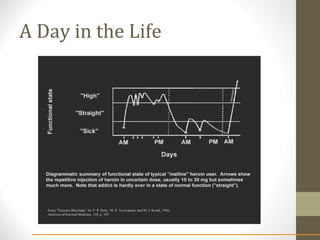
A Day in the Life
Dependency
• Factors affecting the difficulty of withdrawal:
• Social support network
• Desire to stop
• Physical environment during withdrawal
• Alternative opiates
Dependency
• About half of narcotic abusers become dependent:
• Can develop in less than two weeks if they take increasing amounts of
narcotics
• Average addiction is six to eight years (aging out)
Toxicity
• Respiratory depression can be fatal
• Synergistic effect when combined with depressants
• Opioid Triad
• Coma
• Depressed respiration
• Pinpoint pupils
• Death from an overdose of heroin is slow – people who die
quickly are likely to die from anaphylactic shock
Toxicity (risks)
• According to the CDC, painkillers kill twice as many people as
cocaine and five times more people than heroin
• Increased risk of blood-borne disease and infections
• Physical problems frequently result from using narcotics in
unclean, unsafe environments
• Sharing needles is a major risk for HIV infection
• Narcotics often are contaminated with other drugs, sugar,
starch, powdered milk, quinine, or strychnine
Medical Benefits
• Analgesic
• Patients receiving morphine are aware of pain, but their
perception and response are altered in positive ways
• Gastrointestinal difficulties
• In less-developed countries, narcotics treat diarrhea that is a
major cause of death among the young and elderly
• Cough suppressant (antitussive)
• Narcotics slow activity of the cough control center
• Nonopiate dextromethorphan is chemically similar
Treatment and Support Groups
• The recidivism (relapse) rate for narcotic addiction is high
• Gradual detoxification - 10 to 14 days on an inpatient basis
• Rapid detoxification
Narcotic Antagonists
• Drugs that block narcotics from producing their reinforcing
effects are called antagonists
• They remove the physical need for opiates, but not the
psychic need
• Examples are (Suboxone) naltrexone, buprenorphine,
nalorphine, naloxone, and cyclazocine
Methadone – Narcotics Agonists
• Since 1960, methadone has been the drug used most
frequently to treat heroin addiction
• Methadone is highly specific to opiate addiction
• Methadone use leads to addiction, though many people
consider it preferable to heroin addiction
• Methadone has to be administered daily to avert withdrawal
symptoms
Common Narcotics
Perceptions of Narcotics
• Narcotics were
advertised as a cure for
addiction to tobacco
Extent of Narcotic Use
• Controlled users (chippers) fit the following pattern:
• Seldom used the drug more than once a day
• Could keep opiates around without using them
• Avoided opiates when addicts were present
• Did not use opiates to alleviate depression
• Seldom binged on opiates
• Knew the opiate source or dealer
• Took opiates for recreation or relaxation
• Did not take opiates to escape life’s daily hassles

Goldberg Chapter 8

  • 1.
  • 2.
    Attendance Question A. EnterAnswer Text EnterAnsw erText 0%
  • 3.
    Warm up • Whathave you heard about narcotics? • What do you want to learn about this class of drugs? • http://ezproxy.wwcc.edu:2048/login?url=http://digital.films.com/PortalP
  • 4.
    Terms • Narcotic • Anopium-based central nervous system depressant used to relieve pain and diarrhea • Opiate • A class of drugs derived from opium • Opioid • Drugs with characteristics similar to those of opium • Laudanum, a mixture of opium and alcohol, was developed in the 1500s by Paracelsus
  • 5.
    History • The hypodermicneedle hastened the effects of morphine • Ironically, the drug promoted to help people overcome morphine dependency was heroin
  • 6.
    History • By 1906,opium and its derivatives were found in more than 50,000 medicines • By the late 1800s, an estimated 4.59 per 1,000 people were dependent on opiates
  • 7.
    History •The Harrison Actof 1914 made narcotic use without a prescription illegal •The typical opiate addict shifted from a middle-class woman to a young, lower- class man •Perceptions of the opiate addict went from unfortunate victim to a deviant criminal who was a threat to society
  • 8.
    Do you knowsomeone who has used narcotics recreationally in the last 30 days? A. No B. Yes, one person C. Yes, more than one person No Yes,oneperson Yes,m ore than one person 33% 33%33% Response
  • 9.
  • 10.
    Extent of NarcoticUse • 68% of heroin addicts admitted into treatment are male, 59% are White, and ¾ have been in treatment previously • Increase in abuse is significantly higher in rural areas than in metropolitan areas • During the Vietnam War, 10-15% of US troops were addicted to heroin
  • 11.
    • During the1930s, morphine abuse exceeded heroin abuse – by the 1940s, heroin addiction was greater • Heroin use increased greatly beginning in the late 1960s and early 1970s. • In 2010, about 200,000 Americans had used heroin in the previous month • In the US, more than 800,000 people are addicted to heroin and other narcotics
  • 12.
    Worldwide Comparison • Morethan 15 million people worldwide illegally use opium, morphine, and heroin • China is believed to have the largest number of narcotic addicts • An estimated 24 million to 34 million people throughout the world use opium
  • 13.
    Opium •Poppy grows throughoutAsia and the Middle East •Seedpod is scraped, milky sap is collected and dried to a brown resin (opium) •There is a ten-day window in which opium can be extracted
  • 14.
  • 15.
  • 16.
  • 17.
    Morphine •In 1803, FriedrichSerturner of Germany synthesized morphine from opium and called it morphium •Morphine is about ten times more potent than opium, although physicians thought it was safer and purer •Codeine was isolated from opium 30 years later •How morphine is administered and its dosage has a bearing on its effectiveness
  • 18.
    Heroin • Heroin (diacetylmorphine)was first synthesized from morphine in 1874 • When heroin was introduced, it was believed not to be addicting • When smoked, its effects are rapid – it is ineffective when ingested • Heroin is three to ten times more powerful than morphine because it is more lipid-soluble
  • 19.
    Derived from opium A.Enter Answer Text EnterAnsw erText 100% Response
  • 20.
    Synthetic Opiates •Fentanyl (Sublimaze) •Synthetic narcotic 1,000 times more potent than heroin • Greater risk of a fatal overdose than heroin •China white • Synthetic analgesic drug derived from fentanyl that mimics heroin but is considerably more potent •Meperidine • Synthetic derivative of morphine widely used as an analgesic – less potent than morphine
  • 21.
    Synthetic Opiates •Propoxyphene hydrochloride(Darvon) • Mild narcotic that has the potential to cause dependence •Methadone • Drug given to heroin addicts to block withdrawal effects and euphoria •Oxycodone (Percodan)
  • 22.
    OxyContin • OxyContin isa particularly strong painkiller that blocks the pain signals from nerves • Thousands have become addicted to it – the number of addicted babies has doubled or tripled over the past decade • The manufacturer, Purdue Pharma, admits that dozens to hundreds of people have died from it
  • 23.
  • 24.
  • 25.
    Physical Effects • Drowsiness(nodding out), vomiting, nausea, and difficulty concentrating • Euphoria • Gradually anesthetizing sensations • Lethargy and sleep • Difficulty urinating, constipation • Difficulty achieving an erection
  • 26.
    Emotional Effects • Relieffrom anxiety, hostility, feelings of inadequacy, and aggression • Difficulty regulating inhibitions and frequently make risky decisions
  • 27.
    Social Effects • Alienatedfrom and hostile toward friends and family • Correlated with criminal behavior, unemployment, and violence
  • 28.
    NEPs retard thespread of HIV/AIDS
  • 29.
    Needle-Exchange Programs •IV druguse increases HIV, hepatitis risk •Health care personnel favor NEPs •5.9% decrease in HIV infection rates in cities with NEPs •Congress banned federal funding for NEPs in 1988
  • 30.
    Dependency • Physical andpsychological dependence, and tolerance develop quickly • Positive reinforcement • Negative reinforcement • Withdrawal symptoms can be severe
  • 31.
    Withdrawal Hours after lastdoseSigns Heroin or Morphine Methadone Craving for drugs, anxiety 6 24 Yawning, perspiration, running nose, teary eyes 14 34-48 Increase in above signs plus pupil dilation, goose bumps, tremors, hot and cold flashes, aching bones and muscles, loss of appetite 16 48-72 Increased intensity of above, plus insomnia; raised blood pressure; increased temperature, pulse rate, respiratory rate and depth; restlessness; nausea 24-36 Increased intensity of above, plus curled-up position, vomiting, diarrhea, weight loss, spontaneous ejaculation or orgasm, hemoconcentration, increased blood sugar 36-48
  • 32.
    A Day inthe Life
  • 33.
    Dependency • Factors affectingthe difficulty of withdrawal: • Social support network • Desire to stop • Physical environment during withdrawal • Alternative opiates
  • 34.
    Dependency • About halfof narcotic abusers become dependent: • Can develop in less than two weeks if they take increasing amounts of narcotics • Average addiction is six to eight years (aging out)
  • 35.
    Toxicity • Respiratory depressioncan be fatal • Synergistic effect when combined with depressants • Opioid Triad • Coma • Depressed respiration • Pinpoint pupils • Death from an overdose of heroin is slow – people who die quickly are likely to die from anaphylactic shock
  • 36.
    Toxicity (risks) • Accordingto the CDC, painkillers kill twice as many people as cocaine and five times more people than heroin • Increased risk of blood-borne disease and infections • Physical problems frequently result from using narcotics in unclean, unsafe environments • Sharing needles is a major risk for HIV infection • Narcotics often are contaminated with other drugs, sugar, starch, powdered milk, quinine, or strychnine
  • 37.
    Medical Benefits • Analgesic •Patients receiving morphine are aware of pain, but their perception and response are altered in positive ways • Gastrointestinal difficulties • In less-developed countries, narcotics treat diarrhea that is a major cause of death among the young and elderly • Cough suppressant (antitussive) • Narcotics slow activity of the cough control center • Nonopiate dextromethorphan is chemically similar
  • 38.
    Treatment and SupportGroups • The recidivism (relapse) rate for narcotic addiction is high • Gradual detoxification - 10 to 14 days on an inpatient basis • Rapid detoxification
  • 39.
    Narcotic Antagonists • Drugsthat block narcotics from producing their reinforcing effects are called antagonists • They remove the physical need for opiates, but not the psychic need • Examples are (Suboxone) naltrexone, buprenorphine, nalorphine, naloxone, and cyclazocine
  • 40.
    Methadone – NarcoticsAgonists • Since 1960, methadone has been the drug used most frequently to treat heroin addiction • Methadone is highly specific to opiate addiction • Methadone use leads to addiction, though many people consider it preferable to heroin addiction • Methadone has to be administered daily to avert withdrawal symptoms
  • 41.
  • 42.
    Perceptions of Narcotics •Narcotics were advertised as a cure for addiction to tobacco
  • 43.
    Extent of NarcoticUse • Controlled users (chippers) fit the following pattern: • Seldom used the drug more than once a day • Could keep opiates around without using them • Avoided opiates when addicts were present • Did not use opiates to alleviate depression • Seldom binged on opiates • Knew the opiate source or dealer • Took opiates for recreation or relaxation • Did not take opiates to escape life’s daily hassles

Editor's Notes

  • #5 Available in patent medications Increased in 1850 as Chinese laborers arrived in the US Dependence not viewed as a major social problem Opium smoking was limited to certain groups Patent medicines were socially acceptable Opioid dependence was viewed as a “vice of middle life” Typical user was a 30-to-50-year-old middle class white woman, wife, and mother Drugs purchased legally in patent medicines High drugs levels in patent medicines meant that withdrawal symptoms were severe and relieved only by taking more Thomas de Quincey 1823 drank laudanum and wrote a book Life of an Opium Eater. Seen as a vice of middle age.
  • #6 Opium was outlawed in China in 1729 The British East India Company was involved in opium trade in India & China, eventually led to war between British and Chinese Morphine is the active ingredient in opium and was isolated in 1806. It’s 10 times as potent as opium. It was named morphium after Morpheus the God of Dreams. In 1832 another alkaloid of opium was discovered and named codeine “poppy head” The hypodermic syringe was invented in 1853 allowing for IV use of morphine. Medically useful characteristics Clinically useful Pure chemical Known potency Use spread due to two developments 1853: Hypodermic syringe allowed delivery of morphine directly into the blood Widespread use during war provided relief from pain and dysentery Many veterans were dependent on morphine, and dependence was later called “soldier’s disease” or “army disease” Two acetyl groups added to morphine given the brand name Heroin and marketed by Bayer 1898. 3X more potent than morphine because the increased lipid solubility of the heroin molecule easily passes the Blood-Brain Barrier. Acts more quickly. Was originally marketed as a non-habit forming substitute for codeine. Most of today’s heroin comes from South America, Mexico and Southeast Asia. Average purity has increased from about 5% to 25% since the 70s. In 2008, retail purity for Mexican heroin 40% and South American heroin 57%. With the invention of the hypodermic syringe, increased IV use.
  • #7 Opium was outlawed in China in 1729 The British East India Company was involved in opium trade in India & China, eventually led to war between British and Chinese Morphine is the active ingredient in opium and was isolated in 1806. It’s 10 times as potent as opium. It was named morphium after Morpheus the God of Dreams. In 1832 another alkaloid of opium was discovered and named codeine “poppy head” The hypodermic syringe was invented in 1853 allowing for IV use of morphine. Medically useful characteristics Clinically useful Pure chemical Known potency Use spread due to two developments 1853: Hypodermic syringe allowed delivery of morphine directly into the blood Widespread use during war provided relief from pain and dysentery Many veterans were dependent on morphine, and dependence was later called “soldier’s disease” or “army disease” Two acetyl groups added to morphine given the brand name Heroin and marketed by Bayer 1898. 3X more potent than morphine because the increased lipid solubility of the heroin molecule easily passes the Blood-Brain Barrier. Acts more quickly. Was originally marketed as a non-habit forming substitute for codeine. Most of today’s heroin comes from South America, Mexico and Southeast Asia. Average purity has increased from about 5% to 25% since the 70s. In 2008, retail purity for Mexican heroin 40% and South American heroin 57%. With the invention of the hypodermic syringe, increased IV use.
  • #8 Made these drugs available only by prescription. This changed the pattern of opioid use. The only source for these drugs without a prescription was illegal drug dealers. Oral use declined and the primary remaining users were IV users of morphine or heroin. Cost and risk of use increased and so the most potent method of use was favored. Addicts were seen as weak and self-indulgent. Oral use declined and use in low-income areas of large cities increased. By the 60s, heroin use was associated with crime and considered socially unacceptable.
  • #11 Heroin was inexpensive and relatively pure. 95%. Most users smoked or sniffed the drug. Contrary to popular opinion, Vietnam showed that under certain conditions a relatively high number of individuals will use opioids recreationally and that dependence and compulsive use are not inevitable among occasional users.
  • #17 Afghanistan remains the world’s largest producer of opium.
  • #21 5% report non-medical use – given as prescription pain relievers/analgesic Most are given orally as prescriptions Dependence & toxicity from misuse – users misuse by crushing and smoking or snorting the pills Police in WW report that prescription opioids are selling for high prices on the street. $1 per mg, so a 20 mg pill would sell for $20. Have seen an increase in opioid abuse/dependency. Most anecdotal stories involve individuals who began with prescription drug use, misused or abused the prescription, and found it expensive to obtain on the streets/illegally. Many then turn to heroin in order to avoid withdrawal. Heroin is much cheaper, but is also unpredictable as far as potency and purity.
  • #23 5% report non-medical use – given as prescription pain relievers/analgesic Most are given orally as prescriptions Dependence & toxicity from misuse – users misuse by crushing and smoking or snorting the pills Police in WW report that prescription opioids are selling for high prices on the street. $1 per mg, so a 20 mg pill would sell for $20. Have seen an increase in opioid abuse/dependency. Most anecdotal stories involve individuals who began with prescription drug use, misused or abused the prescription, and found it expensive to obtain on the streets/illegally. Many then turn to heroin in order to avoid withdrawal. Heroin is much cheaper, but is also unpredictable as far as potency and purity.
  • #25 Naturally occurring opioid-like products of the nervous system and endocrine glands activate brain opioid receptors Enkephalins: morphine like neurotransmitters found in the brain and adrenals Endorphins: morphine like neurotransmitters found in the brain and pituitary gland
  • #26 Tolerance Tolerance develops to most effects from both medical and recreational usage Higher doses needed to maintain effects Cross-tolerance exists among all the opioids Psychological processes play a key role in tolerance Dependent individuals develop a conditioned reflex response to the stimuli associated with taking the drugs Physical dependence Symptoms of withdrawal appear in sequence following the timing of the most recent dose and the individual’s history of use Opioid withdrawal is unpleasant but rarely life-threatening Methadone (long-lasting synthetic opioid) produces withdrawal symptoms that appear later and are less severe than those from heroin Psychological dependence Positive reinforcement Positive effects reliably follow use of the drug Negative reinforcement Use of the drug removes withdrawal symptoms Fast-acting injectable opioids are most likely to lead to dependence Factors affecting the difficulty of withdrawal: Availability of a social support network Addict’s desire to stop Physical environment during withdrawal Convenience and practicality of alternative opiates About half of narcotic abusers become dependent: People can become drug-dependent in less than two weeks if they take increasing amounts of narcotics Average addiction is six to eight years Narcotics relieve psychic distress arising from anxiety, hostility, feelings of inadequacy, and aggression Heroin addicts have difficulty regulating inhibitions and frequently make risky decisions Users sometimes ignore or become alienated and hostile toward friends and family members Heroin use has been associated with criminal behavior, unemployment, and violence Acute toxicity Opioids depress respiratory centers in the brain Breathing becomes slower and shallower Effects with alcohol are additive Opioid overdose triad Coma Depressed respiration Pinpoint pupils Clouding of consciousness Occasionally, nausea and vomiting Can be counteracted with naloxone Narcotics cause drowsiness, vomiting, nausea, and difficulty concentrating Euphoria is followed by gradually anesthetizing sensations, then sleep and lethargy Opiates impede the ability to urinate, and can cause potentially serious constipation Male addicts have difficulty achieving an erection Chronic toxicity is associated with injection method of use Infections and the spread of blood-borne diseases Narcotics are capable of depressing the respiratory system to the point of death According to the CDC, painkillers kill twice as many people as cocaine and five times more people than heroin Synergistic effect of narcotics and other drugs can be fatal Death from an overdose of heroin is slow – people who die quickly are likely to die from anaphylactic shock
  • #29 Needle exchange programs are designed to reduce the transmission of AIDS and other diseases.
  • #31 Tolerance Tolerance develops to most effects from both medical and recreational usage Higher doses needed to maintain effects Cross-tolerance exists among all the opioids Psychological processes play a key role in tolerance Dependent individuals develop a conditioned reflex response to the stimuli associated with taking the drugs Physical dependence Symptoms of withdrawal appear in sequence following the timing of the most recent dose and the individual’s history of use Opioid withdrawal is unpleasant but rarely life-threatening Methadone (long-lasting synthetic opioid) produces withdrawal symptoms that appear later and are less severe than those from heroin Psychological dependence Positive reinforcement Positive effects reliably follow use of the drug Negative reinforcement Use of the drug removes withdrawal symptoms Fast-acting injectable opioids are most likely to lead to dependence Factors affecting the difficulty of withdrawal: Availability of a social support network Addict’s desire to stop Physical environment during withdrawal Convenience and practicality of alternative opiates About half of narcotic abusers become dependent: People can become drug-dependent in less than two weeks if they take increasing amounts of narcotics Average addiction is six to eight years Narcotics relieve psychic distress arising from anxiety, hostility, feelings of inadequacy, and aggression Heroin addicts have difficulty regulating inhibitions and frequently make risky decisions Users sometimes ignore or become alienated and hostile toward friends and family members Heroin use has been associated with criminal behavior, unemployment, and violence Acute toxicity Opioids depress respiratory centers in the brain Breathing becomes slower and shallower Effects with alcohol are additive Opioid overdose triad Coma Depressed respiration Pinpoint pupils Clouding of consciousness Occasionally, nausea and vomiting Can be counteracted with naloxone Narcotics cause drowsiness, vomiting, nausea, and difficulty concentrating Euphoria is followed by gradually anesthetizing sensations, then sleep and lethargy Opiates impede the ability to urinate, and can cause potentially serious constipation Male addicts have difficulty achieving an erection Chronic toxicity is associated with injection method of use Infections and the spread of blood-borne diseases Narcotics are capable of depressing the respiratory system to the point of death According to the CDC, painkillers kill twice as many people as cocaine and five times more people than heroin Synergistic effect of narcotics and other drugs can be fatal Death from an overdose of heroin is slow – people who die quickly are likely to die from anaphylactic shock
  • #36 Tolerance Tolerance develops to most effects from both medical and recreational usage Higher doses needed to maintain effects Cross-tolerance exists among all the opioids Psychological processes play a key role in tolerance Dependent individuals develop a conditioned reflex response to the stimuli associated with taking the drugs Physical dependence Symptoms of withdrawal appear in sequence following the timing of the most recent dose and the individual’s history of use Opioid withdrawal is unpleasant but rarely life-threatening Methadone (long-lasting synthetic opioid) produces withdrawal symptoms that appear later and are less severe than those from heroin Psychological dependence Positive reinforcement Positive effects reliably follow use of the drug Negative reinforcement Use of the drug removes withdrawal symptoms Fast-acting injectable opioids are most likely to lead to dependence Factors affecting the difficulty of withdrawal: Availability of a social support network Addict’s desire to stop Physical environment during withdrawal Convenience and practicality of alternative opiates About half of narcotic abusers become dependent: People can become drug-dependent in less than two weeks if they take increasing amounts of narcotics Average addiction is six to eight years Narcotics relieve psychic distress arising from anxiety, hostility, feelings of inadequacy, and aggression Heroin addicts have difficulty regulating inhibitions and frequently make risky decisions Users sometimes ignore or become alienated and hostile toward friends and family members Heroin use has been associated with criminal behavior, unemployment, and violence Acute toxicity Opioids depress respiratory centers in the brain Breathing becomes slower and shallower Effects with alcohol are additive Opioid overdose triad Coma Depressed respiration Pinpoint pupils Clouding of consciousness Occasionally, nausea and vomiting Can be counteracted with naloxone Narcotics cause drowsiness, vomiting, nausea, and difficulty concentrating Euphoria is followed by gradually anesthetizing sensations, then sleep and lethargy Opiates impede the ability to urinate, and can cause potentially serious constipation Male addicts have difficulty achieving an erection Chronic toxicity is associated with injection method of use Infections and the spread of blood-borne diseases Narcotics are capable of depressing the respiratory system to the point of death According to the CDC, painkillers kill twice as many people as cocaine and five times more people than heroin Synergistic effect of narcotics and other drugs can be fatal Death from an overdose of heroin is slow – people who die quickly are likely to die from anaphylactic shock
  • #38 Pain relief Reduces the emotional response to pain and diminishes the patient’s awareness of, and response to, the aversive stimulus Typically causes drowsiness but does not induce sleep Treatment of intestinal disorders Reduces colic and counteracts diarrhea and the resulting dehydration Acts by decreasing the number of peristaltic contractions An opium solution known as paregoric is still available for relief of diarrhea Cough suppressant Codeine has long been used to reduce coughing It remains available in prescription cough medications Nonprescription cough remedies contain the opioid analogue dextromethorphan It produces hallucinogenic effects at high doses
  • #40 Reverse depressed respiration from opioid overdose Precipitate withdrawal syndrome Prevent dependent individuals from experiencing a high from subsequent opioid use SUBOXONE is a combination of two drugs: Buprenorphine: an opiate that acts to fill up the brain’s opiate receptors without causing sleepiness or “high” feelings. It has a low risk of overdose. Naloxone , a drug that is not absorbed orally but helps persuade people not to inject Suboxone in the vein as it causes instant withdrawal. Methadone (long-lasting synthetic opioid) produces withdrawal symptoms that appear later and are less severe than those from heroin. Usually administered orally. Can be abused if concentrated and injected.
  • #43 Narcotics were advertised as a cure for addiction to tobacco.