SOC 204
Drugs & Society
Goldberg Chapter 9
Sedative-Hypnotic Drugs
Sedative-Hypnotic Drugs (depressants)
• Drugs that slow activity in the central nervous system
• Include prescription drugs
o To treat anxiety: sedatives
o To treat insomnia: hypnotics
• Alcohol is the most widely used depressant
• Benzodiazepines are the most widely prescribed
depressants
The nonmedical use of
controlled medications by
adolescents is increasing.
A. True
B. False
True
False
4%
96%
Sedative-Hypnotic Drugs
• Sedative-hypnotic drugs are central nervous
system depressants that produce relaxing to
sleep-inducing effects
• Three main types of
sedative-hypnotic
drugs:
o Barbiturates
o Nonbarbiturate sedatives
o Minor tranquilizers
Classification
• Classified based on potency and the length of time they
act:
o Ultra-short-acting
o Short-acting (less than 4 hours)
o Intermediate-acting (4 to 6 hours)
o Long-acting (more than 6 hours)
• Drugs that take effect rapidly
have a higher abuse potential
than slow-acting drugs
Sedative-Hypnotic Drugs
A. Increase energy
B. Depress the CNS
C. Are very quick-acting
D. Have little potential for
abuse
IncreaseenergyDepressthe
CNS
Are
very
quick-acting
Havelittle
potentialfor...
8% 4%
16%
72%
Effects
• Produce a depressed, mood-altering action on the
central nervous system – act on GABA
• Slow activity of the cardiovascular, muscular and
respiratory systems
• Can cause confusion, inadequate emotional control,
slurred speech, poor judgment, and intoxication
Medical Uses
• Used primarily to treat
o Anxiety
o Insomnia
o Convulsive disorders
• Short-acting barbiturates
continue to be used for
anesthetic purposes
Mechanisms of Action
• Benzodiazepines and
barbiturates
o Enhance inhibitory effects of GABA
• Non-benzodiazepine hypnotics
o Selectively target the GABA-A receptor
o Work better as sleep aids rather than anti-anxiety
medications
o Zolpidem (Ambien), zaleplon (Sonata),
eszopiclone (Lunesta)
Medical uses for barbiturates
do NOT include:
A. Treating
depression
B. Reducing anxiety
C. Controlling
seizures
D. Inducing sleep Treatingdepression
Reducing
anxietyControllingseizures
Inducingsleep
54%
38%
8%
0%
Non-barbiturate Sedatives
• Older drugs with similar actions to barbiturates
• With the advent of safer drugs, rarely used now
• Chloral hydrate 1832
• Paraldehyde 1882
• Bromides 1960s
Adolescent boys are more likely to
give medications to their friends than
adolescent girls.
A. True
B. False
True
False
0%0%
Barbiturates
• Veronal was introduced in 1903
• Barbiturates classifications
o Short-acting
• Pentobarbital, secobarbital
o Intermediate-acting
• Amobarbital, butabarbital
o Long-acting
• Mephbarbital, phenobarbital
Barbiturates, continued
• Sodium Pentathol 1934
• Meprobamate 1950s
• Methaqualone 1965
• Great risk for physical and
psychological dependence
• Produce a depressed, mood-altering
action on the central nervous system
– act on GABA
• Slow activity of the cardiovascular,
muscular and respiratory systems
• Can cause confusion, inadequate
emotional control, slurred speech,
poor judgment, and intoxication
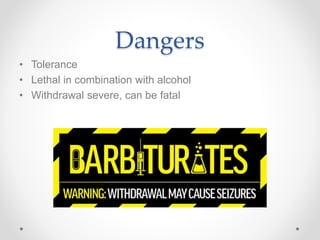
Dangers
• Tolerance
• Lethal in combination with alcohol
• Withdrawal severe, can be fatal
Benzodiazepines
• 1960 introduced chordiazepoxide (Librium)
• 1970s introduced diazepam (Valium)
• Dependence and overdose can occur
o Tolerance
o Withdrawal
o Rarer than with barbiturates
o More common in combination with alcohol
• Wider margin of safety and fewer side effects than
barbiturates
• Used to treat anxiety
Hypnotics
• Non-benzodiazepines
(Ambien, Lunesta, Sonata)
o Short-term treatment of
insomnia
o Short half-life
o Less dependency, less
tolerance, less carry-over
Doctors are more likely to
prescribe barbiturates for
sleep now than they were
20 years ago.
A. True
B. False
True
False
0%0%
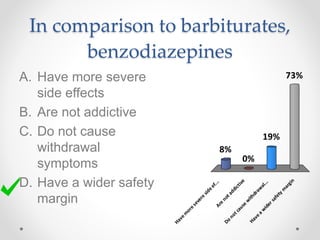
In comparison to barbiturates,
benzodiazepines
A. Have more severe
side effects
B. Are not addictive
C. Do not cause
withdrawal
symptoms
D. Have a wider safety
margin
Havem
oresevere
sideef...Are
notaddictive
Do
notcause
w
ithdraw
al...
Havea
w
idersafety
m
argin
8%
73%
19%
0%
Do you know someone who has had their
drink spiked with GHB or roofies?
A. I think so
B. I don’t think so
Ithinkso
Idon’tthinkso
65%
35%
Do you know someone who has drugged
someone else by spiking their drink?
A. I think so
B. I don’t think so
Ithinkso
Idon’tthinkso
64%
36%
Gamma Hydroxybutyric
Acid
• Naturally occurring chemical found in brain and body
• Similar to GABA
• Causes CNS depression
• Has been used as an anesthetic
• Considered a date-rape drug
o Along with Rohypnol and Ketamine
• GHB is listed on Schedule I
https://www.youtube.com/watch?v=LPtcU_8yvR4
https://www.youtube.com/watch?v=YwtBEkFXBjQ
https://www.youtube.com/watch?v=2udrpuNxcmM
When it is used in
conjunction with alcohol,
the effects of Rohypnol
can be fatal.
A. True
B. False
True
False
6%
94%
Inhalants
• Most frequently used class of
illegal drugs among
adolescents aged 12 and 13
• Sudden Sniffing Death
Syndrome
Inhalants
• High-dose exposure causes
intoxication
• Examples:
o Volatile solvents
o Aerosols, propellants, gases
o Anesthetics
o Nitrites
http://www.youtube.com/watch?v=3g99h4qaCio
Inhalants
• Most abusers are very young
• Abuse tends to occur as localized fads
• Dangers:
o Kidney damage
o Brain damage
o Peripheral nerve damage
o Irritation of respiratory tract
o Severe headache
o Death by suffocation
The highest rate of
inhalant use by
youths occurs
among Asians.
A. True
B. False
True
False
42%
58%
More people die from
inhaling air fresheners than
from inhaling gasoline.
A. True
B. False
True
False
0%0%
Nitrous oxide has
been used as an
anesthetic by dentists.
A. True
B. False
True
False
0%
100%
Benefits Risks
• Anxiolytics
• Sleeping agents
• Anticonvulsants
• Dependence
o Tolerance & Cross Tolerance
o Withdrawal
• Toxicity
o Behavioral
o Physiological
• Can be fatal with alcohol
• Patterns of abuse

Soc 204 goldberg ch 9

  • 1.
    SOC 204 Drugs &Society Goldberg Chapter 9 Sedative-Hypnotic Drugs
  • 2.
    Sedative-Hypnotic Drugs (depressants) •Drugs that slow activity in the central nervous system • Include prescription drugs o To treat anxiety: sedatives o To treat insomnia: hypnotics • Alcohol is the most widely used depressant • Benzodiazepines are the most widely prescribed depressants
  • 3.
    The nonmedical useof controlled medications by adolescents is increasing. A. True B. False True False 4% 96%
  • 4.
    Sedative-Hypnotic Drugs • Sedative-hypnoticdrugs are central nervous system depressants that produce relaxing to sleep-inducing effects • Three main types of sedative-hypnotic drugs: o Barbiturates o Nonbarbiturate sedatives o Minor tranquilizers
  • 5.
    Classification • Classified basedon potency and the length of time they act: o Ultra-short-acting o Short-acting (less than 4 hours) o Intermediate-acting (4 to 6 hours) o Long-acting (more than 6 hours) • Drugs that take effect rapidly have a higher abuse potential than slow-acting drugs
  • 6.
    Sedative-Hypnotic Drugs A. Increaseenergy B. Depress the CNS C. Are very quick-acting D. Have little potential for abuse IncreaseenergyDepressthe CNS Are very quick-acting Havelittle potentialfor... 8% 4% 16% 72%
  • 7.
    Effects • Produce adepressed, mood-altering action on the central nervous system – act on GABA • Slow activity of the cardiovascular, muscular and respiratory systems • Can cause confusion, inadequate emotional control, slurred speech, poor judgment, and intoxication
  • 8.
    Medical Uses • Usedprimarily to treat o Anxiety o Insomnia o Convulsive disorders • Short-acting barbiturates continue to be used for anesthetic purposes
  • 9.
    Mechanisms of Action •Benzodiazepines and barbiturates o Enhance inhibitory effects of GABA • Non-benzodiazepine hypnotics o Selectively target the GABA-A receptor o Work better as sleep aids rather than anti-anxiety medications o Zolpidem (Ambien), zaleplon (Sonata), eszopiclone (Lunesta)
  • 10.
    Medical uses forbarbiturates do NOT include: A. Treating depression B. Reducing anxiety C. Controlling seizures D. Inducing sleep Treatingdepression Reducing anxietyControllingseizures Inducingsleep 54% 38% 8% 0%
  • 11.
    Non-barbiturate Sedatives • Olderdrugs with similar actions to barbiturates • With the advent of safer drugs, rarely used now • Chloral hydrate 1832 • Paraldehyde 1882 • Bromides 1960s
  • 12.
    Adolescent boys aremore likely to give medications to their friends than adolescent girls. A. True B. False True False 0%0%
  • 13.
    Barbiturates • Veronal wasintroduced in 1903 • Barbiturates classifications o Short-acting • Pentobarbital, secobarbital o Intermediate-acting • Amobarbital, butabarbital o Long-acting • Mephbarbital, phenobarbital
  • 14.
    Barbiturates, continued • SodiumPentathol 1934 • Meprobamate 1950s • Methaqualone 1965 • Great risk for physical and psychological dependence • Produce a depressed, mood-altering action on the central nervous system – act on GABA • Slow activity of the cardiovascular, muscular and respiratory systems • Can cause confusion, inadequate emotional control, slurred speech, poor judgment, and intoxication
  • 15.
    Dangers • Tolerance • Lethalin combination with alcohol • Withdrawal severe, can be fatal
  • 16.
    Benzodiazepines • 1960 introducedchordiazepoxide (Librium) • 1970s introduced diazepam (Valium) • Dependence and overdose can occur o Tolerance o Withdrawal o Rarer than with barbiturates o More common in combination with alcohol • Wider margin of safety and fewer side effects than barbiturates • Used to treat anxiety
  • 17.
    Hypnotics • Non-benzodiazepines (Ambien, Lunesta,Sonata) o Short-term treatment of insomnia o Short half-life o Less dependency, less tolerance, less carry-over
  • 18.
    Doctors are morelikely to prescribe barbiturates for sleep now than they were 20 years ago. A. True B. False True False 0%0%
  • 19.
    In comparison tobarbiturates, benzodiazepines A. Have more severe side effects B. Are not addictive C. Do not cause withdrawal symptoms D. Have a wider safety margin Havem oresevere sideef...Are notaddictive Do notcause w ithdraw al... Havea w idersafety m argin 8% 73% 19% 0%
  • 20.
    Do you knowsomeone who has had their drink spiked with GHB or roofies? A. I think so B. I don’t think so Ithinkso Idon’tthinkso 65% 35%
  • 21.
    Do you knowsomeone who has drugged someone else by spiking their drink? A. I think so B. I don’t think so Ithinkso Idon’tthinkso 64% 36%
  • 22.
    Gamma Hydroxybutyric Acid • Naturallyoccurring chemical found in brain and body • Similar to GABA • Causes CNS depression • Has been used as an anesthetic • Considered a date-rape drug o Along with Rohypnol and Ketamine • GHB is listed on Schedule I https://www.youtube.com/watch?v=LPtcU_8yvR4 https://www.youtube.com/watch?v=YwtBEkFXBjQ https://www.youtube.com/watch?v=2udrpuNxcmM
  • 23.
    When it isused in conjunction with alcohol, the effects of Rohypnol can be fatal. A. True B. False True False 6% 94%
  • 24.
    Inhalants • Most frequentlyused class of illegal drugs among adolescents aged 12 and 13 • Sudden Sniffing Death Syndrome
  • 25.
    Inhalants • High-dose exposurecauses intoxication • Examples: o Volatile solvents o Aerosols, propellants, gases o Anesthetics o Nitrites http://www.youtube.com/watch?v=3g99h4qaCio
  • 26.
    Inhalants • Most abusersare very young • Abuse tends to occur as localized fads • Dangers: o Kidney damage o Brain damage o Peripheral nerve damage o Irritation of respiratory tract o Severe headache o Death by suffocation
  • 27.
    The highest rateof inhalant use by youths occurs among Asians. A. True B. False True False 42% 58%
  • 28.
    More people diefrom inhaling air fresheners than from inhaling gasoline. A. True B. False True False 0%0%
  • 29.
    Nitrous oxide has beenused as an anesthetic by dentists. A. True B. False True False 0% 100%
  • 30.
    Benefits Risks • Anxiolytics •Sleeping agents • Anticonvulsants • Dependence o Tolerance & Cross Tolerance o Withdrawal • Toxicity o Behavioral o Physiological • Can be fatal with alcohol • Patterns of abuse

Editor's Notes

  • #3 Depressants = drugs that slow activity in the central nervous system Include prescription drugs that treat anxiety (sedatives) and insomnia (hypnotics) As a group, also called sedative-hypnotics Alcohol is the most widely used depressant Benzodiazepines are the most widely prescribed depressants Barbiturates Barbiturates are used to treat anxiety, insomnia, and seizure disorders. They are not, however, prescribed as often due to the availability of benzodiazepines and non-benzodiazepines. Barbiturates can be addictive and have strong withdrawal symptoms and rebound (exaggerated) effects on rapid eye movement (REM) sleep when they are abruptly stopped and can interfere with sleep. It is advisable, therefore, to stop barbiturates by slowly lowering their dose over a period of more than five or six days. It also is important to use the correct dose of barbiturates since a relatively small overdose may lead to coma or death. The main differences among barbiturates are their half-lives (duration of their effects). Drugs such as secobarbital sodium and pentobarbital sodium are short-acting, while others such as amobarbital sodium and butabarbital sodium are intermediate-acting, and phenobarbital and mephobarbital are long-acting. Examples of barbiturates: Nembutal (phenobarbital) Mebaral (mephobarbital) Amytal Sodium (amobarbital sodium) Butisol (butabarbital sodium) Seconal Sodium Pulvules (secobarbital sodium)
  • #4 Doubled in the last 15 years
  • #5 Barbiturates Barbiturates are used to treat anxiety, insomnia, and seizure disorders. They are not, however, prescribed as often due to the availability of benzodiazepines and non-benzodiazepines. Barbiturates can be addictive and have strong withdrawal symptoms and rebound (exaggerated) effects on rapid eye movement (REM) sleep when they are abruptly stopped and can interfere with sleep. It is advisable, therefore, to stop barbiturates by slowly lowering their dose over a period of more than five or six days. It also is important to use the correct dose of barbiturates since a relatively small overdose may lead to coma or death. The main differences among barbiturates are their half-lives (duration of their effects). Drugs such as secobarbital sodium and pentobarbital sodium are short-acting, while others such as amobarbital sodium and butabarbital sodium are intermediate-acting, and phenobarbital and mephobarbital are long-acting. Examples of barbiturates: Nembutal (phenobarbital) Mebaral (mephobarbital) Amytal Sodium (amobarbital sodium) Butisol (butabarbital sodium) Seconal Sodium Pulvules (secobarbital sodium)
  • #7 In 2011, 4.3% of high school seniors had used a sedative for nonmedical purposes within the previous 12 months Girls are more likely to intentionally abuse prescription drugs than boys One misconception among adolescents is that these drugs provide a medically safe high
  • #8 37 for benzo, 34 for other illegal drugs
  • #10 Can cause confusion, short attention span, impaired cognitive functioning, inadequate emotional control, slurred speech, poor judgment, hangovers, and intoxication Barbital Sedative-hypnotic drug used to treat anxiety and nervousness; the original barbiturate Veronal Brand name for barbital Phenobarbital Second barbiturate developed Produces relaxation and relieves anxiety HAZARDS Reduced attention span Impaired cognitive functioning Diminished hand-eye coordination Inadequate emotional control Nausea Vomiting Birth defects Confusion Poor judgment Slurred speech Vertigo Diarrhea Respiratory failure Violent behavior Combination of alcohol and barbiturates can lead to accidental or intentional death Withdrawal is life-threatening without medical supervision: marked by profuse sweating, insomnia, muscular twitching, paranoia, vomiting, aches and pains, cramps, quick temper, nightmares, hallucinations, and seizures
  • #11 The effectiveness of barbiturates as sleep agents is questionable, because they interfere with rapid eye movement (REM), and may result in rebound insomnia Anticonvulsants These drugs may be used to treat conditions that contribute towards sleep disruption such as restless legs syndrome, nocturnal eating syndrome, periodic limb movement disorder, and insomnia related tobipolar disorder. Examples of anticonvulsants: Tegretol (carbamazepine) Carbatrol (carbamazepine extended-release) Depakene (valproic acid) Depakote (divalproex sodium) Neurontin (gabapentin)
  • #12 Benzodiazepines and barbiturates Bond with brain receptors Enhance the normally inhibitory effects of GABA Nonbenzodiazepine hypnotics Selectively target the GABA-A receptor Seem to work better as sleeping pills than as antianxiety drugs Include zolpidem (Ambien), zaleplon (Sonata), and eszopiclone (Lunesta)
  • #15 Chloral hydrate (“knockout drops” or Mickey Finns) Induces sleep Works rapidly Margin between effective dose (ED) and lethal dose (LD) is slight Risk of hepatoxicity Produces gastric distress, vomiting, and flatulence Paraldehyde Effective and safe central nervous system depressant Used with severely disturbed mental patients Produces a terrible smell and taste Bromides Used to treat epileptic convulsions Build up in the body, cause depression, and can be highly toxic Meprobamate (Miltown and Equanil) Minor tranquilizer used for psychosomatic conditions Severe withdrawal and low margin of safety Minor tranquilizer Drug used primarily to relieve anxiety Anxiolytic Anxiety-reducing drugs Methaqualone (Quaalude) Relieves tension and anxiety without barbiturate-like aftereffects Withdrawal symptoms can be extremely severe, including mania, seizures, vomiting, convulsions, and death Induces dreamlike moods at low dosage levels Memory is affected Especially lethal in combination with alcohol
  • #16 In 2011, 4.3% of high school seniors had used a sedative for nonmedical purposes within the previous 12 months Girls are more likely to intentionally abuse prescription drugs than boys One misconception among adolescents is that these drugs provide a medically safe high
  • #17 Discovery/introduction 1903: Barbital (Veronal) became the first barbiturate to be used clinically Other popular barbiturates include phenobarbital, amobarbital and secobarbital Grouped on the basis of the time of onset and duration of activity Low-dose, long-acting forms used for daytime relief of anxiety Higher-dose, shorter-acting forms used to induce sleep Short-acting (pentobarbital, secobarbital) Time of onset: 15 minutes Duration of action: 2 to 3 hours Intermediate-acting (amobarbital, butabarbital) Time of onset: 30 minutes Duration of action: 5 to 6 hours Long-acting (mephobarbital, phenobarbital) Time of onset: 1 hour Duration of action: 8 hours or longer Barbiturates Barbiturates are used to treat anxiety, insomnia, and seizure disorders. They are not, however, prescribed as often due to the availability of benzodiazepines and non-benzodiazepines. Barbiturates can be addictive and have strong withdrawal symptoms and rebound (exaggerated) effects on rapid eye movement (REM) sleep when they are abruptly stopped and can interfere with sleep. It is advisable, therefore, to stop barbiturates by slowly lowering their dose over a period of more than five or six days. It also is important to use the correct dose of barbiturates since a relatively small overdose may lead to coma or death. The main differences among barbiturates are their half-lives (duration of their effects). Drugs such as secobarbital sodium and pentobarbital sodium are short-acting, while others such as amobarbital sodium and butabarbital sodium are intermediate-acting, and phenobarbital and mephobarbital are long-acting. Examples of barbiturates: Nembutal (phenobarbital) Mebaral (mephobarbital) Amytal Sodium (amobarbital sodium) Butisol (butabarbital sodium) Seconal Sodium Pulvules (secobarbital sodium) Classified based on potency and the length of time they act: Ultra-short-acting Short-acting (less than 4 hours) Intermediate-acting (4 to 6 hours) Long-acting (more than 6 hours) Drugs that take effect rapidly have a higher abuse potential than slow-acting drugs
  • #18 Sodium Pentathol Ultra-short acting barbiturate Administered intravenously Used as an anesthetic for brief surgical procedures Moves very rapidly into the brain Also used to make people relaxed and talkative (truth serum) Thiopental is currently the first of the three drugs administered for the death penalty Meprobamate The first modern antianxiety agent (anxiolytic) Widely prescribed beginning in the 1950s Like barbiturates, can produce psychological and physical dependence Still available as a prescription drug, although largely replaced by benzodiazepines Methaqualone 1965: Despite problems in other countries, methaqualone (Quaalude, Sopor) was introduced in the United States No initial monitoring- Package insert read “Addiction potential not established” Overprescribed; quickly became widely misused and abused 1973: Put on Schedule II 1985: Put on Schedule I Can cause confusion, short attention span, impaired cognitive functioning, inadequate emotional control, slurred speech, poor judgment, hangovers, and intoxication Barbital Sedative-hypnotic drug used to treat anxiety and nervousness; the original barbiturate Veronal Brand name for barbital Phenobarbital Second barbiturate developed Produces relaxation and relieves anxiety HAZARDS Reduced attention span Impaired cognitive functioning Diminished hand-eye coordination Inadequate emotional control Nausea Vomiting Birth defects Confusion Poor judgment Slurred speech Vertigo Diarrhea Respiratory failure Violent behavior Combination of alcohol and barbiturates can lead to accidental or intentional death Withdrawal is life-threatening without medical supervision: marked by profuse sweating, insomnia, muscular twitching, paranoia, vomiting, aches and pains, cramps, quick temper, nightmares, hallucinations, and seizures
  • #19 HAZARDS Reduced attention span Impaired cognitive functioning Diminished hand-eye coordination Inadequate emotional control Nausea Vomiting Birth defects Confusion Poor judgment Slurred speech Vertigo Diarrhea Respiratory failure Violent behavior Combination of alcohol and barbiturates can lead to accidental or intentional death Withdrawal is life-threatening without medical supervision: marked by profuse sweating, insomnia, muscular twitching, paranoia, vomiting, aches and pains, cramps, quick temper, nightmares, hallucinations, and seizures
  • #20 1960: Introduction of chlordiazepoxide (Librium), the first commercially marketed benzodiazepine Reduces anxiety without inducing sleep Much larger safety margin than barbiturates Physical dependence rare Overdose rare and usually only when combined with other depressants like alcohol 1970s: Diazepam (Valium), a lower-dose benzodiazepine, became for a time the best seller among all prescription drugs Benzodiazepines Dependence and overdose can occur; dosage and time course are critical factors Overdose deaths more likely for drugs sold in higher doses Psychological dependence more likely with drugs that have a rapid onset of effects Physical dependence more likely with drugs that have a short duration of action More differences among the barbiturates and among the benzodiazepines than there are between these two classes of drugs? Rhohypnol A 1990s’ version of a “Mickey Finn” Produces profound intoxication when mixed with alcohol Reports surfaced of the drug being slipped into drinks and used as a “date-rape” drug Changes in laws and in the formulation of the pills should reduce its abuse
  • #26 Naturally-occurring chemical found in the brain and body Structurally similar to the inhibitory neurotransmitter GABA Causes CNS depression, especially when combined with alcohol Has been used as an anesthetic Behavioral effects similar to alcohol Lack of coordination and slurred speech Considered a date-rape drug Except for a specific formulation used to treat cataplexy, GHB is listed on Schedule I
  • #28 Inhalants serve as gateway drugs Twice as many 8th-grade students use inhalants as 12th-grade students Strong relationship between inhalant use and other problem behaviors and sensation-seeking Sudden Sniffing Death Syndrome http://www.drugfreeworld.org/drugfacts/inhalants/international-statistics.html 22% first time users Long-term effects: nosebleeds, liver and kidney damage, sores, weight loss, depression, irritability, disorientation, paranoia, hostility, and bone marrow abnormalities
  • #29 Inhalants serve as gateway drugs Twice as many 8th-grade students use inhalants as 12th-grade students Strong relationship between inhalant use and other problem behaviors and sensation-seeking Sudden Sniffing Death Syndrome http://www.drugfreeworld.org/drugfacts/inhalants/international-statistics.html 22% first time users Long-term effects: nosebleeds, liver and kidney damage, sores, weight loss, depression, irritability, disorientation, paranoia, hostility, and bone marrow abnormalities Volatile solvents and other compounds used for intoxicating purposes Have depressant effects similar to sedative-hypnotics High-dose exposure causes intoxication, with effects similar to alcohol Products that can be abused by inhalation include gasoline, glue, paint, lighter fluid, spray cans, nail polish, correction fluid Volatile solvents (petroleum, acetone, toluene) Paint, paint thinner and remover, nail polish remover, correction fluid, glues, cements Overly informative news articles and education programs actually demonstrated how to abuse volatile solvents Abuse tends to occur as localized fads Most abusers are very young—solvents are readily available and inexpensive Aerosols, propellants, gases (butane, propane) Spray paint, hair spray, lighters, whipped cream Anesthetics (nitrous oxide, ether) Current and former medical anesthetics Nitrous oxide (“laughing gas”) was first used in the early 1800s Still used for light anesthesia, especially by dentists Used as a propellant for commercial and home whipping-cream dispensers Nitrites (isoamyl, isobutyl) “Locker room,” “Rush,” “poppers” Relaxes blood vessels which increases blood flow, but also lowers blood pressure. Used as a treatment for cyanide poisoning. With high doses there maybe lightheadedness or faintness Consumer Product Safety Commission has taken steps to remove poppers and other nitrites from the market since 1988 Glue (volatile hydrocarbon solvents) Psychoactive agent is toluene Possible immediate cardiorespiratory arrest Brain damage and memory loss Anesthetic inhalants Ether used as industrial solvent and anesthetic Nitrous oxide (laughing gas) Can cause irreparable brain damage or death due to decreased oxygen (hypoxia) Nitrite inhalants Inhaled for sexual purposes Amyl nitrite: used to treat angina pectoris and congestive heart failure Butyl nitrite: found in perfume and antifreeze Isobutyl: used to treat angina pain; causes vasodilation, flushing, and warmth Suppresses the immune system
  • #30 Inhalants serve as gateway drugs Twice as many 8th-grade students use inhalants as 12th-grade students Strong relationship between inhalant use and other problem behaviors and sensation-seeking Sudden Sniffing Death Syndrome http://www.drugfreeworld.org/drugfacts/inhalants/international-statistics.html 22% first time users Long-term effects: nosebleeds, liver and kidney damage, sores, weight loss, depression, irritability, disorientation, paranoia, hostility, and bone marrow abnormalities Kidney damage Brain damage Peripheral nerve damage Irritation of the respiratory tract Severe headache Death by suffocation
  • #31 White, Hispanic, Asian, black
  • #33 Use has declined in recent years
  • #34 Anxiolytics (anxiety-reducers) Sedatives often prescribed to reduce anxiety Four benzodiazepines (Xanax, Ativan, Klonopin, Valium) are among the top 100 most commonly prescribed medications in the United States Concerns about use of sedatives as anxiolytics: Some anxiety disorders respond to anxiolytics while others seem to be treated more effectively by antidepressants or behavior therapy Patients may take the drugs for long period Anxiolytics may be overprescribed Is a person taking the drug to treat a disorder or to feel better in a general way? As sleeping pills Taking a large enough dose of a hypnotic drug helps a person get to sleep more quickly Insomnia is a common complaint, although people sometimes overestimate its severity Today, fewer hypnotics are prescribed than in the past, and they are usually taken for only a few nights at a time Concerns about use as sleeping agents Hypnotics may induce tolerance, dependence, rebound insomnia, and “hangover” effects After 1976, benzodiazepines displaced barbiturates in the sleeping-pill market Safety issues raised that Halcion produces adverse psychiatric reactions in some patients Nonbenzodiazepine hypnotics Zolpidem (Ambien) binds selectively to GABA-A receptors Rapid onset and short duration of action Concern about people driving while still under the influence (from not allowing 8 hours of sleep after taking drug) Eszopiclone (Lunesta) Approved for long-term use Falling asleep w/o pills Have a regular sleep schedule When you go to bed, turn out the lights and relax Exercise regularly but not late in the evening Prepare a comfortable sleep environment in terms of temperature and noise Eat a light snack before bed Avoid tobacco use If you don’t fall asleep within 30 minutes, get up and do something relaxing before trying to fall asleep again Do not nap during the day Avoid chronic use of sleeping pills As anticonvulsants Barbiturates and benzodiazepines, in low doses or combined with other anticonvulsants, may be prescribed for seizure disorders (epilepsies) Potential problems Tolerance can make it difficult to find a dose that is effective but doesn’t cause excessive drowsiness Abrupt withdrawal is likely to cause seizures Dependence Psychological dependence—especially associated with short-acting barbiturates Physical dependence—potentially life-threatening withdrawal syndrome linked to large doses of sedative-hypnotics Barbiturate withdrawal: anxiety, insomnia, tremulousness, weakness, nausea and vomiting, seizures, disorientation, agitation, delusions, and visual and auditory hallucinations Benzodiazepine withdrawal is less severe: anxiety, irritability, or insomnia Cross-dependence occurs among the barbiturates, the benzodiazepines, and alcohol Toxicity Behavioral Alcohol-like intoxication with impaired judgment and coordination Increased risk of injury while driving or engaging in other activities Additive effects if combined with alcohol Physiological Respiratory depression Especially dangerous if combined with alcohol Patterns of abuse Most abuse associated with oral use of legally manufactured products Two types of typical abusers Older adults using prescription drug who develop tolerance and increase their dosage Younger people who obtain drugs to get high; may take high doses and/or mix with alcohol HAZARDS Reduced attention span Impaired cognitive functioning Diminished hand-eye coordination Inadequate emotional control Nausea Vomiting Birth defects Confusion Poor judgment Slurred speech Vertigo Diarrhea Respiratory failure Violent behavior Combination of alcohol and barbiturates can lead to accidental or intentional death Withdrawal is life-threatening without medical supervision: marked by profuse sweating, insomnia, muscular twitching, paranoia, vomiting, aches and pains, cramps, quick temper, nightmares, hallucinations, and seizures