Albia Dugger • Miami Dade College
Chapter 5
The Pharmacology
and Physiology
of Drug Use
Pharmacology
• Different drugs produce different effects within the psyche
and soma
• The interaction between drugs and living organisms is called
pharmacology
• Drug pharmacology relates to the way it is administered,
absorbed, distributed, metabolized, and excreted
• Drugs that act quickly and produce intense effects are more
likely to be abused than are drugs that act slowly
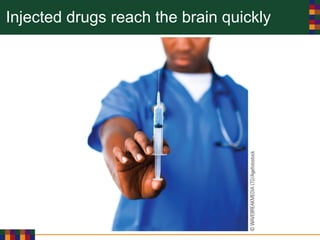
Injected drugs reach the brain quickly
Drug Actions
• Drugs affect various organs, including the nervous system.
• The nervous system consists of the central nervous system
(CNS), the autonomic nervous system (ANS), and the
peripheral nervous system (PNS)
• The CNS consists of the brain and spinal cord, and is
composed of nerve cells (neurons)
• Information is transmitted electrically within the neuron, and
chemically between neurons
The Neuron
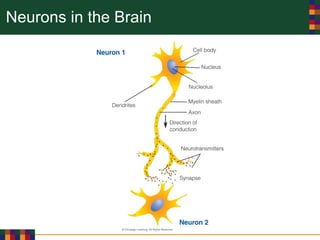
• Dendrites transmit nerve impulses to the nerve’s cell body
(soma)
• Axons send impulses away from the cell body
• Electrical impulses (action potentials) originate in the
dendrite and pass through the cell body via the axon
• Between the axon of one neuron and the dendrite of another
neuron is a space called a synapse
Neurons in the Brain
The Neuron
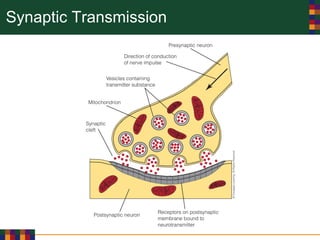
• At the ends of axons are saclike vesicles containing
neurotransmitters which cross the synapse to receptor sites
• Chemicals in the receptor sites generate electrical impulses
• Drugs that influencing the release, storage, and synthesis of
neurotransmitters are classified as presynaptic
• Drugs affecting neurotransmitters after they cross the
synapse are classified as postsynaptic
Synaptic Transmission
Drugs and Synaptic Transmission
• Neurotransmitters linked to addiction include dopamine,
norepinephrine, GABA, and serotonin
• Some drugs increase activity and excitation nerve cells (e.g.
caffeine)
• Sedative-hypnotic drugs make nerve cells less sensitive
• Many nerve cells contain autoreceptors that alter the
synthesis of neurotransmitters (e.g. LSD)
Neurotransmitters
• Most drugs affect brain activity by increasing or decreasing
the activity of various neurotransmitters
• Neurotransmitters enable the brain to receive, process, and
respond to information by carrying impulses from one neuron
to the next
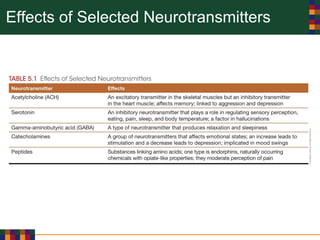
Acetylcholine
• Acetylcholine (ACH)
• Synthesized from choline and acetyl coenzyme A
• Cholinergic neurons are linked to specific behaviors
• Excitatory neurotransmitter in skeletal muscles
• Inhibitory neurotransmitter in heart muscle
• Reduced ACH receptors associated with Alzheimer’s
• Anticholinergic hallucinogens interfere with ACH
• Cholinesterase inhibitors such as nerve gas
Serotonin
• Serotonin
• Inhibitory neurotransmitter in the upper brain stem
(tryptaminergic neurons)
• Helps regulate pain, sensory perception, eating, sleep,
and body temperature
• Excessive reabsorption results in depression
(antidepressant drugs SSRIs)
• Related to hallucinations, psychosis, obsessive-
compulsive disorder, aggression or violence
• Amino acid tryptophan is needed to synthesize serotonin
in tryptaminergic neurons
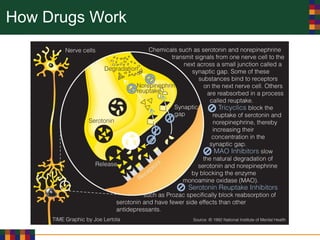
How Drugs Work
Gamma-aminobutyric Acid (GABA)
• Gamma-aminobutyric acid (GABA)
• Inhibits nerve impulses from being sent from one neuron
to another
• Alcohol stimulates GABA, producing relaxation and
feelings of decreased inhibition
• Barbiturates and minor tranquilizers also increase the
action of GABA
Catecholamines
• Catecholamines
• Epinephrine, dopamine, and norepinephrine
• Reabsorbed by the neuron that makes them (reuptake)
• Increase causes stimulation; decrease causes depression
• Amphetamines and cocaine initially increase
catecholamines, followed by depletion
• Dopamine levels are influenced by marijuana, nicotine,
heroin, and amphetamines
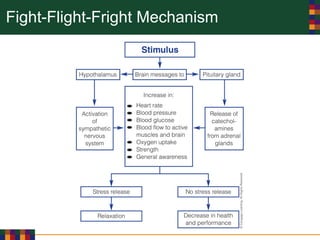
• Epinephrine released in fight-flight-fright syndrome
• Mescaline and MDMA (Ecstasy) reduce norepinephrine
Fight-Flight-Fright Mechanism
Peptides
• Peptides
• Substances in which amino acid sequences are linked
• Modulate the activity of transmitters
• Natural endorphins have opiate-like properties
• High levels of endorphins in the brain (enkaphalins) could
be a factor in morphine dependency
• Chronic alcohol use impairs endorphin production
Effects of Selected Neurotransmitters
Central Nervous System (CNS)
• The CNS consists of the brain and spinal cord
• Messages are transmitted from the brain to the muscles and
organs and back to the brain through the spinal cord
• The type of message depends on which part of the brain is
sending it
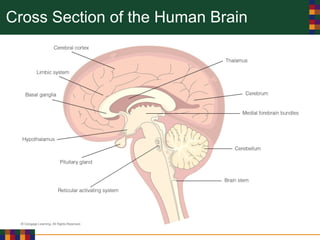
Cross Section of the Human Brain
Reticular Activating System (RAS)
• Reticular Activating System (RAS)
• Part of the central nervous system
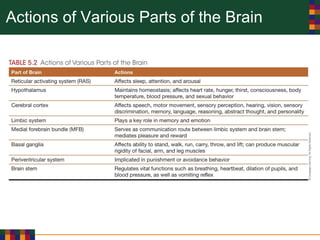
• Affects sleep, attention, and arousal
• Shuts down during sleep
• Many drugs, including barbiturates, LSD, alcohol, and
amphetamines, affect the RAS extensively
• Stimulants activate the RAS
Hypothalamus
• Hypothalamus
• Gland situated near the base of the brain
• Maintains homeostasis
• Controls the pituitary gland, which regulates hormones
that affect stress, aggressiveness, heart rate, hunger,
thirst, consciousness, body temperature, blood pressure,
and sexual behavior
• Linked to behavioral and chemical dependencies from
alcohol to gambling to obesity
Cerebral Cortex
• Cerebral cortex
• Part of the cerebrum involved in intellectual functioning
• Affects speech, motor movement, sensory perception,
hearing, vision, sensory discrimination, memory,
language, reasoning, abstract reasoning, and personality
• Affected by almost all psychoactive drugs
Limbic System
• Limbic system
• Part of the central nervous system that plays a key role in
memory and emotion
• Consists of many diverse structures in the cerebral
hemispheres
• Cocaine affects neurotransmitters in the limbic system,
creating intense feelings of excitement and joy
• Depressants reduce electrical activity in the limbic system,
producing feelings of tranquility and relaxation
Limbic system Regulates Anger
and Hostile Behaviors
Medial Forebrain Bundle
• Medial forebrain bundle (MFB)
• Serves as a communication route between the limbic
system and the brain stem
• Affects pleasure and reward
• Sensation of orgasm originates here
• Amphetamines and cocaine produce intense euphoria
Basal Ganglia
• Basal ganglia
• Part of the central nervous system which maintains
involuntary motor control
• Regulates abilities to stand, walk, run, carry, throw, and lift
• Parkinson’s disease destroys the basal ganglia
• Drugs prescribed for schizophrenia can precipitate
Parkinson’s-like behavior
• China white (fentanyl) has been linked to brain damage
similar to Parkinson’s disease
Periventricular System
• Periventricular System
• Composed of nerve cells above and to either side of the
hypothalamus
• Implicated in punishment or avoidance behavior
• Coupled with the MBF in that stimulation of one inhibits the
other
Brain Stem
• The brain stem is located at the point where the brain and
spinal cord join
• It consists of the medulla oblongata, pons, and midbrain
• Regulates functions such as breathing, heartbeat, dilation of
the pupil of the eye, blood pressure, and the vomiting reflex
• Drugs affecting the brain stem include alcohol and opiates
Actions of Various Parts of the Brain
Peripheral Nervous System
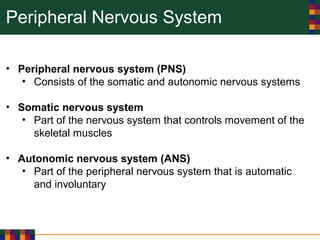
• Peripheral nervous system (PNS)
• Consists of the somatic and autonomic nervous systems
• Somatic nervous system
• Part of the nervous system that controls movement of the
skeletal muscles
• Autonomic nervous system (ANS)
• Part of the peripheral nervous system that is automatic
and involuntary
Autonomic Nervous System
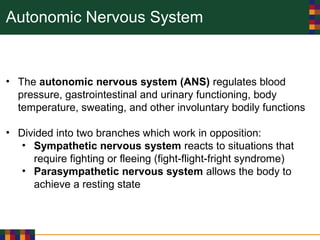
• The autonomic nervous system (ANS) regulates blood
pressure, gastrointestinal and urinary functioning, body
temperature, sweating, and other involuntary bodily functions
• Divided into two branches which work in opposition:
• Sympathetic nervous system reacts to situations that
require fighting or fleeing (fight-flight-fright syndrome)
• Parasympathetic nervous system allows the body to
achieve a resting state
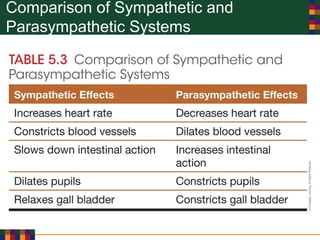
Comparison of Sympathetic and
Parasympathetic Systems
Autonomic Nervous System
• Drugs that mimic actions of the sympathetic system are called
sympathomimetics
• Examples: Amphetamines, cocaine, and caffeine
• Drugs that mimic actions of the parasympathetic system are
called parasympathomimetics
• Examples: Nicotine and the hallucinogen Amanita muscaria
Drugs and Major Body Systems
• Endocrine System
• Hormones stimulate growth of new tissues, store nutrients,
maintain homeostasis, and affect metabolism and sexual
behavior
• The hypothalamus controls the endocrine system and the
pituitary gland
• The adrenal glands, secrete adrenaline and cortisol
• Many synthetic hormones are used as drugs
Drugs and Major Body Systems
• Cardiovascular System
• Drugs that interfere with the heart’s ability to contract
present a danger
• Alcohol can cause the heart muscle to degenerate, induce
cardiac arrhythmia, and increase blood pressure
• Cocaine increases heart rate and blood pressure, and is a
vasoconstrictor
• Cigarettes raise blood pressure and reduce oxygen
• Marijuana causes tachycardia
Drugs and Major Body Systems
• Respiratory System
• Depressant drugs such as barbiturates, minor
tranquilizers, alcohol, and narcotics slow respiration
• Combining depressants with other drugs can have a
synergistic effect
• Stimulants such as amphetamines and cocaine increase
respiratory rate
• Cigarette smoke impedes cilia from removing mucus and
other foreign matter from the lungs
Drugs and Major Body Systems
• Gastrointestinal System
• Antacids containing sodium bicarbonate, calcium
carbonate, aluminum hydroxide, or magnesium salts are
used to neutralize stomach acid
• Laxatives are used to relieve constipation
• Alcohol causes diarrhea and irritates the stomach, small
intestine, esophagus, and pancreas
Factors Influencing the Effects of Drugs
• Age
• Infants and the elderly are more sensitive to the effects of
drugs than people between these two life stages
• Drug actions are prolonged because they are less able to
metabolize and excrete drugs
• Tolerance for alcohol lessens as people age
• Some drugs accumulate in adipose tissue, increasing
sensitivity and the possibility of a toxic reaction
• Elementary-age children respond differently to drugs
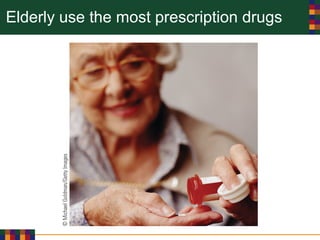
Elderly use the most prescription drugs
Factors Influencing the Effects of Drugs
• Gender:
• Women are more sensitive to drugs because fat stores
drugs and water dilutes drugs in the bloodstream
• Females are especially affected by drugs during the
premenstrual phase of the menstrual cycle and pregnancy
• Teratogenic drugs damage the developing fetus
• Use of tobacco, coffee, and alcohol during pregnancy
increases the risk of miscarriages
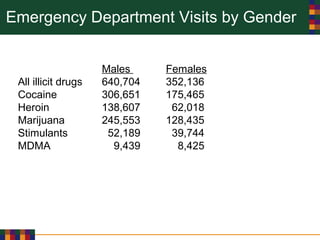
Emergency Department Visits by Gender
Males Females
All illicit drugs 640,704 352,136
Cocaine 306,651 175,465
Heroin 138,607 62,018
Marijuana 245,553 128,435
Stimulants 52,189 39,744
MDMA 9,439 8,425
Factors Influencing the Effects of Drugs
• Dosage
• The smallest amount of a drug required to produce an
effect is the threshold dose
• The amount necessary to achieve a specific response is
the effective dose (ED)
• The quantity required to cause death is the lethal dose
(LD)
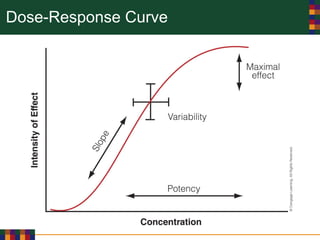
• A dose-response curve represents the effects of drugs at
various levels
Dose-Response Curve
Purity and Potency
• Many problems arise from impurities rather than from the
drugs themselves
• The purity of drugs varies greatly among illegal drugs –
heroin has varied from 4% to 69%
• Potency refers to a drug’s ability to produce an effect relative
to other drugs – some drugs vary naturally in potency
Drug Interactions
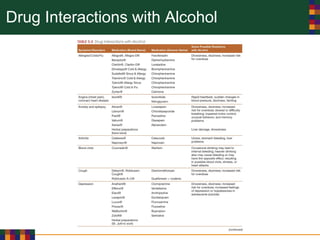
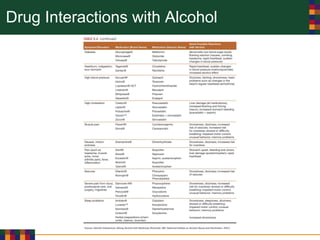
• An estimated 25% of admissions to emergency rooms result
from interactions between alcohol and medications
• The effects of combining drugs and food can be additive,
antagonistic, or synergistic
• Taking certain antidepressants with certain foods can result in
hemorrhaging and stroke
• More than 150 prescription and over-the counter medications
interact negatively with alcohol
Drug Interactions with Alcohol
Tolerance
• Tolerance
• Progressively decreasing responsiveness to a drug
• Pharmacological tolerance
• Adjustment or compensation of the body to the presence
of a given drug
• Behavioral tolerance
• Adjustment or behaviors learned by an individual to
compensate for the presence of drugs
Tolerance
• Cross-tolerance
• Transference of tolerance to a drug to chemically similar
drugs
• Reverse tolerance
• A drug user’s experiencing of the desired effects from
lesser amounts of the same drug
Set and Setting
• The effects of drugs on behavior depend on one’s attitudes
toward drugs, emotional state, and previous experiences
• Set
• The psychological state, personality, and expectations of
an individual while using drugs (internal environment)
• Setting
• The physical and social environment in which drugs are
used (external environment)
Set and Setting
• Placebos are inert substances capable of producing
psychological and physiological reactions
• Placebo prescriptions are effective because of expectations
for the drug
• The notion of a drug being euphoric or dysphoric depends a
great deal on set
• To a large extent, setting determines set
Methods of Administration
• Oral Ingestion
• Drugs can be consumed in the form of pills, liquids,
tablets, or capsules
• Convenient and safe
• Not appropriate in emergencies
• Slow absorption rate may reduce the amount of the drug
to an insufficient level
• Can choke on a drug if not conscious
• Some ingested drugs cause nausea and vomiting
• Because conditions in the gastrointestinal tract change
constantly, drug absorption is variable
Methods of Administration
• Injection (parenteral drug use)
• Reach the brain quickly but carry many risks
• In intravenous injection, or mainlining, drugs are
administered directly into the bloodstream
• In intramuscular injection, drugs are injected into muscle
tissue
• Injecting drugs just below the layers of the skin is called
subcutaneous injection
• Unsterile needles pose risk for infectious diseases such as
AIDS
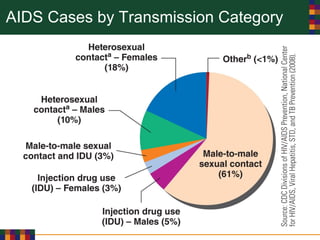
AIDS Cases by Transmission Category
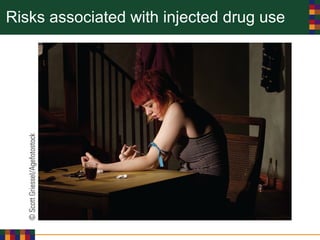
Risks associated with injected drug use
Methods of Administration
• Topical application (transdermal method)
• Drugs applied to the skin and absorbed into the
bloodstream by placing small disks or patches behind the
ear or on the arm or chest
• Introduces drugs into the body slowly
• Drugs are absorbed directly into the bloodstream at
programmed rates
• Used to relieve motion sickness, angina pectoris, and
nicotine dependency
Methods of Administration
• Inhalation
• Drugs absorbed into the bloodstream via the lungs
• Fast and efficient
• Irritates the lungs
• Inhaled drugs include volatile anesthetics such as glue,
paint thinner, and gasoline, in addition to cigarettes,
marijuana, and crack cocaine

Goldberg Chapter 5

  • 1.
    Albia Dugger •Miami Dade College Chapter 5 The Pharmacology and Physiology of Drug Use
  • 2.
    Pharmacology • Different drugsproduce different effects within the psyche and soma • The interaction between drugs and living organisms is called pharmacology • Drug pharmacology relates to the way it is administered, absorbed, distributed, metabolized, and excreted • Drugs that act quickly and produce intense effects are more likely to be abused than are drugs that act slowly
  • 3.
    Injected drugs reachthe brain quickly
  • 4.
    Drug Actions • Drugsaffect various organs, including the nervous system. • The nervous system consists of the central nervous system (CNS), the autonomic nervous system (ANS), and the peripheral nervous system (PNS) • The CNS consists of the brain and spinal cord, and is composed of nerve cells (neurons) • Information is transmitted electrically within the neuron, and chemically between neurons
  • 5.
    The Neuron • Dendritestransmit nerve impulses to the nerve’s cell body (soma) • Axons send impulses away from the cell body • Electrical impulses (action potentials) originate in the dendrite and pass through the cell body via the axon • Between the axon of one neuron and the dendrite of another neuron is a space called a synapse
  • 6.
  • 7.
    The Neuron • Atthe ends of axons are saclike vesicles containing neurotransmitters which cross the synapse to receptor sites • Chemicals in the receptor sites generate electrical impulses • Drugs that influencing the release, storage, and synthesis of neurotransmitters are classified as presynaptic • Drugs affecting neurotransmitters after they cross the synapse are classified as postsynaptic
  • 8.
  • 9.
    Drugs and SynapticTransmission • Neurotransmitters linked to addiction include dopamine, norepinephrine, GABA, and serotonin • Some drugs increase activity and excitation nerve cells (e.g. caffeine) • Sedative-hypnotic drugs make nerve cells less sensitive • Many nerve cells contain autoreceptors that alter the synthesis of neurotransmitters (e.g. LSD)
  • 10.
    Neurotransmitters • Most drugsaffect brain activity by increasing or decreasing the activity of various neurotransmitters • Neurotransmitters enable the brain to receive, process, and respond to information by carrying impulses from one neuron to the next
  • 11.
    Acetylcholine • Acetylcholine (ACH) •Synthesized from choline and acetyl coenzyme A • Cholinergic neurons are linked to specific behaviors • Excitatory neurotransmitter in skeletal muscles • Inhibitory neurotransmitter in heart muscle • Reduced ACH receptors associated with Alzheimer’s • Anticholinergic hallucinogens interfere with ACH • Cholinesterase inhibitors such as nerve gas
  • 12.
    Serotonin • Serotonin • Inhibitoryneurotransmitter in the upper brain stem (tryptaminergic neurons) • Helps regulate pain, sensory perception, eating, sleep, and body temperature • Excessive reabsorption results in depression (antidepressant drugs SSRIs) • Related to hallucinations, psychosis, obsessive- compulsive disorder, aggression or violence • Amino acid tryptophan is needed to synthesize serotonin in tryptaminergic neurons
  • 13.
  • 14.
    Gamma-aminobutyric Acid (GABA) •Gamma-aminobutyric acid (GABA) • Inhibits nerve impulses from being sent from one neuron to another • Alcohol stimulates GABA, producing relaxation and feelings of decreased inhibition • Barbiturates and minor tranquilizers also increase the action of GABA
  • 15.
    Catecholamines • Catecholamines • Epinephrine,dopamine, and norepinephrine • Reabsorbed by the neuron that makes them (reuptake) • Increase causes stimulation; decrease causes depression • Amphetamines and cocaine initially increase catecholamines, followed by depletion • Dopamine levels are influenced by marijuana, nicotine, heroin, and amphetamines • Epinephrine released in fight-flight-fright syndrome • Mescaline and MDMA (Ecstasy) reduce norepinephrine
  • 16.
  • 17.
    Peptides • Peptides • Substancesin which amino acid sequences are linked • Modulate the activity of transmitters • Natural endorphins have opiate-like properties • High levels of endorphins in the brain (enkaphalins) could be a factor in morphine dependency • Chronic alcohol use impairs endorphin production
  • 18.
    Effects of SelectedNeurotransmitters
  • 19.
    Central Nervous System(CNS) • The CNS consists of the brain and spinal cord • Messages are transmitted from the brain to the muscles and organs and back to the brain through the spinal cord • The type of message depends on which part of the brain is sending it
  • 20.
    Cross Section ofthe Human Brain
  • 21.
    Reticular Activating System(RAS) • Reticular Activating System (RAS) • Part of the central nervous system • Affects sleep, attention, and arousal • Shuts down during sleep • Many drugs, including barbiturates, LSD, alcohol, and amphetamines, affect the RAS extensively • Stimulants activate the RAS
  • 22.
    Hypothalamus • Hypothalamus • Glandsituated near the base of the brain • Maintains homeostasis • Controls the pituitary gland, which regulates hormones that affect stress, aggressiveness, heart rate, hunger, thirst, consciousness, body temperature, blood pressure, and sexual behavior • Linked to behavioral and chemical dependencies from alcohol to gambling to obesity
  • 23.
    Cerebral Cortex • Cerebralcortex • Part of the cerebrum involved in intellectual functioning • Affects speech, motor movement, sensory perception, hearing, vision, sensory discrimination, memory, language, reasoning, abstract reasoning, and personality • Affected by almost all psychoactive drugs
  • 24.
    Limbic System • Limbicsystem • Part of the central nervous system that plays a key role in memory and emotion • Consists of many diverse structures in the cerebral hemispheres • Cocaine affects neurotransmitters in the limbic system, creating intense feelings of excitement and joy • Depressants reduce electrical activity in the limbic system, producing feelings of tranquility and relaxation
  • 25.
    Limbic system RegulatesAnger and Hostile Behaviors
  • 26.
    Medial Forebrain Bundle •Medial forebrain bundle (MFB) • Serves as a communication route between the limbic system and the brain stem • Affects pleasure and reward • Sensation of orgasm originates here • Amphetamines and cocaine produce intense euphoria
  • 27.
    Basal Ganglia • Basalganglia • Part of the central nervous system which maintains involuntary motor control • Regulates abilities to stand, walk, run, carry, throw, and lift • Parkinson’s disease destroys the basal ganglia • Drugs prescribed for schizophrenia can precipitate Parkinson’s-like behavior • China white (fentanyl) has been linked to brain damage similar to Parkinson’s disease
  • 28.
    Periventricular System • PeriventricularSystem • Composed of nerve cells above and to either side of the hypothalamus • Implicated in punishment or avoidance behavior • Coupled with the MBF in that stimulation of one inhibits the other
  • 29.
    Brain Stem • Thebrain stem is located at the point where the brain and spinal cord join • It consists of the medulla oblongata, pons, and midbrain • Regulates functions such as breathing, heartbeat, dilation of the pupil of the eye, blood pressure, and the vomiting reflex • Drugs affecting the brain stem include alcohol and opiates
  • 30.
    Actions of VariousParts of the Brain
  • 31.
    Peripheral Nervous System •Peripheral nervous system (PNS) • Consists of the somatic and autonomic nervous systems • Somatic nervous system • Part of the nervous system that controls movement of the skeletal muscles • Autonomic nervous system (ANS) • Part of the peripheral nervous system that is automatic and involuntary
  • 32.
    Autonomic Nervous System •The autonomic nervous system (ANS) regulates blood pressure, gastrointestinal and urinary functioning, body temperature, sweating, and other involuntary bodily functions • Divided into two branches which work in opposition: • Sympathetic nervous system reacts to situations that require fighting or fleeing (fight-flight-fright syndrome) • Parasympathetic nervous system allows the body to achieve a resting state
  • 33.
    Comparison of Sympatheticand Parasympathetic Systems
  • 34.
    Autonomic Nervous System •Drugs that mimic actions of the sympathetic system are called sympathomimetics • Examples: Amphetamines, cocaine, and caffeine • Drugs that mimic actions of the parasympathetic system are called parasympathomimetics • Examples: Nicotine and the hallucinogen Amanita muscaria
  • 35.
    Drugs and MajorBody Systems • Endocrine System • Hormones stimulate growth of new tissues, store nutrients, maintain homeostasis, and affect metabolism and sexual behavior • The hypothalamus controls the endocrine system and the pituitary gland • The adrenal glands, secrete adrenaline and cortisol • Many synthetic hormones are used as drugs
  • 36.
    Drugs and MajorBody Systems • Cardiovascular System • Drugs that interfere with the heart’s ability to contract present a danger • Alcohol can cause the heart muscle to degenerate, induce cardiac arrhythmia, and increase blood pressure • Cocaine increases heart rate and blood pressure, and is a vasoconstrictor • Cigarettes raise blood pressure and reduce oxygen • Marijuana causes tachycardia
  • 37.
    Drugs and MajorBody Systems • Respiratory System • Depressant drugs such as barbiturates, minor tranquilizers, alcohol, and narcotics slow respiration • Combining depressants with other drugs can have a synergistic effect • Stimulants such as amphetamines and cocaine increase respiratory rate • Cigarette smoke impedes cilia from removing mucus and other foreign matter from the lungs
  • 38.
    Drugs and MajorBody Systems • Gastrointestinal System • Antacids containing sodium bicarbonate, calcium carbonate, aluminum hydroxide, or magnesium salts are used to neutralize stomach acid • Laxatives are used to relieve constipation • Alcohol causes diarrhea and irritates the stomach, small intestine, esophagus, and pancreas
  • 39.
    Factors Influencing theEffects of Drugs • Age • Infants and the elderly are more sensitive to the effects of drugs than people between these two life stages • Drug actions are prolonged because they are less able to metabolize and excrete drugs • Tolerance for alcohol lessens as people age • Some drugs accumulate in adipose tissue, increasing sensitivity and the possibility of a toxic reaction • Elementary-age children respond differently to drugs
  • 40.
    Elderly use themost prescription drugs
  • 41.
    Factors Influencing theEffects of Drugs • Gender: • Women are more sensitive to drugs because fat stores drugs and water dilutes drugs in the bloodstream • Females are especially affected by drugs during the premenstrual phase of the menstrual cycle and pregnancy • Teratogenic drugs damage the developing fetus • Use of tobacco, coffee, and alcohol during pregnancy increases the risk of miscarriages
  • 42.
    Emergency Department Visitsby Gender Males Females All illicit drugs 640,704 352,136 Cocaine 306,651 175,465 Heroin 138,607 62,018 Marijuana 245,553 128,435 Stimulants 52,189 39,744 MDMA 9,439 8,425
  • 43.
    Factors Influencing theEffects of Drugs • Dosage • The smallest amount of a drug required to produce an effect is the threshold dose • The amount necessary to achieve a specific response is the effective dose (ED) • The quantity required to cause death is the lethal dose (LD) • A dose-response curve represents the effects of drugs at various levels
  • 44.
  • 45.
    Purity and Potency •Many problems arise from impurities rather than from the drugs themselves • The purity of drugs varies greatly among illegal drugs – heroin has varied from 4% to 69% • Potency refers to a drug’s ability to produce an effect relative to other drugs – some drugs vary naturally in potency
  • 46.
    Drug Interactions • Anestimated 25% of admissions to emergency rooms result from interactions between alcohol and medications • The effects of combining drugs and food can be additive, antagonistic, or synergistic • Taking certain antidepressants with certain foods can result in hemorrhaging and stroke • More than 150 prescription and over-the counter medications interact negatively with alcohol
  • 47.
  • 48.
  • 49.
    Tolerance • Tolerance • Progressivelydecreasing responsiveness to a drug • Pharmacological tolerance • Adjustment or compensation of the body to the presence of a given drug • Behavioral tolerance • Adjustment or behaviors learned by an individual to compensate for the presence of drugs
  • 50.
    Tolerance • Cross-tolerance • Transferenceof tolerance to a drug to chemically similar drugs • Reverse tolerance • A drug user’s experiencing of the desired effects from lesser amounts of the same drug
  • 51.
    Set and Setting •The effects of drugs on behavior depend on one’s attitudes toward drugs, emotional state, and previous experiences • Set • The psychological state, personality, and expectations of an individual while using drugs (internal environment) • Setting • The physical and social environment in which drugs are used (external environment)
  • 52.
    Set and Setting •Placebos are inert substances capable of producing psychological and physiological reactions • Placebo prescriptions are effective because of expectations for the drug • The notion of a drug being euphoric or dysphoric depends a great deal on set • To a large extent, setting determines set
  • 53.
    Methods of Administration •Oral Ingestion • Drugs can be consumed in the form of pills, liquids, tablets, or capsules • Convenient and safe • Not appropriate in emergencies • Slow absorption rate may reduce the amount of the drug to an insufficient level • Can choke on a drug if not conscious • Some ingested drugs cause nausea and vomiting • Because conditions in the gastrointestinal tract change constantly, drug absorption is variable
  • 54.
    Methods of Administration •Injection (parenteral drug use) • Reach the brain quickly but carry many risks • In intravenous injection, or mainlining, drugs are administered directly into the bloodstream • In intramuscular injection, drugs are injected into muscle tissue • Injecting drugs just below the layers of the skin is called subcutaneous injection • Unsterile needles pose risk for infectious diseases such as AIDS
  • 55.
    AIDS Cases byTransmission Category
  • 56.
    Risks associated withinjected drug use
  • 57.
    Methods of Administration •Topical application (transdermal method) • Drugs applied to the skin and absorbed into the bloodstream by placing small disks or patches behind the ear or on the arm or chest • Introduces drugs into the body slowly • Drugs are absorbed directly into the bloodstream at programmed rates • Used to relieve motion sickness, angina pectoris, and nicotine dependency
  • 58.
    Methods of Administration •Inhalation • Drugs absorbed into the bloodstream via the lungs • Fast and efficient • Irritates the lungs • Inhaled drugs include volatile anesthetics such as glue, paint thinner, and gasoline, in addition to cigarettes, marijuana, and crack cocaine

Editor's Notes

  • #4 Injected drugs reach the brain more quickly than drugs administered by other methods.
  • #7 Figure 5.1 Neurons in the Brain
  • #9 Figure 5.2 Synaptic Transmission
  • #14 Figure 5.3 How the Drugs Work
  • #17 Figure 5.4 Fight-Flight-Fright Mechanism
  • #21 Figure 5.5 Cross Section of the Human Brain
  • #26 The limbic system regulates emotions including anger and hostile behaviors.
  • #41 The rate of prescription drug use is higher among the elderly than any other age group.
  • #45 Figure 5.6 Dose-Response Curve
  • #56 Figure 5.7 Proportion of AIDS Cases Among Adults and Adolescents, by Transmission Category and Year of Diagnosis, 1985–2006—United States and Dependent Areas
  • #57 Health risks are associated with injected drug use.