Drug Abuse and Addiction
Abad Agha
IIUI
Drug use and Addiction
1- Taking Drug as Deviance
2- Legal drug use
3- Types of illegal drugs
4- Marijuana Use
5- Opiate use and addiction
6- Becoming an opiate addict
7- Cocaine use
8- Society response to drug use and addiction
9- Prevention of drug use
Drug and Addiction
• Drug
Any substance other than food, that by its chemical or physical nature alter the structure or
function in the living organism.
Ex from Asprine to alcohol
• Addiction
The fact or condition of being dependent (psucological) to a particular substance or activity.
• Drug User
Used more ofently to refer to a person who consumes an illegal psychoactive substance.
• Under the Influence of Drugs
If someone is under the influence, their mind is affected by alcohol or drugs.
Ex. Police charged the man with driving under the influence.
1- Taking Drug as a Deviance
• Many view drugs to be a problem
• Some consider it pleasant and beneficial
• Not the effects or characteristics but the purpose of taking drugs consider
whether it is deviant or not.
Ex. Medical purposes
• Physicality of drugs too do not explain the deviant identity.
Ex. Heroin-Deviant but caffeine escapes that stigma.
1- Continue
• No chemical property distinguishes a drug from a non-drug.
• Socially created concept:
Certain segment of a society considers something to be a drug.
• Some drugs not considered deviant once might be sanctioned at another.
Ex. In the 19th century in the USA, women took opium as patent medicines
for “female disorders”.
1- Continue
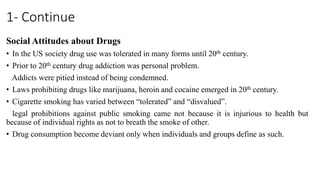
Social Attitudes about Drugs
• In the US society drug use was tolerated in many forms until 20th century.
• Prior to 20th century drug addiction was personal problem.
Addicts were pitied instead of being condemned.
• Laws prohibiting drugs like marijuana, heroin and cocaine emerged in 20th century.
• Cigarette smoking has varied between “tolerated” and “disvalued”.
legal prohibitions against public smoking came not because it is injurious to health but
because of individual rights as not to breath the smoke of other.
• Drug consumption become deviant only when individuals and groups define as such.
1- Continue
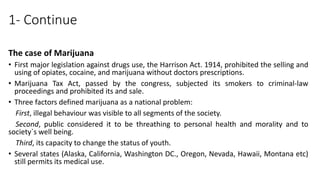
The case of Marijuana
• First major legislation against drugs use, the Harrison Act. 1914, prohibited the selling and
using of opiates, cocaine, and marijuana without doctors prescriptions.
• Marijuana Tax Act, passed by the congress, subjected its smokers to criminal-law
proceedings and prohibited its and sale.
• Three factors defined marijuana as a national problem:
First, illegal behaviour was visible to all segments of the society.
Second, public considered it to be threathing to personal health and morality and to
society`s well being.
Third, its capacity to change the status of youth.
• Several states (Alaska, California, Washington DC., Oregon, Nevada, Hawaii, Montana etc)
still permits its medical use.
1- Continue
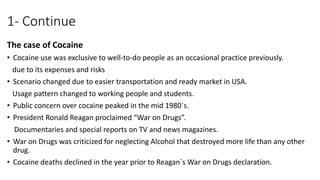
The case of Cocaine
• Cocaine use was exclusive to well-to-do people as an occasional practice previously.
due to its expenses and risks
• Scenario changed due to easier transportation and ready market in USA.
Usage pattern changed to working people and students.
• Public concern over cocaine peaked in the mid 1980`s.
• President Ronald Reagan proclaimed “War on Drugs”.
Documentaries and special reports on TV and news magazines.
• War on Drugs was criticized for neglecting Alcohol that destroyed more life than any other
drug.
• Cocaine deaths declined in the year prior to Reagan`s War on Drugs declaration.
1- Continue
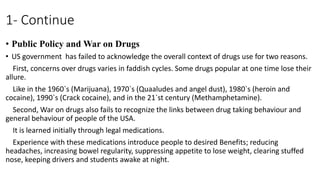
• Public Policy and War on Drugs
• US government has failed to acknowledge the overall context of drugs use for two reasons.
First, concerns over drugs varies in faddish cycles. Some drugs popular at one time lose their
allure.
Like in the 1960`s (Marijuana), 1970`s (Quaaludes and angel dust), 1980`s (heroin and
cocaine), 1990`s (Crack cocaine), and in the 21`st century (Methamphetamine).
Second, War on drugs also fails to recognize the links between drug taking behaviour and
general behaviour of people of the USA.
It is learned initially through legal medications.
Experience with these medications introduce people to desired Benefits; reducing
headaches, increasing bowel regularity, suppressing appetite to lose weight, clearing stuffed
nose, keeping drivers and students awake at night.
2- Legal Drug Use
• Legaly approved drugs includes alcohol, tobacco, tranquilizers for relaxation, barbiturates for
sleeping, and many other minor pain-killers like asprin.
• Users by them over the counter (OTC) without any prescription from a doctor.
• 3 lakhs different drugs available on OTC.
• Caffeine laden coffee is the second largest traded commodity behind oil.
• Coffee usage declined over the last two decades but smoking cigarettes has been increased.
• estimated 5.5 trillion cigarettes were sold in 2002.
• According to the national representative survey 23 percent of Americans smoke.
• 19 percent of students smoking are in grade 9 to 12, and they purchased directly.
• 67 percent of which were not asked to show proof of age.
• Pharmacies sell drugs without doctor`s prescription.
2- continue
• Prescription drugs hold more addiction potential than OTC drugs.
• Women are more likely to go for prescription drugs (tranquilizers) when under stress.
• Men opt OTC (alcohol) drugs when under stress.
• Some coffee manufacturers lower down the amount of caffeine but was not eliminated totally.
• Cigarettes brands promise to low tar and nicotine, but do not eliminate it completely.
• Advertisement to attract more consumers and to influence physicians choice of one drug over the
other.
1- Direct campaigns and medical journals.
2- Photos of attractive women (dermatology related drugs).
3- To influence those physicians who lack expertise of drugs.
3- Types of illegal Drugs
Depressants
• Sometimes called “downers”.
• Mute mental and physical activity in varying degrees.
• SHORT-TERM EFFECTS
Slow brain function, Slowed pulse and breathing, Lowered blood pressure, Poor
concentration, Fatigue, Visual disturbances etc.
• LONG-TERM EFFECTS
depression, chronic fatigue, breathing difficulties, sexual problems and sleep problems
• More commonly discussed depressants are alcohol, morphine, and marijuana.
3- Continue
Stimulants
• Sometimes called “uppers,” temporarily increase alertness and energy.
• Prescription stimulants come in tablets or capsules. When abused, they are swallowed,
injected in liquid form or crushed and snorted.
• Cocaine, crack cocaine, Caffeine, Coca, Nicotine, Tea.
• SHORT-TERM EFFECTS
Exhaustion, apathy and depression.
LONG-TERM EFFECTS
Feelings of hostility, high body temperatures and an irregular heartbeat.
• The most commonly used street drugs that fall into this category are cocaine and
amphetamines.
3- Continue
Hallucinogens
• Hallucinogens are drugs that alter the user’s thinking processes and perception in a
manner that leads to significant distortions of reality.
• Effects
Hallucinations, an altered sense of time, and dissociative experiences (e.g., not feeling
connected to one’s body or reality), Profound sweating, Dry mouth, Mood swings, Distorted
thinking, Coordination problems, Anxiety.
3- Continue
Narcotics
• Narcotic, drug that produces analgesia (pain relief), narcosis (state of stupor or sleep), and
addiction (physical dependence on the drug). In some people narcotics also produce euphoria
(a feeling of great elation).
• The main therapeutic use of narcotics is for pain relief, and hence they are often called
narcotic analgesics.
• The best-known narcotics are the opiates—i.e., compounds found in or derived from opium.
Opium is obtained as the dried milky juice of the seed pods of the opium poppy.
• Examples of narcotic analgesics are:
Methadone, Morphine, Hydrocodone, Fentanyl etc.
• Side effects of narcotic analgesics include:
Constipation, Nausea, Itching, Vomiting, Trouble breathing, Chest pain, Cardiac arrest, Death
3- Continue
Heroin
• An illegal and natural opiate.
• Not approved for medical uses.
• Fastest-acting opiate.
• Distributed as a brown or white powder.
• The drug can be snorted, smoked, or injected.
• Individuals often cycle between an awake and unconscious state, called being “on the nod.”
• Overdose is a major risk of abuse.
• Close to 13,000 people died as the result of a heroin overdose in 2015
3- Continue
Morphine
• Natural opiate derived directly from the opium poppy plant.
• Used for both acute and chronic pain management.
• Also used to provide sedation before surgical procedures.
• Considered most effective pain medication in the market.
• Between 1990 and 2010, the US consumed over half of the world’s morphine.
• An estimated 10 percent of Americans have abused an opioid drug (including morphine) at
least one time in their lives.
3- Continue
Methadone
• Methadone is part of a category called opioids.
• It was created by German doctors during World War II.
• When it arrived in the United States, it was used to treat people with extreme pain.
• Consumed in the form of a tablet, a powder, or a liquid.
• Addicts typically take at-least three daily doses.
• Effects
Restlessness, Nausea or vomiting, Slow breathing, Itchy skin, Heavy sweating, Constipation.
3- Continue
Cocaine
• Best known stimulant drug.
• Users commonly inhale or snort through nose.
• Effects
Extreme happiness and energy, Mental alertness, hypersensitivity to sight, sound, and touch,
Extreme and unreasonable distrust of others, raised body temperature and blood pressure
Faster heartbeat.
4- Marijuana Use
• One of the most abused drugs in the world.
• Marijuana comes from the Indian hemp plant, and the part that contains the “drug” is found
primarily in the flowers.
• It is usually green, brown or gray in color.
• When smoked, both marijuana and hashish give off a distinctive, sweet odor.
• US law prohibits the manufacture, sale, and possession of marijuana.
• Large population of the world has tried it at-least once.
• US surveys indicated that 24 million people had tried marijuana.
• 8.3 million generally use it once in week.
• 5 lakh people use it more than once a day.
• More recent work indicates that 96 million Americans have smoked marijuana at least once.
4- Continue
• Marijuana can be smoked as a cigarette (joint), but may also be smoked in a dry pipe or a water
pipe known as a “bong.”
• When a person inhales the smoke from a joint or a pipe, he usually feels its effect within
minutes.
• The immediate sensations increased heart rate, lessened coordination and balance, and a
“dreamy,” unreal state of mind peak within the first 30 minutes.
• These short term effects usually wear off in two to three hours, but they could last longer,
depending on how much the user takes
• It has been found that smoking one joint gives as much exposure to cancer-producing
chemicals as smoking four to five cigarettes.
• Smoking tobacco and marijuana together in the bowl of a pipe is known as mooking.
• The chemicals of tobacco and marijuana work on the nervous system and affect both the mind
and the body.
4- Continue
• A study of 129 college students found that, among those who smoked the drug at least 27 of
the 30 days before being surveyed, critical skills related to attention, memory, and learning
were seriously diminished.
• A study of postal workers found that employees who tested positive for marijuana had 55%
more accidents, 85% more injuries and a 75% increase in being absent from work.
• In Australia, a study found that cannabis intoxication was responsible for 4.3% of driver
fatalities.
Marijuana and Group support
• it is a social drug and is used in groups.
• Marijuana users come together, either regularly or irregularly smoke it.
• Newbies contact experienced ones to get to know its usage.
• A study found three learned elements.
1) how to smoke drug to produce certain effects, 2) How to recognize these effects, 3) how to
interpret the sensations as pleasurable.
4- Continue
• Group interactions encourage friendships and social participation.
• New user needs a group to access the stuff and get to know its proper usage.
5- opiate and Addiction
Patterns of heroin use
• Heroin is a substance that is both illegal and extremely addictive.
• The substance derives from opium from the poppy plant before it is refined to morphine, then
further chemically modified to become heroin.
• Heroin is sold and used in a number of forms including white or brown powder, a black sticky
substance (tar heroin), and solid black chunks.
• These different forms of heroin can be smoked, snorted, or injected under the skin, into
muscle, or directly into the veins.
• Heroin is abused for the immediate pleasurable feelings it can elicit, including:
1) A rise up enjoyable feelings
2) A warm, calm feeling.
3) An increased sense of well-being and confidence.
5- Continue
• Average addicts range from 40-50 years of age.
• Most addicts took up the habit after 30.
• Wave of widespread heroin usage came in 1945.
• Remained low in 1950s and increased in 1960s.
• By 1971 all large cities experienced highest rates of use.
• There is a strong link between AIDS and dirty heroin needles.
• Worldwide supply increased by 1990s, bringing down the prices and increasing
the availability.
5- Continue
Number of Heroin Users
• By 1967, 108500 addicts were heroin dependent.
• Drastic increase of 660000 addicts by 1975.
• Heroin use among American adults has increased almost fivefold in the last decade, according
to a study based on a survey of almost 80,000 people.
• By the turn of millennium, 0.33 percent reported to have used heroin, but 10 years later
number has risen to 1.6 percent.
• Among users, whites were on the go, rising from 0.34 percent to 1.9 percent over the decade.
• 3.8 million Americans, 1.6 percent of the population admitted to use heroin at some point of
their life.
• Heroin use and heroin dependence or abuse showed a steeper rise for adults who were male,
white, not married, had a lower education or a lower income.
• Adults under the age of 45 showed a greater increase in heroin abuse or dependence than
older adults.
5- Continue
• USA is followed by the following;
1) Iran (4 lakh)
2) Thailand (3.5 lakh)
3) Hongkong (80K)
4) Canada (18K)
5) Singapore (13K)
6) Australia (12.5K)
7) Italy (10K)
8) U.K (6K)
5- Continue
Who use Heroin?
• Heroin use is based on frequency use and the context in which it is used.
Some experiment it without continuing, some use it occasionally. More regular usage needs
addict subculture, and access to supply.
• It is uncommon under 20 years of age.
• National survey of high schools in found that less than 1 percent high school seniors reported
to have tried heroin.
• Young black and Hispanics males of urban lower class are more prone to opiate addiction.
• nearly 30 percent of the addict are the blacks of northeastern part USA.
• About 114000 people aged 12 and above used heroin for the first time in 2008.
• About 12000 (3 every 100) physicians used narcotics.
• According to a survey 59 percent sample of physicians and 78 percent of a sample of medical
students admitted to used illegal psychoactive drugs at sometime during their life.
5- Continue
• Performers of entertainment world also use drugs.
To tolerate long trips away from home, to perform certain kind of music.
• 53 percent of a sample of musicians reported have used heroin at-least once.
6- Becoming an Opiate addict
• Opiate addiction is a learned behaviour.
• Person first learns how to use the drugs, acquire them and how to recognize their effects.
• Most addicts knowingly approach drugs, through friends, peer groups, marital partners.
• Strangers introduced fewer than 10 percent of addicts to drugs.
• Prescription drugs rarely leads to addiction.
• Many addicts begin heroin out of curiosity sparked by addicted associates.
• Addicts introduce friends into habit, to pay for his/her own supply.
• Addicts introduce drugs at parties and first “shot” for free.
• For addiction, one must learn the technique of injecting the drug and the supply of drug.
• Association also perpetuate the rationalization for continued use.
• Addicts needs one another, to fulfill social and interpersonal support.
• Sense of belonging and success to alienated and disenfranchised individuals, in response to the
limited chances of success in the outside world.
6- Continue
The process of Addiction
Waldorf identified the following phases of addiction career.
• Experimentation
In the company of peers, someone may try heroin to satisfy curiosity. Most terminate the use,
but some continue.
• Escalation
Frequent use lead to daily use and increased tolerance. Some continue infrequently without
making them dependent to the drug.
• Maintaining (taking care of Business)
Addict maintain confidence about keeping up with the job and other responsibilities.
• Dysfunction
Addict may be jailed or sent to treatment for the first time, negative effects appear, addict may
try to quit the habit.
6- Continue
• Recovery (getting out of the life)
Addicts develop successful attitude to quit drugs, either within or outside a formal treatment
program
• Ex-Addict
Social identity as an Ex-Addict.
Theories of Addiction
Lindesmith`s theory
• The theory explains the socio-psychological processes that link drugs to their effects and
withdrawal symptoms.
• People use drug because they fear of pain associated with withdrawal.
• Users seem to escape addiction if they fail to realize the connection between potential for
distress and the opiate.
6-Conitnue
• If they be able to link the stress with opiate, they use it to relieve the uncomfortable
symptoms.
• New users learn the techniques of using drugs others and source of supply.
• User must become socialize.
• The more addicts associate with other addicts, the less they would be able to get themselves
free from drug dependence.
• After a while addict use drugs primarily to relieve withdrawal symptoms rather than to
experience euphoria.
7-Cocaine Use
• Discovered in 1800s.
• Attracted the attention of Sigmund Freud.
• By the end 1880s, all gave up the hope of its medical applications.
• Criminals, TV stars, athletes, musicians are addicts.
• Rich persons drug.
The cocaine Highway
• By early 1980s cocaine spread in the USA for two reasons:
1) limitation on amphetamines and strict controls on depressants.
2) World Bank allocated fund to built highway in the jungles of Peru. Which made a
transportation route to link cocaine to its suitable markets.
• Major point of meeting for Colombian and American buyers of cocaine.
• By the time it reaches its ultimate consumer, it has been diluted several times with baking
soda, caffeine, and powdered laxatives, making street prize 100 dollars.
7-Continue
• During the last half of 1985, crystalline cocaine appeared on large scale in the United States of
America, due to certain reasons;
1) Users can smoke it, rather than snorting it, which encourages rapid absorption in the body.
2) It cost less than cocaine. From 5-30 grand of crack cocaine as compared to up to 100$ of
cocaine.
3) Easy to hide and transport crack, facilitating transactions.
Method of Use
• South American users had long smoked cocaine.
• Chronic users take it through injections, which allows it to combine with drugs.
• Combination of cocaine and heroin is called “speedball”, intensifies euphoric effects.
• Cocaine is also used through inhaling through the nose, by using a small straw. It allows short
term sensations lasting 20 to 30 minutes. Such users might take up to 10 dose a day.
• Crack cocaine is taken through small pipes.
7-Continue
Consequences of Cocaine use
• Anxiety. The person starts to feel more of the anxiety associated with use.
• Lack of muscle control. Muscle control problems and other unpleasant effects caused by
cocaine use might also become more pronounced with prolonged abuse.
• Ingestion. People who ingest cocaine might experience less blood flow to the digestive system,
• Injection. People who inject cocaine run all the risks associated with injecting, including:
1) Puncture scars.
2) Infections.
3) Allergic reactions.
3) Contraction of diseases such as HIV and Hepatitis C.
8- Society`s response to drug use and Addiction
• Two potential targets;
1) Control the substance themselves
2) Control the behaviour of the people involved with the substance.
• Alter the supply of the drugs.
Restrict drug imports
• Alter demand of the drugs.
Applying criminal sanctions to deter users and dealers.
Treatment programs
Drug education
9- Prevention of Drug use
Media Messages
• Media messages are more geared towards young users.
• Media messages reaches virtually everyone in their intended audience.
Drug Education
• Drug education target potential users.
• Objective information to potential user might help them to evaluate drug use.
• Increased awareness will result in disapproval of drug use.
• Teaching kid to “just say no”.
• Information about the negative physical consequences seems to influence the drug taking
behaviour.
Thanks for listening
Any Question?

Drugs use and addiction

  • 1.
    Drug Abuse andAddiction Abad Agha IIUI
  • 2.
    Drug use andAddiction 1- Taking Drug as Deviance 2- Legal drug use 3- Types of illegal drugs 4- Marijuana Use 5- Opiate use and addiction 6- Becoming an opiate addict 7- Cocaine use 8- Society response to drug use and addiction 9- Prevention of drug use
  • 3.
    Drug and Addiction •Drug Any substance other than food, that by its chemical or physical nature alter the structure or function in the living organism. Ex from Asprine to alcohol • Addiction The fact or condition of being dependent (psucological) to a particular substance or activity. • Drug User Used more ofently to refer to a person who consumes an illegal psychoactive substance. • Under the Influence of Drugs If someone is under the influence, their mind is affected by alcohol or drugs. Ex. Police charged the man with driving under the influence.
  • 4.
    1- Taking Drugas a Deviance • Many view drugs to be a problem • Some consider it pleasant and beneficial • Not the effects or characteristics but the purpose of taking drugs consider whether it is deviant or not. Ex. Medical purposes • Physicality of drugs too do not explain the deviant identity. Ex. Heroin-Deviant but caffeine escapes that stigma.
  • 5.
    1- Continue • Nochemical property distinguishes a drug from a non-drug. • Socially created concept: Certain segment of a society considers something to be a drug. • Some drugs not considered deviant once might be sanctioned at another. Ex. In the 19th century in the USA, women took opium as patent medicines for “female disorders”.
  • 6.
    1- Continue Social Attitudesabout Drugs • In the US society drug use was tolerated in many forms until 20th century. • Prior to 20th century drug addiction was personal problem. Addicts were pitied instead of being condemned. • Laws prohibiting drugs like marijuana, heroin and cocaine emerged in 20th century. • Cigarette smoking has varied between “tolerated” and “disvalued”. legal prohibitions against public smoking came not because it is injurious to health but because of individual rights as not to breath the smoke of other. • Drug consumption become deviant only when individuals and groups define as such.
  • 7.
    1- Continue The caseof Marijuana • First major legislation against drugs use, the Harrison Act. 1914, prohibited the selling and using of opiates, cocaine, and marijuana without doctors prescriptions. • Marijuana Tax Act, passed by the congress, subjected its smokers to criminal-law proceedings and prohibited its and sale. • Three factors defined marijuana as a national problem: First, illegal behaviour was visible to all segments of the society. Second, public considered it to be threathing to personal health and morality and to society`s well being. Third, its capacity to change the status of youth. • Several states (Alaska, California, Washington DC., Oregon, Nevada, Hawaii, Montana etc) still permits its medical use.
  • 8.
    1- Continue The caseof Cocaine • Cocaine use was exclusive to well-to-do people as an occasional practice previously. due to its expenses and risks • Scenario changed due to easier transportation and ready market in USA. Usage pattern changed to working people and students. • Public concern over cocaine peaked in the mid 1980`s. • President Ronald Reagan proclaimed “War on Drugs”. Documentaries and special reports on TV and news magazines. • War on Drugs was criticized for neglecting Alcohol that destroyed more life than any other drug. • Cocaine deaths declined in the year prior to Reagan`s War on Drugs declaration.
  • 9.
    1- Continue • PublicPolicy and War on Drugs • US government has failed to acknowledge the overall context of drugs use for two reasons. First, concerns over drugs varies in faddish cycles. Some drugs popular at one time lose their allure. Like in the 1960`s (Marijuana), 1970`s (Quaaludes and angel dust), 1980`s (heroin and cocaine), 1990`s (Crack cocaine), and in the 21`st century (Methamphetamine). Second, War on drugs also fails to recognize the links between drug taking behaviour and general behaviour of people of the USA. It is learned initially through legal medications. Experience with these medications introduce people to desired Benefits; reducing headaches, increasing bowel regularity, suppressing appetite to lose weight, clearing stuffed nose, keeping drivers and students awake at night.
  • 10.
    2- Legal DrugUse • Legaly approved drugs includes alcohol, tobacco, tranquilizers for relaxation, barbiturates for sleeping, and many other minor pain-killers like asprin. • Users by them over the counter (OTC) without any prescription from a doctor. • 3 lakhs different drugs available on OTC. • Caffeine laden coffee is the second largest traded commodity behind oil. • Coffee usage declined over the last two decades but smoking cigarettes has been increased. • estimated 5.5 trillion cigarettes were sold in 2002. • According to the national representative survey 23 percent of Americans smoke. • 19 percent of students smoking are in grade 9 to 12, and they purchased directly. • 67 percent of which were not asked to show proof of age. • Pharmacies sell drugs without doctor`s prescription.
  • 11.
    2- continue • Prescriptiondrugs hold more addiction potential than OTC drugs. • Women are more likely to go for prescription drugs (tranquilizers) when under stress. • Men opt OTC (alcohol) drugs when under stress. • Some coffee manufacturers lower down the amount of caffeine but was not eliminated totally. • Cigarettes brands promise to low tar and nicotine, but do not eliminate it completely. • Advertisement to attract more consumers and to influence physicians choice of one drug over the other. 1- Direct campaigns and medical journals. 2- Photos of attractive women (dermatology related drugs). 3- To influence those physicians who lack expertise of drugs.
  • 12.
    3- Types ofillegal Drugs Depressants • Sometimes called “downers”. • Mute mental and physical activity in varying degrees. • SHORT-TERM EFFECTS Slow brain function, Slowed pulse and breathing, Lowered blood pressure, Poor concentration, Fatigue, Visual disturbances etc. • LONG-TERM EFFECTS depression, chronic fatigue, breathing difficulties, sexual problems and sleep problems • More commonly discussed depressants are alcohol, morphine, and marijuana.
  • 13.
    3- Continue Stimulants • Sometimescalled “uppers,” temporarily increase alertness and energy. • Prescription stimulants come in tablets or capsules. When abused, they are swallowed, injected in liquid form or crushed and snorted. • Cocaine, crack cocaine, Caffeine, Coca, Nicotine, Tea. • SHORT-TERM EFFECTS Exhaustion, apathy and depression. LONG-TERM EFFECTS Feelings of hostility, high body temperatures and an irregular heartbeat. • The most commonly used street drugs that fall into this category are cocaine and amphetamines.
  • 14.
    3- Continue Hallucinogens • Hallucinogensare drugs that alter the user’s thinking processes and perception in a manner that leads to significant distortions of reality. • Effects Hallucinations, an altered sense of time, and dissociative experiences (e.g., not feeling connected to one’s body or reality), Profound sweating, Dry mouth, Mood swings, Distorted thinking, Coordination problems, Anxiety.
  • 15.
    3- Continue Narcotics • Narcotic,drug that produces analgesia (pain relief), narcosis (state of stupor or sleep), and addiction (physical dependence on the drug). In some people narcotics also produce euphoria (a feeling of great elation). • The main therapeutic use of narcotics is for pain relief, and hence they are often called narcotic analgesics. • The best-known narcotics are the opiates—i.e., compounds found in or derived from opium. Opium is obtained as the dried milky juice of the seed pods of the opium poppy. • Examples of narcotic analgesics are: Methadone, Morphine, Hydrocodone, Fentanyl etc. • Side effects of narcotic analgesics include: Constipation, Nausea, Itching, Vomiting, Trouble breathing, Chest pain, Cardiac arrest, Death
  • 16.
    3- Continue Heroin • Anillegal and natural opiate. • Not approved for medical uses. • Fastest-acting opiate. • Distributed as a brown or white powder. • The drug can be snorted, smoked, or injected. • Individuals often cycle between an awake and unconscious state, called being “on the nod.” • Overdose is a major risk of abuse. • Close to 13,000 people died as the result of a heroin overdose in 2015
  • 17.
    3- Continue Morphine • Naturalopiate derived directly from the opium poppy plant. • Used for both acute and chronic pain management. • Also used to provide sedation before surgical procedures. • Considered most effective pain medication in the market. • Between 1990 and 2010, the US consumed over half of the world’s morphine. • An estimated 10 percent of Americans have abused an opioid drug (including morphine) at least one time in their lives.
  • 18.
    3- Continue Methadone • Methadoneis part of a category called opioids. • It was created by German doctors during World War II. • When it arrived in the United States, it was used to treat people with extreme pain. • Consumed in the form of a tablet, a powder, or a liquid. • Addicts typically take at-least three daily doses. • Effects Restlessness, Nausea or vomiting, Slow breathing, Itchy skin, Heavy sweating, Constipation.
  • 19.
    3- Continue Cocaine • Bestknown stimulant drug. • Users commonly inhale or snort through nose. • Effects Extreme happiness and energy, Mental alertness, hypersensitivity to sight, sound, and touch, Extreme and unreasonable distrust of others, raised body temperature and blood pressure Faster heartbeat.
  • 20.
    4- Marijuana Use •One of the most abused drugs in the world. • Marijuana comes from the Indian hemp plant, and the part that contains the “drug” is found primarily in the flowers. • It is usually green, brown or gray in color. • When smoked, both marijuana and hashish give off a distinctive, sweet odor. • US law prohibits the manufacture, sale, and possession of marijuana. • Large population of the world has tried it at-least once. • US surveys indicated that 24 million people had tried marijuana. • 8.3 million generally use it once in week. • 5 lakh people use it more than once a day. • More recent work indicates that 96 million Americans have smoked marijuana at least once.
  • 21.
    4- Continue • Marijuanacan be smoked as a cigarette (joint), but may also be smoked in a dry pipe or a water pipe known as a “bong.” • When a person inhales the smoke from a joint or a pipe, he usually feels its effect within minutes. • The immediate sensations increased heart rate, lessened coordination and balance, and a “dreamy,” unreal state of mind peak within the first 30 minutes. • These short term effects usually wear off in two to three hours, but they could last longer, depending on how much the user takes • It has been found that smoking one joint gives as much exposure to cancer-producing chemicals as smoking four to five cigarettes. • Smoking tobacco and marijuana together in the bowl of a pipe is known as mooking. • The chemicals of tobacco and marijuana work on the nervous system and affect both the mind and the body.
  • 22.
    4- Continue • Astudy of 129 college students found that, among those who smoked the drug at least 27 of the 30 days before being surveyed, critical skills related to attention, memory, and learning were seriously diminished. • A study of postal workers found that employees who tested positive for marijuana had 55% more accidents, 85% more injuries and a 75% increase in being absent from work. • In Australia, a study found that cannabis intoxication was responsible for 4.3% of driver fatalities. Marijuana and Group support • it is a social drug and is used in groups. • Marijuana users come together, either regularly or irregularly smoke it. • Newbies contact experienced ones to get to know its usage. • A study found three learned elements. 1) how to smoke drug to produce certain effects, 2) How to recognize these effects, 3) how to interpret the sensations as pleasurable.
  • 23.
    4- Continue • Groupinteractions encourage friendships and social participation. • New user needs a group to access the stuff and get to know its proper usage.
  • 24.
    5- opiate andAddiction Patterns of heroin use • Heroin is a substance that is both illegal and extremely addictive. • The substance derives from opium from the poppy plant before it is refined to morphine, then further chemically modified to become heroin. • Heroin is sold and used in a number of forms including white or brown powder, a black sticky substance (tar heroin), and solid black chunks. • These different forms of heroin can be smoked, snorted, or injected under the skin, into muscle, or directly into the veins. • Heroin is abused for the immediate pleasurable feelings it can elicit, including: 1) A rise up enjoyable feelings 2) A warm, calm feeling. 3) An increased sense of well-being and confidence.
  • 25.
    5- Continue • Averageaddicts range from 40-50 years of age. • Most addicts took up the habit after 30. • Wave of widespread heroin usage came in 1945. • Remained low in 1950s and increased in 1960s. • By 1971 all large cities experienced highest rates of use. • There is a strong link between AIDS and dirty heroin needles. • Worldwide supply increased by 1990s, bringing down the prices and increasing the availability.
  • 26.
    5- Continue Number ofHeroin Users • By 1967, 108500 addicts were heroin dependent. • Drastic increase of 660000 addicts by 1975. • Heroin use among American adults has increased almost fivefold in the last decade, according to a study based on a survey of almost 80,000 people. • By the turn of millennium, 0.33 percent reported to have used heroin, but 10 years later number has risen to 1.6 percent. • Among users, whites were on the go, rising from 0.34 percent to 1.9 percent over the decade. • 3.8 million Americans, 1.6 percent of the population admitted to use heroin at some point of their life. • Heroin use and heroin dependence or abuse showed a steeper rise for adults who were male, white, not married, had a lower education or a lower income. • Adults under the age of 45 showed a greater increase in heroin abuse or dependence than older adults.
  • 27.
    5- Continue • USAis followed by the following; 1) Iran (4 lakh) 2) Thailand (3.5 lakh) 3) Hongkong (80K) 4) Canada (18K) 5) Singapore (13K) 6) Australia (12.5K) 7) Italy (10K) 8) U.K (6K)
  • 28.
    5- Continue Who useHeroin? • Heroin use is based on frequency use and the context in which it is used. Some experiment it without continuing, some use it occasionally. More regular usage needs addict subculture, and access to supply. • It is uncommon under 20 years of age. • National survey of high schools in found that less than 1 percent high school seniors reported to have tried heroin. • Young black and Hispanics males of urban lower class are more prone to opiate addiction. • nearly 30 percent of the addict are the blacks of northeastern part USA. • About 114000 people aged 12 and above used heroin for the first time in 2008. • About 12000 (3 every 100) physicians used narcotics. • According to a survey 59 percent sample of physicians and 78 percent of a sample of medical students admitted to used illegal psychoactive drugs at sometime during their life.
  • 29.
    5- Continue • Performersof entertainment world also use drugs. To tolerate long trips away from home, to perform certain kind of music. • 53 percent of a sample of musicians reported have used heroin at-least once.
  • 30.
    6- Becoming anOpiate addict • Opiate addiction is a learned behaviour. • Person first learns how to use the drugs, acquire them and how to recognize their effects. • Most addicts knowingly approach drugs, through friends, peer groups, marital partners. • Strangers introduced fewer than 10 percent of addicts to drugs. • Prescription drugs rarely leads to addiction. • Many addicts begin heroin out of curiosity sparked by addicted associates. • Addicts introduce friends into habit, to pay for his/her own supply. • Addicts introduce drugs at parties and first “shot” for free. • For addiction, one must learn the technique of injecting the drug and the supply of drug. • Association also perpetuate the rationalization for continued use. • Addicts needs one another, to fulfill social and interpersonal support. • Sense of belonging and success to alienated and disenfranchised individuals, in response to the limited chances of success in the outside world.
  • 31.
    6- Continue The processof Addiction Waldorf identified the following phases of addiction career. • Experimentation In the company of peers, someone may try heroin to satisfy curiosity. Most terminate the use, but some continue. • Escalation Frequent use lead to daily use and increased tolerance. Some continue infrequently without making them dependent to the drug. • Maintaining (taking care of Business) Addict maintain confidence about keeping up with the job and other responsibilities. • Dysfunction Addict may be jailed or sent to treatment for the first time, negative effects appear, addict may try to quit the habit.
  • 32.
    6- Continue • Recovery(getting out of the life) Addicts develop successful attitude to quit drugs, either within or outside a formal treatment program • Ex-Addict Social identity as an Ex-Addict. Theories of Addiction Lindesmith`s theory • The theory explains the socio-psychological processes that link drugs to their effects and withdrawal symptoms. • People use drug because they fear of pain associated with withdrawal. • Users seem to escape addiction if they fail to realize the connection between potential for distress and the opiate.
  • 33.
    6-Conitnue • If theybe able to link the stress with opiate, they use it to relieve the uncomfortable symptoms. • New users learn the techniques of using drugs others and source of supply. • User must become socialize. • The more addicts associate with other addicts, the less they would be able to get themselves free from drug dependence. • After a while addict use drugs primarily to relieve withdrawal symptoms rather than to experience euphoria.
  • 34.
    7-Cocaine Use • Discoveredin 1800s. • Attracted the attention of Sigmund Freud. • By the end 1880s, all gave up the hope of its medical applications. • Criminals, TV stars, athletes, musicians are addicts. • Rich persons drug. The cocaine Highway • By early 1980s cocaine spread in the USA for two reasons: 1) limitation on amphetamines and strict controls on depressants. 2) World Bank allocated fund to built highway in the jungles of Peru. Which made a transportation route to link cocaine to its suitable markets. • Major point of meeting for Colombian and American buyers of cocaine. • By the time it reaches its ultimate consumer, it has been diluted several times with baking soda, caffeine, and powdered laxatives, making street prize 100 dollars.
  • 35.
    7-Continue • During thelast half of 1985, crystalline cocaine appeared on large scale in the United States of America, due to certain reasons; 1) Users can smoke it, rather than snorting it, which encourages rapid absorption in the body. 2) It cost less than cocaine. From 5-30 grand of crack cocaine as compared to up to 100$ of cocaine. 3) Easy to hide and transport crack, facilitating transactions. Method of Use • South American users had long smoked cocaine. • Chronic users take it through injections, which allows it to combine with drugs. • Combination of cocaine and heroin is called “speedball”, intensifies euphoric effects. • Cocaine is also used through inhaling through the nose, by using a small straw. It allows short term sensations lasting 20 to 30 minutes. Such users might take up to 10 dose a day. • Crack cocaine is taken through small pipes.
  • 36.
    7-Continue Consequences of Cocaineuse • Anxiety. The person starts to feel more of the anxiety associated with use. • Lack of muscle control. Muscle control problems and other unpleasant effects caused by cocaine use might also become more pronounced with prolonged abuse. • Ingestion. People who ingest cocaine might experience less blood flow to the digestive system, • Injection. People who inject cocaine run all the risks associated with injecting, including: 1) Puncture scars. 2) Infections. 3) Allergic reactions. 3) Contraction of diseases such as HIV and Hepatitis C.
  • 37.
    8- Society`s responseto drug use and Addiction • Two potential targets; 1) Control the substance themselves 2) Control the behaviour of the people involved with the substance. • Alter the supply of the drugs. Restrict drug imports • Alter demand of the drugs. Applying criminal sanctions to deter users and dealers. Treatment programs Drug education
  • 38.
    9- Prevention ofDrug use Media Messages • Media messages are more geared towards young users. • Media messages reaches virtually everyone in their intended audience. Drug Education • Drug education target potential users. • Objective information to potential user might help them to evaluate drug use. • Increased awareness will result in disapproval of drug use. • Teaching kid to “just say no”. • Information about the negative physical consequences seems to influence the drug taking behaviour.
  • 39.