


Service Oriented Architecture
& Maturity
Douwe Pieter van den Bos
Utrecht, May 1st, 2012
Disclaimer

 “The Open Group Service Integration Maturity Model (OSIMM)” and
  others are property of The Open Group.
 “The Oracle SOA Maturity Model”, “IT Strategies from Oracle”, “The
  Oracle SOA Reference Architecture” and others are property of the
  Oracle corporation.
 Opinions in this presentation are my own, not (in any way) per sé
  Capgemini‟s. The Open Group‟s or Oracle‟s
 This presentation is just because I think the topic is cool. I will not be
  held responsible for any statement made in this presentation, ever.


                                          | Oracle Division – Capgemini The Netherlands – Douwe Pieter van den Bos
CONTENTS

   Introduction
   SOA Maturity
   Models
   Maturity Measurement


                                  | Oracle Division – Capgemini The Netherlands – Douwe Pieter van den Bos

                                                                               © 2011 Capgemini. All rights reserved.   3
Introduction


| Oracle Division – Capgemini The Netherlands – Douwe Pieter van den Bos
Introduction


          | Oracle Division – Capgemini The Netherlands – Douwe Pieter van den Bos

                                                       © 2011 Capgemini. All rights reserved.   5
Yesterday


        | Oracle Division – Capgemini The Netherlands – Douwe Pieter van den Bos

                                                     © 2011 Capgemini. All rights reserved.   6
Today


        | Oracle Division – Capgemini The Netherlands – Douwe Pieter van den Bos

                                                     © 2011 Capgemini. All rights reserved.   7
SOA Maturity
      Why?
Why?


       | Oracle Division – Capgemini The Netherlands – Douwe Pieter van den Bos

                                                    © 2011 Capgemini. All rights reserved.   9
Why?


       | Oracle Division – Capgemini The Netherlands – Douwe Pieter van den Bos

                                                    © 2011 Capgemini. All rights reserved.   10
Why?


       | Oracle Division – Capgemini The Netherlands – Douwe Pieter van den Bos

                                                    © 2011 Capgemini. All rights reserved.   11
SOA Maturity
     Models
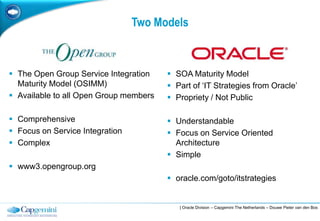
Two Models

         The Open Group                                           Oracle
 The Open Group Service Integration     SOA Maturity Model
  Maturity Model (OSIMM)                 Part of „IT Strategies from Oracle‟
 Available to all Open Group members    Propriety / Not Public

 Comprehensive                          Understandable
 Focus on Service Integration           Focus on Service Oriented
 Complex                                 Architecture
                                         Simple
 www3.opengroup.org
                                         oracle.com/goto/itstrategies


                                           | Oracle Division – Capgemini The Netherlands – Douwe Pieter van den Bos
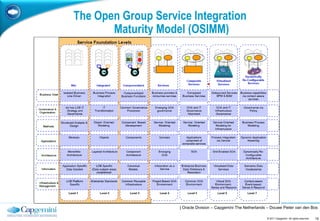
The Open Group Service Integration
       Maturity Model (OSIMM)


                    | Oracle Division – Capgemini The Netherlands – Douwe Pieter van den Bos

                                                                 © 2011 Capgemini. All rights reserved.   15
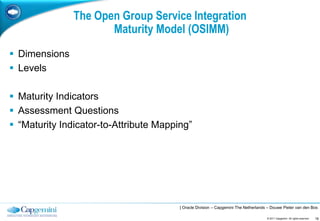
The Open Group Service Integration
                      Maturity Model (OSIMM)
 Dimensions
 Levels

 Maturity Indicators
 Assessment Questions
 “Maturity Indicator-to-Attribute Mapping”


                                        | Oracle Division – Capgemini The Netherlands – Douwe Pieter van den Bos

                                                                                     © 2011 Capgemini. All rights reserved.   16
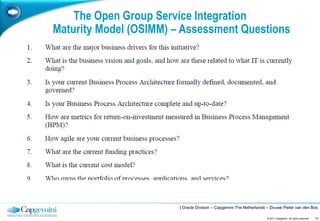
The Open Group Service Integration
Maturity Model (OSIMM) – Assessment Questions


                        | Oracle Division – Capgemini The Netherlands – Douwe Pieter van den Bos

                                                                     © 2011 Capgemini. All rights reserved.   17
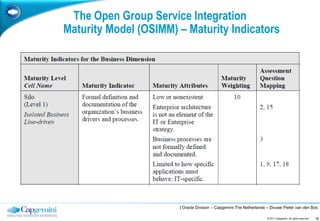
The Open Group Service Integration
Maturity Model (OSIMM) – Maturity Indicators


                       | Oracle Division – Capgemini The Netherlands – Douwe Pieter van den Bos

                                                                    © 2011 Capgemini. All rights reserved.   18
| Oracle Division – Capgemini The Netherlands – Douwe Pieter van den Bos

                                                                                     19
                                                 © 2011 Capgemini. All rights reserved.
Oracle – SOA Maturity Model


                 | Oracle Division – Capgemini The Netherlands – Douwe Pieter van den Bos

                                                              © 2011 Capgemini. All rights reserved.   20
Oracle – SOA Maturity Model

 Dimensions
 Maturity Levels
 Adoption


                                     | Oracle Division – Capgemini The Netherlands – Douwe Pieter van den Bos

                                                                                  © 2011 Capgemini. All rights reserved.   21
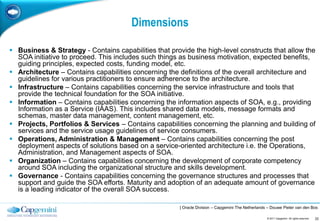
Dimensions

 Business & Strategy - Contains capabilities that provide the high-level constructs that allow the
  SOA initiative to proceed. This includes such things as business motivation, expected benefits,
  guiding principles, expected costs, funding model, etc.
 Architecture – Contains capabilities concerning the definitions of the overall architecture and
  guidelines for various practitioners to ensure adherence to the architecture.
 Infrastructure – Contains capabilities concerning the service infrastructure and tools that
  provide the technical foundation for the SOA initiative.
 Information – Contains capabilities concerning the information aspects of SOA, e.g., providing
  Information as a Service (IAAS). This includes shared data models, message formats and
  schemas, master data management, content management, etc.
 Projects, Portfolios & Services – Contains capabilities concerning the planning and building of
  services and the service usage guidelines of service consumers.
 Operations, Administration & Management – Contains capabilities concerning the post
  deployment aspects of solutions based on a service-oriented architecture i.e. the Operations,
  Administration, and Management aspects of SOA.
 Organization – Contains capabilities concerning the development of corporate competency
  around SOA including the organizational structure and skills development.
 Governance - Contains capabilities concerning the governance structures and processes that
  support and guide the SOA efforts. Maturity and adoption of an adequate amount of governance
  is a leading indicator of the overall SOA success.

                                                       | Oracle Division – Capgemini The Netherlands – Douwe Pieter van den Bos

                                                                                                    © 2011 Capgemini. All rights reserved.   22
Maturity Levels

 0: No SOA - There is no SOA approach being taken. SOA is not underway.
 1: Ad Hoc – Awareness of SOA exists and some groups are embarking on
  building services. There is no SOA plan being followed.
 2: Opportunistic – An approach has been decided upon and is being
  opportunistically applied. The approach has not been widely accepted nor
  adopted. It may be informally defined, or if documented, may exist primarily as
  “shelf ware”.
 3: Systematic – The approach has been reviewed and accepted by affected
  parties. There has been buy-in to the documented approach and the approach is
  always (or nearly always) followed.
 4: Managed – The capability is being measured and quantitatively managed via
  some type of governance structure. Appropriate metrics are being gathered and
  reported.
 5: Optimized – Metrics are being consistently gathered and are being used to
  incrementally improve the capability. Assets are proactively maintained to ensure
  relevancy and correctness.


                                              | Oracle Division – Capgemini The Netherlands – Douwe Pieter van den Bos

                                                                                           © 2011 Capgemini. All rights reserved.   23
Adoption

 0: No Implementation - There is no current implementation anywhere in the
  organization of the capability being measured.
 1: Project Level - Individual projects implement the capability as appropriate for
  that specific project. There may be informal and unregulated sharing across
  projects.
 2: Program Level - A relatively small group of projects (program) share an
  implementation of the capability. The program is under a single management
  structure below the VP level and encompasses less than an entire division or
  business unit.
 3: Division Wide - The capability is implemented consistently across a division or
  business unit. A division or business unit is led by an executive at the VP level or
  higher.
 4: Cross Division – The capability is implemented by multiple divisions using a
  common approach i.e. the approach is being shared or is spreading to multiple
  divisions.
 5: Enterprise Level – The capability is implemented consistently across the
  enterprise i.e. all divisions or business units are applying the same approach.

                                                | Oracle Division – Capgemini The Netherlands – Douwe Pieter van den Bos

                                                                                             © 2011 Capgemini. All rights reserved.   24
Maturity Measurement


| Oracle Division – Capgemini The Netherlands – Douwe Pieter van den Bos

                                                                                     25
                                                 © 2011 Capgemini. All rights reserved.
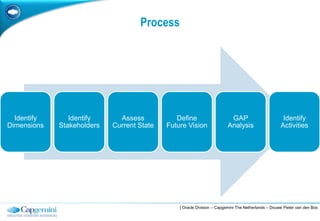
Process


  Identify      Identify      Assess           Define                     GAP                        Identify
Dimensions   Stakeholders   Current State   Future Vision                Analysis                   Activities


                                                | Oracle Division – Capgemini The Netherlands – Douwe Pieter van den Bos
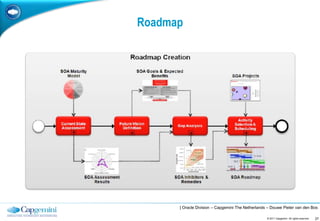
Roadmap


      | Oracle Division – Capgemini The Netherlands – Douwe Pieter van den Bos

                                                   © 2011 Capgemini. All rights reserved.   27
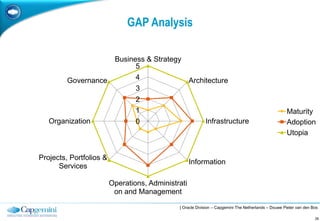
GAP Analysis

                          Business & Strategy
                                5
         Governance             4                   Architecture
                                3
                                2
                                1                                                                    Maturity
   Organization                 0                          Infrastructure                            Adoption
                                                                                                     Utopia


Projects, Portfolios &
                                                    Information
      Services

                         Operations, Administrati
                          on and Management

                                              | Oracle Division – Capgemini The Netherlands – Douwe Pieter van den Bos

                                                                                                                    28
Next Steps


| Oracle Division – Capgemini The Netherlands – Douwe Pieter van den Bos

                                                                                     29
                                                 © 2011 Capgemini. All rights reserved.
| Oracle Division – Capgemini The Netherlands – Douwe Pieter van den Bos
More information


              About Capgemini

         Capgemini, one of the world's          Rightshore®, which aims to get the right
foremost            providers            of     balance of the best talent from multiple
consulting, technology and outsourcing          locations, working as one team to create
services, enables its clients to transform      and deliver the optimum solution for clients.
and perform through technologies.               Present      in    more       than    40
Capgemini provides its clients with insights    countries, Capgemini reported 2010 global
and capabilities that boost their freedom to    revenues of EUR 8.7 billion and employs
achieve superior results through a unique       over 112,000 people worldwide.
way of working, the Collaborative Business      More information is available at:
ExperienceTM. The Group relies on its           www.capgemini.com
global      delivery      model        called


                                                     | Oracle Division – Capgemini The Netherlands – Douwe Pieter van den Bos

                                                                                                  © 20101Capgemini. All rights reserved.   31
More information


Please contact:
• Douwe Pieter van den Bos
  douwe-pieter.vanden.bos@capgemini.com
  +31 6 203 623 88


                       | Oracle Division – Capgemini The Netherlands – Douwe Pieter van den Bos

                                                                    © 2011 Capgemini. All rights reserved.   32
www.capgemini.com


The information contained in this presentation is proprietary. ©2010 Capgemini. All rights reserved

SOA Maturity Models

  • 1.
    Service Oriented Architecture &Maturity Douwe Pieter van den Bos Utrecht, May 1st, 2012
  • 2.
    Disclaimer  “The OpenGroup Service Integration Maturity Model (OSIMM)” and others are property of The Open Group.  “The Oracle SOA Maturity Model”, “IT Strategies from Oracle”, “The Oracle SOA Reference Architecture” and others are property of the Oracle corporation.  Opinions in this presentation are my own, not (in any way) per sé Capgemini‟s. The Open Group‟s or Oracle‟s  This presentation is just because I think the topic is cool. I will not be held responsible for any statement made in this presentation, ever. | Oracle Division – Capgemini The Netherlands – Douwe Pieter van den Bos
  • 3.
    CONTENTS  Introduction  SOA Maturity  Models  Maturity Measurement | Oracle Division – Capgemini The Netherlands – Douwe Pieter van den Bos © 2011 Capgemini. All rights reserved. 3
  • 4.
    Introduction | Oracle Division– Capgemini The Netherlands – Douwe Pieter van den Bos
  • 5.
    Introduction | Oracle Division – Capgemini The Netherlands – Douwe Pieter van den Bos © 2011 Capgemini. All rights reserved. 5
  • 6.
    Yesterday | Oracle Division – Capgemini The Netherlands – Douwe Pieter van den Bos © 2011 Capgemini. All rights reserved. 6
  • 7.
    Today | Oracle Division – Capgemini The Netherlands – Douwe Pieter van den Bos © 2011 Capgemini. All rights reserved. 7
  • 8.
  • 9.
    Why? | Oracle Division – Capgemini The Netherlands – Douwe Pieter van den Bos © 2011 Capgemini. All rights reserved. 9
  • 10.
    Why? | Oracle Division – Capgemini The Netherlands – Douwe Pieter van den Bos © 2011 Capgemini. All rights reserved. 10
  • 11.
    Why? | Oracle Division – Capgemini The Netherlands – Douwe Pieter van den Bos © 2011 Capgemini. All rights reserved. 11
  • 12.
  • 13.
    Two Models The Open Group Oracle  The Open Group Service Integration  SOA Maturity Model Maturity Model (OSIMM)  Part of „IT Strategies from Oracle‟  Available to all Open Group members  Propriety / Not Public  Comprehensive  Understandable  Focus on Service Integration  Focus on Service Oriented  Complex Architecture  Simple  www3.opengroup.org  oracle.com/goto/itstrategies | Oracle Division – Capgemini The Netherlands – Douwe Pieter van den Bos
  • 15.
    The Open GroupService Integration Maturity Model (OSIMM) | Oracle Division – Capgemini The Netherlands – Douwe Pieter van den Bos © 2011 Capgemini. All rights reserved. 15
  • 16.
    The Open GroupService Integration Maturity Model (OSIMM)  Dimensions  Levels  Maturity Indicators  Assessment Questions  “Maturity Indicator-to-Attribute Mapping” | Oracle Division – Capgemini The Netherlands – Douwe Pieter van den Bos © 2011 Capgemini. All rights reserved. 16
  • 17.
    The Open GroupService Integration Maturity Model (OSIMM) – Assessment Questions | Oracle Division – Capgemini The Netherlands – Douwe Pieter van den Bos © 2011 Capgemini. All rights reserved. 17
  • 18.
    The Open GroupService Integration Maturity Model (OSIMM) – Maturity Indicators | Oracle Division – Capgemini The Netherlands – Douwe Pieter van den Bos © 2011 Capgemini. All rights reserved. 18
  • 19.
    | Oracle Division– Capgemini The Netherlands – Douwe Pieter van den Bos 19 © 2011 Capgemini. All rights reserved.
  • 20.
    Oracle – SOAMaturity Model | Oracle Division – Capgemini The Netherlands – Douwe Pieter van den Bos © 2011 Capgemini. All rights reserved. 20
  • 21.
    Oracle – SOAMaturity Model  Dimensions  Maturity Levels  Adoption | Oracle Division – Capgemini The Netherlands – Douwe Pieter van den Bos © 2011 Capgemini. All rights reserved. 21
  • 22.
    Dimensions  Business &Strategy - Contains capabilities that provide the high-level constructs that allow the SOA initiative to proceed. This includes such things as business motivation, expected benefits, guiding principles, expected costs, funding model, etc.  Architecture – Contains capabilities concerning the definitions of the overall architecture and guidelines for various practitioners to ensure adherence to the architecture.  Infrastructure – Contains capabilities concerning the service infrastructure and tools that provide the technical foundation for the SOA initiative.  Information – Contains capabilities concerning the information aspects of SOA, e.g., providing Information as a Service (IAAS). This includes shared data models, message formats and schemas, master data management, content management, etc.  Projects, Portfolios & Services – Contains capabilities concerning the planning and building of services and the service usage guidelines of service consumers.  Operations, Administration & Management – Contains capabilities concerning the post deployment aspects of solutions based on a service-oriented architecture i.e. the Operations, Administration, and Management aspects of SOA.  Organization – Contains capabilities concerning the development of corporate competency around SOA including the organizational structure and skills development.  Governance - Contains capabilities concerning the governance structures and processes that support and guide the SOA efforts. Maturity and adoption of an adequate amount of governance is a leading indicator of the overall SOA success. | Oracle Division – Capgemini The Netherlands – Douwe Pieter van den Bos © 2011 Capgemini. All rights reserved. 22
  • 23.
    Maturity Levels  0:No SOA - There is no SOA approach being taken. SOA is not underway.  1: Ad Hoc – Awareness of SOA exists and some groups are embarking on building services. There is no SOA plan being followed.  2: Opportunistic – An approach has been decided upon and is being opportunistically applied. The approach has not been widely accepted nor adopted. It may be informally defined, or if documented, may exist primarily as “shelf ware”.  3: Systematic – The approach has been reviewed and accepted by affected parties. There has been buy-in to the documented approach and the approach is always (or nearly always) followed.  4: Managed – The capability is being measured and quantitatively managed via some type of governance structure. Appropriate metrics are being gathered and reported.  5: Optimized – Metrics are being consistently gathered and are being used to incrementally improve the capability. Assets are proactively maintained to ensure relevancy and correctness. | Oracle Division – Capgemini The Netherlands – Douwe Pieter van den Bos © 2011 Capgemini. All rights reserved. 23
  • 24.
    Adoption  0: NoImplementation - There is no current implementation anywhere in the organization of the capability being measured.  1: Project Level - Individual projects implement the capability as appropriate for that specific project. There may be informal and unregulated sharing across projects.  2: Program Level - A relatively small group of projects (program) share an implementation of the capability. The program is under a single management structure below the VP level and encompasses less than an entire division or business unit.  3: Division Wide - The capability is implemented consistently across a division or business unit. A division or business unit is led by an executive at the VP level or higher.  4: Cross Division – The capability is implemented by multiple divisions using a common approach i.e. the approach is being shared or is spreading to multiple divisions.  5: Enterprise Level – The capability is implemented consistently across the enterprise i.e. all divisions or business units are applying the same approach. | Oracle Division – Capgemini The Netherlands – Douwe Pieter van den Bos © 2011 Capgemini. All rights reserved. 24
  • 25.
    Maturity Measurement | OracleDivision – Capgemini The Netherlands – Douwe Pieter van den Bos 25 © 2011 Capgemini. All rights reserved.
  • 26.
    Process Identify Identify Assess Define GAP Identify Dimensions Stakeholders Current State Future Vision Analysis Activities | Oracle Division – Capgemini The Netherlands – Douwe Pieter van den Bos
  • 27.
    Roadmap | Oracle Division – Capgemini The Netherlands – Douwe Pieter van den Bos © 2011 Capgemini. All rights reserved. 27
  • 28.
    GAP Analysis Business & Strategy 5 Governance 4 Architecture 3 2 1 Maturity Organization 0 Infrastructure Adoption Utopia Projects, Portfolios & Information Services Operations, Administrati on and Management | Oracle Division – Capgemini The Netherlands – Douwe Pieter van den Bos 28
  • 29.
    Next Steps | OracleDivision – Capgemini The Netherlands – Douwe Pieter van den Bos 29 © 2011 Capgemini. All rights reserved.
  • 30.
    | Oracle Division– Capgemini The Netherlands – Douwe Pieter van den Bos
  • 31.
    More information About Capgemini Capgemini, one of the world's Rightshore®, which aims to get the right foremost providers of balance of the best talent from multiple consulting, technology and outsourcing locations, working as one team to create services, enables its clients to transform and deliver the optimum solution for clients. and perform through technologies. Present in more than 40 Capgemini provides its clients with insights countries, Capgemini reported 2010 global and capabilities that boost their freedom to revenues of EUR 8.7 billion and employs achieve superior results through a unique over 112,000 people worldwide. way of working, the Collaborative Business More information is available at: ExperienceTM. The Group relies on its www.capgemini.com global delivery model called | Oracle Division – Capgemini The Netherlands – Douwe Pieter van den Bos © 20101Capgemini. All rights reserved. 31
  • 32.
    More information Please contact: •Douwe Pieter van den Bos douwe-pieter.vanden.bos@capgemini.com +31 6 203 623 88 | Oracle Division – Capgemini The Netherlands – Douwe Pieter van den Bos © 2011 Capgemini. All rights reserved. 32
  • 33.
    www.capgemini.com The information containedin this presentation is proprietary. ©2010 Capgemini. All rights reserved

Editor's Notes

  • #3 There’s always a lot to do about rights, copyrights and ownership. I only want to make clear that I only give this presentation because I think the topic is cool. The content is taken from various methods, like “The Open Group Service Integration Maturity Model” and “Oracle’s SOA Maturity Model”.These models are not my own, nor did I came up with them. I just think they are smart and well put together. I will not take any responsibility for any incorrectness or something like that.
  • #4 So, what are we’re going to talk about.First, I’ll give a short introduction into the topic of SOA Maturity and why we need it.Then I’m going to show two models that can be used and how they’re put together.Using these models, we’re going through the Maturity Measurement itself.
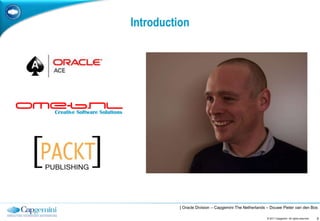
  • #6 I’m Douwe Pieter van den Bos, Solution Architect at Capgemini and Thought Leader SOA. I’m an Oracle ACE on the topics of Middleware and Service-Oriented Architecture.On my blog www.Ome-B.nl I discuss the software development and how we create this. I’ve been blogging about this since 2006.In 2009 my book on modernizing Oracle applications came out at Packt Publishing. (and has completely been obsolute since).
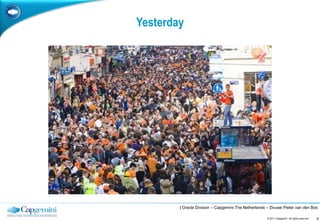
  • #7 First off, let me explain why the session today will not be as fast, inspiring or energetic as I usually do them. Yesterday was Queens-day in The Netherlands. I live in one of the larger cities and had a fantastic time. I spend most of the day revitalizing from the night before in the sun. This morning I was hoping I could take the day off…Unfortunately we have this session… ;-)
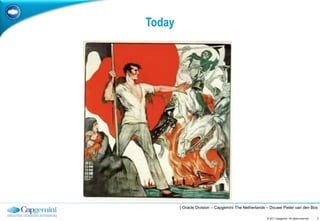
  • #8 Today is Labourday. In all the countries surrounding us this means that it’s a national holiday. Unfortunately for me, in The Netherlands we like working too much and we don’t have an off day today.
  • #9 But Why do we want to know the Maturity of a Service-Oriented Architecture?
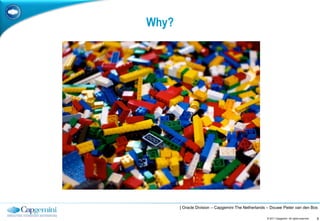
  • #10 First of all, to understand the complexity of an entire, organization wide Service-Oriented Architecture. This is not a light subject, plus it cannot be achieved without grasping the complexity of it.When looking at the complexity of SOA, we tend to look the wrong way. It definitely is not only a technology infrastructure challenge, but an entire organizational change process. This is where the various methods for SOA Maturity help us, it gives us ways to handle this complexity and to understand where an organization is headed and is now.
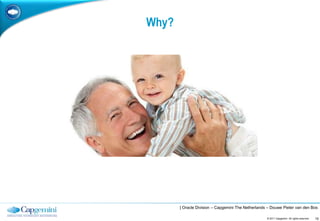
  • #11 The second part of Why is that SOA doesn’t happen overnight. It is something that grows, gets older, get more mature.This path is where the methods for SOA Maturity can help. It gives us insight in the “How old” the SOA is.
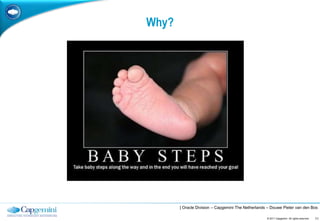
  • #12 The third why is baby steps.We cannot create a fully fledge SOA within a few days, but it will take a lot of steps to become more mature. The steps that we need to take are difficult to identify. The various methods help us to identify the steps we need to take to grow, to become more mature..
  • #13 What SOA Maturity Models can we use for this?
  • #14 There probably are more, but during this presentation we will adress two of them.They come from The Open Group and Oracle.First we will discuss the “The Open Group Service Integration Maturity Model”. This is a very comprehensive and complete model that The Open Group set up. Some Capgemini colleagues participated actively in developing this method. The model is very comprehensive, but therefore also pretty complex to understand and learn. It has a large focus on service integration instead of service orientation. But it is a complete and helpful framework. Especially because of the questions that they offer.The Oracle Model is part of the “IT Strategies from Oracle”. This framework offers us a simple and therefore explainable way to determine the maturity of a SOA. It offers us insight in where an organization is at.
  • #15 First, let us discuss the Open Groups method.
  • #16 The Open Group’s model uses 7 dimensions and 7 levels of maturity to determine the maturity. This picture shows the various parts.
  • #18 These are examples of the assessment questions that are offered by the Open Groups model. These are questions from the Business View level.
  • #19 The answers to the questions help determine where the maturity level on this dimension is.
  • #20 Now, let’s discuss the Oracle model.
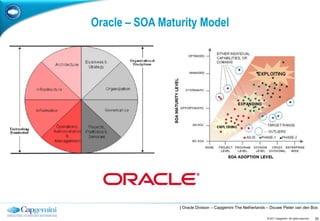
  • #21 Oracle’s model measures maturity and adoption on eight different dimensions. Therefore you can discuss if the Oracle model is more complete, but the outcome is way simpeler to understand.