Mail Migration
Strategies
Fulvio Salanitro
Sr. Technical Advisor
Bruno RR Fernandes
Support Engineer
Session Agenda
Module 1: Introduction
Module 2: IMAP Migration
Module 3: Cutover Exchange Migration (CEM)
Module 4: Staged Exchange Migration (SEM)
Module 1:
Introduction
4 | Microsoft Confidential
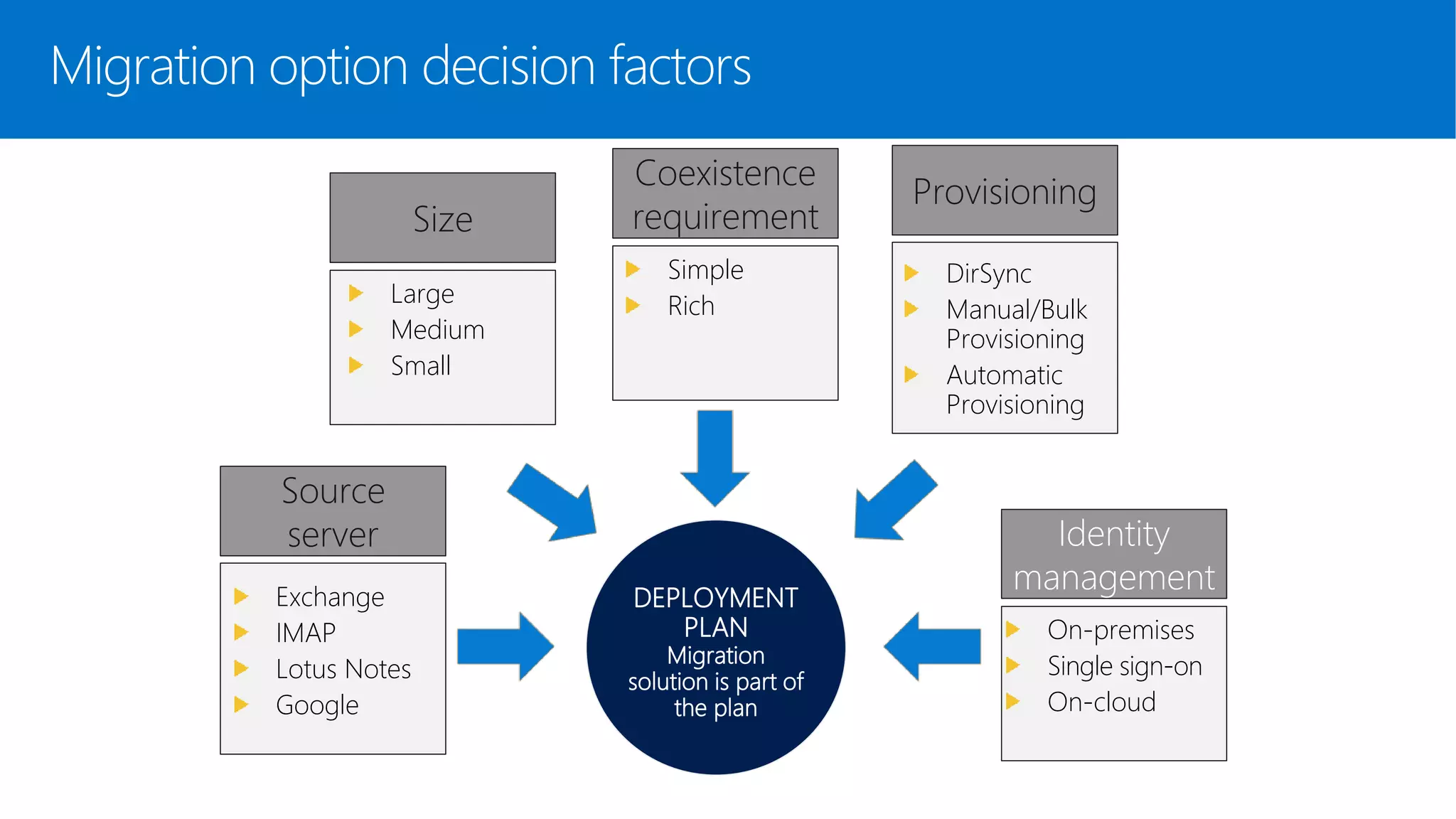
DEPLOYMENT
PLAN
Migration
solution is part of
the plan
Source
server
Exchange
IMAP
Lotus Notes
Google
Size
Large
Medium
Small
On-premises
Single sign-on
On-cloud
Provisioning
DirSync
Manual/Bulk
Provisioning
Automatic
Provisioning
Coexistence
requirement
Simple
Rich
Migration option decision factors
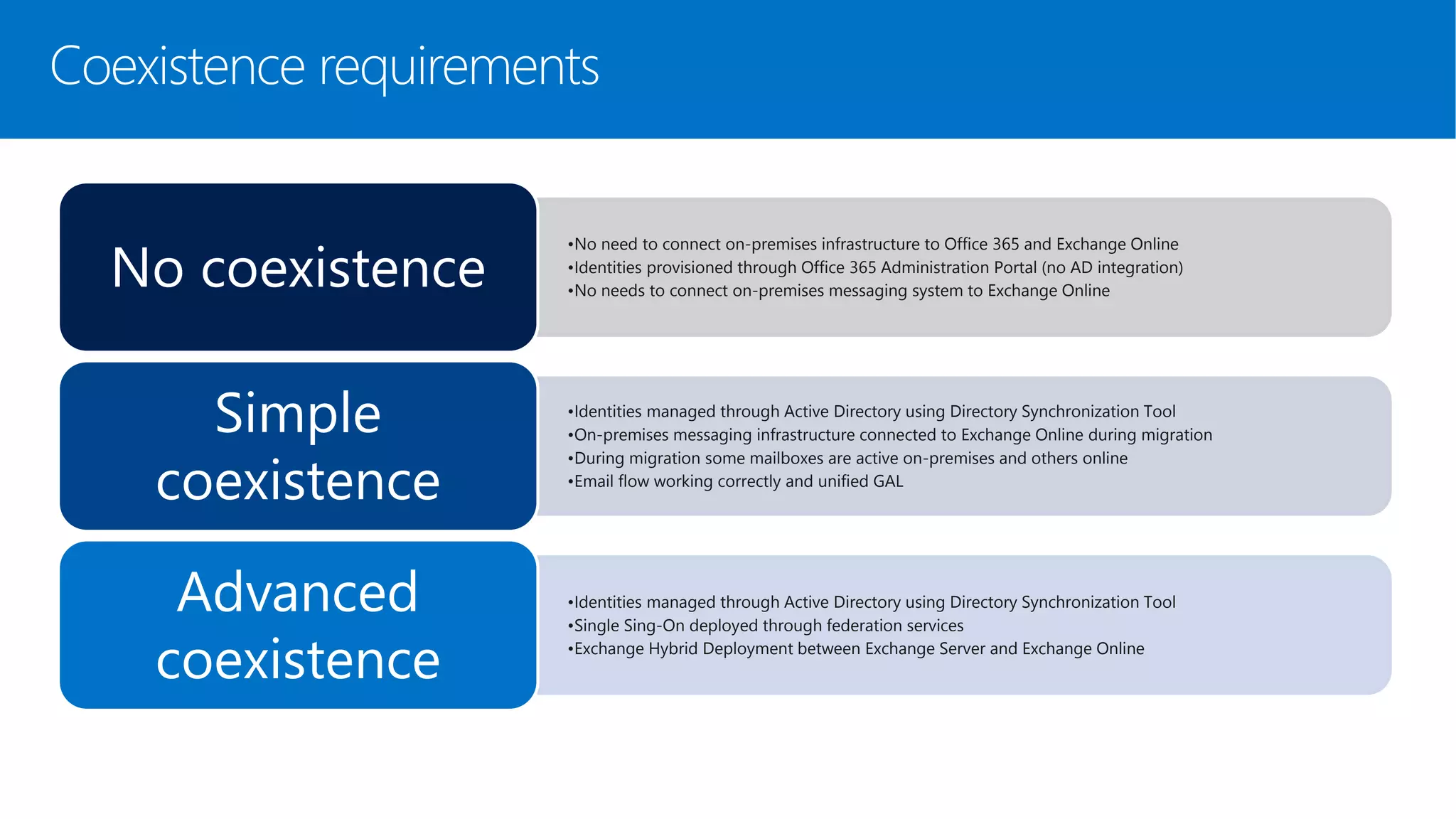
Coexistence requirements
•No need to connect on-premises infrastructure to Office 365 and Exchange Online
•Identities provisioned through Office 365 Administration Portal (no AD integration)
•No needs to connect on-premises messaging system to Exchange Online
No coexistence
•Identities managed through Active Directory using Directory Synchronization Tool
•On-premises messaging infrastructure connected to Exchange Online during migration
•During migration some mailboxes are active on-premises and others online
•Email flow working correctly and unified GAL
Simple
coexistence
•Identities managed through Active Directory using Directory Synchronization Tool
•Single Sing-On deployed through federation services
•Exchange Hybrid Deployment between Exchange Server and Exchange Online
Advanced
coexistence
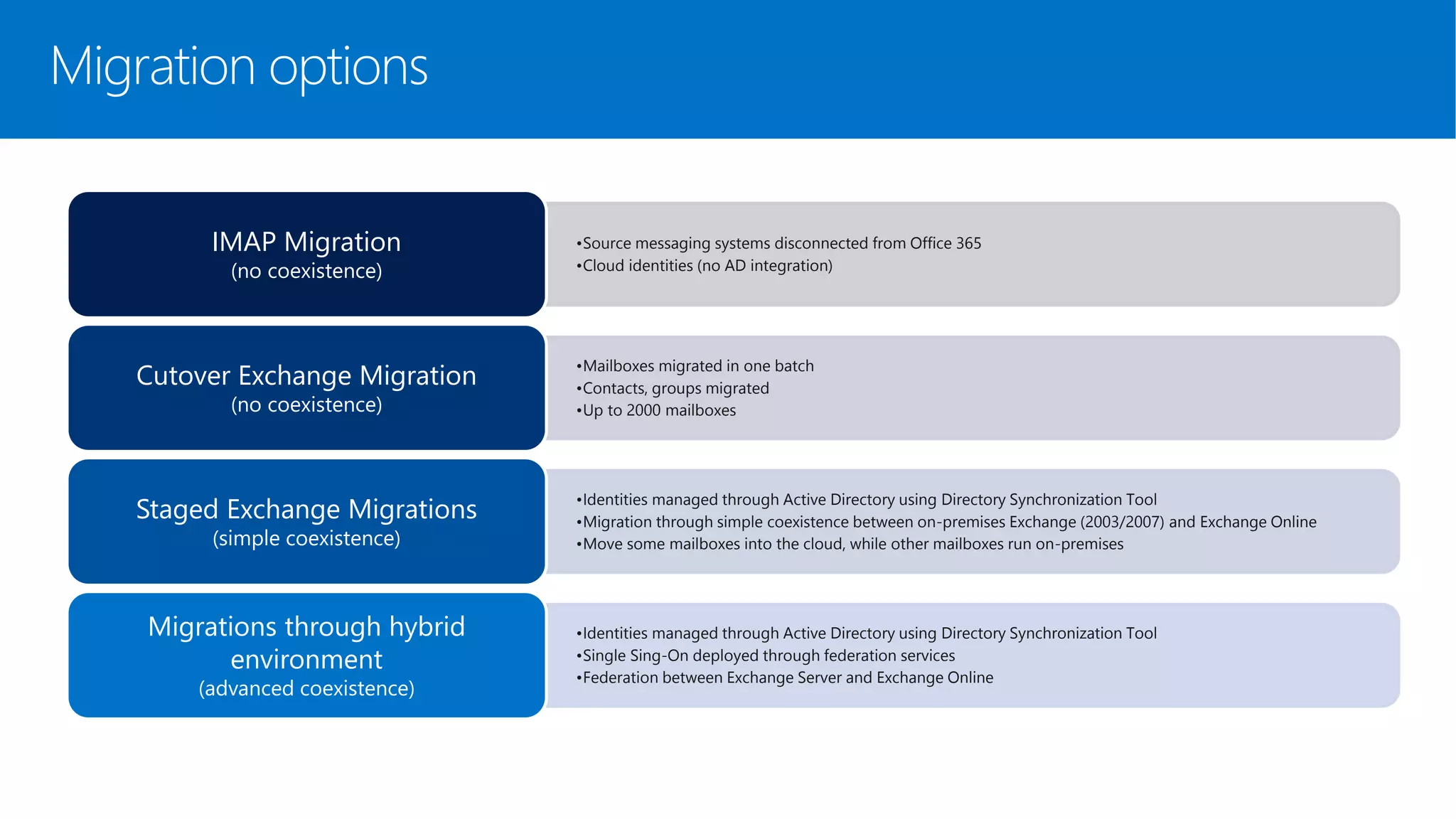
Migration options
•Source messaging systems disconnected from Office 365
•Cloud identities (no AD integration)
IMAP Migration
(no coexistence)
•Mailboxes migrated in one batch
•Contacts, groups migrated
•Up to 2000 mailboxes
Cutover Exchange Migration
(no coexistence)
•Identities managed through Active Directory using Directory Synchronization Tool
•Migration through simple coexistence between on-premises Exchange (2003/2007) and Exchange Online
•Move some mailboxes into the cloud, while other mailboxes run on-premises
Staged Exchange Migrations
(simple coexistence)
•Identities managed through Active Directory using Directory Synchronization Tool
•Single Sing-On deployed through federation services
•Federation between Exchange Server and Exchange Online
Migrations through hybrid
environment
(advanced coexistence)
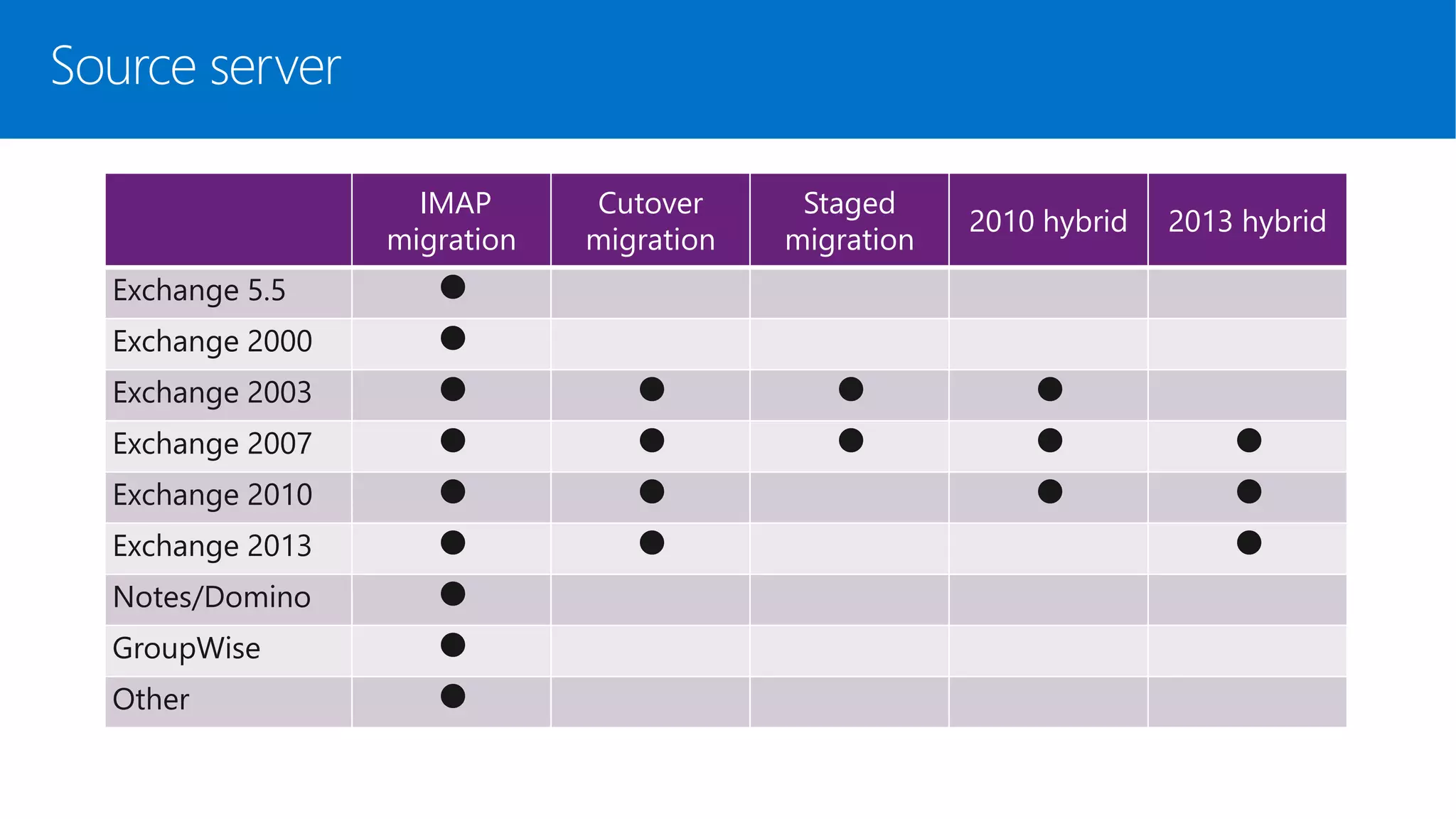
IMAP
migration
Cutover
migration
Staged
migration
2010 hybrid 2013 hybrid
Exchange 5.5 
Exchange 2000 
Exchange 2003    
Exchange 2007     
Exchange 2010    
Exchange 2013   
Notes/Domino 
GroupWise 
Other 
Source server
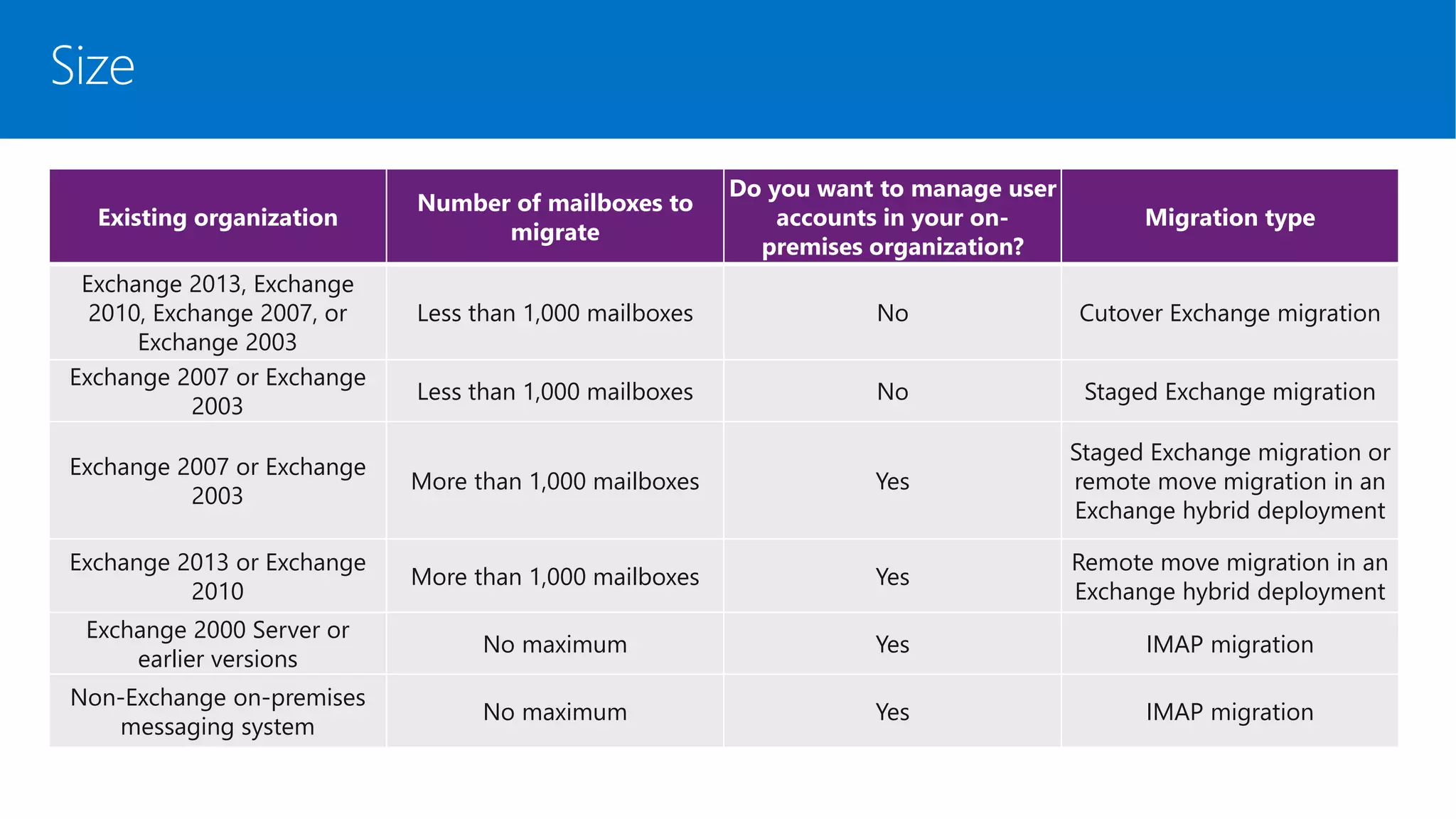
Size
Existing organization
Number of mailboxes to
migrate
Do you want to manage user
accounts in your on-
premises organization?
Migration type
Exchange 2013, Exchange
2010, Exchange 2007, or
Exchange 2003
Less than 1,000 mailboxes No Cutover Exchange migration
Exchange 2007 or Exchange
2003
Less than 1,000 mailboxes No Staged Exchange migration
Exchange 2007 or Exchange
2003
More than 1,000 mailboxes Yes
Staged Exchange migration or
remote move migration in an
Exchange hybrid deployment
Exchange 2013 or Exchange
2010
More than 1,000 mailboxes Yes
Remote move migration in an
Exchange hybrid deployment
Exchange 2000 Server or
earlier versions
No maximum Yes IMAP migration
Non-Exchange on-premises
messaging system
No maximum Yes IMAP migration
IMAPmigration
Cutovermigration
Stagedmigration
2010hybrid
2013hybrid
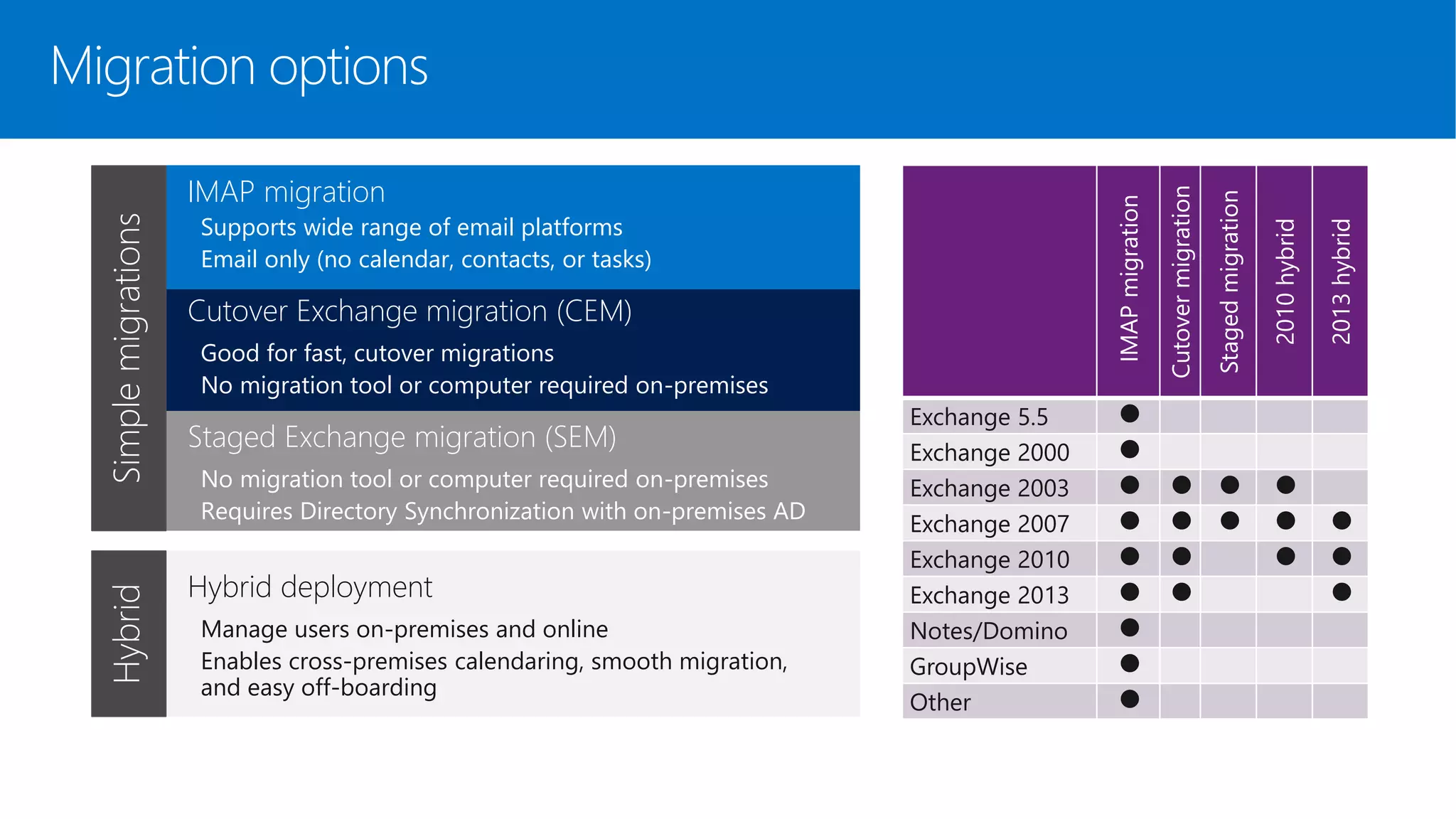
Exchange 5.5 
Exchange 2000 
Exchange 2003    
Exchange 2007     
Exchange 2010    
Exchange 2013   
Notes/Domino 
GroupWise 
Other 
Migration options
SimplemigrationsHybrid
IMAP migration
Supports wide range of email platforms
Email only (no calendar, contacts, or tasks)
Cutover Exchange migration (CEM)
Good for fast, cutover migrations
No migration tool or computer required on-premises
Staged Exchange migration (SEM)
No migration tool or computer required on-premises
Requires Directory Synchronization with on-premises AD
Hybrid deployment
Manage users on-premises and online
Enables cross-premises calendaring, smooth migration,
and easy off-boarding
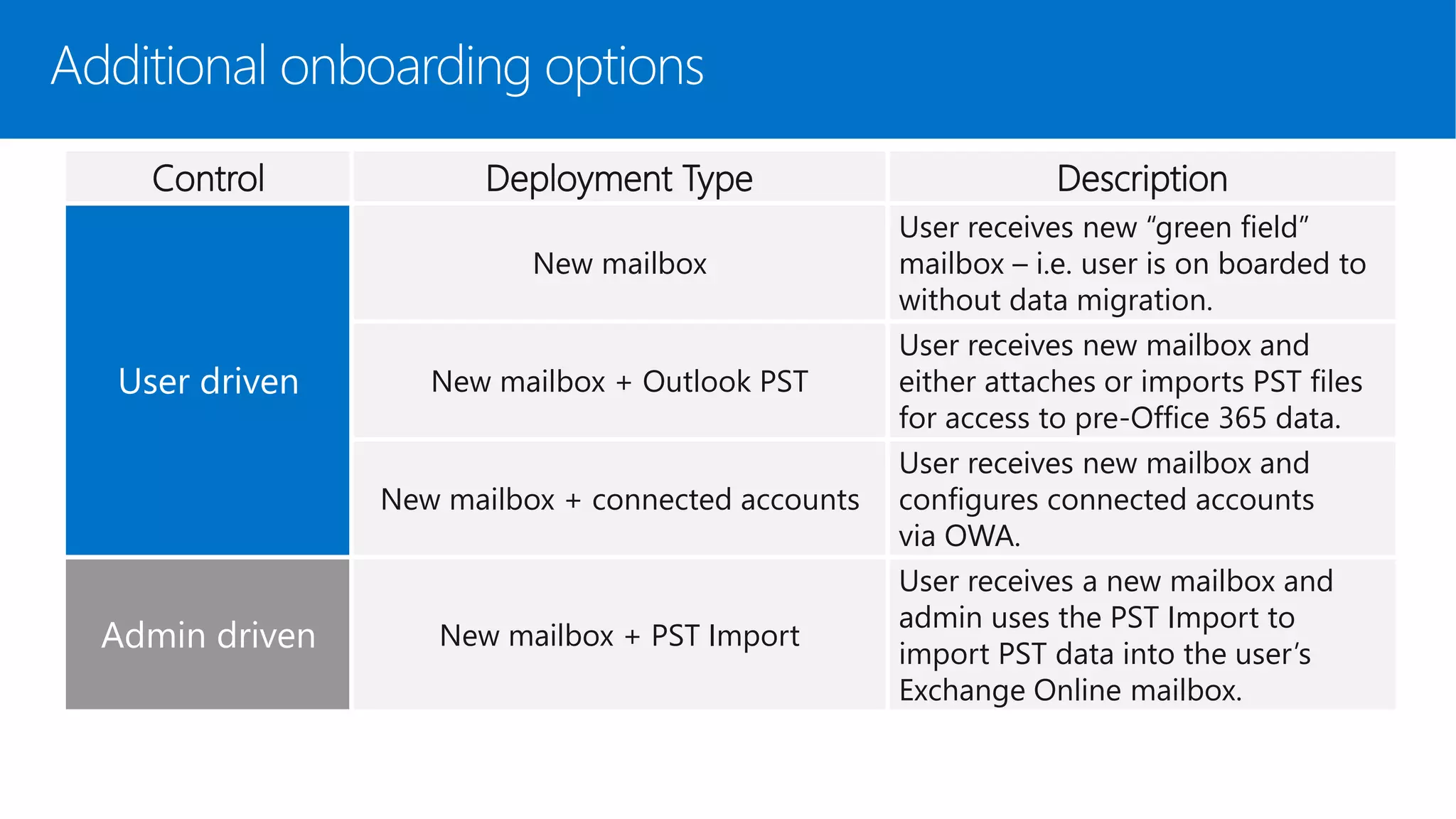
Additional onboarding options
Control Deployment Type Description
User driven
New mailbox
User receives new “green field”
mailbox – i.e. user is on boarded to
without data migration.
New mailbox + Outlook PST
User receives new mailbox and
either attaches or imports PST files
for access to pre-Office 365 data.
New mailbox + connected accounts
User receives new mailbox and
configures connected accounts
via OWA.
Admin driven New mailbox + PST Import
User receives a new mailbox and
admin uses the PST Import to
import PST data into the user’s
Exchange Online mailbox.
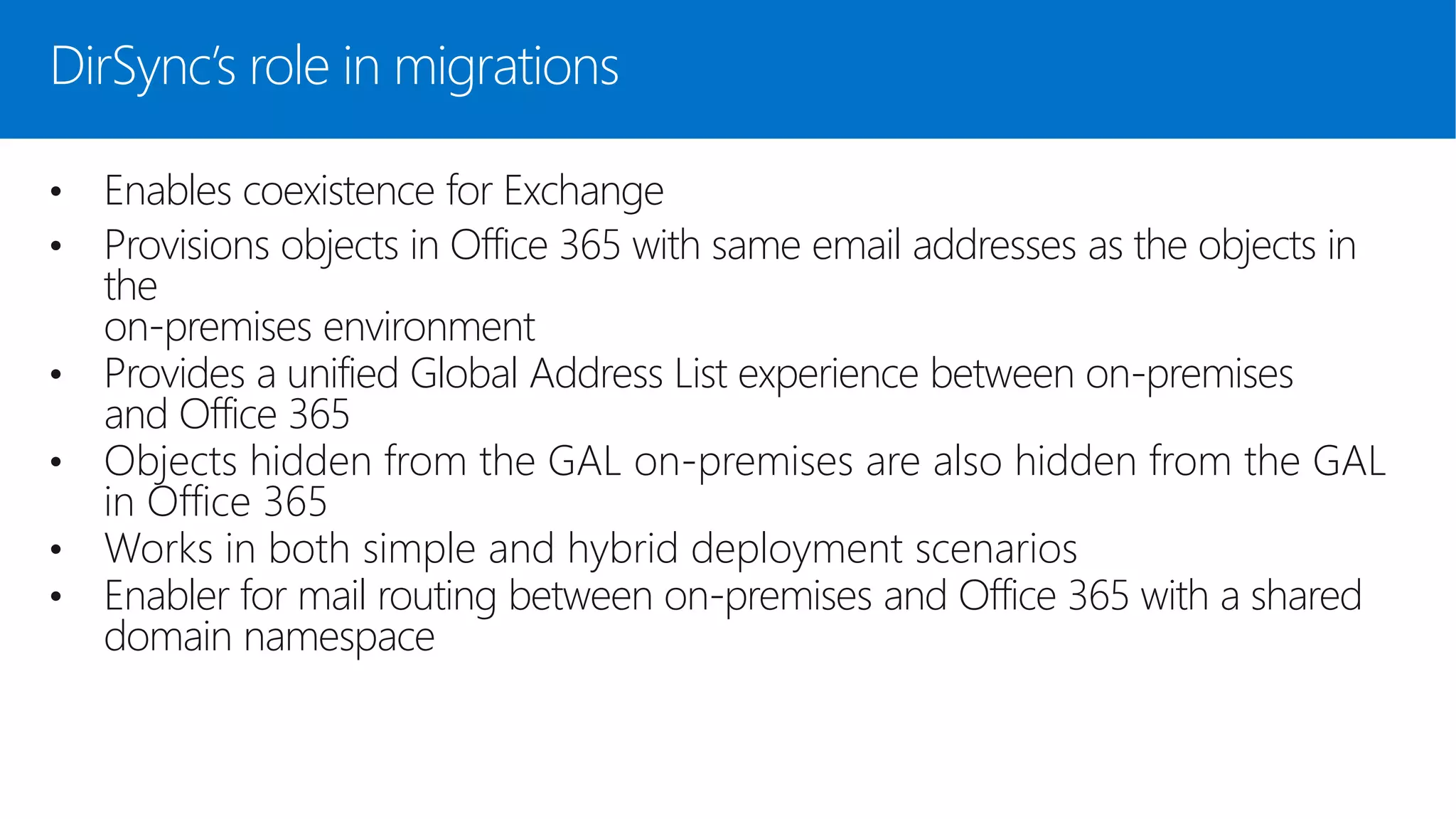
DirSync’s role in migrations
• Enables coexistence for Exchange
• Provisions objects in Office 365 with same email addresses as the objects in
the
on-premises environment
• Provides a unified Global Address List experience between on-premises
and Office 365
• Objects hidden from the GAL on-premises are also hidden from the GAL
in Office 365
• Works in both simple and hybrid deployment scenarios
• Enabler for mail routing between on-premises and Office 365 with a shared
domain namespace
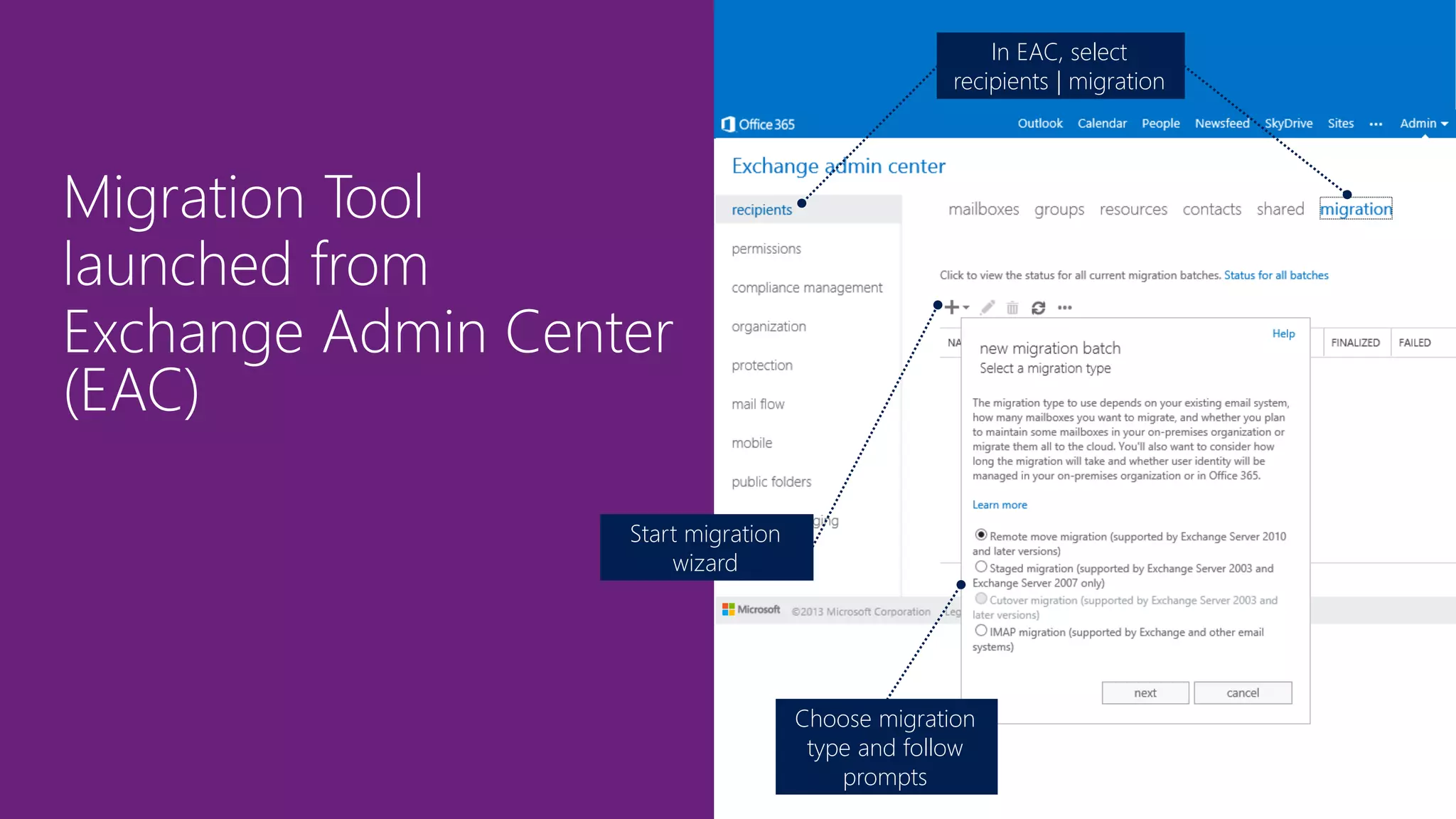
In EAC, select
recipients | migration
Start migration
wizard
Choose migration
type and follow
prompts
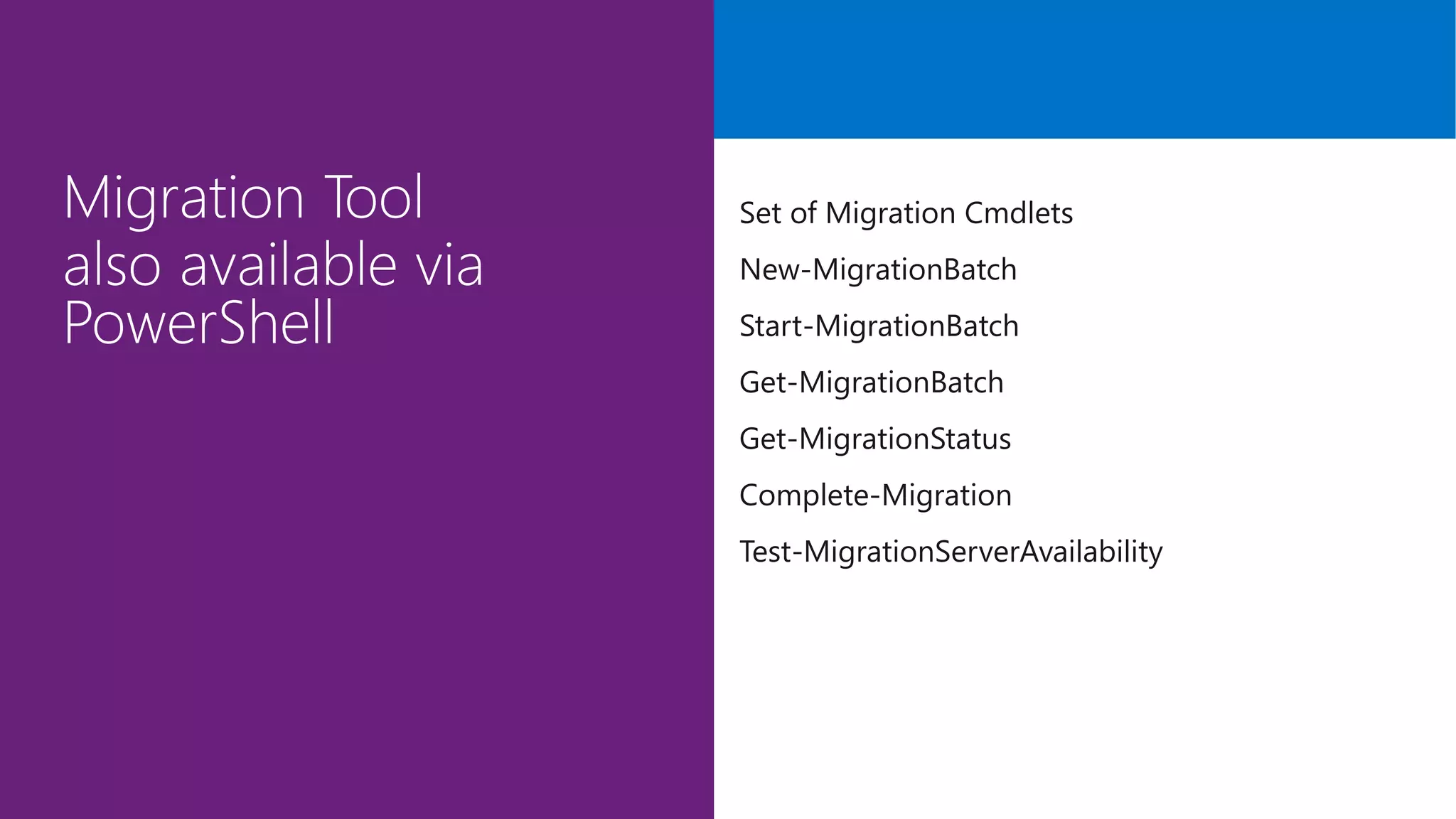
Set of Migration Cmdlets
New-MigrationBatch
Start-MigrationBatch
Get-MigrationBatch
Get-MigrationStatus
Complete-Migration
Test-MigrationServerAvailability
Microsoft
Partner Network
Module 2:
IMAP Migrations
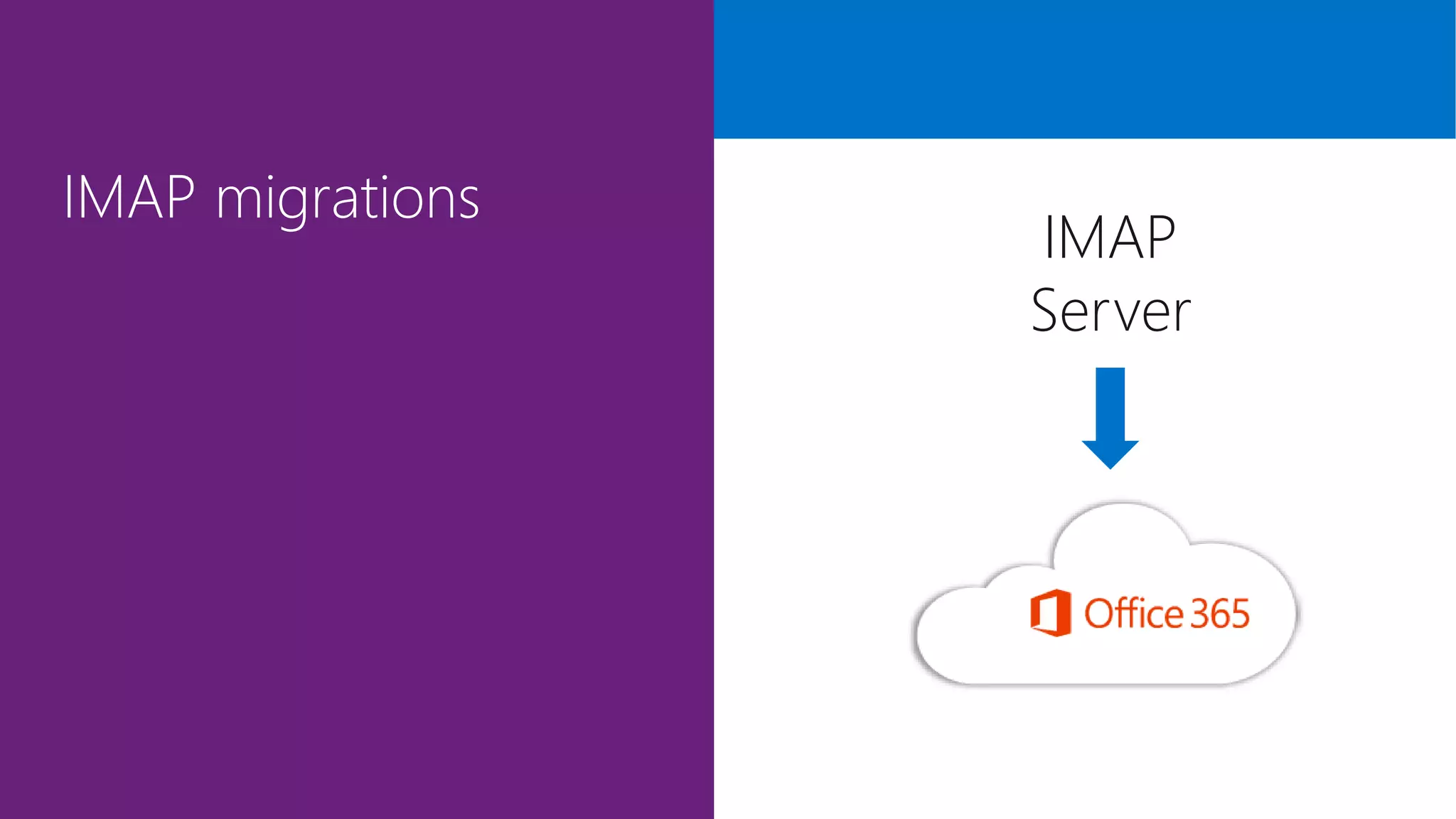
IMAP
Server
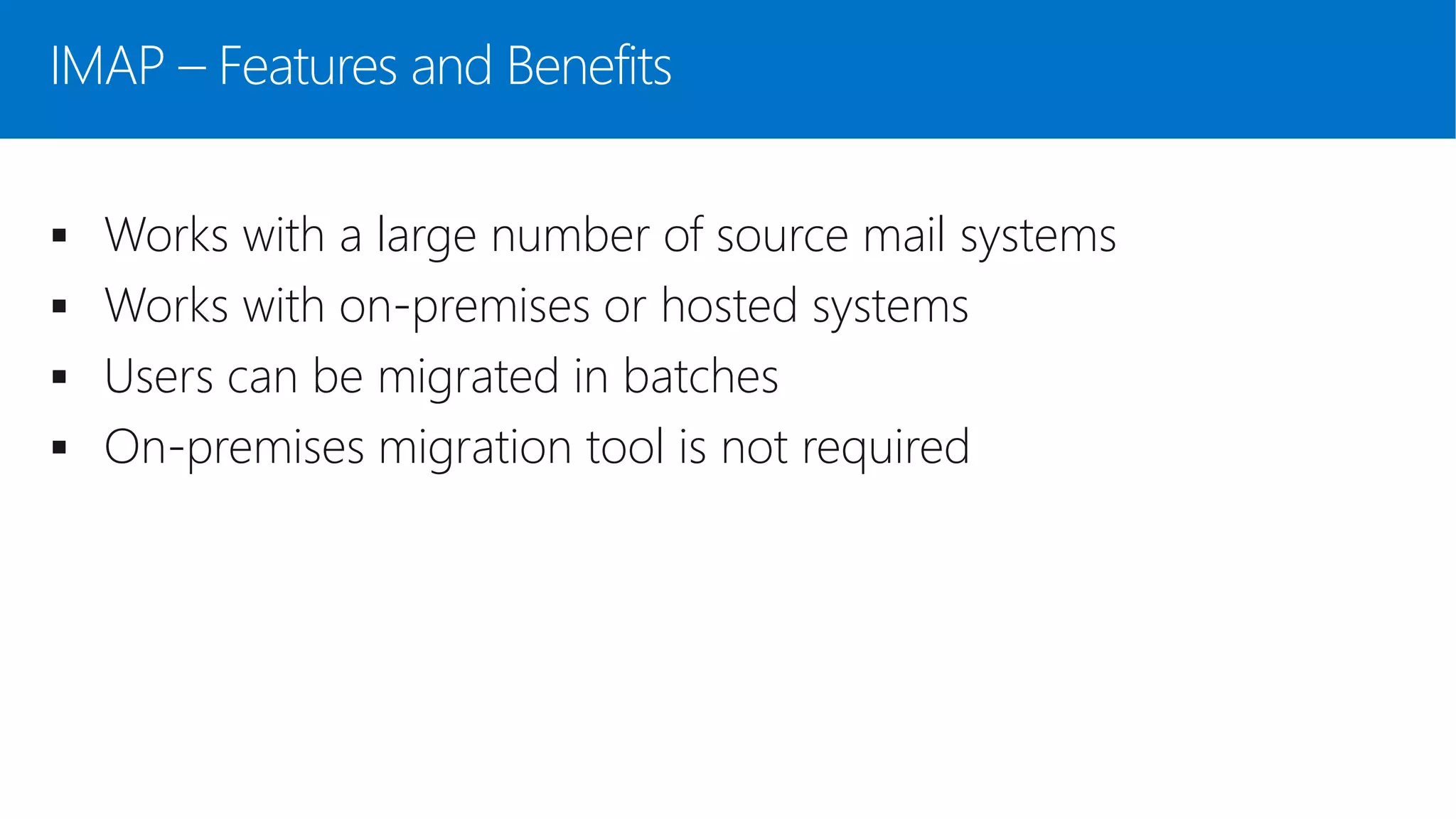
IMAP – Features and Benefits
 Works with a large number of source mail systems
 Works with on-premises or hosted systems
 Users can be migrated in batches
 On-premises migration tool is not required
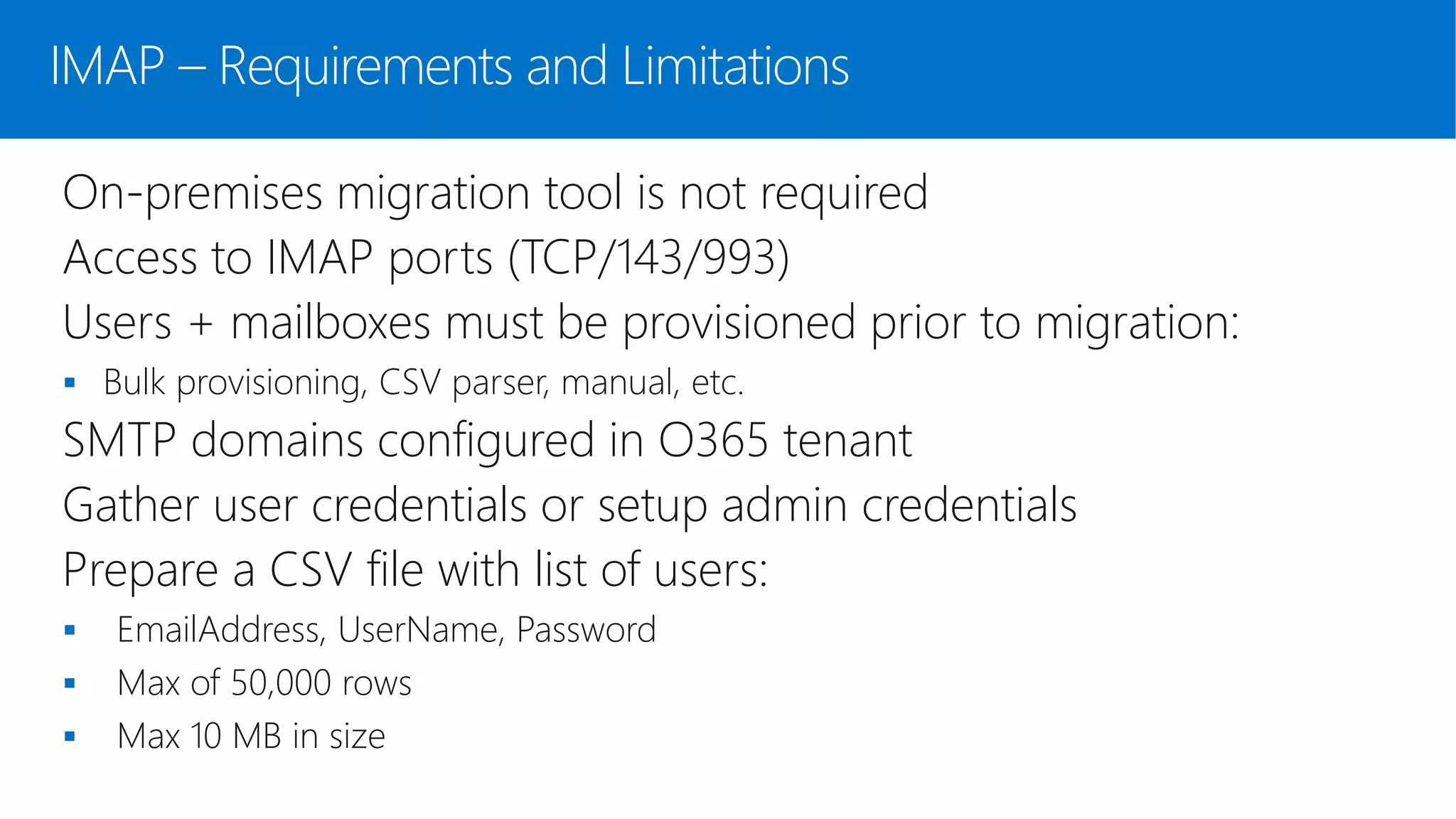
IMAP – Requirements and Limitations
On-premises migration tool is not required
Access to IMAP ports (TCP/143/993)
Users + mailboxes must be provisioned prior to migration:
 Bulk provisioning, CSV parser, manual, etc.
SMTP domains configured in O365 tenant
Gather user credentials or setup admin credentials
Prepare a CSV file with list of users:
 EmailAddress, UserName, Password
 Max of 50,000 rows
 Max 10 MB in size
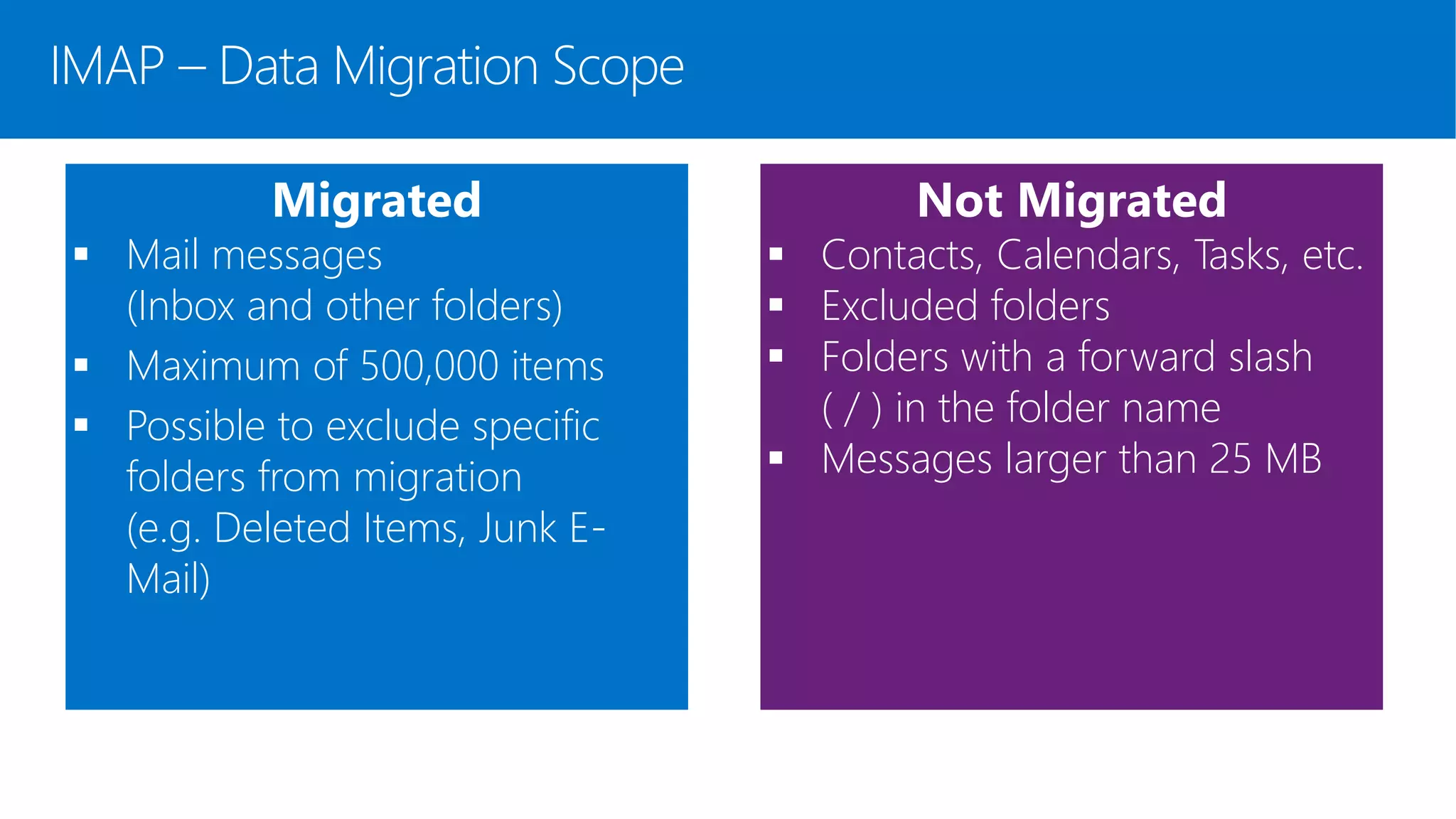
IMAP – Data Migration Scope
Migrated
 Mail messages
(Inbox and other folders)
 Maximum of 500,000 items
 Possible to exclude specific
folders from migration
(e.g. Deleted Items, Junk E-
Mail)
Not Migrated
 Contacts, Calendars, Tasks, etc.
 Excluded folders
 Folders with a forward slash
( / ) in the folder name
 Messages larger than 25 MB
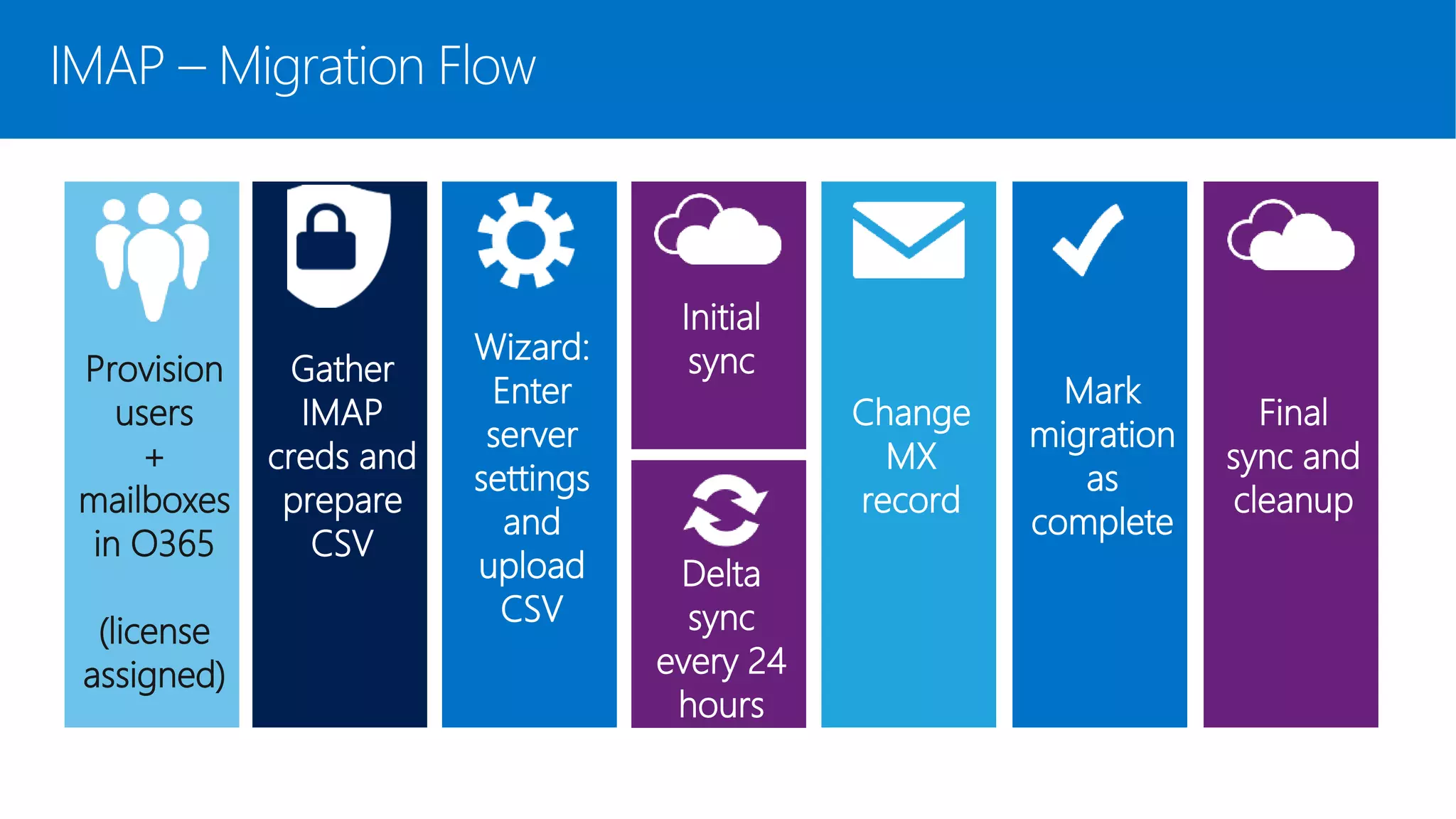
Delta
sync
every 24
hours
Mark
migration
as
complete
Change
MX
record
Gather
IMAP
creds and
prepare
CSV
IMAP – Migration Flow
Provision
users
+
mailboxes
in O365
(license
assigned)
Wizard:
Enter
server
settings
and
upload
CSV
Initial
sync
Final
sync and
cleanup
DEMO - IMAP
Microsoft
Partner Network
Module 3:
Cutover Exchange
Migrations (CEM)
CEM – Features and Benefits
 Simple and quick migration solution
 High-fidelity solution – all mailbox content is migrated
 Typically best suited to small and medium organizations
 Users are provisioned automatically during migration
 Works with Exchange 2003 and newer
 Works with on-premises or hosted Exchange systems
 Identity management in the cloud (at least initially)
 On-premises migration tool is not required
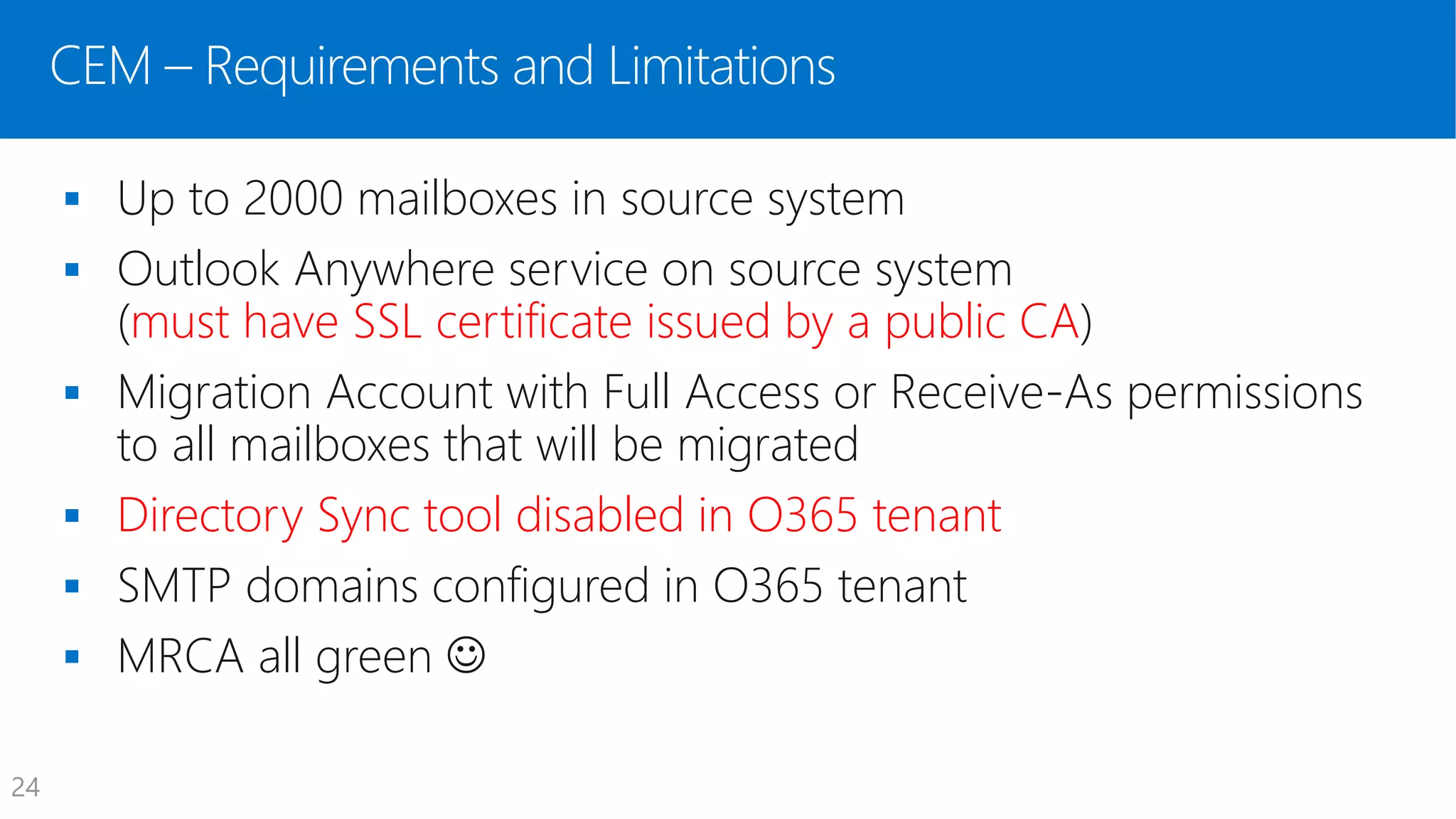
CEM – Requirements and Limitations
 Up to 2000 mailboxes in source system
 Outlook Anywhere service on source system
(must have SSL certificate issued by a public CA)
 Migration Account with Full Access or Receive-As permissions
to all mailboxes that will be migrated
 Directory Sync tool disabled in O365 tenant
 SMTP domains configured in O365 tenant
 MRCA all green 
24
CEM accounts and passwords
Accounts provisioning
 Migration tool creates users, mailboxes, DLs and contacts
 Migration enables replies to migrated messages
(i.e. provision process brings over the Legacy DNs)
Passwords
 No access to passwords from source directory
 New passwords created for all users
 A link to download passwords is sent to admin
 Users must change password on their first login
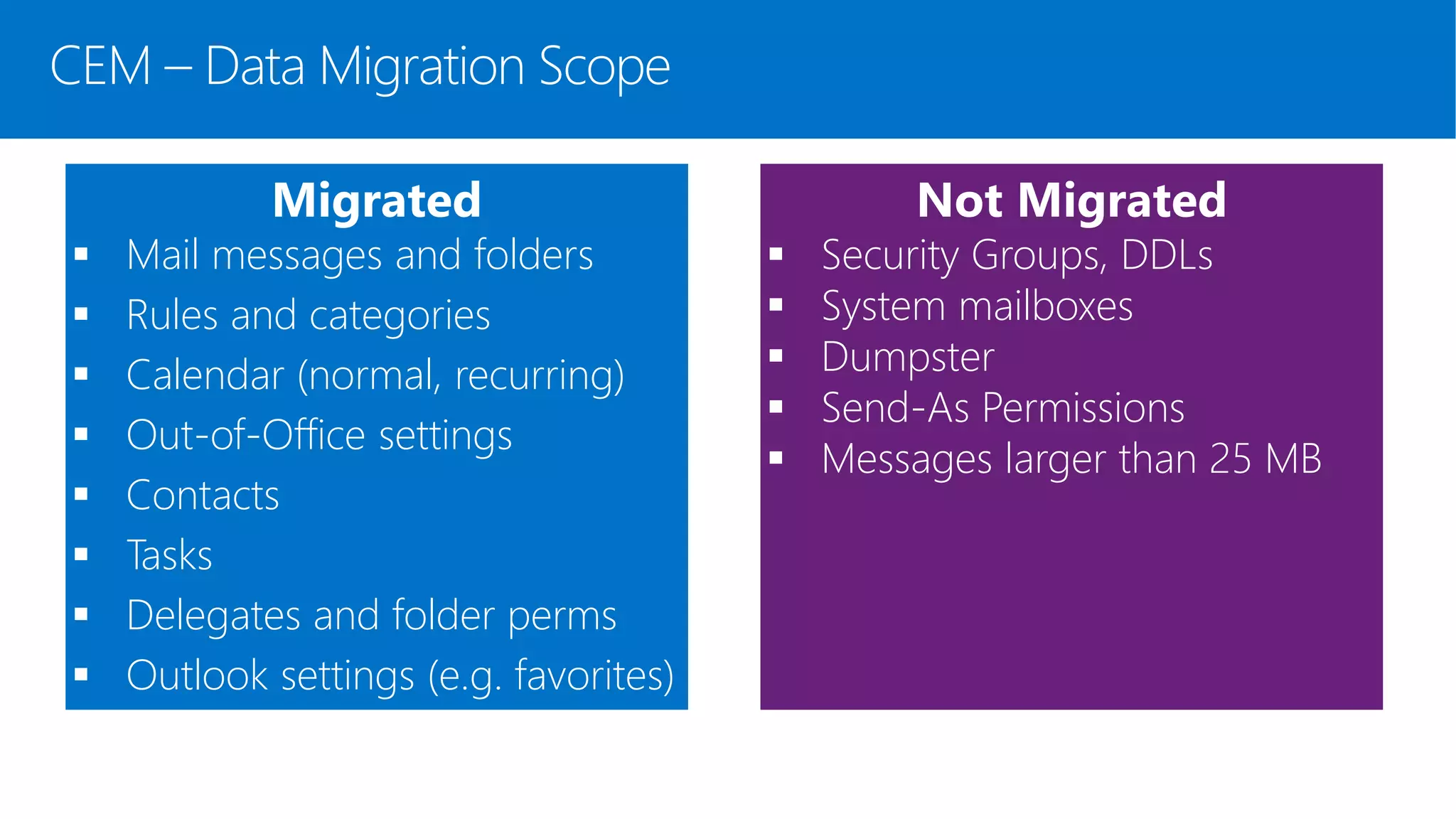
CEM – Data Migration Scope
Migrated
 Mail messages and folders
 Rules and categories
 Calendar (normal, recurring)
 Out-of-Office settings
 Contacts
 Tasks
 Delegates and folder perms
 Outlook settings (e.g. favorites)
Not Migrated
 Security Groups, DDLs
 System mailboxes
 Dumpster
 Send-As Permissions
 Messages larger than 25 MB
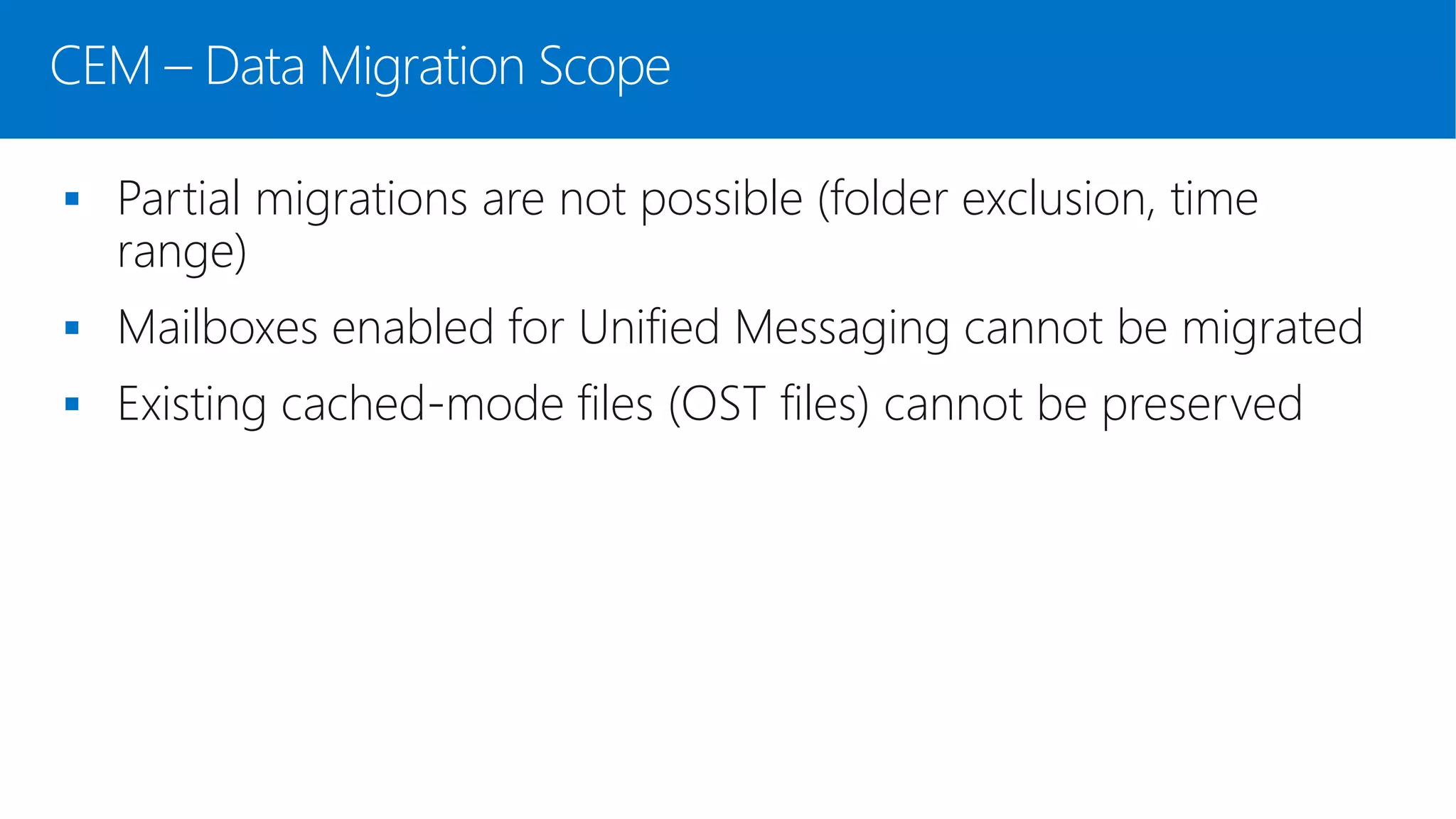
CEM – Data Migration Scope
 Partial migrations are not possible (folder exclusion, time
range)
 Mailboxes enabled for Unified Messaging cannot be migrated
 Existing cached-mode files (OST files) cannot be preserved
CEM – User Experience
 Admin needs to distribute new passwords to users
 Users create their new Outlook profile using O365 username
and new passwords (Autodiscover)
 All mail is downloaded from the Office 365 mailbox
(i.e. the OST file must be recreated)
DEMO - MRCA
Wizard:
Enter
server
settings
and admin
creds Delta
sync
every 24
hours
Mark
migration
as
complete
Change
MX
record
CEM – Migration Flow
Initial
sync
Final
sync and
cleanup
License
users
Configure
Outlook
Anywhere
Test using
MRCA
Assign
migration
perms
Migration
tool
provisions
users
mailboxes
DLs
contacts
in O365
Module 3:
Staged Exchange
Migrations (SEM)
SEM – Features and Benefits
 Simple and flexible migration solution
 High-fidelity solution – all mailbox content is migrated
 Typically best suited to medium and large organizations
 Users are provisioned with Directory Synchronization Tool prior to
migration
 No limit on the number of mailboxes
 Users can be migrated in batches (up to 2000 per batch)
 Works with Exchange 2003 and 2007 only, on-premises or hosted
 Identity management on-premises
 On-premises migration tool is not required
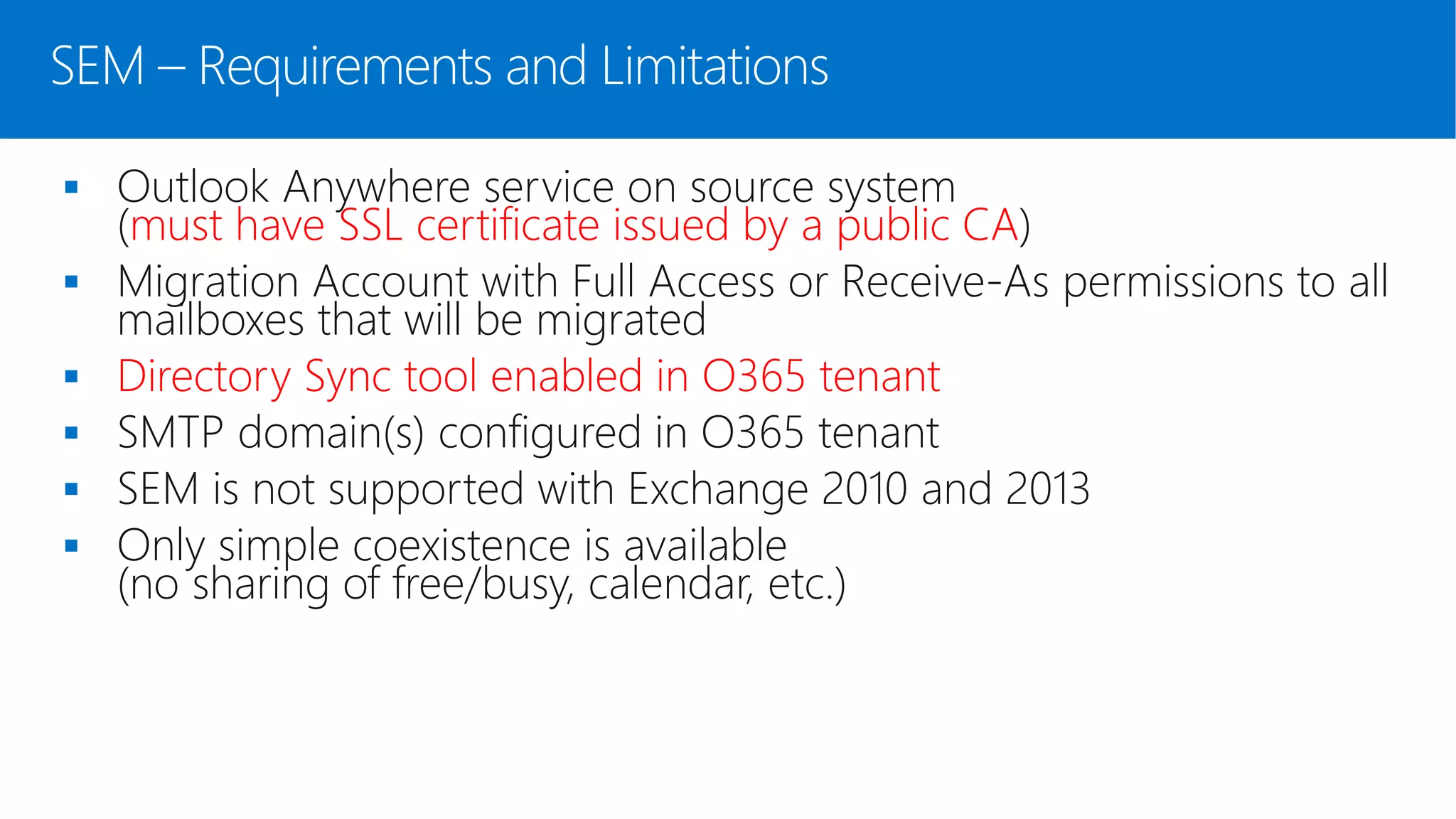
SEM – Requirements and Limitations
 Outlook Anywhere service on source system
(must have SSL certificate issued by a public CA)
 Migration Account with Full Access or Receive-As permissions to all
mailboxes that will be migrated
 Directory Sync tool enabled in O365 tenant
 SMTP domain(s) configured in O365 tenant
 SEM is not supported with Exchange 2010 and 2013
 Only simple coexistence is available
(no sharing of free/busy, calendar, etc.)
Simple coexistence deployment
• Uses Directory Synchronization for GAL synchronization
• Enabler for mail routing between on-premises and Office 365 using a shared
DNS namespace
• Provides a unified GAL experience
• Can be used with cloud identities or federated identities
• Does not require an on-premises Hybrid server
SEM accounts and passwords
Accounts provisioning
 Migration tool relies on Directory Synchronization Tool to do
provisioning
 For every on-premises mailbox to be migrated there needs
to be a MEU or Mailbox in Office 365
Passwords
 Target mailbox passwords must be specified for all users
 Administrators can force users to change passwords
on first login
 Password sync - Optional
SEM – Data Migration Scope
Migrated
 Mail messages and folders
 Rules and categories
 Calendar (normal, recurring)
 Out-of-Office settings
 Contacts
 Tasks
 Delegates and folder perms
 Outlook settings (e.g. favorites)
Not Migrated
 Security Groups, DDLs
 System mailboxes
 Dumpster
 Send-As Permissions
 Messages larger than 25 MB
SEM – Data Migration Scope
• Partial migrations are not possible (folder exclusion, time
range)
• Mailboxes enabled for Unified Messaging cannot be migrated
• Existing cached-mode files (OST files) cannot be preserved
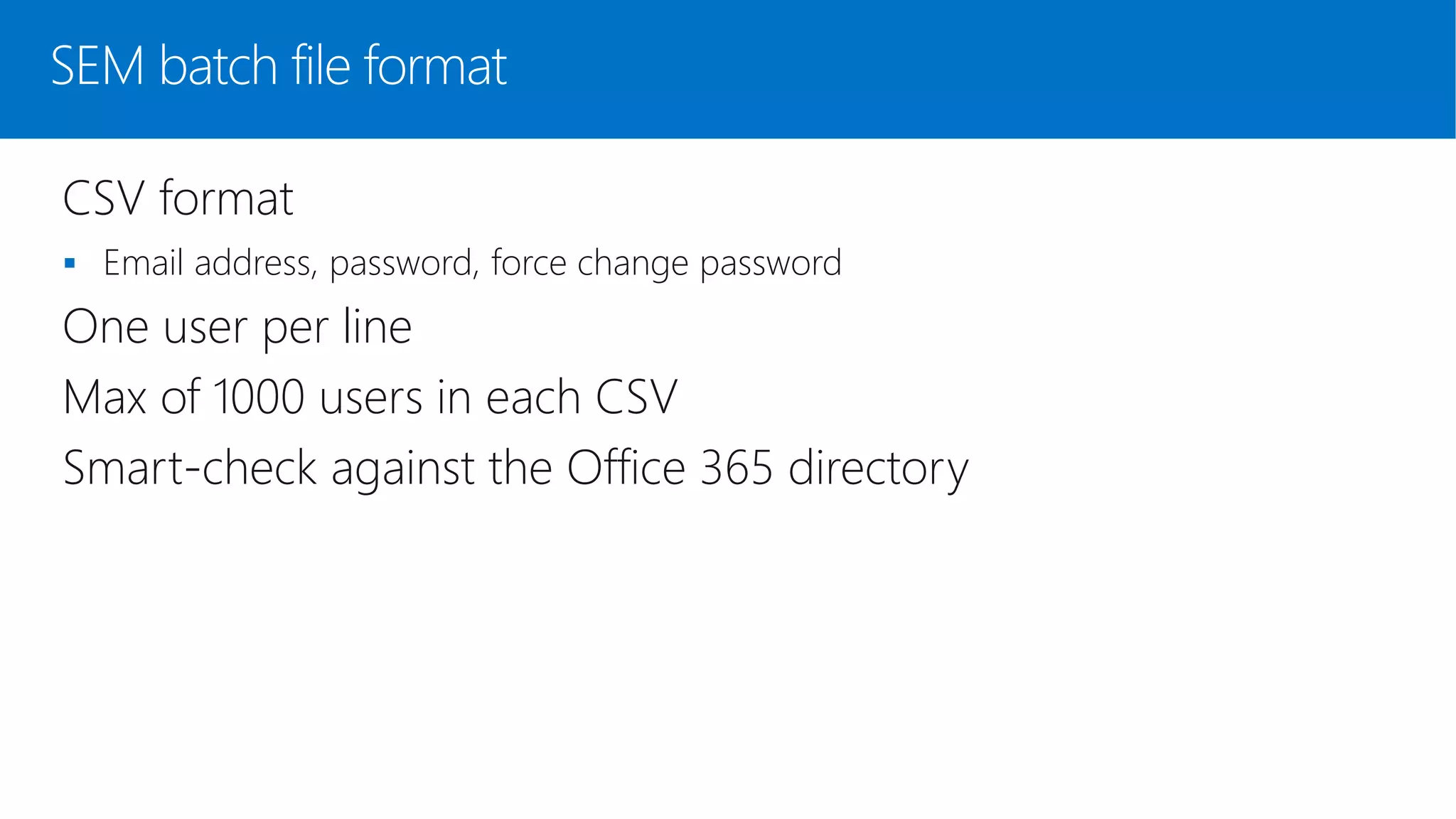
SEM batch file format
CSV format
 Email address, password, force change password
One user per line
Max of 1000 users in each CSV
Smart-check against the Office 365 directory
SEM – User Experience
 Admin needs to distribute new passwords to users
 Users create their new Outlook profile using O365 username
and new passwords (Autodiscover)
 All mail is downloaded from the Office 365 mailbox (i.e. the
OST file must be recreated)
40
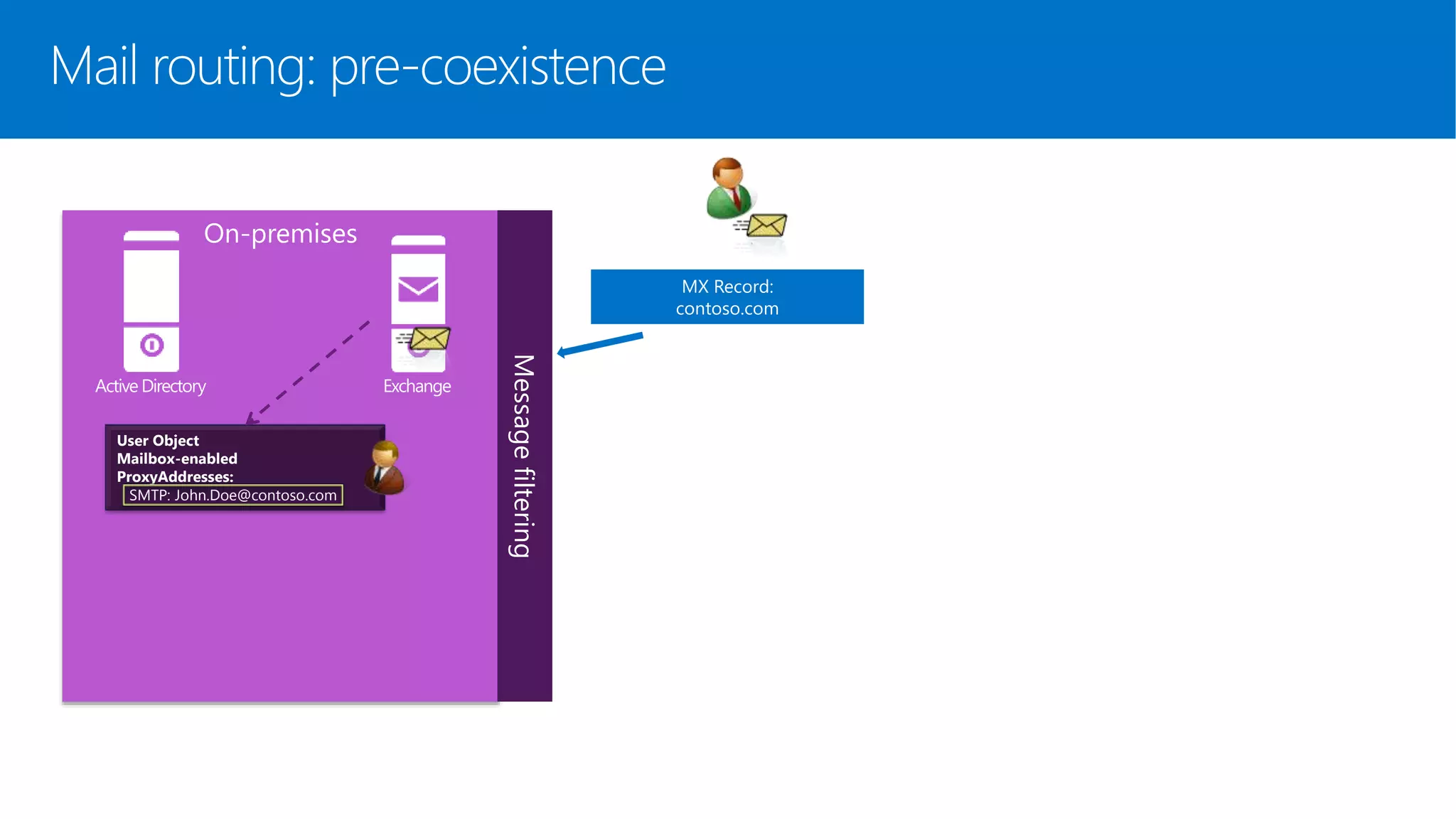
Mail routing: pre-coexistence
On-premises
Messagefiltering
MX Record:
contoso.com
User Object
Mailbox-enabled
ProxyAddresses:
SMTP: John.Doe@contoso.com
ExchangeActive Directory
Mail routing: on-premises to Office 365
On-premises
Messagefiltering
MX Record:
contoso.com
ExchangeActive Directory
Office 365
MX Record:
contoso.onmicrosoft.com
contoso.mail.onmicrosoft.com
ExchangeOnlineProtection
ExchangeOnline OnlineDirectory
DirSync DirSyncWeb
Service
Logon Enabled User
Mailbox-enabled
ProxyAddresses:
SMTP: John.Doe@contoso.com
smtp: John.Doe@contoso.onmicrosoft.com
smtp: John.Doe@contoso.mail.onmicrosoft.com
User Object
Mail-enabled (not mailbox-enabled)
ProxyAddresses:
SMTP: John.Doe@contoso.com
TargetAddresses:
SMTP: John.Doe@contoso.mail.onmicrosoft.com
Mail routing: Office 365 to on-premises
On-premises
Messagefiltering
MX Record:
contoso.com
ExchangeActive Directory
Office 365
MX Record:
contoso.onmicrosoft.com
contoso.mail.onmicrosoft.com
ExchangeOnlineProtection
ExchangeOnline OnlineDirectory
DirSync
DirSyncWeb
Service
Logon Enabled User
Mail-enabled (not mailbox-enabled)
ProxyAddresses:
SMTP: Jane.Doe@contoso.com
smtp: Jane.Doe@contoso.onmicrosoft.com
smtp: Jane.Doe@contoso.mail.onmicrosoft.com
TargetAddresses:
SMTP: Jane.Doe@contoso.com
User Object
Mailbox-enabled
ProxyAddresses:
SMTP: Jane.Doe@contoso.com
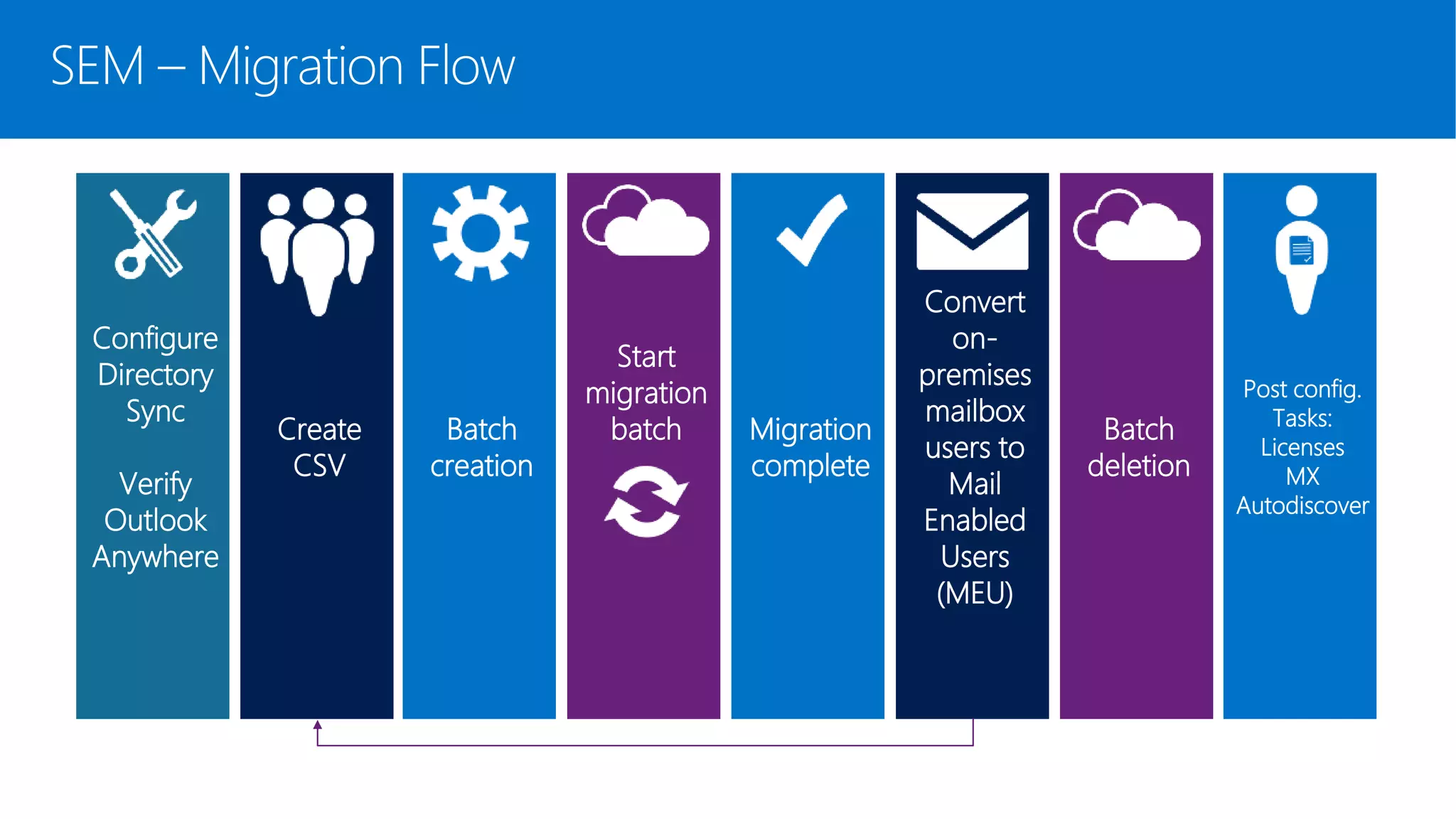
Create
CSV
Batch
creation
Migration
complete
Convert
on-
premises
mailbox
users to
Mail
Enabled
Users
(MEU)
SEM – Migration Flow
Start
migration
batch Batch
deletion
Post config.
Tasks:
Licenses
MX
Autodiscover
Configure
Directory
Sync
Verify
Outlook
Anywhere
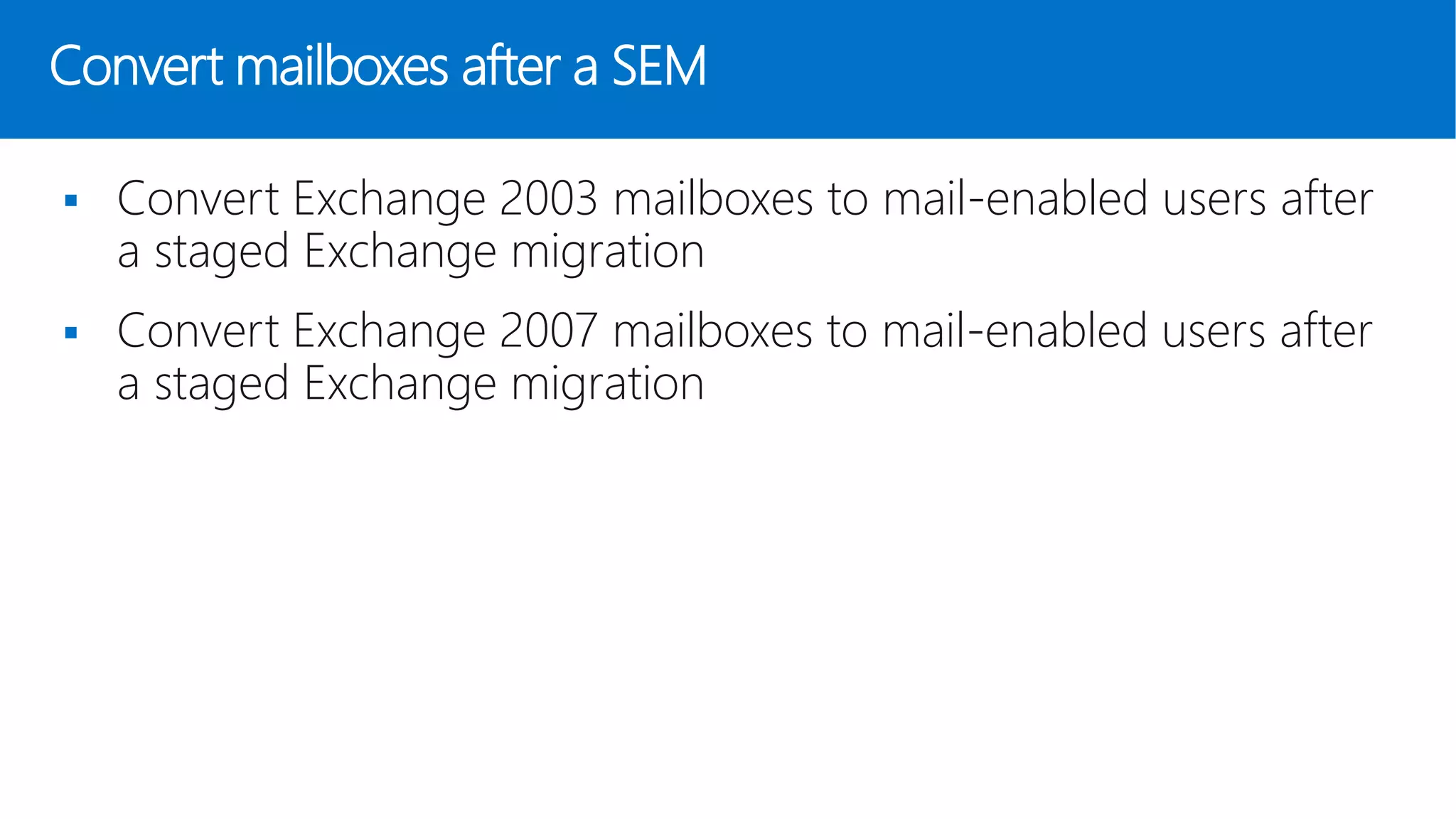
Convert mailboxes after a SEM
 Convert Exchange 2003 mailboxes to mail-enabled users after
a staged Exchange migration
 Convert Exchange 2007 mailboxes to mail-enabled users after
a staged Exchange migration
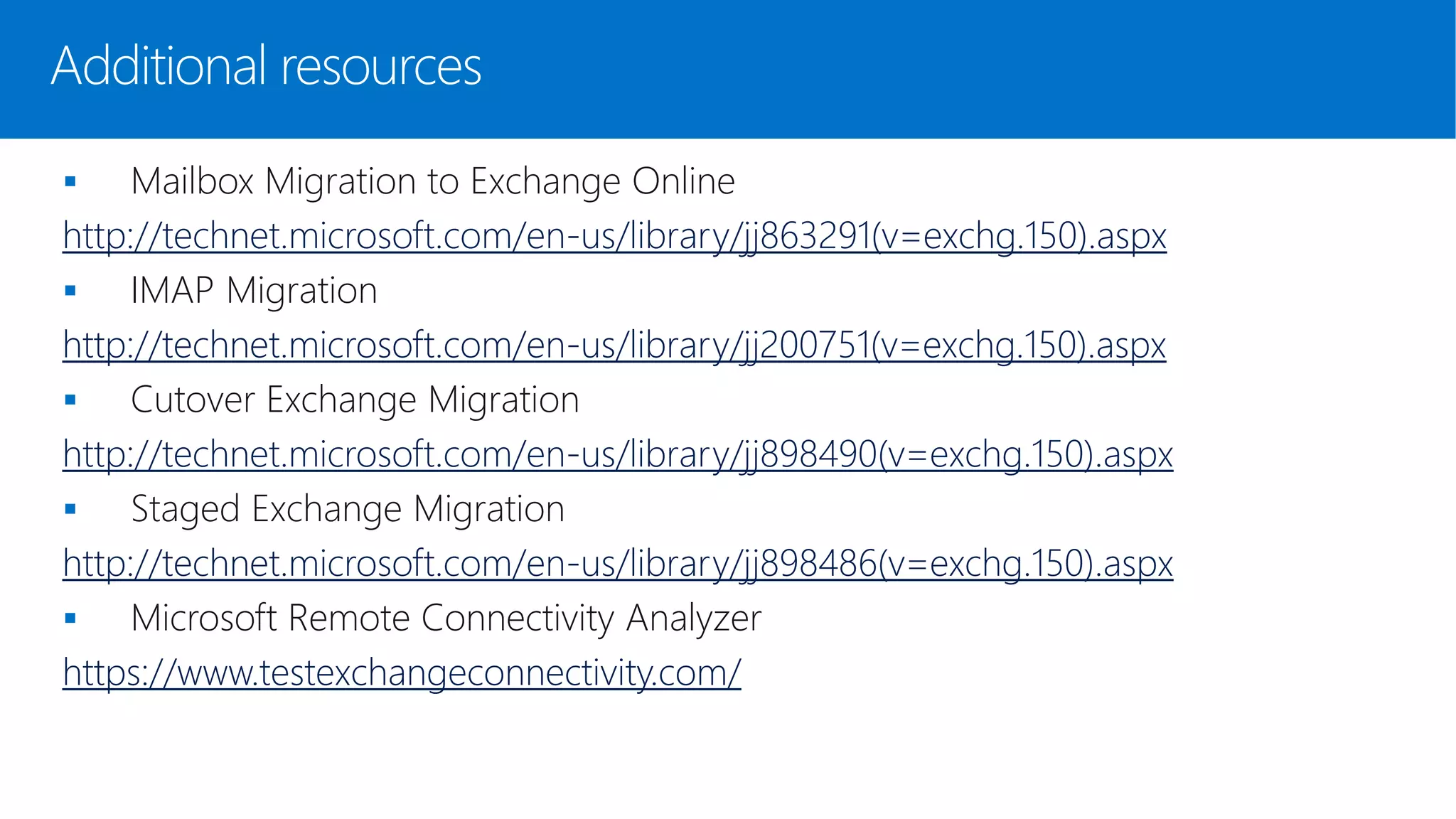
 Mailbox Migration to Exchange Online
http://technet.microsoft.com/en-us/library/jj863291(v=exchg.150).aspx
 IMAP Migration
http://technet.microsoft.com/en-us/library/jj200751(v=exchg.150).aspx
 Cutover Exchange Migration
http://technet.microsoft.com/en-us/library/jj898490(v=exchg.150).aspx
 Staged Exchange Migration
http://technet.microsoft.com/en-us/library/jj898486(v=exchg.150).aspx
 Microsoft Remote Connectivity Analyzer
https://www.testexchangeconnectivity.com/
Additional resources
© 2012 Microsoft Corporation. All rights reserved. Microsoft, Windows, Windows Vista and other product names are or may be registered trademarks and/or trademarks in the U.S. and/or other countries. The information herein is for informational
purposes only and represents the current view of Microsoft Corporation as of the date of this presentations. Because Microsoft must respond to changing market conditions, it should not be interpreted to be a commitment on the part of Microsoft,
and Microsoft cannot guarantee the accuracy of any information provided after the date of this presentation. MICROSOFT MAKES NO WARRANTIES, EXPRESS, IMPLIED OR STATUTORY, AS TO THE INFORMATION IN THIS PRESENTATION.
Thank you!
Thank you!
Office 365 Mail migration strategies

Office 365 Mail migration strategies

  • 1.
    Mail Migration Strategies Fulvio Salanitro Sr.Technical Advisor Bruno RR Fernandes Support Engineer
  • 2.
    Session Agenda Module 1:Introduction Module 2: IMAP Migration Module 3: Cutover Exchange Migration (CEM) Module 4: Staged Exchange Migration (SEM)
  • 3.
  • 4.
    4 | MicrosoftConfidential DEPLOYMENT PLAN Migration solution is part of the plan Source server Exchange IMAP Lotus Notes Google Size Large Medium Small On-premises Single sign-on On-cloud Provisioning DirSync Manual/Bulk Provisioning Automatic Provisioning Coexistence requirement Simple Rich Migration option decision factors
  • 5.
    Coexistence requirements •No needto connect on-premises infrastructure to Office 365 and Exchange Online •Identities provisioned through Office 365 Administration Portal (no AD integration) •No needs to connect on-premises messaging system to Exchange Online No coexistence •Identities managed through Active Directory using Directory Synchronization Tool •On-premises messaging infrastructure connected to Exchange Online during migration •During migration some mailboxes are active on-premises and others online •Email flow working correctly and unified GAL Simple coexistence •Identities managed through Active Directory using Directory Synchronization Tool •Single Sing-On deployed through federation services •Exchange Hybrid Deployment between Exchange Server and Exchange Online Advanced coexistence
  • 6.
    Migration options •Source messagingsystems disconnected from Office 365 •Cloud identities (no AD integration) IMAP Migration (no coexistence) •Mailboxes migrated in one batch •Contacts, groups migrated •Up to 2000 mailboxes Cutover Exchange Migration (no coexistence) •Identities managed through Active Directory using Directory Synchronization Tool •Migration through simple coexistence between on-premises Exchange (2003/2007) and Exchange Online •Move some mailboxes into the cloud, while other mailboxes run on-premises Staged Exchange Migrations (simple coexistence) •Identities managed through Active Directory using Directory Synchronization Tool •Single Sing-On deployed through federation services •Federation between Exchange Server and Exchange Online Migrations through hybrid environment (advanced coexistence)
  • 7.
    IMAP migration Cutover migration Staged migration 2010 hybrid 2013hybrid Exchange 5.5  Exchange 2000  Exchange 2003     Exchange 2007      Exchange 2010     Exchange 2013    Notes/Domino  GroupWise  Other  Source server
  • 8.
    Size Existing organization Number ofmailboxes to migrate Do you want to manage user accounts in your on- premises organization? Migration type Exchange 2013, Exchange 2010, Exchange 2007, or Exchange 2003 Less than 1,000 mailboxes No Cutover Exchange migration Exchange 2007 or Exchange 2003 Less than 1,000 mailboxes No Staged Exchange migration Exchange 2007 or Exchange 2003 More than 1,000 mailboxes Yes Staged Exchange migration or remote move migration in an Exchange hybrid deployment Exchange 2013 or Exchange 2010 More than 1,000 mailboxes Yes Remote move migration in an Exchange hybrid deployment Exchange 2000 Server or earlier versions No maximum Yes IMAP migration Non-Exchange on-premises messaging system No maximum Yes IMAP migration
  • 9.
    IMAPmigration Cutovermigration Stagedmigration 2010hybrid 2013hybrid Exchange 5.5  Exchange2000  Exchange 2003     Exchange 2007      Exchange 2010     Exchange 2013    Notes/Domino  GroupWise  Other  Migration options SimplemigrationsHybrid IMAP migration Supports wide range of email platforms Email only (no calendar, contacts, or tasks) Cutover Exchange migration (CEM) Good for fast, cutover migrations No migration tool or computer required on-premises Staged Exchange migration (SEM) No migration tool or computer required on-premises Requires Directory Synchronization with on-premises AD Hybrid deployment Manage users on-premises and online Enables cross-premises calendaring, smooth migration, and easy off-boarding
  • 10.
    Additional onboarding options ControlDeployment Type Description User driven New mailbox User receives new “green field” mailbox – i.e. user is on boarded to without data migration. New mailbox + Outlook PST User receives new mailbox and either attaches or imports PST files for access to pre-Office 365 data. New mailbox + connected accounts User receives new mailbox and configures connected accounts via OWA. Admin driven New mailbox + PST Import User receives a new mailbox and admin uses the PST Import to import PST data into the user’s Exchange Online mailbox.
  • 11.
    DirSync’s role inmigrations • Enables coexistence for Exchange • Provisions objects in Office 365 with same email addresses as the objects in the on-premises environment • Provides a unified Global Address List experience between on-premises and Office 365 • Objects hidden from the GAL on-premises are also hidden from the GAL in Office 365 • Works in both simple and hybrid deployment scenarios • Enabler for mail routing between on-premises and Office 365 with a shared domain namespace
  • 12.
    In EAC, select recipients| migration Start migration wizard Choose migration type and follow prompts
  • 13.
    Set of MigrationCmdlets New-MigrationBatch Start-MigrationBatch Get-MigrationBatch Get-MigrationStatus Complete-Migration Test-MigrationServerAvailability
  • 14.
  • 15.
  • 16.
    IMAP – Featuresand Benefits  Works with a large number of source mail systems  Works with on-premises or hosted systems  Users can be migrated in batches  On-premises migration tool is not required
  • 17.
    IMAP – Requirementsand Limitations On-premises migration tool is not required Access to IMAP ports (TCP/143/993) Users + mailboxes must be provisioned prior to migration:  Bulk provisioning, CSV parser, manual, etc. SMTP domains configured in O365 tenant Gather user credentials or setup admin credentials Prepare a CSV file with list of users:  EmailAddress, UserName, Password  Max of 50,000 rows  Max 10 MB in size
  • 18.
    IMAP – DataMigration Scope Migrated  Mail messages (Inbox and other folders)  Maximum of 500,000 items  Possible to exclude specific folders from migration (e.g. Deleted Items, Junk E- Mail) Not Migrated  Contacts, Calendars, Tasks, etc.  Excluded folders  Folders with a forward slash ( / ) in the folder name  Messages larger than 25 MB
  • 19.
    Delta sync every 24 hours Mark migration as complete Change MX record Gather IMAP creds and prepare CSV IMAP– Migration Flow Provision users + mailboxes in O365 (license assigned) Wizard: Enter server settings and upload CSV Initial sync Final sync and cleanup
  • 20.
  • 21.
  • 23.
    CEM – Featuresand Benefits  Simple and quick migration solution  High-fidelity solution – all mailbox content is migrated  Typically best suited to small and medium organizations  Users are provisioned automatically during migration  Works with Exchange 2003 and newer  Works with on-premises or hosted Exchange systems  Identity management in the cloud (at least initially)  On-premises migration tool is not required
  • 24.
    CEM – Requirementsand Limitations  Up to 2000 mailboxes in source system  Outlook Anywhere service on source system (must have SSL certificate issued by a public CA)  Migration Account with Full Access or Receive-As permissions to all mailboxes that will be migrated  Directory Sync tool disabled in O365 tenant  SMTP domains configured in O365 tenant  MRCA all green  24
  • 25.
    CEM accounts andpasswords Accounts provisioning  Migration tool creates users, mailboxes, DLs and contacts  Migration enables replies to migrated messages (i.e. provision process brings over the Legacy DNs) Passwords  No access to passwords from source directory  New passwords created for all users  A link to download passwords is sent to admin  Users must change password on their first login
  • 26.
    CEM – DataMigration Scope Migrated  Mail messages and folders  Rules and categories  Calendar (normal, recurring)  Out-of-Office settings  Contacts  Tasks  Delegates and folder perms  Outlook settings (e.g. favorites) Not Migrated  Security Groups, DDLs  System mailboxes  Dumpster  Send-As Permissions  Messages larger than 25 MB
  • 27.
    CEM – DataMigration Scope  Partial migrations are not possible (folder exclusion, time range)  Mailboxes enabled for Unified Messaging cannot be migrated  Existing cached-mode files (OST files) cannot be preserved
  • 28.
    CEM – UserExperience  Admin needs to distribute new passwords to users  Users create their new Outlook profile using O365 username and new passwords (Autodiscover)  All mail is downloaded from the Office 365 mailbox (i.e. the OST file must be recreated)
  • 29.
  • 30.
    Wizard: Enter server settings and admin creds Delta sync every24 hours Mark migration as complete Change MX record CEM – Migration Flow Initial sync Final sync and cleanup License users Configure Outlook Anywhere Test using MRCA Assign migration perms Migration tool provisions users mailboxes DLs contacts in O365
  • 31.
  • 33.
    SEM – Featuresand Benefits  Simple and flexible migration solution  High-fidelity solution – all mailbox content is migrated  Typically best suited to medium and large organizations  Users are provisioned with Directory Synchronization Tool prior to migration  No limit on the number of mailboxes  Users can be migrated in batches (up to 2000 per batch)  Works with Exchange 2003 and 2007 only, on-premises or hosted  Identity management on-premises  On-premises migration tool is not required
  • 34.
    SEM – Requirementsand Limitations  Outlook Anywhere service on source system (must have SSL certificate issued by a public CA)  Migration Account with Full Access or Receive-As permissions to all mailboxes that will be migrated  Directory Sync tool enabled in O365 tenant  SMTP domain(s) configured in O365 tenant  SEM is not supported with Exchange 2010 and 2013  Only simple coexistence is available (no sharing of free/busy, calendar, etc.)
  • 35.
    Simple coexistence deployment •Uses Directory Synchronization for GAL synchronization • Enabler for mail routing between on-premises and Office 365 using a shared DNS namespace • Provides a unified GAL experience • Can be used with cloud identities or federated identities • Does not require an on-premises Hybrid server
  • 36.
    SEM accounts andpasswords Accounts provisioning  Migration tool relies on Directory Synchronization Tool to do provisioning  For every on-premises mailbox to be migrated there needs to be a MEU or Mailbox in Office 365 Passwords  Target mailbox passwords must be specified for all users  Administrators can force users to change passwords on first login  Password sync - Optional
  • 37.
    SEM – DataMigration Scope Migrated  Mail messages and folders  Rules and categories  Calendar (normal, recurring)  Out-of-Office settings  Contacts  Tasks  Delegates and folder perms  Outlook settings (e.g. favorites) Not Migrated  Security Groups, DDLs  System mailboxes  Dumpster  Send-As Permissions  Messages larger than 25 MB
  • 38.
    SEM – DataMigration Scope • Partial migrations are not possible (folder exclusion, time range) • Mailboxes enabled for Unified Messaging cannot be migrated • Existing cached-mode files (OST files) cannot be preserved
  • 39.
    SEM batch fileformat CSV format  Email address, password, force change password One user per line Max of 1000 users in each CSV Smart-check against the Office 365 directory
  • 40.
    SEM – UserExperience  Admin needs to distribute new passwords to users  Users create their new Outlook profile using O365 username and new passwords (Autodiscover)  All mail is downloaded from the Office 365 mailbox (i.e. the OST file must be recreated) 40
  • 41.
    Mail routing: pre-coexistence On-premises Messagefiltering MXRecord: contoso.com User Object Mailbox-enabled ProxyAddresses: SMTP: John.Doe@contoso.com ExchangeActive Directory
  • 42.
    Mail routing: on-premisesto Office 365 On-premises Messagefiltering MX Record: contoso.com ExchangeActive Directory Office 365 MX Record: contoso.onmicrosoft.com contoso.mail.onmicrosoft.com ExchangeOnlineProtection ExchangeOnline OnlineDirectory DirSync DirSyncWeb Service Logon Enabled User Mailbox-enabled ProxyAddresses: SMTP: John.Doe@contoso.com smtp: John.Doe@contoso.onmicrosoft.com smtp: John.Doe@contoso.mail.onmicrosoft.com User Object Mail-enabled (not mailbox-enabled) ProxyAddresses: SMTP: John.Doe@contoso.com TargetAddresses: SMTP: John.Doe@contoso.mail.onmicrosoft.com
  • 43.
    Mail routing: Office365 to on-premises On-premises Messagefiltering MX Record: contoso.com ExchangeActive Directory Office 365 MX Record: contoso.onmicrosoft.com contoso.mail.onmicrosoft.com ExchangeOnlineProtection ExchangeOnline OnlineDirectory DirSync DirSyncWeb Service Logon Enabled User Mail-enabled (not mailbox-enabled) ProxyAddresses: SMTP: Jane.Doe@contoso.com smtp: Jane.Doe@contoso.onmicrosoft.com smtp: Jane.Doe@contoso.mail.onmicrosoft.com TargetAddresses: SMTP: Jane.Doe@contoso.com User Object Mailbox-enabled ProxyAddresses: SMTP: Jane.Doe@contoso.com
  • 44.
    Create CSV Batch creation Migration complete Convert on- premises mailbox users to Mail Enabled Users (MEU) SEM –Migration Flow Start migration batch Batch deletion Post config. Tasks: Licenses MX Autodiscover Configure Directory Sync Verify Outlook Anywhere
  • 45.
    Convert mailboxes aftera SEM  Convert Exchange 2003 mailboxes to mail-enabled users after a staged Exchange migration  Convert Exchange 2007 mailboxes to mail-enabled users after a staged Exchange migration
  • 46.
     Mailbox Migrationto Exchange Online http://technet.microsoft.com/en-us/library/jj863291(v=exchg.150).aspx  IMAP Migration http://technet.microsoft.com/en-us/library/jj200751(v=exchg.150).aspx  Cutover Exchange Migration http://technet.microsoft.com/en-us/library/jj898490(v=exchg.150).aspx  Staged Exchange Migration http://technet.microsoft.com/en-us/library/jj898486(v=exchg.150).aspx  Microsoft Remote Connectivity Analyzer https://www.testexchangeconnectivity.com/ Additional resources
  • 47.
    © 2012 MicrosoftCorporation. All rights reserved. Microsoft, Windows, Windows Vista and other product names are or may be registered trademarks and/or trademarks in the U.S. and/or other countries. The information herein is for informational purposes only and represents the current view of Microsoft Corporation as of the date of this presentations. Because Microsoft must respond to changing market conditions, it should not be interpreted to be a commitment on the part of Microsoft, and Microsoft cannot guarantee the accuracy of any information provided after the date of this presentation. MICROSOFT MAKES NO WARRANTIES, EXPRESS, IMPLIED OR STATUTORY, AS TO THE INFORMATION IN THIS PRESENTATION. Thank you! Thank you!