1
S.T FRANCIS DE SALES COLLEGE,
SEMINARY HILLS,NAGPUR
DEPARTMENT OF CHEMISTRY
SEMINAR BY:
Mr. PRATIK DEVRAO MIRCHE
(M.sc:- 1st SEMESTER)
GUIDED BY:- SNEHA JHADAO MAM
TOPIC NAME:-
NUCLEOPHILIC SUBSTITUTION REACTIONS
NUCLEOPHILES
⚫The word nucleophile comes from nucleus, the
positivepartof an atom, plus -phile from Greek word
philos meaning to love.
⚫A nucleophile is any negative ion orany neutral
molecule that hasat least one unshared electron
pair. Eg:
2
3
MECHANISM OF SN1 REACTION
4
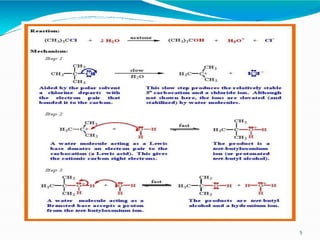
⚫The SN1 reaction is a Substitution, Nucleophilic and
Unimolecular. The reaction of tert-butyl chloride with
sodium hydroxide in a mixture of water and acetone to
form tert-butyl alcohol is a good example for SN1
reaction.
⚫The rate of formation of tert-butyl alcohol is dependent
only on the concentration of tert-butyl chloride and
independent of the concentration of hydroxide ion.
The rate equation for this substitution reaction is first
orderwith respectto tert-butyl chloride.
5
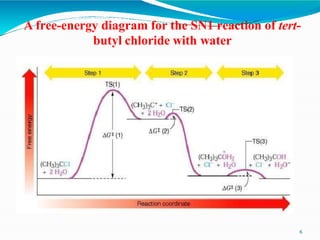
A free-energy diagram for the SN1 reaction of tert-
butyl chloride with water
6
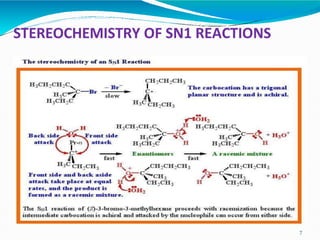
STEREOCHEMISTRY OF SN1 REACTIONS
7
MECHANISM OF SN2 REACTION
8
⚫The SN2 reaction
9
is a Substitution,
Nucleophilic, bimolecular reaction. The
transition state involves both the nucleophile and
the substrate, it accounts for the observed second-
orderreaction rate.
⚫The mechanism for SN2 reaction was proposed
by Edward D. Hughes and Sir Christopher Ingold
(the University College, London) in 1937.
⚫ The nucleophile attacks the carbon bearing the leaving group from the back
side.
⚫ The orbital that contains the electron pair of the nucleophile begins to overlap
withanempty(antibonding)orbitalofthecarbonbearingtheleavinggroup.
⚫ The bond between the nucleophile and the carbon atom is forming, and the
bond between the carbon atom and the leaving group is breaking at the same
time.
⚫ Because bond formation and bond breaking occur simultaneously in a single
transitionstate,theSN2reactionisaconcertedreaction.
⚫ TheconfigurationofthecarbonatombecomesinvertedduringSN2reaction.
⚫ ThereactionisaexothermicreactionwherethefreeenergyvalueGisnegative.
10
11
A free-energy diagram for a hypothetical SN2 reaction that
takes place with a negative value of G°
1. Most of the SN2 chemical reactions occur much more rapidly at higher
temperatures.
2. A reaction with a lower free energy of activation will occur very much
faster than a reaction with a higher one.
12
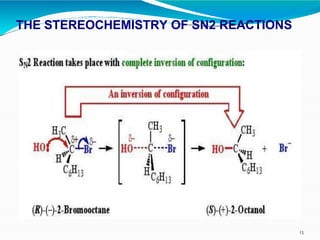
THE STEREOCHEMISTRY OF SN2 REACTIONS
13
FACTORS FAVOURING SN1 &SN2
14
15
REFERENCES
16
ACKNOWLEDGEMENT
ST FRANCIS DE SALES COLLEGE,NAGPUR
• Dr .K .T Thomas Sir (Principal)
• Prof.M.karmarkar Sir(HOD of chemistry Department )
• Ms .Nikita Gupta Mam
• Ms .Rasmi Tiwari Mam
• Dr.Sneha Jhadao Mam
• Ms.Sheetal Pal Mam
17

sn1.PPTX

  • 1.
    1 S.T FRANCIS DESALES COLLEGE, SEMINARY HILLS,NAGPUR DEPARTMENT OF CHEMISTRY SEMINAR BY: Mr. PRATIK DEVRAO MIRCHE (M.sc:- 1st SEMESTER) GUIDED BY:- SNEHA JHADAO MAM TOPIC NAME:-
  • 2.
    NUCLEOPHILIC SUBSTITUTION REACTIONS NUCLEOPHILES ⚫Theword nucleophile comes from nucleus, the positivepartof an atom, plus -phile from Greek word philos meaning to love. ⚫A nucleophile is any negative ion orany neutral molecule that hasat least one unshared electron pair. Eg: 2
  • 3.
  • 4.
    MECHANISM OF SN1REACTION 4 ⚫The SN1 reaction is a Substitution, Nucleophilic and Unimolecular. The reaction of tert-butyl chloride with sodium hydroxide in a mixture of water and acetone to form tert-butyl alcohol is a good example for SN1 reaction. ⚫The rate of formation of tert-butyl alcohol is dependent only on the concentration of tert-butyl chloride and independent of the concentration of hydroxide ion. The rate equation for this substitution reaction is first orderwith respectto tert-butyl chloride.
  • 5.
  • 6.
    A free-energy diagramfor the SN1 reaction of tert- butyl chloride with water 6
  • 7.
  • 8.
    MECHANISM OF SN2REACTION 8
  • 9.
    ⚫The SN2 reaction 9 isa Substitution, Nucleophilic, bimolecular reaction. The transition state involves both the nucleophile and the substrate, it accounts for the observed second- orderreaction rate. ⚫The mechanism for SN2 reaction was proposed by Edward D. Hughes and Sir Christopher Ingold (the University College, London) in 1937.
  • 10.
    ⚫ The nucleophileattacks the carbon bearing the leaving group from the back side. ⚫ The orbital that contains the electron pair of the nucleophile begins to overlap withanempty(antibonding)orbitalofthecarbonbearingtheleavinggroup. ⚫ The bond between the nucleophile and the carbon atom is forming, and the bond between the carbon atom and the leaving group is breaking at the same time. ⚫ Because bond formation and bond breaking occur simultaneously in a single transitionstate,theSN2reactionisaconcertedreaction. ⚫ TheconfigurationofthecarbonatombecomesinvertedduringSN2reaction. ⚫ ThereactionisaexothermicreactionwherethefreeenergyvalueGisnegative. 10
  • 11.
  • 12.
    A free-energy diagramfor a hypothetical SN2 reaction that takes place with a negative value of G° 1. Most of the SN2 chemical reactions occur much more rapidly at higher temperatures. 2. A reaction with a lower free energy of activation will occur very much faster than a reaction with a higher one. 12
  • 13.
    THE STEREOCHEMISTRY OFSN2 REACTIONS 13
  • 14.
  • 15.
  • 16.
    16 ACKNOWLEDGEMENT ST FRANCIS DESALES COLLEGE,NAGPUR • Dr .K .T Thomas Sir (Principal) • Prof.M.karmarkar Sir(HOD of chemistry Department ) • Ms .Nikita Gupta Mam • Ms .Rasmi Tiwari Mam • Dr.Sneha Jhadao Mam • Ms.Sheetal Pal Mam
  • 17.