SMAW Welding Techniques
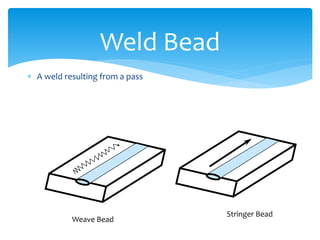
Weld Bead
 A weld resulting from a pass
Stringer Bead
Weave Bead
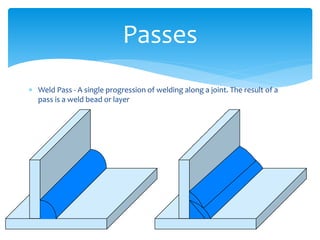
 Weld Pass - A single progression of welding along a joint. The result of a
pass is a weld bead or layer
Passes
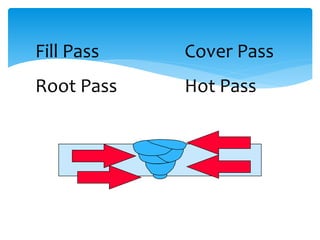
Root Pass Hot Pass
Fill Pass Cover Pass
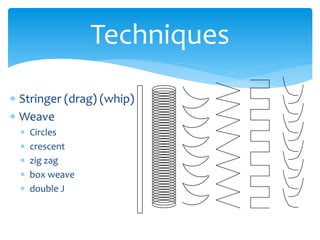
 Stringer (drag) (whip)
 Weave
 Circles
 crescent
 zig zag
 box weave
 double J
Techniques
 Up
 deeper penetration
 Higher deposit rate (lb/hr)
 Use near 90 degree travel angle or slightly up
 Down
 faster (point to point)
 less penetration for thin metal
 less dilution
 Use steep grag angle
Progression (vertical)
 Stay on the leading edge of the puddle
Travel Speed
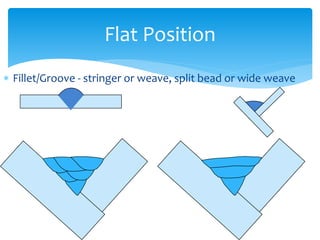
 Fillet/Groove - stringer or weave, split bead or wide weave
Flat Position
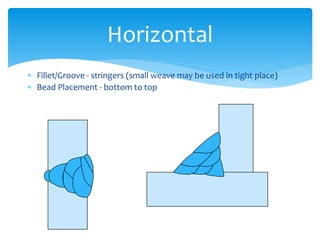
 Fillet/Groove - stringers (small weave may be used in tight place)
 Bead Placement - bottom to top
Horizontal
 Fillet/Groove - weave (or whip but not straight stringers)
 Root pass 6010 whip
 Root pass 7018 straight stringer or weave (open closed)
Vertical
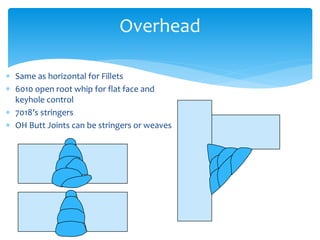
 Same as horizontal for Fillets
 6010 open root whip for flat face and
keyhole control
 7018’s stringers
 OH Butt Joints can be stringers or weaves
Overhead
 Reinforcement -ASME flush 1/16 AWS flush 1/8
discuss key holeing, metallic backing,
nonmetallic backing, partial penetration, root
openings, root faces, tacking, tack grinding, fast
freeze, and fill freeze
 Fill -as many as needed 1/8 per pass flat overload
3/16 vertical
 Cover -flush 1/16 high, 1/16 past edge
Dimensions
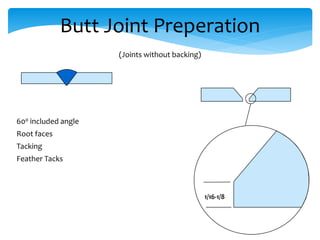
600 included angle
Root faces
Tacking
Feather Tacks
Butt Joint Preperation
1/16-1/8
(Joints without backing)
 Use root opening to allow increase in amperage for
smoother welding
 Whip backwards for penetration
 Whip forwards to reduce penetration
 Do Not Weave a root pass.
 Maintain a short arc gap
 Stay slightly in front of the puddle at all times. Use the
keyholing technique.
Open Root Technique
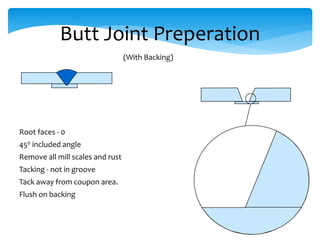
Root faces - 0
450 included angle
Remove all mill scales and rust
Tacking - not in groove
Tack away from coupon area.
Flush on backing
Butt Joint Preperation
(With Backing)
 Keep the root opening wide
 Make the root pass in one bead
 Avoid tight areas at the weld toes
Welding grooves with Backing
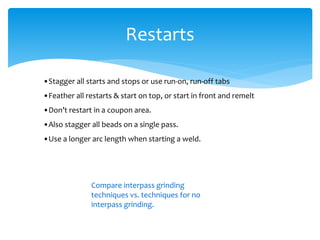
Restarts
•Stagger all starts and stops or use run-on, run-off tabs
•Feather all restarts & start on top, or start in front and remelt
•Don’t restart in a coupon area.
•Also stagger all beads on a single pass.
•Use a longer arc length when starting a weld.
Compare interpass grinding
techniques vs. techniques for no
interpass grinding.
 Fill craters by reversing direction at the weld end
 Use a short arc length to control heat.
Craters
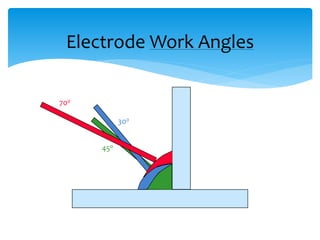
Electrode Work Angles
450
300
700
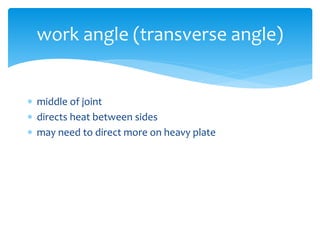
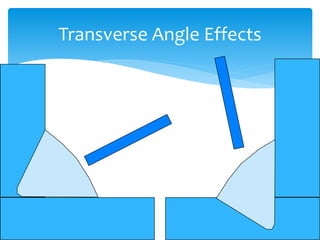
 middle of joint
 directs heat between sides
 may need to direct more on heavy plate
work angle (transverse angle)
Transverse Angle Effects
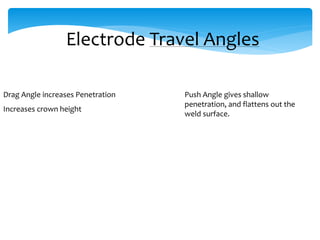
Drag Angle increases Penetration
Increases crown height
Push Angle gives shallow
penetration, and flattens out the
weld surface.
Electrode Travel Angles
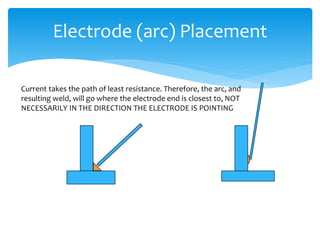
Electrode (arc) Placement
Current takes the path of least resistance. Therefore, the arc, and
resulting weld, will go where the electrode end is closest to, NOT
NECESSARILY IN THE DIRECTION THE ELECTRODE IS POINTING
Arc Length
•Longer arc lengths = increased puddle heat, flatter welds, deeper
penetration
•Shorter arc lengths = less puddle heat, flatter welds, less penetration
•Use arc length to control puddle size, penetration, and burn through.
•Normal arc length is 1/16” - 1/8”
•Use a slightly longer arc length during a start or restart.
Helpful Tips
•Clean your Welding Hood lens
•Drape the cable over your shoulder or knee
•Get Comfortable
•Watch the puddle, not the arc
•Concentrate on steady travel speed and arc
length
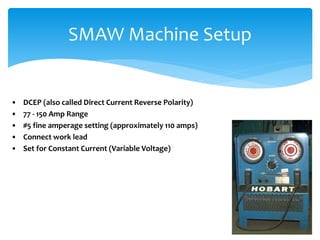
SMAW Machine Setup
• DCEP (also called Direct Current Reverse Polarity)
• 77 - 150 Amp Range
• #5 fine amperage setting (approximately 110 amps)
• Connect work lead
• Set for Constant Current (Variable Voltage)
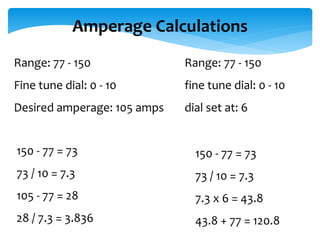
Amperage Calculations
Range: 77 - 150
Fine tune dial: 0 - 10
Desired amperage: 105 amps
150 - 77 = 73
73 / 10 = 7.3
7.3 x 6 = 43.8
43.8 + 77 = 120.8
150 - 77 = 73
73 / 10 = 7.3
105 - 77 = 28
28 / 7.3 = 3.836
Range: 77 - 150
fine tune dial: 0 - 10
dial set at: 6
Do SMAW Pipe Welding Techniques Lecture Now

SMAW welding techniques

  • 1.
  • 2.
    Weld Bead  Aweld resulting from a pass Stringer Bead Weave Bead
  • 3.
     Weld Pass- A single progression of welding along a joint. The result of a pass is a weld bead or layer Passes
  • 4.
    Root Pass HotPass Fill Pass Cover Pass
  • 5.
     Stringer (drag)(whip)  Weave  Circles  crescent  zig zag  box weave  double J Techniques
  • 6.
     Up  deeperpenetration  Higher deposit rate (lb/hr)  Use near 90 degree travel angle or slightly up  Down  faster (point to point)  less penetration for thin metal  less dilution  Use steep grag angle Progression (vertical)
  • 7.
     Stay onthe leading edge of the puddle Travel Speed
  • 8.
     Fillet/Groove -stringer or weave, split bead or wide weave Flat Position
  • 9.
     Fillet/Groove -stringers (small weave may be used in tight place)  Bead Placement - bottom to top Horizontal
  • 10.
     Fillet/Groove -weave (or whip but not straight stringers)  Root pass 6010 whip  Root pass 7018 straight stringer or weave (open closed) Vertical
  • 11.
     Same ashorizontal for Fillets  6010 open root whip for flat face and keyhole control  7018’s stringers  OH Butt Joints can be stringers or weaves Overhead
  • 12.
     Reinforcement -ASMEflush 1/16 AWS flush 1/8 discuss key holeing, metallic backing, nonmetallic backing, partial penetration, root openings, root faces, tacking, tack grinding, fast freeze, and fill freeze  Fill -as many as needed 1/8 per pass flat overload 3/16 vertical  Cover -flush 1/16 high, 1/16 past edge Dimensions
  • 13.
    600 included angle Rootfaces Tacking Feather Tacks Butt Joint Preperation 1/16-1/8 (Joints without backing)
  • 14.
     Use rootopening to allow increase in amperage for smoother welding  Whip backwards for penetration  Whip forwards to reduce penetration  Do Not Weave a root pass.  Maintain a short arc gap  Stay slightly in front of the puddle at all times. Use the keyholing technique. Open Root Technique
  • 15.
    Root faces -0 450 included angle Remove all mill scales and rust Tacking - not in groove Tack away from coupon area. Flush on backing Butt Joint Preperation (With Backing)
  • 16.
     Keep theroot opening wide  Make the root pass in one bead  Avoid tight areas at the weld toes Welding grooves with Backing
  • 17.
    Restarts •Stagger all startsand stops or use run-on, run-off tabs •Feather all restarts & start on top, or start in front and remelt •Don’t restart in a coupon area. •Also stagger all beads on a single pass. •Use a longer arc length when starting a weld. Compare interpass grinding techniques vs. techniques for no interpass grinding.
  • 18.
     Fill cratersby reversing direction at the weld end  Use a short arc length to control heat. Craters
  • 19.
  • 20.
     middle ofjoint  directs heat between sides  may need to direct more on heavy plate work angle (transverse angle)
  • 21.
  • 22.
    Drag Angle increasesPenetration Increases crown height Push Angle gives shallow penetration, and flattens out the weld surface. Electrode Travel Angles
  • 23.
    Electrode (arc) Placement Currenttakes the path of least resistance. Therefore, the arc, and resulting weld, will go where the electrode end is closest to, NOT NECESSARILY IN THE DIRECTION THE ELECTRODE IS POINTING
  • 24.
    Arc Length •Longer arclengths = increased puddle heat, flatter welds, deeper penetration •Shorter arc lengths = less puddle heat, flatter welds, less penetration •Use arc length to control puddle size, penetration, and burn through. •Normal arc length is 1/16” - 1/8” •Use a slightly longer arc length during a start or restart.
  • 25.
    Helpful Tips •Clean yourWelding Hood lens •Drape the cable over your shoulder or knee •Get Comfortable •Watch the puddle, not the arc •Concentrate on steady travel speed and arc length
  • 26.
    SMAW Machine Setup •DCEP (also called Direct Current Reverse Polarity) • 77 - 150 Amp Range • #5 fine amperage setting (approximately 110 amps) • Connect work lead • Set for Constant Current (Variable Voltage)
  • 27.
    Amperage Calculations Range: 77- 150 Fine tune dial: 0 - 10 Desired amperage: 105 amps 150 - 77 = 73 73 / 10 = 7.3 7.3 x 6 = 43.8 43.8 + 77 = 120.8 150 - 77 = 73 73 / 10 = 7.3 105 - 77 = 28 28 / 7.3 = 3.836 Range: 77 - 150 fine tune dial: 0 - 10 dial set at: 6
  • 28.
    Do SMAW PipeWelding Techniques Lecture Now