PRESENTING BY
S. MURALI
KRISHNA
CONTENTS
 INTRODUCTION
 TECHNOLOGY USED
 DESCRIPTION
 BODY OF THE PIN CAMERA
 INSIDE OF THE CAPSULE CAMERA
 WORKING
 TRANSMITTER AND RECEIVER EXTERNAL
CONTROL UNIT
 USES
 ADVANTAGES
 DISADVANTAGES
 CONCLUSION
INTRODUCTION
 An application of nanotechnology.
 A vitamin pill sized camera.
 Travels through body and taking pictures.
 Helps in diagnosing abnormality in small
intestine.
TECHNOLOGIES USED
 Pill Camera developed on the basis of
NANOTECHNOLOGY.
 Nanotechnology deals with objects measured
in nanometers.
 Nanometer can be visualized as billionth of a
meter or millionth of a millimeter or it is
1/80000 width of human hair.
DESCRIPTION
 Comes in capsule form and contains a camera,
lights, transmitter and batteries.
•Video chip : consists of IC CMOS image sensor
which is used to take pictures of the intestine.
•LAMP : It is used for proper Illumination in the
intestine for taking photos.
•Micro actuator: Acts as memory to store the
software code that is the instructions.
•Antenna : Used to transmit the images to the
receiver.
BODY OF PILL CAMERA
Height-25mm Width-10mm
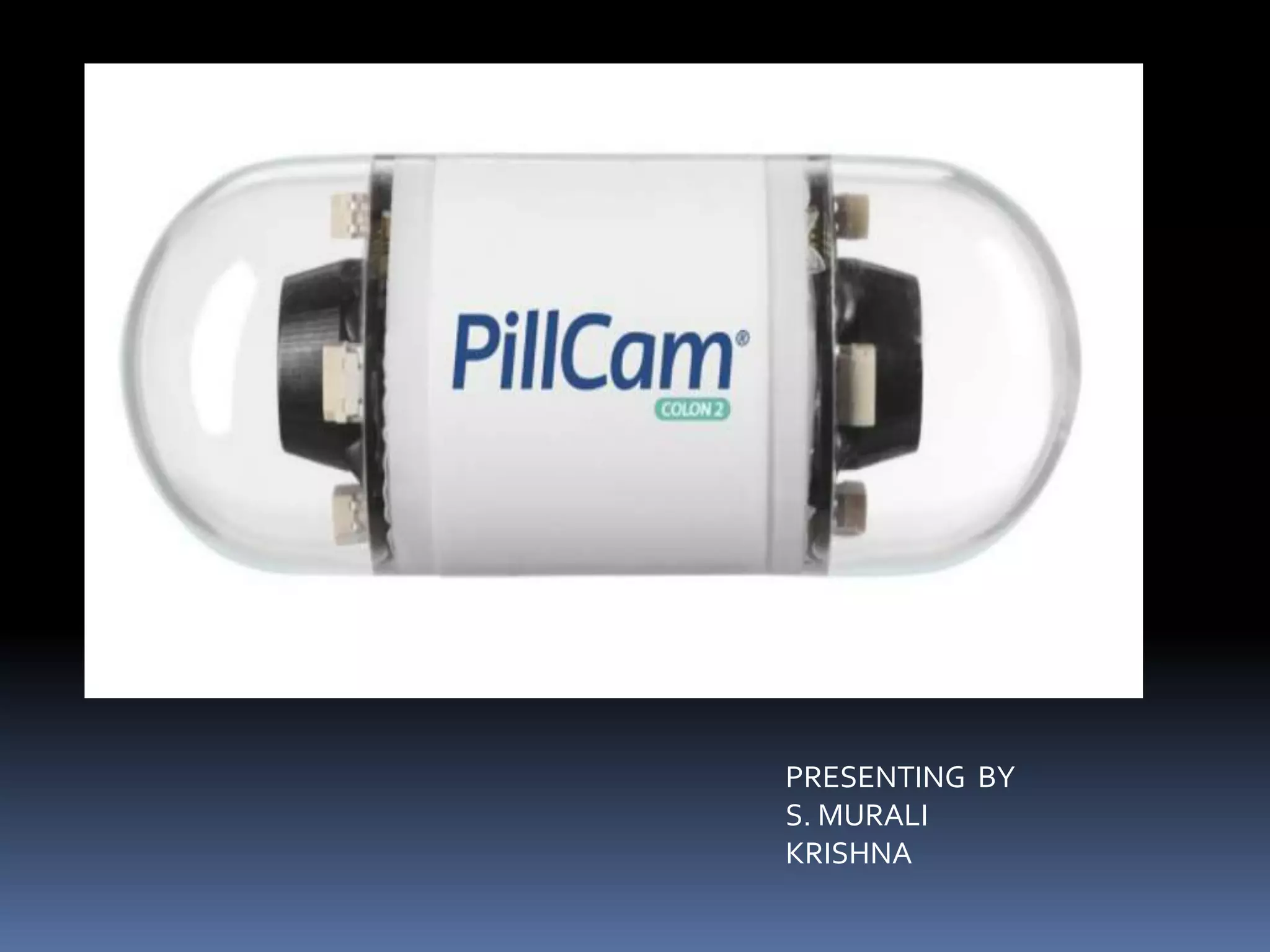
Optical Dome : Contains the light receiving window.
Lens Holder : Accommodates the lens.
Lens : Arranged behind the light receiving window.
Illuminating LED: Around the lens and CMOS
image sensor.
CMOS [ Complementary metal oxide semiconductor
]Image Sensor:
Produces very high quality images. High field view
and detect small objects.
Battery : Two button shaped silver oxide primary
batteries are arranged behind CMOS.
ASIC Transistors: Arranged behind the batteries.
Antennae :At the end.
WORKING
 Pill camera is also called as Capsule
Endoscopy.
 The capsule contains a camera, an LED light,
a battery and a built-in antenna.
 The antenna transmits the images to a small
recording unit that the patient wears on their
waist during the study.
DATA RECORDER AND
COMPUTERIZATION
CIRCUITS USED IN PILL CAM
USES
 Crohn’s disease.
 Mal absorption disease.
 Tumors of the small intestine.
 Vascular disorders.
 Ulcerative colitis.
 Medication related to small injury.
ADVANTAGES
 Painless, no side effect and complications.
 Miniature size.
 Accurate, precise and effective.
 Images taken are of high quality.
 Made of bio compatible material.
DISADVANTAGES
 Patients with narrowing are not good for this
procedure due to risk of obstruction.
 Impossible to control camera behavior.
 Very expensive.
 Not reusable.
CONCLUSION
 The given endoscopy capsule is a pioneering
concept for Medical Technology of the 21st
century.
 The endoscopy system is the first of its kind to
be able to provide non-invasive of the entire
smallest intestine.
 It has revolutionized the field of diagnostic
imaging to great extent and has proved to be
of great help to physicians all over the world.
REFERENCES
 https://scientificcomputing.com
 https://nvidia.com/object/fermi_architecture.ht
ml.
 Mishra, R.Kayak servey of techniques to
resolve problems associated with RTS/CTS
Mechanism.
THANK YOU

Pill camera

  • 1.
  • 2.
    CONTENTS  INTRODUCTION  TECHNOLOGYUSED  DESCRIPTION  BODY OF THE PIN CAMERA  INSIDE OF THE CAPSULE CAMERA  WORKING  TRANSMITTER AND RECEIVER EXTERNAL CONTROL UNIT  USES  ADVANTAGES  DISADVANTAGES  CONCLUSION
  • 3.
    INTRODUCTION  An applicationof nanotechnology.  A vitamin pill sized camera.  Travels through body and taking pictures.  Helps in diagnosing abnormality in small intestine.
  • 4.
    TECHNOLOGIES USED  PillCamera developed on the basis of NANOTECHNOLOGY.  Nanotechnology deals with objects measured in nanometers.  Nanometer can be visualized as billionth of a meter or millionth of a millimeter or it is 1/80000 width of human hair.
  • 5.
    DESCRIPTION  Comes incapsule form and contains a camera, lights, transmitter and batteries.
  • 6.
    •Video chip :consists of IC CMOS image sensor which is used to take pictures of the intestine. •LAMP : It is used for proper Illumination in the intestine for taking photos. •Micro actuator: Acts as memory to store the software code that is the instructions. •Antenna : Used to transmit the images to the receiver.
  • 7.
    BODY OF PILLCAMERA Height-25mm Width-10mm
  • 9.
    Optical Dome :Contains the light receiving window. Lens Holder : Accommodates the lens. Lens : Arranged behind the light receiving window. Illuminating LED: Around the lens and CMOS image sensor. CMOS [ Complementary metal oxide semiconductor ]Image Sensor: Produces very high quality images. High field view and detect small objects. Battery : Two button shaped silver oxide primary batteries are arranged behind CMOS. ASIC Transistors: Arranged behind the batteries. Antennae :At the end.
  • 10.
    WORKING  Pill camerais also called as Capsule Endoscopy.  The capsule contains a camera, an LED light, a battery and a built-in antenna.  The antenna transmits the images to a small recording unit that the patient wears on their waist during the study.
  • 11.
  • 13.
  • 15.
    USES  Crohn’s disease. Mal absorption disease.  Tumors of the small intestine.  Vascular disorders.  Ulcerative colitis.  Medication related to small injury.
  • 16.
    ADVANTAGES  Painless, noside effect and complications.  Miniature size.  Accurate, precise and effective.  Images taken are of high quality.  Made of bio compatible material.
  • 17.
    DISADVANTAGES  Patients withnarrowing are not good for this procedure due to risk of obstruction.  Impossible to control camera behavior.  Very expensive.  Not reusable.
  • 18.
    CONCLUSION  The givenendoscopy capsule is a pioneering concept for Medical Technology of the 21st century.  The endoscopy system is the first of its kind to be able to provide non-invasive of the entire smallest intestine.  It has revolutionized the field of diagnostic imaging to great extent and has proved to be of great help to physicians all over the world.
  • 19.
    REFERENCES  https://scientificcomputing.com  https://nvidia.com/object/fermi_architecture.ht ml. Mishra, R.Kayak servey of techniques to resolve problems associated with RTS/CTS Mechanism.
  • 20.