Intestinal Obstruction
Mintesinot D (C-II)
Introduction
• Intestinal obstruction may be classified into two types:
1. Dynamic: in which peristalsis is working against a mechanical
obstruction. It may occur in an acute or a chronic form
2. Adynamic: in which there is no mechanical obstruction; peristalsis is
absent or inadequate (e.g. paralytic ileus or pseudo-obstruction)
PATHOPHYSIOLOGY
• Irrespective of aetiology or acuteness of onset, in dynamic (mechanical)
obstruction the bowel proximal to the obstruction dilates and the bowel
below the obstruction exhibits normal peristalsis and absorption until it
becomes empty and collapses.
• Initially, proximal peristalsis is increased in an attempt to overcome the
obstruction.
• If the obstruction is not relieved, the bowel continues to dilate; ultimately
there is a reduction in peristaltic strength, resulting in flaccidity and
paralysis.
Cont’d
• The distension proximal to an obstruction is caused by two factors:
1. Gas: there is a significant overgrowth of both aerobic and anaerobic
organisms, resulting in considerable gas production. Following the
reabsorption of oxygen and carbon dioxide, the majority is made up
of nitrogen (90%) and hydrogen sulphide.
2. Fluid: this is made up of the various digestive juices. (saliva 500mL,
bile 500mL, pancreatic secretions 500mL, gastric secretions 1 litre –
all per 24 hours). This accumulates in the gut lumen as absorption by
the obstructed gut is retarded.
Cont’d
• Dehydration and electrolyte loss are therefore due to:
• Reduced oral intake;
• Defective intestinal absorption;
• Losses as a result of vomiting;
• Sequestration in the bowel lumen;
• Transudation of fluid into the peritoneal cavity.
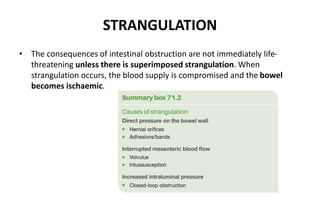
STRANGULATION
• The consequences of intestinal obstruction are not immediately life-
threatening unless there is superimposed strangulation. When
strangulation occurs, the blood supply is compromised and the bowel
becomes ischaemic.
Cont’d
• Ischaemia from direct pressure on the bowel wall from a constricting
band such as a hernial orifice is easy to understand.
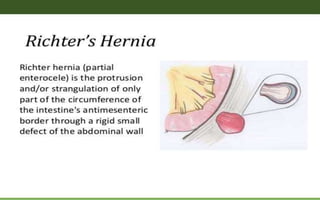
• Distension of the obstructed segment of bowel results in high
pressure within the bowel wall. This can happen when only part of
the bowel wall is obstructed as seen in Richter’s hernias.
• Venous return is compromised before the arterial supply.
• The resultant increase in capillary pressure leads to impaired local
perfusion and once the arterial supply is impaired, haemorrhagic
infarction occurs.
• As the viability of the bowel is compromised, translocation and
systemic exposure to anaerobic organisms and endotoxin occurs.
Cont’d
• The morbidity and mortality associated with strangulation are largely
dependent on the duration of the ischaemia and its extent.
• Elderly patients and those with comorbidities are more vulnerable to its
effects.
• In strangulated external hernias the segment involved is often short; but
any length of ischaemic bowel can cause significant systemic effects
secondary to sepsis
• When bowel involvement is extensive circulatory failure is common.
Cont’d
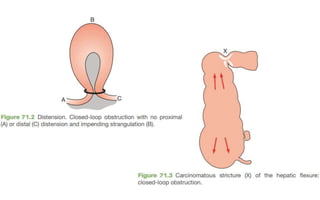
• Closed-loop obstruction
• Occurs when the bowel is obstructed at both the proximal and distal
points. The distension is principally confined to the closed loop.
• A classic form is seen in the presence of a malignant stricture of the
colon with a competent ileocaecal valve. This can occur with lesions
as far distally as the rectum.
• Inability of the distended colon to decompress itself into the small
bowel results in an increase in luminal pressure, which is greatest at
the caecum, with subsequent impairment of blood flow in the wall
resulting necrosis and perforation.
SPECIAL TYPES OF MECHANICAL INTESTINAL
OBSTRUCTION
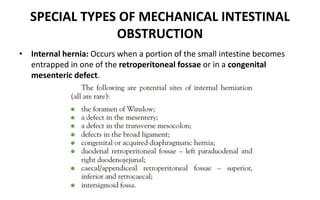
• Internal hernia: Occurs when a portion of the small intestine becomes
entrapped in one of the retroperitoneal fossae or in a congenital
mesenteric defect.
Cont’d
• Internal herniation in the absence of adhesions is rare.
• The standard treatment of an obstructed hernia is to release the
constricting agent by division.
• This should not be undertaken in cases of herniation involving the
foramen of Winslow, mesenteric defects and the
paraduodenal/duodenojejunal fossae as major blood vessels run in the
edge of the constriction ring.
• The distended loop must first be decompressed (minimising
contamination) and then reduced.
Obstruction from enteric strictures
• Small bowel strictures usually occur secondary to tuberculosis or Crohn’s
disease.
• Presentation is usually subacute or chronic.
• Standard surgical management consists of resection and anastomosis.
• Resection is important to establish a histological diagnosis as this can be
uncertain clinically.
• In Crohn’s disease, strictureplasty may be considered in the presence of
short multiple strictures without active sepsis.
Bolus obstruction
• Bolus obstruction in the small bowel may be caused by gallstones, food,
trichobezoar, phytobezoar, stercoliths and worms.
Cont’d
• Gallstones
• Tends to occur in the elderly
• Classically, the impaction is about 60cm proximal to the ileocaecal
valve
• Patient may have recurrent attacks as the obstruction is frequently
incomplete or relapsing as a result of a ball-valve effect.
Cont’d
• The characteristic radiological sign of gallstone ileus on radiographs of the
abdomen is Rigler’s triad, comprising:
• Small bowel obstruction,
• Pneumobilia and
• Atypical mineral shadow (due to the stone outside the gallbladder)
• The presence of two of these radiological signs has been considered
pathognomic of gallstone ileus and is encountered in 40–50% of the
cases.
• At laparotomy, the stone is milked proximally away from the site of
impaction, crushed within the bowel lumen; if not, the intestine is
opened at this point and the gallstone removed.
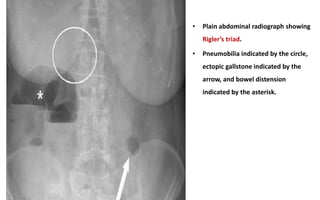
• Plain abdominal radiograph showing
Rigler’s triad.
• Pneumobilia indicated by the circle,
ectopic gallstone indicated by the
arrow, and bowel distension
indicated by the asterisk.
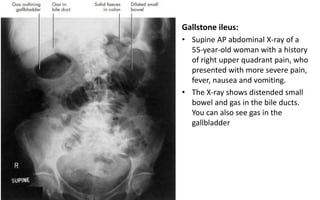
Gallstone ileus:
• Supine AP abdominal X-ray of a
55-year-old woman with a history
of right upper quadrant pain, who
presented with more severe pain,
fever, nausea and vomiting.
• The X-ray shows distended small
bowel and gas in the bile ducts.
You can also see gas in the
gallbladder
Cont’d
• Trychobezoars and phytobezoars
• Are firm masses of undigested hair ball and fruit/ vegetable fibre
respectively.
• May be associated with an underlying psychiatric abnormality.
• Predisposition to phytobezoars results from:
• High fibre intake
• Inadequate chewing
• Previous gastric (partial or total) surgery
• Hypochlorhydria and
• Loss of the gastric pump mechanism
Cont’d
• When possible, the lesion may be kneaded into the caecum; otherwise
open removal is required.
• A preoperative diagnosis is difficult even with high-resolution CT
scanning.
Cont’d
• Stercoliths
• These are usually found in the small bowel in association with a
jejunal diverticulum or ileal stricture.
• Presentation and management are identical to that of gallstones.
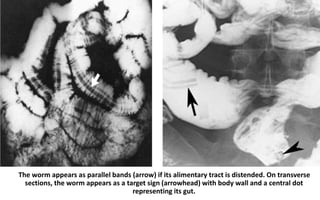
• Worms
• Ascaris lumbricoides may cause low small bowel obstruction,
particularly in children.
• If worms are not seen in the stool or vomitus the diagnosis may be
indicated by eosinophilia or the sight of worms within gas-filled small
bowel loops on a plain radiograph (Naik).
The worm appears as parallel bands (arrow) if its alimentary tract is distended. On transverse
sections, the worm appears as a target sign (arrowhead) with body wall and a central dot
representing its gut.
Obstruction by adhesions and bands
• Adhesions
• In Western countries where abdominal operations are common,
adhesions and bands are the most common cause of intestinal
obstruction.
• The lifetime risk of requiring an admission to hospital for adhesional
small bowel obstruction subsequent to abdominal surgery is 4%.
• Adhesions start to form within hours of abdominal surgery.
• In the early postoperative period, the onset of such a mechanical
obstruction may be difficult to differentiate from paralytic ileus.
Cont’d
• Any source of peritoneal irritation results in local fibrin production,
which produces adhesions between apposed surfaces.
• Early fibrinous adhesions may disappear when the cause is removed or
they may become vascularised and be replaced by mature fibrous
tissue.
Cont’d
• Adhesions may be classified into various types by virtue of whether they
are:
• Early (fibrinous) or
• Late (fibrous)
• From a practical perspective there are only two types:
• ‘Easy’ flimsy ones and
• ‘Difficult’ dense ones.
• Postoperative adhesions giving rise to intestinal obstruction usually
involve the lower small bowel and almost never involve the large bowel.
Cont’d
• Bands
• Usually only one band is culpable
• This may be:
• Congenital; e.g. obliterated vitellointestinal duct;
• A string band following previous bacterial peritonitis;
• A portion of greater omentum, usually adherent to the parietes.
Acute intussusception
• Occurs when one portion of the gut invaginates into an immediately
adjacent segment; almost invariably, it is the proximal into the distal.
• Most commonly encountered in children, with a peak incidence between
5 and 10 months of age.
• About 90% of cases are idiopathic but an associated upper respiratory
tract infection or gastroenteritis may precede the condition.
• It is believed that hyperplasia of Peyer’s patches in the terminal ileum
may be the initiating event.
• Weaning, loss of passively acquired maternal immunity and common
viral pathogens have all been implicated in the pathogenesis of
intussusception in infancy.
Cont’d
• Children with intussusception associated with a pathological lead point
such as Meckel’s diverticulum, polyp, duplication, Henoch–Schönlein
purpura or appendix are usually older than those with idiopathic disease.
• After the age of 2 years, a pathological lead point is found in at least one-
third of affected children.
• Adult cases are invariably associated with a lead point, which is usually a
polyp (e.g. Peutz–Jeghers syndrome), a submucosal lipoma or other
tumour.
Cont’d
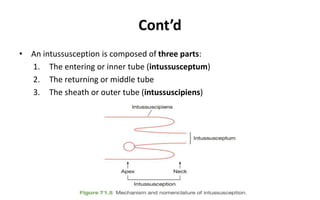
• An intussusception is composed of three parts:
1. The entering or inner tube (intussusceptum)
2. The returning or middle tube
3. The sheath or outer tube (intussuscipiens)
Cont’d
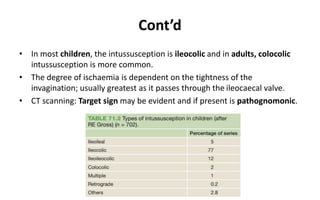
• In most children, the intussusception is ileocolic and in adults, colocolic
intussusception is more common.
• The degree of ischaemia is dependent on the tightness of the
invagination; usually greatest as it passes through the ileocaecal valve.
• CT scanning: Target sign may be evident and if present is pathognomonic.
Volvulus
• Is a twisting or axial rotation of a portion of bowel about its mesentery.
• The rotation causes obstruction to the lumen (>180° torsion) and if tight
enough also causes vascular occlusion in the mesentery (>360° torsion).
• Bacterial fermentation adds to the distension and increasing intraluminal
pressure impairs capillary perfusion.
• Mesenteric veins become obstructed as a result of the mechanical
twisting and thrombosis results and contributes to the ischaemia.
Cont’d
• Volvuli may be primary or secondary
1. Primary volvulus:
• Secondary to congenital malrotation of the gut
• Abnormal mesenteric attachments or congenital bands
• E.g. volvulus neonatorum, caecal volvulus and sigmoid volvulus
2. Secondary volvulus:
• More common
• Is due to rotation of a segment of bowel around an acquired
adhesion or stoma
Cont’d
A. Volvulus neonatorum
• Occurs secondary to intestinal malrotation and is potentially
catastrophic.
B. Sigmoid volvulus
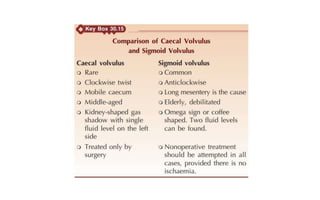
• Most common cause of large bowel obstruction in the indigenous
black African population.
• Rotation nearly always occurs in the anticlockwise direction
Cont’d
• Predisposing clinical features & factors
for sigmoid volvulus:
• Band of adhesions (peridiverticulitis)
• Overloaded pelvic colon
• Long pelvic mesocolon
• Narrow attachment of pelvic
mesocolon
• High-residue diet and constipation
• Chronic psychotropic drug use
Cont’d
• Presentation can be classified as:
• Fulminant: sudden onset, severe pain, early vomiting, rapidly
deteriorating clinical course.
• Indolent: insidious onset, slow progressive course, less pain, late
vomiting.
Cont’d
C. Compound volvulus
• Is a rare condition also known as ileosigmoid knotting.
• The long pelvic mesocolon allows the ileum to twist around the
sigmoid colon, resulting in gangrene of either or both segments of
bowel.
• The patient presents with acute intestinal obstruction, but distension
is comparatively mild.
• Plain radiography reveals distended ileal loops in a distended sigmoid
colon.
• At operation, decompression, resection and anastomosis are required.
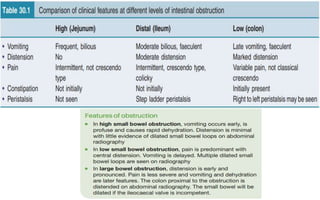
CLINICAL FEATURES OF INTESTINAL OBSTRUCTION
A. Dynamic obstruction
• Diagnosis of dynamic intestinal obstruction is based on the classic quartet
of abdominal pain, distension, vomiting and absolute constipation.
• Obstruction may be classified clinically into two types:
1. Small bowel obstruction: high or low
2. Large bowel obstruction
Cont’d
• The nature of the presentation will also be influenced by whether the
obstruction is complete or incomplete.
• A complete small bowel obstruction has all the 4 cardinal features.
• In cases of complete large bowel obstruction there is often a surprising
lack of preceeding symptoms.
• Both small and large bowel obstruction can present with more chronic
symptoms in which the symptoms are intermittent or the obstruction is
incomplete.
• Incomplete obstruction is also referred to as partial or subacute.
Cont’d
• Presentation will be further influenced by whether the obstruction is:
• Simple: in which the blood supply is intact
• Strangulated: in which there is interference to blood flow
• The clinical features vary according to:
• Location of the obstruction
• Duration of the obstruction
• Underlying pathology
• Presence or absence of intestinal ischaemia
Cont’d
• Late manifestations of intestinal obstruction include:
• Dehydration
• Oliguria
• Hypovolaemic shock
• Pyrexia
• Septicaemia
• Respiratory embarrassment and
• Peritonism
• In all cases of suspected intestinal obstruction, the hernial orifices must
be examined!
Cont’d
Pain:
• Is the first symptom encountered; it occurs suddenly and is usually
severe.
• It is colicky in nature and usually centred on the umbilicus (small bowel)
or lower abdomen (large bowel).
• Coincides with increased peristaltic activity
• With increasing distension, the colicky pain is replaced by a mild and more
constant diffuse pain.
• Severe and continuous pain is suggestive of the presence of strangulation
• Pain does not usually occur in paralytic ileus
Cont’d
Vomiting:
• The more distal the obstruction, the longer the interval between the onset
of symptoms and the appearance of nausea and vomiting.
• As obstruction progresses the character of the vomitus alters from
digested food to faeculent material, as a result of the presence of enteric
bacterial overgrowth.
Cont’d
Distension:
• In the small bowel the degree of distension is dependent on the site of the
obstruction and is greater the more distal the lesion.
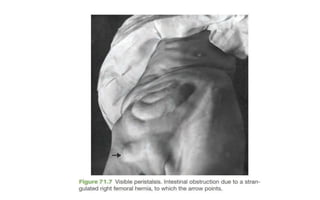
• Visible peristalsis may be present (sometimes be provoked by ‘flicking’
the abdominal wall)
• Is a later feature in colonic obstruction and may be minimal or absent in
the presence of mesenteric vascular occlusion.
Cont’d
Constipation:
• Can be absolute (i.e. neither faeces nor flatus is passed) or relative (where
only flatus is passed).
• Absolute constipation is a cardinal feature of complete intestinal
obstruction.
• The administration of enemas should be avoided in cases of suspected
obstruction. This merely stimulates evacuation of bowel contents distal to
the obstruction and confuses the clinical picture.
Cont’d
• The rule that absolute constipation is present in intestinal obstruction
does not apply in:
• Richter’s hernia
• Gallstone ileus
• Mesenteric vascular occlusion
• Functional obstruction associated with pelvic abscess
• All cases of partial obstruction (in which diarrhoea may occur)
Cont’d
• Dehydration: most common in small bowel obstruction, blood urea level
and haematocrit rise, giving a secondary polycythaemia
• Hypokalaemia: not a common feature in simple mechanical obstruction.
• An increase in serum potassium, amylase or lactate dehydrogenase may
be associated with the presence of strangulation, as may leucocytosis or
leucopenia.
• Pyrexia: in the presence of obstruction is rare and may indicate onset of
ischaemia; intestinal perforation; inflammation or abscess
• Hypothermia: indicates septicaemic shock or neglected cases of long
duration.
Cont’d
Abdominal tenderness:
• Localised tenderness indicates impending or established ischaemia.
• The development of peritonism or peritonitis indicates overt infarction
and/or perforation.
• In cases of large bowel obstruction, it is important to elicit these findings
in the right iliac fossa as the caecum is most vulnerable to ischaemia.
Cont’d
Bowel sounds:
• High-pitched bowel sounds are present in the vast majority of patients
with intestinal obstruction
• Normal bowel sounds are of negative predictive value
• Bowel sounds may be scanty or absent if the obstruction is longstanding
and the small bowel has become inactive
Cont’d
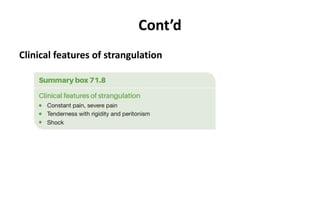
Clinical features of strangulation
Cont’d
Clinical features of intussusception
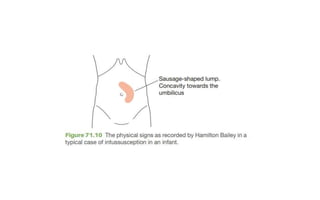
• Classical presentation of intussusception is with episodes of screaming
and drawing up of the legs in a previously well male infant.
• The attacks last for a few minutes and recur repeatedly.
• During attacks the child appears pale.
• Vomiting may or may not occur at the outset but becomes conspicuous
and bile-stained with time.
Cont’d
• Initially, the passage of stool may be normal, whereas, later, blood and
mucus are evacuated – the ‘redcurrant jelly’ stool.
• Apex and inner tubes will have compromised blood supply which leads
to gangrene.
• Apex sloughs off and bleeds which mixes with the mucus to produce
the classic red currant jelly passed per anus.
• Red currant jelly stools are not found in adult intussusception.
• Classically, the abdomen is not initially distended; a lump that hardens
on palpation may be discerned but this is present in only 60% of cases.
Cont’d
• There may be an associated feeling of emptiness in the right iliac fossa
(the sign of Dance).
• On rectal examination, blood-stained mucus may be found on the finger.
• Occasionally, in extensive ileocolic or colocolic intussusception, the apex
may be palpable or even protrude from the anus.
• Progressive dehydration and abdominal distension from small bowel
obstruction will occur, followed by peritonitis secondary to gangrene.
• Rarely, natural cure may occur as a result of sloughing of the
intussusception.
Cont’d
Volvulus of the small intestine
• This may be primary or secondary and usually occurs in the lower ileum.
• It may occur spontaneously in African people, particularly following the
consumption of a large volume of vegetable matter, whereas in western
countries it is usually secondary to adhesions passing to the parietes or
female pelvic organs
Cont’d
Caecal volvulus
• May occur as part of volvulus neonatorum or de novo and is usually a
clockwise twist.
• It is more common in females in the 4th and 5th decades and usually
presents acutely with the classic features of obstruction.
• In the majority of cases, rotation occurs around the ileocolic blood vessels and
vascular impairment (ischaemia) occurs early, is common.
• At first the obstruction may be partial, with the passage of flatus and faeces.
• Palpable tympanic swelling in the midline or left side of the abdomen (in
25% of cases).
• The volvulus typically results in the caecum lying in the left upper quadrant.
Cont’d
Sigmoid volvulus
• The symptoms are of large bowel obstruction.
• Presentation varies; younger patients develop acute (fulminant) form and
elderlies develop chronic (indolent) form.
• Abdominal distension is an early and progressive sign, which may be
associated with hiccough and retching.
• Constipation is absolute.
• In some patients the grossly distended torted left colon is visible through
the abdominal wall
Cont’d
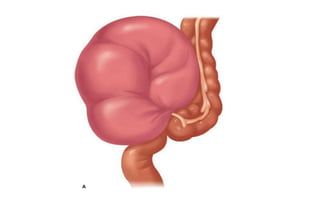
Transverse Colon Volvulus
• Transverse colon volvulus is extremely rare.
• Nonfixation of the colon and chronic constipation with megacolon may
predispose to transverse colon volvulus.
• The radiographic appearance of transverse colon volvulus resembles
sigmoid volvulus, but Gastrografin enema will reveal a more proximal
obstruction.
• Although colonoscopic detorsion is occasionally successful in this setting,
most patients require emergent exploration and resection.
IMAGING
• Erect abdominal films are no longer routinely obtained and the
radiological diagnosis is based on a supine abdominal film.
• An erect film may subsequently be requested when further doubt exists.
• In intestinal obstruction, fluid levels appear later than gas shadows as it
takes time for gas and fluid to separate (most prominent on an erect film).
• In adults, two inconstant fluid levels, one at the duodenal cap and the
other in the terminal ileum, may be regarded as normal.
• In infants a few fluid levels in the small bowel may be physiological.
• In this age group it is difficult to distinguish large from small bowel in the
presence of obstruction, because the characteristic features seen in adults
are not present or are unreliable.
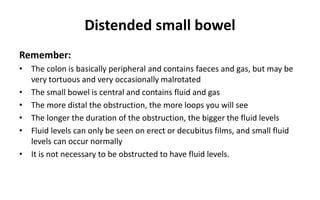
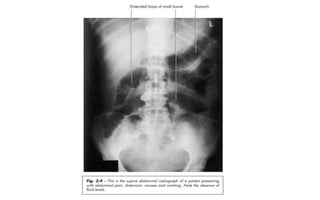
Distended small bowel
Remember:
• The colon is basically peripheral and contains faeces and gas, but may be
very tortuous and very occasionally malrotated
• The small bowel is central and contains fluid and gas
• The more distal the obstruction, the more loops you will see
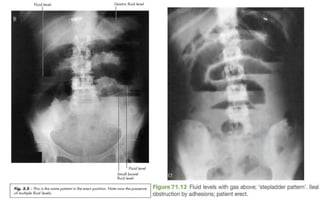
• The longer the duration of the obstruction, the bigger the fluid levels
• Fluid levels can only be seen on erect or decubitus films, and small fluid
levels can occur normally
• It is not necessary to be obstructed to have fluid levels.
Cont’d
• In contrast, low colonic obstruction does not commonly give rise to small
bowel fluid levels unless advanced, whereas high colonic obstruction
may do so in the presence of an incompetent ileocaecal valve.
• Colonic obstruction is usually associated with a large amount of gas in the
caecum.
• A limited water-soluble enema should be undertaken to differentiate
large bowel obstruction from pseudo-obstruction.
• A barium follow-through is contraindicated in the presence of acute
obstruction and may be life-threatening.
Cont’d
• CT scan is highly accurate to investigate all forms of intestinal obstruction.
• Its only limitations are in diagnosing ischaemia.
• Two CT scan findings may be used when looking for intestinal ischaemia:
• Reduced bowel wall enhancement on CT increases the probability of
strangulation 11-fold
• Absence of mesenteric fluid on CT decreases the probability of strangulation
6-fold.
• It is important to remember that even with the best imaging techniques,
the diagnosis of strangulation remains a clinical one.
Cont’d
• Impacted foreign bodies may be seen on abdominal radiographs.
• Gas-filled loops and fluid levels in the small and large bowel can also be
seen in established paralytic ileus and pseudo-obstruction. The former
can, however, normally be distinguished on clinical grounds whereas the
latter can be confirmed radiologically.
• Fluid levels may also be seen in nonobstructing conditions such as:
• Gastroenteritis
• Acute pancreatitis and
• Intra-abdominal sepsis
Imaging in intussusception
• A plain abdominal field usually reveals evidence of small or large bowel
obstruction with an absent caecal gas shadow in ileocolic cases. A soft tissue
opacity is often visible in children.
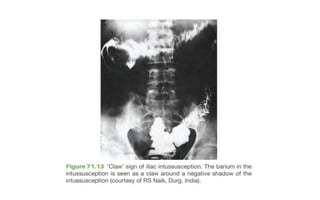
• A barium enema may be used to diagnose the presence of an ileocolic
intussusception (the claw sign) but does not demonstrate small bowel
intussusception.
• An abdominal ultrasound scan has a high diagnostic sensitivity in children,
demonstrating the typical doughnut appearance.
• CT scanning is the most sensitive radiological method to confirm
intussusception, with a reported diagnostic accuracy of 58–100%.
• The characteristic features of CT scan include a ‘target’- or ‘sausage’- shaped
soft-tissue mass with a layering effect; mesenteric vessels within the bowel
lumen are also typical.
Distended large bowel
Look for:
• Dilated loops (>6cm)
• Marked distension of the caecum
• General peripheral position of bowel
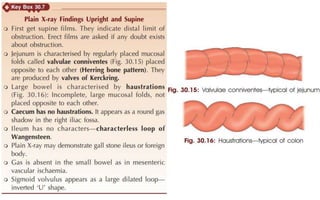
• Several incomplete haustral folds, typical of the colon, and a few complete
ones — normal variation!
• Fluid faeces on the left (erect film), indicating colonic malfunction
• Involvement down to the level of the descending colon
• A lack of distension of the small bowel, indicating a competent ileocaecal
valve.
Imaging in volvulus
Caecal volvulus
• Radiological abnormalities are often nonspecific, with caecal dilatation (98–
100%), single air-fluid level (72–88%), small bowel dilatation (42–55%) and
absence of gas in distal colon (82–91%) reported as the most common
abnormalities.
• Plain X-rays of the abdomen show a characteristic kidney-shaped, air-filled
structure in the left upper quadrant (opposite the site of obstruction).
• Gastrografin enema confirms obstruction at the level of the volvulus.
• A barium enema may be used to confirm the diagnosis if there are no
concerns about ischaemia, with an absence of barium in the caecum and a
bird beak deformity.
• CT scanning is replacing barium enema as the imaging of choice in these less
urgent cases.
Cont’d
Sigmoid volvulus
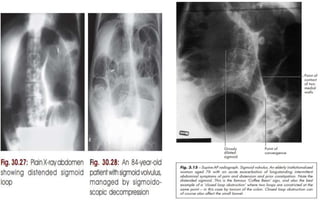
• Plain X-ray abdomen erect shows a hugely dilated sigmoid loop which is
described as ‘bent inner tube sign’. The dilated loop may be visible on the
right side, centre and to the left of abdomen, having two fluid levels, one
on right side and one on left side. This is also described as ‘omega sign’.
• A grossly distended loop of sigmoid colon extending from the pelvis to
under the diaphragm. Compression together of the two medial walls
produces the ‘coffee bean sign’.
• Erect films may show excessive quantities of gas relative to fluid >2:1.
Cont’d
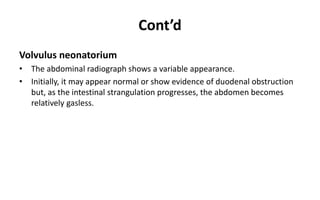
Volvulus neonatorium
• The abdominal radiograph shows a variable appearance.
• Initially, it may appear normal or show evidence of duodenal obstruction
but, as the intestinal strangulation progresses, the abdomen becomes
relatively gasless.
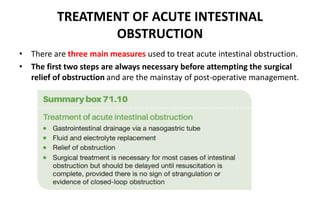
TREATMENT OF ACUTE INTESTINAL
OBSTRUCTION
• There are three main measures used to treat acute intestinal obstruction.
• The first two steps are always necessary before attempting the surgical
relief of obstruction and are the mainstay of post-operative management.
Supportive management
• Nasogastric decompression
• Normally placed on free drainage with 4-hourly aspiration but may be
placed on continuous or intermittent suction.
• Facilitate decompression proximal to the obstruction
• Essential to reduce the risk of subsequent aspiration during induction
of anaesthesia and post-extubation.
• Fluid and electrolyte replacement
• Hartmann’s solution or normal saline
Cont’d
• Antibiotic therapy
• Antibiotics are not mandatory but many clinicians initiate broad-
spectrum antibiotics early in therapy because of bacterial overgrowth.
• Antibiotic therapy is mandatory for all patients undergoing surgery for
intestinal obstruction.
Surgical treatment
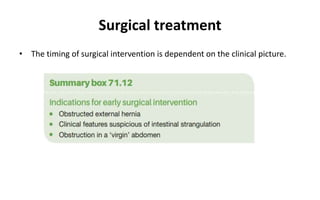
• The timing of surgical intervention is dependent on the clinical picture.
Cont’d
• The classic clinical advice that ‘the sun should not both rise and set’ on a
case of unrelieved acute intestinal obstruction was based on the concern
that intestinal ischaemia would develop while the patient was waiting for
surgery.
• If there is complete obstruction, but no evidence of intestinal ischaemia, it
is reasonable to defer surgery until the patient has been adequately
resuscitated.
• Where obstruction is likely to be secondary to adhesions, conservative
management may be continued for up to 72 hours in the hope of
spontaneous resolution.
Cont’d
• If the site of obstruction is unknown, adequate exposure is best achieved
by a midline incision.
• Assessment is directed to the:
• Site of the obstruction;
• Nature of the obstruction;
• Viability of the gut.
Cont’d
• Operative decompression should be performed whenever possible.
• This reduces pressure on the abdominal wound, reducing pain and
improving diaphragmatic movement.
• The simplest and safest method is to insert a large-bore orogastric tube
and to milk the small bowel contents in a retrograde manner to the
stomach for aspiration.
• All volumes of fluid removed should be accurately measured and
appropriately replaced.
• It is important to ensure that the stomach is empty at the end of the
procedure to prevent postoperative aspiration.
Cont’d
• The type of surgical procedure required will depend upon the cause of
obstruction:
• Division of adhesions (enterolysis)
• Excision
• Bypass or
• Proximal decompression
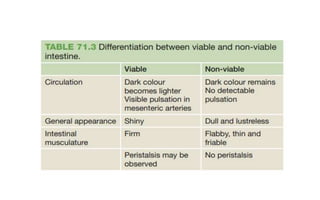
• Following relief of obstruction, the viability of the involved bowel should
be carefully assessed.
Cont’d
• Intestinal ischaemia/reperfusion injury can occur following reperfusion of
ischaemic bowel; and this should be considered when dealing with
ischaemic bowel.
• For example if there is a volvulus with established infarction, detorsion
should be avoided until the affected mesentery has been clamped and
thus reperfusion injury prevented.
• When no resection has been undertaken or there are multiple ischaemic
areas (mesenteric vascular occlusion), a second-look laparotomy at 24–48
hours may be required.
Ischemia-Reperfusion Injury
• Restoration of blood flow to ischemic tissues can promote recovery of
cells if they are reversibly injured, but can also paradoxically exacerbate
the injury and cause cell death.
• As a consequence, reperfused tissues may sustain loss of cells in addition
to the cells that are irreversibly damaged at the end of ischemia. This
process, called ischemia-reperfusion injury.
How does reperfusion injury occur?
Oxidative stress
• Increased generation of free radicals (reactive oxygen and nitrogen
species) may be produced in reperfused tissue as a result of incomplete
reduction of oxygen by damaged mitochondria, or because of the action
of oxidases in leukocytes, endothelial cells, or parenchymal cells.
• Compromised cellular antioxidant defense mechanisms by ischemia,
favoring the accumulation of free radicals.
Cont’d
Intracellular calcium overload
• Intracellular and mitochondrial calcium overload which begins during
acute ischemia is exacerbated during reperfusion; due to influx of calcium
resulting from cell membrane damage and ROS mediated injury to
sarcoplasmic reticulum.
• Calcium overload favors opening of the mitochondrial permeability
transition pore with resultant depletion of ATP and this in turn causes
further cell injury.
Cont’d
Inflammation
• As a result of “dangers signals” released from dead cells, cytokines
secreted by resident immune cells, and increased expression of adhesion
molecules by hypoxic parenchymal and endothelial cells, all of which act
to recruit circulating neutrophils to reperfused tissue. The inflammation
causes additional tissue injury.
Activation of the complement system
• Some IgM antibodies deposit in ischemic tissues, for unknown reasons,
and when blood flow is resumed, complement proteins bind to the
deposited antibodies, are activated, and cause more cell injury and
inflammation.
Postoperative intestinal obstruction
• Differentiation between persistent paralytic ileus and early mechanical
obstruction may be difficult in the early postoperative period.
• Mechanical obstruction is more likely if the patient has regained bowel
function postoperatively which subsequently stops.
• Obstruction is usually incomplete and the majority settle with continued
conservative management.
• Postoperative intra-abdominal sepsis is a potent cause of postoperative
obstruction.
• CT scanning with oral contrast is of particular value in the assessment of
the postoperative abdomen.
• Instant gastrografin enemas are also of value.
Treatment of adhesions
Conservative Treatment
• Nasogastric aspiration, resuscitation with fluids and electrolytes to correct
dehydration may be successful in early postoperative obstruction.
• Generally 48–72 hours is the waiting period in patients who present to the
hospital as late adhesive obstruction.
• If it is not successful, reoperation is required.
• Record PR, BP, abdominal girth and urine output.
• Tachycardia, hypotension, increasing abdominal girth and oliguria in spite
of adequate IV fluids will suggest gangrene; and need to be explored
immediately.
Cont’d
Surgical Methods
• Where fibrous bands are the cause, they need to be divided to relieve
obstruction.
• Laparoscopic adhesiolysis is more often being used and it is indicated in
pelvic adhesion, selected cases of abdominal adhesion, single band
adhesion and obstruction with mild distension.
Treatment of intussusception
Conservative Treatment
• In the infant with ileocolic intussusception, after resuscitation with
intravenous fluids, broad-spectrum antibiotics and nasogastric drainage,
non-operative reduction can be attempted using an air or barium enema.
• Contraindicated if there are signs of peritonitis or perforation, there is a
known pathological lead point or in the presence of profound shock.
• Recurrent intussusception occurs in up to 10% of patients after non-
operative reduction.
Cont’d
Barium enema
• A lubricated catheter is introduced into the rectum and 1–2 litres of saline
from a height of 1–2 metres is allowed to run. Catheter is removed and
buttocks are pressed together.
• More than 70% of cases are reduced by this method.
• 1:3 barium sulphate in warm isotonic saline can also be used.
Air contrast enema
• Air is pumped into the colon at a pressure of 60–80 mmHg.
• It will not reduce gangrenous bowel.
Cont’d
Surgical Treatment
• Laparotomy and reduction of intussusception
• Intussusception is reduced by milking (squeezing) the colon in
opposite direction, which is facilitated by breaking the adhesions at
the neck using the little finger.
• Appendicectomy is also done, as it avoids any future confusion as to
the reason for the abdominal scar.
• If the loop is gangrenous, resection and ileocolic anastomosis is done.
TREATMENT OF ACUTE LARGE BOWEL
OBSTRUCTION
• Large bowel obstruction is usually caused by an underlying carcinoma or
occasionally diverticular disease, and presents in an acute or chronic form.
• The condition of pseudo-obstruction should always be considered and
excluded by a limited contrast study or CT scan to confirm organic
obstruction.
• After full resuscitation, the abdomen should be opened through a midline
incision.
• Distension of the caecum will confirm large bowel involvement.
Cont’d
Surgery for malignant bowel cancer
• When a removable lesion is found in the caecum, ascending colon,
hepatic flexure or proximal transverse colon, an emergency right
hemicolectomy should be performed.
• A primary anastomosis is safe if the patient’s general condition is
reasonable.
• If the lesion is irremovable (this is rarely the case) a proximal stoma
(colostomy or ileosotomy if the ileocaecal valve is incompetent) or
ileotransverse bypass should be considered.
• Obstructing lesions at the splenic flexure should be treated by an
extended right hemicolectomy with ileodescending colonic anastomosis.
Cont’d
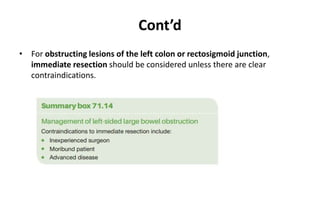
• For obstructing lesions of the left colon or rectosigmoid junction,
immediate resection should be considered unless there are clear
contraindications.
Treatment of caecal volvulus
• At operation the volvulus is usually found to be ischaemic and needs
resection.
• If viable, the volvulus should be reduced. Sometimes, this can only be
achieved after decompression of the caecum using a needle.
• Further management consists of fixation of the caecum to the right iliac
fossa (caecopexy) and/or a caecostomy.
• Recurrence of volvulus after caecopexy has been reported in up to 40%.
Treatment of sigmoid volvulus
Nonoperative management
• Flexible or rigid sigmoidoscopy and insertion of a flatus tube should be
carried out to allow deflation of the gut.
• The tube should be secured in place with tape for 24 hours and a repeat
x-ray taken to ensure that decompression has occurred.
• If obstruction is completely relieved or if there is no gangrene and the
general condition of the patient improves, an elective resection is done
after 7 days.
• If resistance is found while passing flatus tube, instill barium for guidance.
Cont’d
Operative Treatment
• Single-stage resection:
• Done if general condition of the patient is good.
• If the loop is gangrenous, resection followed by end to end
anastomosis is done, after giving ‘on table’ lavage using saline washes
till the contents of the colon are clear.
Cont’d
• Hartmann’s procedure:
• If the loop is gangrenous and proximal bowel is loaded with faecal
matter, resection of the sigmoid colon is done.
• Proximal descending colon is brought out as an end colostomy and
rectum is closed (Hartmann’s procedure).
• After 6 weeks, colorectal anastomosis is done.
Cont’d
• Sigmoidopexy:
• If the loop is not gangrenous, untwist the sigmoid loop and fix the
sigmoid to the posterior abdominal wall (sigmoidopexy).
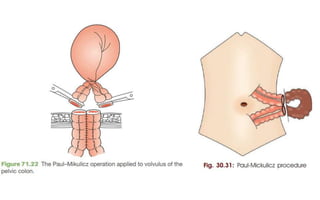
• Exteriorisation:
• Paul-Mickulicz procedure is done when general condition of the
patient is poor as in elderly patients, in severely dehydrated patient
with impending septicaemia.
• In such cases, the gangrenous loop is brought outside and resected,
with a proximal colostomy and a distal mucous fistula.
CHRONIC LARGE BOWEL OBSTRUCTION
• The symptoms of chronic intestinal obstruction may arise from two
sources: the cause and the subsequent obstruction.
• The causes of obstruction may be:
• Organic or
• Functional
Cont’d
• Organic:
• Intraluminal (rare): faecal impaction
• Intrinsic intramural: strictures (Crohn’s disease, ischaemia,
diverticular), anastomotic stenosis
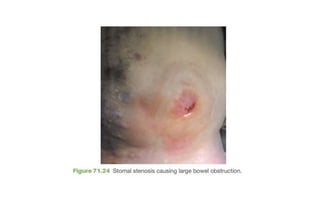
• Extrinsic intramural (rare): metastatic deposits (ovarian),
endometriosis, stomal stenosis
• Functional:
• Hirschsprung’s disease
• Idiopathic megacolon
• Pseudo-obstruction
Cont’d
• The symptoms of chronic obstruction differ in their predominance, timing
and degree from acute obstruction.
• In functional cases, the symptoms may have been present for months or
years.
• Constipation appears first and it is initially relative and then absolute,
associated with distension.
• In the presence of large bowel disease, the point of greatest distension is
in the caecum, and this is heralded by the onset of pain.
Cont’d
• Vomiting is a late feature and therefore dehydration is less severe.
• Examination is unremarkable, save for confirmation of distension, which
can be profound and the onset of peritonism in late cases.
• Rectal examination may confirm the presence of faecal impaction or a
tumour.
Cont’d
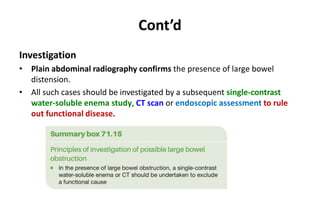
Investigation
• Plain abdominal radiography confirms the presence of large bowel
distension.
• All such cases should be investigated by a subsequent single-contrast
water-soluble enema study, CT scan or endoscopic assessment to rule
out functional disease.
Cont’d
Management
• Surgical management after resuscitation depends on the underlying cause
• Organic disease requires decompression with a laparotomy or stent.
• Stomal stenosis can usually be managed at the abdominal wall level
• Functional disease requires colonoscopic decompression in the first
instance and conservative management.
• Intestinal perforation can occur in patients with functional obstruction.
• Those at risk have such gross distension that the abdomen is rigid on
palpation.
ADYNAMIC OBSTRUCTION
Paralytic ileus
• Is a state in which there is failure of transmission of peristaltic waves
secondary to neuromuscular failure (i.e. in the myenteric (Auerbach’s)
and submucous (Meissner’s) plexuses).
• The resultant stasis leads to accumulation of fluid and gas within the
bowel, with associated distension, vomiting, absence of bowel sounds and
absolute constipation.
• Different varieties are recognised.
Cont’d
• Postoperative:
• Usually occurs after any abdominal procedure and is self-limiting, with
a variable duration of 24–72 hours.
• Postoperative ileus may be prolonged in the presence of
hypoproteinaemia or metabolic abnormality.
• Infection:
• Intra-abdominal sepsis may give rise to localised or generalised ileus.
Cont’d
• Reflex ileus:
• May occur following fractures of the spine or ribs, retroperitoneal
haemorrhage or even the application of a plaster jacket.
• Metabolic:
• Uraemia and hypokalaemia are the most common contributory
factors.
Cont’d
Clinical features
• Paralytic ileus takes on a clinical significance if, 72 hours after laparotomy:
• There has been no return of bowel sounds on auscultation
• There has been no passage of flatus
• Abdominal distension becomes more marked and tympanitic
• Colicky pain is not a feature
• Distension increases pain from the abdominal wound
• In the absence of gastric aspiration, effortless vomiting may occur
• Radiologically, the abdomen shows gas-filled loops of intestine with
multiple fluid levels (if an erect film is felt necessary)
Cont’d
Management
• Nasogastric tubes are not required routinely after elective intra-abdominal
surgery.
• Paralytic ileus is managed with the use of nasogastric suction and
restriction of oral intake until bowel sounds and the passage of flatus
return.
• Electrolyte balance must be maintained.
Cont’d
• Specific treatment is directed towards the cause, but the following general
principles apply:
• If a primary cause is identified this must be treated.
• Gastrointestinal distension must be relieved by decompression.
• Close attention to fluid and electrolyte balance is essential.
• There is no convincing evidence for the use of prokinetic drugs to treat
postoperative adynamic ileus.
• If paralytic ileus is prolonged CT scanning is the most effective
investigation; it will demonstrate any intra-abdominal sepsis or
mechanical obstruction and therefore guide any requirement for
laparotomy.
Cont’d
• The need for a laparotomy becomes increasingly likely the longer the
bowel inactivity persists, particularly if it lasts for more than seven days or
if bowel activity recommences following surgery and then stops again.
Cont’d
Pseudo-obstruction
• This condition describes an obstruction, usually of the colon, that occurs
in the absence of a mechanical cause or acute intra-abdominal disease.
• It is associated with a variety of syndromes in which there is an underlying
neuropathy and/or myopathy and a range of other factors.
Cont’d
• Small intestinal pseudo-obstruction
• May be primary (i.e. idiopathic or associated with familial visceral
myopathy) or secondary.
• The clinical picture consists of recurrent subacute obstruction.
• The diagnosis is made by the exclusion of a mechanical cause.
• Treatment:
• Initial correction of any underlying disorder.
• Metoclopramide and erythromycin may be of use.
Cont’d
• Colonic pseudo-obstruction
• May occur in an acute or a chronic form.
• The acute form is also known as Ogilvie’s syndrome, presents as acute
large bowel obstruction.
• Abdominal radiographs show evidence of colonic obstruction, with
marked caecal distension being a common feature.
• Caecal perforation is a well-recognised complication.
• The absence of a mechanical cause requires urgent confirmation by
colonoscopy or a single contrast water-soluble barium enema or CT.
Cont’d
• Treatment
• Correction of any identifiable cause.
• If this is ineffective, IV neostigmine (1mg) should be given, with a
further 1 mg given IV within a few minutes if the first dose is
ineffective. During this procedure, it is best to sit the patient on a
commode.
• ECG monitoring is required and atropine should be available.
• If neostigmine is not effective, colonoscopic decompression
should be peformed.
Cont’d
• Caecal perforation can occur in pseudo-obstruction.
• Check for tenderness and peritonism over the caecum since caecal
perforation is more likely if the caecal diameter is ≥ 14cm.
• Surgery is associated with high morbidity and mortality and should
be reserved for those with impending perforation when other
treatments have failed or perforation has occurred.
• Rarely, an endoscopically placed tube colostomy is used as a vent for
patients with a chronic unremitting condition.
Thank You!

Intestinal obstruction.pptx

  • 1.
  • 2.
    Introduction • Intestinal obstructionmay be classified into two types: 1. Dynamic: in which peristalsis is working against a mechanical obstruction. It may occur in an acute or a chronic form 2. Adynamic: in which there is no mechanical obstruction; peristalsis is absent or inadequate (e.g. paralytic ileus or pseudo-obstruction)
  • 5.
    PATHOPHYSIOLOGY • Irrespective ofaetiology or acuteness of onset, in dynamic (mechanical) obstruction the bowel proximal to the obstruction dilates and the bowel below the obstruction exhibits normal peristalsis and absorption until it becomes empty and collapses. • Initially, proximal peristalsis is increased in an attempt to overcome the obstruction. • If the obstruction is not relieved, the bowel continues to dilate; ultimately there is a reduction in peristaltic strength, resulting in flaccidity and paralysis.
  • 6.
    Cont’d • The distensionproximal to an obstruction is caused by two factors: 1. Gas: there is a significant overgrowth of both aerobic and anaerobic organisms, resulting in considerable gas production. Following the reabsorption of oxygen and carbon dioxide, the majority is made up of nitrogen (90%) and hydrogen sulphide. 2. Fluid: this is made up of the various digestive juices. (saliva 500mL, bile 500mL, pancreatic secretions 500mL, gastric secretions 1 litre – all per 24 hours). This accumulates in the gut lumen as absorption by the obstructed gut is retarded.
  • 7.
    Cont’d • Dehydration andelectrolyte loss are therefore due to: • Reduced oral intake; • Defective intestinal absorption; • Losses as a result of vomiting; • Sequestration in the bowel lumen; • Transudation of fluid into the peritoneal cavity.
  • 8.
    STRANGULATION • The consequencesof intestinal obstruction are not immediately life- threatening unless there is superimposed strangulation. When strangulation occurs, the blood supply is compromised and the bowel becomes ischaemic.
  • 9.
    Cont’d • Ischaemia fromdirect pressure on the bowel wall from a constricting band such as a hernial orifice is easy to understand. • Distension of the obstructed segment of bowel results in high pressure within the bowel wall. This can happen when only part of the bowel wall is obstructed as seen in Richter’s hernias. • Venous return is compromised before the arterial supply. • The resultant increase in capillary pressure leads to impaired local perfusion and once the arterial supply is impaired, haemorrhagic infarction occurs. • As the viability of the bowel is compromised, translocation and systemic exposure to anaerobic organisms and endotoxin occurs.
  • 11.
    Cont’d • The morbidityand mortality associated with strangulation are largely dependent on the duration of the ischaemia and its extent. • Elderly patients and those with comorbidities are more vulnerable to its effects. • In strangulated external hernias the segment involved is often short; but any length of ischaemic bowel can cause significant systemic effects secondary to sepsis • When bowel involvement is extensive circulatory failure is common.
  • 12.
    Cont’d • Closed-loop obstruction •Occurs when the bowel is obstructed at both the proximal and distal points. The distension is principally confined to the closed loop. • A classic form is seen in the presence of a malignant stricture of the colon with a competent ileocaecal valve. This can occur with lesions as far distally as the rectum. • Inability of the distended colon to decompress itself into the small bowel results in an increase in luminal pressure, which is greatest at the caecum, with subsequent impairment of blood flow in the wall resulting necrosis and perforation.
  • 14.
    SPECIAL TYPES OFMECHANICAL INTESTINAL OBSTRUCTION • Internal hernia: Occurs when a portion of the small intestine becomes entrapped in one of the retroperitoneal fossae or in a congenital mesenteric defect.
  • 15.
    Cont’d • Internal herniationin the absence of adhesions is rare. • The standard treatment of an obstructed hernia is to release the constricting agent by division. • This should not be undertaken in cases of herniation involving the foramen of Winslow, mesenteric defects and the paraduodenal/duodenojejunal fossae as major blood vessels run in the edge of the constriction ring. • The distended loop must first be decompressed (minimising contamination) and then reduced.
  • 16.
    Obstruction from entericstrictures • Small bowel strictures usually occur secondary to tuberculosis or Crohn’s disease. • Presentation is usually subacute or chronic. • Standard surgical management consists of resection and anastomosis. • Resection is important to establish a histological diagnosis as this can be uncertain clinically. • In Crohn’s disease, strictureplasty may be considered in the presence of short multiple strictures without active sepsis.
  • 17.
    Bolus obstruction • Bolusobstruction in the small bowel may be caused by gallstones, food, trichobezoar, phytobezoar, stercoliths and worms.
  • 18.
    Cont’d • Gallstones • Tendsto occur in the elderly • Classically, the impaction is about 60cm proximal to the ileocaecal valve • Patient may have recurrent attacks as the obstruction is frequently incomplete or relapsing as a result of a ball-valve effect.
  • 19.
    Cont’d • The characteristicradiological sign of gallstone ileus on radiographs of the abdomen is Rigler’s triad, comprising: • Small bowel obstruction, • Pneumobilia and • Atypical mineral shadow (due to the stone outside the gallbladder) • The presence of two of these radiological signs has been considered pathognomic of gallstone ileus and is encountered in 40–50% of the cases. • At laparotomy, the stone is milked proximally away from the site of impaction, crushed within the bowel lumen; if not, the intestine is opened at this point and the gallstone removed.
  • 20.
    • Plain abdominalradiograph showing Rigler’s triad. • Pneumobilia indicated by the circle, ectopic gallstone indicated by the arrow, and bowel distension indicated by the asterisk.
  • 21.
    Gallstone ileus: • SupineAP abdominal X-ray of a 55-year-old woman with a history of right upper quadrant pain, who presented with more severe pain, fever, nausea and vomiting. • The X-ray shows distended small bowel and gas in the bile ducts. You can also see gas in the gallbladder
  • 22.
    Cont’d • Trychobezoars andphytobezoars • Are firm masses of undigested hair ball and fruit/ vegetable fibre respectively. • May be associated with an underlying psychiatric abnormality. • Predisposition to phytobezoars results from: • High fibre intake • Inadequate chewing • Previous gastric (partial or total) surgery • Hypochlorhydria and • Loss of the gastric pump mechanism
  • 23.
    Cont’d • When possible,the lesion may be kneaded into the caecum; otherwise open removal is required. • A preoperative diagnosis is difficult even with high-resolution CT scanning.
  • 24.
    Cont’d • Stercoliths • Theseare usually found in the small bowel in association with a jejunal diverticulum or ileal stricture. • Presentation and management are identical to that of gallstones. • Worms • Ascaris lumbricoides may cause low small bowel obstruction, particularly in children. • If worms are not seen in the stool or vomitus the diagnosis may be indicated by eosinophilia or the sight of worms within gas-filled small bowel loops on a plain radiograph (Naik).
  • 25.
    The worm appearsas parallel bands (arrow) if its alimentary tract is distended. On transverse sections, the worm appears as a target sign (arrowhead) with body wall and a central dot representing its gut.
  • 26.
    Obstruction by adhesionsand bands • Adhesions • In Western countries where abdominal operations are common, adhesions and bands are the most common cause of intestinal obstruction. • The lifetime risk of requiring an admission to hospital for adhesional small bowel obstruction subsequent to abdominal surgery is 4%. • Adhesions start to form within hours of abdominal surgery. • In the early postoperative period, the onset of such a mechanical obstruction may be difficult to differentiate from paralytic ileus.
  • 27.
    Cont’d • Any sourceof peritoneal irritation results in local fibrin production, which produces adhesions between apposed surfaces. • Early fibrinous adhesions may disappear when the cause is removed or they may become vascularised and be replaced by mature fibrous tissue.
  • 28.
    Cont’d • Adhesions maybe classified into various types by virtue of whether they are: • Early (fibrinous) or • Late (fibrous) • From a practical perspective there are only two types: • ‘Easy’ flimsy ones and • ‘Difficult’ dense ones. • Postoperative adhesions giving rise to intestinal obstruction usually involve the lower small bowel and almost never involve the large bowel.
  • 29.
    Cont’d • Bands • Usuallyonly one band is culpable • This may be: • Congenital; e.g. obliterated vitellointestinal duct; • A string band following previous bacterial peritonitis; • A portion of greater omentum, usually adherent to the parietes.
  • 30.
    Acute intussusception • Occurswhen one portion of the gut invaginates into an immediately adjacent segment; almost invariably, it is the proximal into the distal. • Most commonly encountered in children, with a peak incidence between 5 and 10 months of age. • About 90% of cases are idiopathic but an associated upper respiratory tract infection or gastroenteritis may precede the condition. • It is believed that hyperplasia of Peyer’s patches in the terminal ileum may be the initiating event. • Weaning, loss of passively acquired maternal immunity and common viral pathogens have all been implicated in the pathogenesis of intussusception in infancy.
  • 31.
    Cont’d • Children withintussusception associated with a pathological lead point such as Meckel’s diverticulum, polyp, duplication, Henoch–Schönlein purpura or appendix are usually older than those with idiopathic disease. • After the age of 2 years, a pathological lead point is found in at least one- third of affected children. • Adult cases are invariably associated with a lead point, which is usually a polyp (e.g. Peutz–Jeghers syndrome), a submucosal lipoma or other tumour.
  • 32.
    Cont’d • An intussusceptionis composed of three parts: 1. The entering or inner tube (intussusceptum) 2. The returning or middle tube 3. The sheath or outer tube (intussuscipiens)
  • 33.
    Cont’d • In mostchildren, the intussusception is ileocolic and in adults, colocolic intussusception is more common. • The degree of ischaemia is dependent on the tightness of the invagination; usually greatest as it passes through the ileocaecal valve. • CT scanning: Target sign may be evident and if present is pathognomonic.
  • 34.
    Volvulus • Is atwisting or axial rotation of a portion of bowel about its mesentery. • The rotation causes obstruction to the lumen (>180° torsion) and if tight enough also causes vascular occlusion in the mesentery (>360° torsion). • Bacterial fermentation adds to the distension and increasing intraluminal pressure impairs capillary perfusion. • Mesenteric veins become obstructed as a result of the mechanical twisting and thrombosis results and contributes to the ischaemia.
  • 35.
    Cont’d • Volvuli maybe primary or secondary 1. Primary volvulus: • Secondary to congenital malrotation of the gut • Abnormal mesenteric attachments or congenital bands • E.g. volvulus neonatorum, caecal volvulus and sigmoid volvulus 2. Secondary volvulus: • More common • Is due to rotation of a segment of bowel around an acquired adhesion or stoma
  • 36.
    Cont’d A. Volvulus neonatorum •Occurs secondary to intestinal malrotation and is potentially catastrophic. B. Sigmoid volvulus • Most common cause of large bowel obstruction in the indigenous black African population. • Rotation nearly always occurs in the anticlockwise direction
  • 37.
    Cont’d • Predisposing clinicalfeatures & factors for sigmoid volvulus: • Band of adhesions (peridiverticulitis) • Overloaded pelvic colon • Long pelvic mesocolon • Narrow attachment of pelvic mesocolon • High-residue diet and constipation • Chronic psychotropic drug use
  • 38.
    Cont’d • Presentation canbe classified as: • Fulminant: sudden onset, severe pain, early vomiting, rapidly deteriorating clinical course. • Indolent: insidious onset, slow progressive course, less pain, late vomiting.
  • 39.
    Cont’d C. Compound volvulus •Is a rare condition also known as ileosigmoid knotting. • The long pelvic mesocolon allows the ileum to twist around the sigmoid colon, resulting in gangrene of either or both segments of bowel. • The patient presents with acute intestinal obstruction, but distension is comparatively mild. • Plain radiography reveals distended ileal loops in a distended sigmoid colon. • At operation, decompression, resection and anastomosis are required.
  • 40.
    CLINICAL FEATURES OFINTESTINAL OBSTRUCTION A. Dynamic obstruction • Diagnosis of dynamic intestinal obstruction is based on the classic quartet of abdominal pain, distension, vomiting and absolute constipation. • Obstruction may be classified clinically into two types: 1. Small bowel obstruction: high or low 2. Large bowel obstruction
  • 41.
    Cont’d • The natureof the presentation will also be influenced by whether the obstruction is complete or incomplete. • A complete small bowel obstruction has all the 4 cardinal features. • In cases of complete large bowel obstruction there is often a surprising lack of preceeding symptoms. • Both small and large bowel obstruction can present with more chronic symptoms in which the symptoms are intermittent or the obstruction is incomplete. • Incomplete obstruction is also referred to as partial or subacute.
  • 43.
    Cont’d • Presentation willbe further influenced by whether the obstruction is: • Simple: in which the blood supply is intact • Strangulated: in which there is interference to blood flow • The clinical features vary according to: • Location of the obstruction • Duration of the obstruction • Underlying pathology • Presence or absence of intestinal ischaemia
  • 44.
    Cont’d • Late manifestationsof intestinal obstruction include: • Dehydration • Oliguria • Hypovolaemic shock • Pyrexia • Septicaemia • Respiratory embarrassment and • Peritonism • In all cases of suspected intestinal obstruction, the hernial orifices must be examined!
  • 45.
    Cont’d Pain: • Is thefirst symptom encountered; it occurs suddenly and is usually severe. • It is colicky in nature and usually centred on the umbilicus (small bowel) or lower abdomen (large bowel). • Coincides with increased peristaltic activity • With increasing distension, the colicky pain is replaced by a mild and more constant diffuse pain. • Severe and continuous pain is suggestive of the presence of strangulation • Pain does not usually occur in paralytic ileus
  • 46.
    Cont’d Vomiting: • The moredistal the obstruction, the longer the interval between the onset of symptoms and the appearance of nausea and vomiting. • As obstruction progresses the character of the vomitus alters from digested food to faeculent material, as a result of the presence of enteric bacterial overgrowth.
  • 47.
    Cont’d Distension: • In thesmall bowel the degree of distension is dependent on the site of the obstruction and is greater the more distal the lesion. • Visible peristalsis may be present (sometimes be provoked by ‘flicking’ the abdominal wall) • Is a later feature in colonic obstruction and may be minimal or absent in the presence of mesenteric vascular occlusion.
  • 49.
    Cont’d Constipation: • Can beabsolute (i.e. neither faeces nor flatus is passed) or relative (where only flatus is passed). • Absolute constipation is a cardinal feature of complete intestinal obstruction. • The administration of enemas should be avoided in cases of suspected obstruction. This merely stimulates evacuation of bowel contents distal to the obstruction and confuses the clinical picture.
  • 50.
    Cont’d • The rulethat absolute constipation is present in intestinal obstruction does not apply in: • Richter’s hernia • Gallstone ileus • Mesenteric vascular occlusion • Functional obstruction associated with pelvic abscess • All cases of partial obstruction (in which diarrhoea may occur)
  • 51.
    Cont’d • Dehydration: mostcommon in small bowel obstruction, blood urea level and haematocrit rise, giving a secondary polycythaemia • Hypokalaemia: not a common feature in simple mechanical obstruction. • An increase in serum potassium, amylase or lactate dehydrogenase may be associated with the presence of strangulation, as may leucocytosis or leucopenia. • Pyrexia: in the presence of obstruction is rare and may indicate onset of ischaemia; intestinal perforation; inflammation or abscess • Hypothermia: indicates septicaemic shock or neglected cases of long duration.
  • 52.
    Cont’d Abdominal tenderness: • Localisedtenderness indicates impending or established ischaemia. • The development of peritonism or peritonitis indicates overt infarction and/or perforation. • In cases of large bowel obstruction, it is important to elicit these findings in the right iliac fossa as the caecum is most vulnerable to ischaemia.
  • 53.
    Cont’d Bowel sounds: • High-pitchedbowel sounds are present in the vast majority of patients with intestinal obstruction • Normal bowel sounds are of negative predictive value • Bowel sounds may be scanty or absent if the obstruction is longstanding and the small bowel has become inactive
  • 54.
  • 55.
    Cont’d Clinical features ofintussusception • Classical presentation of intussusception is with episodes of screaming and drawing up of the legs in a previously well male infant. • The attacks last for a few minutes and recur repeatedly. • During attacks the child appears pale. • Vomiting may or may not occur at the outset but becomes conspicuous and bile-stained with time.
  • 56.
    Cont’d • Initially, thepassage of stool may be normal, whereas, later, blood and mucus are evacuated – the ‘redcurrant jelly’ stool. • Apex and inner tubes will have compromised blood supply which leads to gangrene. • Apex sloughs off and bleeds which mixes with the mucus to produce the classic red currant jelly passed per anus. • Red currant jelly stools are not found in adult intussusception. • Classically, the abdomen is not initially distended; a lump that hardens on palpation may be discerned but this is present in only 60% of cases.
  • 57.
    Cont’d • There maybe an associated feeling of emptiness in the right iliac fossa (the sign of Dance). • On rectal examination, blood-stained mucus may be found on the finger. • Occasionally, in extensive ileocolic or colocolic intussusception, the apex may be palpable or even protrude from the anus. • Progressive dehydration and abdominal distension from small bowel obstruction will occur, followed by peritonitis secondary to gangrene. • Rarely, natural cure may occur as a result of sloughing of the intussusception.
  • 59.
    Cont’d Volvulus of thesmall intestine • This may be primary or secondary and usually occurs in the lower ileum. • It may occur spontaneously in African people, particularly following the consumption of a large volume of vegetable matter, whereas in western countries it is usually secondary to adhesions passing to the parietes or female pelvic organs
  • 60.
    Cont’d Caecal volvulus • Mayoccur as part of volvulus neonatorum or de novo and is usually a clockwise twist. • It is more common in females in the 4th and 5th decades and usually presents acutely with the classic features of obstruction. • In the majority of cases, rotation occurs around the ileocolic blood vessels and vascular impairment (ischaemia) occurs early, is common. • At first the obstruction may be partial, with the passage of flatus and faeces. • Palpable tympanic swelling in the midline or left side of the abdomen (in 25% of cases). • The volvulus typically results in the caecum lying in the left upper quadrant.
  • 61.
    Cont’d Sigmoid volvulus • Thesymptoms are of large bowel obstruction. • Presentation varies; younger patients develop acute (fulminant) form and elderlies develop chronic (indolent) form. • Abdominal distension is an early and progressive sign, which may be associated with hiccough and retching. • Constipation is absolute. • In some patients the grossly distended torted left colon is visible through the abdominal wall
  • 63.
    Cont’d Transverse Colon Volvulus •Transverse colon volvulus is extremely rare. • Nonfixation of the colon and chronic constipation with megacolon may predispose to transverse colon volvulus. • The radiographic appearance of transverse colon volvulus resembles sigmoid volvulus, but Gastrografin enema will reveal a more proximal obstruction. • Although colonoscopic detorsion is occasionally successful in this setting, most patients require emergent exploration and resection.
  • 64.
    IMAGING • Erect abdominalfilms are no longer routinely obtained and the radiological diagnosis is based on a supine abdominal film. • An erect film may subsequently be requested when further doubt exists. • In intestinal obstruction, fluid levels appear later than gas shadows as it takes time for gas and fluid to separate (most prominent on an erect film). • In adults, two inconstant fluid levels, one at the duodenal cap and the other in the terminal ileum, may be regarded as normal. • In infants a few fluid levels in the small bowel may be physiological. • In this age group it is difficult to distinguish large from small bowel in the presence of obstruction, because the characteristic features seen in adults are not present or are unreliable.
  • 67.
    Distended small bowel Remember: •The colon is basically peripheral and contains faeces and gas, but may be very tortuous and very occasionally malrotated • The small bowel is central and contains fluid and gas • The more distal the obstruction, the more loops you will see • The longer the duration of the obstruction, the bigger the fluid levels • Fluid levels can only be seen on erect or decubitus films, and small fluid levels can occur normally • It is not necessary to be obstructed to have fluid levels.
  • 70.
    Cont’d • In contrast,low colonic obstruction does not commonly give rise to small bowel fluid levels unless advanced, whereas high colonic obstruction may do so in the presence of an incompetent ileocaecal valve. • Colonic obstruction is usually associated with a large amount of gas in the caecum. • A limited water-soluble enema should be undertaken to differentiate large bowel obstruction from pseudo-obstruction. • A barium follow-through is contraindicated in the presence of acute obstruction and may be life-threatening.
  • 71.
    Cont’d • CT scanis highly accurate to investigate all forms of intestinal obstruction. • Its only limitations are in diagnosing ischaemia. • Two CT scan findings may be used when looking for intestinal ischaemia: • Reduced bowel wall enhancement on CT increases the probability of strangulation 11-fold • Absence of mesenteric fluid on CT decreases the probability of strangulation 6-fold. • It is important to remember that even with the best imaging techniques, the diagnosis of strangulation remains a clinical one.
  • 72.
    Cont’d • Impacted foreignbodies may be seen on abdominal radiographs. • Gas-filled loops and fluid levels in the small and large bowel can also be seen in established paralytic ileus and pseudo-obstruction. The former can, however, normally be distinguished on clinical grounds whereas the latter can be confirmed radiologically. • Fluid levels may also be seen in nonobstructing conditions such as: • Gastroenteritis • Acute pancreatitis and • Intra-abdominal sepsis
  • 73.
    Imaging in intussusception •A plain abdominal field usually reveals evidence of small or large bowel obstruction with an absent caecal gas shadow in ileocolic cases. A soft tissue opacity is often visible in children. • A barium enema may be used to diagnose the presence of an ileocolic intussusception (the claw sign) but does not demonstrate small bowel intussusception. • An abdominal ultrasound scan has a high diagnostic sensitivity in children, demonstrating the typical doughnut appearance. • CT scanning is the most sensitive radiological method to confirm intussusception, with a reported diagnostic accuracy of 58–100%. • The characteristic features of CT scan include a ‘target’- or ‘sausage’- shaped soft-tissue mass with a layering effect; mesenteric vessels within the bowel lumen are also typical.
  • 75.
    Distended large bowel Lookfor: • Dilated loops (>6cm) • Marked distension of the caecum • General peripheral position of bowel • Several incomplete haustral folds, typical of the colon, and a few complete ones — normal variation! • Fluid faeces on the left (erect film), indicating colonic malfunction • Involvement down to the level of the descending colon • A lack of distension of the small bowel, indicating a competent ileocaecal valve.
  • 76.
    Imaging in volvulus Caecalvolvulus • Radiological abnormalities are often nonspecific, with caecal dilatation (98– 100%), single air-fluid level (72–88%), small bowel dilatation (42–55%) and absence of gas in distal colon (82–91%) reported as the most common abnormalities. • Plain X-rays of the abdomen show a characteristic kidney-shaped, air-filled structure in the left upper quadrant (opposite the site of obstruction). • Gastrografin enema confirms obstruction at the level of the volvulus. • A barium enema may be used to confirm the diagnosis if there are no concerns about ischaemia, with an absence of barium in the caecum and a bird beak deformity. • CT scanning is replacing barium enema as the imaging of choice in these less urgent cases.
  • 77.
    Cont’d Sigmoid volvulus • PlainX-ray abdomen erect shows a hugely dilated sigmoid loop which is described as ‘bent inner tube sign’. The dilated loop may be visible on the right side, centre and to the left of abdomen, having two fluid levels, one on right side and one on left side. This is also described as ‘omega sign’. • A grossly distended loop of sigmoid colon extending from the pelvis to under the diaphragm. Compression together of the two medial walls produces the ‘coffee bean sign’. • Erect films may show excessive quantities of gas relative to fluid >2:1.
  • 80.
    Cont’d Volvulus neonatorium • Theabdominal radiograph shows a variable appearance. • Initially, it may appear normal or show evidence of duodenal obstruction but, as the intestinal strangulation progresses, the abdomen becomes relatively gasless.
  • 81.
    TREATMENT OF ACUTEINTESTINAL OBSTRUCTION • There are three main measures used to treat acute intestinal obstruction. • The first two steps are always necessary before attempting the surgical relief of obstruction and are the mainstay of post-operative management.
  • 82.
    Supportive management • Nasogastricdecompression • Normally placed on free drainage with 4-hourly aspiration but may be placed on continuous or intermittent suction. • Facilitate decompression proximal to the obstruction • Essential to reduce the risk of subsequent aspiration during induction of anaesthesia and post-extubation. • Fluid and electrolyte replacement • Hartmann’s solution or normal saline
  • 83.
    Cont’d • Antibiotic therapy •Antibiotics are not mandatory but many clinicians initiate broad- spectrum antibiotics early in therapy because of bacterial overgrowth. • Antibiotic therapy is mandatory for all patients undergoing surgery for intestinal obstruction.
  • 84.
    Surgical treatment • Thetiming of surgical intervention is dependent on the clinical picture.
  • 85.
    Cont’d • The classicclinical advice that ‘the sun should not both rise and set’ on a case of unrelieved acute intestinal obstruction was based on the concern that intestinal ischaemia would develop while the patient was waiting for surgery. • If there is complete obstruction, but no evidence of intestinal ischaemia, it is reasonable to defer surgery until the patient has been adequately resuscitated. • Where obstruction is likely to be secondary to adhesions, conservative management may be continued for up to 72 hours in the hope of spontaneous resolution.
  • 86.
    Cont’d • If thesite of obstruction is unknown, adequate exposure is best achieved by a midline incision. • Assessment is directed to the: • Site of the obstruction; • Nature of the obstruction; • Viability of the gut.
  • 87.
    Cont’d • Operative decompressionshould be performed whenever possible. • This reduces pressure on the abdominal wound, reducing pain and improving diaphragmatic movement. • The simplest and safest method is to insert a large-bore orogastric tube and to milk the small bowel contents in a retrograde manner to the stomach for aspiration. • All volumes of fluid removed should be accurately measured and appropriately replaced. • It is important to ensure that the stomach is empty at the end of the procedure to prevent postoperative aspiration.
  • 88.
    Cont’d • The typeof surgical procedure required will depend upon the cause of obstruction: • Division of adhesions (enterolysis) • Excision • Bypass or • Proximal decompression • Following relief of obstruction, the viability of the involved bowel should be carefully assessed.
  • 90.
    Cont’d • Intestinal ischaemia/reperfusioninjury can occur following reperfusion of ischaemic bowel; and this should be considered when dealing with ischaemic bowel. • For example if there is a volvulus with established infarction, detorsion should be avoided until the affected mesentery has been clamped and thus reperfusion injury prevented. • When no resection has been undertaken or there are multiple ischaemic areas (mesenteric vascular occlusion), a second-look laparotomy at 24–48 hours may be required.
  • 91.
    Ischemia-Reperfusion Injury • Restorationof blood flow to ischemic tissues can promote recovery of cells if they are reversibly injured, but can also paradoxically exacerbate the injury and cause cell death. • As a consequence, reperfused tissues may sustain loss of cells in addition to the cells that are irreversibly damaged at the end of ischemia. This process, called ischemia-reperfusion injury.
  • 92.
    How does reperfusioninjury occur? Oxidative stress • Increased generation of free radicals (reactive oxygen and nitrogen species) may be produced in reperfused tissue as a result of incomplete reduction of oxygen by damaged mitochondria, or because of the action of oxidases in leukocytes, endothelial cells, or parenchymal cells. • Compromised cellular antioxidant defense mechanisms by ischemia, favoring the accumulation of free radicals.
  • 93.
    Cont’d Intracellular calcium overload •Intracellular and mitochondrial calcium overload which begins during acute ischemia is exacerbated during reperfusion; due to influx of calcium resulting from cell membrane damage and ROS mediated injury to sarcoplasmic reticulum. • Calcium overload favors opening of the mitochondrial permeability transition pore with resultant depletion of ATP and this in turn causes further cell injury.
  • 94.
    Cont’d Inflammation • As aresult of “dangers signals” released from dead cells, cytokines secreted by resident immune cells, and increased expression of adhesion molecules by hypoxic parenchymal and endothelial cells, all of which act to recruit circulating neutrophils to reperfused tissue. The inflammation causes additional tissue injury. Activation of the complement system • Some IgM antibodies deposit in ischemic tissues, for unknown reasons, and when blood flow is resumed, complement proteins bind to the deposited antibodies, are activated, and cause more cell injury and inflammation.
  • 95.
    Postoperative intestinal obstruction •Differentiation between persistent paralytic ileus and early mechanical obstruction may be difficult in the early postoperative period. • Mechanical obstruction is more likely if the patient has regained bowel function postoperatively which subsequently stops. • Obstruction is usually incomplete and the majority settle with continued conservative management. • Postoperative intra-abdominal sepsis is a potent cause of postoperative obstruction. • CT scanning with oral contrast is of particular value in the assessment of the postoperative abdomen. • Instant gastrografin enemas are also of value.
  • 96.
    Treatment of adhesions ConservativeTreatment • Nasogastric aspiration, resuscitation with fluids and electrolytes to correct dehydration may be successful in early postoperative obstruction. • Generally 48–72 hours is the waiting period in patients who present to the hospital as late adhesive obstruction. • If it is not successful, reoperation is required. • Record PR, BP, abdominal girth and urine output. • Tachycardia, hypotension, increasing abdominal girth and oliguria in spite of adequate IV fluids will suggest gangrene; and need to be explored immediately.
  • 97.
    Cont’d Surgical Methods • Wherefibrous bands are the cause, they need to be divided to relieve obstruction. • Laparoscopic adhesiolysis is more often being used and it is indicated in pelvic adhesion, selected cases of abdominal adhesion, single band adhesion and obstruction with mild distension.
  • 98.
    Treatment of intussusception ConservativeTreatment • In the infant with ileocolic intussusception, after resuscitation with intravenous fluids, broad-spectrum antibiotics and nasogastric drainage, non-operative reduction can be attempted using an air or barium enema. • Contraindicated if there are signs of peritonitis or perforation, there is a known pathological lead point or in the presence of profound shock. • Recurrent intussusception occurs in up to 10% of patients after non- operative reduction.
  • 99.
    Cont’d Barium enema • Alubricated catheter is introduced into the rectum and 1–2 litres of saline from a height of 1–2 metres is allowed to run. Catheter is removed and buttocks are pressed together. • More than 70% of cases are reduced by this method. • 1:3 barium sulphate in warm isotonic saline can also be used. Air contrast enema • Air is pumped into the colon at a pressure of 60–80 mmHg. • It will not reduce gangrenous bowel.
  • 100.
    Cont’d Surgical Treatment • Laparotomyand reduction of intussusception • Intussusception is reduced by milking (squeezing) the colon in opposite direction, which is facilitated by breaking the adhesions at the neck using the little finger. • Appendicectomy is also done, as it avoids any future confusion as to the reason for the abdominal scar. • If the loop is gangrenous, resection and ileocolic anastomosis is done.
  • 101.
    TREATMENT OF ACUTELARGE BOWEL OBSTRUCTION • Large bowel obstruction is usually caused by an underlying carcinoma or occasionally diverticular disease, and presents in an acute or chronic form. • The condition of pseudo-obstruction should always be considered and excluded by a limited contrast study or CT scan to confirm organic obstruction. • After full resuscitation, the abdomen should be opened through a midline incision. • Distension of the caecum will confirm large bowel involvement.
  • 102.
    Cont’d Surgery for malignantbowel cancer • When a removable lesion is found in the caecum, ascending colon, hepatic flexure or proximal transverse colon, an emergency right hemicolectomy should be performed. • A primary anastomosis is safe if the patient’s general condition is reasonable. • If the lesion is irremovable (this is rarely the case) a proximal stoma (colostomy or ileosotomy if the ileocaecal valve is incompetent) or ileotransverse bypass should be considered. • Obstructing lesions at the splenic flexure should be treated by an extended right hemicolectomy with ileodescending colonic anastomosis.
  • 103.
    Cont’d • For obstructinglesions of the left colon or rectosigmoid junction, immediate resection should be considered unless there are clear contraindications.
  • 104.
    Treatment of caecalvolvulus • At operation the volvulus is usually found to be ischaemic and needs resection. • If viable, the volvulus should be reduced. Sometimes, this can only be achieved after decompression of the caecum using a needle. • Further management consists of fixation of the caecum to the right iliac fossa (caecopexy) and/or a caecostomy. • Recurrence of volvulus after caecopexy has been reported in up to 40%.
  • 105.
    Treatment of sigmoidvolvulus Nonoperative management • Flexible or rigid sigmoidoscopy and insertion of a flatus tube should be carried out to allow deflation of the gut. • The tube should be secured in place with tape for 24 hours and a repeat x-ray taken to ensure that decompression has occurred. • If obstruction is completely relieved or if there is no gangrene and the general condition of the patient improves, an elective resection is done after 7 days. • If resistance is found while passing flatus tube, instill barium for guidance.
  • 106.
    Cont’d Operative Treatment • Single-stageresection: • Done if general condition of the patient is good. • If the loop is gangrenous, resection followed by end to end anastomosis is done, after giving ‘on table’ lavage using saline washes till the contents of the colon are clear.
  • 107.
    Cont’d • Hartmann’s procedure: •If the loop is gangrenous and proximal bowel is loaded with faecal matter, resection of the sigmoid colon is done. • Proximal descending colon is brought out as an end colostomy and rectum is closed (Hartmann’s procedure). • After 6 weeks, colorectal anastomosis is done.
  • 108.
    Cont’d • Sigmoidopexy: • Ifthe loop is not gangrenous, untwist the sigmoid loop and fix the sigmoid to the posterior abdominal wall (sigmoidopexy). • Exteriorisation: • Paul-Mickulicz procedure is done when general condition of the patient is poor as in elderly patients, in severely dehydrated patient with impending septicaemia. • In such cases, the gangrenous loop is brought outside and resected, with a proximal colostomy and a distal mucous fistula.
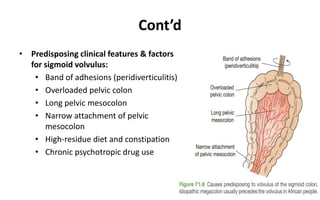
  • 110.
    CHRONIC LARGE BOWELOBSTRUCTION • The symptoms of chronic intestinal obstruction may arise from two sources: the cause and the subsequent obstruction. • The causes of obstruction may be: • Organic or • Functional
  • 111.
    Cont’d • Organic: • Intraluminal(rare): faecal impaction • Intrinsic intramural: strictures (Crohn’s disease, ischaemia, diverticular), anastomotic stenosis • Extrinsic intramural (rare): metastatic deposits (ovarian), endometriosis, stomal stenosis • Functional: • Hirschsprung’s disease • Idiopathic megacolon • Pseudo-obstruction
  • 113.
    Cont’d • The symptomsof chronic obstruction differ in their predominance, timing and degree from acute obstruction. • In functional cases, the symptoms may have been present for months or years. • Constipation appears first and it is initially relative and then absolute, associated with distension. • In the presence of large bowel disease, the point of greatest distension is in the caecum, and this is heralded by the onset of pain.
  • 114.
    Cont’d • Vomiting isa late feature and therefore dehydration is less severe. • Examination is unremarkable, save for confirmation of distension, which can be profound and the onset of peritonism in late cases. • Rectal examination may confirm the presence of faecal impaction or a tumour.
  • 115.
    Cont’d Investigation • Plain abdominalradiography confirms the presence of large bowel distension. • All such cases should be investigated by a subsequent single-contrast water-soluble enema study, CT scan or endoscopic assessment to rule out functional disease.
  • 116.
    Cont’d Management • Surgical managementafter resuscitation depends on the underlying cause • Organic disease requires decompression with a laparotomy or stent. • Stomal stenosis can usually be managed at the abdominal wall level • Functional disease requires colonoscopic decompression in the first instance and conservative management. • Intestinal perforation can occur in patients with functional obstruction. • Those at risk have such gross distension that the abdomen is rigid on palpation.
  • 117.
    ADYNAMIC OBSTRUCTION Paralytic ileus •Is a state in which there is failure of transmission of peristaltic waves secondary to neuromuscular failure (i.e. in the myenteric (Auerbach’s) and submucous (Meissner’s) plexuses). • The resultant stasis leads to accumulation of fluid and gas within the bowel, with associated distension, vomiting, absence of bowel sounds and absolute constipation. • Different varieties are recognised.
  • 118.
    Cont’d • Postoperative: • Usuallyoccurs after any abdominal procedure and is self-limiting, with a variable duration of 24–72 hours. • Postoperative ileus may be prolonged in the presence of hypoproteinaemia or metabolic abnormality. • Infection: • Intra-abdominal sepsis may give rise to localised or generalised ileus.
  • 119.
    Cont’d • Reflex ileus: •May occur following fractures of the spine or ribs, retroperitoneal haemorrhage or even the application of a plaster jacket. • Metabolic: • Uraemia and hypokalaemia are the most common contributory factors.
  • 120.
    Cont’d Clinical features • Paralyticileus takes on a clinical significance if, 72 hours after laparotomy: • There has been no return of bowel sounds on auscultation • There has been no passage of flatus • Abdominal distension becomes more marked and tympanitic • Colicky pain is not a feature • Distension increases pain from the abdominal wound • In the absence of gastric aspiration, effortless vomiting may occur • Radiologically, the abdomen shows gas-filled loops of intestine with multiple fluid levels (if an erect film is felt necessary)
  • 121.
    Cont’d Management • Nasogastric tubesare not required routinely after elective intra-abdominal surgery. • Paralytic ileus is managed with the use of nasogastric suction and restriction of oral intake until bowel sounds and the passage of flatus return. • Electrolyte balance must be maintained.
  • 122.
    Cont’d • Specific treatmentis directed towards the cause, but the following general principles apply: • If a primary cause is identified this must be treated. • Gastrointestinal distension must be relieved by decompression. • Close attention to fluid and electrolyte balance is essential. • There is no convincing evidence for the use of prokinetic drugs to treat postoperative adynamic ileus. • If paralytic ileus is prolonged CT scanning is the most effective investigation; it will demonstrate any intra-abdominal sepsis or mechanical obstruction and therefore guide any requirement for laparotomy.
  • 123.
    Cont’d • The needfor a laparotomy becomes increasingly likely the longer the bowel inactivity persists, particularly if it lasts for more than seven days or if bowel activity recommences following surgery and then stops again.
  • 124.
    Cont’d Pseudo-obstruction • This conditiondescribes an obstruction, usually of the colon, that occurs in the absence of a mechanical cause or acute intra-abdominal disease. • It is associated with a variety of syndromes in which there is an underlying neuropathy and/or myopathy and a range of other factors.
  • 125.
    Cont’d • Small intestinalpseudo-obstruction • May be primary (i.e. idiopathic or associated with familial visceral myopathy) or secondary. • The clinical picture consists of recurrent subacute obstruction. • The diagnosis is made by the exclusion of a mechanical cause. • Treatment: • Initial correction of any underlying disorder. • Metoclopramide and erythromycin may be of use.
  • 126.
    Cont’d • Colonic pseudo-obstruction •May occur in an acute or a chronic form. • The acute form is also known as Ogilvie’s syndrome, presents as acute large bowel obstruction. • Abdominal radiographs show evidence of colonic obstruction, with marked caecal distension being a common feature. • Caecal perforation is a well-recognised complication. • The absence of a mechanical cause requires urgent confirmation by colonoscopy or a single contrast water-soluble barium enema or CT.
  • 127.
    Cont’d • Treatment • Correctionof any identifiable cause. • If this is ineffective, IV neostigmine (1mg) should be given, with a further 1 mg given IV within a few minutes if the first dose is ineffective. During this procedure, it is best to sit the patient on a commode. • ECG monitoring is required and atropine should be available. • If neostigmine is not effective, colonoscopic decompression should be peformed.
  • 128.
    Cont’d • Caecal perforationcan occur in pseudo-obstruction. • Check for tenderness and peritonism over the caecum since caecal perforation is more likely if the caecal diameter is ≥ 14cm. • Surgery is associated with high morbidity and mortality and should be reserved for those with impending perforation when other treatments have failed or perforation has occurred. • Rarely, an endoscopically placed tube colostomy is used as a vent for patients with a chronic unremitting condition.
  • 130.

Editor's Notes

  • #17 Strictureplasty: Is a surgical procedure to repair a stricture by widening the narrowed area without removing any portion of the intestine.
  • #18 Stercolith: a hard mass of fecal matter
  • #34  ● Radiological reduction is indicated in most paediatric cases ● Adults require surgery
  • #39 ● The commonest spontaneous type in adults is sigmoid ● Sigmoid volvulus can be relieved by decompression per anum
  • #61 Unlike sigmoid volvulus, cecal volvulus can almost never be detorsed endoscopically.
  • #64 Gastrografin enema: Barium enema
  • #68 In the small bowel, the number of fluid levels is directly proportional to the degree of obstruction and to its site, the number increasing the more distal the lesion.
  • #72 The clinical reliability of other CT signs is doubtful for predicting strangulation.
  • #74 The claw sign is also called ‘meniscus sign’.
  • #97 PR: Pulse Rate, BP: Blood Pressure
  • #100 Successful reduction can only be accepted if there is free reflux of air or barium into the small bowel, together with resolution of symptoms and signs in the patient.