
Definition and numerical estimation
TOTAL SOLUBLE SOLIDS
TOTAL SUSPENDED SOLIDS
Compiled By-
Anuj Jha
2014027007
ENS 451- POLLUTION CONTROL IN FOOD INDUSTRIES
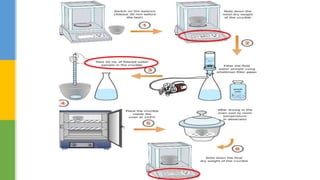
 It refers to materials that are completely dissolved in water and are
filterable in nature
 Also defined as residue upon evaporation of filterable sample
INTRODUCTION: Total Soluble Solids
 Is useful to determine whether the water is suitable for drinking purpose,
agriculture and industrial purpose
 Soluble minerals, gases and organic constituents may produce
aesthetically displeasing colour, taste and odour
 Soluble organic chemicals may deplete the dissolved oxygen and inert to
biological oxidation
 Water with higher solids reverses the effect upon people whose bodies
are not adjusted to them
 Use of water with high soluble solids may lead to scaling in boilers,
corrosion and degraded quality of the product
SIGNIFICANCE: SOLUBLE SOLIDS
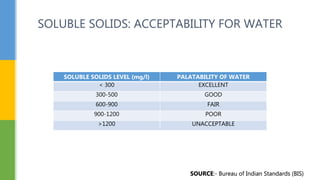
SOLUBLE SOLIDS: ACCEPTABILITY FOR WATER
SOLUBLE SOLIDS LEVEL (mg/l) PALATABILITY OF WATER
< 300 EXCELLENT
300-500 GOOD
600-900 FAIR
900-1200 POOR
>1200 UNACCEPTABLE
SOURCE:- Bureau of Indian Standards (BIS)
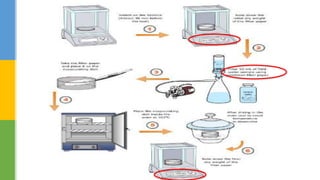
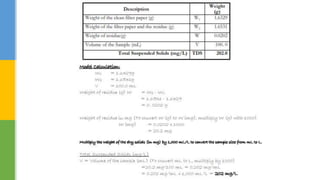
 It refers to materials which are not dissolved in water and are non
filterable in nature
 Also defined as residue upon evaporation of non filterable sample
on filter paper
INTRODUCTION: Total Suspended Solids
 Suspended material is aesthetically displeasing and provides adsorption
sites for chemical and biological agents
 They are degraded anaerobically may release obnoxious odours
 Biologically suspended solids may include disease causing organisms
 Their determination is extremely valuable in the analysis of polluted
waters.
 They exclude light, thus reducing the growth of oxygen producing plants
SIGNIFICANCE: SUSPENDED SOLIDS
DISCUSSION SESSION…..

Total soluble solids and Total suspended solids

  • 1.
    Definition and numericalestimation TOTAL SOLUBLE SOLIDS TOTAL SUSPENDED SOLIDS Compiled By- Anuj Jha 2014027007 ENS 451- POLLUTION CONTROL IN FOOD INDUSTRIES
  • 2.
     It refersto materials that are completely dissolved in water and are filterable in nature  Also defined as residue upon evaporation of filterable sample INTRODUCTION: Total Soluble Solids
  • 3.
     Is usefulto determine whether the water is suitable for drinking purpose, agriculture and industrial purpose  Soluble minerals, gases and organic constituents may produce aesthetically displeasing colour, taste and odour  Soluble organic chemicals may deplete the dissolved oxygen and inert to biological oxidation  Water with higher solids reverses the effect upon people whose bodies are not adjusted to them  Use of water with high soluble solids may lead to scaling in boilers, corrosion and degraded quality of the product SIGNIFICANCE: SOLUBLE SOLIDS
  • 4.
    SOLUBLE SOLIDS: ACCEPTABILITYFOR WATER SOLUBLE SOLIDS LEVEL (mg/l) PALATABILITY OF WATER < 300 EXCELLENT 300-500 GOOD 600-900 FAIR 900-1200 POOR >1200 UNACCEPTABLE SOURCE:- Bureau of Indian Standards (BIS)
  • 7.
     It refersto materials which are not dissolved in water and are non filterable in nature  Also defined as residue upon evaporation of non filterable sample on filter paper INTRODUCTION: Total Suspended Solids
  • 8.
     Suspended materialis aesthetically displeasing and provides adsorption sites for chemical and biological agents  They are degraded anaerobically may release obnoxious odours  Biologically suspended solids may include disease causing organisms  Their determination is extremely valuable in the analysis of polluted waters.  They exclude light, thus reducing the growth of oxygen producing plants SIGNIFICANCE: SUSPENDED SOLIDS
  • 11.