Sanjivani Rural Education Society’s
Sanjivani College of Engineering, Kopargaon – 423601
(An Autonomous Institute, Affiliated to SPPU, Pune)
ISO 9001:2015 Certified, Approved by AICTE, Accredited by NBA and NAAC (A Grade)
Department of Civil Engineering
Course Title: Environmental Engineering – II (401001)
Chemical Oxygen Demand (COD)
Instructor
Mr. Chaudhari V. S (Assistant Professor)
Contact id: chaudharivishalcivil@sanjivani.org.in
Environmental Engineering– II: COD
 COD is measure of organic materials in a wastewater in terms of the oxygen required to
oxidize the organic materials chemically.
 Chemical oxygen demand is measured as a standardized laboratory assay in which a
closed water sample is incubated with a strong chemical oxidant, potassium dichromate
(K2Cr2O7), which is used in combination with boiling sulfuric acid (H2SO4).
 COD along with BOD are two different ways to measure how much oxygen the water will
consume when it enters the recipient. In both the COD and BOD tests, the organic material
concentration is calculated from the oxidant consumption necessary for the oxidation of the
organic material.
 Since biologically on biodegradable organic matter can be oxidize while chemically almost
all oxidizable matters could be oxidized, COD values are always higher than BOD.
Introduction
Environmental Engineering– II: COD
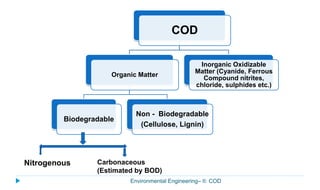
COD
Organic Matter
Biodegradable
Non - Biodegradable
(Cellulose, Lignin)
Inorganic Oxidizable
Matter (Cyanide, Ferrous
Compound nitrites,
chloride, sulphides etc.)
Nitrogenous Carbonaceous
(Estimated by BOD)
Environmental Engineering– II: COD
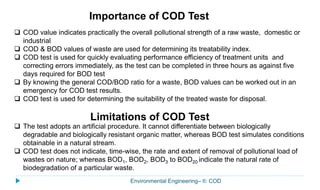
Importance of COD Test
 COD value indicates practically the overall pollutional strength of a raw waste, domestic or
industrial
 COD & BOD values of waste are used for determining its treatability index.
 COD test is used for quickly evaluating performance efficiency of treatment units and
correcting errors immediately, as the test can be completed in three hours as against five
days required for BOD test
 By knowing the general COD/BOD ratio for a waste, BOD values can be worked out in an
emergency for COD test results.
 COD test is used for determining the suitability of the treated waste for disposal.
Limitations of COD Test
 The test adopts an artificial procedure. It cannot differentiate between biologically
degradable and biologically resistant organic matter, whereas BOD test simulates conditions
obtainable in a natural stream.
 COD test does not indicate, time-wise, the rate and extent of removal of pollutional load of
wastes on nature; whereas BOD1, BOD2, BOD3 to BOD20 indicate the natural rate of
biodegradation of a particular waste.
Environmental Engineering– II: COD
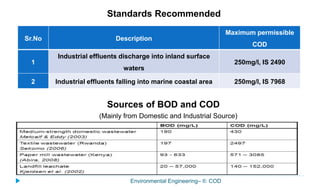
Standards Recommended
Sr.No Description
Maximum permissible
COD
1
Industrial effluents discharge into inland surface
waters
250mg/l, IS 2490
2 Industrial effluents falling into marine coastal area 250mg/l, IS 7968
Sources of BOD and COD
(Mainly from Domestic and Industrial Source)
Environmental Engineering– II: COD
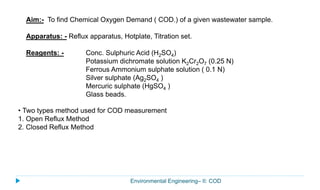
Aim:- To find Chemical Oxygen Demand ( COD.) of a given wastewater sample.
Apparatus: - Reflux apparatus, Hotplate, Titration set.
Reagents: - Conc. Sulphuric Acid (H2SO4)
Potassium dichromate solution K2Cr2O7 (0.25 N)
Ferrous Ammonium sulphate solution ( 0.1 N)
Silver sulphate (Ag2SO4 )
Mercuric sulphate (HgSO4 )
Glass beads.
• Two types method used for COD measurement
1. Open Reflux Method
2. Closed Reflux Method
Environmental Engineering– II: COD
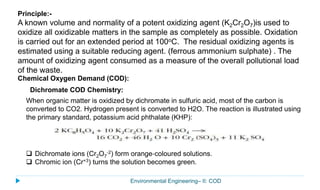
Principle:-
A known volume and normality of a potent oxidizing agent (K2Cr2O7)is used to
oxidize all oxidizable matters in the sample as completely as possible. Oxidation
is carried out for an extended period at 100oC. The residual oxidizing agents is
estimated using a suitable reducing agent. (ferrous ammonium sulphate) . The
amount of oxidizing agent consumed as a measure of the overall pollutional load
of the waste.
Chemical Oxygen Demand (COD):
Dichromate COD Chemistry:
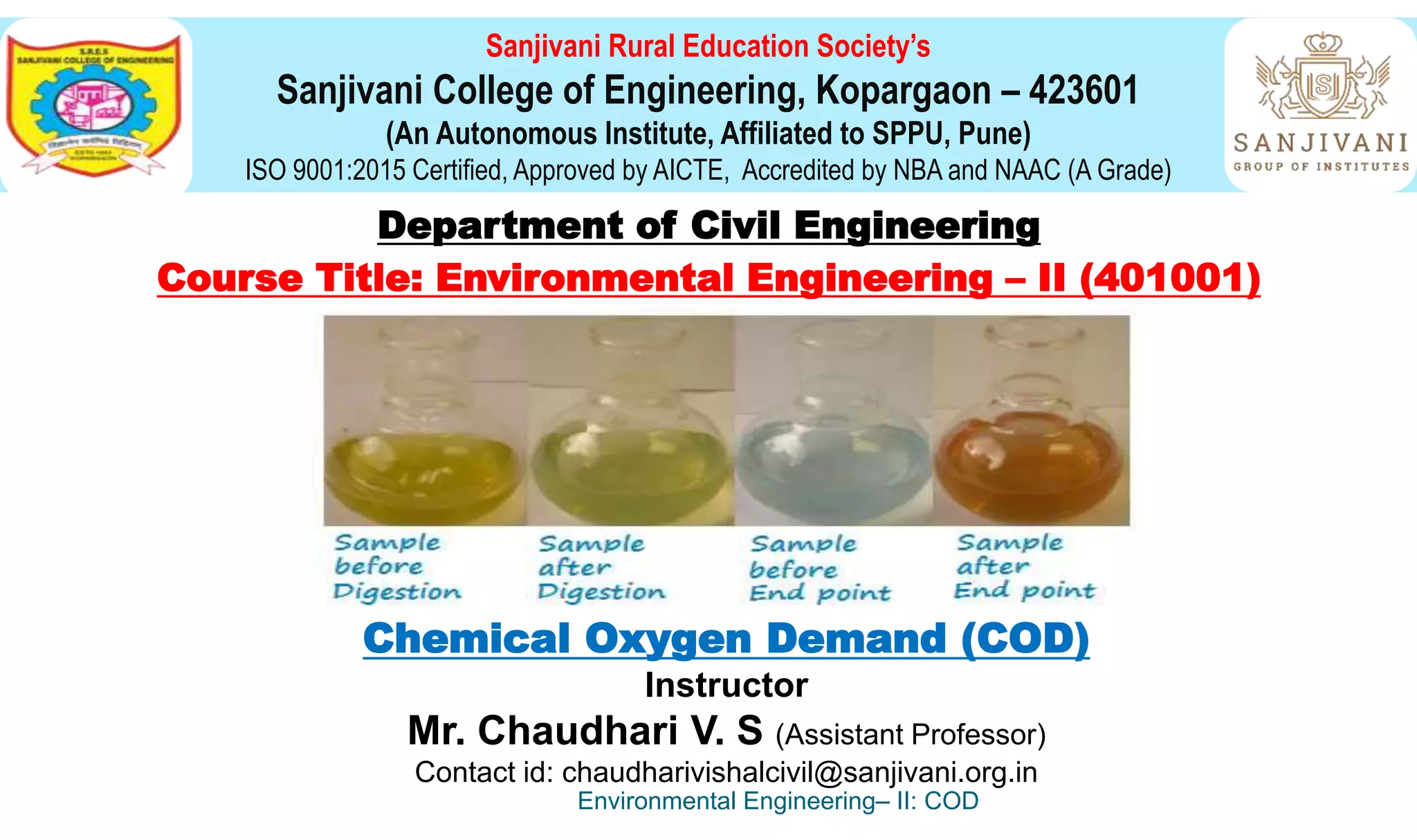
When organic matter is oxidized by dichromate in sulfuric acid, most of the carbon is
converted to CO2. Hydrogen present is converted to H2O. The reaction is illustrated using
the primary standard, potassium acid phthalate (KHP):
 Dichromate ions (Cr2O7
‐2) form orange‐coloured solutions.
 Chromic ion (Cr+3) turns the solution becomes green.
Environmental Engineering– II: BOD
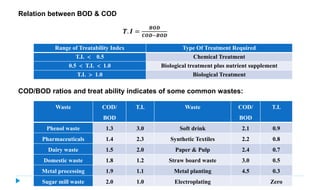
𝑻. 𝑰 =
𝑩𝑶𝑫
𝑪𝑶𝑫−𝑩𝑶𝑫
Range of Treatability Index Type Of Treatment Required
T.I.  0.5 Chemical Treatment
0.5  T.I.  1.0 Biological treatment plus nutrient supplement
T.I.  1.0 Biological Treatment
Relation between BOD & COD
COD/BOD ratios and treat ability indicates of some common wastes:
Waste COD/
BOD
T.I. Waste COD/
BOD
T.I.
Phenol waste 1.3 3.0 Soft drink 2.1 0.9
Pharmaceuticals 1.4 2.3 Synthetic Textiles 2.2 0.8
Dairy waste 1.5 2.0 Paper & Pulp 2.4 0.7
Domestic waste 1.8 1.2 Straw board waste 3.0 0.5
Metal processing 1.9 1.1 Metal planting 4.5 0.3
Sugar mill waste 2.0 1.0 Electroplating Zero
Environmental Engineering– II: COD
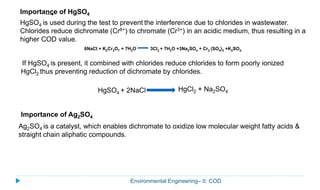
Importance of HgSO4
HgSO4 is used during the test to prevent the interference due to chlorides in wastewater.
Chlorides reduce dichromate (Cr6+) to chromate (Cr3+) in an acidic medium, thus resulting in a
higher COD value.
6NaCl + K2Cr2O7 + 7H2O 3Cl2 + 7H2O +3Na2SO4 + Cr2 (SO4)3 +K2SO4.
If HgSO4 is present, it combined with chlorides reduce chlorides to form poorly ionized
HgCl2 thus preventing reduction of dichromate by chlorides.
HgCl2 + Na2SO4HgSO4 + 2NaCl
Importance of Ag2SO4
Ag2SO4 is a catalyst, which enables dichromate to oxidize low molecular weight fatty acids &
straight chain aliphatic compounds.
Environmental Engineering– II: COD
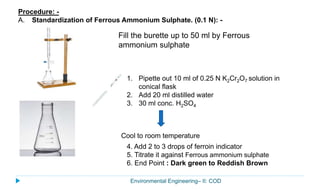
Procedure: -
A. Standardization of Ferrous Ammonium Sulphate. (0.1 N): -
1. Pipette out 10 ml of 0.25 N K2Cr2O7 solution in
conical flask
2. Add 20 ml distilled water
3. 30 ml conc. H2SO4
Cool to room temperature
Fill the burette up to 50 ml by Ferrous
ammonium sulphate
4. Add 2 to 3 drops of ferroin indicator
5. Titrate it against Ferrous ammonium sulphate
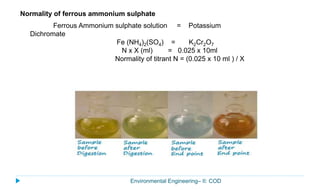
6. End Point : Dark green to Reddish Brown
Environmental Engineering– II: COD
Ferrous Ammonium sulphate solution = Potassium
Dichromate
Fe (NH4)2(SO4) = K2Cr2O7
N x X (ml) = 0.025 x 10ml
Normality of titrant N = (0.025 x 10 ml ) / X
Normality of ferrous ammonium sulphate
Environmental Engineering– II: COD
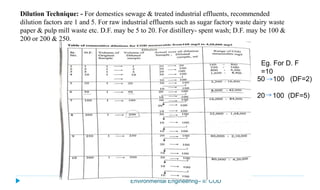
Dilution Technique: - For domestics sewage & treated industrial effluents, recommended
dilution factors are 1 and 5. For raw industrial effluents such as sugar factory waste dairy waste
paper & pulp mill waste etc. D.F. may be 5 to 20. For distillery- spent wash; D.F. may be 100 &
200 or 200 & 250.
Eg. For D. F
=10
50 100 (DF=2)
20 100 (DF=5)
Environmental Engineering– II: COD
Procedure of COD test
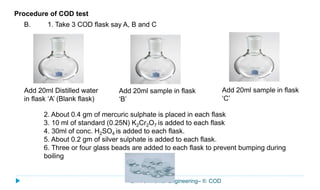
B. 1. Take 3 COD flask say A, B and C
Add 20ml Distilled water
in flask ‘A’ (Blank flask)
Add 20ml sample in flask
‘B’
Add 20ml sample in flask
‘C’
2. About 0.4 gm of mercuric sulphate is placed in each flask
3. 10 ml of standard (0.25N) K2Cr2O7 is added to each flask
4. 30ml of conc. H2SO4 is added to each flask.
5. About 0.2 gm of silver sulphate is added to each flask.
6. Three or four glass beads are added to each flask to prevent bumping during
boiling
Environmental Engineering– II: COD
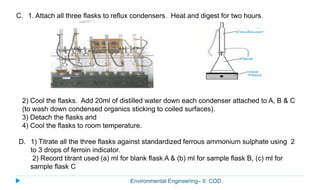
C. 1. Attach all three flasks to reflux condensers. Heat and digest for two hours.
2) Cool the flasks. Add 20ml of distilled water down each condenser attached to A, B & C
(to wash down condensed organics sticking to coiled surfaces).
3) Detach the flasks and
4) Cool the flasks to room temperature.
D. 1) Titrate all the three flasks against standardized ferrous ammonium sulphate using 2
to 3 drops of ferroin indicator.
2) Record titrant used (a) ml for blank flask A & (b) ml for sample flask B, (c) ml for
sample flask C
Environmental Engineering– II: BOD
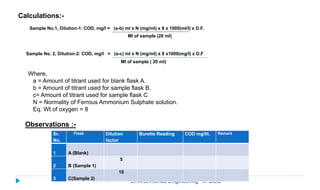
Calculations:-
Sample No.1, Dilution-1: COD, mg/l = (a-b) ml x N (mg/ml) x 8 x 1000(ml/l) x D.F.
Ml of sample (20 ml)
Sample No. 2, Dilution-2: COD, mg/l = (a-c) ml x N (mg/ml) x 8 x1000(mg/l) x D.F
Ml of sample ( 20 ml)
Where,
a = Amount of titrant used for blank flask A.
b = Amount of titrant used for sample flask B.
c= Amount of titrant used for sample flask C
N = Normality of Ferrous Ammonium Sulphate solution.
Eq. Wt of oxygen = 8
Observations :-
Sr.
No.
Flask Dilution
factor
Burette Reading COD mg/lit. Remark
1 A (Blank)
2 B (Sample 1)
5
3 C(Sample 2)
10
Environmental Engineering– II: COD
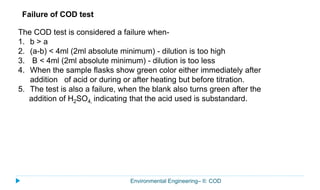
Failure of COD test
The COD test is considered a failure when-
1. b > a
2. (a-b) < 4ml (2ml absolute minimum) - dilution is too high
3. B < 4ml (2ml absolute minimum) - dilution is too less
4. When the sample flasks show green color either immediately after
addition of acid or during or after heating but before titration.
5. The test is also a failure, when the blank also turns green after the
addition of H2SO4, indicating that the acid used is substandard.
Environmental Engineering– II: COD

Practical on COD

  • 1.
    Sanjivani Rural EducationSociety’s Sanjivani College of Engineering, Kopargaon – 423601 (An Autonomous Institute, Affiliated to SPPU, Pune) ISO 9001:2015 Certified, Approved by AICTE, Accredited by NBA and NAAC (A Grade) Department of Civil Engineering Course Title: Environmental Engineering – II (401001) Chemical Oxygen Demand (COD) Instructor Mr. Chaudhari V. S (Assistant Professor) Contact id: chaudharivishalcivil@sanjivani.org.in Environmental Engineering– II: COD
  • 2.
  • 3.
    Environmental Engineering– II:COD  COD is measure of organic materials in a wastewater in terms of the oxygen required to oxidize the organic materials chemically.  Chemical oxygen demand is measured as a standardized laboratory assay in which a closed water sample is incubated with a strong chemical oxidant, potassium dichromate (K2Cr2O7), which is used in combination with boiling sulfuric acid (H2SO4).  COD along with BOD are two different ways to measure how much oxygen the water will consume when it enters the recipient. In both the COD and BOD tests, the organic material concentration is calculated from the oxidant consumption necessary for the oxidation of the organic material.  Since biologically on biodegradable organic matter can be oxidize while chemically almost all oxidizable matters could be oxidized, COD values are always higher than BOD. Introduction
  • 4.
    Environmental Engineering– II:COD COD Organic Matter Biodegradable Non - Biodegradable (Cellulose, Lignin) Inorganic Oxidizable Matter (Cyanide, Ferrous Compound nitrites, chloride, sulphides etc.) Nitrogenous Carbonaceous (Estimated by BOD)
  • 5.
    Environmental Engineering– II:COD Importance of COD Test  COD value indicates practically the overall pollutional strength of a raw waste, domestic or industrial  COD & BOD values of waste are used for determining its treatability index.  COD test is used for quickly evaluating performance efficiency of treatment units and correcting errors immediately, as the test can be completed in three hours as against five days required for BOD test  By knowing the general COD/BOD ratio for a waste, BOD values can be worked out in an emergency for COD test results.  COD test is used for determining the suitability of the treated waste for disposal. Limitations of COD Test  The test adopts an artificial procedure. It cannot differentiate between biologically degradable and biologically resistant organic matter, whereas BOD test simulates conditions obtainable in a natural stream.  COD test does not indicate, time-wise, the rate and extent of removal of pollutional load of wastes on nature; whereas BOD1, BOD2, BOD3 to BOD20 indicate the natural rate of biodegradation of a particular waste.
  • 6.
    Environmental Engineering– II:COD Standards Recommended Sr.No Description Maximum permissible COD 1 Industrial effluents discharge into inland surface waters 250mg/l, IS 2490 2 Industrial effluents falling into marine coastal area 250mg/l, IS 7968 Sources of BOD and COD (Mainly from Domestic and Industrial Source)
  • 7.
    Environmental Engineering– II:COD Aim:- To find Chemical Oxygen Demand ( COD.) of a given wastewater sample. Apparatus: - Reflux apparatus, Hotplate, Titration set. Reagents: - Conc. Sulphuric Acid (H2SO4) Potassium dichromate solution K2Cr2O7 (0.25 N) Ferrous Ammonium sulphate solution ( 0.1 N) Silver sulphate (Ag2SO4 ) Mercuric sulphate (HgSO4 ) Glass beads. • Two types method used for COD measurement 1. Open Reflux Method 2. Closed Reflux Method
  • 8.
    Environmental Engineering– II:COD Principle:- A known volume and normality of a potent oxidizing agent (K2Cr2O7)is used to oxidize all oxidizable matters in the sample as completely as possible. Oxidation is carried out for an extended period at 100oC. The residual oxidizing agents is estimated using a suitable reducing agent. (ferrous ammonium sulphate) . The amount of oxidizing agent consumed as a measure of the overall pollutional load of the waste. Chemical Oxygen Demand (COD): Dichromate COD Chemistry: When organic matter is oxidized by dichromate in sulfuric acid, most of the carbon is converted to CO2. Hydrogen present is converted to H2O. The reaction is illustrated using the primary standard, potassium acid phthalate (KHP):  Dichromate ions (Cr2O7 ‐2) form orange‐coloured solutions.  Chromic ion (Cr+3) turns the solution becomes green.
  • 9.
    Environmental Engineering– II:BOD 𝑻. 𝑰 = 𝑩𝑶𝑫 𝑪𝑶𝑫−𝑩𝑶𝑫 Range of Treatability Index Type Of Treatment Required T.I.  0.5 Chemical Treatment 0.5  T.I.  1.0 Biological treatment plus nutrient supplement T.I.  1.0 Biological Treatment Relation between BOD & COD COD/BOD ratios and treat ability indicates of some common wastes: Waste COD/ BOD T.I. Waste COD/ BOD T.I. Phenol waste 1.3 3.0 Soft drink 2.1 0.9 Pharmaceuticals 1.4 2.3 Synthetic Textiles 2.2 0.8 Dairy waste 1.5 2.0 Paper & Pulp 2.4 0.7 Domestic waste 1.8 1.2 Straw board waste 3.0 0.5 Metal processing 1.9 1.1 Metal planting 4.5 0.3 Sugar mill waste 2.0 1.0 Electroplating Zero
  • 10.
    Environmental Engineering– II:COD Importance of HgSO4 HgSO4 is used during the test to prevent the interference due to chlorides in wastewater. Chlorides reduce dichromate (Cr6+) to chromate (Cr3+) in an acidic medium, thus resulting in a higher COD value. 6NaCl + K2Cr2O7 + 7H2O 3Cl2 + 7H2O +3Na2SO4 + Cr2 (SO4)3 +K2SO4. If HgSO4 is present, it combined with chlorides reduce chlorides to form poorly ionized HgCl2 thus preventing reduction of dichromate by chlorides. HgCl2 + Na2SO4HgSO4 + 2NaCl Importance of Ag2SO4 Ag2SO4 is a catalyst, which enables dichromate to oxidize low molecular weight fatty acids & straight chain aliphatic compounds.
  • 11.
    Environmental Engineering– II:COD Procedure: - A. Standardization of Ferrous Ammonium Sulphate. (0.1 N): - 1. Pipette out 10 ml of 0.25 N K2Cr2O7 solution in conical flask 2. Add 20 ml distilled water 3. 30 ml conc. H2SO4 Cool to room temperature Fill the burette up to 50 ml by Ferrous ammonium sulphate 4. Add 2 to 3 drops of ferroin indicator 5. Titrate it against Ferrous ammonium sulphate 6. End Point : Dark green to Reddish Brown
  • 12.
    Environmental Engineering– II:COD Ferrous Ammonium sulphate solution = Potassium Dichromate Fe (NH4)2(SO4) = K2Cr2O7 N x X (ml) = 0.025 x 10ml Normality of titrant N = (0.025 x 10 ml ) / X Normality of ferrous ammonium sulphate
  • 13.
    Environmental Engineering– II:COD Dilution Technique: - For domestics sewage & treated industrial effluents, recommended dilution factors are 1 and 5. For raw industrial effluents such as sugar factory waste dairy waste paper & pulp mill waste etc. D.F. may be 5 to 20. For distillery- spent wash; D.F. may be 100 & 200 or 200 & 250. Eg. For D. F =10 50 100 (DF=2) 20 100 (DF=5)
  • 14.
    Environmental Engineering– II:COD Procedure of COD test B. 1. Take 3 COD flask say A, B and C Add 20ml Distilled water in flask ‘A’ (Blank flask) Add 20ml sample in flask ‘B’ Add 20ml sample in flask ‘C’ 2. About 0.4 gm of mercuric sulphate is placed in each flask 3. 10 ml of standard (0.25N) K2Cr2O7 is added to each flask 4. 30ml of conc. H2SO4 is added to each flask. 5. About 0.2 gm of silver sulphate is added to each flask. 6. Three or four glass beads are added to each flask to prevent bumping during boiling
  • 15.
    Environmental Engineering– II:COD C. 1. Attach all three flasks to reflux condensers. Heat and digest for two hours. 2) Cool the flasks. Add 20ml of distilled water down each condenser attached to A, B & C (to wash down condensed organics sticking to coiled surfaces). 3) Detach the flasks and 4) Cool the flasks to room temperature. D. 1) Titrate all the three flasks against standardized ferrous ammonium sulphate using 2 to 3 drops of ferroin indicator. 2) Record titrant used (a) ml for blank flask A & (b) ml for sample flask B, (c) ml for sample flask C
  • 16.
    Environmental Engineering– II:BOD Calculations:- Sample No.1, Dilution-1: COD, mg/l = (a-b) ml x N (mg/ml) x 8 x 1000(ml/l) x D.F. Ml of sample (20 ml) Sample No. 2, Dilution-2: COD, mg/l = (a-c) ml x N (mg/ml) x 8 x1000(mg/l) x D.F Ml of sample ( 20 ml) Where, a = Amount of titrant used for blank flask A. b = Amount of titrant used for sample flask B. c= Amount of titrant used for sample flask C N = Normality of Ferrous Ammonium Sulphate solution. Eq. Wt of oxygen = 8 Observations :- Sr. No. Flask Dilution factor Burette Reading COD mg/lit. Remark 1 A (Blank) 2 B (Sample 1) 5 3 C(Sample 2) 10
  • 17.
    Environmental Engineering– II:COD Failure of COD test The COD test is considered a failure when- 1. b > a 2. (a-b) < 4ml (2ml absolute minimum) - dilution is too high 3. B < 4ml (2ml absolute minimum) - dilution is too less 4. When the sample flasks show green color either immediately after addition of acid or during or after heating but before titration. 5. The test is also a failure, when the blank also turns green after the addition of H2SO4, indicating that the acid used is substandard.
  • 18.