Modul ke:
Fakultas
Program Studi
Aplikasi Komputer
Pengenalan Ms. Power Point
Devi Fitrianah
08FASILKOM
Sistem
Informasi
Objectives
 Open and view an existing PowerPoint presentation
 Switch views and navigate a presentation
 View a presentation in Slide Show view
 Plan a presentation
 Create a presentation using a template
New Perspectives on Microsoft Office PowerPoint 2007 2
Objectives
 Edit text on slides
 Add, move, and delete slides
 Promote and demote bulleted text
 Check the spelling in a presentation
 Use the Research task pane
 Create speaker notes
 Preview and print slides, handouts, and speaker notes
New Perspectives on Microsoft Office PowerPoint 2007 3
What Is PowerPoint?
 PowerPoint is a powerful presentation graphics program
that provides everything you need to produce an
effective presentation in the form of on-screen slides, a
slide presentation on a Web site, or black-and-white or
color overheads
 Using PowerPoint, you can prepare each component of
a presentation: individual slides, speaker notes, an
outline, and audience handouts
New Perspectives on Microsoft Office PowerPoint 2007 4
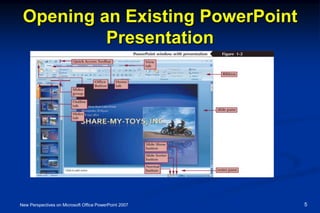
Opening an Existing PowerPoint
Presentation
New Perspectives on Microsoft Office PowerPoint 2007 5
Switching Views and
Navigating a Presentation
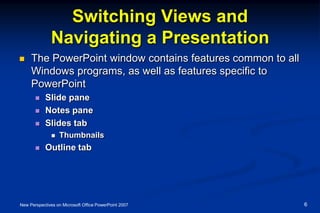
 The PowerPoint window contains features common to all
Windows programs, as well as features specific to
PowerPoint
 Slide pane
 Notes pane
 Slides tab
 Thumbnails
 Outline tab
New Perspectives on Microsoft Office PowerPoint 2007 6
Switching Views and
Navigating a Presentation
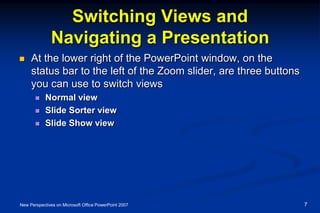
 At the lower right of the PowerPoint window, on the
status bar to the left of the Zoom slider, are three buttons
you can use to switch views
 Normal view
 Slide Sorter view
 Slide Show view
New Perspectives on Microsoft Office PowerPoint 2007 7
Viewing a Presentation
in Slide Show View
 Slide Show view is the view you use when you
present an on-screen presentation to an
audience
 When you click the Slide Show button on the
status bar, the slide show starts beginning with
the current slide
 When you click the Slide Show button on the
View tab on the Ribbon or press the F5 key, the
slide show starts at the beginning of the
presentationNew Perspectives on Microsoft Office PowerPoint 2007 8
Viewing a Presentation
in Slide Show View
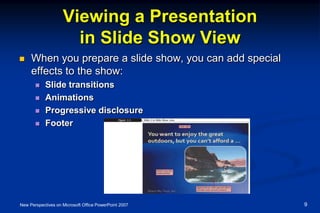
 When you prepare a slide show, you can add special
effects to the show:
 Slide transitions
 Animations
 Progressive disclosure
 Footer
New Perspectives on Microsoft Office PowerPoint 2007 9
Planning a Presentation
 Planning a presentation before you create it:
 Improves the quality of your presentation
 Makes your presentation more effective and
enjoyable
 Saves you time and effort
 As you plan your presentation, you should
determine the following aspects:
 Purpose of the presentation
 Type of presentation
 Audience for the presentation
 Audience needs
 Location of the presentation
 Format
New Perspectives on Microsoft Office PowerPoint 2007 10
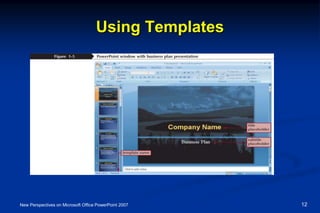
Using Templates
 PowerPoint helps you quickly create effective
presentations by using a template
 A PowerPoint file that contains the colors, background
format, font styles, and accent colors for a presentation
 Click the Office Button , and then click New
 In the pane on the left side of the New Presentation
dialog box, click New from existing in the list under
Templates
 Double-click the template you wish to use
New Perspectives on Microsoft Office PowerPoint 2007 11
Using Templates
New Perspectives on Microsoft Office PowerPoint 2007 12
Modifying a Presentation
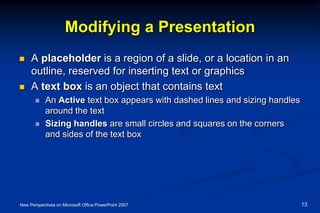
 A placeholder is a region of a slide, or a location in an
outline, reserved for inserting text or graphics
 A text box is an object that contains text
 An Active text box appears with dashed lines and sizing handles
around the text
 Sizing handles are small circles and squares on the corners
and sides of the text box
New Perspectives on Microsoft Office PowerPoint 2007 13
Modifying a Presentation
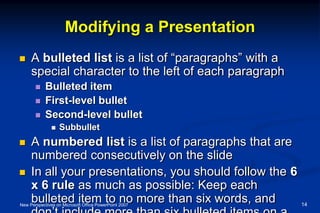
 A bulleted list is a list of “paragraphs” with a
special character to the left of each paragraph
 Bulleted item
 First-level bullet
 Second-level bullet
 Subbullet
 A numbered list is a list of paragraphs that are
numbered consecutively on the slide
 In all your presentations, you should follow the 6
x 6 rule as much as possible: Keep each
bulleted item to no more than six words, andNew Perspectives on Microsoft Office PowerPoint 2007 14
Creating Effective Text
Presentations
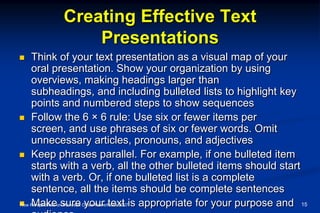
 Think of your text presentation as a visual map of your
oral presentation. Show your organization by using
overviews, making headings larger than
subheadings, and including bulleted lists to highlight key
points and numbered steps to show sequences
 Follow the 6 × 6 rule: Use six or fewer items per
screen, and use phrases of six or fewer words. Omit
unnecessary articles, pronouns, and adjectives
 Keep phrases parallel. For example, if one bulleted item
starts with a verb, all the other bulleted items should start
with a verb. Or, if one bulleted list is a complete
sentence, all the items should be complete sentences
 Make sure your text is appropriate for your purpose andNew Perspectives on Microsoft Office PowerPoint 2007 15
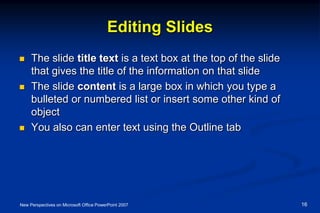
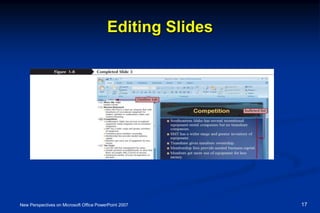
Editing Slides
 The slide title text is a text box at the top of the slide
that gives the title of the information on that slide
 The slide content is a large box in which you type a
bulleted or numbered list or insert some other kind of
object
 You also can enter text using the Outline tab
New Perspectives on Microsoft Office PowerPoint 2007 16
Editing Slides
New Perspectives on Microsoft Office PowerPoint 2007 17
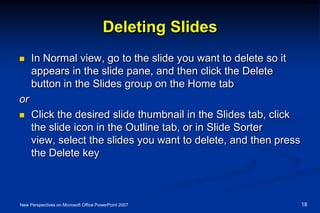
Deleting Slides
 In Normal view, go to the slide you want to delete so it
appears in the slide pane, and then click the Delete
button in the Slides group on the Home tab
or
 Click the desired slide thumbnail in the Slides tab, click
the slide icon in the Outline tab, or in Slide Sorter
view, select the slides you want to delete, and then press
the Delete key
New Perspectives on Microsoft Office PowerPoint 2007 18
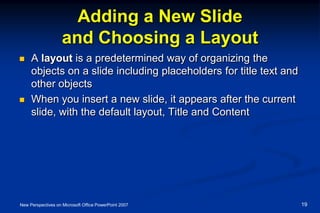
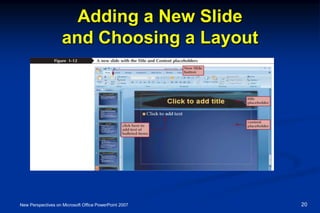
Adding a New Slide
and Choosing a Layout
 A layout is a predetermined way of organizing the
objects on a slide including placeholders for title text and
other objects
 When you insert a new slide, it appears after the current
slide, with the default layout, Title and Content
New Perspectives on Microsoft Office PowerPoint 2007 19
Adding a New Slide
and Choosing a Layout
New Perspectives on Microsoft Office PowerPoint 2007 20
Promoting, Demoting,
and Moving Outline Text
 Working in the Outline tab gives you more flexibility
because you can see the outline of the entire
presentation
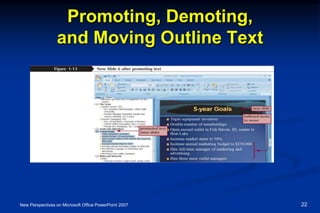
 To promote an item means to raise the outline level of
that item
 To demote an item means to decrease the outline level
New Perspectives on Microsoft Office PowerPoint 2007 21
Promoting, Demoting,
and Moving Outline Text
New Perspectives on Microsoft Office PowerPoint 2007 22
Promoting, Demoting,
and Moving Outline Text
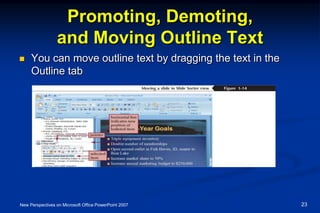
 You can move outline text by dragging the text in the
Outline tab
New Perspectives on Microsoft Office PowerPoint 2007 23
Moving Slides in Slide Sorter
View
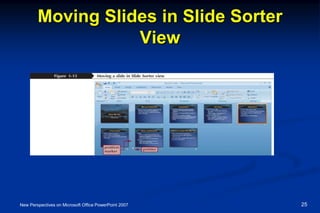
 In Slide Sorter view, PowerPoint displays all the slides
as thumbnails, so that several slides can appear on the
screen at once
 On the status bar, click the Slide Sorter button
 Dragging and dropping slides in Slide Sorter view will
rearrange them in the presentation
New Perspectives on Microsoft Office PowerPoint 2007 24
Moving Slides in Slide Sorter
View
New Perspectives on Microsoft Office PowerPoint 2007 25
Checking the Spelling in a
Presentation
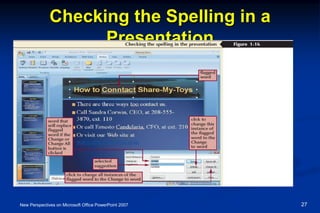
 Before you print or present a slide show, you should
always perform a final check of the spelling of all the
slides in your presentation
 PowerPoint does two types of spell check:
 The regular type is when PowerPoint finds a word that’s not in its
dictionary
 The other type is called contextual spelling, which checks the
context in which a word is used
New Perspectives on Microsoft Office PowerPoint 2007 26
Checking the Spelling in a
Presentation
New Perspectives on Microsoft Office PowerPoint 2007 27
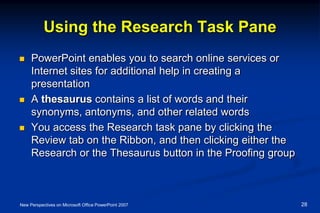
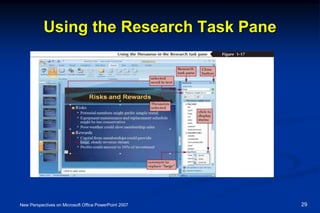
Using the Research Task Pane
 PowerPoint enables you to search online services or
Internet sites for additional help in creating a
presentation
 A thesaurus contains a list of words and their
synonyms, antonyms, and other related words
 You access the Research task pane by clicking the
Review tab on the Ribbon, and then clicking either the
Research or the Thesaurus button in the Proofing group
New Perspectives on Microsoft Office PowerPoint 2007 28
Using the Research Task Pane
New Perspectives on Microsoft Office PowerPoint 2007 29
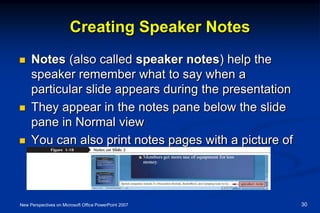
Creating Speaker Notes
 Notes (also called speaker notes) help the
speaker remember what to say when a
particular slide appears during the presentation
 They appear in the notes pane below the slide
pane in Normal view
 You can also print notes pages with a picture of
and notes about each slide
New Perspectives on Microsoft Office PowerPoint 2007 30
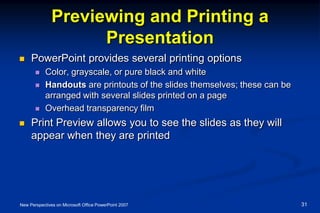
Previewing and Printing a
Presentation
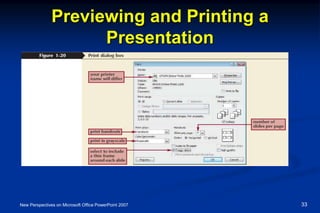
 PowerPoint provides several printing options
 Color, grayscale, or pure black and white
 Handouts are printouts of the slides themselves; these can be
arranged with several slides printed on a page
 Overhead transparency film
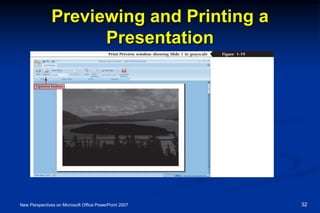
 Print Preview allows you to see the slides as they will
appear when they are printed
New Perspectives on Microsoft Office PowerPoint 2007 31
Previewing and Printing a
Presentation
New Perspectives on Microsoft Office PowerPoint 2007 32
Previewing and Printing a
Presentation
New Perspectives on Microsoft Office PowerPoint 2007 33

Slide8 apikom

  • 1.
    Modul ke: Fakultas Program Studi AplikasiKomputer Pengenalan Ms. Power Point Devi Fitrianah 08FASILKOM Sistem Informasi
  • 2.
    Objectives  Open andview an existing PowerPoint presentation  Switch views and navigate a presentation  View a presentation in Slide Show view  Plan a presentation  Create a presentation using a template New Perspectives on Microsoft Office PowerPoint 2007 2
  • 3.
    Objectives  Edit texton slides  Add, move, and delete slides  Promote and demote bulleted text  Check the spelling in a presentation  Use the Research task pane  Create speaker notes  Preview and print slides, handouts, and speaker notes New Perspectives on Microsoft Office PowerPoint 2007 3
  • 4.
    What Is PowerPoint? PowerPoint is a powerful presentation graphics program that provides everything you need to produce an effective presentation in the form of on-screen slides, a slide presentation on a Web site, or black-and-white or color overheads  Using PowerPoint, you can prepare each component of a presentation: individual slides, speaker notes, an outline, and audience handouts New Perspectives on Microsoft Office PowerPoint 2007 4
  • 5.
    Opening an ExistingPowerPoint Presentation New Perspectives on Microsoft Office PowerPoint 2007 5
  • 6.
    Switching Views and Navigatinga Presentation  The PowerPoint window contains features common to all Windows programs, as well as features specific to PowerPoint  Slide pane  Notes pane  Slides tab  Thumbnails  Outline tab New Perspectives on Microsoft Office PowerPoint 2007 6
  • 7.
    Switching Views and Navigatinga Presentation  At the lower right of the PowerPoint window, on the status bar to the left of the Zoom slider, are three buttons you can use to switch views  Normal view  Slide Sorter view  Slide Show view New Perspectives on Microsoft Office PowerPoint 2007 7
  • 8.
    Viewing a Presentation inSlide Show View  Slide Show view is the view you use when you present an on-screen presentation to an audience  When you click the Slide Show button on the status bar, the slide show starts beginning with the current slide  When you click the Slide Show button on the View tab on the Ribbon or press the F5 key, the slide show starts at the beginning of the presentationNew Perspectives on Microsoft Office PowerPoint 2007 8
  • 9.
    Viewing a Presentation inSlide Show View  When you prepare a slide show, you can add special effects to the show:  Slide transitions  Animations  Progressive disclosure  Footer New Perspectives on Microsoft Office PowerPoint 2007 9
  • 10.
    Planning a Presentation Planning a presentation before you create it:  Improves the quality of your presentation  Makes your presentation more effective and enjoyable  Saves you time and effort  As you plan your presentation, you should determine the following aspects:  Purpose of the presentation  Type of presentation  Audience for the presentation  Audience needs  Location of the presentation  Format New Perspectives on Microsoft Office PowerPoint 2007 10
  • 11.
    Using Templates  PowerPointhelps you quickly create effective presentations by using a template  A PowerPoint file that contains the colors, background format, font styles, and accent colors for a presentation  Click the Office Button , and then click New  In the pane on the left side of the New Presentation dialog box, click New from existing in the list under Templates  Double-click the template you wish to use New Perspectives on Microsoft Office PowerPoint 2007 11
  • 12.
    Using Templates New Perspectiveson Microsoft Office PowerPoint 2007 12
  • 13.
    Modifying a Presentation A placeholder is a region of a slide, or a location in an outline, reserved for inserting text or graphics  A text box is an object that contains text  An Active text box appears with dashed lines and sizing handles around the text  Sizing handles are small circles and squares on the corners and sides of the text box New Perspectives on Microsoft Office PowerPoint 2007 13
  • 14.
    Modifying a Presentation A bulleted list is a list of “paragraphs” with a special character to the left of each paragraph  Bulleted item  First-level bullet  Second-level bullet  Subbullet  A numbered list is a list of paragraphs that are numbered consecutively on the slide  In all your presentations, you should follow the 6 x 6 rule as much as possible: Keep each bulleted item to no more than six words, andNew Perspectives on Microsoft Office PowerPoint 2007 14
  • 15.
    Creating Effective Text Presentations Think of your text presentation as a visual map of your oral presentation. Show your organization by using overviews, making headings larger than subheadings, and including bulleted lists to highlight key points and numbered steps to show sequences  Follow the 6 × 6 rule: Use six or fewer items per screen, and use phrases of six or fewer words. Omit unnecessary articles, pronouns, and adjectives  Keep phrases parallel. For example, if one bulleted item starts with a verb, all the other bulleted items should start with a verb. Or, if one bulleted list is a complete sentence, all the items should be complete sentences  Make sure your text is appropriate for your purpose andNew Perspectives on Microsoft Office PowerPoint 2007 15
  • 16.
    Editing Slides  Theslide title text is a text box at the top of the slide that gives the title of the information on that slide  The slide content is a large box in which you type a bulleted or numbered list or insert some other kind of object  You also can enter text using the Outline tab New Perspectives on Microsoft Office PowerPoint 2007 16
  • 17.
    Editing Slides New Perspectiveson Microsoft Office PowerPoint 2007 17
  • 18.
    Deleting Slides  InNormal view, go to the slide you want to delete so it appears in the slide pane, and then click the Delete button in the Slides group on the Home tab or  Click the desired slide thumbnail in the Slides tab, click the slide icon in the Outline tab, or in Slide Sorter view, select the slides you want to delete, and then press the Delete key New Perspectives on Microsoft Office PowerPoint 2007 18
  • 19.
    Adding a NewSlide and Choosing a Layout  A layout is a predetermined way of organizing the objects on a slide including placeholders for title text and other objects  When you insert a new slide, it appears after the current slide, with the default layout, Title and Content New Perspectives on Microsoft Office PowerPoint 2007 19
  • 20.
    Adding a NewSlide and Choosing a Layout New Perspectives on Microsoft Office PowerPoint 2007 20
  • 21.
    Promoting, Demoting, and MovingOutline Text  Working in the Outline tab gives you more flexibility because you can see the outline of the entire presentation  To promote an item means to raise the outline level of that item  To demote an item means to decrease the outline level New Perspectives on Microsoft Office PowerPoint 2007 21
  • 22.
    Promoting, Demoting, and MovingOutline Text New Perspectives on Microsoft Office PowerPoint 2007 22
  • 23.
    Promoting, Demoting, and MovingOutline Text  You can move outline text by dragging the text in the Outline tab New Perspectives on Microsoft Office PowerPoint 2007 23
  • 24.
    Moving Slides inSlide Sorter View  In Slide Sorter view, PowerPoint displays all the slides as thumbnails, so that several slides can appear on the screen at once  On the status bar, click the Slide Sorter button  Dragging and dropping slides in Slide Sorter view will rearrange them in the presentation New Perspectives on Microsoft Office PowerPoint 2007 24
  • 25.
    Moving Slides inSlide Sorter View New Perspectives on Microsoft Office PowerPoint 2007 25
  • 26.
    Checking the Spellingin a Presentation  Before you print or present a slide show, you should always perform a final check of the spelling of all the slides in your presentation  PowerPoint does two types of spell check:  The regular type is when PowerPoint finds a word that’s not in its dictionary  The other type is called contextual spelling, which checks the context in which a word is used New Perspectives on Microsoft Office PowerPoint 2007 26
  • 27.
    Checking the Spellingin a Presentation New Perspectives on Microsoft Office PowerPoint 2007 27
  • 28.
    Using the ResearchTask Pane  PowerPoint enables you to search online services or Internet sites for additional help in creating a presentation  A thesaurus contains a list of words and their synonyms, antonyms, and other related words  You access the Research task pane by clicking the Review tab on the Ribbon, and then clicking either the Research or the Thesaurus button in the Proofing group New Perspectives on Microsoft Office PowerPoint 2007 28
  • 29.
    Using the ResearchTask Pane New Perspectives on Microsoft Office PowerPoint 2007 29
  • 30.
    Creating Speaker Notes Notes (also called speaker notes) help the speaker remember what to say when a particular slide appears during the presentation  They appear in the notes pane below the slide pane in Normal view  You can also print notes pages with a picture of and notes about each slide New Perspectives on Microsoft Office PowerPoint 2007 30
  • 31.
    Previewing and Printinga Presentation  PowerPoint provides several printing options  Color, grayscale, or pure black and white  Handouts are printouts of the slides themselves; these can be arranged with several slides printed on a page  Overhead transparency film  Print Preview allows you to see the slides as they will appear when they are printed New Perspectives on Microsoft Office PowerPoint 2007 31
  • 32.
    Previewing and Printinga Presentation New Perspectives on Microsoft Office PowerPoint 2007 32
  • 33.
    Previewing and Printinga Presentation New Perspectives on Microsoft Office PowerPoint 2007 33